




Abstract
Participatory Design Research (PDR) aims to dismantle researcher-participant hierarchies through inclusion and elevation of participants’ voices in the design, implementation, and analysis of educational interventions. PDR builds upon Design-Based Research (DBR) which investigates the effectiveness of educational interventions in authentic settings through iterative design and ongoing analysis. This paper describes how we drew from both PDR and DBR to center participants in the iterative design of an afterschool program about Latina/x youth in museums. We used multiple qualitative methods to analyze how a cohort of eight Latina/x middle-school girls responded to the initial design of activities, which led to mid- and post-implementation changes to the design of the afterschool program as afforded by PDR and DBR. By viewing the girls’ rejection and redirection of planned activities as productive, we gained opportunities to learn what topics were salient to the girls, such as events from the school day. In turn, our participants increasingly “drove” the programming and co-created museum exhibits that represented their identities, communities, linguistic diversity, and artistry. From these findings, we discuss how drawing from PDR and DBR allowed us to center participants in the design of the afterschool program and museum exhibition while allowing justified pivots in our research plan. Notably, we situate our project’s methodology between PDR and DBR to illustrate how these methodologies create space for participant-driven design even when participant-led analysis is constrained by logistics and resources. We also note the emotional and mental labor invested in engaging in participant-centered research. Last, we contribute design recommendations for researchers and designers who aim to serve marginalized youth, amplify their voices, and counter epistemic injustice.
Keywords
Curated sites of learning, including museums, can perpetuate epistemic injustice, which describes the harm caused by the invalidation of marginalized epistemologies (Stroupe, 2021). While museums offer powerful learning opportunities, they also tend to represent communities of color though colonial lenses, resulting in inauthentic narratives and/or cultural erasure (Blackwood & Purcell, 2014; Hooper-Greenhill, 2000; Martinez, 2020; Seitz, 2012). For example, museums may inaccurately contextualize Latinx artworks or lack heterogenous representation, which can produce feelings of exclusion and irrelevance (Acevedo & Madara, 2015; Zamora, 2007). To counter this, museums must make intentional efforts to include historically marginalized groups and diversify curation and interpretation staff (Conaty & Carter, 2005; Feinstein & Meshoulam, 2014).
One way to diversify collection and curation is through the development of “participatory” exhibits that invite visitors, and ideally community members, to contribute their input to exhibits, with the end result being museum spaces that more accurately represents their local communities (Simon, 2010). Aligned with this aim, educational researchers can engage in Participatory Design Research (PDR; Bang & Vossoughi, 2016), a theoretical and methodological approach that pays “explicit attention to what forms of knowledge are generated, how, why, where and by whom” (Bang & Vossoughi, 2016, p. 174). PDR promotes epistemic justice by actively centering participants’ input in the process of design and learning. In museums, this can take place as participant-created exhibitions.
PDR builds upon Design-Based Research (DBR; Barab & Squire, 2004), which studies educational interventions in authentic settings. With a central goal of effective, engaging learning environments, DBR creates opportunities for justifiable design iteration based on systematic observation of processes and outcomes (Barab & Squire, 2004). DBR prioritizes the quality of the learning experience over fidelity to intended designs. While DBR can be inclusive of participant input, it tends to prioritize decision-making by researcher-designers (Bang & Vossoughi, 2016).
Given the related underpinnings of PDR and DBR, we investigated how these methodologies could work in synergy to center participants’ knowledge and input in the design of an afterschool program for Latina/x middle school girls. In this program, Latina/x girls collaboratively designed an exhibition for an art museum that represented their personal and collective identities, communities, and artistry. The program’s goal was to highlight the personal, cultural, and linguistic knowledge that Latina/x girls incorporated into exhibits as rarely represented epistemologies in museums. The questions guiding this paper were: • In what ways did the theoretical and methodological principles of PDR and DBR allow us to center Latina/x middle school girls in the iterative design of an afterschool program? • In what ways did PDR and DBR allow us to address epistemic injustice experienced by Latina/x girls in afterschool spaces? In turn, how were these methodologies limited in their capacity to address epistemic justice in these settings?
In differentiating PDR from DBR, Bang and Vossoughi (2016) emphasized that PDR examines and re-mediates the identities, roles, and power relations between researchers and participants, whereas DBR tends to maintain typical power hierarchies. This paper describes how we navigated this methodological tension as we co-created an afterschool program and museum exhibition with Latina/x girls. While DBR provides guidance for documenting and justifying changes to design in response to participants, this paper argues that PDR’s elevation of participants and their input is necessary for the effective, non-tokenized design of educational interventions (e.g., an afterschool program).
We contribute to theory-building around Latina/x girls’ experiences of epistemic in/justice by highlighting how afterschool programs, which fall between school and out-of-school settings, can promote epistemic justice by centering Latina/x middle school girls’ meaning-making of their world(s) and sharing of personal, cultural, and communal knowledge, narratives, and creativity. While not technically part of school, afterschool programs set in school spaces may stimulate recollection of events and experiences that, in turn, influence practices within the program, such as decompressing from the school day (Nuñez et al., 2024). Rather than de-influence participant-initiated practices, we found that such practices were beneficial to achieving research goals (i.e., welcoming multiple epistemologies, creating museum exhibits) and promoting epistemic justice. The culminating museum exhibition challenged deficit narratives of Latina/x girls by highlighting their role as knowledge-producers. Also, the combined use of PDR and DBR principles created space for the research and design team to follow participants’ practices, such as rejection and redirection of program activities, in favor of activities that were enjoyable and representative of participants’ input while still achieving research goals. Also, this paper contributes practical “lessons learned” from our experiences with designing, facilitating, and researching this afterschool program. While we resist the notion that these recommendations will be scalable for all afterschool contexts (Bang & Vossoughi, 2016), we share them to promote more inclusive epistemological representation within afterschool programs and museums.
Conceptual Framework and Related Literature
Epistemic Injustice & Latina/x Youth
We employed the idea of epistemic injustice as a conceptual framing for examining how epistemologies of Latina/x youth are represented in educational spaces (Fricker, 2007; Stroupe, 2021). Epistemic injustice refers to the “privileging certain knowledge that maintains inequities, dismissing particular forms of participation, and confining the lenses through which children learn to see the world” (Stroupe, 2021, p. 2). This form of injustice causes harm to those whose knowledge and lived experiences are continuously invalidated by society and institutions. For example, epistemic injustice can occur in any curated site of learning, including schools, by questioning credibility, dismissing and erasing knowledge, limiting collaborative sensemaking, and structurally reinforcing these practices (Fricker, 2007; Stroupe, 2021). On the other hand, epistemic justice, according to Gonzales (2015), refers to “a state where individuals from all backgrounds, but especially marginalized backgrounds, have the opportunity to leave impressions on old and new knowledge, and especially to articulate knowledges that have long been silenced” (p. 28). To reach epistemic justice, Alvarez and colleagues (2023) note the need for those in power (e.g., teachers, facilitators) to be critical listeners, and for speakers to have opportunities to critical reflect and voice their experiences to contribute to knowledge building.
Historically, Latinx youth have experienced epistemic injustice in schools because schools are often a place where deficit ideologies perpetuate narratives that Latinx homes are knowledge-less and lacking in cultural capital (Nuñez., 2023; Valencia, 2010; Yosso, 2005). Latinx youth receive messages that their language, culture, and literacies are not valuable in school (Flores & Rosa, 2015; Paris, 2011). For Latina/x girls, these ways of understanding, reading, and writing their lives are often marked by deficit and dehumanizing discourses about their language, bodies, skin color, and citizenship status. The overt and subtle messages that Latina/x girls receive daily (Hernández & Villodas, 2020; Huber & Cueva, 2012) impact their mental wellbeing, school performance, and sense of self and community, resulting in widespread and systemic harm on a routine basis.
The reality of many Latinx lived experiences has prompted scholars to study community-based educational contexts that draw on the wealth of knowledge in Latinx communities, especially language and literacies, to provide learning opportunities typically unavailable to Latinx youth (Delgado-Gaitán, 2005; de los Rios & Molina, 2020; Gallo & Link, 2015; González Ybarra, 2020; Huerta & Riojas-Cortez, 2011; Moll, 1992; Noguerón-Liu, 2017; Nuñez, 2019; Orellana & Reynolds, 2008; Zentella, 1997). Out-of-school contexts, such as afterschool programs, are one way to create space for Latina/x youth to share their narratives and funds of knowledge. While afterschool programs may not change the deficit ideologies experienced during the school day, these programs can create space for Latina/x youth to decompress and process negative experiences through “desahogamiento” (venting to relieve personal and emotional burdens; Nuñez et al., 2024).
For students to engage in desahogamiento, they must have time to build community and “confianza”, or mutual trust (Nuñez et al., 2024). For example, in the planning of an afterschool program, facilitators should dedicate time for students to express negative experiences from their school day (Casanova, 2024; Cole, 2004; Nuñez et al., 2024). This kind of sharing can be therapeutic for students (Cole, 2004) and create opportunities for students to address school-based injustices (Casanova, 2024). Simultaneously, facilitators must create a safe environment; welcome multiple identities and perspectives; focus on real-life experiences; and welcome discussions (and presence) of families in the space (Hall et al., 2010; Harris & Kiyama, 2015; Lee & Hawkins, 2008; Yu et al., 2021). Collectively, these practices help students to build confianza with each other and facilitators. As such, researchers who aim to re-design educational spaces for and with Latinx youth must contend with the epistemic justice they face in their everyday lives and consider the rich cultural and relationship practices that already exist within their communities.
Resisting Epistemic Injustice through Participatory Design Research (PDR) and Design Based Research (DBR)
To address epistemic injustice in educational spaces, we look towards the theoretical underpinnings and implications of participatory methods in research with youth. Participatory Design Research (PDR) actively attends to the forms of knowledge that are shared and validated within learning spaces, which, in turn, strives to counter epistemic injustice (Bang & Vossoughi, 2016; Stroupe, 2021). PDR examines and re-mediates how critical historicity, power, and relational dynamics manifest themselves within the design process and dismantles researcher-participant hierarchies by situating participants’ role as equal to that of researchers. In affirming and centering participants’ contributions, PDR can transform learning contexts and promote epistemic justice.
When describing epistemic injustice, Stroupe (2021) mentions four forms of injustice: questioning credibility, limiting sensemaking, ignoring marginalized knowledge, and reinforcing the above injustices structurally. PDR directly counters these practices by elevating and centering participants’ voice in the research process, including planning, allocating resources, and decision-making. Participants are invited to actively share their worldviews, knowledge, and sensemaking in the creative process, through the languages that are most comfortable to them, and they are attributed the credibility to create their own self-representations. In turn, the research team acts as facilitators of this process, providing guidance and models when needed.
The inclusion of multicultural epistemologies supports effective PDR (Anderson-Coto et al., 2024; Belgrave et al., 2022). For example, Culturally Sustaining Pedagogy emphasizes participants’ values, contexts, and ways of knowing as central to the design process (Anderson-Coto et al., 2024). In describing their Participatory Design project, Anderson-Coto and colleagues (2024) “started from [families’] ideas and values around technology, learning, cultural practices and the contexts of their stories and lived experiences” (p. 11), then contributed their expertise toward the collaborative design goal. This design process authentically centered input from participants and their communities, as compared to a tokenized approach that diminishes or negates participants’ contributions.
PDR is built upon Design-Based Research (DBR), a methodology with twin aims to contribute to theory while refining the design of an educational intervention (Brown, 1992; Cobb et al., 2003; Collins et al., 2004). DBR involves multiple cycles of design, implementation, analysis, and redesign along with documentation of effectiveness, connections between implementations and outcomes, and transferable design principles (Design-Based Research Collective, 2003). DBR emphasizes naturalistic research settings and aims to understand how learning occurs in situ (Brown, 1992; Collins et al., 2004). Though many DBR studies occur in classrooms, informal learning environments are also appropriate DBR settings (Reisman, 2008). As summarized by Shavelson and colleagues (2003): “The strengths of design studies lie in testing theories in the crucible of practice; in working collegially with practitioners, co-constructing knowledge; in confronting everyday classroom, school, and community problems that influence teaching and learning and adapting instruction to these conditions; in recognizing the limits of theory; and in capturing the specifics of practice and the potential advantages from iteratively adapting and sharpening theory in its context.” (p. 25)
Researchers often act as designers in DBR studies. While dual roles may seem like a threat to validity, they afford effective design of interventions and theoretical insights based on ongoing analysis along with input from practitioners and participants (Barab & Squire, 2004; Reisman, 2008). DBR incorporates mixed-methods approaches due to the variety and amounts of data collected during an implementation: surveys, interviews, pre-post tests, artifacts, audio and video recordings, and more (Brown, 1992; Collins et al., 2004). Analysis can occur at any point in the project’s lifetime to guide change between implementations, or, if urgent, during implementations in direct response to participants’ and researchers’ concerns about experiences and outcomes. McKenney and Reeves (2012) describe DBR analysis within cycles at different levels: macro, reflecting the entire project; meso, reflecting one cycle of planning, implementation, and evaluation; and micro, reflecting one phase (e.g., mid-implementation). As researchers engage in DBR, they contribute findings to domain theories, design frameworks, and design methodologies (Edelson, 2002). While theories derived from DBR are “humble” in that they are domain- and context-specific (Cobb et al., 2003), they provide guidance for learning contexts that match the conditions of the researched environment (e.g., afterschool programs for Latina/x youth).
To counter epistemic injustice, researchers must attend to methodological assumptions that diminish or erase input from marginalized communities by questioning traditional methodological practices (Ennser-Kananen, 2019). For example, Watharow and Wayland (2024) described how traditional qualitative narrative inquiry methods were inadequate for participants who are d/Deafblind. The authors found that they needed greater support and understanding for touch-based communication, non-linear narratives, and use of strong verbs and metaphors when gathering narratives. By innovating traditional practices, Watharow and Wayland (2024) expanded narrative inquiry’s capacity to include d/Deafblind communities and address epistemic harm by legitimizing knowledge. Methodologies that center participants force researchers to confront their own assumptions about “rigorous” research, such as self-doubt around credibility and validity (Bang & Vossoughi, 2016; van den Breemer et al., 2024). In facing those assumptions, researchers must consider that participants offer lived experiences and interpretations, irreplaceable and distinct from those of researchers, as crucial information that guides the emergence of findings (e.g., Nuñez et al., 2024; van den Breemer et al., 2024; Watharow & Wayland, 2024). Beyond triangulation, this process aims to achieve epistemological pluralism and broaden contributions to theory.
Drawing on the concept of epistemic in/justice, we how methodological approaches like PDR and DBR, which prioritize participants as co-researchers, provide opportunities to develop afterschool programs that center the voices, knowledge, and experiences of Latina/x middle school girls. For us, engaging in research approaches that consider the realities and knowledge of our participants is necessary to the work of creating more epistemically just spaces. Thus, in this study, epistemic in/justice was central to the research design and analysis, guiding our approach to our work with Latina/x middle school girls and shaping the goals of the study.
Methods: Designing the “Voces” Program
We drew from Participatory Design Research (PDR; Bang & Vossoughi, 2016) and Design-Based Research (DBR; Barab & Squire, 2004) as guiding methodologies for this project, which is still ongoing. We selected these methodologies because both emphasize the necessity of effective design over fidelity, although who decides what is “effective” differs slightly across both. PDR’s principles allowed us to center participants’ input as we implemented the afterschool program, while DBR provided guidance for examining how the program’s goals, activities, and structure changed in response to participants both during implementation of the program (as a microcycle change) and between implementations (as a mesocycle change; McKenney & Reeves, 2012). This paper reports on a mesocycle of the program: initial design, implementation, analysis, and redesign.
We want to acknowledge that this project does not reflect the full scale of PDR described by Bang and Vossoughi (2016); while participants led the design of the afterschool program and museum exhibition, they did not participate in the analytic process. The Latina/x middle school girls we worked with (described below) had schedules, responsibilities, and logistical constraints (e.g., working parents, caregiving for siblings, limited transportation) that prohibited them from participating in analysis. Yet, applying principles from PDR allowed us to center Latina/x girls in the iterative design of the afterschool space and activities. As such, our project exists in a space between PDR and DBR (an approach that often restricts participants’ roles in design; Bang & Vossoughi, 2016). We offer this clarification to avoid tokenistic claims of “participatory research” (Liebenberg et al., 2020; Montreuil et al., 2021).
Partners
Our research team includes scholars working at a research university in a small city in the U.S. Midwest. Catherine is a white American woman who researches the design of curricula and scaffolds for learning, especially in out-of-school contexts. Idalia is a Chicana/Latina from the U.S.-Mexico borderlands who specializes in bilingualism, biliteracy, and translanguaging. Mónica is a Mexican-American woman who studies youth language and literacy practices. Citlalli is a Chicana graduate assistant who studies familial and communal language and critical literacy practices in out-of-school settings. Catherine, Idalia, and Mónica collaboratively adapted the initial curriculum provided by a local nonprofit partner. Idalia and Mónica co-facilitated the program sessions, and Catherine attended sessions to collect data and evaluate progress. Citlalli joined the team after the first implementation and, after reviewing data, led facilitation of the second implementation.
We partnered with a local public middle school (“Middle School”), a university-affiliated art museum (“Art Museum”), and a local nonprofit organization (“Nonprofit”) to begin this work. The Middle School’s student body is racially diverse, with 14.6% of students being emerging bilinguals, 69.4% considered “low income”, and 4.4% experiencing housing insecurity in 2021 (Illinois Report Card, 2022). The principal and afterschool coordinator were supportive of hosting a program for Latina/x youth and, as part of the larger afterschool program, provided snacks and transportation home.
The Art Museum expressed strong support for hosting student-created exhibitions and volunteered time and exhibition space. The Nonprofit shared their afterschool curriculum about career planning; they wished to have it translated to Spanish. As we revised the curriculum, we worked with the university’s IRB to identify concerns related to vulnerable populations and received approval to begin in September 2021. Prior to participating, participants obtained written parental permission and signed written informed assent documents.
Recruitment & Participants
We worked closely with two dual-language teachers, Mrs. Cavazos and Mx. Xichel (pseudonyms), to identify program spaces and recruit students. We posted program flyers at the Middle School and listed the program in the afterschool catalog. Ms. Cavazos suggested the program to specific Latina/x students and their families.
All participants identified as Latina/x female youth. Identity was a focal point of the program, so we learned that the girls used the term Latina/x to identify their ethnic and complex gendered identities. We refer to the participants as “girls” but recognize that they have evolving gender identities. The girls spoke English, Spanish, and/or Indigenous Mayan languages (e.g., Q’anjob’al and K’iche’). Weekly participation ranged from three to eight girls with five girls attending most sessions: Raya, Julia, Anabel, Daniela, and Marla (pseudonyms).
Approach to Facilitation
When developing the program, we considered how we would embed PDR practices into our approach to facilitation; we reflected on this throughout implementation. The “Initial Program Design” portion of the Findings (below) describes our key values in detail, but to summarize, our aim was to ensure that Latina/x middle school girls felt safe and comfortable in the space, especially when engaging in their full range of cultural and linguistic practices (González Ybarra et al., 2024) . While Bang and Vossoughi (2016) do not explicitly name safety or comfort as components of PDR, we saw these as essential to building “confianza,” or mutual trust, with our participants (Nuñez et al., 2024). We also demonstrated genuine consideration for the girls’ ideas by foregrounding them in program reconfigurations, as described in the Findings below; this required balance in what we originally intended for the project and what the girls sought to experience from the program. We continually emphasized that the girls had the authority and credibility to share about their own lives, experiences, and identities, thus reinforcing essential components of epistemic justice (Stroupe, 2021). Simultaneously, we respected the girls’ limits on participation and did not assign tasks for completion beyond program hours. These emphases on safety and comfort, participant-driven decision-making, and self-representation expand upon Bang and Vossoughi’s (2016) description of PDR and DBR by contributing specific practices for dismantling researcher-participant hierarchies.
Data Sources & Analyses
Data Sources for Each Design Stage.

The first stage was the initial program design, which occurred in the summer before implementation. Using guidance from Participatory Design, we analyzed values that emerged during the design process to understand how values impacted decisions and relational dynamics (Iversen et al., 2012). We began the analysis by exploring the initial program design, which included the original funding proposal, team meeting notes and correspondence, and the student packet we developed. We employed thematic analysis (Braun & Clarke, 2006) to identify six emergent design values: community engagement, building rapport and safety, bilingualism and translanguaging, identities, envisioning the future, and youth agency (described in the Findings). We checked and refined our analysis through discussion.
Next, using the implementation data set, we analyzed how program structures and activities changed in response to the girls during implementation (as a microcycle change) and afterward (as a mesocycle change). We analyzed the student packet, weekly program agendas, transcripts of weekly sessions, and post-implementation interviews. For session transcripts, we used process and pattern coding (Saldaña, 2016) to code participants’ interactions with facilitators and peers. Codes indicated how the initial program design was used, accepted, or rejected by participants during the implementation; how facilitators solicited suggestions; and how participants gave and reacted to suggestions (see Table A1 in the Appendix for the full codebook). For the interviews, we used thematic analysis to identify themes related to original perceptions of the program, outcomes, favorite parts, forms of support, and suggested changes.
Last, for the program redesign, we analyzed second-implementation planning agendas to identify changes between implementations that honored participant input. Also, we engaged in reflective discussions and recalled justifications for design choices. Analysis of subsequent implementations will be forthcoming upon project completion in 2025.
Findings
Initial Program Design
We used thematic analysis (Braun & Clarke, 2006) to determine design values based on the original funding proposal, team meeting notes and correspondence, and the student packet. We identified six values during the initial program design, which occurred during the summer before the first implementation.
First, we prioritized community engagement. We ensured that our partners (Middle School, Art Museum, and Nonprofit) were involved in sharing feedback on program drafts. We also leaned on the Art Museum’s input during installation to work within their space and safety constraints. Also, we engaged communities through building relationships with local Latina/x girls and their families. A stated goal of our proposal was to support belongingness in the community, including on the university’s campus. To support this, we invited the girls’ families to the exhibit opening that featured music, dance, and food.
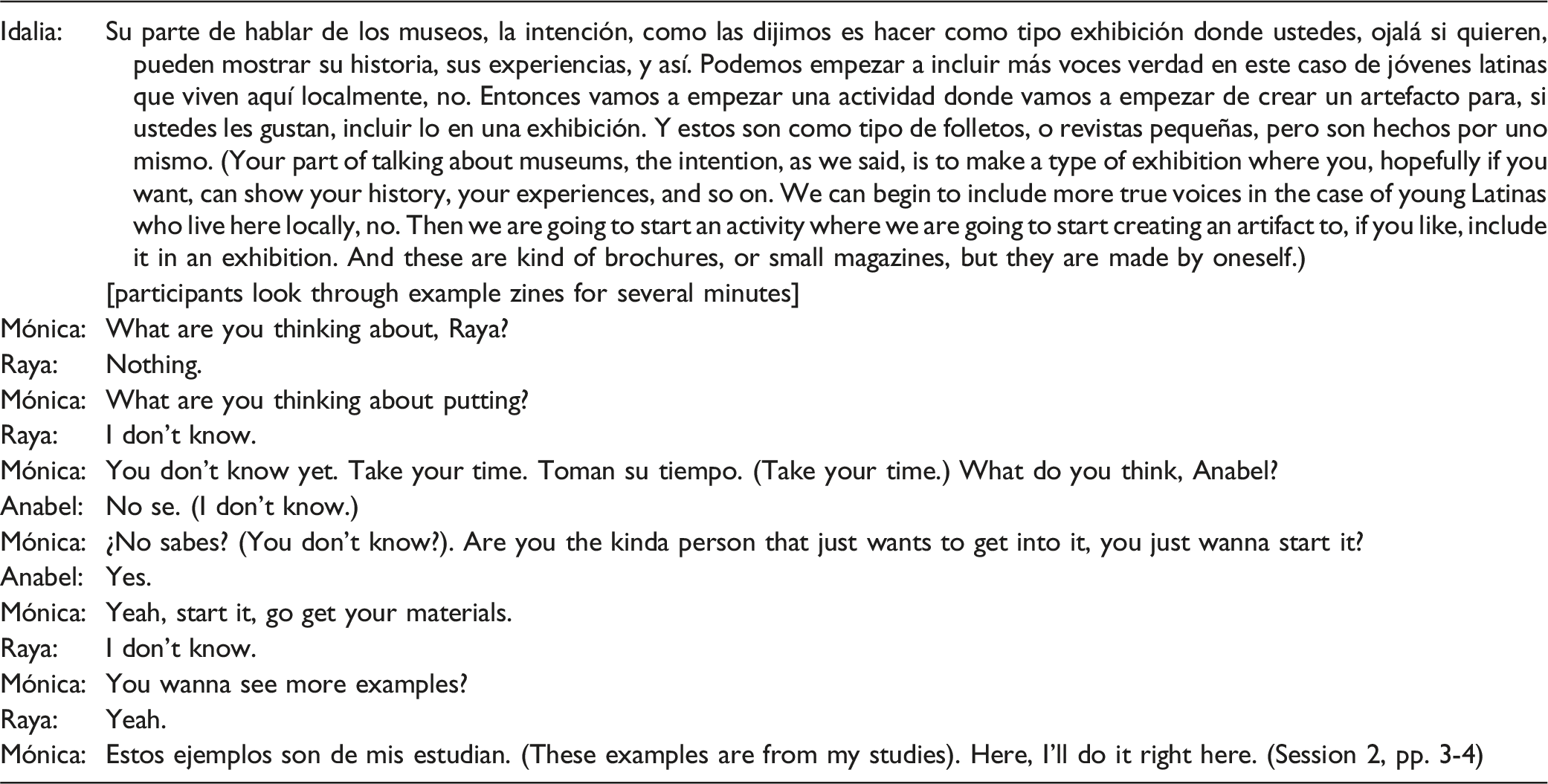
Second, we prioritized building rapport and safety among participants. To support this goal, we needed to scaffold students’ sense of comfort with revealing vulnerability, such as by using icebreakers, co-constructing norms, and including individual “journal writing” reflections in the student packet that could be shared voluntarily in group discussions.
Third, we prioritized bilingualism and translanguaging 1 throughout the program. Sixteen pages of the 17-page student packet featured titles in the girls’ home language (i.e., named language Spanish) followed by the named language English. Nine pages included language features associated with Spanish and English, with features of the minoritized named language, Spanish, being listed first. Facilitators led the program primarily using Spanish languaging, though girls were encouraged to speak flexibly and based on their comfort.
Fourth, we prioritized activities that examined identities within different aspects of life: home, school, and third spaces. We also prompted discussions about identities and their connections to bullying, future careers, and representation in the world, including museums. These discussions also served as motivation for addressing the lack of Latina/x youth narratives in museums.
Fifth, we prioritized activities focused on envisioning the future, especially future careers, because of our partnership with the Nonprofit. To broaden the discussion, we prompted participants to write and/or draw about their goals, their sources of inspiration and mentorship, and anticipated knowledge and skills for achieving goals.
Sixth, we prioritized youth agency in museums. To quote our proposal, “[t]his project’s significance is centered on a process of developing youth-driven representation of Latina/x girls in museums as part of a sustained university-community collaboration, with emphasis on youth agency and knowledge-sharing across communities.” As such, it was essential that our Art Museum partner allowed participants to freely express their identities, narratives, and artistry. While the girls had constraints as to what kinds of objects or artworks could be safely installed on walls and/or pillars, their artistic freedom and arrangement of the exhibition was otherwise open-ended.
Furthermore, these six values—community engagement, building rapport and safety, bilingualism and translanguaging, prioritizing students’ identities, envisioning the future, and youth agency—served to amplify and empower the voices and epistemologies of Latina/x girls.
Program Implementation
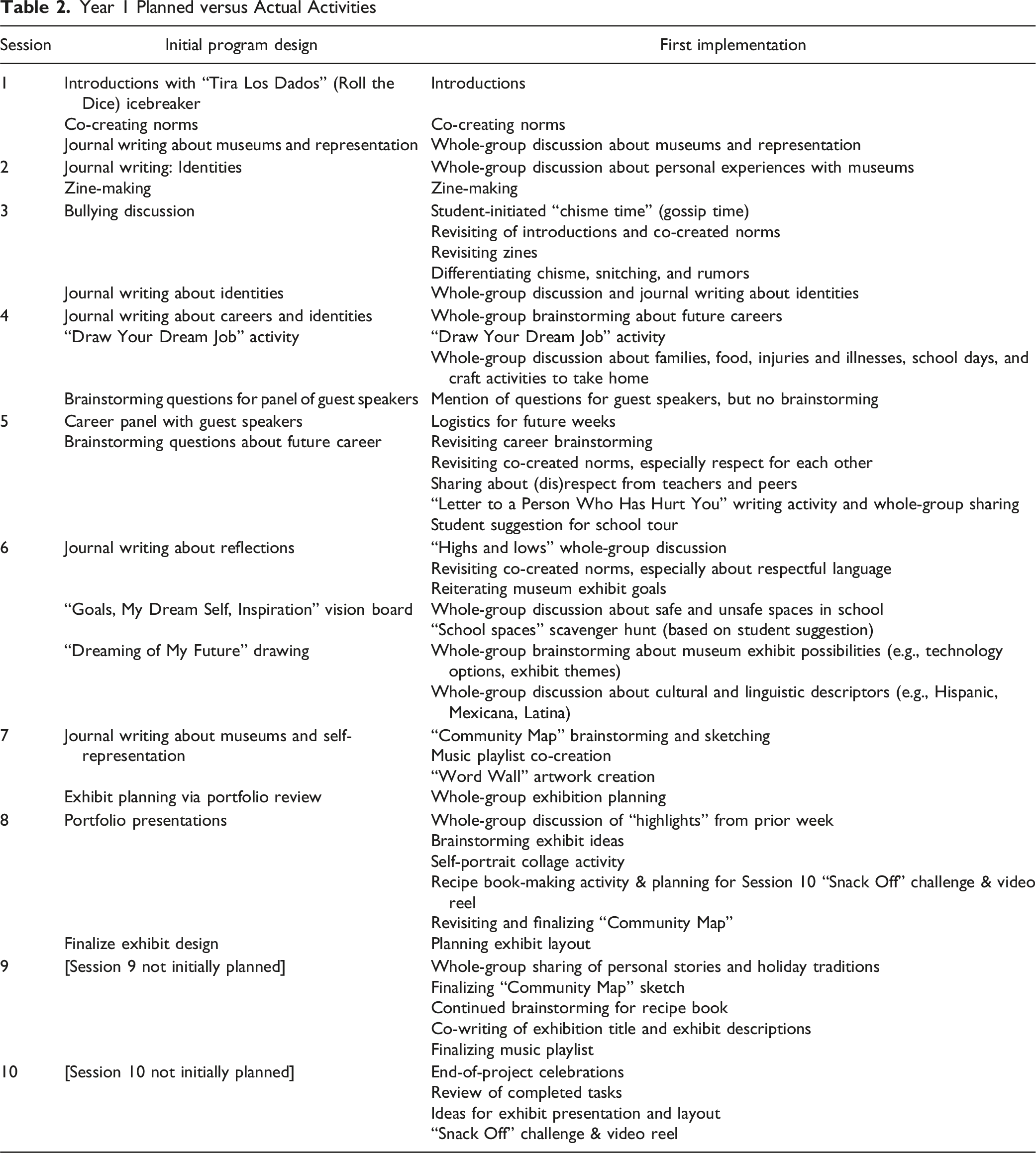
Year 1 Planned versus Actual Activities
The divergence is also visualized in Figure 1, which shows when the initial program design was used by facilitators during the first implementation and whether participants accepted or rejected the program. While the initial program was used in the first five sessions, starting around Session 3, the girls began to reject the initial program (“Initial Program Rejection”) more frequently. This rejection continued across Sessions 4 and 5, then ceased after we discontinued the initial program (embodied by the student packet). Frequency of Use, Acceptance, and Rejection of the Initial Program Across Sessions.
To explain how changes occurred, we describe two central findings: (1) how participants’ rejection of proposed activities redirected program activities productively, and (2) how centering participants allowed redirection of the program and successful design of a museum exhibition.
Productive Rejection

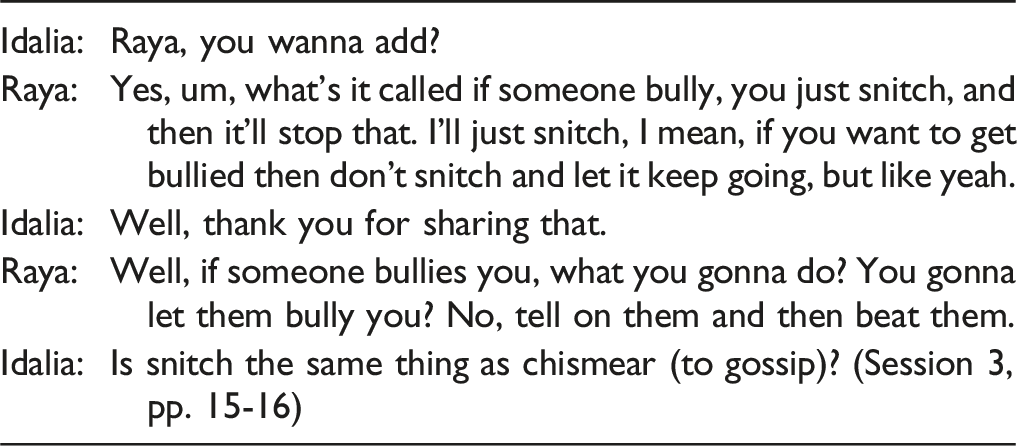
In this excerpt, Raya pivoted the conversation to bullying and snitching. Instead of returning to the topic of identity, Idalia followed Raya’s pivot by asking about the difference between chisme and snitching. This pivot, which we coded as “Indirect Student Input” (see Figure 2), showed a proposed change in topic by a participant followed by the facilitator’s acceptance of the pivot (coded as “Invited Student Input”). This pivot had implications for the remainder of the program, as the girls indicated that they needed time to decompress from the school day, which we accommodated in future sessions as a productive program change (see Nuñez et al., 2024). Frequency of Codes Reflecting Facilitators’ and Students’ Responses to Changes in the Program’s Design Over the 10 Program Sessions.

While the girls’ initial refusals seem to indicate rejection, they fully engaged in the letter-writing activity once they learned that their letters would remain private; several shared letters with facilitators. We viewed their rejection of the planned activity (discussing future careers) as productive because it allowed us to center a topic that held greater immediate importance to them.
Participant-Driven Programming
When participants rejected planned activities, the tandem use of principles from PDR and DBR allowed facilitators to create space for participants to actively contribute to programmatic design iteration, especially after the student packet was discontinued. Facilitators’ invitations were coded as “Invited Student Input” and “Invited Student Planning,” while participants’ contributions were coded as “Direct Student Input,” “Indirect Student Input,” “Direct Student Planning,” and “Indirect Student Planning.” “Direct” referred to input or planning that included overt suggestions, while “indirect” referred to subtler indications (e.g., disengagement, redirection). Figure 2 shows the relative frequency of codes across sessions, along with the girls’ reactions to their peers’ suggestions (“Student Activity Acceptance”, “Student Activity Rejection”, and “Student Activity Modification”).

The research team took up Julia’s request by creating a scavenger hunt activity for Session 6, which asked the girls to lead facilitators to spaces that evoked certain feelings (e.g., a “safe” space). The girls seemed to enjoy leading the tours and noted the relative comfort they had in different classrooms along the way, building on their earlier conversation.

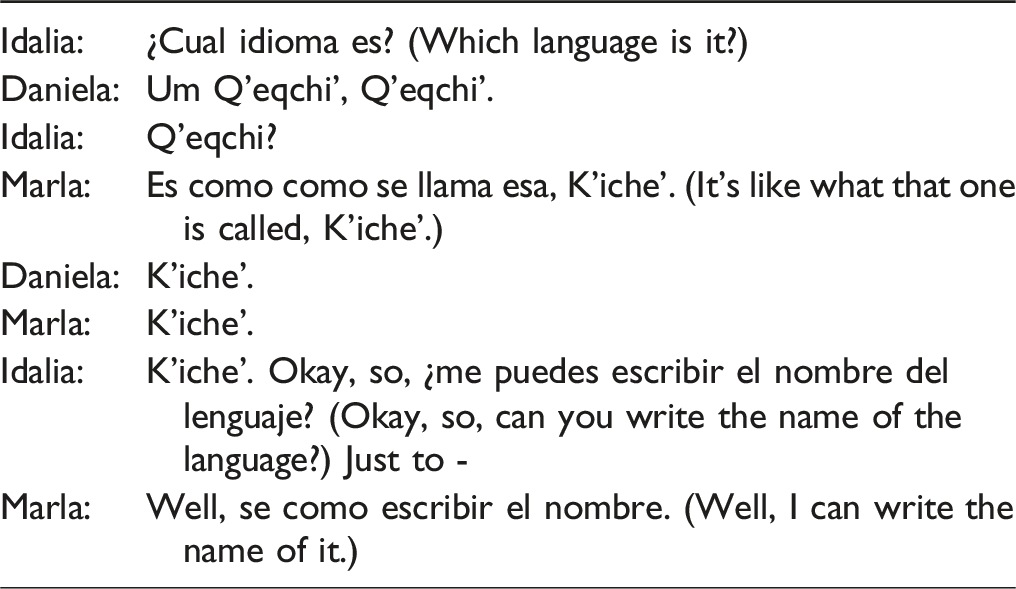

Photo of the Exhibit of Everyday Words and Phrases in Spanish, English, Q’anjob’al, and K’iche’. At the Top Left in Orange, we can See that Marla Wrote “Patej,” the Q’anjob’al Word for Tortilla. In the Middle Row, Furthest Left in Green, we See that Daniela Wrote “ak’wa,” which is the K’iche’ Word for Tortilla. We also See Words and Phrases in Spanish, English, and Spanglish.
The two girls wrote the names of the Indigenous languages they spoke on colorful paper. Also, Marla wrote “patej,” the Q’anjob’al word for tortilla, while Daniela wrote “ak’wa,” the K’iche’ word for tortilla. The whole group decided to include their collection of words and phrases in the exhibition, thus representing the multilingual space of the afterschool program (see Figure 3).

In this excerpt, facilitators asked questions (“...a taste test?”) or made requests for additional information (“...me dicen a cuales quieren tratar”) to guide decision-making, and the girls made the final selection of the various chips and condiments they needed. The girls continued to brainstorm the “chip-off” during Session 9 and finalized their list of ingredients. In the culminating session (Session 10), the girls assembled their “chip-off” combinations and held taste tests among the whole group. A highlight reel created from recordings of the “chip-off” was included in the exhibit. Figure 4 shows several exhibits that the participants and facilitators co-created during the program. Photographs of the Exhibition, including (a) Everyday Words and Phrases in Spanish, English, Q’anjob’al, and K’iche’, (b) an Entry in the “Chip-off” Competition, (c) the Digitized Community Map, and (d) Three of the Participants Viewing the Artist Statement They Co-created.
Post-Implementation Feedback
To center the girls’ perspectives about the program, we asked them to provide program feedback during post-implementation interviews with three participants (Julia, Raya, and Daniela) on the day that they visited their exhibition. The post-implementation feedback allowed for facilitators to engage in ongoing reflection of the program and its impact on the girls’ experiences.
A central theme related to the girls’ ethnic and linguistic identities. Julia and Raya mentioned that they were drawn to the program because it was intended for Latina/x girls. Also, all three girls mentioned increased use of home languages. Julia noted that prior to the program, she spoke Spanish mostly with her father but spoke it in more settings after the program. Raya felt pride in being able to speak Spanish: “Like, it's cool because, like, some people, like, wants to know Spanish. And like us, Latinos were born with it. And we don't. We don't even need to learn it.”
Daniela mentioned that she enjoyed being able to share words in K’iche’, an Indigenous Mayan language. Collectively, the interviews indicated that the program’s emphasis on multilingualism was appreciated by participants.
Participants had different perspectives on their favorite part of the program. Julia chose the music playlist curation as her favorite part, which Daniela mentioned as well. Daniela also mentioned creating the Community Map that showcased important locations in the girls’ neighborhoods. Raya specified the “chip-off” competition. These “favorites” emerged from organic changes the girls made to discussion topics, highlighting how the facilitators’ willingness to engage with suggestions was necessary. Also, Raya mentioned liking the student packet to the extent that she kept hers, which we found surprising because Raya demonstrated reluctance to engage with packet activities during the program.
All three girls indicated that the support provided by facilitators and other girls was essential to their enjoyment of the program. Julia specified that she felt very supported by Raya, who was known for being vocal like her. Raya specified that dedicating time for sharing about school and personal topics was important to her: “Yeah, like I remember, like in the beginning, we said our, like, our tea and I would actually, like, spread out my, my, my drama and everything. I would come out like, this happened and I was like, mad. And I was like, I feel like, I feel happy. Like I don't even tell my mom that. And it was, I feel better, like coming like, say, now I feel like more alive when I said stuff. And I'm like, it was fun. And then when I had to stop going, I was honestly sad because I love, I mostly like, I loved los miercoles y jueveses [the Wednesdays and Thursdays].”
Also, Raya indicated that she was reluctant to share about herself in most contexts for fear of being judged. She stated that the lack of judgment from facilitators during others’ sharing increased her comfort with sharing about herself.
Last, when asked about changes, the girls suggested having more time and structure for brainstorming and creating exhibits. However, no other changes were suggested. When asked about changes, Julia stated: “Um, honestly, I don't think I would change anything because I feel like the program itself is perfect and even the name is perfect. It kind of brings out what the Latina voice is all about. So I feel like I wouldn't change anything about it because it's the way that it is. It's perfect.”
Overall, the girls voiced a positive outlook about the program and shared their favorable experiences in it. In particular, their feedback highlighted the language practices, activities, and the naming of the program as elements that resonated with them. More importantly, their feedback reflected a sense of affirmation and support that they felt from the program.
Program Iteration
Guided by McKenney and Reeves’s (2012) description of “mesocycle” analysis in DBR, which includes phases of analysis, design, evaluation, and reflection, we examined how we redesigned the program between implementations. We evaluated the weekly program agendas, changes to activities (see Table 2), and post-implementation feedback along with personal reflections on the program. From this process, we identified the following structural changes to the program design: • • • •
Regarding what was kept, we continued the practice of “chisme” (more than gossip; Nuñez et al., 2024) at the beginning of each session to foster rapport among the girls and facilitators. To further support community-building, we continued to dedicate substantial time to co-creation of norms and discussions about identities and communities (e.g., Latina/x, ages 10-14, girls); we expanded on this by discussing feelings of belonging in schools and museums. All of this was consistently shaped and informed by the perspectives, epistemologies, and voices of the girls.
Discussion
In this paper, we illustrate how methodological principles from PDR and DBR could work synergistically to center the perspectives of Latina/x middle school girls in the design of an afterschool program. From an epistemic justice lens, we drew on PDR because it actively centers participants in the process of design. Additionally, because PDR builds upon DBR, we gained guidance for iterating on program design based on continuous analysis and documentation. Here, we discuss how these methodological affordances were evidenced in our program, with real impacts for Latina/x middle school girls who face epistemic injustice in educational settings.
Our first research question was, “In what ways did the theoretical and methodological principles of PDR and DBR allow us to center Latina/x middle school girls in the iterative design of an afterschool program?” We drew from PDR by centering Latina/x girls as co-designers of the afterschool program. This was enacted in moment-to-moment interactions, as the girls redirected conversations to their personal and school lives (e.g., “chisme” time) and in substantial changes to programming (e.g., the “chip-off”). The facilitators followed the girls’ redirection of discussions to topics that were more salient to them. In doing so, facilitators were able to cultivate “confianza” or mutual trust with the girls, which encouraged further sharing of ideas and experiences.
Centering of participants meant that we honored the girls’ rejection of planned activities with invitations for input and planning. The implementation changes reflect our willingness to adjust planned activities in response to the girls’ suggestions, which included the letter-writing activity; the school-wide scavenger hunt; music playlist curation; the illustration of “dichos” or sayings; the Community Map; and the “chip-off” competition, amongst others. While unplanned, these activities revealed what the girls found important, cathartic, or enjoyable. This approach is necessary in afterschool spaces where students seek space to share and socialize (Casanova, 2024; Cole, 2004; Nuñez et al., 2024).
The principles of PDR guided us in engaging “culturally congruent methodology” (Belgrave et al., 2022) and allowed us to interweave the girls’ diverse Latina/x identities, linguistic practices, and experiences throughout the program–from the initial icebreaker to exhibit installation. Our welcoming of resistance and responsive change was led by Mónica, who had conducted Youth Participatory Action Research before (González Ybarra, 2018). We see our enactment of PDR as similar to that of Anderson-Coto and colleagues (2024) who centered input from international families in the design process. In designing for Latina/x middle school girls, we found that our “creative failures” (Puzio et al., 2017) or as we refer to them in this study, productive rejections, resulted from mistaken assumptions about engaging topics and activities, possibly due to our professional and generational differences from the girls. As Puzio and colleagues (2017) note, reporting failures can support deeper understanding of culturally sustaining pedagogy.
Three DBR principles that emerged were iteration based on continuous analysis and documentation of effectiveness in an authentic environment. We met weekly to debrief prior sessions and adjust activities to center participants’ suggestions, reflecting changes within a “microcycle” (McKenney & Reeves, 2012). When discontinuing the student packet, we retained certain prompts but used different formats with room for redirection. Yet, the process of ongoing change was difficult to grapple with at times, with ongoing discussion about implications for outcomes and research as originally stated in the grant proposal. However, our commitment to Participatory Design ensured that meeting the girls’ needs was prioritized over fidelity to proposed plans. Subsequently, we generated new questions that contributed to research about literacy practices (Nuñez et al., 2024) and belonging in museums (Dornfeld Tissenbaum et al., 2023) while providing practical recommendations.
Our second research question was, “In what ways did PDR and DBR allow us to address epistemic injustice experienced by Latina/x girls in afterschool spaces? In turn, how were these methodologies limited in their capacity to address epistemic justice in these settings?” The underpinnings of PDR and DBR emphasize effective design, with PDR committing to elevation of participants’ role at all points. Specific to epistemic justice, we emphasized that the girls had the authority and credibility to tell their own stories within their created exhibition; their voices were central to planning the program, allocating resources to program activities, and deciding the objects within and design of the museum exhibition. The girls’ rejection of planned activities and subsequent changes to programming highlighted how the affordances of PDR and DBR allowed facilitators to respond with curiosity, requests for elaboration, and action. This flexibility was especially important given the voluntary nature of the afterschool program. To sustain engagement, we needed to center the girls’ vision of the program, which we accomplished by witnessing and trusting the girls’ knowledge, experiences, and histories. The culminating exhibition represented how the epistemologies of Latina/x middle school girls could be valued in educational spaces, thus serving as a counter-narrative that challenges deficit perspectives of Latinx communities in the U.S., and especially Latina/x girls.
Creating an epistemically just space requires significant mental and emotional investment for both researchers and participants. We emphasized safety and comfort within the afterschool space, including through relationship-building and translanguaging, but the labor to attend to and maintain this space was high, especially as we continuously reconfigured the program and examined our own positionalities while navigating the girls’ rejections, redirections, and boundary-testing. This affective component is implied but not named in Bang and Vossoughi’s (2016) description of PDR; it is certainly not named in DBR (though “effectiveness” is; Design-Based Research Collective, 2003). We emphasize relationship- and trust-building as essential to our enactment of PDR because of their necessity for building confianza, showing vulnerability, and ensuring that participants’ voices were not diminished or silenced (see Nuñez et al., 2024, for more examples of building confianza).
Our study contributes to prior literature in two specific ways. First, we show how explicit inclusion of participants’ cultural and linguistic practices (e.g., modeling and supporting translanguaging), combined with shared decision-making for the design of the program and culminating museum exhibition, illustrated how PDR can be operationalized in an afterschool space designed for a marginalized group (i.e., Latina/x youth). This example showcases how drawing upon PDR increased the girls’ role and voice in determining their experience and creative outputs, thus supporting epistemic justice in the afterschool space. The reflective, iterative nature of PDR and DBR also allowed us to make changes during implementation to craft a worthwhile experience for participants.
Second, while time and logistical constraints limited our participants’ ability to participate in analysis, we still consider this project to be PDR because of the participant- and justice-centered practices we employed throughout. To address Bang and Vossoughi’s (2016) critique of DBR, we actively attended to the girls’ feelings of belonging, importance, and safety, which served as key factors to success. We hope that the practices embedded in this project, especially those that demonstrate care for participants, are useful to fellow researchers who design out-of-school spaces for marginalized groups with epistemic justice in mind.
We acknowledge multiple limitations of this study. First, as indicated above, participants did not engage in research, thus limiting the scale of our PDR enactment as compared to its original description (Bang & Vossoughi, 2016; Liebenberg et al., 2020; Montreuil et al., 2021). As such, our interpretations are limited to our own perspectives as researchers who work with youth on a regular basis, but who are not youth ourselves, thus limiting the validity of our findings. However, we engaged in principles and practices associated with PDR (e.g., critically examining power, elevating participants’ role) when iterating on the afterschool program and co-creating the museum exhibition. In particular, our study details specific practices that illustrate the mental and emotional investment needed to sincerely and continuously engage with participants’ feedback. This aspect of our project also reflects a participant-driven version of DBR, as DBR varies considerably in its inclusion and uptake of participant feedback.
Second, this paper reports on the first mesocycle of a DBR project. With two implementations completed and one upcoming, we expect to reflect on the full scope of the project upon its conclusion, including more detail on facilitation and visitor-focused outcomes (e.g., Dornfeld Tissenbaum et al., 2023) that are beyond the scope of this paper. In future papers, we will explore options for including participants’ voices in the manuscript preparation process that fit within logistical constraints. Two options include revising the post-implementation interview protocol to include questions related to epistemic justice along with member-checking of preliminary findings during school lunch sessions, both of which would promote epistemic justice in the data collection and publishing processes.
Third, given our multiple roles as researchers, designers, and facilitators, we anticipate concerns about distancing ourselves when checking interpretations. We add that the research traditions we represent are wide (and sometimes clash), and we engaged in questioning of theoretical and methodological assumptions as we examined claims and evidence. Indeed, we plan to explore our experiences of “epistemic self-doubt” (van de Breemer et al., 2024) given our different disciplines, positionalities, and comfort in varying educational settings.
Here, we provide design recommendations for those who design, facilitate, and research afterschool programs for Latina/x middle school girls. First, we recommend contextualizing afterschool programs as spaces for participant-driven meaning-making, which counters the testimonial and hermeneutical injustices experienced by marginalized groups when their credibility is questioned or their opportunities to engage in shared sensemaking are undermined or eliminated (Stroupe, 2021). Foregrounding this approach reminds researchers of participants’ leadership in producing and representing knowledge in the afterschool space. In practice, this involves allocating substantial time for rapport-building and co-construction of discussion norms to cultivate trust and vulnerability (i.e., building confianza). Also, to support relationship-building, leaning into “off-task” discussions can reveal experiences, histories, knowledge, and ideas that inform and lead the design process. For example, facilitators may be tempted to limit conversations about chisme; however, sharing chisme is a powerful method of reinforcing social connections and producing knowledge (González Ybarra & Player, 2024; Nuñez et al., 2024). As such, allocating time to cultural and literacy practices such as chisme allows for deeper meaning-making. Furthermore, we recommend a flexible planning approach that allows for extensions and redirections, with attention to verbal and nonverbal cues from participants indicating engagement. Facilitators will need to consider who is in the room, where participants are collected (or separated), how participants interact, and how disengagement manifests, overtly and subtly. For us, flexible planning meant holding weekly debriefing sessions in which we adjusted plans and practices based on participants’ reactions and suggestions. Collectively, these strategies work flexibly with cultural and relational practices practiced by Latina/x youth in their communities, thus supporting shared meaning-making through familiar practices.
Conclusion
In this study, we drew from PDR and DBR to iteratively design an afterschool program while centering input from Latina/x middle school girls. Drawing from PDR meant that we committed to foregrounding participants’ input in program design, and DBR provided guidance for analysis, iteration, and documentation. This approach afforded redesign of the program while achieving the same end: the co-creation of an exhibition that authentically represented the lived experiences, identities, communities, and linguistic diversity of Latina/x middle school girls. We contribute our case as an example of a methodology situated between PDR and DBR, with constraints on co-research due to our participants’ lived realities. As such, we offer methodological contributions to other iterative Participatory Design projects that center Latina/x youth.
Latina/x youth continue to find themselves in the margins of society where their voices are often silenced and bodies are hyper-policed and subjected to violence. Despite having to navigate sociopolitical contexts that sharpen their critical thinking and worldviews toward a more just world, their ideas and lived experiences are often disregarded and overlooked. Additionally, Latina/x girls are young people who are fully human with likes and dislikes about music, food, and other things that bring joy to their lives and their educational spaces—all of which are often dismissed as trivial and irrelevant by adults. We argue that researchers and practitioners alike must take seriously the knowledge that the Latina/x girls bring to educational spaces and leverage their unique epistemologies and desires of joy to co-design spaces that they can claim as authentically theirs. These spaces have the potential to serve as places of reflection and rest from the broader intersecting weight of sexism, xenophobia, racism, and adultism that they face every day.
Supplemental Material
Supplemental Material - Pairing Principles From Participatory Design Research and Design-Based Research to Center Latina/x Youth in an Afterschool Program
Supplemental Material for Pairing Principles From Participatory Design Research and Design-Based Research to Center Latina/x Youth in an Afterschool Program by Catherine L. Dornfeld Tissenbaum, Idalia Nuñez, Mónica González Ybarra, and Citlalli Garcia in International Journal of Qualitative Methods
Footnotes
Acknowledgements
We are tremendously grateful to the Latina/x middle school girls who participated in this project along with our partners at the local middle school, university art museum, and nonprofit organization.

Ethical Statement
Funding
The authors disclosed receipt of the following financial support for the research, authorship, and/or publication of this article: This work was funded by two sponsors. The first year of the project was funded by the UIUC Office of the Vice Chancellor for Diversity, Equity, & Inclusion: Call to Action to Address Racism & Social Injustice Research Program. The research reported in this article was made possible in part by a grant from the Spencer Foundation (#202200165). The views expressed are those of the authors and do not necessarily reflect the views of the Spencer Foundation.
Declaration of Conflicting Interests
The authors declared no potential conflicts of interest with respect to the research, authorship, and/or publication of this article.
Data Availability Statement
The data from this paper are not available for public access given the sensitive nature of topics within program discussions.
Supplemental Material
Supplemental material for this article is available online.
Note
References
Supplementary Material
Please find the following supplemental material available below.
For Open Access articles published under a Creative Commons License, all supplemental material carries the same license as the article it is associated with.
For non-Open Access articles published, all supplemental material carries a non-exclusive license, and permission requests for re-use of supplemental material or any part of supplemental material shall be sent directly to the copyright owner as specified in the copyright notice associated with the article.
