




Abstract
In this article, we introduce the framework of Affective Facilitation to the practice of focus group research. In this context, Affective Facilitation is defined as a framework that helps researchers (1) surface and deeply understand participants’ lived experiences, bearing in mind their individual differences, (2) make space for exploring common ground across their diverse backgrounds, and (3) connect with participants through empathy and compassion using active and reflective listening skills. Conceptually, the framework draws on the theoretical and philosophical strands of phenomenology, existential dialogue, holism, and Gestalt therapy. In practice, it employs graphic facilitation as a technique for fostering group learning and connection while creating a visual memory of the dialogue. We explain the implementation of this actionable framework through a case study of facilitated conversations with parents who share their lived experiences, providing insight into their perceptions, beliefs, and concerns regarding childhood vaccination. This study contributes to a growing body of work on creative, participatory, and arts-based research methods.
Focus groups, a core data collection method in qualitative research, allow multiple perspectives to be shared and portrayed in small group settings. Focus groups, which are informed by the research agenda and the questions determined by the researchers, build on the interaction facilitated between group participants (Duggleby, 2005; Morgan, 1997). These in-group interactions afford a synergistic effect (Palmer et al., 2010; Stewart et al., 2007) that allows participants to reveal points of agreement, conflict, or uncertainty. By listening to discussions, concerns, and contradictions, researchers gain insights into participants’ diverse perspectives.
Over approximately the past century, focus group methods have evolved as “a way of listening to people and learning from them” (Morgan, 1997, p. 9). This approach has been considered ‘ideal’ [sic] for examining individuals’ stories, experiences, points of view, beliefs, needs, and concerns (Kitzinger, 2005). However, the method has been called into question for not enabling researchers to gain a deep understanding of the participants’ experiences or to generate in-depth personal narratives that build on lived experiences (Hopkins, 2007; Krueger & Casey, 2009).
In this article, we argue that by introducing the framework of Affective Facilitation to the practice of focus group research and opening up the scholarly discussion around more experience-based, participant-led facilitated conversations, we can address these challenges. The two authors have developed the framework as a theoretical and actionable approach to support researchers in their role as facilitators, and to help research participants in surfacing and sharing their diverse, lived experiences in uniquely creative and immersive ways. In this context, we define Affective Facilitation as a framework that supports researchers to (1) surface and deeply understand participants’ lived experiences, bearing in mind their individual differences, (2) make space for exploring common ground across their diverse backgrounds, and (3) connect with participants through empathy and compassion using active and reflective listening skills. Additionally, we suggest techniques that support skill development for designing creative and interactive activities, which will effectively facilitate the focus groups.
To unfold our framework, we draw inspiration from the theoretical and philosophical strands of phenomenology, existential dialogue, and holism. In addition, we enrich the facilitation of groups with the conceptual aspects and methodological considerations of group process and group dynamics (Fairfield, 2004; Hodges, 2003, 2008; Kepner, 1980). By group process, we mean everything that takes place during the group’s life cycle, which is shaped moment by moment. As group dynamics, we understand all the developing interactions that affect the ways in which the group engages during the dialogic process.
In the first part of the article, we introduce the Affective Facilitation framework by synthesizing the theoretical, philosophical, and methodological perspectives that we draw on for studying lived experiences, and by designing the facilitation method and style. We conclude the first part of the article by reviewing a set of techniques to support the facilitation practice. The next part of the article explicates and illustrates how we designed and implemented the framework based on a series of experience-based focus groups we facilitated. We conclude the article by reviewing the skills that researchers can acquire and work on when joining similar research endeavors. As the objective of this article is to focus on our suggested framework and its empirical implementation, we will not be presenting any findings or discussing any data collected for the specific study.
How the Framework Unfolded
In 2020, we initiated a close collaboration spanning over the course of 8 months. The aim was to develop a theoretical and methodological framework that would support the research study designed by the first author. In particular, the first author aimed to design and facilitate a series of focus group-style dialogues to study the perceptions of childhood vaccination, as shared by parents of children under 12 years old. The objective of this work was to bring out the parents’ personal and diverse stories and to create a space for an inclusive and empathic dialogue across different perspectives, backgrounds, and experiences. 1 The design of this process called for an approach that would draw on different disciplines and fields, and transcend the limitations of focus groups when exploring lived experiences. The conflicting and polarizing nature of the issue under study warranted the development of an approach that would be based on the experiential and embodied processes of interaction and engagement between the researcher and the participants, as well as among the participants themselves (see also Dimitrakopoulou, 2021).
As experiential, we consider the actual interactions that take place in the here and now of the group, both on a mental and emotional level; the term refers to the humanistic and phenomenological points of view that were developed around the 1940’s as a kind of alternative to psychoanalytic and behavioral approaches (Yontef & Jacobs, 2008). By embodied we mean acknowledging the importance of the body in (a) synthesizing the human experience and contributing to the fundamental sense of one’s self (Damasio, 1999; The Psychiatry Online Italia Videochannel, 2014) and (b) eliciting any kind of human interaction (Appel-Opper, 2009).
While working on the design of the study, we became aware of the need to solidify our approach by describing the disciplines and fields from which we draw the framework’s principles. We therefore argue for the need to infuse the practice of focus group research with knowledge, principles, and values from these fields. The result of this collaboration is the Affective Facilitation framework that can inform the facilitation practice in a wide array of research (academic and non-academic) settings. With this article, we aspire to contribute to the fields of focus group research and facilitation practice in the following ways: 1. By highlighting the importance of the experiential process for studies that aim to surface participants’ lived experiences in an authentic and organic way, and which take place in collective (group) settings. 2. By offering a facilitation blueprint that grounds this experiential process, and enables both researchers and participants to co-create this phase of the research process. 3. By suggesting a set of skills, and the expertise that qualitative researchers who engage in research with participants need to attain, in order to be able to support group processes in an engaging and empathic way.
Overall, we propose an actionable framework that is flexible enough to be adjusted to the research goals and agenda that each researcher needs to address. Our contribution can support researchers from the fields of journalism studies, communication research, and ethnographic studies, as well as practitioners in non-research settings such as facilitation practice, community-centered journalism, community engagement, and civic design.
Theoretical and Philosophical Underpinnings of the Affective Facilitation Framework
In what follows, we outline the theoretical and philosophical underpinnings of the Affective Facilitation framework that draws on principles stemming from a humanistic approach. In our context, humanism (McLeod, 2015) builds on the foundational idea that the complex depths of the human conscious awareness and of what it means to be human, needs to be understood through multiple and combined streams of thought, such as holism, Gestalt psychology, field theory, phenomenology, and existentialism (Yontef & Jacobs, 2008).
Study of Lived Experiences
In this section, we refer to the disciplines that pertain to the complex ways in which the human experience is synthesized. Specifically, we review the principles of phenomenology, and how these inform the space of facilitation in qualitative research.
Phenomenology, joint situation, and self-organization
The term phenomenology is used in philosophy and cognitive sciences to refer to a first-person description of what is directly and subjectively being experienced (Gallagher & Zahavi, 2012). Since its initial presentation as a system of philosophical thought by the German philosopher Edmund Husserl, phenomenology has expanded, giving birth to existential philosophy, and has entered into dialogue with the natural sciences, such as neurophenomenology (Gordon, 2013; Glazier & McInerney, 2016), opening new possibilities for understanding the diverse ways in which we experience our being in the world.
Phenomenology has greatly influenced the methodologies for designing and implementing interventions for individuals and groups. In its essence, phenomenology aims to surface the meaning that an experience has for an individual both in terms of the “what” and the “how” (Moran, 2000). Phenomenology also informs how diverse, or in some cases, conflicting experiences or perspectives participants may offer. It focuses on the subjective meaning that an experience has for a person by holding the space for such an experience to be shared and reflected on.
In our study, we draw inspiration from the front-loaded phenomenological approach (see Gallagher, 2003; Gallagher & Zahavi, 2012). The basic idea is to allow phenomenological insights, concepts, and analyses to inform empirical research, such as the design of experimental protocols and the conduct of interviews or focus groups. Rather than eliciting first-person reports from a respondent, the application of phenomenology in qualitative research can provide a comprehensive theoretical and empirical framework to describe, understand, and interpret the meanings of human life experiences. It can support research questions that aim to explore what it is like to experience a particular situation (a phenomenon).
Our framework employs the principles on which contemporary phenomenological methods are based. Such methods, originating from the work of Husserl, have gradually become flexible tools, applicable to several fields of knowledge and qualitative research. These methods are used when we need to explore the diverse, subjective ways in which humans experience and attribute unique meanings to different phenomena (Moustakas, 1994; Smith & Osborn, 2015). These fundamental principles directly inform our facilitating framework, in a focus group or facilitated conversation setting, with the aim to explore (a) how particular situations are experienced by the participants, and (b) how participants build and express their personal lived experiences during their interactions within the group (Smith & Osborn, 2015). In order to be grounded in this approach, the facilitator needs to: Suspend pre-existing assumptions, perceptions, biases, and affinities. In other words, they need to stay open and curious to explore other people’s experiences by bracketing their own views. Perceive personal stories as they are shared without trying to interpret them. Follow the rule of horizontalization, according to which the facilitator should not assign importance to one element over another based on their personal criteria. Create and hold space for the group process to evolve authentically, step by step. The facilitator needs to be present in the moment and open to what is going on.
Next, we introduce the concepts of field, situation, and joint situation. These concepts emphasize the importance of approaching studies conducted with human subjects in group settings as ‘living organisms’ that exist in a constant process of multiple interactions. Their continually evolving nature calls for the design of an experiential research approach.
The term field appeared in psychology around the middle of the past century in the work of the psychologist Kurt Lewin, who introduced the idea that all humans are interrelated to everything else within a unified field of interactions (Lewin, 1951; Staemmler, 2006; 2007). Since its introduction in the early ‘50’s, the term field has been gradually replaced by the term situation that better denotes the interactive and inseparable unity of these interrelationships (Mann, 2010; Robine, 2001).
More specifically, the concept of the joint situation (Staemmler, 2007) helps us understand a person’s individual reality not only at their individual level, but rather as a variable of the total situation co-created with another person when they meet and interact. When two or more persons co-create their joint situation, they define themselves simultaneously in terms of (a) their individuality and (b) the joint situation they are both experiencing.
The phenomenological field and the lived body
Phenomenology and the lack of objectivity in the human experience are also connected to the idea of the field. Any field is always changing because its parts change, as do the interconnections of those parts (Parlett, 1991). As we are all of the field and not simply in the field (Yontef, 1993), no one can ever have an overall objective view of what is happening in the field. When the participants meet in a group, they instantly create an evolving relational field that includes all of them. Their interactions create changes to their field, and we can define these changes as the group’s dynamic process.
If we place the concept of the field in relation to phenomenology, we obtain a multi-level approach to psychological phenomena and existence, the phenomenological field theory. The core concept of this theory is the subjective micro-universe of every human being, called their phenomenological field (i.e., their subjective world) (Mann, 2010; Philippson, 2012).
In our proposed framework, facilitators need to be very careful not to control, direct, or affect in any way, how the group composes its overall field through the participants’ phenomenological fields, or through their own phenomenological field. The facilitators need to guide the changes taking place in the group’s phenomenological field without controlling them. In doing so, the authenticity of the group’s process is ensured, as is the authenticity of the experiences shared, as part of that process.
A person’s phenomenological field includes among other things, the unique psychological meanings that their own body acquires. These meanings transform the physical body into its own living body (Appel-Opper, 2009). Recent research provides data suggesting that the synthesis of our phenomenological fields is not only the work of our minds. Neuroscience affirms that our personal world begins to take on its original shape through processes that are equally affected by our bodies (Damasio, 1999, 2005). This happens because our brain is capable of ‘translating’ the individual features of sensory inputs to a series of micro-emotions that form the foundation of our highly complex emotions (Harris et al., 2015). Additionally, our existence is largely shaped by nonconscious incidents that are related to our body and our emotions, and not so much by what we experience with our mind and consciousness (Stern, 2004). Even the basic feeling of one’s self derives from the body (Damasio, 1999), and this is because the brain has the ability to continuously ‘map’ the changes of the inner body as the human senses receive countless stimuli in every instant. The brain is able to translate this mapping into minimal and nonconscious micro-emotions (also called affects, see Stern, 2004). Such affects do not only form an elementary sense of self, but also accompany, in a nonconscious way, any experiential event, making it unique.
From converging neurophysiological, developmental, clinical, and phenomenological indications in the field of neuroscience, we know that when we meet in person, our bodies develop a nonconscious dialogue that is distinct from anything we say or think. This happens because humans employ many non-verbal and nonconscious mechanisms, which constitute our mirroring system. This system is made up of specialized brain structures, overlapping neural networks, and a special network of neurons known as mirror neurons (Gallagher & Zahavi, 2012; Staemmler, 2007).
It seems that the very first ‘stories’ that people exchange when they meet are nonconscious interactions between their ‘talking’ bodies; the ‘plots’ that take place are minimal emotional fluctuations that do not reach the conscious mind. Because of our living bodies (Appel-Opper, 2009), it is essential to acknowledge the importance of the experiential aspect of any dialogues or conversations that take place in a group context.
Facilitation Method and Style
In this section, we build on the framework we have introduced, by incorporating principles and concepts that inform the facilitation practice from the fields of existentialism, holism, and Gestalt therapy.
Existentialism and existential dialogue
As phenomenology evolved, various thinkers produced ideas rather different from Husserl’s original views. One of these is the philosophical current known as existentialism, which emphasizes the uniqueness and value of every human being. Existentialist thinkers focused on questions of the human authentic existence; in other words, on “how the human being is formed and comes into being” (Cohn, 1997, p. 126).
A central concept in existentialism is (existential) dialogue which needs to be distinguished from everyday conversation or communication that primarily has to do with the exchange of information. At the core of existential dialogue, we find the work of Martin Buber (1970), according to whom, the dialogic stance is characterized by two perspectives: I-Thou and I-It. In the I-Thou perspective, we accept the Other as a whole world, inaccessible and entirely different from our own. In the I-It perspective, we focus on what we want from the Other and in a way ‘objectify’ them (i.e., we do not engage in co-creating a common relational field). The dialogic stance can constitute an excellent foundation for the application of the ideas of phenomenology, particularly the I-Thou position, in accordance with which the facilitators approach their research in group settings, such as focus groups or facilitated conversations. Additionally, the I-thou position informs how facilitators can hold the space for the full diversity of lived experiences that are shared in a group setting. The principles of existential dialogue allow us to explore and accept the alterity in other human beings––a mindset that affords to learn and connect the Other with genuine curiosity, empathy, and courage.
The following fundamental points emerge from the I-Thou perspective as far as the facilitator’s I-Thou role and practice are concerned: The facilitators need to be aware of what is happening during their interactions with the participants while maintaining self-awareness. They need to acknowledge all participants as individuals with different backgrounds, beliefs, and perspectives of their own. They need to stay present in the group’s process and participate authentically in all kinds of evolving interactions. They need to trust that the group process will meet its objectives by authentically creating a relational field. They need to remind participants that the goal is to stay curious, by asking open-ended questions, and to explore each other’s experiences rather than trying to persuade each other, find points of agreement, or reach a shared conclusion.
The organization of the human experience and the cycle of experience
A central idea in the philosophy that underpins Gestalt therapy, is that every experience constitutes a figure that is formed on the ground from which it emerges. This ground consists of thoughts, feelings, external and internal stimuli, the body’s physiology, past experiences, belief and value systems, or the actual situation emerging in a given moment as we interact with the environment (Spinelli, 2005). In this context, facilitators need to tune into (a) everything that emerges (i.e., the experiential figures) at every moment within a group, (b) each participant’s ground, and (c) the overall ground of the group (i.e., the context within which the group functions).
While we move through the world and interact with it, the figures of our experience are constantly constructed and deconstructed in a continuous flow. In the theory of Gestalt therapy, this fundamental process of dynamically relating with the world is called contact (Yontef, 1993). Our experiences are organized following a kind of rhythm or pulse, which develops into intersecting contact events of differing durations, forming a kind of ‘map’, usually called the cycle of experience.
The sequence of phases within the cycle of experience, or in other words, its ‘syntax’ (Theodorou, 2017), consists of the following stages (see Zinker, 1977): Figure formation: a need emerges, as a figure standing out from its ground. Excitation – mobilization: the energy of the need starts to move toward its satisfaction. During that process, the figure of the experience stands out more and more clearly against the ground. Main contact: the need is satisfied. Withdrawal: the whole experience starts to wind down, as the figure begins to dissolve back into the ground. Fertile void: the experience has been metabolized so that the next cycle of experience may begin.
Facilitators must always be attentive to the group’s cycle of experience. This means that, from the moment participants are welcomed to the space, to the wrap-up phase of the group session, the facilitator needs to observe and tend to everything that happens during the various interactions among the group. That level of awareness of the group processes is the foundation on which the facilitator is able to create an ambience of safety and trust.
When the various stages of the cycle of experience are left unhindered, our experience is synthesized authentically and flows effortlessly. In contrast, when the experiential contact cycle is disrupted at any of its phases, what we experience is left unfinished, creating a sense of discomfort or even anxiety. Some of the types of such ‘short-circuiting’ of the experiential flow typically addressed in Gestalt therapy are the following (Yontef & Jacobs, 2008): Projection, which occurs when a person attributes their own thoughts, feelings, and meanings to others. Introjection, by which we mean the indiscriminate acceptance of other people’s behaviors and ideas. Retroflection, meaning one does to one’s self what one would like to do to others or would like others to do to them (Zinker, 1977). Deflection, where the diminution of the emotional impact of contact processes (Harman, 1982), such as using language games, avoiding direct answers, or generalizing. Confluence, which occurs when we lose any sense of boundaries between ourselves and the environment or others (for example, using “We-statements” instead of “I-statements”).
In our framework, as is the case for all humanistic approaches, the facilitator should not try to break down these defense mechanisms. Rather, they need to acknowledge and respect these ‘short-circuiting’ contact events, without letting them interfere with the overall process of the group.
Holism, creative adjustment, and self-regulation
The term holism was coined in 1926 by Jan Smuts (1870–1950). It is used to describe a fundamental tendency of the universe, according to which things tend to form wholes which are parts of bigger wholes (Smuts, 2013). Holism is the forerunner of the modern systems theory (Hoell, 2016). The whole can be seen as another way to describe a system. It builds on the idea that a system is more than the sum of its parts (Meadows, 2008) and offers a framework for seeing interrelationships rather than static “snapshots” (Senge, 1990, p. 88).
Translating this approach into our context, the facilitator does not view the group as an arithmetic sum of participating individuals, but rather as a unified whole. The facilitator must hold the group as a single unit and always be aware of its overall pulse. In Gestalt therapy, each person is constantly seeking and engaging in the subsequent moment–a possible next state of dynamic balance. In other words, we could say that group participants are a whole that self-organizes at every moment. In our context, a specific group self-regulates both on a participant and group level. The facilitator develops their own creative adjustments (Perls et al., 1951) by addressing and managing different phases of balance, possible tensions, and moments of empathy or conflict.
Awareness and the relational self
In our context, awareness is viewed as the ability to sense the continuum of all bodily, mental, emotional, conscious, or nonconscious processes that synthesize the human experience (Mann, 2010; Theodorou, 2019). We use the terms basic awareness, mostly in reference to what happens bodily and emotionally, and conscious awareness, to refer mainly to how we mentally observe the flow of our experiences. (Theodorou, 2017). In our context, we associate awareness with the concept of the relational self, a self that is not static, but rather is in a constant state of becoming; a process that emerges continuously and lively as we engage with the world and each other (Spagnuolo-Loob, 2001).
Techniques to Support Facilitation
In this section, we review the techniques we propose as part of the process design of the group facilitation. We focus on tasks or activities that are custom designed for each group, as well as experiments based on improvisation. The latter aims to support the group’s process, and the authentic and organic connection among participants and facilitators, as well as among the participants themselves.
Process-oriented activities and experiments
Experience is itself a process, and as such, it relates to action (Zinker, 1977) and to our actual being. In our process-oriented framework, the facilitator can employ a variety of custom-designed techniques as experiential tools to support and facilitate the group’s process. These techniques can take the form of activities or experiments.
Activities are pre-designed techniques that are introduced to the group. Apart from supporting and enhancing the group process, they help it become more experiential and create a space of safety and trust. At the same time, participants have the opportunity to be present with their entire existence, and not merely participate with their rational thoughts. In addition, experiential activities constitute inventive ways of data collection, as we demonstrate in our example case, going far beyond the usual question-answer routine.
In our case study, we introduce a series of activities that are inspired by the Process Stage Practice (PSP) approach (Theodorou, n.d.). PSP is an embodied interaction approach that can complement any kind of work that has to do with process and awareness (including but not limited to psychotherapy, social interventions, education, art, and organizational communication). When applied to group settings, PSP offers the possibility of integrating the individual and collective levels of the group’s process, in innovative and creative ways. One such way is the idea of the personal film, which supports the exploration of emerging awareness by the participants of any kind of group setting, based on lived interactions (Theodorou, 2011).
Graphic facilitation as an alternative way of seeing
The process was designed with a strong visual component in mind. Our focus on lived experiences inspired us to explore the power of visuals (Brand, 2017) as a way to empower the facilitator, the participants, and the group process as a whole. Drawings and visuals allow us to have physical contact with the world through the optic centers, utilizing all the information that can reach us through our eyes (Nikolaides, 1969). In this context, the act of drawing is by itself a path toward the goal–that is to see–and not the other way around. Visuals also make conversations less confrontational and provide great starting points for asking questions and self-reflection.
To support our objective, we collaborated with a professional graphic facilitator, Kelvy Bird, 2 who offered a visual representation of each group-session dialogue through her method of generative scribing which extends the art of scribing “by attending to the field of energy and relation between people, and to the emerging potential of a system” (Bird, n.d.). The process of scribing offers a reflective representation of the dialogue, creating an interactive, co-creative, and relational way of seeing (Bird, 2018). Through graphic facilitation, we were able to (a) support associative thinking, namely to elaborate on what participants have in front of them; (b) support the conversation so it can evolve organically; (c) facilitate group learning and connection; and (d) ignite the visual memory of the group by recording thoughts as they emerge. In the example case that we present in the next section, we outline how the different techniques we have presented so far were designed and implemented. All of the figures included in the article are original outputs from the dialogue sessions.
Description of the Case Study: Exploring Parents’ Lived Experiences, Concerns, and Emotions on Childhood Vaccination
Study Background and Purpose
We describe the case study where the first author applied the Affective Facilitation framework we outlined in detail in the previous section. In particular, we report on the design and facilitation of a series of dialogues studying parents’ perceptions of childhood vaccination. More specifically, the first author invited parents of children under 12 years old to join a facilitated dialogue group, and share their lived experiences. The goal was to gain insight into the parents’ perceptions, concerns, and values on the issue. The objective of this study was to extract the parents’ personal and diverse stories and to create a space for an inclusive and empathic dialogue across different perspectives and backgrounds. Subsequently, and based on the principles of the Affective Facilitation framework, we outline the various steps of the design and implementation of the facilitation process, and we highlight the different methodological aspects and components of our study. As the focus of this paper is primarily on the design and the methods used, we will not be sharing results and findings that emerged from the analysis of the data here. Graphic illustrations that capture the different parts of the process design have been added throughout this section to illustrate how each step of the process works.
Design and Process
To illustrate how we designed the empirical implementation of the Affective Facilitation framework, we review the individual steps of the process. These steps are offered as inspiration and examples for activities that the facilitator can introduce to participants. Researchers can use some, or all of these activities and modify them depending on the focus of their study and the research questions and objectives they are pursuing. For each step, we outline our rationale for the selection of the activity introduced, and connect it with the Affective Facilitation framework we have already described. The facilitation setup followed circle practice (Figure 1). Each participant was supplied with a set of materials, such as stickers, pens, and index cards, that they would use during the session. In the section that follows, we review when and how the materials were incorporated into the process. Room setup.
Welcome and introduction activity
In the opening part of the process, the facilitator welcomes all participants, introduces the project, and shares key administrative information about the process. This part sets the tone for the experience that will be shared among the researchers and the participants and serves as a reminder for the how and the why of everyone’s participation and role. It also allows for a shared sense of understanding of the project’s goals and purpose.
This initial stage marks the start of the overall cycle of experience, which is the awareness phase analyzed in our theoretical framework. In this early stage, the facilitator’s main responsibility is to fuel the space with constant energy by mindfully observing and supporting all the participants, while helping build the joint situation that the group co-creates. This way, the facilitator primes the connections that will begin emerging between participants, especially those that will be formed in the nonconscious process of the group.
Dialogue agreements
The facilitator builds the dialogic process on a set of guidelines that are introduced at the beginning.
3
As soon as the participants acknowledge and agree on the shared guidelines, these become the dialogue agreements for the group and an invisible safety net of respect and accountability (Figure 2). Dialogue agreements.
As a facilitation tool, these ‘agreements’ support the facilitator in case any challenges arise during the dialogue. For instance, if a participant demonstrates disrespectful behavior against another participant, verbally attacks a participant, or two or more participants engage in a flaming or heated discussion, the facilitator can always refer to the guidelines to safeguard the process from any intentional or unintentional harmful behaviors. Metaphorically speaking, the conversation guidelines serve as the group’s anchor; even if at some point the conversation sways away from its original intention, the facilitator can always steer the group back to a safe space.
Building on the principles of existential dialogue, this stage sets the cornerstone for the entire dialogic process. The collective co-existence that researchers and participants join into, requires them to be aware of, respect, and accept everyone’s differences. What may seem like just a set of rules, is in its essence, the pure aim of the dialogue: to move beyond merely listening to another person, but accepting them in their entirety; to make an honest effort to understand and acknowledge, engage and connect, even if it is only for the duration of this shared experience. The dialogue agreements help to acknowledge our willingness to meet another person, another entity, their different personal universe, and to connect with their otherness as those present start building their “joint situation”.
Introductions
Next, the facilitator invites everyone to a quick round of introductions. After each participant introduces themselves, they are invited to call on the next person. This intentional action prompts the participants to build rapport with each other and supports the feeling that they are already beginning to form some connections with each other. Overall, this step offers the time and space for everyone (both participants and researchers) to be present and start synchronizing with the rest of the group. At this moment, each person transitions from being a sole individual to becoming an active member of the whole living organism, i.e., the group. Additionally, this is the time when participants have the chance to share something about themselves. This action consists of their first intentional engagement in the dialogue.
Creating a canvas for stories
In the framework we’ve described, lived experiences play a central role in the dialogue. To prime the participants to share their stories, the facilitator needs to establish the space for everyone to share their understanding of the topic under discussion by exploring it through a rapid brainstorming activity. Participants are invited to reflect on and share aloud any words, concepts, processes, individuals, and/or places they associate with the topic under discussion. They are reminded that there are no right or wrong answers in brainstorming, so spontaneous responses are encouraged.
The graphic facilitator captures everyone’s contributions during the brainstorming. The scribing process allows for all contributions to be captured visually, remaining vivid throughout the process, and so, participants build on each other’s inputs in a spontaneous fashion. Through these free-flow, unstructured interactions, participants are empowered to self-organize and add their mark to the collective process. At the same time, the group also self-organizes, as a unified whole. At this point, the facilitator needs to monitor the time, manage silences or process voids, and make sure that all members have had the chance to share and are not being overshadowed by more vocal or active participants.
The brainstorming session is used as a framing mechanism, inviting participants to open up a broad spectrum of ideas, record their thoughts as they emerge, and create a visual memory of everyone’s contributions (Figure 3). Through this activity, participants spontaneously engage in defining the issue collectively, allowing for a smooth transition to the in-depth conversation on the topic. A wide diversity of inputs is collected to create a canvas for the personal stories that participants are invited to share later on. At the same time, this process helps the group explore what is important to each participant regarding the topic. Brainstorming board.
Reflecting on the canvas
This next activity builds on the brainstorming board that was previously created, and is facilitated in two separate rounds. Round 1 includes an activity on feelings and emotions, and Round 2 focuses on identifying patterns and insights. The facilitator invites participants to use the words and concepts that were added during the brainstorming session as a canvas to reflect on. They invite the group to take a moment and look at what they created together.
Attributing feelings and emotions to concepts and drawing associations.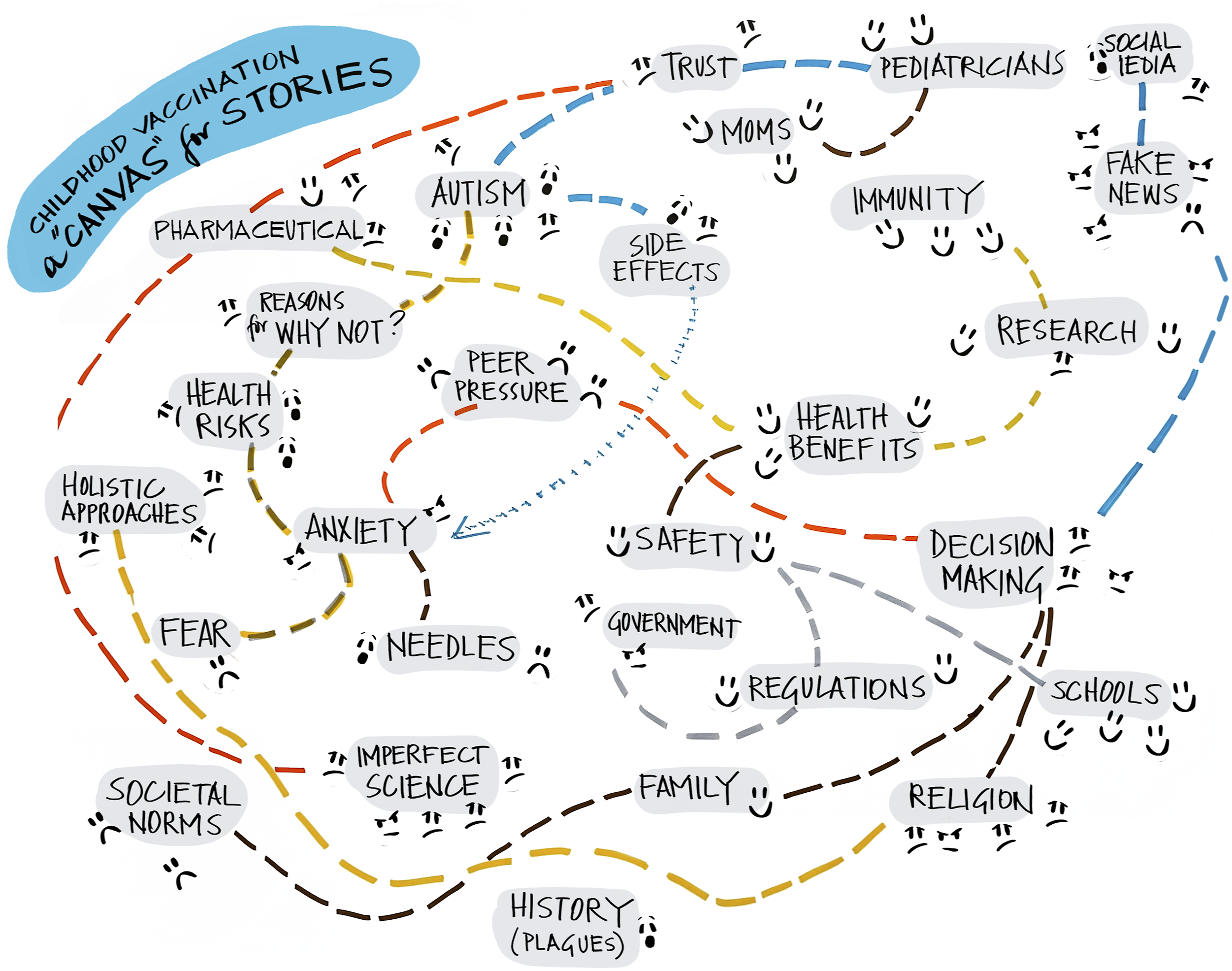
This technique involves the participants’ bodies, and consequently all the bodily nonconscious processes of interaction and sharing based on affect. In this activity, it is critical to remind everyone not to over-rationalize their inputs, but rather to reflect on their emotional state when they read or think of each of the contributed words. Participants can comment on any words they choose, whether they are the ones that contributed them or not. If there is a lack of diversity, if for example mostly one type of response is gathered (i.e., mostly negative or positive), the facilitator can kindly nudge the group to notice any patterns and capture any additional thoughts or feelings they would like to include.
By doing so, participants are invited to reflect on their visual co-creation and share any patterns they observe. This step is about observing together and inferring key learnings from the process. The facilitator may help keep the conversation going by offering additional prompts, for example: “What do you notice?” “What is meaningful/interesting for you?” “What might we learn from this?” or “What might be missing from this?”
Sharing lived experiences
The next part marks the climax of the dialogic process. As emotions derive from moments, and moments come from experiences, the facilitator has by now primed the process for memories and experiences to start surfacing organically. The facilitator invites each participant to take a moment and think of a story that has deeply affected their views and perspectives on the topic under discussion. Helpful prompts can be, “Can you describe an experience at any time in your life when you were made aware of any hopes or concerns around [topic under discussion]?” “How does this contribute to your thoughts on the topic under discussion?”
Participants may choose to share a personal story or a story they heard which had a profound impact on them. In this process, the group listens to each other’s stories and participants are invited to reflect on how each story makes them feel, what personal experiences come to mind, and what, if any, underlying values they identify as they listen. In essence, this part introduces the concept of personal narrative and invites the other participants to engage and draw connections with the experience shared. The facilitator must remind everyone to comment on their own thoughts and feelings, and refrain from interpretations. While participants share and elaborate on their lived experiences, the graphic facilitator captures the essence of their stories (using visuals and keywords), as well as the emotions and reflections contributed by the other group participants (see Figures 5 and 6). In the examples shared, each story is visually represented inside each bubble, while the comments by the other participants are captured outside. Visually capturing participants’ stories and experiences (example 1). Visually capturing participants’ stories and experiences (example 2). Visually capturing participants’ stories and experiences.

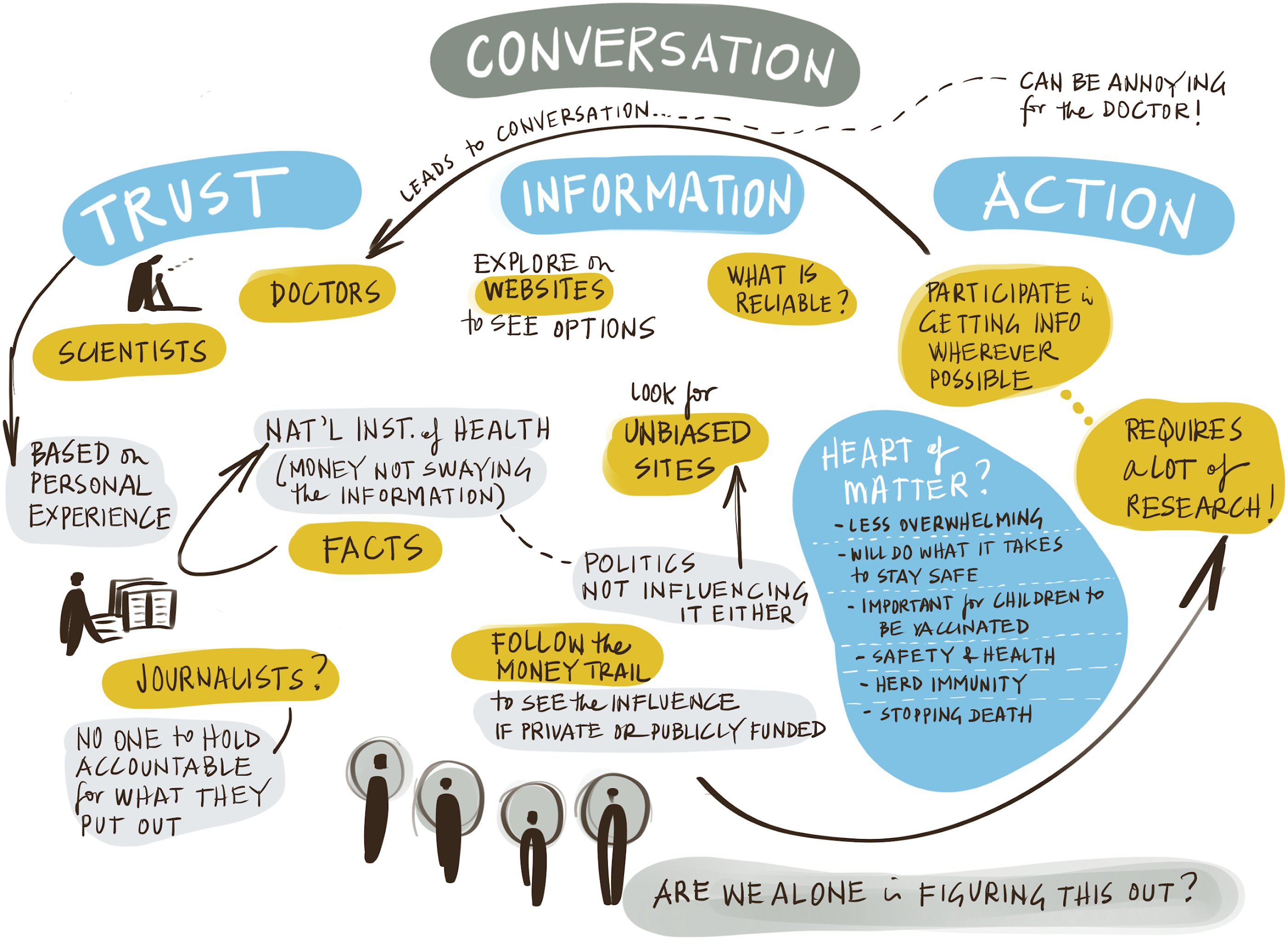
Free-flow discussion: Trust, information, and actions
In the last part of the dialogue, the facilitator opens the floor for a free-flow discussion designed around three main pillars: trust, information, and actions (Figure 7). The purpose is to move the conversation from the shared lived experiences of the past, to their present relevance (trust and information) and the future (actions). The prompts we use are built on these three pillars:
• Trust: “When you think of your personal experiences related to childhood vaccination, where would you say you draw the most confidence from? And where are you puzzled about what to do?”
• Information: “When you think of all the information that is available out there, how do you determine which sources to trust before making decisions that concern your child’s well-being?”
• Actions: “When you think of how childhood vaccination should be addressed, how does your personal experience weigh into what you think would be helpful/suitable to be done today?”
For this part of the dialogue, the facilitator can choose to focus the discussion on their respective research questions. The framework around trust, information, and actions can offer a helpful structure for a wide range of topics. The main objective of this part is to create a narrative arc between the past, the present, and the future. The graphic facilitator visually records the main points contributed by each participant thus creating a visual memory of the dialogue. Through this visual representation, the facilitator can more effectively monitor the flow of the dialogue while the participants can see their thoughts and reflections come to life.
Check-out and final reflections
This part signals the final activity of the group’s contact cycle: the withdrawal phase. Checking out is equally important as checking in at the beginning of the session. Both activities consist of rituals that signal the beginning and the end of the contact cycle. The facilitator needs to ensure that there is enough time for this last part. Often sessions run over the allocated time, and facilitators have to rush the group through the final stage to be respectful of everyone’s time. This takes a toll on the group’s smooth transition from the focus-group experience to the next experience that will follow in their everyday lives. During check-out, participants have time to reflect on what worked well for them during the session and what didn’t work for them at all. The facilitator has the opportunity to receive feedback about the process and the participants’ overall experience.
Facilitation and Beyond
To the best of our knowledge, this is the first time a theoretical and methodological framework is offered as a scaffold to support conversation and process design with the goal to facilitate dialogues in research settings that focus on surfacing participants' lived experiences as a means of understanding their perspectives and perceptions. In this article, we have outlined the importance of the concepts of group process and group dynamics as the foundation for understanding how groups are formed (Schneider-Corey et al., 2010). By reviewing the implementation of the framework in a specific case study, we offer an actionable example of revisiting and reimagining how focus groups can be facilitated and supported. In this closing section, we identify the skills that researchers need to have when engaging in such facilitation work. Specifically, we review the skills in three different areas: the facilitator’s overall stance, their interactions and attitude toward the participants, and their awareness of the group process.
The Facilitation Stance
Facilitators should “bracket off” their personal beliefs and value systems, interpretations, and causal assumptions regarding everything that happens in the group, in order to affect interactions and processes as little as possible. Moreover, they should be able to consider all these interactions and processes as equally important, and actively intervene or improvise when needed. At the same time, the facilitator needs to be aware of their own biases regarding beliefs and values, as well as their perspectives of life and relationships, and manage these during the group process. For example, if they carry their own issues with anger or conflict, these may be triggered if a conflict between participants occurs.
Interactions and Attitude Toward Participants
Facilitators must be driven by respect for the individuality and uniqueness of each participant. They need to consider each participant’s broader personal reality (their phenomenological field), as that affects their interactions within the group. Being part of a group process means that each participant, the facilitator included, is individually responsible for choosing to be part of the group. This means that the facilitator, as well as the participants, should take part in the group events with their authentic selves, while still maintaining their individuality and respecting each other’s diversity. It is also important to remember that the facilitator needs to follow the live flow of the group process, in other words, which aspects of themselves the participants present during the group’s processes, as well as how these aspects create and modify the variety of roles within the group. 4
Awareness of the Group Process
Since the group is viewed as a unified whole, the facilitator has to be aware of the ways in which all participants, and the sub-groups they have created, interact in order to self-organize their co-created field, both psychologically and physically. This awareness is necessary so that the facilitator can ‘hold’ the group (i.e., tune into the pulse, the flow, and the rhythm of the group as it moves through its different phases). The facilitator (a) supports and aids the group by helping it move on when its process freezes, (b) facilitates and frames any sudden or unexpected events, and (c) manages any possible conflicts, hesitations, frustrations, fears, complaints, or doubts that may emerge, or even the activation of trauma.
Additionally, the full potential of the framework should be further tested in a variety of contexts and disciplines. Nonetheless, we argue that such approaches can offer exciting pathways to reimagining the future of focus group research by grounding research in participants’ lived experiences and bringing into play facilitation techniques, creativity, and deep listening modalities.
Footnotes
Acknowledgments
The first author would like to thank Kelvy Bird, who brought the participants’ stories and experiences to life through her generative scribing practice. All images in this article were created by her. The first author would also like to thank Local Voices Network and Cortico for the introduction into the world of experience-based facilitated conversations. The first author wishes to thank Professors Deb Roy and Ceasar McDowell at the Massachusetts Institute of Technology for their support and inspiration in advancing deep listening and sense-making methods. Finally, both authors would like to express their gratitude to all participants who took part in these dialogues and shared their experiences and insights.
Declaration of Conflicting Interests
The author(s) declared no potential conflicts of interest with respect to the research, authorship, and/or publication of this article.
Funding
The author(s) disclosed receipt of the following financial support for the research, authorship, and/or publication of this article: This work was supported by the H2020 Marie Skłodowska-Curie Actions (844167).
