




Abstract
The Covid-19 pandemic has severely impacted empirical research practices relying on face-to-face interactions, such as interviews and group discussions. Confronted with pandemic management measures such as lockdowns, researchers at the height of the pandemic were widely limited to the use of online methods that did not enable direct contact with their research subjects. Even as the pandemic subsides, online data collection procedures are being widely applied, in many cases possibly recklessly. In this paper, we urge the implementation of a reflective approach to online research. In particular, we argue that both digital access and the research subjects’ digital literacy affect participation in online research and thus also the quality of the research. By combining these two dimensions, we develop a typology of four types of research subjects (digital outcasts, illiterates, sceptics and natives) that allows researchers to adapt their data collection to the specifics of each research situation. We illustrate these types in the context of our own research projects and discuss them with regard to three main challenges of empirical research, i.e., acquiring participants, establishing a basis for conversation, and maintaining ethical standards. We conclude by developing recommendations that help researchers to deal with these challenges in the context of online research to avoid unintended biases.
Introduction
Measures introduced to prevent the spread of Covid-19 such as lockdowns and other kinds of contact restrictions as well as an increased reluctance of many people during the pandemic to meet others in informal settings have affected empirical research in an unprecedented way (Howlett, 2022). Conversation-based methods such as interviews and group discussions were rarely implemented in face-to-face-settings at the height of the pandemic. While collecting data online for conversation-based methods was not the norm in the past, the need to apply software for data collection purposes significantly increased with the pandemic, as this seemed to be the only way to generate any empirical data at all. Researchers who needed to collect qualitative primary data through interviews or group discussions suddenly had to rely on video conferencing software such as Microsoft Teams, Webex or Zoom, to name only a few (Lobe et al., 2020), to connect to and engage with (potential) interview partners. While carrying out interviews and group discussions thus remained possible in principle, it should not be ignored that not every research subject can be reached by online tools in the same way. A loss of potential research participants, however, can seriously affect the quality of research results and thus poses considerable problems to researchers when it comes to analysing and publishing their findings. To avoid such pitfalls, scholars need to greatly reflect upon how to access research subjects, especially when applying conversation-based and mixed research designs, and ensure a basis for conversation, while at the same time maintaining ethical standards well before they start collecting empirical data for their research. As little is known about the limitations connected with the virtual implementation of conversation-based methods in qualitative field research, we seek to systematically analyze which groups can or cannot be reached for qualitative data collection using online tools. In particular, by considering the research subjects’ digital access, and their literacy with digital tools and practices, we derive a typology of research subjects that also provides relevant information about the efforts and opportunities to integrate them into the research process.
In the following, we first take a closer look at the challenges associated with field access in social science research and analyze how recruiting research participants for conversation-based qualitative data collection, establishing a basis for conversation, and maintaining ethical standards have changed in the face of digitization related to the constraints of the Covid-19 pandemic. We will then focus on the prerequisites for participating in online research. Based on this, we establish a typology of research subjects which we will explain in more detail using illustrative examples of our own research conducted during the pandemic. The final chapter summarizes our findings and outlines directions for future research.
Challenges of Engaging Research Subjects in Online Guided Interviews and Group Discussions
Literature on empirical methods in the social sciences has pointed out some great advantages related to carrying out conversation-based qualitative data collection, e.g., guided interviews online, such as the fast and uncomplicated bridging of large geographical distances between researchers and research subjects (Glassmeyer & Dibbs, 2012), the comparatively low costs and time involved (Rodham & Gavin, 2006), as well as the simplification of data processing using software (Flick, 2002). Furthermore, it has been shown that researchers benefit from applying appropriate online instruments when they themselves or their research subjects feel insecure about meeting one another face-to-face (Tiidenberg, 2019) – something which might be particularly relevant when it comes to addressing vulnerable research subjects and/or exploring unsafe or even dangerous research fields that may pose a risk to the researcher (Thunberg & Arnell, 2022). Also, for those researchers facing mobility constraints, or the ones who are unable to participate in personal meetings, for example, for physical or mental reasons, or for those who prefer not to travel long distances, e.g., for environmental reasons, methods of online data collection have multiple advantages over conventional settings. Despite these and other important advantages, online conversation-based qualitative research designs did not play a major role before the pandemic (Neville et al., 2016; Roberts et al., 2016; Rogers, 2013). With Covid-19 affecting the entire world, however, this changed fundamentally after 2020. Practical research standards, previously widely unquestioned, now had to be reflected upon and, if necessary, redefined. With regard to conversation-based methods, challenges related in data collection have arisen in three different areas (Kvale & Brinkmann, 2009) as a result of these changes: (1) Acquiring research subjects. It is without a doubt that online media and tools have simplified and sped up the process of identifying interview partners and group discussion participants and involve them in the research process (Deakin & Wakefield, 2014), even when located at very remote locations (Lo Iacono et al., 2016), e.g., by systematically screening social media platforms, mailing lists, websites etc. At the same time, however, there is a high risk that people who, in principle, belong to the relevant group of research subjects will not be considered as they are not part of the social networks analyzed, or not included in the mailing lists accessed, e.g., when they conceal their profiles in order not to be identified for privacy reasons. Especially when it comes to collecting sensitive data (e.g., collecting personal work history), researchers have encountered significant reservations to aquire participants for their field work (Bürgin et al., 2022; Mealer & Jones, 2014). (2) Establishing a basis for conversation. In addition to the basic requirements, such as the absence of disturbances – interruptions and technical problems can greatly affect the course of the data collection by causing tension and disrupting concentration (Lobe et al., 2020) – a number of other factors must also be considered to ensure a basis for conversation for data collection. In particular, the relationship between the researcher and the research subjects can have a significant impact on the data collection situation and thus on the quality of the data (Flick, 2002). It is widely recognised, for example, that researchers’ and research subjects’ roles and their associated positionings have an influence on interactions during the collection of qualitative data (Bourke, 2014). This needs to be reflected upon by researchers and considered accordingly in the planning of the project. Further, a certain degree of trust can foster information flows, which can be decisive, especially when it comes to sharing sensitive insights, and in settings where anonymity cannot be guaranteed (Seitz, 2016). Research, however, has shown that the specific framework conditions of online settings affect the way in which relationships are established between researchers and research subjects (Jenner & Myers, 2019). It is, for example, difficult to build the same level of trust in online interview settings as it is in face-to-face meetings (Tiidenberg, 2019) because researchers and research subjects in digital settings find it more difficult to read their counterparts’ body language and other sensory aspects (Longhurst, 2017). Also, psychological literature suggests that people intuitively make a lasting assessment of their counterpart when meeting someone for the very first time (Willis & Todorov, 2006). This kind of an assessment, however, clearly becomes more difficult in digital settings or even distorted, mainly because physical factors that extend beyond optical and acoustical ones (e.g., scents) play a crucial role and cannot yet be simulated digitally. With regard to data collection instruments that involve numerous people rather than just the researcher and one respondent (e.g., group discussions), these findings not only apply to the relationship and interaction between researchers and research subjects, but also to the manifold relations among the research subjects, e.g., as participants of focus groups (Shamsuddin et al., 2021). Although some scholars argue that in certain data collection situations, such as in telephone interviews, the distance between the researcher and the research subject can have a beneficial effect on the quality of the data (Novick, 2008; Oltmann, 2016), in many cases the lack of physical presence will negatively affect the interviewer-interviewee-relationship (Novick, 2008; Seitz, 2016), or the relationship of focus group participants among one another. This can lead to situations where information is intentionally or subconsciously held back, which may jeopardize the entire research process in certain cases (Johnson et al., 2021). (3) Keeping ethical standards. Ethical aspects are important as a moral compass for the researcher as they help to protect the rights of the parties involved in the research process (Henn et al., 2021; Wilson, 2020). While important ethical principles such as ensuring scientific quality and researcher integrity, avoiding harm and maintaining willingness and self-determination (Buchanan, 2011; Hopf, 2004) are still relevant, even when applying digital methods (Janghorban et al., 2014; Rodham & Gavin, 2006), participants may feel insecure about whether these standards are actually adhered to in online settings (Newman et al., 2021). For example, it might be more difficult for research subjects to rule out that the conversation is being recorded or that third parties are covertly present without permission (Sullivan, 2012), and in general many people feel more in control of a situation when they are able to look into each other’s eyes (Thunberg & Arnell, 2022; Tiidenberg, 2019). In addition, perceived or actual inability to participate in online data collection due to a lack of literacy could embarrass research participants. This is not only an ethical issue, as these individuals find themselves in an uncomfortable situation for taking part in the research, but could also cause these individuals to completely refrain from participating in research, sometimes also under the guise of other reasons. To prevent people from deciding not to participate in research for these reasons, ethical principles might have to be implemented and communicated in a different way in digital settings – something that should also be reflected in formalized processes, such as ethic reviews.
Including Research Subjects – Conceptual Considerations and Typology Construction
The practical experience gained in several research projects during the pandemic made us give more consideration to the challenges outlined above. Since potential research subjects can differ regarding their accessability and familiarity with online tools, we believe a systematic segmentation is helpful in order to avoid systematic biases in empirical research. In constructing a typology, we followed the approach suggested by Kluge (2000) which includes four steps: (1) elaboration of relevant dimensions of comparison, (2) grouping of cases and analysis of empirical regularities, (3) analysis of the contextual meaning and formation of types and (4) characterization of the types formed.
Elaboration of Relevant Dimensions of Comparison
We derived the typology by combining two dimensions that have been widely discussed in the literature dealing with equal access to and equal use of digital, especially online, communication and tools (Hargittai, 2003; Ragnedda & Muschert, 2013; Van Dijk, 2020): the research subjects’ digital access and their competence in using digital technologies (‘digital literacy’). We chose these dimensions as they not only refer to important prerequisites for participation in online data collection formats (Self, 2021), but also affect the extent to which research standards are successfully maintained (Beddows, 2008; Duffy, 2002). • Digital access. Suitable technical infrastructure is a necessary prerequisite for receiving and transmitting data in the digital space. Without the appropriate hardware, software and an Internet connection (Lobe et al., 2020), research subjects can neither be reached nor participate in online research designs (Aydin, 2021). In the context of online research, we clearly observed disadvantages for those residing in regions which lack a fast and stable Internet connection (Thompson et al., 2014), such as peripheral rural areas (Welser et al., 2019). This aspect is also reflected in the concept of the ‘first-level digital divide’ (Van Deursen & Van Dijk, 2019) which has been debated since the very early days of the Internet (Compaine, 2001; Hargittai, 2002). Of course, the lack of an Internet access is not always related to regional or other external circumstances. Rather, there are also actors who voluntarily and quite consciously disconnect from digital infrastructures (e.g., by not using a smartphone) (Radtke et al., 2022). • Digital literacy. It is not just the mere access to technologies and infrastructures that determines individual communication practices and enables actors to participate in research (Hargittai, 2002). Rather, digital access constitutes a prerequisite for the development or utilization of what might be called digital literacy, which – in the sense of what Robinson (2009) described as the ‘information habitus’ – enables individuals to both master the use of digital solutions such as online communication tools technically and understand them as part of their everyday lives. It can be assumed that potential research subjects who show this habitus will act more naturally and confidently in online data collection than those who have the fundamental and necessary skills, but do not regard the use of online solutions to be routine (Mirick & Wladkowski, 2019). Several socioeconomic factors were found to be critical (Dimaggio et al., 2004; Hargittai et al., 2019) in developing such skills (Simões et al., 2020; Van Deursen et al., 2017). In particular, formal education plays an important role, meaning that the higher the level of formal education, the more likely it is that people will have a high level of digital literacy (Van Dijk & Van Deursen, 2010). Furthermore, it has been shown that the ‘parents’ level of education’ strongly influences younger people’s degree of digital literacy (Aydin, 2021, p. 7). Moreover, research suggests that the younger research subjects are, the more likely they are to have a high degree of digital literacy, making age another important determinant (Hunsaker & Hargittai, 2018; Loges & Jung, 2001). In addition, numerous studies on differences in user behavior have shown that ethnicity is also a relevant factor with digital literacy comparatively lower among ethnic minorities (Fairlie, 2014; Jackson et al., 2008; Walker et al., 2020). With regard to gender, previous studies have not provided clear-cut results (Ertl & Helling, 2011; Hunsaker & Hargittai, 2018), but vary in their findings depending on the different forms of use and hardware (Kennedy et al., 2003). At the same time, numerous studies confirm a persistent general disadvantage of females in terms of digital literacy, which can be explained by particular financial hurdles and the influence of socio-cultural norms (Liff et al., 2004; Mariscal et al., 2019).
Grouping of Cases and Analysis of Empirical Regularities
Overview of the Four Research Projects.

In one project (Project A) we focused on resentment towards foreigners in regional business networks, and its associated effects on discourses and practices. We interviewed 65 chief executive officers and human resource managers in regional firms and 11 experts from the corporate environment (e.g., business development and associations), predominantly in rural regions, to understand how xenophobic discourses and practices are reproduced in firms and networks and thus influence the development of the regional economy. In this project, we did not face any problems in aquiring participants for online data collection since we could phone them using telephone numbers that we had systematically collected from databases to encourage them to participate in qualitative interviews conducted online. In some cases, however, it was not possible to establish a basis for discussion because some potential research participants regarded the topic to be too sensitive. Because of partly extreme political attitudes often accompanied by a rejection of political and academic elites, we were unable to generate a sufficient degree of trust in these cases. Two CEOs, for example, whom we sought to interview using Zoom because personal meetings were not possible at that time, withdrew their consent as they had concerns about the procedure. In particular, they feared that the information shared would not be kept confidential and that this could be disadvantageous for them. Both pointed out that they had no control over both recordings that could be made without their explicit consent and the subsequent use of the data. We tried to convince them by explaining the procedure in detail and also provided them with information on data protection and corresponding legally binding declarations but were not successful. Two other CEOs of small rural firms were unable to conduct the interview online due to lack of literacy. They felt unfamiliar with the setting, were unwilling to learn the necessary steps and therefore did not agree to the interview. Offers to provide active technical support could not change their minds. In the end, we were not able to include them in the project. Although we could reach other research subjects, these examples show that there is a risk of not being able to include certain individuals, particularly when it comes to researching sensitive topics such as xenophobic sentiments. We would also like to mention that some of the participating interview partners appeared nervous due to a lack of experience. They had to get used to the setting before they were able to fully concentrate on the content of the interview. At the same time, we observed how experts from the corporate environment, obviously familiar with computer work, felt very comfortable conducting the interview online.
A second research project (Project B) dealt with climate change adaptation in the context of regional planning in rural areas. To better understand district officials’ awareness of climate change risks and how they incorporate aspects of climate change into regional development plans, we conducted 12 semi-structured expert interviews with the mayors of rural districts in Saxony, Saxony-Anhalt, and Thuringia in 2020 and 2021, which had to be designed as online interviews for pandemic reasons. From the outset, the research team knew that the research subjects had Internet access, software, and digital devices due to their professional activity, which inevitably requires these prerequisites. As such, online acquisition was not a problem in this case. However, the team encountered several challenges along the way: First, due to data security issues and corresponding regulations, some mayors were not allowed to use certain video software. This issue was solved by using alternative software packages that they were allowed to use. Second, several research subjects struggled with the online interview situation, as they either had difficulties to log in or experienced problems with the audio and/or video connection. Some received help from co-workers, while others gave up and switched to the telephone. Once the connections had been established – either online or by phone – the interviews could take place.
A third project (Project C) aimed at developing a platform for intelligent sensory telemedicine solutions for holistic health care in structurally weak regions. Because of the pandemic, all scheduled face-to-face events had to be switched to online formats. These included network meetings, workshops and regional conferences designed to bring together stakeholders from different fields. For the project, the challenges associated with this were particularly revealing, in that increasing trust and acceptance towards digital (medical) solutions was an explicit project goal. The very acquisition of research subjects proved to be a challenge, as we knew of many potential participants who did not use the Internet at all, for example, due to their age and personal circumstances. We addressed this problem by relying on various local stakeholders whom we already knew and who enabled us to indirectly contact the individuals in question to encourage them to participate. Finally, it became apparent at the beginning of the group discussions that people from different backgrounds reacted quite differently to the online format: The vast majority of business stakeholders were familiar with the software tools used, as they work in knowledge- and technology intensive sectors that apply the same or at least similar solutions. Individuals from public policy administration and the medical field sometimes seemed to experience minor issues with regard to access and digital literacy. This was evident, for example, in the fact that they were proficient in the basic functions of the tools, but not in advanced requirements, such as selecting and entering a breakout session. For those working in the area of volunteering, however, the hurdles appeared to be much higher: In particular, some older volunteers from rural areas required special support to enable participation, as they did not have an Internet connection on their premises and/or the corresponding literacy for the use of online conference tools. We therefore connected them with other actors in the vicinity, who helped them to overcome these challenges, especially in taking part in breakout sessions and participating in online polls, etc. that were part of the meeting. Although we ultimately succeeded in directly reaching all of those people who were willing to participate and needed help, we had to assume that some people previously unknown to us, who might have participated in onsite events held locally did not do so in the online format due to felt personal insecurities. It can be stated that establishing a basis for the conversation became more complex and work-intensive, the more research subjects were involved at the same time. Since even the irritation of one person can affect the entire dynamics of the discussion and thus the quality of the data, it is important to anticipate the composition of the group and the individual participants’ literacy as best as possible.
In the context of a fourth project (Project D), we conducted 36 narrative interviews with entrepreneurs of small firms, mainly from urban regions in Germany, to analyze their situation after the pandemic lockdowns and how they reacted to the crisis. Coordinating and implementing narrative interviews differed a lot depending on the industry of our interview partners. Acquiring suitable research participants and conducting the interviews with entrepreneurs having a background in knowledge-intensive industries turned out to be very uncomplicated. By contrast, several entrepreneurs working in retail and trade experienced problems registering the software and running the audio and video tracks. In some cases, interviews had to be delayed due to technical problems. The results gained from data collection in this project suggest that the interview partners perceived the atmosphere of the interviews differently: For some of them it appeared to be natural in the sense that the interview took place as if it was conducted face-to-face, while others experienced the entire situation as somewhat foreign and difficult to handle. This was, among other things, reflected in the fact that more comprehensive questions were asked and the course of the conversation became more fluid somewhat later compared to the other group. Further, keeping ethical standards turned out to be a challenge. Documents about the aim of the project and the participants’ rights had been sent to the research subject in advance. However, the research team experienced difficulties in receiving the signed copies back. Although each entrepreneur agreed to the data management plan and acknowledged their own rights (e.g., terminating the interview at any time, anonymity) at the beginning of the interview, the lack of signed documents in some cases made us to think about suitable new ways to efficiently organize good scientific practice and ethical standards in online settings.
Analysis of the Contextual Meaning and Type Formation
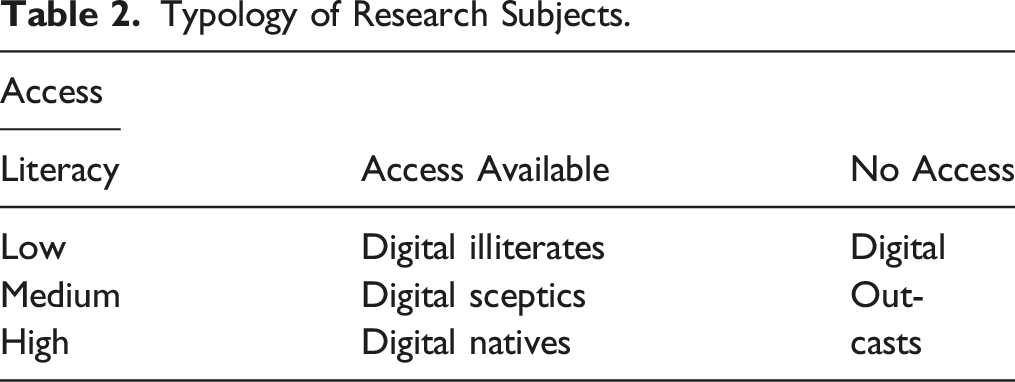
Typology of Research Subjects.
Characterization of the Types
In the following, we illustrate the different types in more detail. In particular, we describe which actors they comprise, and how they differ with regard to the three central challenges of conversation-based online data collection discussed above. Finally, we explain the particular challenges that the different types pose for empirical research and provide examples of how we have dealt with them in our own research. • Digital outcasts are individuals living without any or with only a very restricted digital access. They are typically located in places severely lacking infrastructure. This may be, for example, the case in very peripheral rural regions and some so-called ‘left behind places’ (MacKinnon et al., 2021) or in regions that have been affected by a natural extreme event, e.g., a hurricane, resulting in a major destruction of the relevant digital infrastructure (German & Keane, 2020). Furthermore, digital outcasts also include those individuals who voluntarily (e.g., ‘digital detox’, Syvertsen & Enli, 2020) or due to third-party influences (have to) renounce the Internet connection, such as young children, mentally impaired individuals, imprisoned persons, or persons in precarious economic situations (e.g., homeless people). Facing a lack of digital access in everyday life, these research subjects are unable to develop digital literacy. As these individuals are typically not part of online social networks and mailing lists, it is difficult to identify them through research on the Internet. If these individuals are assisted by third parties in gaining (temporary) access to the Internet to integrate them into the research process, uncertainties on their part are likely to impede the establishment of a basis for conversation for data collection. These uncertainties could, for example, hinder the formation of an unbiased relationship between the researcher and the research subjects. For the same reasons there will probably also be major doubts on their side as to whether the researchers will maintain ethical standards. Against the background of the last two aspects mentioned, only a comparatively reduced flow of information can be expected in such settings. Researchers have to keep these aspects in mind when focusing on these groups in their research. Consequently, projects that target this group must therefore look for alternatives in order to be able to come up with convincing results in the end. To include digital outcasts in their research designs, researchers basically have three options, namely: (1) returning to offline formats (e.g., face-to-face interviews), especially in cases of a complete lack of infrastructure – or, in the case of limited digital access (2) combining offline and online methods or (3) using digital intermediaries who provide research subjects with concrete support before and during data collection. • Digital illiterates have digital access but lack or only have a low degree of digital literacy. This means that some groups (i.e., a significant amount of elderly people, illiterates, mentally impaired persons or persons living in precarious economic circumstances), even if they consume digital content (e.g., Netflix) are unable to regularly actively engage in digital communication or digital transactions (e.g., online banking, e-commerce) and thus only develop a very basic, to some extent passive digital literacy. As with the case of digital outcasts, these actors are unlikely to be organized in professional online social networks, which is why it is difficult to identify them on the basis of Internet inquiries. Also, in terms of building a basis for conversation for data collection and the presumed handling of ethical standards, these actors will largely correspond to the first type, although in individual cases it can be assumed that there will be somewhat less of a problem. To include digital illiterates in the research process, researchers must ensure that the target group is either provided with competencies that enable them to participate in the research (e.g., by providing practicable guidelines that have been designed exactly for the concrete contexts) or (additionally) switch to analog formats. Some scholars have therefore proposed educating local digital experts in rural-peripheral regions so that they can act as multipliers in their community (Sept & Christmann, 2022). • Digital sceptics can access digital infrastructures and are digitally literate but have major concerns when it comes to sharing, communicating and sometimes disclosing confidential information through digitally mediated forms of communication. In general, they are cautious about digitization and apprehensive about data protection or maintaining the quality of interpersonal relationships, which for them manifests itself primarily or exclusively in irreplaceable face-to-face interactions. In principle, there is a medium probability of being able to identify these actors by undertaking a suitable Internet search, so that their inclusion in online data collection seems possible in principle, assuming that the potential research subjects in question are registered on homepages or common platforms with their real names. However, it can be assumed that some representatives of this type do not want to be found on the Internet due to their scepticism and even if they can be found, it must be assumed that they greatly mistrust the online setting for data collection. This not only makes it difficult to establish a setting which enables reliable data collection, but also goes along with considerable doubts on their part with regard to the researcher’s adherence to ethical standards. In case of research projects that could include digital sceptics, researchers need to anticipate reservations and should therefore try to apply a high level of transparency by taking time to explain the digital processes of data recording and storage in detail to build trust. In fact, it seems necessary to allocate additional time to get to know research subjects and to interact with them more frequently. When digital sceptics make up a major proportion of the study cohort, researchers can strengthen their involvement by including participatory elements in empirical research. In addition, communication with digital sceptics should be maintained after data collection to allow participants to follow the progress of the research project, which could also help prevent them from retroactively revoking their consent. • Digital natives are characterized by having digital access, and being both digitally literate and familiar with sharing, communicating and sometimes disclosing confidential information online on a more or less daily basis. They are primarily, but by no means exclusively, located in urban areas. Digital natives are open to digitization and maintain their private and business relationships through various digital channels. They feel safe and confident in the online environment that they are used to (Hanna, 2012), and as such the situations of online interviews or group discussions are not unfamiliar to them. It is more likely than in the case of digital sceptics that these actors can be identified very quickly through suitable searches on the Internet, as they generally perceive the online environment as normal due to their socialization, are less sceptical and see no reason to be cautious with their personal data. Furthermore, establishing a setting that enables reliable data collection in most cases will be quite easy as they are familiar with various online tools and will probably regularly take part in online meetings. For the same reasons, it can be expected that there will probably be no major concerns with regard to maintaining ethical standards on the side of the researchers. Including digital natives in online research therefore does not require any additional measures to be taken from the researcher’s side. The uncomplicated access to digital natives can be confirmed by our own research experiences.
Conclusion and Future Research Directions
‘“Come on, let’s zoom”’ seems to be an easy solution for replacing face-to-face interviews and group discussions. However, as our typology has shown, carrying out conversation-based qualitative data collection on the basis of online formats is accompanied by major challenges. In fact, in many cases, merely the identification of potential research subjects and their acqusisition will prove to be a major difficulty. Even if this can be achieved, establishing a basis for conversation with the research subjects to get this group to participate in the research process can turn out to be another challenge because, as in the case of digital sceptics, there may be significant privacy concerns or worries that data will be handled in an unethical manner. In this context, particular attention must be paid to the changed conditions for establishing a relationship between the researcher and the research subject. Only in the case of digital natives, which primarily include young, well-educated individuals from urban areas using digital technologies on a more or less daily basis, minimal to no challenges are likely to be expected when conducting conversation-based qualitative data collection online. Our analysis therefore makes one thing very clear: Since only in a minority of cases empirical researchers will be dealing exclusively with digital natives, they need to intensively reflect on the question about who their actual target group is, as early as possible in the research process. If there is an unreflective use of online tools, the exclusive use of digital methods will most likely result in more or less severe biases in data collection – something that should be avoided at all costs in the interest of the quality of the results. Otherwise, certain social problem fields could be overlooked in the resulting analysis and recommendations, which in the worst case could put socially disadvantaged people at an additional disadvantage. Not only because issues of social cohesion and justice are becoming more and more important, it may be necessary to include marginalized social groups in order to avoid such biases. For this purpose, it is necessary to reflect more on the methods used and, if necessary, to adapt them. In order to prevent systematic dropouts, researchers can, for example, already consider implementing measures of sensitization and trust-building in the run-up to the data collection – e.g., by developing a manual of the software using pictograms, simple language or by explaining the data recording in detail. Alternatively, or additionally, digital intermediaries could be involved at all stages of the process, both for the overall improvement of the literacy of the population as well as for assistance in concrete data collection in individual cases. Furthermore, they can deploy a combination of established offline procedures and online methods (Bürgin et al., 2022). However, whether or not this is feasible from an empirical perspective in a specific case depends on factors that may be beyond the researchers’ influence, as demonstrated by the pandemic. In the long term, it can be expected that digital literacy in the population will continue to increase, so that deploying online instruments to collect data will become increasingly promising in the future. In the short term, however, the challenges highlighted in this paper are likely to persist. To get a better picture of them, future studies should aim to further explore these four types. In particular, this could include more detailed descriptions of the types in terms of social milieus and spatial patterns so that requirements enable an equal inclusion in the data collection process based on our typology. An evaluation of the recommendations suggested could also contribute to this aim. Likewise, a comparison of different good practices in the combination of off- and online formats would presumably provide a substantial gain in knowledge.
Footnotes
Declaration of Conflicting Interests
The author(s) declared no potential conflicts of interest with respect to the research, authorship, and/or publication of this article.
Funding
The author(s) received no financial support for the research, authorship, and/or publication of this article.
