



Abstract
This transdisciplinary research project employed a multi-method approach to address health information inequities in Kentucky’s Fayette County during the COVID-19 pandemic. We drew from the study of Sociotechnical Infrastructures, Health Inequities, and Community-Based and Intergroup Dialogue (IGD) to co-create an Alternative Sociotechnical Infrastructure to facilitate information sharing among three stakeholder groups: (1) Latinx community members, (2) civil society organizations, and (3) government officials. Our research design included a combination of methodologies that addressed the technical and, more importantly, the underlying social causes of information access disparities. Focus groups helped identify Information Communication Technology (ICT) use, preferences, barriers, and information-sharing strategies. Community dialogues highlighted information barriers, existing resources, and proposed community-based solutions. The findings informed development of a web-based platform prototype that will facilitate information sharing during a crisis among all stakeholders. The methodology used also allowed the emergence of community champions among Latinx people who need to be invited to the table for these initiatives. We found that combining participatory action research (PAR) principles with critical dialogic methods fosters an environment of trust that enhances collaboration among stakeholders and consequently makes the design of information infrastructures more equitable and sustainable. As Information Communication Technologies embody social relations, we recommend emphasizing dialogic competencies and knowledge around racism/difference while valuing differences, collaboration, equality, and inclusions.
Keywords
Introduction
This paper presents our experiences and lessons learned from the first phase of a pilot study that sought to build a sociotechnical information infrastructure for the Latinx community. Through transdisciplinary study design, we combined Information Science and Technology, Public Health, and Social Justice Education approaches to build an Alternative Sociotechnical Infrastructure (ASI) for emergency information sharing among Latinx people, civil society organizations, and the local government in Fayette County, Kentucky. We took a sociotechnical approach, recognizing that people, organizations, institutional systems, software, and hardware operate in coordination. Building a sociotechnical infrastructure involves more than just implementing information technology. It means holistically understanding the relationship between social structures/institutions, human behavior, and information technology. Moreover, building this infrastructure benefits from employing participatory principles via various data elicitation methods. Alternative Sociotechnical Infrastructures (ASIs) are the interconnected networks of technical, human, cultural, and organizational resources that civil society/communities create when their local institutional environments do not provide mechanisms for them to engage fully in local political and economic life (Espinoza Vasquez, 2021). This pilot study is part of a larger project that engages Fayette County’s Latinx community, civil organizations, and the local government as collaborators in building an ASI consisting of a community organization and a web-based platform. Such an infrastructure is necessary because local structural inequities limit information dissemination, impeding Latinxs from receiving reliable life-saving information and essential resources.
We use “health inequity” to denote health differences from a justice framework. In other words, inequity recognizes that a specific group’s unfair access to resources is based on race, ethnicity, or any other dimension in the matrix of domination (Collins, 1990). Thus, differences in health are systemic and could be avoided by realistic means (Arcaya, et al., 2015). In the same way, we refer to insecure and undependable access to information as “information precarity.” Information precarity refers to the idea that policies and technologies cause and are caused by unequal information access. Thus, information precarity is a condition of life that affects the social, political, legal, economic status, and general well-being of groups (Stewart-Robertson, 2022), perpetuating health inequity.
This paper demonstrates the steps and methodological and practical learned lessons from the project’s first phase which consists of the conceptual framework and methods used to assess local information uses, practices, and barriers and the development of a web-based platform prototype.
Due to its geographic location, Kentucky can be considered a borderland between the South and the Midwest. Lexington is a mid-size city located in Fayette County with a population of 321,793 (US Census Bureau, 2022). From 2010 to 2020, Kentucky’s Latinx population has risen by 56.5%. Latinxs are now 9.2% of the county’s population, roughly 29,604 people. However, not all Latinx immigrants arrive under the same conditions. For example, Puerto Ricans have had U.S. citizenship since 1917 because of the archipelago’s colonial status, while Cubans have been able to get political asylum or refugee status in the past. On the other hand, many South and Central American immigrants continuously cross into the US under dangerous and, in many instances, deadly conditions. Those that successfully settle into their communities face risks and threats of deportation. Moreover, immigration statuses are mixed within family units; within a single family, there might be U.S.-born citizens, recent and earlier immigrants, some possessing documentation and some without
Internet usage among Latinx people in 2020 in the U.S. was 81.9% (Statista, n.d.). There are two local Latinx radio stations, one of which is one of few Spanish-only community-led radio stations in the country. Both radio stations dedicate airtime to social service programming like legal immigration talk shows. The only Spanish-language newspaper, an essential local information source, ceased operations recently, leaving an information gap in the community. Although many Latinx people are employed in local industries (equine, service, and warehouse fulfillment centers), there are Latinx-owned businesses such as grocery stores and restaurants, among others. Politically, the state has traditionally been Republican. However, recently Kentuckians elected a Democratic governor, which has raised partisan tensions with the state legislature and other political leaders. Meanwhile, the local city government has traditionally been moderately liberal, counting on a globalization office that aims to address all “foreign-born” residents' information needs.
A network of local civil society organizations plays an essential role in addressing the needs that government and health institutions do not address, including affordable legal counseling, free health clinics, civil legal counseling, advocacy, connecting to community resources, addressing poverty, education, housing stabilization, media, financial aid during hardship, language skills, civic awareness and participation, and culture and arts. It comprises local and national-level non-profits, churches, activists, and several Latinx-owned businesses. Local civil society is highly networked, sharing information and referring patrons to each other as needed. It relies heavily upon the local Latinx media to broadcast information. Latinx radio stations dedicate a portion of their programming to talk shows about topics related to the services provided by non-profits, with some non-profit members producing those shows. Aside from typical budget constraints and language barriers, civil society finds it challenging to reach out to a large portion of the Latinx community.
Latinxs face numerous structural barriers to accessing health care and were disproportionately impacted by the Covid-19 pandemic. Further, occupational exposure due to work deemed essential, as well as lack of health insurance, language barriers, and the threat/risk/fear of deportation also factor into the precariousness and vulnerability Latinx migrants face (Rodriguez-Diaz, Guilamo-Ramos, Mena, Hall, et al., 2020). These inequities negatively impacted civil society’s ability to coordinate COVID-19 response efforts. Consequently, Latinx people had significantly higher rates of COVID-19 spread and related morbidity (Chishti & Bolter, 2020).
Members of civil society indicated that while there was an increase in initiatives to address unequal information access, they were either not enforced or met with rejection by some actors. For example, city law requires local agencies to provide accessible language resources (City of Lexington, n.d.). However, the televised daily COVID press briefings and most official communications were in English only. Members of the local Latinx community volunteered to provide interpretation services for official announcements but were met with resistance by some government officials who stated, “We do not want Spanish on our Facebook page, we do not want a Spanish press conference, we worry people might get upset’” (Daniel).
In the same vein, Lexington also considered becoming a sanctuary city to protect undocumented people from deportation. However, in February 2020, the state Senate passed a measure to ban sanctuary cities, thus preventing counties from protecting undocumented immigrants from federal immigration persecution (Schreiner, 2020). Moreover, both documented and undocumented Latinx people in the state report unequal living and working conditions. This had worsened during the past decade with increasing mass deportation of undocumented Latinx migrants or detention in Immigration and Customs Enforcement facilities (Lopez, et al., 2018). Trump's administration continued the mass deportation of undocumented Latinx migrants of the Obama administration, with hundreds of thousands deported or detained in Immigration and Customs Enforcement facilities. Trump’s anti-immigrant and nationalist rhetoric “increased Latinos’ experiences of institutionalized legal violence via the expansion of the detention and deportation regime, state-sponsored abuse against children, and the stripping of civil rights, while fomenting racial violence directed at Latinos and other groups '' (Canizales & Vallejo, 2021, p. 155). This coincided with increased experiences of violence int he community; as confirmed by a 2019 FBI report that found that hate crimes against Latinxs in the U.S. increased by over 21 percent in 2018 (Canizales & Vallejo, 2021).
These types of inequities in Latinx communities are well-established in the information and health research (Mudd-Martin, 2019; Waters & Sullivan, 2009; Tappen, et al., 2022); however, underlying social and structural determinants are rarely addressed in efforts to reduce them (Eubanks, 2009). We understood the challenges and risks that the Fayette County Latinx population face, and these informed the study’s design. Our project uses participatory and design justice methods to bring together the Latinx community, civil society organizations, and the local government to test the feasibility of a community-based Alternative Sociotechnical Infrastructure (ASI) to address the aforementioned structural information precarities. This paper reports on the project’s first phase, which identifies community problems, unveils information-based practices, understands social dynamics, and builds a platform prototype by employing focus groups, community dialogues, UX design, and Design Justice principles.
Epistemological and Theoretical Foundations
This study is guided by the notion of Alternative Sociotechnical Infrastructures (ASI), which are social and technical systems that communities bring together when their local institutional environment does not provide mechanisms to engage in their local political and economic life (Espinoza Vasquez, 2021). ASIs are social and technical re-arrangement created as a response to the misalignment between the institutional environment and local communities (often marginalized). The creation of ASI happens through practices in which communities are aware of such misalignment, have deep situated knowledge of their communities, and use the expertise and resources they have at hand to build alternative systems that allow them to address structural inequities (Espinoza Vasquez, 2021). ASIs are not a new phenomenon; marginalized communities have created alternative economic models, alternative processes of self-government, and alternative networks of allies. For example, Puerto Rican activists created an ASI by building connections between technical, institutional, and social structures. In the immediate aftermath of Hurricane Maria, when critical infrastructures were obliterated, brought together an assortment of collaborators across the archipelago and the United States through a configuration of available technologies like skype, landlines, Facebook, and text messaging. In this way, they coordinate relief more effectively than the local and federal governments (Espinoza Vasquez, 2021; Santiago-Ortiz, 2020).
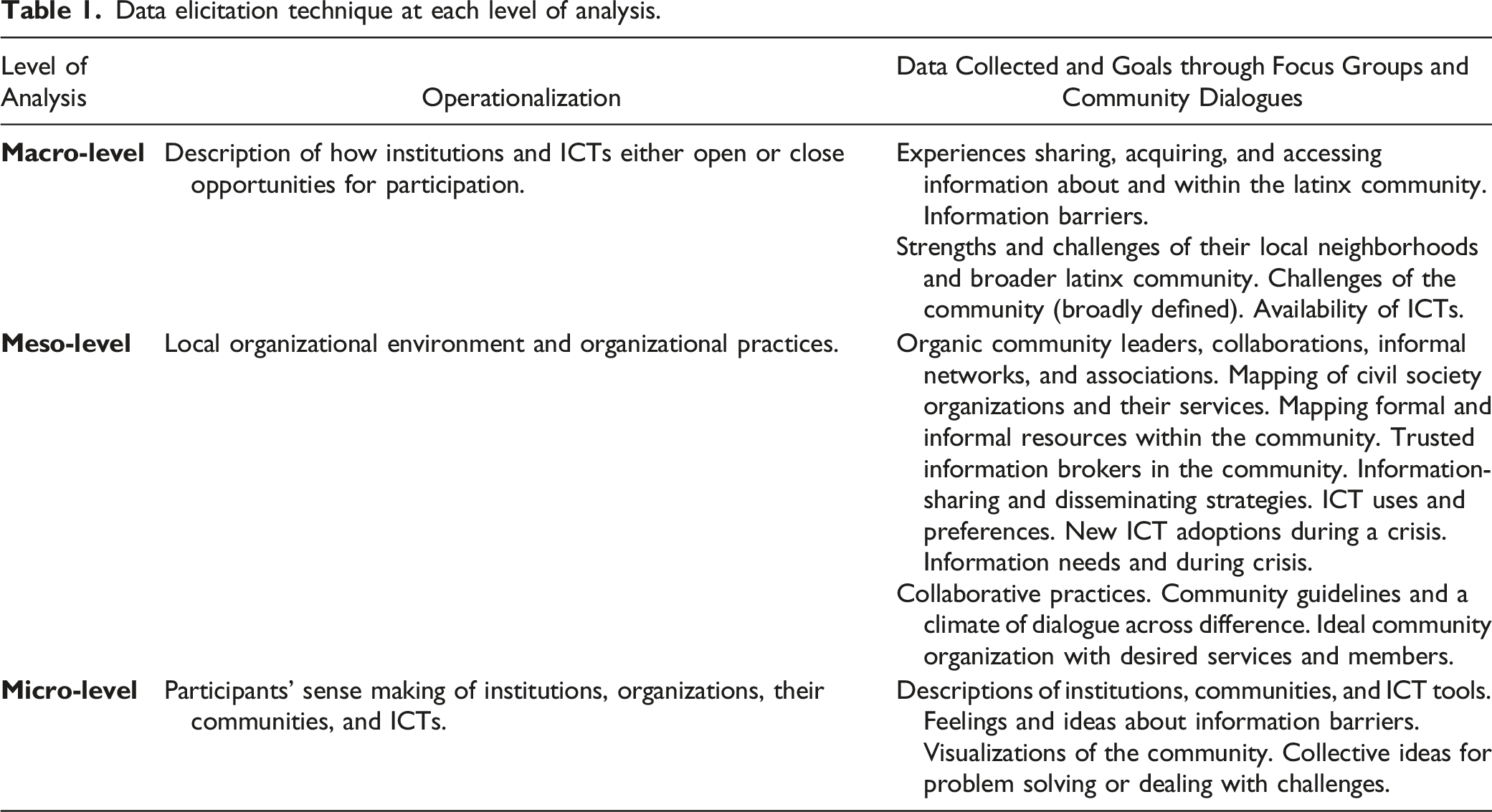
ASIs assume a reflexive relationship between people and Information Communication Technologies (ICTs), in which humans shape ICTs based on their values and meanings; meanwhile, the resulting ICTs' physical properties also shape human practices (Orlikowski, 1992). Thus, ICTs do not have an autonomous role nor determine social change; they are continually socially and physically shaped, reshaped and used differently by each social group. That is why we looked at three levels from the experiences of participants. At the macro level, we explored the socio-material and institutional conditions under which Latinx people operate. More specifically, we looked at how institutions and ICTs either open or close opportunities for participation. This type of evidence provided insight into the sociotechnical environment Latinx people inhabit, making it visible and describing how the institutional infrastructure shapes social life. At the meso level, we described local organizations and social organizing practices including their communities, the resources they mobilize (i.e., people, information, ideas), and how and where they mobilize them (i.e., tactics, techniques, ICTs). For this purpose, we collected evidence describing the characteristics of the organizations, culture, the dynamics embedded in an organizational structure, communication, information flow, information sharing, and group activities. At the micro level, we unveiled participants’ collective meanings about the macro and meso levels (See Table 1). Actors make sense of institutions, organizations, and ICTs; therefore, we explored how people conceptualize institutions, their collaborators, and their ICTs use. We required a holistic and participatory approach to grasp the three levels of social and technical relations among stakeholders to later build the infrastructure.
Philosophical Foundations of PAR
Participatory action research (PAR) is a research methodology and epistemological stance that combines aspects of popular education, community-based research, and action for social change. Emphasizing collaboration within marginalized or oppressed communities, PAR works to address the underlying causes of inequity while at the same time focusing on finding solutions to specific community concerns (Williams & Brydon-Miller, 2004, p. 245). PAR’s theoretical foundations draw from “education, sociology, political economy, community psychology, community development, feminist studies, critical psychology, organizational development” among other fields of study and disciplines (Hall, 1992, p. 16). The emergence of PAR can be traced back to social psychologist Kurt Lewin (1946). Lewin proposed an iterative, flexible spiral of “planning, acting, observing, and evaluating” in action research (McTaggart, 1991, p. 170). In a PAR setting, academic researchers, or external agents, collaborate with nonacademic community members to address a particular issue or concern relevant to that group. Although the practice of PAR does not dictate a rigid set of practices, there is international consensus among scholars that participation and collaboration are crucial elements. Australian PAR practitioner Robin McTaggart (1991) outlined a set of guiding principles for the practice of PAR which include: action and reflection that occurs as a spiral process; knowledge production by the external agents and nonacademic co-researchers; and methodological resources that “seek an understanding of the circumstances within which they are working” (p. 177). Due to its flexibility, PAR allows for a variety of methods in its practice. For example, interviews, participant observation, surveys, as well as arts-based methods can be employed in PAR.
Given its multi-disciplinarity, PAR’s objectives are also heterogeneous. While PAR has been employed in organizational development settings, the vein or approach to PAR we employed in this study is aligned with social justice-based approaches, which is to say that an analysis of power and social transformation informs the approach we employed. The work of Colombian sociologist Orlando Fals Borda is crucial in this aspect. Fals-Borda (1987, 1991) worked with grassroots activists, indigenous people, and rural workers during the 1970’s to find ways to improve their living conditions, particularly in the political and economic realm. PAR should serve a transformative purpose. Therefore, the results of the research should be accessible to broad audiences and can take on diverse forms, such as comic books, reports, and oral histories (Rappaport, 2020).
The research team chose to incorporate principles and practices of PAR in the community dialogues for several reasons. First, because if done intentionally, PAR advocates “for power to be deliberately shared between the researcher and the researched” through the active participation on the part of research subjects (Baum et al., 2006, p. 854). Second, PAR is commonly used in community health settings (Baum et al., 2006; Racher & Annis, 2008; Thobias & Kiwanuka, 2018). Third, infusing PAR techniques into the community dialogues allows for a “community driven approach” to addressing health disparities (Collins et al., 2018). Moreover, a participatory approach values participants’ input in the creation of an Alternative Sociotechnical Infrastructure that speaks to the realities of the Latinx community in the region.
Methods
Sociotechnical infrastructures have traditionally been built as hierarchical systems of power and control that benefit those who govern them, which leads to various forms of inequity (Benjamin, 2019), social exclusion (Eubanks, 2012), and information precarity (Espinoza Vasquez & Oltmann, 2023). Paradoxically, infrastructure interventions built to benefit marginalized people often exclude them from decision-making (Noble, 2018); thus, shifting power relations to benefit those who manage and control them in the first place, thus, perpetuating inequity (Peer, 2022). Moreover, it has been a challenge aligning the goals of an infrastructure project to the diversity of stakeholders and ultimately to move beyond the prototype to operational, maintainable, robust infrastructure (Ribes & Finholt, 2009).
The scholarship on sociotechnical infrastructures proposes addressing these challenges by a research methodology that questions distribution of power and addresses adequate representation or participation in infrastructural development, emphasizing the reflexive relationship between the infrastructure, people, and social life (Edwards et al., 2009). The scholarship calls for more inclusive and participatory approaches to involve marginalized groups in the building process (Baskerville, R., & Wood-Harper, A. T. 1998; Irani, et al., 2010) also to incorporate their local values and contextual factors (Peer, 2022) to incorporate more stakeholders and further the application of dialogical approaches (Edwards et al., 2009).
Our methodology addressees these concerns through a methodological toolkit that integrates principles of PAR, User Experience (UX) Design, Design Justice, and Intergroup Dialogue (IGD) to develop an Alternative Sociotechnical Infrastructure. The toolkit includes (1) focus groups, (2) community dialogues, and (3) UX Design with Design Justice principles (See Figure 1). Participants were initially selected using purposive sampling and later using snowball sampling. The initial sampling criteria were based on how well they could represent several groups in the city and how well they could inform the research problem (Merriam & Tisdell, 2017). We recruited a total of 34 participants, who were divided into two groups of “community allies” (11) and “community partners” (23) based on their roles. Participatory and dialogue-driven toolkit for developing an Alternative Sociotechnical Infrastructure.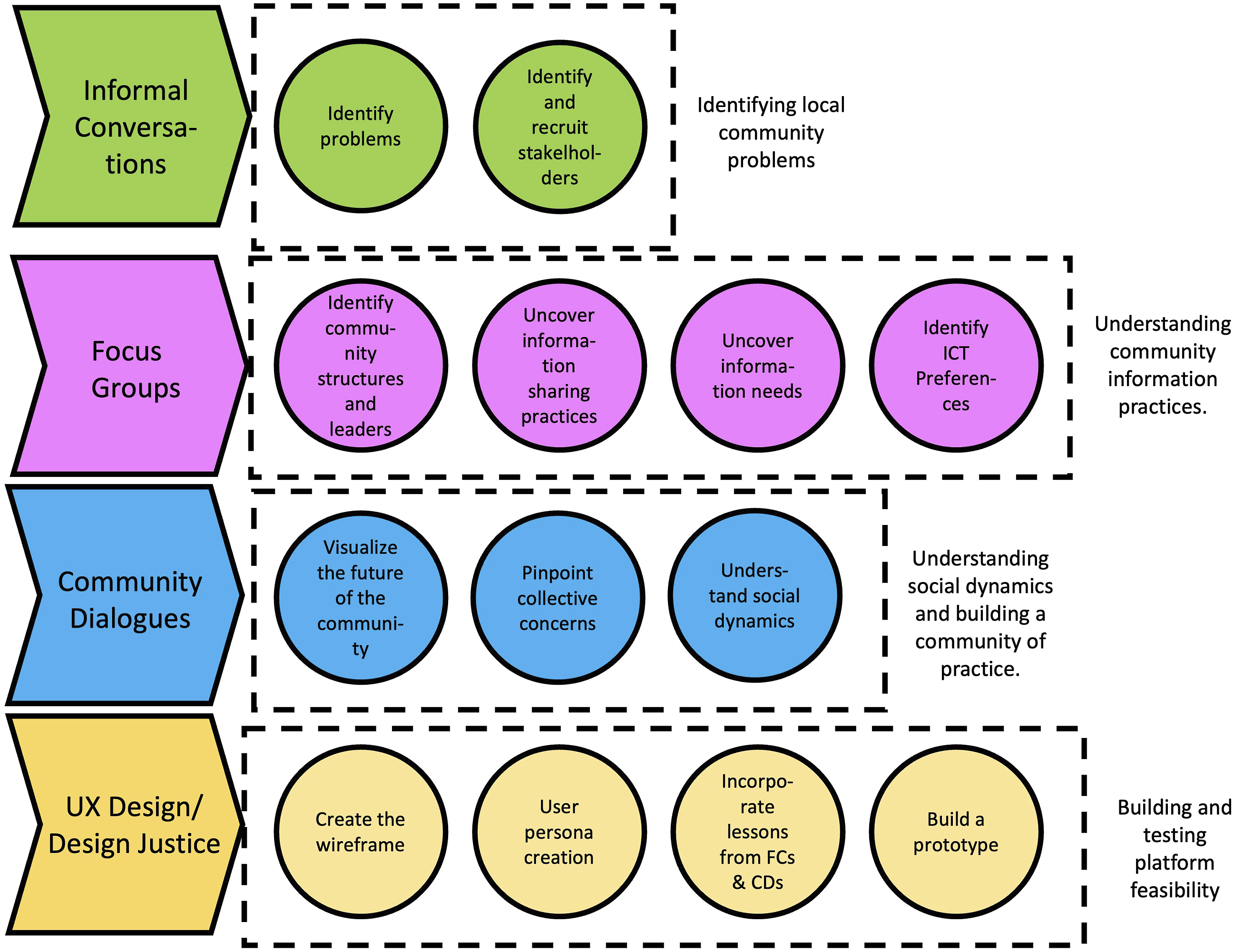
Online Focus Groups
In the previously mentioned meetings, Community Allies indicated the information needs and challenges that helped us model the focus groups. We conducted four (4) online focus groups with “Community Allies”. We divided them into four groups based on their Spanish language skills and availability. The focus groups followed a semi-structured format with open-ended questions. Bearing in mind that we are using a sociotechnical approach, we classified information challenges into two broad categories:
Community Characteristics and Practices
To understand the shape and structure of the local community and its information-sharing practices was essential. Allies serve people from various economic, political, social, and educational backgrounds; however, they need a clearer sense of the local Latinx community’s profile. Thus, we incorporated a discussion about the community’s diversity. Identifying local informal/natural community leaders and experts was crucial to enhancing their outreach efforts. Moreover, they also indicated the need to unveil the current extent of collaborations between community members, civil society, and government. Finally, it was crucial to understand the community’s information needs, trusted local information sources, information-sharing practices, and challenges. Thus, we set out to identify the organizations and people that community members go to for information, particularly during emergencies.
Technical Proficiencies and Practices
Ally participants identified challenges related to using ICTs for information sharing as they still wonder what ICTs community members use and how. Thus, we designed the focus groups as a technical, practical, and needs assessment of Lexington’s local civil society organizations and Latinx community members. First, we discussed the characteristics and social structures of the local Latinx community that included,for example, socioeconomic characteristics, community leaders, collaborations, trusted leaders, informal networks, and associations. Then we elicited information needs, information-sharing practices, and challenges such as trusted information brokers in the community, the official and unofficial sources of information they rely on, and the language barriers. Finally, we discussed ICT uses, preferences, and barriers. They shared their ICT preferences to reach the community, digital literacy, and ICT adoptions during a crisis.
Online focus group logistics
We used the secure University of Kentucky Zoom application to conduct and record the focus groups. We chose it as Zoom was widely available and increasingly popular during the first months of the pandemic. It also allowed joining the conference from any browser and a variety of devices and enabled us to see participants' expressions as we asked participants to use both the camera as well as the audio feature of the program. We started the focus group with an introduction to the project, its objectives, procedures, and a discussion of informed consent. We established a code of behavior and procedures that encouraged participants to listen actively and wait for their turn to speak. We also did a quick Zoom tutorial in which we explained how to use Zoom and features like how to raise their hand and turn on and off the camera and microphone. After these preliminary technical preparations, we conducted each focus group and recorded it. The information gathered in the focus groups informed the intervention materials and guided topic selection for the prototype platform and community dialogues.
Community Dialogues
Data elicitation technique at each level of analysis.
Summary of methods and participant types in each community dialogue.

The community dialogues portion of the study builds upon Santiago Ortiz’s work (2020), incorporating a critical methodology called intergroup dialogue (IGD). IGD is an educational and community building approach that brings together members of diverse social and cultural identities to engage in learning together [sic], sharing and listening to each other’s perspectives and stories and exploring inequities and community issues that affect them all (Nagda & Maxwell, 2011, p. 1). Theoretically and conceptually, IGD “draws on multiple and intersecting critical educational orientations and practice traditions, including intergroup education, and critical, anti-racist, feminist, democratic, and experiential pedagogies” (Zúñiga, et al., 2012, p. 2). IGD encourages meaning making across differences “by understanding one’s own and others’ perspectives on issues” (p. 5). Research has shown that in classroom settings, IGD helps students “build skills for developing and maintaining relationships across difference and enhance[s] their ability to work together toward social justice” (Zúñiga, Nagda, & Sevig, 2010, p. 7; Nagda et al., 2018). Communication processes are crucial in IGD pedagogy for relationship building among the participant group. IGD facilitation fosters communication through active listening, storytelling, and critical reflection to create a space for openness, participation, and engagement (p. 6). Research has shown that consciousness-raising, individual and collective capacity building for social justice and relationship building are some of the learning outcomes associated with IGD in university settings (Zúñiga et al., 2007). These outcomes are linked to alliance building, solidarity, and action taking for social change (Nagda & Maxwell, 2011).
While IGD has mainly been implemented in higher education, a growing body of scholarship points to its use in community settings. Thus, part of this study contributes to extant literature of the application of IGD principles in community settings. In her study examining the collaborative process in PAR, Santiago Ortiz (2021), found that the incorporation of IGD principles into a community-university partnership allowed for improved communication and conflict management among students and community co-researchers. In other community or nonacademic contexts, IGD has been used to address “conflict around a social issue” (Dessel & Rogge, 2008, p. 220). Outcomes of community dialogues include “stereotype reduction, increased understanding and empathy” as well as “increased perspective taking, [and] increased awareness about structural power relations” (Dessel & Rogge, 2008, p. 226).
IGD principles and techniques informed the design and processes of the community dialogues. Dialogue 1 (D1) for Groups 1 and 2 (G1 and G2), and the dialogue for Group 3 (G3) were designed so that the participants could get to know one another, create a climate for dialogue across differences, and continue in the familiarization process with the local community. This was done through various experiential and participatory activities such as icebreakers, pair share activities, and the collective creation of community agreements. We took an asset-based (Haines, 2014) and desire-based approach (Tuck, 2009) in the dialogues to identify the resources and strengths of the participants’ local communities and broader Latinx community of the region.
The building blocks of IGD, a central piece of this methodology, were employed to build a common language in the space. The blocks were developed by Ximena Zúñiga (2010), social justice educator and one of the founders of IGD. Drawing from the work of Paulo Freire (1970/1996), David Bohm, (2012), and bell hooks, (1994) among other dialogue scholars, Zúñiga outlined and defined the following building blocks: respect, deep listening, suspension of judgment, identifying assumptions, voicing, and reflection and inquiry. The building blocks were discussed among the participants and framed the community dialogues throughout.
Dialogue 1 for G1 and G2 followed an almost identical curricular design, with the major difference that both dialogues for the G1 were held virtually. G1 and G2 discussed what they like the most about the city they live in and what they enjoy doing, to break the ice and get to know one another. After creating the community guidelines and discussing the building blocks of dialogue, the participants broke off into pairs for an active listening exercise. The questions were geared around what the strengths and challenges of their local neighborhood and broader Latinx community in the city were.
The second dialogue for G1 and G2 replicated those processes of familiarization with the participants and their community life and environment. The groups participated in an icebreaker activity that highlighted the group’s individual cultures, revisited the community guidelines and building blocks of IGD. The second dialogue focused on identifying which information and communication technologies (ICTs) the participants use regarding health care and education. In smaller groups, they designed a flow chart that provided step-by-step guidance to a newcomer to the region that needed to enroll their child or children in school or when enrolling in a health care plan. This experiential activity helped us assess participants’ ICT literacy, identify resource or knowledge gaps regarding these topics as well as identify which participants want to continue participating in the following phase of the project. After the activity, the participants debriefed on what the process was like, and then transitioned into a small group dialogue that prompted the participants to look towards the future. Furthermore, the small dialogue also prompted participants to think collectively about problem solving or dealing with challenges in their local communities by identifying resources—human or otherwise—and the ICTs that help them deal with challenges they might face.
The final dialogue (D3, G3) brought together 8 participants from G1 and G2, as well as civil society members from the focus group. D3 followed a sequence like the other dialogues, beginning with an icebreaker, followed by community guidelines and a review of the building blocks of dialogue. D3 was informed by findings of the first two dialogues. Participants were placed in small groups to work on designing a community center. Using poster paper, each group presented the center they created. They outlined who would be involved in the organization, what services the organization would offer, what technologies the organization would use, and how they would promote the organization (See Figure 2). After the presentation, the larger group debriefed and shared the commonalities they saw across the groups as well as what role they would take in the organization. Finally, G3 discussed what would be needed to make their community organization a reality. The dialogue ended with the presentation of the website prototype and a brief discussion to receive feedback on the prototype. Community center outline and its translation.
Building a Prototype
We integrated User Experience (UX) design and Design Justice principles to build the pilot infrastructure platform. The combination of both approaches allowed for a participatory design that encourages the involvement of all stakeholders, with a particular emphasis on marginalized groups, usually excluded from the process of information infrastructure design. This exclusion perpetuates existing power imbalances in information systems and further marginalize these groups (Irani, et al., 2010). Thus, understanding the local contexts of communities is essential for developing more effective and equitable interventions that align with the local values of the communities they aim to serve (Peer, 2022).
In this way, UX Design acknowledges the complexity of constructing objects. It focuses on user-led design while providing an interactive experience to make the final product useful and easy to use. The Design Justice approach, meanwhile, aims to stop the reproduction of existing power structures and inequality in the design process through conscious consideration of race, class, gender, disability, and other intersecting causes of inequality (Costanza-Chock, 2020). Design justice guides our attention toward the matrix of domination (Collins, 1990) and how it shapes affordance, perceptibility, and availability while encouraging the creation of information access opportunities.
This way, we first focused on understanding how Latinx people experience social structures and institutions that were not designed for them to unveil how they affected the availability and access to information during a crisis like the COVID-19 pandemic. Then, we enabled participants to guide the study’s direction by incorporating the focus group and community dialogue insights into the platform prototype design. The following sections outline our steps to incorporate UX Design and Design Justice into the platform prototype.
Research
This step involves deeply understanding the platform’s user types (Canziba, 2018), including information needs, available resources, and ICT use and literacy. Through the focus groups and Community Dialogues, we learned that our Community Partners have small networks to share information with close friends and relatives. They rely on their cell phones and applications like WhatsApp and Facebook. They need to expand and interconnect these networks and the topics to: 1. Health-related information on topics like COVID-19 2. Schooling and education 3. Immigration 4. Housing regulation 5. Legal services 6. Civil rights 7. Professional development 8. Contact information for all organizations that work with Latinx people in the city 9. Access to COVID-19 data in Lexington and Latin America 10. Information about cultural and political events in town 11. Information in Spanish
Our Community Allies had been working to address Community Partners’ information needs since before the pandemic, making resource inventories for grants, donations, and financial aid resources. However, they needed a mechanism to compile and distribute them to the broader Latinx community. Thus, during this phase, we learned the platform needed to provide: 1. A centralized virtual forum for discussions and networking; 2. A map of the geographic distribution of the community, civil society organizations, government, and resources; 3. A centralized virtual repository for information about readily available resources for Latinx community; 4. Compatibility with mobile devices; 5. Connectivity to WhatsApp and social media.
User-Persona Creation
This step consisted of recognizing and understanding there are diverse types of users. We carefully considered how stakeholders would interact with the platform and defined the type of users that will engage with it to be accessible to the diversity of users’ needs and roles. Regardless of their role in this study (i.e., Allies or Partners), we identified several types of users: 1. Platform administrators. These are lay and professional formal and informal leaders with higher ICT proficiency who would be willing to take on administrative responsibilities. They are Technology Champions, 2. Regular engagers. Community Champions and Information brokers are those who would engage in the platform to interact with and upload information. 3. Information consumers. These people would go to the platform for reference but would not necessarily interact with its features or with other users.
Making a Wireframe
Wireframes visually represent the platform interface before design and implementation. They illustrate the platform structure for its content, making the design process easier for the programmers (Schmidt & Etches, 2012). Relying on the information gathered in previous steps and during several virtual collaborative sessions, we created the platform’s wireframe, ensuring that: • It addressed Latinx people’s most prominent needs; • It incorporated a design in harmony with participants' ICT use profiles; • It considered the local context, so as to be accessible to the type of devices used by Latinx people, including browsing apps from smartphones and iPads.
We employed two programmers to create the interface design and the site structure. The front page describes the platform to new users; it also has the latest news and a calendar of events. It prominently displays access to the community’s WhatsApp group and emergency contact information. The top hierarchy included a menu of four main sections: 1. Forum: A discussion feature to facilitate multiple inter-stakeholder dialogues. 2. Resources: Information readily available and categorized using the participants’ classification system. 3. Organizations: A visual map of civil society and government organizations, including a description, a link to their website, and contact information (See Figure 3). 4. COVID-19 live data. A live feed of Local and Latin American Covid Data. Collaborative wireframe creation during a virtual meeting.

We converted the wireframe into an accessible online ASI platform prototype in the next step.
Creating a Prototype
We adopted Petate.org as a domain name. A petate is a mat made of palm fabric used in Central America and Mexico to sleep, dry seeds, and make toys and baskets. Petate symbolizes the fabric of the local Latinx community (See Figure 4). The prototype will be available for testing in our project’s next phase when participants will interact with it and provide feedback. We will then train them and identify champions who take ownership and administration roles. Based on their experiences and feedback, we will improve it and devise a sustainability plan. We will build capacity through training on ICT literacy, racial awareness, cybersecurity issues, etc. Petate’s visual classification of local civil society organizations by services provided.
Building Trust and Managing Power Dynamics
One of the project co-investigators works with CHWs which provided the infrastructure that facilitated the recruitment of the community dialogue participants. The CHWs have an existing relationship with the Latinx community in the area which facilitated the recruitment of community participants and enabled the trust building process between researchers and community partners. The authors were born and raised in Honduras and Puerto Rico respectively, and our experiences as im/migrants was another factor that facilitated the development of trust and participation among the researchers and participants. However, being part of the community that one studies does not automatically make the researcher any “less complicit in what is researched or written through fieldwork” (Subedi & Rhee, 2008, p. 1087). Subedi and Rhee suggest listening and engaging in meaningful dialogue with research participants, as well as engaging in self-reflexivity, as ways to foster collaborative spaces. These ethical actions are all part of being answerable to the communities we work with (Patel, 2016).
Power dynamics will always be a critical dilemma within PAR (Nygreen, 2009). Although PAR aims to equalize, or lessen power among participants as much as possible, “in practice PAR projects may quite easily “reproduce and exacerbate” these dynamics (p. 19). To address power in the community dialogues, the two of us were cognizant of our privilege as educated Latinas but also as im/migrants to the U.S. Thus, recognizing and being transparent about the privileges we held as facilitators during the community dialogues was crucial. We did this, for example, by participating in the ice breaking exercises that were designed to foster a sense of comfort and trust within the group, and sharing our own experiences as im/migrants to the U.S. In the case of author 2, it also meant being open about having citizenship privilege, even though this privilege was part of a colonial imposition.
Although power dynamics are inherent to any community-university partnership, we leveraged our “cultural intuition, personal experience, and academic training to enter the communities with respect” (Manzo et al., 2020 p. 14). Latinx community-based researchers Rivera-López, Flores, Brazil-Cruz, and Manzo (2020) developed a collaborative model that centers communities throughout and beyond the study. They point to the importance of establishing sustainable partnerships that support communities beyond the study. In our case, the PAR + IGD model implemented in the community dialogues illuminated the concerns and desires of the participants, which led the authors to expand the study to a next phase.
Fostering Participation and Engagement
We created a safe and inclusive environment through exercises that built a sense of safety and technological confidence by engaging participants in creating community agreements that would allow safe, respectful, and inclusive collaboration (Marquart & Verdooner, 2020). We also built technological scaffolding (Cogburn et al., 2011) by providing an overview of the videoconferencing technology (Zoom) and providing technical support; this helped build trust in a virtual environment (Jarvenpaa, 1999). These measures made participants comfortable sharing their ideas and expressing their opinions.
We also employed multimodal facilitation techniques to enable wider accessibility and participation, like open-ended questions, follow-up questions, prompts, and elaboration. By incorporating a variety of visual aids, we encouraged participants to provide input in multiple ways. For example, during virtual sessions we used Zoom’s drawing and texting features; in face-to-face sessions we used the whiteboard, flip charts, flashcards, and sticky notes. Likewise, we implemented a variety of discussion modalities that gave participants various options to engage. (Lazar et al., 2017) These included ice-breaking exercises, brainstorming sessions, role-playing, designing data flow diagrams, small group discussions, and individual activities.
Finally, we provided incentives for participation and engagement through just compensation and feedback. We provided all participants with a gift card each time they attended a focus group or dialogue in recognition of their time and expertise contributed. We also requested their written anonymous feedback after each dialogue. All these measures promoted reiterative participation, clarified expectations, improved collaboration, highlighted progress, and ultimately helped us improve our research design.
Discussion
Sociotechnical infrastructures are hierarchical systems that benefit those who administer them, leading to various forms of inequity, social exclusion, and information precarity. Paradoxically, infrastructure interventions built to support marginalized people often exclude them from the building process, perpetuating inequity and shifting power relations to benefit those who manage and control them, further perpetuating information precarity and health inequities. The sociotechnical infrastructure scholarship acknowledges that those challenges must be addressed theoretically and methodologically using holistic transdisciplinary approaches. Thus, we present a participatory intervention toolbox (See Figure 1) to build a culturally relevant sociotechnical infrastructure called Alternative Sociotechnical Infrastructure (ASI) which will provide a new organizational and virtual information-sharing space to address information precarity and, consequently, health information inequity experienced by the Latinx community in Lexington, Kentucky. The toolbox contribution has methodological and practical contributions, which we discuss next.
Methodological Contributions
Our toolkit addresses the well-documented need for inclusive methodological approaches to building information infrastructures that include and empower marginalized groups and consider their local values to achieve a sustainable infrastructure (Baskerville, R., & Wood-Harper, A. T. 1998; Irani, et al., 2010) We show that combining UX Design principles, Design Justice, and PAR principles into the design of the infrastructure has the potential to empower emerging community champions. Moreover, we show that incorporating an asset-based approach makes it possible to develop a community-sustained infrastructure that can better address the community’s concerns.
The scholarship also calls for approaches that question the distribution of power and address adequate representation or participation in infrastructural development (Edwards, 2009); while warning that aligning the goals of an infrastructure project to the diversity of stakeholders is challenging (Ribes & Finholt, 2009). We show this is feasible by incorporating dialogic approaches as it centers the community’s knowledge, concerns, and desires while fostering multi-stakeholder engagement.
This study adds to the growing body of research emphasizing the reflexive relationship between infrastructure, people, and social life (Edwards, 2009). Though we initially planned to address health information inequity, the holistic quality of the ASI framework allowed us to uncover the interconnectedness of health inequities to other areas, including education, jobs, art, culture, and digital literacy.
Moreover, this study provides important insights into the literature that recommends incorporating participatory methodologies involving marginalized groups in designing sociotechnical infrastructures (Irani et al., 2010; Peer, 2022). We drew on previous research that explored the integration of IGD principles into PAR. We found this integration beneficial in fostering collaboration and building solidarity in support of social change. IGD and PAR principles prioritize relationship-building and promote engagement with reflection and action, or praxis, throughout the collaborative process. As Santiago-Ortiz (2020) highlighted, these methodologies prioritize participatory processes that give precedence to community knowledge, concerns, and desires. This study contributes to a growing body of research that advocates for integrating these methodologies or their variants in different contexts, as demonstrated by previous studies (Aldana et al., 2016; Chataway, 1997; Genat, 2009).
Practical Lessons and Implications
This study has elucidated lessons with practical implications for the second phase of our project and for researchers, activists, government officials, and civil society organizations who want to engage their communities in building community-based sociotechnical infrastructures through a bottom-up participatory approach.
Incorporating more Dialogue into PAR
Our innovative interdisciplinary collaboration within Information Science and Technology and Social Justice Education addresses health information inequity’s social and technical determinants while enhancing community self-reliance. Participants welcomed this methodology as they wanted to continue connecting with each other. Therefore, we recommend incorporating critical dialogic methods to bring together people from different social identity groups within the Latinx community to explore social justice issues and develop mutual understanding and alliances across differences.
Empowering emerging community champions
This combination of participatory research and intergroup dialogue techniques motivated participants in several ways. As the dialogues progressed, we witnessed a change in participants where new charismatic community leaders surfaced, demonstrating enthusiasm and desire to continue the project in a new phase. This next phase will consist of the development of a Community Promoter model in which self-selected participants will be trained as a team of community champions and technology intermediaries, resulting in a community-sustained sociotechnical infrastructure. During this phase there will be another round of in-person and virtual community dialogues, followed by health, housing, technology, education, and labor workshops. The Community Promoters will then be able to share the knowledge they acquire with their local neighborhoods and spheres of influence.
Ethical Considerations when Working with Latinx Populations in Kentucky
Given the challenges Latinx migrants face, particularly undocumented ones, there are ethical considerations related to participants’ migratory status we could not ignore. First, we did not ask about documentation status because it was not a relevant factor for the study, would have deterred recruitment and was a measure to protect participants. However, the matter arose organically during the community dialogues. Participants felt comfortable disclosing their status, which we argue was due to several confluent factors. First, the CHWs were familiar with most participants, facilitating a quicker trust-building process. Second, the location of the in-person dialogues was in Latinx serving, Spanish speaking religious institutions. Third, two of us who facilitated the community dialogues are Latina, from Honduras and Puerto Rico, respectively. The dialogues were held in Spanish, which made the participants more comfortable with one another, and with us. However, one notable unexpected element was that we had to recalibrate some of the dialogue questions to account for some of the participants’ undocumented status, something not previously considered given that one of us was Puerto Rican, and by consequence, a US citizen, and the other one had a work visa.
Second, during the focus groups, some civil society participants mentioned they had been harassed for working with undocumented Latinx people. Given that Petate.org serves Latinx populations in Lexington and its content is in Spanish, there is potential for the site to be vulnerable to cyber-attacks. We implemented mitigation measures to address potential risks. For example, the platform is in a secure web host using secure file transfer protocols and backup services. Moreover, during user-personae creation, we enabled several levels of site access. “Administrators” have more privileges to modify the site, and “information consumers” have the least. Moreover, at its current stage, Petate is not yet available to the broad public; access is password-protected and available only to “administrators.” During this exploratory and diagnostic phase, participants did not engage directly with the prototype; however, in the next phase, they will define user privileges and engagement protocols.
Moreover, the platform will have the potential to make hidden knowledge public. Thus, the decision to produce information (that does not put participants at risk) depends on the trust associated with the partnership we can achieve with all stakeholders (Gone, 2017). That is, the decision to do so will emerge from a dialogue in which knowledge will be “thoroughly considered and critically vetted-provide the most stable and enduring platforms for action, engagement, resistance” (Gone, 2017, p. 8) As we continue to engage with community participants, we will collectively discuss ways to mitigate and address potential privacy and security threats under professional web developers’ counseling.
Addressing Researchers’ and Participants’ Assumptions
Through our interaction with a diverse group of Latinx participants from diverse backgrounds and identities, we observed that participants held normative and stereotypical assumptions and biases regarding other marginalized groups. Our sociotechnical approach assumes that information technologies embody social relations (including race and power); thus, it is crucial to prevent the reproduction of ideas about race and differences in the resulting community organization and its virtual platform. Treating “social” and “technical” aspects as interdependent parts of a complex system allows for engaging participants' cultures, goals, and values in the design process. Thus, we will continue developing dialogic competencies and knowledge around racism/difference within Latinx communities valuing differences, collaboration, mutual respect, equality, and inclusion. We will expand the dialogues to combine technological aspects with social justice-based approaches.
Virtual vs. in-person
The online focus groups and community dialogues were successful in that participants contributed actively. Online engagement requires extensive pre-work and logistic preparation on our side and on the participant to enable engagement. Regardless of our efforts, we still experienced participants' distractions when joining from home and the inability to engage fully due to multitasking. Also, this medium makes it easy for timid participants to disappear into the background. Thus, it is essential to continually build community through exercise and frequently remind participants about the expectation of focusing on the meeting instead of multitasking. In the next phase, we will support ICT literacy through workshops to strengthen existing ICT competencies and address gaps. These workshops will be the foundational training for participants to become community technology mediators.
Building an Inclusive and Sustainable Infrastructure
Given the elevated level of technical expertise required to build a virtual ASI platform, fostering ownership, and incorporating sustainability into it can be challenging. Moreover, traditionally implemented top-down information systems are known to reinforce inequity rather than address it. Therefore, it will be crucial not to replicate the traditional technology intervention projects. It is crucial to acknowledge that each Latinx community has characteristics, requirements, and opportunities that necessitate intervention strategies different from the widely accepted models of individual/commercial ICTs access and use. Thus, the system will require full engagement from partners/participants, which we plan to achieve by building technical and social capacities.
Participatory Research and University Bureaucracy
This project results from an excellent university grant to foster interdisciplinary research collaborations and racial equity. While this initiative is timely and well-intentioned, as researchers, we experienced a misalignment between the university initiative and its institutional infrastructure. Current institutional mechanisms make it difficult to conduct participatory research. For example, as supported by the Institutional Review Board (IRB), it was critical to protect our participants' identities but the budget system through which we needed to process their monetary incentives required providing identifiable information like name, address, and even social security number. We think that to foster participatory and social justice-based research, these procedures at the university level need to be reconsidered.
Next Steps
Our next steps will build on these learned lessons and focus on four goals. (1) Build capacity and sustainability among the human infrastructure through digital literacy and education about local information needs on education, healthcare, housing, laws, and work. (2) Build teams of Community Promoters and Technology Intermediaries that can, in turn, train other Community Promoters and Intermediaries, resulting in a community-sustained sociotechnical infrastructure. (3) Create a community infrastructure with various stakeholders, including Latinx community members, Civil Society partners, and Local Government. (4) Co-design and improve the virtual ASI platform. We will do it through four techniques: community dialogues, workshops, surveys, community asset maps, and user experience design. They will allow us to continue to engage participants in intergroup dialogue methodology (IGD) techniques and principles to identify the gaps in sociotechnical and educational information and train participants who will become community champions/promoters and technology mediators. Moreover, participants will co-imagine and co-create the community’s infrastructure and provide technical support. Finally, partners, who had previously engaged in Phase I will participate in testing and further developing the web-based infrastructure. We expect Community Promoters to share their knowledge and resources with other Latinx people in the area and the infrastructure available to the broader local Latinx population.
Conclusions
This study uses inclusive and participatory approaches that consider the values and empower marginalized groups to foster effective dissemination of health-related information. We brought together the Latinx community, civil organizations, and the local government to test the feasibility of a community-based Alternative Sociotechnical Infrastructure (ASI), ASIs are interconnected networks of technical, human, cultural, and organizational resources that underserved communities create to address institutional inequities. We engaged with Lexington’s Latinx community, civil organizations, and the local government as collaborators to assess Latinx community’s information uses, practices, and barriers, co-create an ASI prototype, and determine its feasibility. We combined several participatory methodologies incorporating epistemological principles from the study of Sociotechnical Infrastructures, Health Inequities, and Community-Based and Intergroup Dialogue (IGD). Focus groups and community dialogues allowed us to understand existent information needs, available resources, and co-imagine ways to address them. User-based design combined with design justice principles allowed us to design a digital platform prototype to support the community infrastructure.
We learned several lessons. First, Latinx people face structural barriers to information as they are actively overlooked by government institutions. The Latinx community needs to feel invited at the table to further build the infrastructure and claim ownership to it. We propose that incorporating UX design, Design Justice, and PAR principles into infrastructure design can empower emerging community champions and develop community-sustained infrastructure. We highlight the importance of participatory methodologies involving marginalized groups in designing sociotechnical infrastructures and suggest that integrating IGD and PAR principles can foster collaboration, solidarity, and environment of trust and communication in the design of social and information systems. The study also highlights the interconnectedness of health inequities with other areas such as education, jobs, art, culture, and digital literacy.
We witnessed a change of attitude in participants where new charismatic community leaders surfaced. They have the potential of becoming Community Champions and Technology Intermediaries who will sustain the infrastructure. This in turn will be the foundation of a self-managing infrastructure that will reflect their situated knowledge and agency that will connect with government institutions and partners while maintaining their autonomy.
The project assumes that ICTs embody social relations, thus it is crucial to prevent the reproduction of stereotypical ideas about race and differences in order to build an ASI that is inclusive and sustainable. We recommend emphasizing in dialogic competencies and knowledge around racism/difference within Latinx communities valuing differences, collaboration, mutual respect, equality, and inclusion. The same way building ICT capacity will address the challenges of virtual collaboration and create a community of technology mediators.
Finally, we found institutional dichotomy to carry out this project as it was supported by institutional initiatives to promote transdisciplinary collaboration and community-based research. However, the imposed bureaucratic rules and regulations constrained participatory work, making it more challenging and time-consuming.
Footnotes
Acknowledgments
We would like to thank our research assistants, Naomi Rojas, Sarah Khan, Sophia R. Abraham, and Adrian D. Godboldt. We would also like to thank Alberto Carrillo, Dot Bennet, and Jim Bennet for providing space for the community dialogues. This work would also not have been possible without community promoters Guipsy Lopez-Ramirez and Herlinda Martinez’s invaluable contributions.
Declaration of Conflicting Interests
The author(s) declared no potential conflicts of interest with respect to the research, authorship, and/or publication of this article.
Funding
The author(s) disclosed receipt of the following financial support for the research, authorship, and/or publication of this article: This research was supported by the Igniting Research Collaborations program funded by the University of Kentucky Vice President for Research, the College Deans and UNITE Research Priority Area. Additional support was provided by the National Center for Advancing Translational Sciences, National Institutes of Health, through Grant UL1TR001998. The content is solely the responsibility of the authors and does not necessarily represent the oficial views of the NIH.
