




Abstract
Participatory research offers a valuable opportunity for collaboration between universities and citizens. It allows people with diverse educational and professional trajectories outside of academia to become partners in the research process, leading to multiple positive outcomes such as enhanced capacity building, contextually sensitive research design, and effective dissemination of findings. The chain of activities in the standard version of participatory research, however, stops short of developing solutions for improved quality of life, without making clear how enhanced capacities or locally embedded research findings will translate into tangible change for the communities where the research takes place. This shortcoming, we claim, is linked to the relatively short-term nature of most participatory research, as well as the scarcity of institutional structures and funding schemes to support the development of community-led solutions in the long run. The present article demonstrates that another model of research is both possible and desirable. It does this by presenting the outcomes of a sustained, long-term collaboration between university researchers and citizen social scientists in Beirut, Lebanon. The sustained nature of this work – running for over 3 years at the time of writing – has enabled our team to roll out a substantial programme of qualitative and quantitative data collection on prosperity and quality of life, and to subsequently use the findings and experience gained to create a set of interventions that address pressing challenges. We specifically argue that sustained, open-ended work on multiple activities – from research design and data collection, to data analysis, design of interventions and more – leads to accumulation of skills and experiences within the team, which can then be channelled towards implementing high quality interventions. This new model of impact for social science research prioritises partnership between universities and citizens, while highlighting the potential of such partnership to lead to solutions that make a real difference.
Keywords
This article argues for sustained, long-term citizen social science as a new model of impact for university research and training in the social sciences. It draws on the authors’ 3-year experience of working together as a team of university researchers and citizen scientists to deliver a programme of research and interventions in the Hamra neighbourhood of Beirut, Lebanon. The longevity of this collaboration has allowed us to work together on multiple activities, including project design, data collection and analysis, publication of outputs, presentation of findings in local and international fora, and, most innovatively, development of interventions that deliver concrete solutions. These activities, in turn, exemplify a new model of impact for academic training and research – a model that focuses not just on generating knowledge and building capacities, but also on the creation of solutions within communities. This model is fundamentally different from traditional teaching and research in parochial university settings, but it also departs from most community-based participatory approaches insofar as it facilitates the design and implementation of citizen-led interventions for improved quality of life.
Within the framework of sustained citizen science, we argue that learning from fieldwork experiences creates new understandings of existing social challenges and new commitments to making change happen. Our programme of research includes quantitative and qualitative elements, both of which are indispensable for creating pathways to impact for the communities we work with in the context of Lebanon’s current hardships. A key methodological lesson that we have learned is that the practice of quantitative data collection produces forms of engagement, experience and knowledge for the people carrying out the data collection, but none of this is reflected in the quantitative data outcomes produced by the exercise (Jallad & Mintchev, 2019; Shourbaji, 2020). In other words, the practice of quantitative data collection generates significant benefits in the form of learning and capacity building that are neither captured by the data, nor adequately channelled towards creating solutions or supporting social change in the sites of research. We do agree that the standard practice of hiring enumerators for a specific and limited task of conducting surveys does indeed lead to practical experience and learning for those carrying out the fieldwork. The problem with this model, however, is that the enumerators’ lack of involvement in any other project activities outside of data collection, together with their limited commitment to the site of inquiry, curtails the potential for building future projects on the basis of fieldwork experience. They are brought into a site of inquiry for the sole purpose of data collection and just as swiftly removed from it.
Sustained citizen science, as we argue in this article, operates in a radically different manner: it enhances the value of experience produced during fieldwork; it allows for the retention and cumulative building of knowledge within the research team; and it encourages the application and expansion of this experience into other impact activities that benefit the wider community. The present article illustrates this process through a number of examples of citizen scientist-led interventions in Hamra, Beirut – interventions that were shaped by experiences and impressions during fieldwork and data analysis, and were subsequently developed into evidence-based impact activities through an open-ended and flexible process in which citizen scientists chose the focus of their work. The result was a set of three diverse projects respectively aiming to (1) support the education of children (especially out-of-school children and children in the public school system in need of additional support), (2) produce new green spaces and food support through urban agriculture, and (3) improve the visibility of local small businesses.
The crucial point, we argue, is that if citizen social science is organised as a long-term process with multiple activities, then individual capacity building becomes a means for generating further value and impact within the community where the research takes place and beyond. Expanding this new model of impact within the university is both desirable and possible, and it presents us with a significant opportunity to rethink the value of research methods, the landscape of funding for social research, and the measures by which we judge the quality and impact of academic work.
Impact, Collaboration and Capacity Building
The question of impact is one that every social scientist encounters at one point or another in their work. Understanding how research makes a difference and developing models through which it can make a difference have become such important topics that they themselves are now subjects of research (e.g. Bastow et al., 2015; Reale et al., 2018; Stein, 2018; Soler-Gallart & Flecha, 2022). For many academics, the term ‘impact’ does not necessarily evoke positive associations. In fact, the notion of impact and the practices that universities have developed around it, is frequently associated with management-driven requests for academics to justify their research agendas and accomplishments, often in a format that fails to do justice to the full value of their work (Stein, 2018). This is usually done for the purposes of bidding for funding, reporting on the progress of funded projects, and having one’s performance as a researcher assessed by audits such as the United Kingdom’s Research Excellence Framework.
At the same time, however, the wider question of how social research affects, and ought to affect, people’s lives has a long history of debate that is linked to deliberations about power and ethics in academic practice, quite independently of university management structures and funder requirements. In qualitative research, especially where fieldwork is involved, a big part of the debate has been about the relationship between the researcher and the communities who are researched, with a focus on the power dynamics between the two and the politics of who benefits from the research and how (e.g. Abu-Lughod, 2006[1991]; Sultana, 2007; Wolf, 1996). Critiques of asymmetrical power relations in the ability to control resources, define research agendas, and produce narratives or representations of oneself and others have transformed the landscape of social research, as have calls for stronger engagement with publicly relevant issues and service to the public interest (Beck, 2009; Burawoy, 2005). The solutions that have emerged in response to such critiques since the 1980s are many, and they have been written about under various names, including ‘participatory action research’, ‘community-based participatory research’, ‘public anthropology/sociology’, ‘collaborative ethnography’, ‘critical ethnography’, ‘citizen ethnography’, and ‘citizen science’/‘citizen social science’, to name just a few (e.g. Albert et al., 2021; Badami & Goodman, 2021; Beck, 2009; Burawoy, 2005; Foley & Valenzuela, 2005; Hemment, 2007; Lassiter, 2005; Salma & Giri, 2021; Wallerstein, 2020).
Within this expanded ecology of transformative research practices, we follow Louise Lamphere (2004) in arguing that the types of action that researchers can take towards a more ethically robust practice fall into three broad categories:
1) increased collaboration and partnership with the communities and members of populations we study; 2) expanded outreach to the public so that the results of our research become broadly disseminated; 3) concrete efforts to influence policy in areas where we have expertise and where our research points to important changes that need to be made (Lamphere, 2004, p. 432).
Each of these three points represents a relatively open category that can be made operational in multiple ways. Collaboration and partnership, for example, can refer to a number of different practices, ranging from participation in activist organizations, to consultation with community leaders, or recruitment and training of members of the communities as researchers on the project. These are vastly different forms of collaboration, and a similar diversity of possibilities applies to the other two categories of outreach/dissemination and policy work: how they are done, by whom, and on what scale, are all important factors that determine how a pathway to impact and ethical research practice might begin to shape up.
The three points of action can serve as guiding principles for researchers working alone (and channelling their individual efforts towards collaboration, dissemination and policy change), but they can also apply to participatory projects that recruit and collaborate with residents from the sites of inquiry. Projects in the latter category – variously referred to as ‘community research’, ‘citizen science’, etc. – frequently advocate for impact models in which partnership with communities (Lemphere’s first point) leads to local capacity building and skills acquisition through the experience of carrying out the research (for examples, see Jallad et al., 2021 p. 2). This outcome is often said to be complimented by other benefits of the participatory approach, such as making the research more sensitive and relevant to the local context, embedding the findings into the community as a dissemination strategy (Lamphere’s second point), and in some cases generating policy responses (Lamphere’s third point) (e.g. Kythreotis et al., 2019; Richardson, 2016).
Our view is that all of these outcomes ought to be taken seriously. There is a caveat, however, which is that within the framework of capacity building, one needs to be mindful of the different degrees – or, more precisely, different models – of capacity building. One model starts with a pre-defined project and a set of concomitant outcomes and outputs that are envisaged from the outset. In this case, citizen scientists and other researchers have the job of carrying out the various activities, while gaining experience and knowledge along the way. A second model – the one to which we aspire – is to posit the capacity to carry out research, and the supporting structures that enable this capacity, as a foundational starting point that citizen scientists/researchers can then use to create solutions to the problems they wish to address themselves. Here, building a collective capacity to do research and the support structures that are needed to do it, are primary aims of the research programme, not secondary effects of working on a project.
This latter model resonates closely with Arjun Appadurai’s (2006) notion of ‘the right to research’. Appadurai’s argument builds on the idea that the term ‘research’ effectively means ‘disciplined inquiry’ leading to new knowledge, which is something that all humans do anyways: ‘All human beings are, in this sense, researchers, since all human beings make decisions that require them to make systematic forays beyond their current knowledge horizons’ (Appadurai, 2006, p. 167). The ability to carry out structured inquiry and to expand one’s field of knowledge about important social, economic and political issues, leads to more informed and engaged citizenship (taken in the participatory rather than legal sense of the term), and so it must be cultivated and protected. This, in turn, points to the need to ‘de-parochialise’ the practice of academic research and the work of universities more generally. Universities must move away from the idea that research is the exclusive remit of academics who do it professionally after years of specialised training, and aim instead for a wider distribution of training and resources whereby research is treated as part of community life and an expression of active citizenship that ought to be available to everyone regardless of previous academic or professional history.
The difference between the two aforementioned visions of capacity building is not always clear-cut in practice. In fact, in our programme, citizen scientists undertake multiple forms of quantitative and qualitative data collection, often requiring meticulous adherence to well-defined procedures and protocols, as well as many hours of gruelling work. In this sense, citizen scientists on our team perform the same data collection activities that would normally be done by enumerators hired specifically for the task. What distinguishes our approach from others is the fact that data collection is only one part of a sustained open-ended programme of multiple activities, many of which are designed, developed and implemented by citizen scientists. Data collection, within our vision of citizen science, is only one step of a bigger process of making a positive change. This approach to collaboration offers continuity of experience across different activities that enables members of the team to transfer knowledge from one activity to another, and to develop multiple skills in a cumulative fashion. It also impacts people’s commitment to the work because it sets up long term goals and opportunities for future projects.
Sustained Citizen Science and Pathways to Prosperity
What, then, does a sustained citizen social science project look like in practice? How does it build and embed the right to research, and what is its pathway to impact for the sites where the research takes place? Building a research team of citizen scientists is a complex process that requires attention to a number of issues and procedures: recruitment, criteria for participation in the team, research training, and co-ordination of the team, among other things. Our approach to these issues and some of the challenges that emerge are discussed in detail elsewhere (Jallad et al., 2021). For the purposes of this article, we will only briefly state that citizen scientists in Hamra were recruited through the online jobs platform ‘Daleel Madani’ and in some cases through the networks of project partners and of already established citizen scientists on the project. The job description for a citizen scientist does not require academic qualifications or prior research experience, although having such experience can indeed be beneficial. The main criterion for participation is a dedication to the neighbourhood and its quality of life, and a passion and willingness to make a difference through research. This approach has helped us ensure that our team is diverse in terms of gender, nationality, religious background, level of qualification, and socio-economic background among other things, and that people with different experiences in the Hamra community are able to actively participate in shaping the project.
It is important to note that our citizen science work in Hamra is part of a bigger agenda of research and action for prosperity in Lebanon. It is part of what we call the Prosperity Co-Lab for Lebanon or PROCOL Lebanon – a continuously evolving network of projects and partnerships dedicated to developing experimental/innovative methods, measures, concepts, datasets, policy proposals and interventions for driving recovery and improving quality of life. Projects cover research on multiple scales, from national-level policy work to neighbourhood-level, ‘deep dive’ research that is sensitive to the complexities of people’s everyday experiences. The Hamra neighbourhood of Beirut is one of a number of sites where PROCOL Lebanon projects are in operation. Hamra, a neighbourhood located in the northern part of Beirut, is well-known for a number of distinguishing characteristics: it is a diverse place inhabited by Lebanese from different social, cultural and religious backgrounds as well as migrants of multiple different nationalities (Seidman, 2012); it has long had a reputation for being a lively commercial area and health hub whose shops, restaurants, cafes, hospitals and clinics attract people from all over Beirut and Lebanon, as well as tourists from other countries; and it is also an area that is frequently associated with its intellectual community due to its close proximity to two of Lebanon’s most prestigious universities, the American University of Beirut and the Lebanese American University. Over the past decade or so the area has also experienced rapidly growing inequality, especially as a result of accelerated construction of high-end residential blocs and regeneration that is putting pressure on low- and middle-income residents in the area (Khechen, 2018). Since 2020 the area has undergone particularly drastic changes, as has the rest of Beirut and Lebanon. The economic crisis, coupled with Covid-related lockdowns, has put strains on businesses, forcing many of them to close, and it has also exerted enormous pressure on people’s livelihoods, making it difficult to acquire even basic necessities such as food, electricity, medicine, and education (Zaher, 2022).
This overview of the Hamra context raises the important questions of why the notion of prosperity is relevant here, and how it affects the practice of citizen social science. Understanding recovery through the conceptual lens of prosperity has very important methodological consequences. The concept of prosperity, as we understand it, is both multi-dimensional and context-specific (Moore & Mintchev, 2021). First, it is multi-dimensional because it includes a range of provisions, rights, and forms of social and economic value: secure livelihoods, good educational opportunities, clean and affordable utilities, and liveable urban environments, to name just a few. In this sense, we see the narrowly defined vision of prosperity as aggregate economic wealth and infinite GDP-growth as fundamentally misguided (Moore & Mintchev 2021; see also Costanza et al., 2020; Jackson 2017; Kubiszewski et al., 2022; Kubiszewski & Costanza 2012); generation of wealth alone cannot guarantee a good quality of life based on justice and equality, nor is it capable of addressing the dire ecological and environmental crises that many countries and communities are grappling with. Second, our notion of prosperity is context-specific, meaning that the things that people need to live a prosperous life depend on cultural, social and economic factors that vary across time and space. The methodological implication of this conceptual multiplicity and fluidity have been significant for our research for a number of reasons: in terms of data collection, studying prosperity in such wide terms has meant that our datasets cover a broad range of themes and challenges in the sites of inquiry; in terms of subsequent action for change, the rich data sets that our studies generated have presented citizen scientists with opportunities to freely design interventions on diverse themes in line with their skills and passions, while simultaneously being able to ground these projects in the findings of the research. In short, research on prosperity aims to address multiple challenges while offering flexibility for citizen scientists to take subsequent work in a direction that suits them best. We will see how this approach leads to diverse forms of impact in the section on interventions.
The citizen science teams in the projects that we work on are relatively small, usually numbering between 6 and 12 people per research site. They are, however, highly involved and they take part in a wide range of activities. The sites in which we carry out research are also relatively small compared to the areas covered in other citizen science studies in the literature. The catchment area of our study of Hamra, Beirut, encompasses 634 buildings (RELIEF Centre & UN Habitat, 2020). Other research sites where we work in Beirut and El Mina/Tripoli are also relatively small in size (see Pietrostefani et al., 2022a, 2022b). The citizen scientist teams for each site are people who live in or near the site, or else spend much of their time in it, and so they are both familiar with the area and invested in its future. Citizen scientists, furthermore, are not full-time professional researchers and most have jobs and careers in other professions. This is an important point because one of the central facets of our methodology is the ability of citizen scientists to bring into the project experiences and knowledges from their personal and professional trajectories outside of academic research. Although the academic staff on our team provide a number of training sessions on research ethics, quantitative and qualitative data collection methods, and research proposal development, among other things, the role of this training is to enhance and support the already-existing abilities that people bring to the team, not to create them anew. This transfer of skills into the team is particularly relevant at the intervention development stage where established skills and experience become key factors in the success of the activities.
Prosperity Research: Three Phases
Our research on prosperity in Hamra, Beirut can be broken down into roughly three phases: (1) concept definition, (2) data collection and analysis, and (3) creation of interventions. Concept definition is the creation of an operational context-specific prosperity model that reflects the issues that matter locally for Hamra residents. This model is based on data from interviews and workshops in which residents, citizen scientists and stakeholders identify the key issues that ought to be measured for a comprehensive understanding of prosperity. These issues are then mapped as themes and sub-themes (or indicators) belonging to a five-domain prosperity structure that is designed to offer comparability of prosperity models across sites while remining conceptually flexible and allowing contextual variation (see Jallad et al., 2021; Moore & Mintchev, 2021). Our final prosperity model in Hamra consisted of 18 themes and 44 sub-themes/indicators (see Figure 1). Hamra prosperity model with indicators.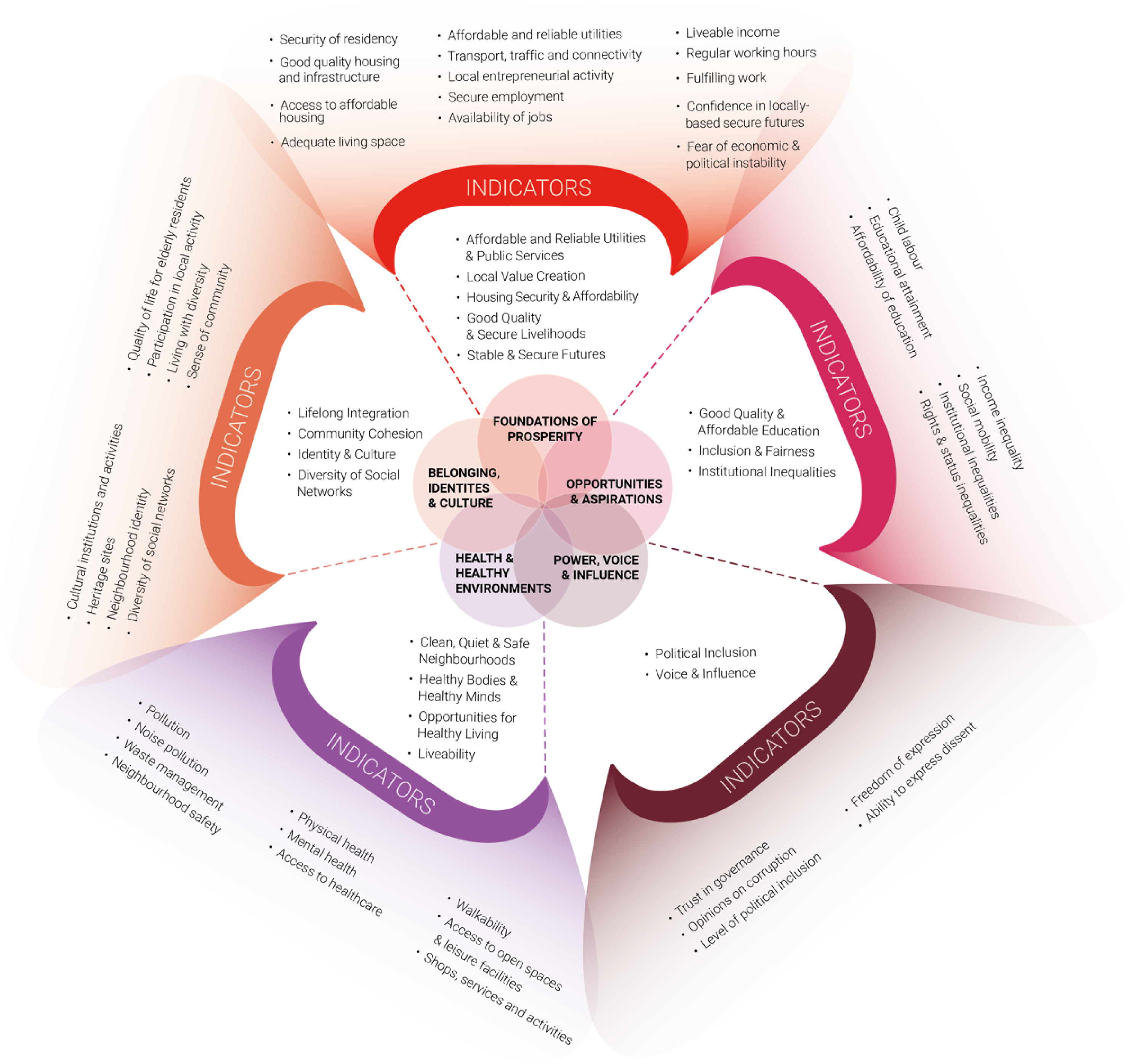
The second stage is the design of a data collection programme on the relevant indicators identified in phase 1. In the case of Hamra, our data collection was done with support from UN Habitat Lebanon, and partially modelled on the surveys they carry out for their Neighbourhood Profile publication series. This phase included the following surveys: (1) a building survey that recorded basic information (height, period of construction, structural condition, etc.) for all 634 buildings in the Hamra study site, (2) a population count of all residents in the neighbourhood (usually acquired from the concierge or from one of the residents of each building); (3) an infrastructure and open space survey, assessing the quality of various street level infrastructures (domestic water network, storm water drainage network, electricity infrastructure, sidewalks, roundabouts, gardens, etc.); (4) an enterprise survey with 300 business owners to collect basic data about Hamra’s commercial sector (e.g. age, tenure type, customer catchment area); and (5) a household survey with questions informed by the prosperity model created in phase 1, and conducted for a representative sample of 688 households. These surveys were further complimented by qualitative data in the form of interviews and focus groups with neighbourhood residents and key stakeholders. (Figure 2). Posters in the Hamra neighbourhood promoting our enterprise survey to the public.
The main findings of this research were subsequently published and made publicly available (RELIEF Centre & UN Habitat, 2020). But the value of the data collection was not only in the findings it produced but also in the process of fieldwork. The thorough and comprehensive nature of the surveys helped the citizen scientists acquire detailed knowledge of the neighbourhood and experience it in a radically new way: they visited buildings, lanes and courtyards that they had never visited before; they met and spoke to people with whom they would hardly cross paths otherwise; and they learned about social problems, the extent of which they were previously unaware of or did not expect to encounter in Hamra on such a scale. In other words, citizen scientists learned about places, people, and challenges that were ‘hidden’ from the view of many local residents.
Although the fieldwork’s primary aim was to collect quantitative survey data, it also provided citizen scientists with new qualitative knowledge and embodied experiences. On one level – which we can roughly classify as ‘cognitive’ – the team learned about things that were previously unknown to them, whether this was the presence of isolated and vulnerable Syrian families, or the small businesses tucked away in quiet lanes that few people passed through. On a second level, this learning occurred as embodied learning, as a lived experience of physical and affective encounters that generated feelings of surprise, sadness, concern and compassion, as well as joy, pride and satisfaction (see Shourbaji, 2020; Zaher, 2022). The reason this second level of knowledge is important in the context of sustained citizen science is that affective encounters play an important role in shaping people’s relations to themselves and others, as well as in animating their aspirations to contribute to their community. Encountering and engaging with people and places, witnessing their realities, and listening to their stories – these can be transformative experiences that leave deep impressions. For citizen scientists, these experiences became catalysts for new ideas about the problems that residents faced and the solutions that might help to redress them – ideas that would subsequently be developed into interventions and implemented in Hamra and beyond. The data analysis, data visualisation and writing up of research findings – activities in which citizen scientist also played a big role – were important as well. These activities strengthened engagement with the data and evidence that could support and substantiate the knowledge that team members gained in the field. Later on, during the development of intervention proposals and plans, the data would justify the urgency of the interventions and validate the relevance of the ideas. (Figure 3). Citizen scientist data analysis session at AUB Neighbourhood Initiative.
The third phase of our work is the design of interventions. The starting point of this phase in Hamra was a series of team workshops in which citizen scientists were asked to present on the pressing challenges identified during the research process, and to propose ideas about possible initiatives that can tackle these issues. The selection of challenges had to be backed up with evidence from the research findings. The first workshop, which took place in October 2019, was a ‘discovery’ workshop in which everyone shared and discussed their ideas with the wider team. This was followed up by a series of meetings over the next 12 months (many held online as a result of Covid-related lockdowns). These meetings were used to group and consolidate ideas, organise sub-teams to focus on specific interventions, and develop intervention proposals with aim and objectives, plan for implementation, timeline, budget, and justification of resources. (Figure 4). Citizen scientist intervention brainstorming at the Lebanese American University.
The result was a set of three distinct and highly original proposals which were then presented by the citizen scientists at a public forum (RELIEF Centre 2020), and subsequently funded by the RELIEF Centre for implementation. At the time of writing (summer of 2022) all three interventions are active, and we expect that they will continue to operate, develop and grow in the longer term.
From Research to Solutions: Building Interventions in the Community
Each of the three interventions developed by our team operates as an independent project, with its unique identity, branding and management. The first project that we present here is the Jouwan Community Centre (مركز جوان المجتمعي) (JCC), jointly led by Assia Al Harrache and Amanie Majed, both of whom have careers as teachers and project coordinator/program managers at local NGO NAHNOO, in addition to working as citizen scientists on our team. This intervention is a teaching and learning programme designed to provide out-of-school children and children attending underserved public schools with an opportunity for educational support, with the ultimate goal of passing the ninth grade official exams. The programme delivers instructions on three different subjects – Arabic, English and Mathematics – each taught for 2 hours per week.
The Hamra area has been historically seen as a relatively affluent area that boasts high end residential buildings, commercial enterprises, and hotels, as well as trendy cafes frequented by intellectuals and relatively well-off university students. At the same time, Hamra is also a very unequal area with sizeable pockets of poverty and deprivation. Economically and socially vulnerable people, a disproportionate number of whom are Syrian refugees, often live in dilapidated and overcrowded housing, ‘hidden’ from public view, with limited presence and participation in the neighbourhood’s shared spaces and public activities. This problem of vulnerability is multi-dimensional, but one of the most serious and alarming aspects of it is that many children and young people from vulnerable backgrounds are currently out of school. This problem was well-known to us prior to the start of data collection, but the data from the surveys revealed just how massive the scale of the problem is in Hamra: in 2019, at the time of data collection, only 58.1% of all children aged 12–17 residing in Hamra were reported to be attending school. Although the attendance rate for Lebanese children was relatively high at 97.2%, for Syrian children, this number was only 41.4% (RELIEF Centre & UN Habitat, 2020: 33). The reasons for the low attendance rate are multiple, but two prominent issues are the difficulty of obtaining resources to send children to school, especially in an area where the majority of schools are privately run and require a tuition fee, and the lack of available school places. Additionally, many parents whose children are enrolled in school are concerned that the quality of provision that students are receiving is not adequate due to the overburdened schooling system.
The Jouwan Community Centre intervention was designed to respond to this educational deficit and offer out-of-school children an opportunity to make up their lost learning. The initial idea was to teach in a face-to-face format, but this plan was derailed by the pandemic and so Harrache and Majed resorted to creating a ‘virtual community centre’ where learning would occur online, but with periodic in-person meetings and field trips to places such as the local library. This meant that funding that was initially planned for venue hire was redirected towards supplying children in the programme with the necessary equipment that would enable them to connect to classes from their homes – tablets, earphones, prepaid SIM cards, ‘MyFi’ mobile broadband routers, and a battery to provide an electricity supply. The online nature of the school also became relevant when Harrache and Majed realised that many Hamra-based children had moved to less expensive housing outside of Hamra during the last couple of years. The JCC team thus recruited children living all over Beirut to participate in the programme as well as volunteer teachers whom they subsequently trained to help with the delivery of the classes. The first rollout of the JCC teaching programme began in January 2022, and will run for 9 months until September. The inaugural cohort consists of 15 students. (Figure 5). Training session for Jouwan Community Centre teachers. Ghamrawi giving presentation at NEST.

A second intervention project, entitled ‘The Goods of Our City’ (خيرات مدينتنا), is led by Ghadir Ghamrawi, an urban planner by profession, as well as a citizen scientist. Ghamrawi’s project aims to develop an urban agriculture programme that would make the neighbourhood greener, while simultaneously offering food support in the form of a fruit and vegetable supply. Part of the challenge is that there are no parks and gardens in Hamra where urban agriculture can be implemented, and so the intervention has to focus on private spaces, including balconies, terraces, and rooftops.
Beirut’s deficit of public spaces is well-known, as is the lack of greenery and parks (Nazzal & Chinder, 2018). In Hamra, our research revealed that the public open spaces in the neighbourhood amount to only 0.007 km2, or 1.4% of the neighbourhood’s total area of 0.54 km2. These open spaces are roundabouts which are usually surrounded by street traffic and are effectively unusable (RELIEF Centre & UN Habitat, 2020, p. 69). Private and semi-private open spaces make up 11% of the neighbourhood’s area, but these are mostly parking lots, plazas of building complexes, and private gardens (RELIEF Centre & UN Habitat, 2020, p. 69), which cannot be used for urban agriculture either.
The early plans of the intervention were therefore to bring urban agriculture to balconies, terraces and rooftops, and to eventually expand to other spaces at a later stage. This meant that the intervention would include a design component (namely, the design of low-cost planters that would fit into small spaces), as well as a community outreach component that would promote the project to people and organizations in the neighbourhood interested in ordering planters for their own private spaces. Ghamrawi’s project needed to secure an open space where planters could be installed and the intervention piloted. The pilot would then be used to advertise the planters through a community engagement and outreach campaign on social media and in person through direct contact with potential users. The space for the pilot was secured with the support of a local community hub that allowed Ghamrawi to use the rooftop of its building and design site-specific planters (two different designs in total, one vertical the other slanted). The planters were built, installed and planted with vegetables. This stage of the intervention, although successful, presented a number of challenges and lessons learned regarding the practicalities of organising reliable maintenance of the planters and care for the plants, hiring a reliable carpenter, and seeking better advice about the type of materials to be used.
The next phase of the intervention was to accelerate community outreach, by seeking potential users either of the existing planter designs or of new designs that would be better suited to enhance people’s spaces. At this phase, the Goods of Our City became first and foremost a community intervention, whereby Ghamrawi’s focus shifted to establishing contact with local organizations and delivering presentations about the value of urban agriculture and the possibilities of creating designs that combine food production with greening and creation of socially friendly space. At the time of writing, the Goods of Our City has just completed its first major project – the creation of a seating and gardening area on the spacious terrace of the Near East School of Theology (NEST). The installation was co-designed and co-constructed with the NEST community of staff and students, and will be maintained by that community in the future. The next step for Goods of Our City is to build upon the successes accomplished thus far and to expand the interventions to other spaces in order to make Hamra greener, while also providing users with a supply of fresh produce. (Figures 6, 7, 8, and 9). A view of the NEST terrace prior to the intervention. Co-construction of the intervention. The intervention after completion. Map of workshops in Hamra.


The third intervention that emerged out of our research programme is the Wirach (وِرَشْ) project, led by Yara Younes who is also an architect by training, currently working as the Project Coordinator of Allo, Beirut Project. The aim of Wirach is to convene ‘a taskforce’ to locate small businesses (especially workshops), and create an online platform and a series of small urban installations to improve the businesses’ visibility and connect them to prospective customers. The category of ‘workshops’, in this instance, covers businesses that are small in size and independently owned such as tailors, shoemakers and bagmakers, printing shops, mechanics, and electronics workshops. (Figures 10 and 11). A screengrab of the Wirach online platform.
The idea for this project emerged out of two key fieldwork observations. The first was that many of Hamra’s workshops are ‘hidden’ away from public view, and so potential customers, including local residents, are unaware of their presence. There are a number of reasons for this: some workshops are tucked away in small lanes and backstreets that see very little foot traffic; others are located in the basements or above the ground floor of buildings; and yet others are combined with bigger shops, rendering them marginal in terms of visibility. Rent in Beirut can be prohibitively expensive and so small businesses cannot always afford storefronts on busy streets. Furthermore, the majority of workshops do not have a strong online presence, and this limits their outreach. The second fieldwork observation was that businesses are an important part of the cultural and social fabric of the Hamra neighbourhood. Hamra’s reputation as a commercial area was something that residents took pride in and associated with social status, as well as vibrancy and cultural richness. Small business owners similarly highlighted the value that they bring to the neighbourhood beyond the goods and services they offer. They act as hubs of sociality where neighbours drop by to socialise without pressure to buy anything, and they also contribute to the culture and character of the neighbourhood. Without small businesses, Hamra would feel generic and lifeless.
The Wirach project, recognising small businesses for the value they bring to the community, is designed to enhance their visibility. The online component of the intervention will be a platform where users can find the service they need, and learn basic information such as location and contact details of the business, prices of products, and available promotions. The platform will also host short promotional videos about some of the business, highlighting their history in the neighbourhood and their connection to the community, while archiving their legacy in the community in an online database. The physical element of the intervention will be a series of QR code installations, located in proximity to the businesses. Scanning the codes will link users to the platform page. The aim of these installations is to raise awareness about the social and cultural value of Hamra’s small businesses and to encourage people to support them. The creation of the platform, including the filming of videos will all be created by Wirach at no cost to the businesses themselves.
What is particularly notable about Wirach is that the intervention includes its own research programme that follows up from the enterprise survey of the initial research. The aim of the new data collection is to survey businesses in Hamra and the greater Ras Beirut area (of which Hamra is a part) in order to recruit participants for the project, collect the information needed for the platform, and organise the filming and production of the promotional videos. This data collection will be carried out by citizen scientists, and Younes – who has worked as a citizen scientist for over 3 years and has extensive research experience – has already trained a new team of citizen scientists, workshopped the survey questions, and is currently coordinating the fieldwork for the survey. In this way, her work is not only aiming to support the livelihoods of small business owners at a time of economic difficulty, but is also affirming the right to research and building the capacity to research of a new cohort of citizen social scientists.
The three interventions by Ghamrawi, Harrache and Majed, and Younes were all conceived in the context of Hamra and borne out of the data collection and analysis that was conducted in the neighbourhood. All three of the interventions, however, have potential to be expanded to other neighbourhoods and cities in Lebanon, allowing them to magnify their impact from a simple idea that was tried, tested and proven to be successful in one neighbourhood, to a project that responds to nation-wide challenges commonly shared by communities across Lebanon. The Wirach initiative is already set to be replicated in a second site, in El Mina/Tripoli, where the PROCOL Lebanon team has also carried out data collection on prosperity and is developing a prosperity index. Plans for expansion of the other two interventions will likely be part of their future development as well. These expansions will be guided by evidence about the interventions’ impact, which will be evaluated by a bespoke evaluation programme designed to monitor each intervention and make adjustments where necessary. The fact that the interventions were piloted in Hamra has demonstrated that they can be successfully implemented with the skills and experience that we have within our diverse team. But even more important than that is the passion and commitment that these three projects nurtured once their impact on the community became evident. It is this passion for making a difference that is driving us – and especially the citizen scientists on the team – to seek additional funding, recruit new participants, and sustain and expand this work in the long run.
Conclusion: A New Impact Model for Social Science Research
The approach to research described in this paper presents a specific vision of how the social sciences can lead to meaningful impact through collaborative, community-based work, while maintaining strict adherence to academic rigour via the involvement, input and continuous support of more experienced academic researchers. From one angle, the programme we have described does not mark any radical departures from the principles of partnership, capacity building, public outreach, and influence on policy that have been identified as pathways to more ethical and impact-oriented research. We could even argue that our work aims to expand (in scope of activities) and extend (in duration) existing approaches and methodologies that have already been carried out by dozens, if not hundreds, of research projects. Yet, at the same time, we also contend that the impact of social research is frequently envisaged in a rather limited way. In the vast majority of cases, impact activities do not go beyond knowledge production, outreach/dissemination, and capacity building; they do not venture into the domain of co-creating and implementing interventions that solve problems directly and concretely as logical next steps of partnership, capacity building and so forth (there are of course exceptions, two notable examples known to us in Lebanon being the work of the charity CatalyticAction and the Beirut Urban Lab).
The three interventions we have showcased demonstrate how research can lead to diverse solutions within communities, but they also highlight the critical importance of long-term engagement and partnership between universities and communities. If funders and academics are serious about solving problems through citizen engagement, then sustained participatory research certainly has to be an important part of the conversation. In the final pages of this article we suggest that important steps can be taken in three different domains in order to advance sustained citizen science as a means of renewed impact.
First, there needs to be action at the level of funding structures and research priorities. Bringing the kind of long term collaboration we describe to the forefront of academic work is not a simple matter that can be achieved by merely choosing to do research differently; it is a complex problem that is linked to various structural issues of funding, administration, and career progression criteria, all of which are currently set up in favour of narrow traditional visions of what impact we should strive for and what kinds of expertise are needed to deliver it. The current emphasis on academic specialisation and individual merit, usually acquired through accumulation of academic publications, has to be decentred to allow for long-term collaborations with citizens outside of the university that lead to other forms of outcome and impact. A structural transformation of how we do research can make a huge difference in terms of enabling both full-time university researchers and citizen scientist researchers to make the best use of their expertise in serving the public. In the case of our work, it was evident that the diverse abilities and skills that citizen scientists brought into the team, combined with the valuable experience they gained during training and fieldwork, harboured tremendous potential for social impact. But in order to fulfil this potential we had to collectively create a new process for generating ideas and implementing solutions. This was only possible within a framework of working together in the long run – over 3 years at the time of writing, and still only at the beginning of an interventions phase that will likely continue for years to come. Working together across multiple activities has been a fundamental factor at play in our ability to deliver outcomes: it has strengthened commitments and produced cumulative expertise that simply aren’t possible to achieve when different phases of the research are carried out by separate teams of people (academics, enumerators, private companies, etc.).
This point about the importance of structural support also has important implications for capacity building. The model of sustained citizen science takes the right to research and the capacity to research seriously, but it also seeks to support people in using this capacity towards the creation of solutions. The fewer resources and support structures there are, the more difficult this process becomes. Data collection, training sessions, and various kinds of research activities may contribute to capacity building and personal and professional growth; but even when this is the case, there are still looming questions about what happens with these capacities afterwards, and to what extent they can lead to solutions without supporting institutional structures, sources of funding, and people whose job is to coordinate the delivery of impact. In our case, having secure funding for the duration of the three phases of prosperity research has been a key factor in helping us advance our work to its current stage. This has enabled us to pay citizen scientists for their work and to fund the interventions that they designed, as well as to employ a team of full-time research staff who convene, coordinate and support the process from beginning to end. We have been in a fortunate position in this regard, but we are aware that the majority of social science projects, including projects that are explicitly dedicated to citizen science, are usually short lived and have scarce resources. We would thus argue that the current structures of funding, and especially the duration over which participatory projects are funded, must undergo significant changes if meaningful and lasting partnerships between universities and communities are to be formed as a means of tackling social problems. Contrary to light touch citizen science projects in which unpaid volunteers collect data and perform other small tasks, highly engaged and highly demanding variations of citizen science research cannot, and should not, rely on unpaid volunteers putting in long hours of work; they have to be well-resourced in order to be both ethical and successful.
A second important aspect of sustained citizen science is the importance of being open to a diversity of outcomes in terms of what problems are addressed and what kinds of solutions are created. Prosperity, as we argue elsewhere (Moore & Mintchev, 2021), can be theorised as an ‘assemblage’ of multiple actors with different skills and resources, who organise into context-specific partnerships in response to emergent challenges. Organisation, however, requires a sustained effort of building, coordinating and maintaining networks of people over time; it also demands flexibility and adaptability in defining the relevant challenges and the appropriate solutions. In the case of our three interventions, the designs reflected the problems experienced on the ground and revealed through the data, on the one hand, and the expertise and passions of the citizen scientists, on the other. The process also benefited from invaluable support from partners in our network, such as the American University of Beirut’s Neighbourhood Initiative, who helped in countless ways, from offering intellectual input and advice on logistics, to allowing us to use their office space. Approaching the programme as a long-term, open-ended and flexible process, rather than a fixed-term project with pre-defined outcomes, ensures that the citizen scientists who drive change can make use of their existing expertise (as teachers, urban planners, and other kinds of professionals, or simply as people with knowledge of their community), while simultaneously using data and evidence to steer their contributions.
Finally, as a concluding point, we would like to emphasise that sustained citizen science must go beyond the temporal boundaries of short-term projects, but also beyond the spatial parameters of the locales where the research takes place. The research and interventions that we have presented were created within a specific context and adapted to fit that context, including the limitations and possibilities it offered for the kind of work we aim to do. At the same time, the lessons learned about research design, methodology, and solutions have relevance that goes far beyond the context of Hamra or even Lebanon; they have global relevance for social research and impact as a relation between universities and communities. Acknowledging this wider relevance and seeing citizen scientists’ expertise in wider terms than just ‘local expertise’ is essential firstly for ethical reasons (see Shuayb, 2022) and secondly because citizen scientists make valuable contributions to international and global academic debates. Building an international programme of knowledge sharing, training and research across countries is indispensable for the development of citizen science and participatory methods in the 21st century, but such a programme would be patently untenable – and also blatantly hypocritical – without the active involvement of citizen scientists themselves. In our work, we have already began this conversation with numerous exchange activities between citizen scientists in different countries, including a 2020 workshop, jointly run by the Institute for Global Prosperity and the British Academy, where citizen scientists from Lebanon, the UK and Kenya spoke about their work and shared the lessons and outcomes that had emerged from it (Institute for Global Prosperity 2020). The next step is to continue building this knowledge exchange process and to expand it to researchers from other countries, contexts, and disciplines. Sustained citizen science presents a brilliant opportunity to deliver solutions in a radically new way through lasting partnerships, trust, and community engagement. In order to adapt this work to a larger scale, we have to expand the conversation and demonstrate that social research, especially when done in a collaborative fashion, can indeed make a tangible difference to people’s quality of life.
Footnotes
Acknowledgments
The authors would like to thank all the citizen scientists, collaborators, and participants who made this research possible. We would also like to thank Lea Riggi for designing the Prosperity Model diagram.
Declaration of conflicting interests
The author(s) declared no potential conflicts of interest with respect to the research, authorship, and/or publication of this article.
Funding
The author(s) disclosed receipt of the following financial support for the research, authorship, and/or publication of this article: This work was supported by the Economic and Social Research Council via the RELIEF Centre (Grant ES/P008003/1) and by The British Academy, via the project ‘Developing Infrastructural Solutions for Lebanon’s Challenges of Mass Displacement’ (Grant UWB190164).
