




Abstract
Mainland Chinese born in the 1940s–1950s have experienced unique socio-cultural circumstances that have shaped their late-life immigration experiences. Little is known about what this population perceives would reduce their loneliness. This study aimed to investigate the role of co-design in the development of community-based resources/services for ameliorating the loneliness of Chinese late-life immigrants. Eight co-researchers completed three co-design workshops, and two key service providers were consulted. Co-researchers co-designed guidebooks on accessing primary healthcare facilities, social services, aged care facilities, and public transport, which were considered helpful for ameliorating loneliness. Co-housing was co-designed as a concept and regarded as a feasible way of living to strengthen social interactions and reduce loneliness. Providing more public social housing, adding ‘next-bus stop’ announcements, and conducting loneliness screening were recommended at the national level. Our findings affirmed the need to truly listen to the voices of both service end-users and service providers.
Introduction
Chinese Late-Life Immigrants’ Roots in China
Mainland Chinese born in the 1940s–1950s encountered unique socio-cultural circumstances that shaped their later life experiences. Following the Chinese civil war, the People’s Republic of China was founded on the 1st October 1949. The generation born before, or around, the establishment of the new government experienced rapid political and cultural changes, such as the Anti-Rightist Campaign and the Cultural Revolution. This cohort tends to value authority more than democracy, both within their system of schooling and their family. Most had been employed in the state-owned sector. The employment system at the time was a product of China’s planned economy, and lifelong medical care, a retirement pension, housing, child education, and career training were all provided (Cheng et al., 2018). In such a public enterprise system, authoritarian obedience to the leadership was considered a fundamental virtue for this generation (Bedford & Yeh, 2021). Moreover, women of this generation were expected to assume a domestic role, reinforced by traditional Chinese cultural and social expectations that prioritised obedience to leadership by men. Male domination at that time was subsequently shown to have reinforced imbalances in modes of communication between older Chinese men and women (Zhang, 2014). Representing the high value placed on a person’s social reputation, saving and maintaining face continues to play a primary cultural role in the life of people of Chinese heritage (Hwang, 2012). Among older Chinese adults, it has been shown to be associated with avoidance of disclosing social and familial concerns (Zhao et al., 2021). Furthermore, Chinese families have historically valued filial piety, which requires children to respect and obey their parents. Parents would regard any unmet filial duty of their adult children as a loss of face. China’s economy developed rapidly in the 1970s onwards, and the younger generation were expected by their parents to achieve career success through education and training. As a means of gaining and maintaining face, some Chinese families sent their children overseas to study, which gave them the potential to be able to immigrate to a developed country in later life. However, the importance of filial obligations and the value placed on immigration for better opportunities coincided with the implementation of the one-child policy in China (1970s–2016). This served to further complicate intergenerational relationships. For example, Chinese late-life immigrants have been found to be less likely than others to disclose their intergenerational conflicts because of the cultural imperative of upholding face (Zhang, 2014).
Loneliness of Chinese Late-Life Immigrants
Loneliness in later life is an important health and social phenomenon when considered in conjunction with the challenges imposed by both immigration and ageing (Dane et al., 2020). International immigration is a salient life course transition that can be particularly difficult for late-life immigrants (Zhao et al., 2021). Age-related losses, an unfamiliar physical environment, a foreign language, and the need to assimilate by learning the new cultural, health-seeking, and care practices of the host population have been deemed risk factors of loneliness for late-life immigrants (Zhao et al., 2021, 2022).
Loneliness in older adults is an emerging and significant concern for providers of primary healthcare and long-term residential care services, as it is strongly associated with adverse health effects (Gale et al., 2018), depressive symptoms, impaired cognitive health, poor functional health (Gerino et al., 2017; Yin et al., 2019), increased mortality (OʼSúilleabháin et al., 2019), and a decline in quality of life (Kang et al., 2018). In New Zealand, the ethno-cultural diversity of older immigrants and their specific healthcare needs poses challenges to an already strained health delivery system to provide culturally responsive and competent care (Montayre et al., 2019).
Although Chinese are a substantial minority group in New Zealand, the loneliness of Chinese late-life immigrants has rarely been addressed in national demographic studies. Moreover, there has been little research on socio-cultural interventions to ameliorate the effects of loneliness on such immigrants. This is particularly the case with studies in which service end-users and key stakeholders are involved in designing such interventions. Consequently, the aim of this study was to investigate the role of co-design in the development of community-based resources and services for ameliorating the loneliness of Chinese late-life immigrants. This article presents approaches that can be utilized in countries to which Chinese citizens have immigrated in later life.
Overview of the Study’s Methodology and Design
The primary study was designed for implementation in two phases. Phase one involves the application of a mixed-method approach comprised of a standardized survey and individual interviews. This phase of the study has already been completed (Zhao et al., 2020). Phase two is a co-design study involving the translation of phase one of the research findings into community-based resources and services for improving the loneliness of Chinese late-life immigrants. A theoretical framework comprised of a conceptual model of ‘Exclusion from Social Relations for Older People’ (Burholt et al., 2020), the philosophy of Confucianism (moral principles and the belief systems shaping the views of older Chinese people) (Confucius, 1971), and Arthur Kleinman’s theory of social suffering (Kleinman, 2010) was used to inform the methodological approach in the primary study. Before commencing phase two of the study, key stakeholders were involved in determining the focus and development of this phase, in accordance with the public involvement principles of participatory research (Niedderer et al., 2020). This approach falls within the spectrum of public engagement, from consultation to co-design. Their involvement included making suggestions on the most appropriate potential participants to approach.
In phase one, a purposive strategy for recruitment was adopted. Criteria for the inclusion of participants were: (1) those who were born and had spent most of their adult life in mainland China, Hong Kong, Macau, or Taiwan; (2) who were aged 65 years or older upon immigration; (3) who had lived in New Zealand for more than a year prior to the commencement of the study; and (4) who were able to understand the objectives of the study and abide by the study procedures.
Twenty-three Chinese late-life immigrants met the enrolment criteria and provided written consent to be included in phase one of the study. According to an analysis of the interview data, Chinese late-life immigrants value family obligations, such as looking after grandchildren for their adult children (Zhao et al., 2022). Their experience of loneliness was generalized and associated with a sense of imbalance in relation to intergenerational reciprocity. They indicated that their social relationships had been disrupted after they had immigrated to New Zealand, and that they had experienced a sense of alienation. The participants aspired to having their voices heard by New Zealand policymakers and service providers. These findings suggest that engaging these late-life immigrants in a culturally specific approach to solving problems would help them to authentically communicate their needs.
Methodology and Methods of Phase Two of the Co-design Study
The focus of this paper is a methodological critique of how the findings from the phase one mixed-methods study were used to translate research findings into community-based resources and services for improving the loneliness of Chinese late-life immigrants in New Zealand. A co-design methodology (McNiff & Whitehead, 2011) was employed to develop and conduct co-design workshops and hold consultations with stakeholders. The co-design workshops followed a qualitative community-based participatory research approach that enabled the participants (co-researchers) and researchers to collaborate in an interactive enquiry to address the research aim. This approach enabled the targeted co-researchers, who had diverse social and cultural backgrounds and needs, to co-learn and engage, and to collectively resolve questions and issues (Minkler, 2000; Reason & Bradbury, 2008). In keeping with co-design principles, the knowledge, sharing, and creative ideas of the co-researchers were valued in this approach. In addition, the research methodology is sensitive to gender differences (Kemmis et al., 2014) and is frequently employed to address health inequities in marginalized communities (Wallerstein, 2006). These intentions were well aligned with those of our stakeholders, a minority group of Chinese late-life immigrants in New Zealand whose experiences of loneliness were substantially underreported. We utilized the Consolidated Criteria for Reporting Qualitative Research (COREQ) checklist (Tong et al., 2007) to report the study.
The co-design methodology was composed of a four-step cycle. In step one, we as researchers, prepared the workshops from an analysis of the data from phase one of our study (Zhao et al., 2020), taking into consideration culturally and ageing-specific expectations, values, and behaviours. Two co-design workshops were conducted in step two to develop community-based resources/services to address the loneliness of Chinese late-life immigrants. In step three, key stakeholders (Age Concern Auckland and Housing New Zealand), identified by the co-researchers, were approached to provide feedback on how the findings from the co-design workshops could be further implemented. Finally, in step four, a summary of the consultations with the key stakeholders was related to all of the co-researchers to further refine the results. All co-design workshops were conducted face-to-face in Chinese (Mandarin) at the study team’s affiliated university. Below, we will detail each step and elaborate on the reasons behind the choices in the design and implementation of the study based on a Chinese cultural lens.
Participants and Recruitment for a Co-Design Study
Recruitment
Framework for the Selection of Potential Participants.
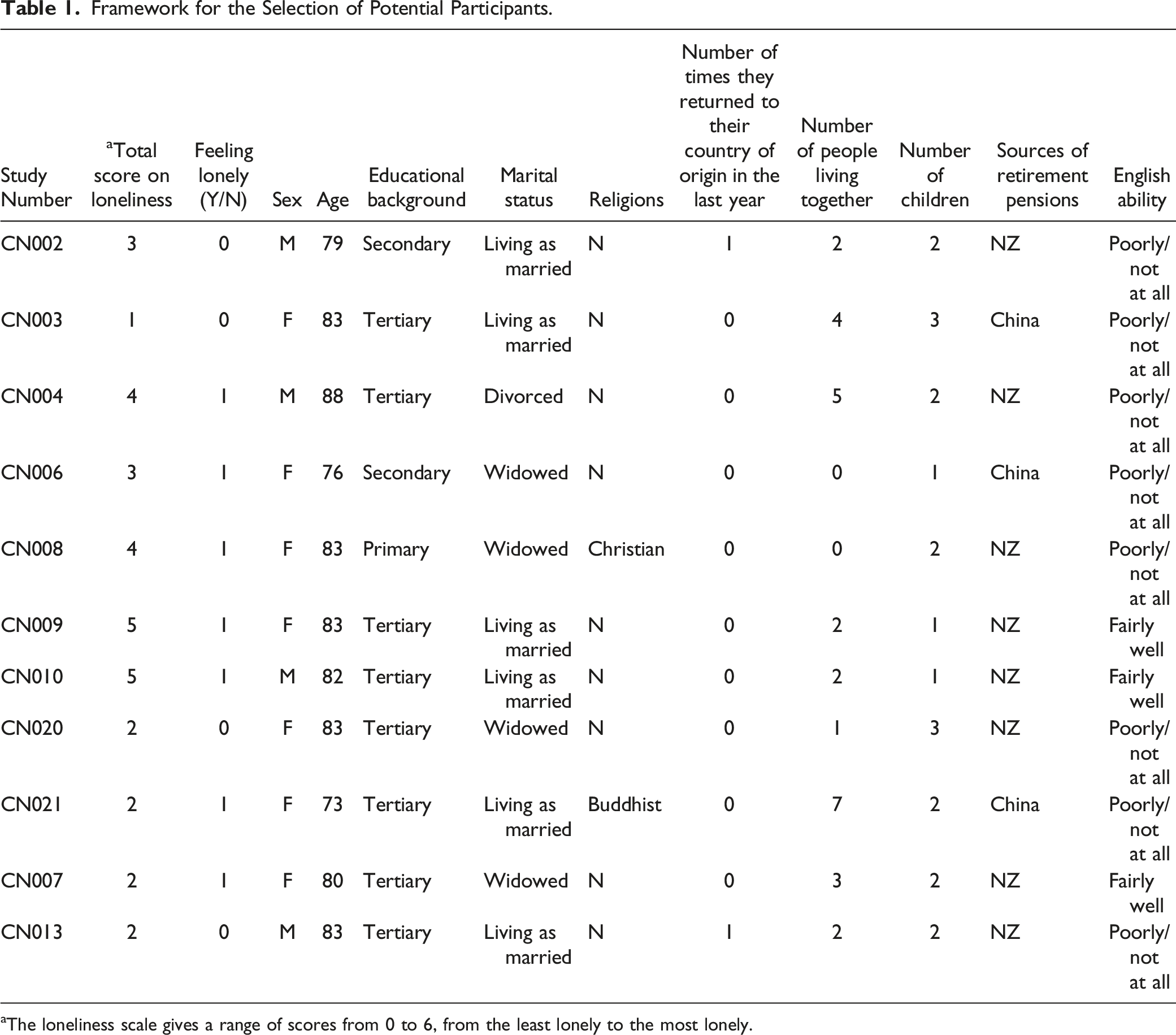
aThe loneliness scale gives a range of scores from 0 to 6, from the least lonely to the most lonely.
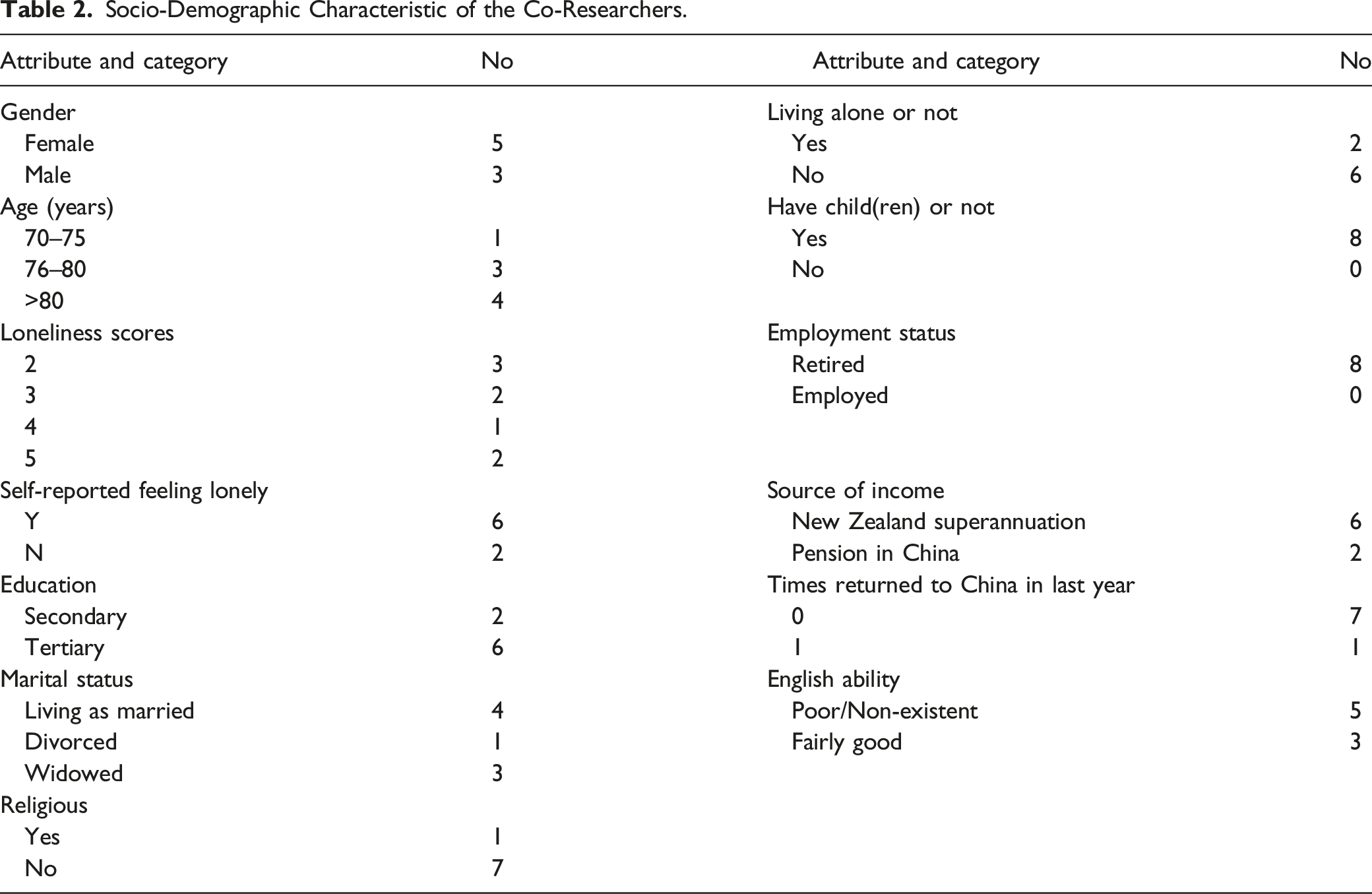
Socio-Demographic Characteristic of the Co-Researchers.
Preparing the Co-Design Workshops
Choosing the Venue
The following aspects were taken into consideration when preparing the co-design workshops: Chinese cultural suitability, proximity to parking and public transport, physical access, a comfortable space with ambient lighting, heating, an adjacent room for preparing food and drinks, privacy, a quiet environment, the availability of toilets, the flexibility of the setup for working desks, space for flip charts, electronic facilities for visual presentations, a table for food and drinks, and so on. A workshop room in the campus of the Auckland University of Technology was selected because it was a convenient place for all of the co-researchers to meet.
Transportation to the Workshop
The co-researchers were able to travel free on public transport upon presenting their SuperGold card (a government-subsidized discount card). A member of the research team, holding up name signs, met participants who had travelled by bus at the designated stop. Nonetheless, transportation arrangements posed challenges for this study. The barrier that the English language posed to the co-researchers and the unfamiliarity of some of them with public transportation routes were obstacles that they faced in travelling to the workshop venue. Hence, the research leader (IYZ) checked the travel plans of all co-researchers to ensure that each would travel safely from different parts of Auckland. A taxi service was arranged for those unable to catch a bus. An 85-year-old male co-researcher rejected the taxi service and asserted his independence by catching a bus. After finishing the first co-design workshop, he got lost on his way home. The workshop facilitator (IYZ) subsequently agreed to regularly communicate by phone with his daughter, whom he lived with, to ensure that he would attend the other workshops and arrive home safely.
Workshop Environment and Refreshments
The room and refreshments were prepared in ways that would make the Chinese co-researchers feel comfortable, respected, and safe. The workshop room was set up in a co-researcher-centred way. Two tables were moved together in the middle of the room and two digital recording devices were placed on each table. Name cards with the initials of the co-researchers were placed on the table to indicate the seating arrangements, which were organized so that all co-researchers could see the AV screen. Two side tables were set on one side of the room to display the flip charts. The co-researchers were able to check the information on the charts and update it at any time during the workshop. Another side table, covered with a red tablecloth, was positioned near the door of the workshop room and laid out with refreshments. The culturally relevant hospitality was provided by the study team. The colour red was used because it is regarded as auspicious by Chinese people.
The facilitator (IYZ) and her assistant (VWC) noticed that the co-researchers were reluctant to collect food from a side table in the first co-design workshop (Supplementary document 1), perhaps because they were in an unfamiliar environment. To rectify this, in the following co-design workshop, the food was set out on the main table with personalized servings (Supplementary document 2). This resulted in improved group dynamics, and better opportunities to get to know each other.
The community-based participatory research cycle (Figure 1) guided the data collection process. The co-design workshops took place from March to August 2019 and were facilitated by IYZ, who had been born and raised in mainland China. She is bilingual and has many years of working experience in providing ageing services in Auckland. Working primarily as an observer, VWC assisted IYZ by taking notes and photographs. The ages, transportation issues, and health status of the co-researchers were taken into consideration, and each workshop was set to last approximately 2.5 hours. All of the workshops were digitally recorded. We observed and documented the process by which the co-design workshops were implemented, and critically reflected upon the findings immediately after the completion of each co-design workshop. Issues were discussed within the research team and a relevant strategy was developed for the subsequent step. The community-based participatory research cycle.
The First Co-Design Workshop
The first co-design workshop was held on 26 March 2019. The workshop opened with a welcome speech and a round of introductions. The co-researchers agreed to use Mandarin to communicate during the entire co-design process. Before presenting a summary of the research, the facilitator (IYZ) led an ice-breaking activity so that each co-researcher felt connected to the group.
At the beginning of the first workshop, the IYZ and co-researchers generated ground rules for the co-design workshops. This helped the co-researchers to follow a democratic process. First, the co-researchers were encouraged to work collaboratively as a group. Second, to mitigate potential stigma from loneliness associated with the culture of saving face (Zhao et al., 2021), the co-researchers were reminded that the group workshops were about co-designing community resources and services for Chinese late-life immigrants rather than for sharing personal experiences of loneliness. This reminder was further confirmed when a potential co-researcher contacted IYZ and expressed her concerns about disclosing to the other co-researchers her loneliness-related family issues. Lastly, it was agreed that workshop discussions would be focused on achieving the study objectives.
IYZ explained the steps of the co-design process and the co-researchers’ associated responsibilities. The co-researchers then paired up. Each group of two received a flip chart to record their ideas about their needs, as well as about the gaps and issues relating to existing resources/services in the community for addressing loneliness in Chinese late-life immigrants (Supplementary documents 3 & 4). Then, each group was invited to share their ideas with the other co-researchers.
The team agreed to use an hourglass to measure time. This is a device composed of two glass bulbs connected vertically by a narrow neck that allows sand to flow from the upper bulb to the lower one. It served to remind all of the co-researchers about the passage of time. The effects of using an hourglass will be explained in the following co-design workshop.
The Second Co-Design Workshop
The second co-design workshop was undertaken on 2nd April 2019. IYZ commenced the workshop by reading excerpts of Chinese late-life immigrants’ accounts of their experiences of loneliness in New Zealand. These excerpts were selected from phase one of the interview study (we excluded excerpts of the co-researchers’ own accounts). IYZ and VWC further observed the non-verbal gestures of the co-researchers, as an indication of the emotional impact of the excerpts, and observed that they became engaged in the ensuing discussion, and interacted more dynamically with their co-researchers than they had appeared to do in the first workshop.
Towards the end of workshop two, the workshop team collectively reflected on the findings in the flip charts (Supplementary documents 3 & 4). The co-researchers were also asked to identify potential key stakeholders who could be approached to discuss the co-designed outcomes. IYZ wrote a summary report of the workshop proceedings in Chinese and gave this to the co-researchers after the workshop, to verify the content and correct any inconsistencies.
Consultations with Key Stakeholders
In order to translate the collective knowledge co-designed in the workshops into practice, two stakeholders were identified by the co-researchers as people who should be consulted. Key stakeholder 1 Housing New Zealand was employed by one of the largest providers of national public social housing, and key stakeholder 2 Age Concern Auckland was employed by the principal provider of social services for older adults in New Zealand. The findings of ‘feeling less connected’ and feeling lonely in public social housing communities and needing an information guide for older Chinese immigrants in Chinese language were discussed in three face-to-face consultations. The suggestions of the key stakeholders were documented and summarized by IYZ.
The Final Co-Design Workshop
The final co-design workshop was held on 07 August 2019. In this workshop, the co-researchers reviewed the summary report, received via WeChat after the previous co-design workshop. This included findings from the first two co-design workshops, which summarized what had been accomplished in the previous two workshops. Their feedback and comments on the report were collected. IYZ and VWC then presented to our co-researchers a summary of this part of the process with Housing New Zealand and Age Concern Auckland. The co-researchers re-designed the current Chinese information guidebook together with the Age Concern Auckland. In the last phase of data collection, the research team created a final report and returned it to the co-researchers so that they could check the accuracy of the source data. The first author also submitted the co-researchers’ feedback to the Housing New Zealand and Age Concern Auckland.
Data Analysis
Digital recordings of the co-design workshops were concurrently transcribed verbatim in Chinese by IYZ. Transcripts were returned to the participants to seek verification of the content. Changes were made to ensure the accuracy of the source data. Data were analysed using an inductive thematic approach, guided by Braun and Clarke’s framework (Braun & Clarke, 2006). All members of the research team participated in the process of analysing the data. That began with transcribing the data, reading, and repeatedly rereading and identifying key relevant categories of interest. The information that they summarized and wrote on the flip charts (Supplementary documents 3 & 4) were also included in the data analysis. IYZ translated the codes and themes and all members of the research team reviewed the translated data and came to a consensus on what the final themes should be. The socio-ecological framework of McLeroy et al. (1988), which focuses on intrapersonal factors, interpersonal factors, institutional factors, and community factors, was adopted to help organize the themes.
Workshop Observations and Findings
Reflections on the Workshop Experience
It was perceived that the culture-specific and thoughtful preparation of the co-design workshops made it possible to gain the trust of the co-researchers. Their trust was an essential step for engagement in the subsequent workshops. The co-researchers shared accounts of how they had grown up and been educated in an authoritarian environment, where they were used to following the guidance of leaders and needed to avoid expressing their individual perspectives. The co-design methods created a safe and encouraging atmosphere for them to have their voices heard by stakeholders. The co-researchers were proactive in engaging in the co-design workshops and affirmed that this process is an essential one to follow if resources and services in the community are to be tailored to meet the specific needs of Chinese late-life immigrants to address their loneliness.
Individual Factors
Many co-researchers confessed to anticipating that they would need to rely on formal aged care services instead of on family support. They expected to live separately from their adult children in the rental sector and later move to aged care facilities when needed. As co-researcher 4 said, ‘I hope more rest homes and retirement villages could expand their multilingual and cultural services. It will be very helpful for reducing the loneliness and depression of older Chinese immigrants’. For all of the co-researchers, public social housing was the preferred option for accommodation, as all agreed that public social housing provides good security and makes older people feel more included. They feel more settled in public housing than in private housing. Moreover, co-researcher 6 expressed her concern about the culturally specific taboo of death in a private home: ‘Chinese property owners do not like to consider elderly tenants. If I lived in public housing, I would worry less about my health and ageing. I told myself I must not die in a private home, since it would contaminate their room’. In addition, they co-designed a culturally specific support or counselling service to help late-life immigrants who experience loneliness. All of the co-researchers agreed that a culturally diverse counselling service is required to support older Chinese immigrants who are experiencing typical problems of loneliness. Service providers should play a role in referring older people to potentially helpful resources if they are not able to solve the problem themselves. Yet during this research, the older people did not explicitly express their expectations of their adult children’s filial obligations. The following excerpts indicate that the co-researchers were reluctant to co-design intergenerational resources/services: ‘I do not like to talk to my children about my feelings of loneliness. I would not burden them’ (Co-researcher 1). ‘I do not believe a family-centred, intergenerational intervention would make any difference to my loneliness’ (Co-researcher 7).
Institutional Factors
The lack of information in Chinese about available healthcare services, such as residential care and collective social services, was identified as a major concern. As co-researcher 8 said, ‘I would feel less lonely if I had the necessary information and access to those essential services, and felt my illness or issues can be treated appropriately’. Moreover, the co-researchers’ excerpts indicated how their loneliness was exacerbated by receiving information and communication in English. As co-researcher 5 said: ‘I was calling the Chinese Positive Ageing Telephone Befriending Services to overcome my loneliness, but it stopped operating due to low rates of use. I know the direct cause was that the service could not reach out to the target population’. Co-researcher 4 stated that: ‘I hope that more rest homes and retirement villages will adopt multilingual and cultural services. There would be a reduction in loneliness and other bad moods among older Chinese immigrants if they could communicate with healthcare staff. It is difficult to access most services in residential care facilities. My husband and I are considering whether we should return to Beijing for the rest of our lives. Meanwhile, co-researcher 6 said: ‘I observed that my friend was very lonely when she lived in a rest home. The language barrier was the key cause’. To cope with these gaps, the co-researchers designed information guidebooks on how to access primary healthcare facilities, social services, aged care facilities, and end-of-life care and public transport, which they recognized as important resources that might to help ameliorate feelings of loneliness in late-life immigrants. All of the co-researchers agreed that ‘information about application procedures and the available Chinese services would be helpful.’ As a result of the consultations that were undertaken, the co-researchers upgraded Age Concern Auckland’s existing information guidebook for older Chinese by including information about local facilities, and offered to do the same for a guidebook to be used at the national level.
Community Factors
All of the co-researchers saw current Chinese community groups as essential to connecting others to healthcare and social services when needed, for example, as Co-researcher 1 suggested: ‘Chinese community groups should mediate between older immigrants and local services’. It was agreed that the WeChat mobile phone app was a useful tool for providing this connection for older Chinese members. As some co-researchers said: ‘People could seek help by sending a quick message in the WeChat group’ (Co-researcher 7) and ‘those service providers could assign a Chinese-speaking contact person and disseminate information via WeChat’ (Co-researcher 3).
Co-researcher 6 mentioned the importance of addressing language barriers and knowing your neighbours in publicly funded social housing communities. She shared how ‘one of my Indian neighbours died in his toilet and lay there for 4 days until I asked my daughter to help call the tenancy manager to come to check up on him. I am so sad that he had to die alone’. Regular community activities organized by multilingual tenancy managers, such as sharing food and health education workshops, were co-designed by the co-researchers, in order to improve neighbourhood engagement and reduce the loneliness and social isolation of residents.
With regard to Chinese late-life immigrants’ unmet need for public social housing, Housing New Zealand raised the concept of shared housing or co-housing. The idea of shared housing was rejected by all of the co-researchers due to their concerns about ‘potential conflicts or incompatibilities with roommates in sharing a kitchen and bathroom’. However, they endorsed the concept of co-housing – living with a self-selected group of people as neighbours with some common facilities and a shared neighbourhood life. They considered it to be a feasible style of living for strengthening social interactions and reducing loneliness.
Public Policy-Level Factors
At the public policy level, the co-researchers recommended three changes to address the loneliness of late-life immigrants. First, the government should provide more public housing for late-life immigrants ‘as current public social housing is limited and we have to wait for a long time’ (All Co-researchers). Second, they co-designed a ‘next-bus stop’ announcement and a display system in different languages for the public transport system to support older immigrants and people with disabilities. They said, ‘The next-bus stop announcement and display are very important for older immigrants and people with visual or hearing impairments. We do not mind whether it is in English or in multiple languages’ (All Co-researchers). ‘Owing to the restricted public transportation service, older Chinese immigrants seldom socialize with people outside their family circle and neighbourhood, which is a major factor contributing to their isolation and loneliness’ (Co-researcher 4). Lastly, the co-researchers co-designed a national census strategy to incorporate a multilingual loneliness measurement scale for the early screening of the prevalence of loneliness. They said, ‘At a national level, statistical data, containing information on the loneliness, life expectancy, physical health, and mental health status of Chinese late-life immigrants are essential to influence the generation of future policies’ (All Co-researchers).
Consultation Outcomes
The consultation outcomes were generated from meetings with stakeholders, an article published on Housing New Zealand’s intranet (Supplementary document 5), and written communications with Age Concern Auckland (Supplementary document 6). It was recommended that three principal considerations for addressing loneliness in Chinese late-life tenants in public social housing be included in the tenancy agenda. The first was to recruit more multilingual tenancy managers to address maintenance issues. Moreover, buildings in the surrounding neighbourhood should be designed to be adjacent to social infrastructure such as schools or early childhood education facilities to support intergenerational contact (Supplementary document 5). Finally, evidence of this co-design research should be considered when arranging new tenancy agreements. In addition, Age Concern Auckland advised that they might liaise with the Ministry of Social Development to develop a national guidebook as a resource, which older Chinese immigrants would receive with their SuperGold card when accessing their state retirement pension.
Discussion
This study demonstrated the feasibility of using a co-design research approach with Chinese late-life immigrants. Their engagement as co-researchers enabled them to collectively define the issues and identify two key stakeholders who could implement solutions to the loneliness and social isolation experienced by Chinese late-life immigrants.
In summary, inadequate socio-culturally responsive services, information, and communication channels were seen as contributing to Chinese late-life immigrants’ experiences of loneliness. These were deemed to be of a high priority to be addressed by all co-researchers. Our findings are consistent with those found in other studies conducted in New Zealand on Asian populations (Morgan et al., 2019; Tian et al., 2021), where culturally diverse and targeted service provisions were insufficient.
This manner of involving participants as co-researchers in co-designing community-based resources and services to ameliorate loneliness has extended previous studies that focused primarily on the issue of loneliness (Zhao et al., 2021). The present study also highlighted the opinions of key stakeholders. The results of consultations with key stakeholders satisfied the co-researchers that the issues they had raised had been heard by service providers and proved that these could be translated into practice. However, undertaking co-design workshops with older co-researchers presented come challenges, which had been previously identified by Baldwin et al. (2018). These included language constraints, transportation difficulties, group dynamics, communication skills, conflict with domestic work obligations, and health issues, such as hearing or visual problems and breathlessness, which negatively impacted their ability and commitment to participate in a co-design research process (Baldwin et al., 2018). Nonetheless, the advantages of involving participants as co-researchers far outweighed the difficulties. The outcome from the participation of the co-researchers is a plan that is closer to meeting the real needs of people than one that the researchers could have come up with by themselves.
In this study, accommodations and living arrangements were raised as a major issue relating to loneliness in Chinese late-life immigrants in New Zealand. This finding is consistent with the study by Lyu and Forsyth (2021), which identified inadequate housing and living conditions as playing a role in older people’s experiences of social inclusion and loneliness. For Chinese late-life immigrants, immigration and co-residing with their adult children challenged their expectations and resources, straining filial obligations and creating intergenerational conflicts. One strategy that was adopted to address these issues was to depart from expectations of co-residing with their adult children and to live by themselves, either by renting a place or living in an aged care facility when they are unable to care for themselves independently, in order to avoid intergenerational conflicts and burdening their adult children. In New Zealand, as indicated by the co-researchers, the provision of public social housing was associated with feelings of security and of being settled in the host country. According to the Wright-St Clair’s study (2019), being settled leads to a reduction in loneliness for Chinese late-life immigrants. However, the Ministry of Social Development (2019) published a report highlighting the widespread demand and lack of availability of public social housing in New Zealand. Thus, most Chinese late-life immigrants who intended to live separately from their adult children might have to settle for private rental housing offered by Chinese property owners. However, aligning with the concerns of the co-researchers, Chinese property owners showed a reluctance to consider elderly tenants, as dying at home is a taboo in the Chinese culture (Tian et al., 2021). Chinese late-life immigrants reported experiencing difficulties accessing private housing, as reported in Zhao’s study (2022). At a public policy level, these findings identified the challenges of housing security faced by Chinese late-life immigrants, who hope to address their loneliness by establishing a foothold in their host country. Housing policies aimed at promoting inclusivity are therefore required. The state and housing providers need to go further in supporting the needs of late-life immigrants, by providing more culturally responsive services.
Within the context of person-centred care, cultural congruence and cultural responsiveness are relevant to successfully working with Chinese late-life immigrants living in aged care settings. The different cultural system in a host country poses a challenge to healthcare providers. The evidence indicates that late-life immigrants are prone to loneliness and isolation when accessing an unfamiliar healthcare system, as they encounter language barriers and different methods of caregiving from those in their country of origin (Ali & Watson, 2018). Insufficient information in Chinese about available healthcare services and a lack of cultural understanding were found in Australia, and these were associated with loneliness in female Chinese late-life immigrants (Heidenreich et al., 2014).
In this study, we co-designed community-based resources and services for addressing the loneliness felt by Chinese late-life immigrants. We argue that these are not only vital for social service providers to consider, but also essential for the central government and healthcare providers. The implementation of these measures would serve to address the culturally specific needs of this group and go some way towards ameliorating loneliness. All relevant stakeholders should collaborate to support late-life immigrants and provide culturally tailored resources and services designed with the principle of inclusive participation in mind.
Strengths and Limitations
This study gives Chinese late-life immigrants, who are commonly marginalized in their host countries, a chance to voice their thoughts and feelings. In particular, it provides novel data on the involvement of Chinese late-life immigrants as co-researchers. Consultations with Housing New Zealand and Age Concern Auckland were an example of the translation of research findings into practice. The co-design approach enhanced the quality of the research and the results, by including perspectives from different angles. However, the findings from this study should be interpreted with caution due to the following limitations. These findings are contextualized to the New Zealand setting and involved a small sample. That said, the findings on loneliness and late-life immigration are transferable to other late-life immigrant groups in other host countries because late-life immigration is a global phenomenon.
Conclusion
The findings of this study demonstrated that it is essential to listen to the voices of both service end-users and service providers. It demonstrated how the authentic engagement of Chinese late-life immigrants can be utilized in participatory research, in spite of differences in their cultural expectations due to their upbringing in mainland China. The outcomes of the study showed that findings from participatory research with Chinese late-life immigrants who had resettled in a developed or high resource society provided new insights into the provision of services to ameliorate loneliness. As co-researchers, they found gaps in the existing resources and suggested new approaches to addressing loneliness in their communities. They co-designed new resources, and suggested a new service orientation and potential changes in the community, within a community-based participatory research cycle. Our findings highlighted the importance of culturally tailored interventions and systematic approaches (e.g., at the intrapersonal and interpersonal, institutional, community, and public policy levels) to address the loneliness of Chinese late-life immigrants.
Supplemental Material
Supplemental Material - Using Co-design Methods With Chinese Late-Life Immigrants to Translate Mixed-Method Findings to Social Resources
Supplemental Material for Using Co-design Methods With Chinese Late-Life Immigrants to Translate Mixed-Method Findings to Social Resources by Ivy Yan ZHAO, Eleanor HOLROYD, Nick GARRETT, Stephen NEVILLE, and Valerie A. WRIGHT-ST CLAIR in International Journal of Qualitative Methods.
Footnotes
Acknowledgments
This manuscript analyzed part of the data from the first author’s PhD thesis which was supervised by other co-authors. We would like to acknowledge all the co-researchers who made this research possible. We would also like to thank Age Concern Auckland and Housing New Zealand’s feedback on consultations.
Declaration of Conflicting Interests
The author(s) declared no potential conflicts of interest with respect to the research, authorship, and/or publication of this article.
Funding
The author(s) disclosed receipt of the following financial support for the research, authorship, and/or publication of this article: This work was supported by the Faculty of Health and Social Sciences, the Hong Kong Polytechnic University.
Author contributions
All authors contributed to conceptualisation of the paper and data analysis. The first author had primary responsibility for data analysis and manuscript writing.

Supplemental Material
Supplemental material for this article is available online.
References
Supplementary Material
Please find the following supplemental material available below.
For Open Access articles published under a Creative Commons License, all supplemental material carries the same license as the article it is associated with.
For non-Open Access articles published, all supplemental material carries a non-exclusive license, and permission requests for re-use of supplemental material or any part of supplemental material shall be sent directly to the copyright owner as specified in the copyright notice associated with the article.
