




Abstract
Photo elicitation is a powerful data collection tool that involves using photographs within an interview encounter to articulate, expand on and uncover experiences of the social world. Between 2020 and 2022, 41 Muslim immigrant older women between the ages of 54 and 85 were recruited via community liaisons in an Urban Canadian setting to participate in a qualitative descriptive photo elicitation study on social connectedness. We explore methodological and ethical considerations of using photo elicitation in narrative interviews with Muslim older women with a focus on: (1) selection and access to photographs, (2) informed consent, (3) shared meaning-making, (4) politics of a photograph, and (5) digital opportunities within a pandemic. The discussion highlights the ways gender, age and religion intersect to influence decision-making during research activities.
Photo elicitation was first used by photographer and researcher John Collier who saw photographs as communication tools that could bridge cultural and language divides to allow for a shared understanding of the social world (Collier & Collier, 1986). Photo elicitation interviewing uses photographs within an interview to foster conversation around an issue of interest (Harper, 2002, p. 23). Photographs become conversation starting points, mutually interesting foci between interviewer and interviewee, and a gentle probing tool to uncover meaning within complex social worlds (Collier & Collier, 1986; Pink, 2007). A photo leads to ‘deep and interesting talk,’ allowing the researcher to bridge the cultural divide between themselves and the participant through a common visual cue (Harper, 2002) and can help overcome language barriers (Fitzpatrick et al., 2012). A photo or image then becomes a gateway to the unseen and the difficult-to-articulate which helps access data that cannot be obtained via interviews alone (Bailey et al., 2021; Collier & Collier, 1986; Harper, 2002; Mysyuk & Huisman, 2020; Nunn, 2022; O’Neill, 2018; Weber, 2008). Unlike other participatory forms of visual methodologies such as photovoice (Wang & Burris, 1997), photo elicitation is neither always participant driven nor always adheres to emancipatory and participatory goals (Rose, 2001). Photo elicitation, however, has the potential to empower by providing a democratic means of self-expression and self-exploration via the evocative nature of images (Bigante, 2010; Glaw et al., 2017; Pink, 2007).
Visual methodologies, such as photo elicitation, are acceptable and feasible data collection approaches with older adults (Mysyuk & Huisman, 2020). Photo elicitation facilitates a rich understanding of older adults’ social, physical, and mental wellbeing (Airth et al., 2022; Bryanton et al., 2019; Novek et al., 2012; Quinton et al., 2022). Photo elicitation creates spaces for empowerment via personal learning and challenges older adults’ assumptions about the world and themselves (Bailey et al., 2021; Bryanton et al., 2019; Mysyuk & Huisman, 2020; Padgett et al., 2013). Older adults become co-producers of knowledge, where photographs are visual cues for memories across the life course (Quinton et al., 2022). The choice of whether to engage older adults with visual methodologies depends on the cultural and individual uses of photography and the social, political, and cultural context of the research study (Pink, 2007; Seitz & Orsini, 2022). There has been little discussion of methodological and ethical considerations of using photo elicitation with immigrant and racialized older adults (Salma et al., 2023; Seitz & Orsini, 2022). To be effective as a means of knowledge production, photo elicitation must be adapted to the cultural and social contexts of participants (Leavy, 2015). Muslim older adults can better share their experiences and needs for healthy aging when inclusive research practices are utilized that respect their preferences and enhance agency. Interest in photo elicitation began during the first author’s doctoral research on stroke prevention in immigrant Arabic-speaking Muslim older women (Salma et al., 2018). Participants shared nuanced emotions and meanings when tangible objects happened to be present and relevant to the interview question; for example, observing a pill container when discussing medication adherence or taking a walk through the garden when describing hobbies. The potential for visual cues to enhance the depth of reflection and open new avenues for mutual exploration was evident from these early experiences which prompted the decision to use photo elicitation in subsequent research. Visual methodologies have been utilized to explore the lived experiences of younger Muslim women (Miled, 2020; Murray et al., 2015) but not their older adult counterparts.
The photo elicitation described in this study is participant-driven where the interview centers on the images provided or produced by participants (Rose, 2001). The interview encounter focuses on the meanings that these images convey, the emotions they elicit, and the information that is forthcoming from them (Bigante, 2010; Harper, 2002). We discuss below methodological and ethical practices of engaging in photo elicitation via individual narrative interviews with immigrant Muslim women as they explore their experiences of social connectedness in older age.
The Women-Connect Project
The Women-CONNECT project engaged Muslim older women, mostly from South Asian and Arabic-speaking immigrant communities, between 2020 and 2022 in an in-depth exploration of social connectedness. The research question was: “What are Muslim women’s experiences of social connectedness in older age and what are the range of factors that influence their social connections?” Social connectedness, the meaningful and positive connections we have with others, is an essential dimension of wellbeing that minimizes vulnerabilities in older age (O’Rourke & Sidani, 2017). There are nearly 1.8 million Muslims in Canada with a large number belonging to South Asian and Arabic-speaking communities (Statistics Canada, 2022). This population often reports social isolation, loneliness, and exclusion in older age due to the intersecting influences of racism, sexism, ageism, and islamophobia (Ahmad & Khan, 2015; Ajrouch & Fakhoury, 2013; Alfarah et al., 2012; Salma & Salami, 2019). Religiosity and religious affiliation have positive influences on older adults’ social connections via enhanced belonging and social capital derived from familial, kinship, and community ties (Agli et al., 2015; Levin & Chatters, 2008; Rosenberg & Eckstrom, 2023). This study aimed to explore the unique influences of faith and religious community on social connectedness. This project was conceptualized before the onset of the COVID-19 Pandemic and was intended to include group photography lessons and in-person conversation circles to share stories and photographs. The onset of the pandemic meant women’s experiences of living through this global event became a central component of the study. Data collection pivoted to individual narrative interviews to accommodate pandemic restrictions on in-person social gatherings.
Recruitment and Sampling
Participant Socio-Demographics.

Data Collection
Photography Guide.
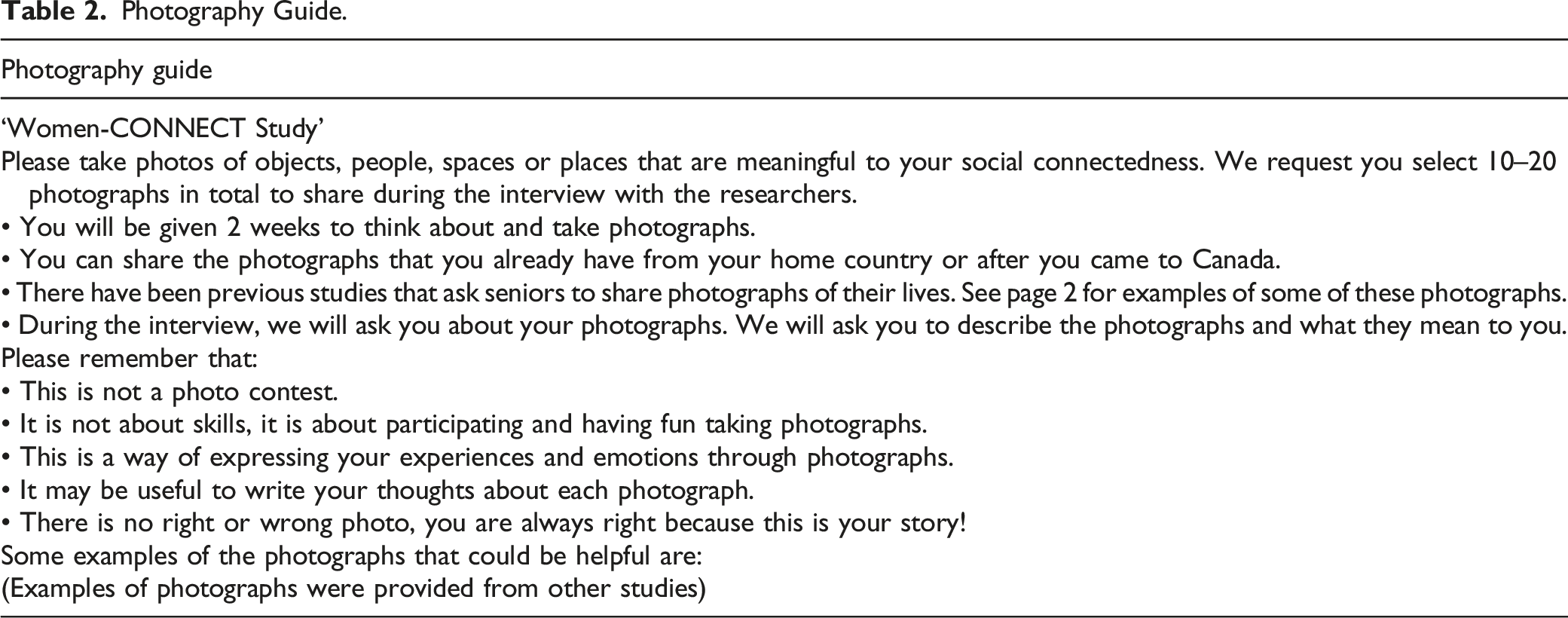
Interview Guide.

Data Analysis
All interviews were transcribed verbatim in English, Urdu or Arabic. All non-English transcripts were translated to English and validated by a member of the research team. The lead researcher was a bilingual Arabic speaker and the team included bilingual Urdu-speaking graduate students. A reflexive thematic analysis (Braun & Clarke, 2022) was used to identify patterns of experiences across the data set that spoke to women’s social connectedness. Data analysis was a collective effort, involving co-construction within the research team, that included the lead author and six graduate and undergraduate students. Three students identify as belonging to the same religious, cultural and linguistic communities of research participants. Having an insider lens helped facilitate cross-cultural understandings during data analysis. The lead researcher has expertise in qualitative analysis methods, aging, and migration which facilitated the mentorship of students on this project. A number of peer-reviewed academic publications on study results are in progress. A website of the photographs and accompanying stories was created to disseminate study findings to non-academic audiences (See Figures 1 and 2 for sample website content). Study results were, also, communicated to non-academic audiences via a print and television national news story. Study findings. Study findings.

Photo-Elicitation Lessons Learnt
We focus below on the aspects of photo elicitation that were central to our experience of collaborating with Muslim older women on the women-CONNECT project. Some of the discussion addresses the significant implications of the COVID-19 pandemic on project activities. In the sections below, we cover: (1) selection and access to photographs, (2) informed consent, (3) shared meaning-making, (4) politics of a photograph, and (5) digital opportunities within a pandemic.
Selection and Access to Photographs
Participants were asked to identify 10–20 photographs or images that spoke to their experiences of social connectedness. Family were often involved in selecting photos and participants consulted with the community liaison to validate their choices or re-affirm that they were meeting the expectations of the project. Photos were mostly from their digital or physical photo albums. A smaller percentage opted to take new photographs within the 2-week timeframe before the main interview and some shared images from the internet. Initially, some participants were unsure if their chosen photographs met the criteria of the study or would be useful to the researcher. Interviewer: Do you feel that there’s some pictures that you would have liked to share today if you were able to, that you didn’t get to show us? Participant 2: I don’t know what kind of pictures to share, you know. They’re mostly old family pictures or of my paintings, there’s Zoom weddings, and so those are the happy, good memories…then there are pictures of sceneries that I take, of just our plants, or the trees, or the park, so I don’t know if that would make any sense to you.
The worry about obtaining the right photographs has been mentioned in other studies with older adults (Bryanton et al., 2019; Novek et al., 2012; Ronzi et al., 2016; Vigurs & Kara, 2017). Taking the time to encourage participants and emphasize the value of their contributions was important. Women chose images that were meaningful and reflected important people, places, and events in their lives. While difficulties capturing the intangible aspects of life, such as loneliness were identified in other studies (Mysyuk & Huisman, 2020; Padgett et al., 2013), there was a range of responses from participants. Some participants focused on images that represented abstract ideas such as loss (jewelry that belonged to a friend who passed away), belonging (a plant native to the homeland), and community (cultural food and non-English books). Others were more concrete in their exploration of social connectedness and chose to share images of people, events, and places. Studies using participant-driven photo elicitation with older adults show the range of images from concrete to abstract, for example, by using symbolism to depict body image concerns in relation to disability and older age (Bailey et al., 2021). Similar to Vigurs & Kara (2017), we framed the research study in the present but the majority of participants shared photographs from the past; this was evidence of the power of photo elicitation in allowing participants to re-negotiate the boundaries of the research project. Participants uniformly shared images of deceased parents to explain their current sense of resilience, connections to their homeland and culture, and the continuity of valued relationships with their children and grandchildren.
Participants exhibited a range of emotions from laughter to tears as they reflected with the interviewers on the experiences and meanings of their photographs. This highlights the intimate nature of the interview and the centrality of trust required for participants in the interview encounter (Padgett et al., 2013). This picture (image of a family gathering) makes me cry…So there was so much going on. It is such a happy moment in our life. But things just changed, you know. Things just changed in a week. And this guy was not even sick. It was only one night. One day he was not well, and he was just gone with a click of a finger. So now this picture tells me that live for the moment. Live for the moment because you don’t know what’s going to happen the next moment. (Participant 3)
Overall, women reported positive experiences with photo elicitation as it allowed them to reminisce about their lives. During an initial group introduction to the study with seniors from a social program, the research team chose an image of a black and white village in Lebanon as an example of a possible type of photo. A few participants rushed up to the projected image and began pointing out their neighborhood, the tree that was near their childhood street and their family home. The photo was of a village of some of the Lebanese participants and led to reminiscing in the group. The power of photographs to elicit memories, reflections and meaningful sharing was immediately apparent in this encounter with the community. Positive experiences with photo elicitation have been reported in other studies with older adults where participants valued the space to share their perspectives with the research team and the public (Quinton et al., 2022). A group of participants opted to continue the storytelling sessions for four months as a social activity after the research study concluded and pandemic restrictions were lifted which is further evidence of acceptability and potential for meaningful engagement with visual methods. Interviewer: I want to ask you how was the experience for you getting the pictures and showing them to me and talking. How did that feel? Participant 20: I feel good. It was a good thing. My friend told me about you and she said you will enjoy it. So, I did that. I liked sharing experiences of my life with you, collecting pictures and sharing them with you, about people here, especially in Canada, cultural pictures that are related to Pakistan too.
We did not note instances where the experience of sharing photos was emotionally overwhelming or traumatic. This could be because participation was voluntary and those with more traumatic experiences might not have chosen to participate. Also, participants likely selected photos they wanted to talk about and avoided those that would bring up difficult memories. Women did use images as anchors for life experiences that were particularly challenging, such as the image (Figure 3) that was taken at the funeral of one woman’s spouse, where a light rain was an omen of good passage to the afterlife. She said: “So, this made me really happy and that’s why I really do love this picture…I keep it with me in my folder on FaceTime” (Participant 07). Other studies using arts-based methods identify the potential for reliving difficult memories (Salma et al., 2023). For those who shared experiences of loss of loved ones in this study, the interview was an opportunity to reminisce about happier times. Image taken at the funeral of a participant’s spouse.
For some women, sharing photos was not a preference, and they opted either to not share photos in the interview or did so after encouragement from their family members. One participant was clearly not interested in the photo elicitation process but were trying to meet the study requirements. Interviewer: Why did you send this picture? Participant 27: Actually, I don’t like being photographed. They said a photo is necessary, so due to this condition my eldest daughter clicked this picture and sent that to Alaa (research assistant).
The desire to engage with photography and the resulting images is key to success for participant-driven photo elicitation. A strong preference to avoid engaging in photography was identified by Collier and Collier (1986) in an Amish community. Bigante (2010) described photo-elicitation working in one community in Tanzania but not others because of the variable acceptance of the camera. For some participants in this study, photographing humans and animals is religiously prohibited and they chose not to provide photographs or shared photographs of objects and places. Participant 23: That’s why I don’t take pictures…Because of Islam, because in Islam it’s not good, it’s prohibited…That’s why I don’t make photographs, only sceneries we can make photo. It’s prohibited for a living thing. Interviewer: And that’s why your pictures don’t have people in them. Participant 23: Yeah, that’s why. I strictly obey this rule of Islam.
Interestingly, the photographs of inanimate objects were still rich with meaning and evoked thick descriptions of social connectedness (Figure 4). This indicates that photo elicitation is a feasible data collection tool even for those who might have restrictions on what can and cannot be photographed. It’s a perfume bottle. But it’s empty…I wanted to show this because the inner self of this bottle has always contained perfume… its fragrance isn’t gone…right now I feel that I’m old, my husband passed away. He was a very happy person and a very funny guy. He was a very close friend to me. After he passed sometimes I felt I’m alone even when my children are here. If my inner self is alone, then there is problem. I have to keep myself alive. I have to bring out that aroma in myself. (Participant 24) Image of inanimate object.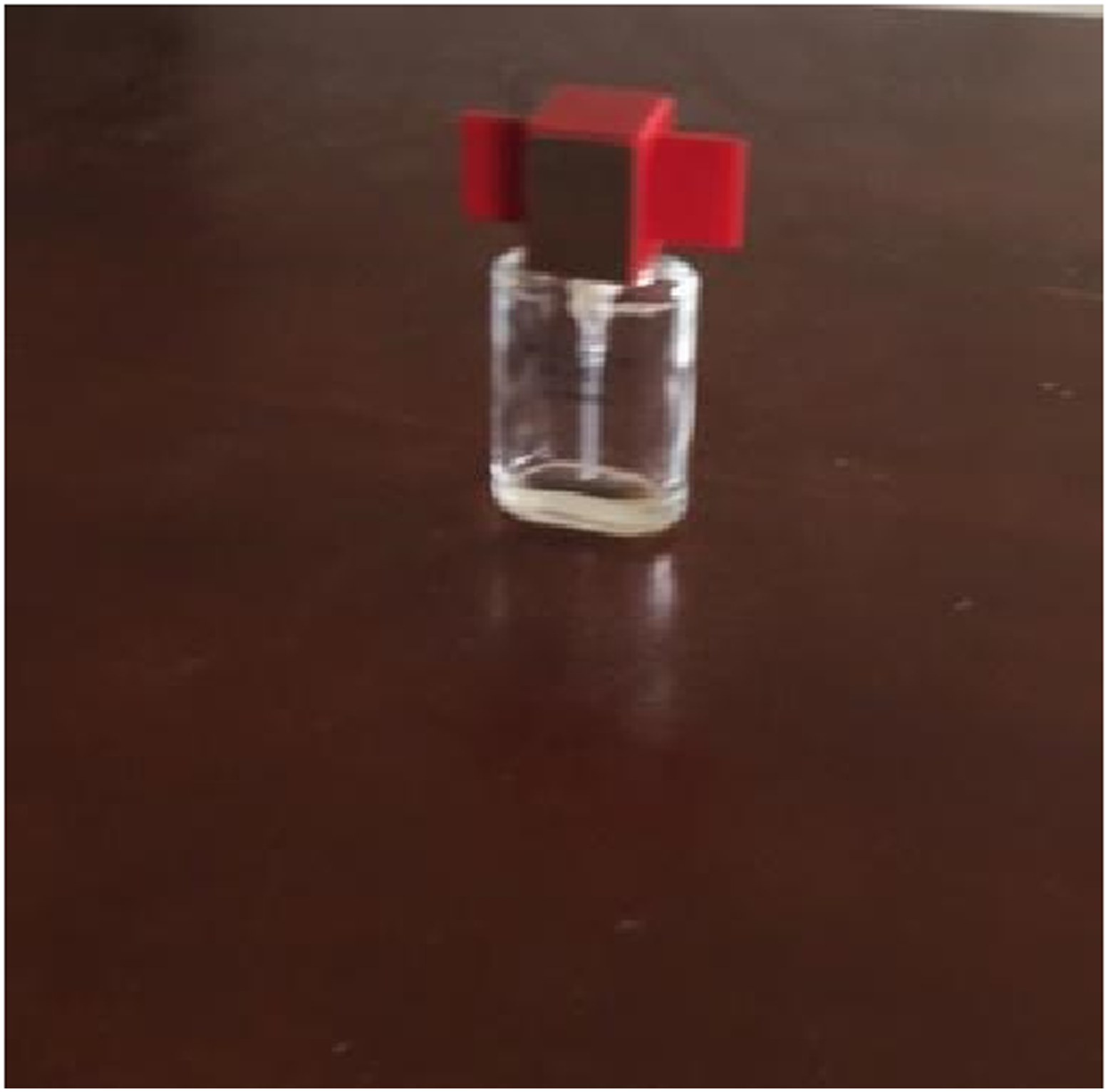
Informed Consent
The risks of going public with a photograph can be high especially if it counters prevailing social or cultural norms (Sinding et al., 2008). Consent was obtained for each image, if it was to be shared with the public, and participants could choose which images were shared. Anonymity is of particular concern in local and close-knit immigrant communities where participants are easily identifiable through their stories and photographs. A balance is needed between safeguarding participants’ rights to privacy protection with their moral right to have their voices heard (Wiles et al., 2012). We used a three-level consent process for this study, drawing from best practices identified by other researchers (Ferlatte et al., 2022; Wang & Redwood-Jones, 2001; Wiles et al., 2012): (1) consent to share photographs with the interviewer during the interview or with the interviewer, (2) consent to provide copies of the photographs to the research team for data analysis, and (3) consent to use photographs for public dissemination. Verbal consent was obtained for a few virtual interviews that did not include photos because submitting a signed electronic consent form was difficult for participants.
Sharing photographs with the research team was initially seen as low risk to participants; however, two unique challenges were identified with some participants wearing the hijab (the Islamic head-covering) and with the close-knit nature of the immigrant communities. After the first few interviews, we realized that many photos were of participants and their family members who wore the hijab and these images could not be shown to men outside their immediate families. Only research assistants who identified as women were allowed to engage in data analysis of the complete data set that included these private photographs. These women put extensive trust in the primary researcher and the research team, many of whom were Muslim women who also wore the hijab. Future researchers who are not from Muslim communities or are from different genders than their Muslim research participants should address the issue of who has access to the full data set from the research team. One participant said “One request I do have is don’t share any picture without hijab… I asked (community liaison), and she said that nobody is going to see. I said okay” (Participant 28).
Ensuring the anonymity of a photograph can be difficult even when identifiable information is not readily apparent. It is important to note that since the advisory committee was involved in recruitment and snowball sampling was a useful approach, some participants were from the same social circles. In a meeting with the advisory committee, we shared some exemplar photos from our data set. One image was of an indoor plant in the corner of a home (Figure 5). Immediately a member of the committee stated: “I know whose house that is.” Image of a houseplant from a participant’s home.
This incident reflects the real challenges of using photos in close-knit immigrant communities within a particular geographical region. While it is possible to change the details of a narrative exemplar, it is more difficult to alter a photograph without changing the experience that the photograph represents. As careful as the research team had been in informing participants that identifying photographs would be used only for analysis and not for knowledge dissemination, we could not predict whether a particular image of an object or place would be identifiable. This risk will need to be communicated to participants in the future for projects with close-knit immigrant communities.
Shared Meaning-Making
Interviewing using photographs to guide and provide reference points is described by Collier and Collier (1986) as ‘exploring the photographs together’ (p. 105) with participants, while other researchers have called this process ‘joint theorizing’ (Glaw et al., 2017, p. 7). Photo elicitation helped move from experiences related to photographs to more abstract discussions about social connectedness in older age. We labeled this shared process of meaning-making between the interviewer and the participant as proximal and distal meaning-making. Proximal meaning-making involves answering why they selected a particular photograph or what it could tell about their lives. Often participants then moved, with or without probing from the interviewer, to distal meaning-making. This involves expanding from immediate experiences and emotions related to the photograph to other threads of their aging experiences to weave a cohesive narrative. Distal meaning-making is similar to what Hodgetts et al. (2007) described as happening beyond what is captured in the frame of a photograph; capturing situations, events, and issues that are central to participants’ lifeworlds and are unrestrained by time and place.
Collier & Collier (1986) describe the analysis of photographs as a decoding process that moves from the visual to the verbal, articulating and building ‘systematic knowledge’ (p. 170). In interviews with participants, decoding, exploring and, joint theorizing resonated during the interviews. Participants explained the photographs, the meaning and intention of sharing the photographs, and then used these photographs as a jumping-off point to expand on core themes in their lives that related to social connectedness. This process maintained a participant-driven interview process and allowed the participant to reflect on the shared images and explore their experiences that were derived from this reflection. Participant 1 [referring to Figure 6 Image from a birthday party. Interviewer: Tell me about why you chose this particular picture. Participant 1: This picture depicts all the hard work to make him feel special. All the food we made, the decorations, and the amount of time it took to set it up…I think saying we love each other, and we do, but you have to show people actions also. [meaning-making, proximal] Interviewer: Is there anything else that this kind of picture brings to mind? Participant 1: My daughters always say, “Mom, you always go overboard. You tire yourself out. You went through all this trouble.” But the thing is, I enjoy it…With age- a few years ago I could do a lot more, and a lot quicker, than today. [meaning-making, distal] Participant 19 [referring to an internet image of tea & samosas]: Why I picked up this samosa and chai is that this was one of the many ways of communication during the pandemic[image description]. I learned that samosa is one of the things that most Muslim communities not only enjoy, but each claims samosa to be their own. I met ladies at the Masjid. We attended Quran recitation sittings and enjoyed them thoroughly. We were happy. We were talking. Talking was all that really mattered. And you talk more freely when you know that you won’t be judged…most Muslim ladies, they have the same problems. Our sense of dignity, our sense of family honor…samosa and tea became symbols of social gatherings in the mosque, or people’s homes, sometimes parks. [meaning-making-proximal] Interviewer: I’ve heard a lot of women say that they need women their same age to share these worries. Participant 19: There’s a human, there’s a lady, there’s a feminine person very much alive that needs intelligent talk. When we are with these relations (kin/family), it is indeed a blessing from Allah, but the thing is that you need your ‘me time’ as well. [meaning-making-distal]
Visual methodologies can allow for non-verbal expression of experiences and emotions that can overcome language barriers; however, cross-language translation must still occur through interpreters during data collection and knowledge dissemination (Fitzpatrick et al., 2012; Lager et al., 2012). Moving from description to proximal and distal meaning-making was limited when interpreters were used. While interpreters function as cultural brokers, participants seemed to simplify their responses which were more concrete and descriptive versus analytical and reflective. This might have been because of the lack of spontaneity in the conversation when the flow was interrupted by the interpretation process or because the language barrier hindered rapport development between interviewer and participant to allow for shared meaning-making to occur. We strongly encourage photo elicitation to occur in the language participants are most fluent and comfortable speaking.
Politics of a Photograph
While empowerment has been explored in the context of photovoice (Bryanton et al., 2019; Ronzi et al., 2016; Seitz & Orsini, 2022), the ways that power dynamics impact photo elicitation should be further addressed within marginalized groups. Muslim women selected their photos which resulted in a two-fold research agenda: to answer the research question and to avoid re-stereotyping participants. The second objective became more apparent as data analysis progressed and the politics of knowledge dissemination surfaced. The ethical implications of disseminating images beyond the research team has raised concerns, including the risks of breaking trust with a community (Collier & Collier, 1986) or presenting communities in ways that do not reflect the stories they want to be told about themselves (Wang & Redwood-Jones, 2001). A visual image is fraught with socially constructed and politically implicated interpretations, with tangible consequences for those who produce, view, interpret, and share them (Rose, 2001; Wiles et al., 2012). We did not anticipate that the decision of which photos were to be used for public dissemination was a political act as much as a scientific exercise of rigor. Packard (2008) raises an important issue about power and knowledge where ‘knowledge is power only to the extent which it can be communicated’ (p. 73). We were not only asking which images represented the study themes on social connectedness, but also which images risked re-stereotyping Muslim women and which images could be misinterpreted.
One participant explicitly stated that there were rarely public images that reflected her experiences as a Muslim older woman wearing the niqab. While this participant wanted more images of women wearing the niqab to be included, the picture she shared did not capture the complexity and richness of her life, her love of her daughter, or her pursuit of education. The image was a faded photograph of a woman wearing a black niqab with a bare wall as a background. The image risked re-stereotyping the ‘Muslim woman’ within an already politically fraught Canadian landscape where policies such as Bill-62 continue to have negative impacts on women who wear the niqab (Mercier-Dalphond & Helly, 2021; Stonebanks, 2019). The power of older adults to create and share images that truly represent them can be limited as it was for this participant whose low digital literacy did not allow her to share images of social connectedness that reflected her current life. A look at the Instagram site of Amy Roko, the Saudi Arabian niqab-wearing influencer, or at episodes of We are Lady Parts, a British sitcom about a punk rock band of Muslim women, shows the diverse ways that the niqab can showcase the individuality and agency of its wearer. The images that participants chose to share, or not share, reflect as much of their understanding of what is acceptable, required, and possible to share in a particular interview encounter as they do about their actual life experiences (Hodgetts et al., 2007). Providing adequate support and tools to take photographs was limited due to the pandemic restrictions but would have been helpful in these instances where older adults did not have in their possession a large range of images to share that reflected the narratives they wanted to convey.
A second challenge related to consent but had critical implications for knowledge dissemination. Participants shared images of family and friends and other researchers have discussed the challenges of consent in these instances (Bryanton et al., 2019; Mysyuk & Huisman, 2020; Wiles et al., 2012). We could not obtain informed consent from everyone in the photographs, even when participants were willing to do so, because of pandemic restrictions that limited social interaction or because the individuals in the photographs had died or were living in other countries. These images were not used for public dissemination and were kept for data analysis only. Some participants struggled to find photos that did not include people and tried to obtain verbal consent from family and friends, while others did not want any identifying photographs made public. Participant 2: You told me you guys going to delete the faces, right? Interviewer: We won’t take any pictures with faces…We will be sending you the pictures with consent form. So, you can see which pictures we are keeping with us and which your permission and signature we will be using those pictures.
Family and friends were central to the women’s stories and were in the overwhelming majority of photos shared by participants to reflect their social connections. Removing these photographs from any public displays meant that a rich and colorful portrait of women’s lives was kept hidden. This became even more problematic as the research team reflected on the negative representation of Muslim women in public discourse (Hunt et al., 2020). The positive, joyful, and empowering group photos that the women shared challenged these stereotypes. Women shared images of colorful celebrations, friendly gatherings of women over food, women embracing family members, and women active with their daily hobbies. Another researcher working with an older LGBTQ+ community called for re-exploring consent in photovoice when participants choose photographs that were created for a time and place beyond the research study and cited concerns around representation (Chen, 2022). Hodgetts et al. (2007) discussed the concerns of participants living in homelessness around being stereotyped and misrepresented in popular imagery, while trying to counter these depictions in taken photographs. In hindsight, a more proactive approach to obtaining consent for these rich depictions of social life would have been beneficial such as working with the Ethics Review Board on ways to obtain consent from family and friends. Photo-anonymization is not always best practice as it includes loss of meaning, misinterpretation of the anonymized photo, and disempowerment of participants by taking away their right to be seen and heard (Allen, 2015; Glaw et al., 2017; Wiles et al., 2012). In working with older adults, we agree with Wiles et al. (2012) that the vulnerability of participants within a given time and place, the focus of the research study, and the ways that the data are presented to the public need to be considered together when deciding how to use non-anonymization.
We recognize the challenge of finding publicly available images that depict older Muslim women as they wish to be seen-vibrant, engaged in their communities, intelligent, and diverse; therefore, we scheduled a photoshoot for some of the study participants and their peers. The photoshoot was to celebrate the conclusion of the project and to create a range of photographs for knowledge mobilization activities that represent the vibrant lives of Muslim older women. The resulting images, once approved by the women, were used for knowledge mobilization activities such as on the study website, in conference presentations and in community reports. The photos included women praying, conversing with peers, and engaging in recreation activities. Consent was given by all participants of the photoshoot to use the images for knowledge mobilization. This helped meet the research objective of showcasing positive images of Muslim older women and countered the limitations experienced during the pandemic with the lack of ability to produce new photographs that reflected participants’ current lives.
Digital Opportunities with a Pandemic
Comfort with technology is a prerequisite for effective participation in visual methodologies and can be a barrier for older adults (Mysyuk & Huisman, 2020; Novek et al., 2012; Quinton et al., 2022; Ronzi et al., 2016). The physical distancing requirements of the COVID-19 pandemic meant that we could not train less digitally literate participants on how to use required technologies. Additionally, physical disabilities, loss of eyesight, and reduced hearing can prevent participants from using the technologies required for participant-driven data collection (Hepburn, 2018). Similar to Ferlatte et al. (2022), who collected photovoice data with older adults during the pandemic, we used multiple strategies to make the project accessible, decrease the burden on participants, and alleviate technological anxiety. For those with a basic understanding of information and communication technologies (ICT) and who had access to digital devices, social media and videoconferencing tools were instrumental to overcome time and spatial limitations. We held an introductory meeting to increase comfort with technology use and used the messaging tool WhatsApp to share Zoom videoconferencing links and photos. Digital technologies offer an opportunity to connect within the comfort of one’s home while providing visual access into the home lives of participants (Chen, 2022). Conducting virtual interviews had the added benefit of enabling the participation of individuals who did not frequently venture outside due to limited access to transportation or adverse weather conditions. Two unique participant behaviors were identified in this study that highlighted the potential for ICT to democratize research even with older adults who often experience the brunt of the digital divide: (1) asynchronous photo sharing and (2) live video tours.
WhatsApp is one of the most common social media platforms used in the Middle East, North Africa, and South Asia, making it a key transnational communication tool. Participants were comfortable with WhatsApp and used this platform to share images and communicate with the research team. In addition to sharing images outside the interview timeframe, participants used the interview space to show additional objects or photographs that they had at home when prompted by a probe from the interviewer. The following two examples of video tours show the spontaneous and informal nature of sharing that occurred during video exchanges.
Example 1: Interpreter: She is saying that the “money plant” is between those two plants. So, we can’t see that. So, she actually went to bring it…[participant shows a house plant on video]. Again, going to bring something else. [participant shows a Jasmine bush].
Example 2: Participant 23: I’m going to the backyard. I: Oh, okay P: So see, these are all grapes. I: Oh, there they are. Oh, that’s beautiful. P: Yeah, these are grapes, grapes, grapes, grapes. And this is a peach tree, and these are plums, see? I: Oh, wow P: Mashallah, too much plums. But it’s firm. Not ready. Yeah. See, these are grapes. I: Oh, that’s beautiful. [video tour of a participant’s garden]
One participant brought an old DVD player to an in-person interview to show a video of her international volunteer work, while other participants sent videos via WhatsApp to supplement the photographs shared during the virtual interviews. While technology enhanced the quality of participation for many participants by offering flexibility and new ways of engaging in data collection, some significant barriers to participation remained for many older adults in the community. Manual dexterity and visual acuity are required to take a photograph, select photographs, and share them with others (Mysyuk & Huisman, 2020; Vigurs & Kara, 2017). Two older adults who were interested in the study during the peak of the COVID-19 pandemic opted to only participate in interviews because of their vision loss and tremors that limited their ability to share photographs with the research team. Access to spaces and people that the participants wished to photograph is a prerequisite for effective participant-led photo elicitation which can be limited by mobility or other health barriers (Airth et al., 2022). Participants reported that the pandemic restricted their access to meaningful people and places, and shared old photographs by taking pictures of them with their smartphones and sending them via WhatsApp to the research team. Some refugees and newcomers reported that they did not have any photographs or a sufficient range of photos of particular people, places, or events that were meaningful in their lives, having left everything behind in their home countries. Asking about photographs not taken explores the aspects of loss, absence, and change (Hodgetts et al., 2007) and was an important element of this study with immigrant older adults where spatial (transnational lives) and temporal (aging-related losses and changes) disruptions often made an over-reliance on photographs potentially misleading. Most significant was the emotional distress that might result when the researcher is unaware of these losses during data collection. While we allowed some participants to engage in interviews without photographs, this study requirement could have heightened their sense of loss but we did not explore this during the interviews. With the purpose of valuing what the participant could offer, their stories, we intentionally did not ask about missing photographs during the interview after we were informed in the introductory meeting that the participant did not have access to them. One refugee woman from Afghanistan, who we interviewed without photos, shared her feelings. Thank you so much for listening. She says now she feels a little bit better that she talked to you. She said there was never someone that she could sit and talk to, say how she was feeling in the time since she’s been in Canada. And she feels very happy for that, and she was saying thank you so much for that. (Translator)
Opening up visual methodologies to new ways of sensory knowing by using other visual artifacts can allow for wider participation and could be included in future studies to enhance equity and reduce the potential for psychological harm.
Conclusion
Photo elicitation can be a rich source of data. What participants choose to share vs. not share via photographs might not always be the result of how they decide to answer the research question. Instead photo elicitation success can be influenced by external barriers and what is perceived as a sharable image. Using photographs in research is a double-edged sword. Images can be dangerous when not reflecting the experiences and self-understandings of the communities they represent. Images can be empowering when used as rich emotional and experiential conduits of communities’ experiences by strengthening and expanding our understanding beyond what words alone convey.
Consent as an ongoing process requires continuous re-examination as the researcher becomes familiar with the research context. Asking participants about meaningful photographs that they did not want to share or could not share can be telling. Technology might facilitate the transnational exchange of digital photographs, linking older adults with what they left behind. Additionally, incorporating other arts-based approaches where older adults create new artifacts to reflect their experiences and emotions might be more appropriate for populations that have lost access to photographs reflecting their most meaningful life experiences. Older adults find emotional value in reminiscing and allowing for life-course narratives can enrich the understanding of the research topic and enhance engagement in the research process. We identify three questions to ask when using participant-driven photo elicitation with immigrant older adults: 1) Are participants consulted on research risk mitigation plans, including risks to anonymity and confidentiality? Risks of emotional and psychological harm? 2) Do participants have access to the range and types of photographs that are meaningful to them? 3) What political and social considerations for knowledge dissemination should be safeguarded for participant’s right to ‘just representation’?
This study is one case example of engaging Muslim older women in a visual methodology and the findings might not be applicable to all Muslim women. We wish to avoid essentializing our participants’ research experiences because Muslim women embody diverse socio-cultural, religious, and personal histories across temporal and spatial contexts. The experiences described in this article are a range of possibilities and complexities to be considered when engaging older Muslim women in research.
Footnotes
Declaration of Conflicting Interests
The author(s) declared no potential conflicts of interest with respect to the research, authorship, and/or publication of this article.
Funding
The author(s) disclosed receipt of the following financial support for the research, authorship, and/or publication of this article: This work was supported by the Social Sciences and Humanities Research Council of Canada grant number (SSHRC IG 435-2020-0867 Salma).
