




Abstract
Despite well-documented physical, mental and developmental health benefits of organised sport participation, sport dropout rates for female adolescents continue to surpass those of male adolescents. Currently, sport dropout is seen as a negative endpoint of an adolescent’s sport participation journey, and no effective method of re-engaging dropped out participants exists globally. Co-design workshops may be a productive method of creating strategies to re-engage this cohort, but there is currently limited literature documenting their use in this setting. To address this gap, this paper presents a case study which employed co-design workshops with adult stakeholders in female adolescent sport (n = 25) to create a sport re-engagement strategy for female adolescents. Workshop design was informed by two conceptual models (the Youth Sport System and the Participation Re-Engagement model) and rich qualitative data from female adolescents. Across three interactive workshops, participants engaged in multiple individual and group activities which informed the development of sport re-engagement guidelines for female adolescents. These guidelines have subsequently been endorsed, published, and disseminated by State Government. This paper critically discusses the strengths and limitations of the method, and succinct recommendations are made for researchers considering the use of co-design workshops as an interactive data collection method in future.
Introduction
Participation in organised sport can lead to broad and significant health and developmental benefits for adolescents, including improvements in mental health (Vella et al., 2017), increased cardiovascular endurance (Carlisle et al., 2019), and improved social skills (Eime et al., 2013). Despite this, less women and girls participate in sport than men and boys, in part due to heightened levels of dropout during adolescence (Australian Sports Commission, 2024; Drummond et al., 2022). To counter this, multiple sport organisations globally have incorporated female participation into strategic plans, or have female-specific participation initiatives (e.g. Football Australia, 2024; International Olympic Committee, 2021). However, there remains a distinct lack of interventions or strategies aimed at engaging female adolescents in organised sport and closing the gap between male and female participation rates in both the peer-reviewed and grey literature (Allison et al., 2017; Kay, Elliott, et al., 2025).
Dropout during adolescence is generally seen as the endpoint of an individual’s sporting journey. However, recent scholarship has theorised that adolescent dropout may be an appropriate and necessary process which allows adolescents to sample a variety of activities and experience positive identity development (Battaglia et al., 2024; Battaglia & Kerr, 2022). In addition, sport dropout may reflect adolescents withdrawal from harmful environments, or transitioning to less structured forms of sport and physical activity, as indicated by increased participation in informal sport (Battaglia et al., 2024; Jeanes et al., 2022). Therefore, short-term dropout from sport may not be the crisis it is often portrayed as, and scholars and sport organisations should instead focus their efforts on preventing dropout from leading to long-term, sustained disengagement from sport (Battaglia et al., 2024; Kay et al., 2024). One method of achieving this is via targeted re-engagement strategies which allow adolescents to participate in, drop out of, and re-engage with sport on their own terms (Kay, Klass, et al., 2025).
A strategy to re-engage participants should be distinctly different to strategies designed to enrol new participants or retain existing members, and its creation requires a targeted approach that considers re-engagement distinct from other participatory behaviours (Kay et al., 2024). In addition, given the highly contextual nature of the barriers to sport participation that female adolescents face (e.g. Charway & Strandbu, 2024; Cooky et al., 2016), a place-based approach which considers contextually relevant factors is warranted. Co-design may be a productive method of developing sport participation strategies that are specific to a participatory phase, particularly for populations that have previously been marginalised in sport. For the purposes of this paper, we adopt the definition of co-design proposed by Constantin et al. (2022, p. 6) which states that it is “a user-centred approach involving collaboration between researchers, end-users, and other relevant stakeholders who are actively engaged throughout a process of iteration and continuous reflection to create an intervention tailored to the specific needs of the target population.” Co-design allows those with firsthand knowledge to propose strategies and solutions rather than just recount their experiences, and has been posited to have additional benefits over more common qualitative methods by allowing interventions to be developed in with the population, rather than being placed on them (Bogomolova et al., 2021; Daly-Smith et al., 2020).
Co-design has previously been employed to create physical activity interventions with female adolescents. The Girls Active Project was developed using a three-stage co-design process, resulting in a peer-led after-school exercise program focussing on fun, inclusivity, and peer-support (McQuinn et al., 2022a). Despite a robust co-design process, only 10% of eligible students were recruited to the program and average attendance per session was approximately two thirds of those registered (McQuinn et al., 2022b). This was potentially due to the co-design process focussing primarily on the development of the program and not incorporating advertisement and recruitment which are equally important to program success (McQuinn et al., 2022b). Corr and Murtagh (2020) used a co-design method which combined questionnaire and focus group data to devise a 6-week physical activity intervention for female adolescents. The program had a significant effect on some measures of physical activity, along with a 100% participant retention rate (Corr & Murtagh, 2020). This may be attributable to the incorporation of qualitative data in the intervention design creating a sense of participant ownership over the program (Corr & Murtagh, 2020). Finally, the Girls Active program (different from the Girls Active Project) worked with teachers and pupils to co-design a physical activity intervention for female adolescents in schools (Harrington et al., 2019; O’Reilly et al., 2023). The program’s aims and objectives were supported by students and teachers. However, its success was limited due to schools focussing on consultation and cultural change rather than actual physical activity opportunities, a lack of training for leaders, and schools not utilising all the resources provided (Gorely et al., 2019).
The extant literature shows that co-design can inform the creation of well-designed physical activity programs for female adolescents. However, actual effectiveness of these programs on physical activity levels has been limited due to the co-design process not incorporating all aspects of the program or all individuals involved in its delivery (e.g. participant recruitment, training for service providers etc.; Gorely et al., 2019; McQuinn et al., 2022b). Community sport is heavily dependent on an unpaid workforce and constraints such as lack of funding, ground/venue availability, and volunteers can limit the impact of participation programs (Byers, 2009). By better understanding the complex social and structural conditions that limit the capacities of key stakeholders such as state sporting organisation staff, local government, teachers, coaches, and parents, effectiveness and applicability of research findings can be maximised (O’Reilly et al., 2023). Therefore, inclusion of those responsible for the service delivery of sport in the co-design process may help overcome some of the barriers that have limited previous co-designed interventions (Gorely et al., 2019; McQuinn et al., 2022b). Although co-design has been used to create physical activity interventions with female adolescents, this approach has not been used to develop an intervention to increase female adolescent participation in organised sport. Therefore, an important gap exists in the use of co-design as a method to create sport participation initiatives or strategies for this population.
Workshops, which can be defined as “an arrangement whereby a group of people learn, acquire new knowledge, perform creative problem-solving, or innovate in relation to a domain-specific issue” (Ørngreen & Levinsen, 2017, p. 71) provide a practical opportunity to address this gap. Although workshops as a research method are specifically manufactured to produce reliable and valid data to satisfy a research outcome, they can also provide an authentic and beneficial experience to participants by achieving an outcome specifically related to participants’ interests (Ørngreen & Levinsen, 2017). Co-design workshops have been used successfully as a research method across multiple domains including healthcare (Bradway et al., 2020), service design (Steen et al., 2011), and physical activity (Brown et al., 2020).
Despite potential benefits, workshops do not always have the outcomes that facilitators intend (Elsden et al., 2020). This can be due to researchers dominating discussions with participants, thus hampering the generation of genuinely co-designed outputs (Nierse & Abma, 2011; Northway et al., 2014). In addition, it has been argued that workshops are often unclear in their purpose, with researchers implementing workshops in an ad hoc manner which lacks clear direction (Elsden et al., 2020). Without deliberate planning and delegation of roles, a researcher may be required to simultaneously assume multiple roles during a workshop which each carry distinct responsibilities (e.g. facilitator, host, minute-taker etc.), potentially limiting the depth and/or quality of data that can be collected (Elsden et al., 2020). Ultimately, workshops are just one piece of the researcher’s methodological arsenal when creating interventions, but optimally designed and facilitated workshops can lead to beneficial findings (e.g. Adler et al., 2022).
The purpose of this paper is to critically discuss the strengths and limitations of using co-design workshops to create sport participation strategies for specific populations. For the purposes of presenting the method, a case study which sought to create a sport re-engagement strategy for female adolescents in South Australia is described. This study used three co-design workshops with adult stakeholders in female adolescent sport and was informed by empirical qualitative data from female adolescents (Kay, Klass, et al., 2025). Following a brief description of the case study, a detailed discussion of the method’s characteristics, strengths and limitations is offered, as well as lessons learned from this method’s implementation and recommendations for future research.
Case Study: Re-Engaging Female Adolescents in South Australia
Study Underpinning and Design
To situate this case study for the reader, it is necessary to provide an overview of the philosophical and conceptual underpinnings that eventuated in the resultant study design. This study was underpinned by a critical realist philosophical viewpoint, which employs a realist ontological perspective and a relativistic or fallibilistic view of epistemology (Wiltshire, 2018; Yucel, 2018). The ontological assumptions of a critical realist advocate for one universal truth that may have multiple valid interpretations, as opposed to multiple individually constructed truths and realities (Wiltshire, 2018). In line with this, a Participatory Action Research (PAR) design was employed, which can broadly be defined as “a qualitative research approach that takes account of researchers and participants collaborating to investigate social issues and take actions to bring about social change” (De Oliveira, 2023, p. 287). This study involved active collaboration between researchers and community stakeholders to ideate solutions to pre-determined issues, distinguishing the co-design used in this method from other similar methods including co-production and co-creation (Smith et al., 2022; Vargas et al., 2022).
Conceptually, this study was underpinned by the Participation Re-Engagement (PRE) model (Kay et al., 2024) and the Youth Sport System (YSS; Dorsch et al., 2022). The PRE model advances our conceptual understanding of youth sport participation by considering seven distinct phases of sport participation, as opposed to “participation” as a broad, nebulous concept. Kay et al. (2024, p. 721) define re-engagement as “re-enrolment in any organised sport following at least 12 months of absence” which was used to frame the workshop activities. Dorsch et al.’s (2022) YSS uses a systems-based approach to understand the complex phenomenon of youth sport engagement. The YSS comprises three subsystems that contribute to a participant’s youth sport experience: the family subsystem, the team subsystem, and the environmental subsystem. As a participant ages, the proportional role each subsystem plays varies, with the family subsystem (parents and siblings) playing a greater role in childhood and early adolescence, and the team subsystem (coaches and peers) playing a greater role during late adolescence. The environmental subsystem is the all-encompassing macrosystem and plays a ubiquitous role in a youth sport participant’s development. Dorsch et al. (2022, p. 106) note that a consequence of the recent deepening of knowledge in youth sport has been the formation of research “silos,” where the roles of parents, siblings, peers, coaches, organisations, communities, and societies are viewed independently, rather than collectively. This paper responds to Dorsch et al.’s (2022, p. 106) call for “holism” and considers the members of the co-design group and the sport environments in which they operate as an interconnected collective which form a complex system, rather than as separate, independent entities.
Recruitment and Sampling
Summary of Participant Demographics
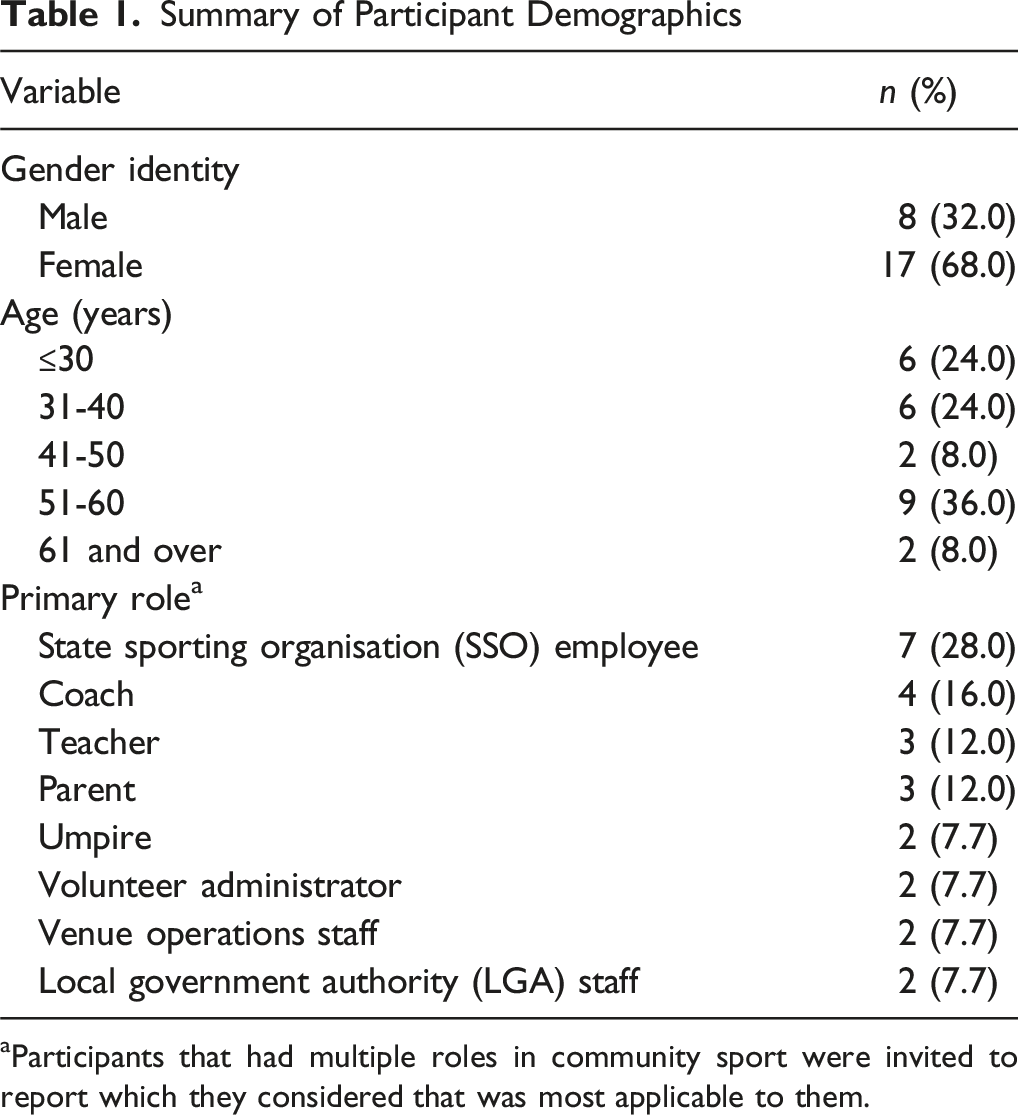
aParticipants that had multiple roles in community sport were invited to report which they considered that was most applicable to them.
Data Collection
Data was collected across three separate workshops, with a summary of the data collection process outlined in Figure 1. All workshops were held at a State Government venue in a central metropolitan location in Adelaide, South Australia. All workshops were 2 hours in length and held from 6:00pm to 8:00pm to allow participants to attend after work. Participants were separated into four groups (three groups of six, one of seven) by the research team prior to the start of the first workshop. Due to participant availability, the actual attendance for each group varied from a minimum of two, to a maximum of six participants. Each group was deliberately constructed to ensure variation in age, gender, and role of participants, allowing diverse ideas and experiences to be shared. Proformas were prepared for each workshop to ensure that all data collected from small-group activities was consistent across groups and in-line with the study’s aims underpinnings. Full copies of these proformas are available in Appendix 1. Summary of data collection process
Workshops were co-facilitated by the lead author and an external, professional facilitator that had run numerous consultations and workshops with the sport sector in South Australia. Workshop activities were developed by adapting those used in previous successful workshops and statewide consultations that informed earlier government physical activity initiatives. The basic structures and proformas of the activities were then adapted to suit the context of female adolescent sport participation. For example, the question “what are the key challenges or barriers to being active in your community?” was adapted to “what act as barriers to female adolescents participating in sport in South Australia?”
Workshop 1
Twenty-one participants attended the first workshop (66.7% female), with the subgroup composition outlined in Figure 2. Subgroup composition for Workshop 1
Example Outcomes From Workshop 1

Workshop 2
Eleven participants attended the second workshop (63.6% female), with the subgroup composition outlined in Figure 3. Subgroup composition for Workshop 2
Example Outcomes From Workshop 2

Following the completion of Workshop 2, the outputs from both workshops were considered alongside findings from previous female adolescent sport research in South Australia (see Kay, Elliott, et al., 2025; Kay, Klass, et al., 2025) to generate a set of re-engagement guidelines to provide explicit guidance for sporting organisations and clubs in developing and implementing interventions to re-engage female adolescents in sport. This was achieved via a mind mapping process, similar to the “thematic map” proposed by Braun and Clarke (2006), and also followed their six steps of thematic analysis. Familiarisation with the data was achieved by the first author, who co-facilitated all workshops and was therefore present during the creation of the initial workshop outputs, and subsequently read all completed proformas twice. The first author then generated initial codes directly from the workshop proforma data and organised these into preliminary themes that formed the basis of a draft set of guidelines. The third author, who was also present during data collection, independently reviewed the draft themes to verify that they accurately represented the feedback provided by participants. Consensus on the thematic structure of the guidelines was reached through iterative discussion between the first and third authors, noting that the draft guidelines were to be presented to the co-design group in Workshop 3. No qualitative analysis or artificial intelligence software was used at any point in the data analysis process.
This process revealed four key themes from the data: (1) improve competition structures, (2) maximise social connection, (3) targeted promotion, and (4) elevate female leaders. These themes were positioned as the core principles of the guidelines, with three distinct recommendations developed under each theme, resulting in a total of 12 guidelines. These guidelines are designed to assist the South Australian sport sector’s readiness for a potential influx of female adolescent participants, ensuring that these individuals return to an environment that meets their needs, therefore increasing the likelihood of retention and sustained engagement of re-engaged participants (Kay et al., 2024).
Workshop 3
Fifteen participants attended the third workshop (66.7% female), with the subgroup composition outlined in Figure 4. Subgroup composition for Workshop 3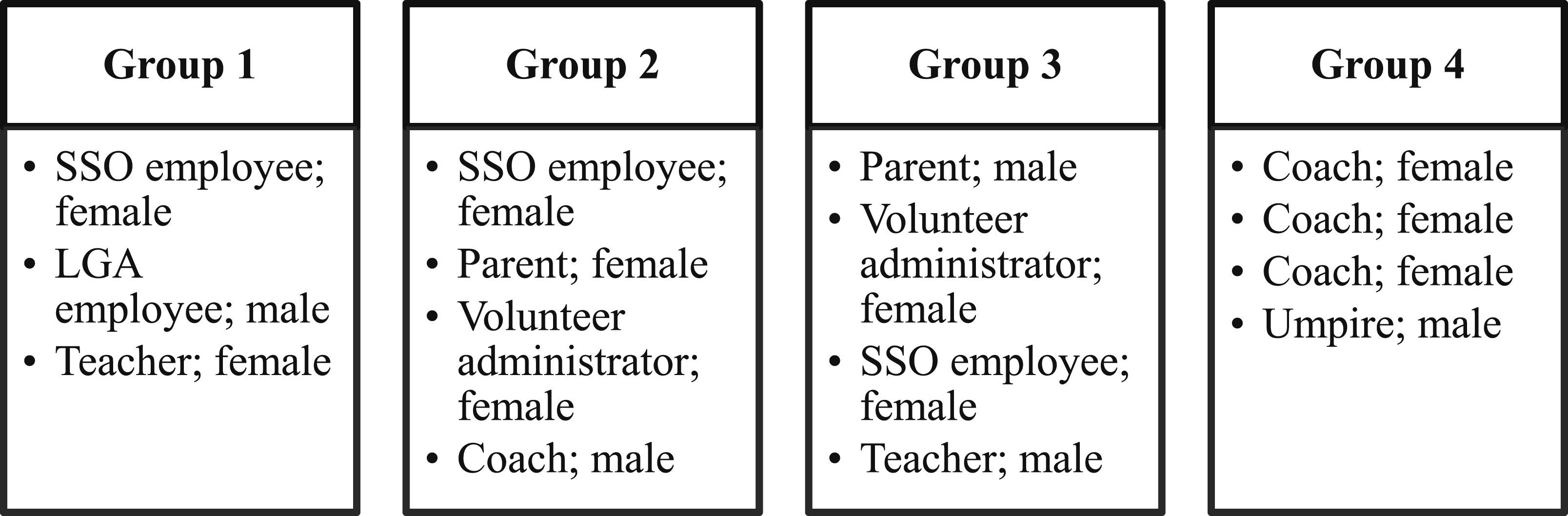
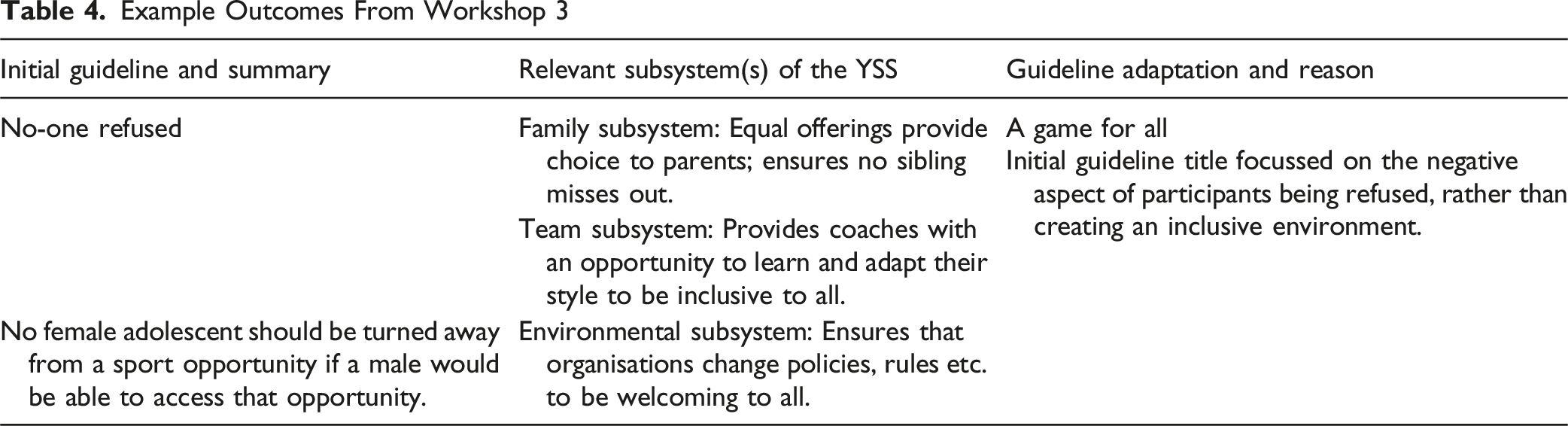
Example Outcomes From Workshop 3
Activities and Outcomes for all Workshops

Discussion
This paper presents a case study where co-design workshops were used as a method of developing a sport participation strategy for female adolescents. However, the purpose of this discussion is to critically discuss the characteristics of, and considerations for, implementing co-design workshops in qualitative sport research. This discussion will be separated into three distinct sections. Firstly, the strengths and prospects of the method will be discussed. Then, the challenges and issues elucidated during the use of this method will be critically evaluated. Finally, considerations for subsequent use of this method by future scholars will be reviewed.
Strengths and Prospects
Upon critical reflection, the co-design workshop method possesses multiple strengths. Firstly, the use of deliberate sampling ensured that the co-design group were representative of those involved in female adolescent sport in South Australia, with participants comprising a range of volunteer and paid roles including parent volunteers, paid coaches and umpires, full-time state sporting organisation staff, and teachers. Group diversity can be separated into three distinct dimensions: separation (differences in the group’s task-related goals and processes); variety (variation in the relevant knowledge or experience amongst the group), and disparity (the range of social positions or resources that are held by group members; Harrison & Klein, 2007; Trischler et al., 2018). It has been shown that co-design groups that have similar goals and processes (small separation), have a wide range of knowledge and experience (large variety), and comprise a moderate variety of social positions (medium disparity) typically produce the most beneficial outcomes (Trischler et al., 2018). Often, co-design groups and project steering groups responsible for sport participation initiatives are comprised primarily of sport ‘leaders’ and those in high-level positions who are removed from the day-to-day issues in community sport, such as managers and executive officers (Australian Sports Commission, 2023). Although these groups are likely to have small separation, favouring organisational seniority can severely limit the group’s variety disparity which may act to reinforce existing challenges faced by end users and impede the successful adoption of co-designed outcomes (Chauhan et al., 2021).
The use of an external facilitator can also be considered as a strength of this method. As well as providing valuable experience and insight into the planning of workshop activities, the external facilitator was known to the sport sector in South Australia and was able to create a familiar, welcoming environment that may not have been possible if members of the research team were facilitating the sessions. As alluded to in the Introduction, using a known, non-academic facilitator may have helped to create a workshop environment where equitable power dynamics thrived, and valuable, unpredictable outcomes were generated (Bradway et al., 2020; Nierse & Abma, 2011; Northway et al., 2014). Although this is considered a strength of the case study presented, the potential pitfalls of using an external facilitator are worth noting. Workshops can lack clarity of purpose even when led by a close-knit research team (Elsden et al., 2020), and introducing an external facilitator may further increase ambiguity by adding additional perspectives. While familiarity between an external facilitator and the co-design group can help to create a more comfortable and welcoming environment, it also introduces risks to participant anonymity. Given the uniqueness of each study setting and population, careful planning and clear role definition are crucial to effectively navigating these trade-offs.
Noteworthy, undertaking data analysis at multiple timepoints (as outlined in Figure 1) enabled continuous reflection and adaptation in response to input from the co-design group. This method adopts characteristics of the integrated co-design concept model proposed by Kerr et al. (2022, p. 85) as a way to “conceptualise, develop and apply an extended co-design process throughout a project, from initial scoping and ideation to ongoing collaboration.” This provided participants and the research team to the opportunity to contribute to research outcomes at multiple junctures, meaning participants could provide feedback to intermediary outcomes throughout the research process. This aspect of the method can be considered as Integrative Knowledge Translation, defined as a process where “academic researchers work with ‘knowledge users’ throughout the research process with the aim of increasing the utility and impact of research” (Smith et al., 2022, p. 162; emphasis added).
Challenges and Limitations
Despite the strengths of this method, several limitations emerged which should be considered prior to future implementation. Firstly, it was intended that all participants would attend all workshops, however only 24% (n = 6) of participants were able to attend all three sessions. In hindsight, given the diverse and often unpredictable demands placed on those working and volunteering in community sport, it was imprudent not to anticipate some participant attrition and unavailability throughout the research process. Incentivising continued attendance via participant payments may help to ensure consistent attendance, however this can increase the administrative burden for the research team and presents ethical concerns over whether a payment is received as an incentive or coercion to participate (Head, 2009). Future studies may benefit from developing a clear understanding early in the co-design process of the factors that prevent participants from attending all sessions. This could identify straightforward adjustments to improve overall attendance for later workshops. For example, Benz et al. (2024) favoured hybrid workshops that provided both in-person and virtual attendance options for participants. This reduced the travel burden for participants, and meant the disparity of the co-design group could be increased (Benz et al., 2024; Harrison & Klein, 2007).
The inconsistency of attendance during certain workshops posed the risk of some perspectives not being consistently represented across all stages of the process. This was mitigated by there consistently being at least one continuing member from each subgroup in the subsequent workshop (typically at least two or three). In addition, the analysis incorporated only the data contributed by the attendees present at each session, and no assumptions were made about what absent participants might have contributed, or their perspectives reconstructed or inferred from earlier or later sessions. To further reduce the influence of uneven attendance, the guidelines were shaped by comparing outputs across all subgroups and triangulating this with previous qualitative data (Kay, Klass, et al., 2025). This helped to ensure that no single session or subset of participants disproportionately shaped the final outputs.
Although the co-design group was diverse with regards to age and roles held in sport, the sample could not be considered diverse with regards to gender identity, as 68% of the group (n = 17) identified as female. Despite attempts to recruit more male participants, the female-oriented nature of the study may have deterred those identifying as male from being involved. Although a gender-diverse group may seem ideal, it is worth considering that a female-dominated group may have positively influenced group dynamics, particularly when discussing female-specific barriers to sport participation. In addition, an under-representation of men in health promotion research is not uncommon, with reviews showing research samples in this domain are typically over 80% female (Maher et al., 2014). Nonetheless, it is important to acknowledge that many individuals involved in the administration, coaching, and officiating of female adolescent sport programs are male (de Haan & Norman, 2020; Kane & LaVoi, 2016). It is therefore necessary that outcomes resonate with male stakeholders to ensure maximal impact and effectiveness. Researchers applying this method in future studies on female sport should carefully consider the gender composition of the co-design group and balance workshop dynamics with the broader applicability of the findings.
The majority of workshop activities garnered the desired and anticipated outcomes outlined in Table 5. Despite this, some activities generated a greater depth and volume of research outputs than others. For example, participants excelled when brainstorming barriers to sport re-engagement and generating solutions to these barriers. However, when tasked with developing these solutions into preliminary intervention ideas, significant assistance and input was required from the research team. This may be attributable to insufficient time being devoted to the task or the task being inadequately explained, but may also be due to the composition of the co-design group. While the group had a wealth of on-the-ground, lived experience, some participants may not have had previous experience in long-term strategic planning. Future researchers should ensure that adequate time, explanation and support is provided for tasks that require ideation and in-depth thought when compared to more straightforward identification activities. Incorporating primer or pre-workshop activities (e.g. a pre-workshop questionnaire; Sivarajah et al., 2023) to facilitate engagement between the researcher and co-design group outside of the workshop may help to support this and allow time in workshops to be directed towards more demanding tasks.
Considerations for Future Applications of this Method
The reflections on the method presented in this paper highlight the need for further methodological consideration regarding the utility of workshops as a tool for qualitative data collection specifically in an organised sport context. Indeed, while the use of structured proformas in this study enabled consistent data collection across all groups, it may have inadvertently constrained participant creativity during the problem-solving process. More creative methods, such as use of sticky notes and drawings, may produce more rich and authentic outcomes in certain contexts (Eidenskog et al., 2024). Similarly, three workshops were deemed optimal for this study to provide participants with adequate time to consider barriers and ideate solutions. However, different contexts may require a different number of sessions, and use of fewer, longer workshops may be beneficial (or detrimental) to participant recruitment and retention. Importantly, the timing and scheduling of workshops is critical to participant retention and consistent research outcomes. This study’s data collection was spread across five months, from October 2024 to February 2025. The second workshop was scheduled during December, where many Australians take extended leave for summer, or have additional work and social commitments. This was ultimately an oversight in the study’s scheduling, and future research should avoid similar busy periods relevant to the study’s cultural context to maximise participant availability.
This paper presents the use of this method in the domain of female adolescent sport participation; however, it has vast potential to be applied in adjacent fields. For example, scholars may find this a productive method for the ideation of strategies to engage other groups that have previously been marginalised in organised sport, such as indigenous populations, LGBTQIA + groups, and those from culturally and linguistically diverse backgrounds (Allen et al., 2021; O’Driscoll et al., 2014; Symons et al., 2017). Despite the co-design group in this study being comprised solely of adults, prioritisation of female adolescent voices was central to the method. This was achieved by the workshop design and activities being underpinned by empirical qualitative data from female adolescents regarding their experiences in organised sport collected by Kay, Klass, et al. (2025).
In Workshop 1, the goal was to generate a consolidated list of barriers to female adolescent sport re-engagement that could be directly compared to the thematic outputs of Kay, Klass, et al. (2025) and used as a foundation for intervention/guideline development. Notably, there was only one barrier identified by the co-design group in this study that was not present in the previous qualitative data (poor mental health/self-esteem). In Workshop 2, the draft intervention proposals presented to the co-design group were born from a combination of the outputs from Workshop 1 and the needs and wants identified by adolescents in Kay, Klass, et al. (2025). In Workshop 3, the draft guidelines presented to the co-design group were aimed at upskilling the community sport sector based on the outputs from Workshops 1 and 2, and the issues raised by female adolescents in Kay, Klass, et al. (2025) in equal measure. This enabled participants to refine and synthesise the guidelines which remained anchored in adolescent voices while also incorporating adult stakeholder knowledge of feasibility and implementation.
Researchers seeking to implement this method in a contiguous domain must ensure that the knowledge and lived experiences of both the target population for the strategy and those involved in the service delivery of that strategy are informing the co-design process. Without the former, it would be tenuous to claim co-design and the strategy is unlikely to be of genuine benefit to the population or reflect the views of its end-users. Without the latter, researchers risk creating a ‘pie in the sky’ strategy that does not consider practical barriers to implementation known to service providers but not necessarily to the target population.
Future researchers should also consider how the outcomes of this method will be successfully implemented in their relevant setting. With regards to the case study presented, although there is a paucity of extant literature on organised sport participation strategies for female adolescents (Kay, Elliott, et al., 2025), research from related fields such as physical activity and sport injury prevention may help to elucidate some of the likely barriers and facilitators to implementation. The most commonly reported barriers to implementing physical activity policies in schools were found to be the lack of value placed on physical activity, insufficient time or space for physical activity in school, and social influences from parents and teachers (Nathan et al., 2018). Similarly, Donaldson et al. (2019) found lack of program knowledge from coaches, lack of facilities and resources, and lack of links to football-related goals to be key barriers to implementing an injury prevention programme in female adolescent soccer. Despite different contexts, the barriers highlighted by Nathan et al. (2018) and Donaldson et al. (2019) have inherent similarities. For example, insufficient time/space for physical activity in school (Nathan et al., 2018), is similar to lack of facilities and resources (Donaldson et al., 2019). Therefore, in the current context, we can expect lack of value placed on female adolescent sport participation, lack of capacity in existing sport structures, and social influences from peers and parents to be amongst the key barriers to successful implementation of the outcomes. Future researchers should consider previous, contextually relevant findings when implementing their research outcomes.
Conclusion
This paper critically discusses the use of co-design workshops to create a sport participation strategy and details the use of this method through the presentation of a case study. In the case study presented, a series of three workshops was used to create a set of sport re-engagement guidelines for female adolescents in South Australia. Despite the challenges and limitations inherent to this method, the strengths and opportunities outlined in this manuscript situate co-design workshops as a productive means of developing population-informed strategies and interventions that promote fair and equitable access to sport. The authors encourage scholars to use this manuscript as a starting point for further discussion and reflection on the utility of co-design workshops in an organised sport setting. Future scholars should also consider how contextual factors are likely to influence the strengths, limitations, implementation and ultimate effectiveness of this method in different settings.
Supplemental Material
Supplemental Material - Using Co-Design Workshops to Create Sport Participation Strategies: Insights From a Case Study in Female Adolescent Sport
Supplemental Material for Using Co-Design Workshops to Create Sport Participation Strategies: Insights From a Case Study in Female Adolescent Sport by James Kay, Jasmine Petersen, Michelle Crisp, Murray Drummond and Sam Elliott in International Journal of Qualitative Methods
Footnotes
Acknowledgments
The authors would like to acknowledge Nicole Halsey for her contribution to facilitating the workshops, and the South Australian Government’s Office for Recreation, Sport and Racing for providing venues.

Ethical Considerations
This project was ethically approved by the Flinders University Human Research Ethics Committee (Project ID: 7618).
Consent to Participate
All participants provided written informed consent prior to being involved in the workshops.
Consent for Publication
Not applicable – no identifying information in this manuscript.
Funding
The author(s) disclosed receipt of the following financial support for the research, authorship, and/or publication of this article: James Kay is supported by a co-funded enterprise PhD scholarship by the Office for Recreation, Sport and Racing and Flinders University.
Declaration of Conflicting Interests
The authors declared the following potential conflicts of interest with respect to the research, authorship, and/or publication of this article: James Kay and Michelle Crisp are both paid employees of the Office for Recreation, Sport and Racing. Given the non-commercial nature of the research outputs, any conflicts of interest were deemed negligible.
Data Availability Statement
Full datasets are available from the corresponding author upon reasonable request
Supplemental Material
Supplemental material for this article is available online.
References
Supplementary Material
Please find the following supplemental material available below.
For Open Access articles published under a Creative Commons License, all supplemental material carries the same license as the article it is associated with.
For non-Open Access articles published, all supplemental material carries a non-exclusive license, and permission requests for re-use of supplemental material or any part of supplemental material shall be sent directly to the copyright owner as specified in the copyright notice associated with the article.
