




Abstract
Despite the advice given in evidence-based policy guidelines, intervention programmes incorporating effectiveness assessments are still rare in the Spanish context. To emphasise the potential of qualitative data for impact assessment, this study presents a mixed-methods study protocol evaluating the impact of European Union intervention programmes aimed at improving employability for women at risk of poverty and social exclusion. The protocol for impact assessment is based on a randomised clinical trial of three intervention groups – women with assistance in the social and employment sphere; with healthcare assistance; or with a personalised plan combining both – and a control group, applying validated, standardised scales at three key points during a 12-month period. The protocol also incorporates qualitative techniques to gather thick descriptions of the participants experiences. This proposal underscores the importance of producing qualitative empirical materials – not just as a complementary feature or to illustrate statistical results, but because they allow breaking traditional paradigms and incorporating “qualitative significance” as a tool for effectiveness assessment. The impact assessment of interventions is presented in terms of numerical correlations as well as findings derived from the processes of understanding embedded in the participants’ life narratives.
Contributions to Current Understanding
Scientific literature has emphasised the importance of an evidence-based approach to policy-making and impact assessment of public policies (Hendren et al., 2018; 2022; Newcomer & Hart, 2021; Yang et al., 2008). The increasing importance of evidence-based policy-making (Cairney, 2016; Sanderson, 2002) is underpinned by evidence hierarchy proposals developed within biomedical research (Cartwright & Hardie, 2012). Increasingly, public policy assessment design relies on systematic reviews (SR) or projects methodologically conceived as clinical trials (Flemming et al., 2008; Hall & Howard, 2008). This approach has also fostered the development of mixed-methods research designs (Caracelli & Greene, 1997; Greene et al., 1989). It has been suggested that incorporating qualitative data might help improve the validity of the research and reduce bias (Boivin, 2021; Creswell & Plano Clark, 2011; Creswell et al., 2009; Greene et al., 1989; Johnson & Onwuegbuzie, 2004; Mason, 2006; Pluye & Hong, 2014). However, a review of relevant literature on mixed-methods research methods suggests that qualitative approaches appear almost exclusively “embedded” or “nested” within the prevailing framework of Randomised Control Trials (RCTs) (Pearce & Raman, 2014; see also Creswell & Poth, 2017; Hendren et al., 2018; Ospina et al., 2018). Quantitative approaches have long enjoyed an almost absolute, dominant position for the generation of evidence when assessing the effectiveness of intervention programmes. From this viewpoint, qualitative data have only played a secondary role – to provide nuance and help refine the interpretation of quantitative data (Boruch, 1997; Spillane et al., 2010). However, an alternative to the orthodoxy of this evidentialist paradigm, anchored in numbers and statistics, is also possible – assuming that data produced through qualitative research could and should be valued as able to generate first-class evidence on the impact of the actions implemented. Indeed, it is possible to consider that the narratives of personal experiences might provide “qualitative significance” within intervention impact assessments.
Interventions in each sphere.

The research protocol suggested is based on a mixed-methods, quantitative-qualitative protocol that integrates, with equal value, measurements of life (collected through qualitative techniques) and measurements of impact (collected through quantitative techniques) (Figure 1). The effect of interventions for each one of the four groups considered within the PVIS will be assessed using different data acquisition and analysis methods. The quantitative analysis is based on an RCT with a sample size of 2000 participants, divided as follows: (G1) n = 350 participants; (G2) n = 350 participants; (G3) n = 950 participants; (GC) n = 350 participants. Each intervention will be assessed using validated, standardised scales. Quantitative data acquisition will be conducted at three different points within a 12-month period: an initial measurement at the start of fieldwork (baseline), halfway through it (midline), and once the fieldwork is completed (endline). At the same time, different qualitative techniques will be used to gather data from 10 participants in each of those groups, to obtain thick descriptions of their practices and dynamics during active employment search (n = 40 participants). Techniques will include, among others, informal conversations, note-taking in a field diary, participant observation, and in-depth interviews. Research protocol.
All data will be triangulated through the analysis and comparison of the empirical material obtained through both the RCT and the qualitative techniques. Qualitative data will be analysed diachronically to examine the real impact of interventions in the narratives and life experiences of the study participants, and their possible evolution. Data collection and analysis will follow the normative ethical framework for personal data handling, ensuring their protection and confidentiality.
Background
A reduction of the income gap and poverty rates is one of the main priorities for European public policy agendas (Objective 4 of the EU Cohesion Policy for 2021–2027). This has become an even more pressing issue as a result of the COVID-19 pandemic, which has caused widening inequalities in those countries already underperforming (Eurostat, 2022). In the Spanish context, inequalities have historically affected a large percentage of the population due to the limited impact of instruments aimed at economic redistribution, tackling poverty, and supporting vulnerable groups (Homs et al., 2017). Indeed, although the AROPE rate (at-risk-of-poverty or social exclusion) steadily decreased between 2014 and 2019 (from 30.2 to 26.2), in the aftermath of the COVID-19 pandemic this rate increased again (27.8 in 2021) (INE, 2021).
The example of Spain and other neighbouring countries highlights the limitations of social protection measures to tackle poverty and social exclusion (Graziano & Hartlapp, 2019). A wide range of programmes and policies have been advanced to counter this situation, which have been heterogeneous both in their design and targets (Rhodes, 2015). Common elements are fostering employability plans and, more recently, advocating for implementing minimum income programmes (Ståhl & MacEachen, 2021; van Parijs, 2004). In general lines, these plans tend to target social groups disproportionally impacted by social and employment exclusion, such as the young (Dhakal et al., 2018; Kluve et al., 2017), older adults (Anderson et al., 2013), people with disabilities (Lysaght et al., 2012; Morwane et al., 2021; Vornholt et al., 2018), people with mental health problems (Alfozan & Alkahtani, 2021; Charette-Dussault & Corbière, 2019; Gmitroski et al., 2018; Lettieri & Villoria, 2017), people with addictions to drugs and other substances (Sutton et al., 2004) and, significantly, women (Barsoum, 2019; Dolan & Stancanelli, 2021; Ferragina, 2020; Madero-Cabib et al., 2019; Koolwal, 2019; 2021; van der Lippe & van Dijk, 2002). Approaches to problems range from the analysis of social and employment inclusion factors (Dhakal et al., 2018; Wilson, 2006; Shore et al., 2011) to barriers to employment (Anderson et al., 2013; Morwane et al., 2021; Charette-Dussault & Corbière, 2019; Gmitroski et al., 2018; Harmuth et al., 2018) or employability (Lettieri & Villoria, 2017; Alfozan & Alkahtani, 2021; Lysaght et al., 2012; Williams et al., 2016; Vornholt et al., 2018; van der Lippe & van Dijk, 2002).
Impact assessment of these programmes is usually based on comparing the numerical value yielded by a number of indicators – largely macroeconomic statistics – measured before and after the interventions (Innes, 2002). In addition, sometimes assessment protocols incorporate also clinical trials within the design of interventions (Plano Clark et al., 2013). This reliance on measurable entities – numerical coefficients and standardised scales – underscores the dominance of the quantitative approach in research in this field (Hendren et al., 2022).
However, it is clear that processes of randomisation, control, and comparison cannot always grasp the nuances of social reality (Plano Clark et al., 2013; Spillane et al., 2010). A number of research studies have suggested incorporating alternative approaches beyond the quantification of intervention impacts to obtain assessments that are closer to real life and practices (Creswell et al., 2009; Flemming et al., 2008; Kennedy-Martin et al., 2015; Nastasi & Schensul, 2005; Sandelowski, 1996; Schumacher et al., 2005; Song et al., 2010). The protocol presented in this article aims to show how a combination of methods, tools, and approaches can help achieve a more detailed understanding of the complexity of the social processes shaping social and employment inclusion for people participating in these intervention programmes.
Objectives
The main aim of this research protocol is to assess the impact of the different interventions considered within the design of the PVIS programme. In addition, the protocol aims to highlight the potential of qualitative methods and techniques to create qualitative significance within impact assessment procedures generally.
Specific Goals Could Also Include
1. Describing different job search routes for people at risk of poverty and social exclusion. 2. Producing qualitative and quantitative empirical materials on the impact of interventions on specific aspects such as employability skills or the participants’ mental and physical health. 3. Comparing data gathered through different quantitative and qualitative instruments and methods and describing the scope and limitations of approaches focused on the notion of Verstehen as an indicator of effectiveness and efficiency.
Explanation and Justification of the Method
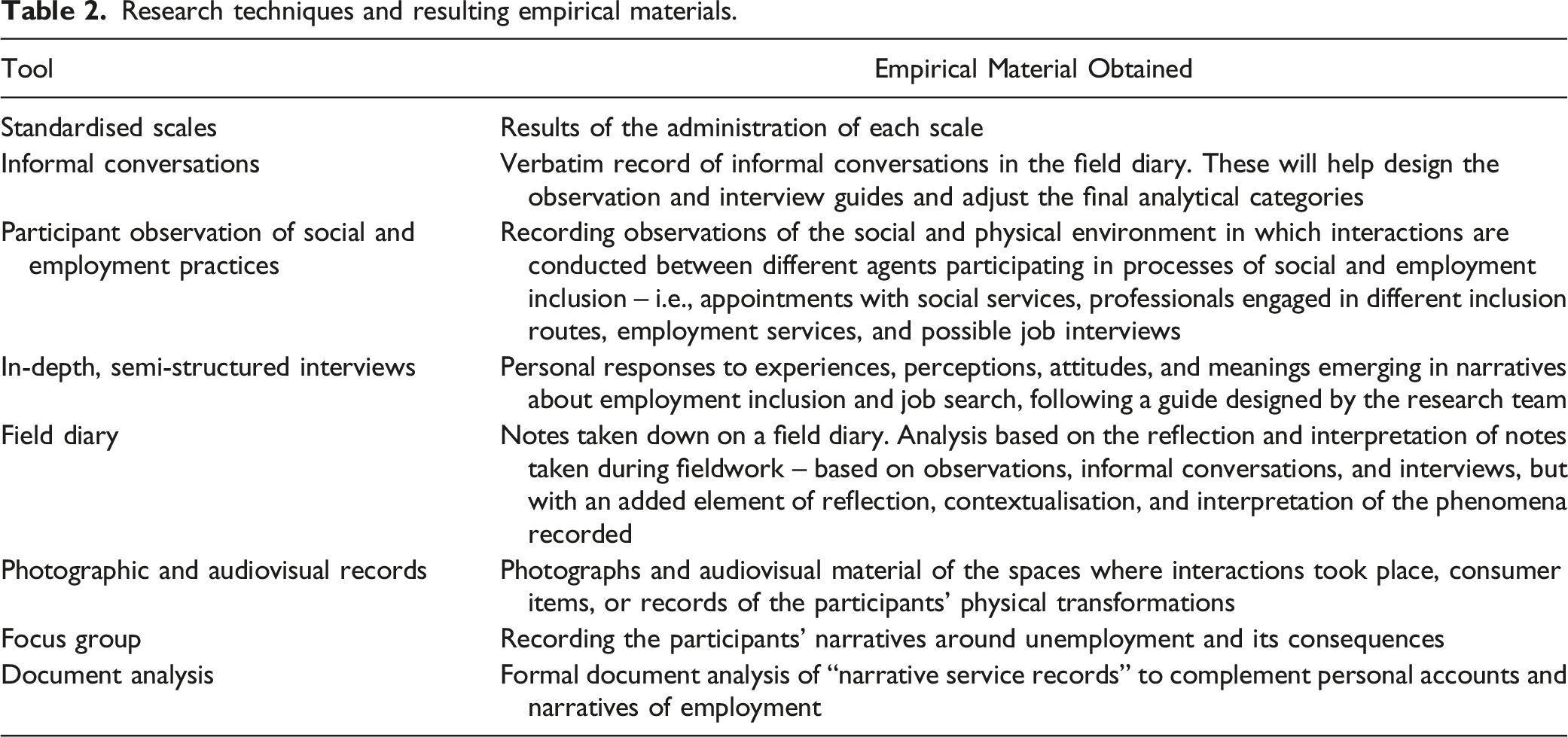
Research techniques and resulting empirical materials.
Materials and Methods
Study Period
The study will be conducted between 1 January 2023 and 15 December 2023. During this period, we will review relevant literature on the topic, conduct fieldwork (RCT and application of qualitative instruments), and analyse the empirical materials obtained. Quantitative data will be gathered at three key points: at the start of fieldwork (March 2023), halfway (June 2023), and once it is completed (October 2023). Qualitative data will be collected between March 2023 and October 2023. Two months after completing the fieldwork (December 2023), a report will be submitted, including data, final conclusions, recommendations, and scientific findings.
Scope of the Study
The study will be conducted in the autonomous community of Extremadura, located in Western Spain, along the border with Portugal. This region was selected by the Spanish government as one of the regions for PVIS implementation due to the social and demographic profile of its population. The study will be conducted within four of the eight different healthcare management areas in which the region is subdivided. These have been selected to ensure data collection from both rural and urban areas. The research population will be women between 30 and 45 years of age that receive assistance to prevent the risk of poverty and social exclusion. The sample will include a total of 2000 participants, randomly selected from a total population of 4419 women.
Measuring Instruments
Table 2 summarises the research techniques included in the protocol and the empirical materials generated through each of them.
Quantitative Tools
The protocol includes thirteen questionnaires – two scales designed by the research team and eleven standardised, validated scales – to quantify the impact of interventions in the social/employment and healthcare spheres. These instruments measure levels of residential exclusion (authors’ own scale), self-perception of barriers to employment (authors’ own scale), employability factors (Employability Factors Scale, EFE) (Martínez-Rueda & Galarreta, 2021), expectations during job search (Perceived Control Expectations in Job Search Scale, ECPBE) (Gómez et al., 2016), quality of life (Medical Outcomes Study, MOS, 36-Item Health Survey) (McHorney et al., 1993), anxiety levels (Hamilton Anxiety Rating Scale, HAM-A) (Hamilton, 1959), nicotine dependence (Fagerström Test for Nicotine Dependence, FTND) (Heatherton et al., 1991), motivation for smoking cessation (Richmond test) (Richmond et al., 1993), alcoholism (CAGE questionnaire) (Corrao et al., 1999), severity of alcohol dependence (Severity of Alcohol Dependence Scale, SADQ) (Stockwell et al., 1979), levels of physical activity (International Physical Activity Questionnaire, IPAQ) (Craig et al., 2003), oral/dental health (Oral Health Impact Profile-14) (Slade, 1997), and suicide risk (Plutchik Suicide Risk Scale) (Guirao Goris & Gallud, 2006). A team of social workers and occupational therapists will administer these questionnaires to the 2000 participants, using mobile devices. These professionals are not part of the research team and will receive specific training for correct data gathering. A member of the research team, experienced in statistical data management, will monitor the data management process. The IT system guarantees participants’ anonymity during all stages of the analysis and interpretation process.
Qualitative Tools
The qualitative instruments are those commonly used for ethnographic fieldwork (Díaz de Rada, 2011) and include different tools – i.e., informal conversations, participant observation, in-depth interviews, and notes taken in a field diary. Complementary techniques include photographic and audiovisual recordings, focus groups, and analysis of egodocuments (autobiographical writings). These techniques will allow us to gather thick descriptions (Geertz, 1973) of the barriers (structural and perceived) to access employment, and describe the impact of long-term unemployment on the participants’ mental health. Moreover, we will be able to examine the relationships established between the participants and the institutional environment that shapes their opportunities, and to recognise the strategies of vital support existing within the informal or grey economy – including the solidarity provided by peer, community, and family support networks.
During the initial stages of fieldwork, we will conduct informal conversations with participants in this research project and with workers in the healthcare and employment departments of the Junta de Extremadura. These conversations will allow us to identify and adjust the categories of analysis and refine the observation and interview protocols (Swain & King, 2022).
The observation protocol aims to record interactions between actors in different contexts, from daily life interactions and socialisation in public spaces – i.e., parks, public squares, or leisure environments, among others – to appointments with employment services, attending job interviews, or meetings with social services and other professionals engaged in different inclusion routes. Participant observation will allow us to identify social interaction strategies and practices between the various actors and examine the consequences of the observed social behaviours.
A record of the empirical material obtained during fieldwork will be kept in the field diary. In this diary, we will note informal conversations, observations, and interviews, to describe and help interpret the actions observed from an emic perspective (Díaz de Rada, 2011). Each member of the research team will have their own field diary, and we will also have a shared diary to facilitate interpretation at later stages.
Semi-structured interviews will examine experiences, perceptions, attitudes, and feelings regarding employment inclusion and job searches among the study participants. Interviews will be a conversational dialogue based on an interview guide prepared by the research team. This guide will be adjusted based on the categories of analysis emerging from the review of relevant literature and other empirical materials gathered during our research. A total of 54 interviews with 18 participants will be conducted. The selection of participants for interviews will ensure an equal balance of individuals from both urban and rural contexts (five urban and five rural participants in each group). Before the interviews, each participant will be informed of the study goals and will need to provide written consent. We will aim for interviews to be conducted in places where the participants feel comfortable. All interviews will be audio-recorded. Video recording will only take place if the participants provide specific consent.
Another qualitative tool that will be used for gathering empirical materials is the focus group – one to be conducted at an advanced stage during fieldwork with eight participants (two from each intervention group). With a semi-structured and relatively open debate (Hennink, 2014), the focus group aims to examine participants’ experiences of unemployment and its consequences. We will also explore the participants’ CVs and former employment contracts to complement their narratives. This will allow us to create “narrative service records” describing their previous employment experiences. We will also analyse cover and motivation letters for new job applications, and other types of communications associated with the assistance received. Whenever possible, we will try to obtain photographic and audiovisual recordings during all the research stages in which qualitative techniques are used. The images obtained from the ethnographic fieldwork will be a very useful source of information on the materiality and sociocultural dynamics of the research participants (Brisset Martin, 2004). Audiovisual records will also be used to examine the spaces in which the participants conduct their daily activities – i.e., homes, home furnishings and furniture, or community spaces, among others.
Fieldwork will be conducted by four members of the research team, extensively experienced in qualitative research. A fifth team member will supervise and coordinate the work conducted.
Contributions of Qualitative Methods to RCT
This study protocol aims to illustrate how the use of what we have called “qualitative significance” – all the empirical materials obtained by applying qualitative instruments – can help broaden and enrich the information yielded by quantitative data. We argue that qualitative data in mixed-method research designs are not only valuable as a complement to quantitative data. On the contrary, the variety of available tools and the rich and diverse texture of the empirical materials they help produce means we can use them as first-class evidence.
Qualitative research allows us to examine crucial aspects of employment inclusion and job search – individual experiences, perceptions, attitudes, and attributed meanings – which cannot be fully comprehended through quantitative research. The use of qualitative methods provides “thick descriptions” (Geertz, 1973) of the structural and perceived barriers that hinder access to employment. Moreover, they allow us to describe in detail other issues, such as the consequences of long-term unemployment on the research participants’ mental health. They also help us examine the relationships established between the participants and the institutional environment that plays a crucial role in shaping their opportunities, as well as the support strategies prevailing within informal economy frameworks – in particular, the solidarity provided by peer, neighbour, and family support networks.
Sampling/Recruitment
Participants
Selection of participants will be carried out between 1 January 2023 and 1 March 2023. Criteria for inclusion will be: (1) women residing in the region of Extremadura, aged between 30–40 years, receiving assistance to prevent the risk of poverty and social exclusion; (2) participation is voluntary, after signing the informed consent form.
Recruitment Strategy
National and regional government bodies will be responsible for selecting participants for this research project. The selection will be made on the basis of socio-demographic data managed by government agencies at both levels. The final selection of participants will be randomly drawn from women meeting both eligibility criteria.
Choice of Sample Size
The study population sample for quantitative techniques will include 2000 participants. Qualitative analysis will include a total of 40 participants. We will conduct 54 interviews with 18 participants at three different stages – initial, halfway, and final. It is estimated that this number of interviews will be sufficient to attain thematic saturation – the stage where further interviews reveal no new themes or categories of analysis (Lewis-Beck et al., 2004). We will also conduct a focus group discussion with eight participants. Finally, the analysis of egodocuments will include five participants.
Data Analysis
A mobile device application has been developed to automatise quantitative data collection. This application offers each participant a catalogue of standardised scales that they need to fill in, indicating which ones have already been completed and the dates on which new ones ought to be completed. Once quantitative data collection has been conducted, the results will be analysed with the IBM SPSS statistical software.
Semi-structured interviews and the focus group will be audio-recorded and transcribed. Recordings of the application of other qualitative techniques will also be transcribed. Transcriptions will be analysed with ATLAS.ti qualitative analysis software. Qualitative data analysis will follow an ethnographic approach based on grounded theory (White & Cooper, 2022). This approach will consider two levels of analysis: (1) an initial iterative process of adjusting and open coding of categories of analysis, based on the emic data gathered during fieldwork, and (2) a second stage of axial coding, grouping, and interpretation of analytical categories. For this adjustment, we will consider the main categories of analysis identified in scientific literature and the observation and interview guides designed by the research team. Coding and analysis will include all the empirical material obtained.
Four members of the research team will be responsible for analysing the empirical materials. Following the two-level process described above, during an initial stage each researcher will code the empirical material collected. Then, during the second stage, the rest of the research team will examine this empirical material – suggesting, if necessary, new interpretations of categories. In case of disagreements at this second stage, a fifth member of the research team will arbitrate and help reach a consensus.
Impact assessment for each methodological proposal will follow established standards for analysing and interpreting quantitative and qualitative variables. This protocol aims to offer diverse and complementary ways of conceptualising the impact of interventions. In addition, we have also included a process of continuous exchange between the two types of empirical materials. The indicational review of the quantitative results will allow us to reflect on and adjust the qualitative instruments, improve the understanding of the numerical results, and refine the categories of qualitative analysis. The two processes of analysis are based on the diachronic character of the data, while the validation hypothesis is based on the modification of the results obtained during the generation of empirical materials. By combining these two approaches, the qualitative significance will add accounts and narratives of experiences to the different categories in which the results of the scales would have contemplated only numerical results, thus broadening the fields of meaning for the participants and enriching the analyses proposed.
Rigour
The protocol follows strict criteria of credibility, precision, and replicability of research procedures to guarantee rigour (Fàbregues & Molina-Azorín, 2017).
Credibility
Different triangulation methods will be applied to ensure data quality, precision, and validity. Empirical material will be collected by using different methods and will be analysed by different researchers. Results obtained through the midline RCT will be used to adjust the qualitative instruments. This triangulation will allow us to refine the final analytical categories. Five researchers will participate in this process – four will be responsible for coding and creating categories, and a fifth will act as coordinator and arbiter.
Precision
Due to the application of different data collection techniques, the guarantee of data precision is imperative. All empirical materials obtained will be used in the design of the interview and focus group guides. These materials will allow us to validate the correspondence between categories emerging from coding, theoretical categories guiding the analysis, and data obtained through different methods – including quantitative methods.
Replicability
This protocol is a pilot design focused on a specific Spanish region. To ensure it could be replicated in other scenarios and regions, the methodology described above will be explained in detail in further reports. The protocol follows the Consolidated Criteria for Reporting Qualitative Research (COREQ) checklist for reporting results and describing the data collection methods, research design, and analytical procedures developed (Tong et al., 2007). In addition, the research team will work toward ensuring open access to raw data once confidentiality issues are sorted to ensure that participants cannot be identified – complying with transparency and openness criteria for scientific research.
Limitations of the Study
Qualitative assessment of the impact of intervention programmes is not common. This approach values the importance of understanding phenomena, in contrast to the traditional assessment approach based solely on statistics. This requires establishing a viewpoint outside the dominating paradigm; consequently, the possibilities of comparing this study with previously published research are limited.
Other limitations of the study are its temporal limitations, which are determined by funding bodies. Indeed, the timing of measurements might affect the assessment of the programme’s effectiveness – since the impact of some of the interventions might not be appreciable for months or even years into the future. As a result, it might be necessary to consider a further assessment at a later date. On the other hand, given the large size of the study population, a certain level of heterogeneity in the impact of interventions could be expected – e.g. participants engaging with different psychologists or social workers. However, the design of the study and analysis procedures is intended to minimise the influence of different professionals being involved in the intervention programme.
Implications for Research and Dissemination
It has been suggested that the potential of mixed-methods studies might be limited due to the low level of interaction between different methods and the dominance of quantitative approaches (Creswell & Plano Clark, 2011). This study aims to underscore that the importance of qualitative data is not limited to illustrating specific points or statistical results. On the contrary, the inclusion and analysis of accounts of personal experiences can help produce more nuanced impact assessments. This is a novel approach in the field of employment policy impact assessment – where, to date, the contribution of ethnographic studies has been limited. The protocol introduced here, and the research study that will follow, could contribute to shaping the design of future public policies on social and employment inclusion in other regions and contexts. The results obtained could be disseminated in meetings with policy-makers, social workers, and healthcare professionals, both at academic meetings and conferences and those addressed to the general public.
Data Confidentiality
Protection of the participants’ personal data is a central concern in this study protocol. Data collected during fieldwork will be treated in line with the Spanish Organic Law 3/2018 of 5 December on Protection of Personal Data and Guarantee of Digital Rights. Data collected, including via mobile device applications, will not include information that could allow the study participants to be identified. Besides, all data written down in field diaries will be anonymised, including location data. Data collected through mobile applications will not be stored in the devices themselves but cloud-based and will only be accessible to members of the research team. Audiovisual records will be destroyed following transcription. Written documents containing personal information will only be accessible to members of the research team and will be stored in secure locations.
Footnotes
Declaration of Conflicting Interests
The author(s) declared no potential conflicts of interest with respect to the research, authorship, and/or publication of this article.
Funding
The author(s) disclosed receipt of the following financial support for the research, authorship, and/or publication of this article: Programa Operativo FEDER Extremadura (2014–2020) y Fondo Europeo Desarrollo Regional (FEDER), grant number: GR21153. The “Plan Vital de Inclusión Social” is financed by the European Union NextGenerationEU fund.
Ethical Approval
The PVIS has been approved by the Ethics Committee associated with the Spanish government inclusion programmes (Order ISM/208/2022, of 10 March). The study will be conducted in accordance with the Declaration of Helsinki and the Belmont Report. Confidentiality of personal data will be guaranteed throughout the investigative process. Data management will follow the FAIR guiding principles (Findable, Accessible, Interoperable, Reusable) for scientific data management.
Informed Consent
All subjects must sign an informed consent form before their inclusion in the study. They will be informed of the characteristics of their participation, research goals, channels for dissemination of research results, and the possibility of expanding on the information provided or ceasing their involvement altogether at any time without fear of consequences. The informed consent form will follow a standardised model from the Ministry of Inclusion, Social Security and Migrations, and will be collected by the research team and professionals involved in administering the instruments. The consent form to be completed will be available in the data collection application. In addition, participants in interviews and the focus group will need to provide oral informed consent at the start of each session. The recording will only start once consent has been indicated, with the footage including the participants providing oral consent.
