




Abstract
Transformative and indigenous research frameworks can help facilitate social change; however, few studies have demonstrated their application to the study of the injustices of wildlife conservation in neo-colonial African contexts. This study illustrates the opportunities and limitations presented by these frameworks through a reflexive account of a PhD research journey at a conflict and private wildlife border in Zimbabwe. Villagers rescued the study from failing by steering it toward a research design that mixed different forms of knowledge, frameworks, and methods that were responsive to their research questions and complex political situations. The study concludes that transformative and indigenous researchers at sensitive wildlife boundaries in Africa should work with suffering villagers in teams without power hierarchies. Team membership should reflect different races, genders, and proximity to certain powerful actors. Such a research process may result in the transformation of both the researchers and the suffering villagers, although to achieve policy transformation, they must engage politically based on the research findings.
Introduction
This study illustrates the application of transformative and indigenous frameworks (Chilisa, 2019; Mertens & Cram, 2016) to research involving villagers adversely affected by wildlife conservation in neo-colonial Zimbabwe. I began my doctoral studies with the desire to investigate the social impacts of wildlife conservation on displaced local peoples owing to my interest in poverty and underdevelopment, which emanates from my personal experiences. This study combines my fieldwork experiences with those of some early-career researchers in similar contexts, aiming to answer the question:
How can researchers put the shared philosophical and theoretical assumptions of the transformative and indigenous frameworks into practice to support villagers oppressed by powerful wildlife actors?
This article first outlines the transformative and indigenous research assumptions, stressing reflexivity and their potential application in the context of the injustices faced by villagers displaced by wildlife conservation. Thereafter, I offer a reflexive account of my fieldwork in my home village. Over a century ago, colonial administrators evicted my ancestors to create a vast cattle farm named Devuli Ranch. Years later, powerful actors transformed the farm into a private wildlife sanctuary, known as a conservancy in Zimbabwe. My account shows how I could have failed if the villagers, who defined the research agenda and guided me toward data collection techniques appropriate for their political situation, had not helped me undertake the research. I then describe an indigenous mixed methods research (MMR) design that emerged from the research process and offered transformative lessons through its three stages of integration.
Contested Wildlife Boundaries: The Rationale for Transformative and Indigenous Frameworks
During the 1980s and 1990s, some researchers felt the existing philosophical underpinnings of research did not fully support an action agenda that could help marginalized peoples. Recently, scholars have argued for using multimethod research and MMR with transformative research objectives to study complex issues in which power structures maintain social inequality. A transformative research framework involves a political agenda that may change the lives of the researcher, the participants, and the institutions in which they work or live (Creswell & Creswell, 2017).
Transformative research focuses on social oppression, domination, alienation, or injustice, which are concerns raised by marginalized communities, such as people with disabilities, minority groups, women, economically oppressed groups, neo-colonized societies, and indigenous peoples (Chilisa & Tsheko, 2014; Mertens, 2018). To prevent the research process, findings, or recommendations from causing more harm, transformative research involves the marginalized groups at all stages, giving oppressed peoples a voice and an agenda to change their lives (Creswell & Creswell, 2017). While these principles may seem straightforward, difficulties arise when research involves evicted peoples who are suffering from neo-colonial oppression.
In neo-colonial African societies, villagers near wildlife-protected areas live in challenging circumstances. Political, economic, symbolic, and cultural interests create unequal power relations and “knowledge” that mediate human actors’ interaction with the land in and around protected areas. Today, protected areas founded upon histories of racism, settler colonialism, and capitalist expansion promote development through nature tourism and elite trophy hunting (Gumbo, 2019). Powerful actors associated with protected areas continue to curtail villagers’ rights to the land by using military strategies at the boundary and offering incentives to adopt alternative livelihoods that are not dependent on the land outside (Mushonga & Matose, 2020). Villagers sometimes engage in battles to recover these rights, although the conservancies and their allies always win (Mogende & Ramutsindela, 2020). Such conflicts over the meaning and control of resources pose practical and methodological challenges, especially for researchers who may want to improve suffering villagers’ lives.
Philosophical Assumptions of Transformative and Indigenous Frameworks
Transformative and indigenous researchers know the importance of reflexivity across the research process. Reflexivity involves a researcher truthfully describing their position within existing power structures during all phases of data collection and analysis (Chilisa, 2019, p. 160).
Guba and Lincoln (2005, as cited in Mertens, 2018) improved the concept of paradigms to include four sets of philosophical assumptions that characterize a person’s worldview. Axiological (nature of values), ontological (nature of reality), and epistemological (nature of knowledge) aspects inform methodological assumptions (the purpose and process of research). Reflexive researchers examine themselves and their institutions to ascertain if their worldviews are suitable to conduct a particular study (Chilisa, 2019).
The transformative and indigenous frameworks share the axiological value that knowledge production must improve the situation of suffering people (Held, 2019). Accordingly, the primary purpose of research is to promote social justice and decolonization (Chilisa, 2019; Mertens & Cram, 2016). Colonization was, however, a complex process involving violent resource dispossession, forced labor, and the dehumanization of colonized peoples and their knowledge and value systems (Ndlovu-Gatsheni, 2018). Colonial research was integral to the process of “[exploiting] local knowledge and resources for profits, without any benefit to the communities and custodians of the knowledge” (Koitsiwe, 2016, p. 271). In Africa, colonial domination is still present in the economy, the education sector, the way knowledge is produced, and in the dominant ways of thinking and being (Ndlovu-Gatsheni, 2018).
Among indigenous and neo-colonized peoples, reality involves a set of many relationships: with themselves; the dead; future generations; other living things; past, present, and future events; spirits; and the land, earth, and universe (Chilisa & Mertens, 2021). In this way, reality includes the physical, the spiritual, and the relational. It follows that, in indigenous epistemology, knowledge is collective and spiritual and must be used to improve relationships and health (Mertens, 2018, p. 141). Nevertheless, the concept of relationality is visibly absent from the transformative and other “Western” research frameworks (Held, 2019, p. 7).
On the contrary, the transformative framework does not clearly say whether one reality exists. Instead, it accepts a historical ontology based on power, which dictates that over time at different places, different privileges have shaped what different people consider real or different versions of reality. While some versions of reality facilitate social justice, others maintain oppressive systems (Mertens & Cram, 2016). Transformative researchers do not work for the interests of dominant power structures in a society; instead, they view research as a moral and political activity that requires them to commit themselves to social justice and decolonization (Mertens, 2009; as cited in Chilisa, 2019, p. 42).
As such, transformative and indigenous frameworks adopt a decolonization-of-methodology approach, a small part of the overall decolonization project that ultimately aims at radical social reform (Held, 2019): Decolonisation is thus a process of conducting research in such a way that the worldviews of those who have suffered a long history of oppression and marginalisation are given space to communicate from their frames of reference. (Chilisa, 2019, p. 11)
Transformative and indigenous researchers cannot show generosity to participants; instead, oppressed peoples play a significant role in solving their problems by prioritizing, initiating, and designing research projects to improve their lives. The relationship between the “researcher” and oppressed peoples involves the transformation and emancipation of both. This knowledge production can result in changes that oppressed peoples can recognize as legitimate (Chilisa & Mertens, 2021).
The Role of Research in Transforming Wildlife Conservation
Profit-making businesses, industries, and broader global processes are responsible for biodiversity loss and injustices in wildlife conservation and management (Massarella et al., 2021). Scientists and experts from dominant societies control the focus and direction of research projects and the knowledge used to bring changes in wildlife conservation in a top-down fashion (Apostolopoulou et al., 2021). This approach does not consider villagers’ knowledge as an alternative but, in a few circumstances, supports dominant systems. Most of the policy and academic literature has focused on transforming the attitudes, behaviors, and values of rural people who live near protected areas, ignoring the wider issues of power and politics. This has resulted in “circular changes,” whereby powerful actors try new courses of action within the same hierarchies of power and knowledge (Massarella et al., 2021).
Assumptions of the Two Paradigms Broadly Applied to the Wildlife Conservation Industry.
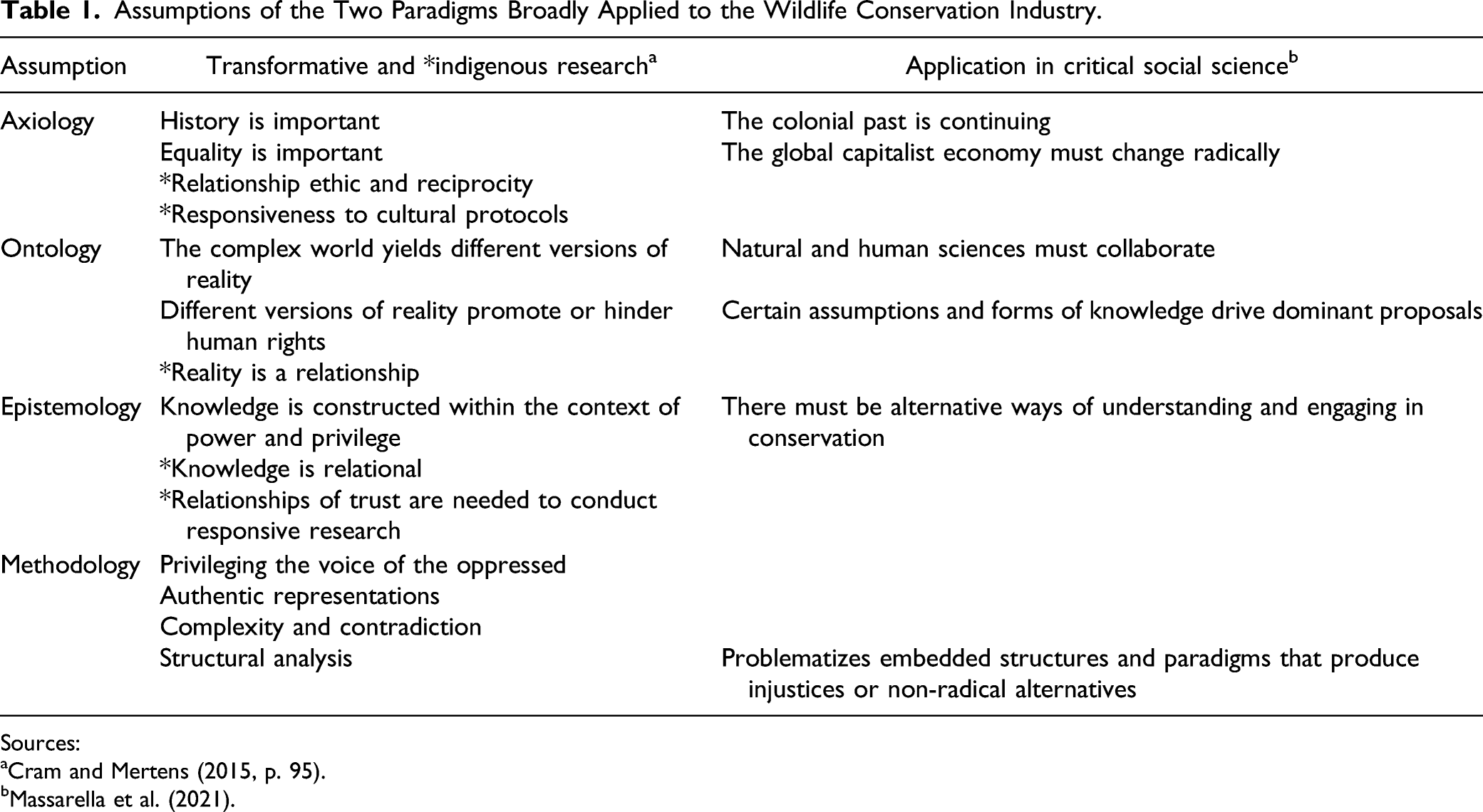
Sources:
aCram and Mertens (2015, p. 95).
Critical scholars have highlighted past injustices and the continuing power struggles to manage wildlife and have questioned whose worldview drives transformative change. These scholars have called for “axial transformation,” that is, a complete structural change of the current global capitalist political economy. They challenge dominant views that contribute to injustices, for example, that “the current global capitalist economic system is the only development model.” They encourage multiple views, debates, and collaboration with the natural sciences. Therefore, critical scholars welcome alternative ideas about wildlife conservation, especially those developed by indigenous peoples and social movements (Massarella et al., 2021, p. 82).
Here, I do not provide a comprehensive overview; for instance, I do not mention the environmental justice research (e.g., Schlosberg & Carruthers, 2010). The brief summary above is sufficient to highlight that the critical social analysis has been insufficient in terms of indigenous epistemology and methodology (Table 1). There has been little consideration of how critical scholars can operationalize transformative issues. Critical work has not necessarily translated into culturally sensitive methods and recommendations emanating from indigenous peoples or from below to the top. Methodology-wise, critical work is fragmented. Beyond acting as critics, scholars have taken limited action to operationalize their recommendations (Chua et al., 2020). Exceptional cases are few, such as Aini and West (2018).
Transformative and indigenous frameworks are helpful for several reasons. For instance, there must be a coordinated way of thinking and researching to achieve a radical shift in wildlife conservation. The transformative and indigenous paradigms offer a framework to systematically practice the theory used in the research process. Transformation is a deliberate intervention through action-oriented strategies that already exist (see Sweetman et al., 2010). The following section illustrates this argument with a reflexive account of my PhD research journey in villages at the border of a conservancy in Zimbabwe.
The Story of My Research
I grew up in a poor urban working-class family. We supplemented the household income by helping our mother, a homemaker, illegally cultivate and collect firewood on municipal land. I vividly remember my parents talking with visitors from our home village about a place where their grandparents used to stay but that was now inaccessible in a ranch. I visited our village once when I was 9 years old. When my father, a government laborer, retired, I began my doctoral studies at the KU Leuven Geography and Tourism Division, Belgium in late 2013. My family moved to the village in Buhera District, Zimbabwe.
Before starting my PhD, I worked at Bindura University for almost 2 years. My personal experiences and knowledge of poverty helped develop my interest in inequalities and land and wildlife issues. However, I had never worked in the wildlife industry and knew only a few students and lecturers who had connections with the Zimbabwe Parks and Wildlife Authority (ZIMPARKS).
During my pre-doctoral year, I began reading about local people being evicted from their ancestral lands and sources of livelihood because of wildlife conservation. As my research interests shifted toward understanding how these people fight evictions, I read about protest and politics (e.g., Holmes & Cavanagh, 2016). Armed with a proposal entitled “Parks and local people: Conflict and resistance in Zimbabwe,” I approached the International Office, which rejected my request for travel funding, stating “the objectives and activities of your field trip remain unclear.” 1
Novice researchers underestimate the importance of exploratory fieldwork. When I eventually arrived in Harare, I did not know where to start. I contacted several people from my bachelors’ studies network (Figure 1). Now a ZIMPARKS employee, one was willing to take me into a community wildlife project. I traveled to Gokwe, where I found the Rural District Council and ZIMPARKS workers to be uncooperative. I was also afraid to stay in a remote place without funding. Some of my contacts tried to connect me with the Chitsa people, who occupied a small part of Gonarezhou National Park. I dropped all the choices (Figure 1). Procedures in the three fieldwork phases.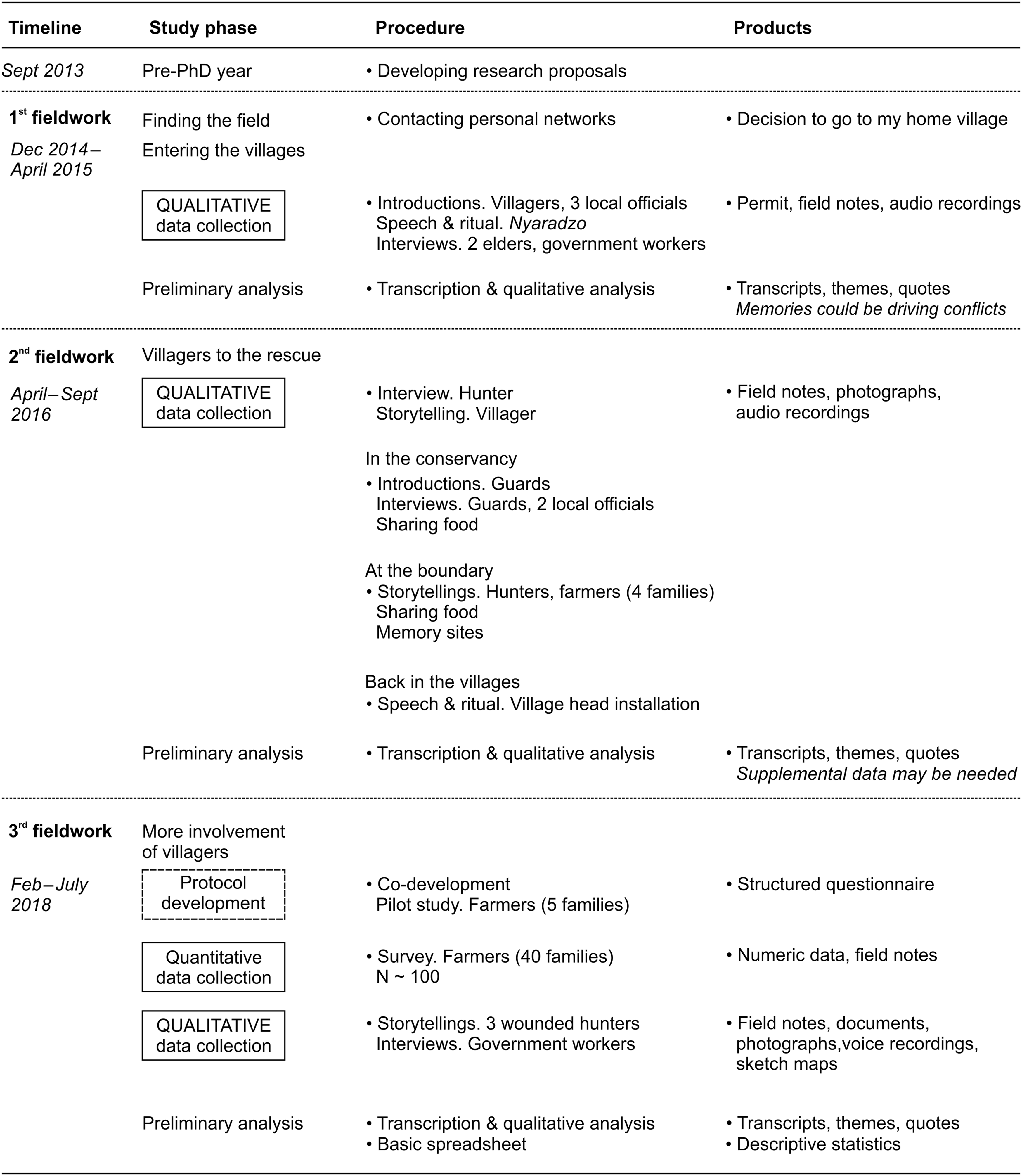
I knew the place that our visitors from the village had mentioned was in what is now the Save Valley Conservancy (SVC). I was also in contact with a man who had researched near my home village, who explained that he had accessed the villages because his in-laws stayed there. He told me the names of the two most-known village hunters, Dziyani and Muganhu (all names are pseudonyms). During his fieldwork, detectives nearly arrested him when they suspected he was connecting villagers with wildlife product buyers in Harare. This awareness created a feeling in me—chauya chauya, that is, whatever comes, let it come.
Entering the Villages
In Bindura, I had met Moyana, a man in his late twenties. He had come from my village to apply for an undergraduate degree program. Moyana waited for me at Birchenough Bridge Business Centre (Bhirinji). Later, I wrote: I left Harare at 7 a.m. and arrived at Bhirinji around 6 p.m. (about 400 km). Trucks passing through our village, about 13 km away, had left. Around 9 p.m., we entered a new minibus, got off after 5 km with another villager. We walked in darkness, carrying luggage on our shoulders and talking. Current village rumors were that the minibus owner had sacrificed his father in a ritual to expand his business. (Diary, January 2015)
Initially, I found it hard to accept how villagers talked about spirituality and witchcraft (see Shoko, 2016). The visible poverty among the villagers touched me. Many struggled to get necessities such as food or transport; for instance, I saw many children walking long distances to school, barefoot and in torn uniforms: Life here can be rough. For dinner today, each person ate three tiny roasted quelea birds, dipping morsels of sadza into tomato soup. I shed tears. What did these people do to deserve this? (Diary, January 2015)
I experienced many internal conflicts and later became aware of my previous struggles with urban poverty. I thought about renting a room with electricity and piped water at Bhirinji, but I abandoned the idea to stay in the village. Living with the villagers made me sensitive: I understood what they were going through and accepted how they talked about everyday issues.
Involvement in Village Life
Born in the village, Moyana worked in the neighboring ward at the Agricultural Research and Extension Services (AREX), a government department, and returned to our village on weekends. He knew the village norms, customs, and daily routines, as well as many villagers of all ages and ranks. One weekend, we explored the traditional and political leadership of the villages and the villagers’ relationship to their ancestors and the spirit world.
During the week, I immersed myself in village life. I did not plan many interactions, such as a long chat at the grocery shop, grinding mill, or bottle store, or traveling to Bhirinji in an open truck.
Through either my father’s ox-heart or my mother’s zebra totem, I introduced myself to the villagers or some villagers introduced me to others, like a researcher conducting an indigenous interview (Chilisa, 2019, p. 263). I attended church services, the village court, and, more importantly, funeral and nyaradzo 2 ceremonies. During a funeral, close relatives of the deceased must repeatedly recount the circumstances of death to mourners. I sat with village men for hours consoling and listening to Taona, a villager whose mother-in-law died after a buffalo from the SVC gored her and her grandchild. 3
Though I spent many hours at Bhirinji, I did not find helpful information there. I learned that the SVC fence was about 4 km from Bhirinji, making it between 15 and 17 km from our village, depending on the route. The SVC comprises several ranches, which villagers called farms. The Deure River separates Mapari Ranch and the villages.
When I had some basic knowledge of the villages’ social and physical characteristics, Moyana introduced me to Bongai, a low-ranking government worker and my relative through the ox-heart totem. Bongai knew many SVC and junior employees in government departments. He advised me to introduce myself to the local authorities, so they would not suspect that I was spying for nongovernmental organizations (NGOs), opposition political parties, or wildlife dealers.
Visiting the Offices
I began introducing myself as a Bindura University employee researching the relationship between Mapari and the villagers. Bongai facilitated my visit to some government offices in the provincial town of Murambinda. Three local officials, the district administrator (DA), a police inspector, and Chief Chamutsa, received me well (Figure 1). The DA explained the significant challenges in Buhera District: Very few homesteads in the villages can eat more than one proper meal a day. [Out of] the entire country, this district has the highest number of NGOs, about 34. Thirty of them do the same activity, food aid. (Interview, March 2015)
The DA explained that the National Archives kept the historical records that his colonial predecessor wrote about Devuli Ranch. However, I did not need to return to Harare as all the village elders who sat with the young Chief Chamutsa knew the history. Chief Chamutsa said that my work had his blessing and issued me a stamped document that I could use as a research permit.
Some government workers, however, refused to accept me. At ZIMPARKS, after a three-hour interview with a senior worker, he said, “I did not meet you today. We do not know each other” (Diary, March 2015).
Back in the Village
Moyana and I identified spiritual practices that connected villagers to pre-colonial events and places. We then purposefully selected two elders who narrated how the ancestors settled on the land (Figure 1). Shortly afterward, colonial settlers turned them into slaves and criminals before seizing the land and evicting them. We allowed the elders to control the storytelling process. Elders hold rich knowledge that they transmit orally (Koitsiwe, 2016); however, I still struggled to embrace this way of recounting events in episodes of war, magic, witchcraft, conquest, spirits of the dead, slavery, and violence. I did not immediately understand the stories because I did not know certain places. Thus far, not all villagers had welcomed me as an insider. To the hunting networks, I was an outsider. When I talked with villagers, they consistently mentioned Dziyani and Muganhu, although I had no idea how to approach them. I returned to Belgium.
Villagers to the Rescue
I analyzed my field notes, the elders’ narrations, and the unsuccessful interviews. I created a table with three columns: place, practice, and discourse. I listed all the sites mentioned in the transcripts and tried to link them to the villagers’ practices. My promoter encouraged me to accept the stories as they were and ask questions such as, “Why do villagers associate hunting with the spirits of the dead?” We suspected that young male villagers, central to the criminalized hunting networks, used the elders’ stories to justify their claim to the resources in Mapari.
A student colleague, who knew what funders look for, helped me write a precise qualitative research proposal entitled “Contesting conservation: Practices and narratives at the boundary with Mapari.” The Junior Mobility program granted me funding to spend 6 months between the University of Cape Town in South Africa and the villages, the second phase of fieldwork (Figure 1).
In the villages, I put the Junior Mobility proposal aside and began spending more time with Bongai. However, Bongai never talked about village hunting, although he had participated in many SVC meetings where they discussed poaching. It felt like another false start; the hunters seemed far away.
One weekend, Moyana heard about a nyaradzo for Dziyani’s late neighbor. Moyana’s family and I went to Dziyani’s village; while Moyana’s wife joined the ceremony, Moyana and I avoided the deceased’s homestead, breaking all the protocols of arriving at, participating in, and leaving such an event. We stood about 100 m from the graveyard, where men were building a tombstone. Moyana sent for Dziyani, who arrived with two men. I could not believe that I was finally shaking hands with a man I had heard so much about: He wore a ZANU-PF
4
T-shirt and braided hair. Faces beamed as we proved we were relatives. We began addressing one another as “heart” or “steer.” The moment I said, “Steer! My schoolwork looks into how the farm and our people are staying together,” Dziyani’s expression changed. His voice became combative. (Diary, July 2016)
Moyana calmed Dziyani and told him that if he agreed, we could arrange a formal interview during which he could explain more. After exchanging phone numbers, Moyana and I snuck away. As we walked toward Bhirinji, Moyana pointed the way to Dziyani’s homestead. About 2 weeks later, I was back in Dziyani’s village. However, I failed to locate the homestead, and Dziyani’s mobile phone was not reachable. Hesitant to ask for directions, I started walking back. Halfway toward our village, I met Farai, a villager I knew. I told him my ordeal, and we agreed to meet the following day so that he could show me the way.
The First Storytelling
In a sense, this study began the following day, when I walked with Farai toward Dziyani’s homestead. I noted some landmarks and asked questions. As we focused on Dziyani’s homestead, I found it easy to directly ask a villager about hunting for the first time.
We avoided Bhirinji and took a path up an elevation. The green Deure riverine vegetation stood out below. Farai explained that the hunters were clearing this vegetation, creating gardens on Mapari land, a new poaching approach. He suggested I ask Dziyani to take me to his garden, where I should make observations and ask questions about trenches and dogs.
Near Dziyani’s homestead, we took another direction toward Bhirinji, passing and greeting many hunters. Farai described a typical transaction between Mapari scouts, a male hunter, a village woman, and a villager who buys game meat. He explained the role of spirituality and physical violence. I realized the land at the boundary was giving me a new angle. I was convinced that I now had something important: the hunters’ changing strategies or another dimension of the harsh relationship between the conservancy and the villagers.
An Interview With a Hunter
Days later, I arrived at Dziyani’s homestead alone. We discussed some general issues: the weather, the crops and livestock, and the health of family members. We then moved to sit under a veranda for a formal interview. I wanted to conduct an open-ended interview and then ask Dziyani to introduce me to other hunters in a snowball method. Dziyani said, “You are a student. Where is the paper with the questions that you want to ask?” I took out a notebook and looked at some notes I had scribbled the previous night: He was a different steer from the one we met at the nyaradzo. Composed, he waited for a question, pondered, and responded carefully without disclosing much. (Diary, July 2016)
Dziyani focused on what apolitical researchers call human-wildlife conflict: wild animals destroying crops and attacking livestock and villagers. He said they had met many researchers before, yet nobody listened to them. I felt it was not the right moment to ask about hunting and violence.
Entering the Conservancy
I exchanged a few emails with the SVC secretary, who said they could not help with my research. The conservancy is inaccessible without off-road vehicles and has no mobile phone coverage. After many days of trying, Bongai and I met an SVC worker (the villagers call them “guards”), Mabhimbo, in a bottle store known to be popular with “poachers.”
Early the following day, Mabhimbo and I crossed the unflooded Deure River on foot and walked to a camp deep in the bush. After I had exhausted my questions, Mabhimbo showed me snares and explained the poachers’ wasteful techniques. Mabhimbo stressed that the SVC was protecting wildlife for future generations. Together with another worker, we ate sadza and game meat before more workers came to consult him, including one who had been sick for many months and asked Mabhimbo to extend his leave from work. Mabhimbo agreed and advised him to consult faith or traditional healers and not rely on the village clinic alone. I learned that none of the workers, including Mabhimbo, had been paid for more than 6 months.
Toward evening, another conservancy guard, Makomo, and his colleague Gweje collected me in a truck. We drove deeper into the bush, collected a buffalo carcass, and went to another camp. Some workers packed the meat into one-kg portions, which the conservancy sold to villagers for US$2 each. Chiefs received 10 kg each month for free. Other conservancy guards began processing the trophy, and we discussed boundary issues with Gweje and other guards.
Around 10 p.m., I interviewed Makomo. He stressed that the SVC participated in development issues by paying taxes to the government and engaging in community projects. Generally, the conservancy guards’ relationship with the villagers had improved after villagers occupied the riverbed.
The following day, we toured a trophy processing plant, where I freely interacted with black workers. Makomo then took me to a camp where white hunters from abroad stayed. We entered an exclusive tent, quickly leaving since I felt that Makomo did not want me near the white hunters; some were relaxing and reading. Coincidentally, Chief Budzi and a senator came to collect their monthly meat rations. I briefly interviewed them, asking questions about the contested land at the boundary (Figure 1).
Back in the Villages: The Second Storytelling
I was away when the villagers installed a new village head, which caused deep divisions among them. The winners were closer to me through the ox-heart totem, and Dziyani sided with the winners. I soon discovered that I could not interact with certain villagers. Weeks later, a young villager, Karidza, accompanied me to Dziyani’s homestead. We sat on the veranda, ate sweet potatoes, and drank tea with milk and sugar, signifying that we were welcome. Another villager, Gwenzi, joined us and shared his memories of the lost land.
We then set off to see the gardens, with Dziyani leading us. In retrospect, we could have walked straight to his garden; instead, we walked about 4 km toward the upper part of the Deure River, where the gardens started. Dziyani wanted to tell a story.
We stopped at Batanai irrigation, about 37 hectares. Dziyani angrily recounted how his group lost this land to the other group that contested the new village head. This land conflict partly led the hunters to occupy SVC land at the Deure riverbed and induced Dziyani to join populist politics. We then crossed the Deure River on foot.
We visited the first garden, where a young male farmer was clearing the land. Dziyani and the farmer explained how they set up gardens, stressing soil erosion control, and opened up about hunting:
After making sure that Karidza and I had understood what they were talking about, they changed the subject to farming.
From outside the Mapari fence, Dziyani showed us Maomoomo Hill. Here, the stories told by the elders came to life. To the villagers, Maomoomo is a monument of the land lost to Mapari. We stood there with reverence. Dziyani narrated how Maomoomo connects the present to the past through the ancestors buried there. Villagers hunted in Mapari in acts of resistance against the injustices of the conservancy.
Dziyani took us to several other gardens. If the farmer was not present, we still entered, and Dziyani showed us around. In four gardens, the farming families were present (Figure 1) and the farmer walked us around. We helped one another observe while I recorded, for example, zero tillage, water conservation, and mixed cropping. We then sat in a circle with the family and engaged in spontaneous discussions.
Thereafter, we walked along the fence. Dziyani showed us that the SVC had neglected the fence, a symbol of their exclusion from the land. However, villagers repaired the fence near their gardens using their own resources to protect themselves, their crops, and livestock from stray animals. We took turns taking photographs.
Last, Dziyani took us to his garden, a place of violent meetings, first with a chief sent by the SVC to evict them. Dziyani narrated the slaughtering of animals followed by fierce battles with scouts. The tour ended with Dziyani explaining his career, together with Muganhu, a fellow hunter and party cadre, in national party politics. He openly recounted how they occupied the riverbed and defied the conservancy and its local allies.
Further Villager Involvement
I left the villages confident that the fieldwork had yielded something worthwhile. Preliminary qualitative analysis with the villagers, my promoter, and my University of Cape Town host professor indicated that an unusual phenomenon had occurred at the boundary. Contrary to many studies, which portray hostile relationships, villagers had taken back some boundary land from Mapari, started farming, repaired the fence, and improved their relationship with the guards. However, the professors asked me whether there was enough evidence to support these claims and publish the results. We decided to collect additional data while I was in Belgium in the third fieldwork phase (Figure 1). I knew that Moyana and Dziyani owned smartphones, and researchers are increasingly using smartphone functions (Remijn et al., 2015).
Moyana Interviews Government Workers
Moyana and I realized that Dziyani had told a one-sided story of the Batanai irrigation as we could not interact with the rival group. Therefore, as an AREX insider, Moyana interviewed two colleagues responsible for the Batanai irrigation during the land conflict. He also traveled to local government offices in Mutare, Buhera, and Chimanimani, where he brainstormed with government workers and sketched the traditional chiefs’ boundaries, which helped simplify the village elders’ oral histories.
Wounded Hunters Tell Their Stories
We drafted an interview guide with open-ended questions on the violent encounters between Mapari guards and hunters. Moyana and Dziyani identified four hunters whom the guards had wounded. Three hunters told their stories into a smartphone voice recorder, and Moyana shared his field notes, voice recording, documents, and photographs with me.
Quantitative Data
At this point, we had designed the study without quantitative data. Moyana, my promoter, and I drafted a questionnaire including closed and open-ended questions targeted at the garden farmers. Using Google Earth, we estimated that there were about 100 gardens. Moyana and Dziyani interviewed 40 farmers in Ndau, a dialect of the Shona language, and completed the questionnaire forms. This supplemental quantitative project aimed to add information that we could not obtain from the qualitative data.
Illustrative Results From the Quantitative Phase.

Exposing Conservation, Celebrating Oppressed Peoples
Properties of the Emergent Design.

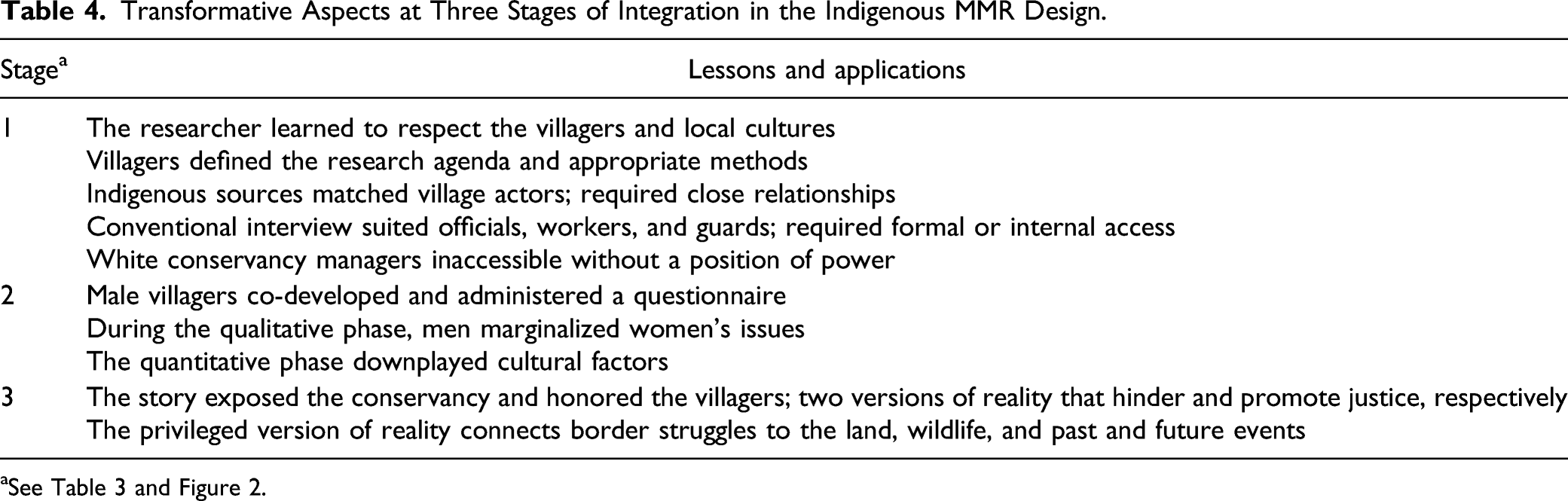
According to Cram et al. (2013, p. 11), “the ‘bad name’ that research has within Indigenous communities is not about the notion of research itself; rather it is about how that research has been practiced, by whom, and for what purpose that has created ill feeling.” This section describes “how,” “by whom,” and “for what purpose” to identify transformative aspects at the three stages of integration in the indigenous MMR design illustrated in Figure 2. The first and second stages mainly resulted in my transformation and a better understanding of the oppressed peoples and their needs, which influenced the outcome of the third stage. An indigenous MMR design with transformative aspects at three integration stages.
Core, Qualitative Component
Transformative Aspects at Three Stages of Integration in the Indigenous MMR Design.
Village Actors and Their Sensitive Political Situations
Kinship and my knowledge of poverty had connected me to the villagers easily. Before entering the villages, I did not know that indigenous data collection techniques go beyond conventional qualitative methods to include culturally responsive methods that engage with oppressed peoples through language, stories, cultural artefacts, and rituals and ceremonies (Chilisa, 2019, p. 92). For instance, when I attended nyaradzo ceremonies (Figure 1), it was a mundane village activity. It took me time, however, to develop a relationship with the hunters.
When I tried to use the conventional, seated interview method with the hunters, it failed. Again, Farai rescued me when he suggested that walking storytelling was the best data collection technique to study the boundary struggles from the villagers’ viewpoint. Walking interviews are common in geography, where place features evoke rich, specific narratives (Evans & Jones, 2011). However, for the boundary issues such as hunting and recovering lost land, an indigenous interview approach (Chilisa, 2019) encouraged villagers to talk more openly about criminalized issues. As we walked, although Dziyani was the key informant who explained many issues, whenever we met villagers, they were willing to join a group discussion and give us specific or sensitive information. No one determined the composition or subject of the group discussions.
During the indigenous interviews, farmers freely shared their produce with us as evidence that access to the land was necessary for food provision in their homesteads and as a complementary gesture after we listened to their boundary stories. Likewise, sharing meals with the guards and hunters was a sign of acceptance (Figure 1).
Officials, Government Workers, Conservancy Guards, and Managers
The conventional interview method was more suited to government workers, local officials, and conservancy guards (Figure 2, Table 4). State workers, especially those at ZIMPARKS and the guards, were difficult to access. Early-career researchers who entered the field in Southern Africa have described various experiences with accessing actors, depending on their position. For instance, some white males have noted that their access to powerful actors led them to renounce the opportunity to work with villagers (Masse, 2017; Wels, 2003). Owing to the volatile political situation, Wels (2003) had almost given up doing fieldwork in Zimbabwe when white conservancy farmers eventually accepted him. White male trophy farmers in South Africa readily welcomed Brandt (2013), a white woman, on their farms; however, they soon accused her of preaching “Marxist ideologies,” and she became unwelcome in the farmhouses and worked mainly with farmworkers. Mushonga (2018), a black woman, accessed all layers of her employer, the Zimbabwe Forestry Commission. After leaving the organization, she worked with villagers, who remained suspicious of her government links. Likewise, we used internal access when Moyana interviewed his AREX colleagues and some government workers.
My inability to access white conservancy managers or trophy hunters and my informal access to the conservancy guards limited the collected data. Given the little time that I spent with the guards, it was understandable that I failed to examine their understanding of the boundary struggles. In contrast, Brandt (2013), Masse (2017), Mushonga (2018), and Wels (2003) spent much time with state rangers, white trophy hunters, and conservancy managers and managed to document powerful actors’ views on violence, women, and race.
Supplemental Quantitative Component
The arrow 5 in Figure 2 shows that, after the core qualitative dataset (QUAL in uppercase letters), a survey followed, resulting in supplemental quantitative data (quan in lowercase). The second stage (*2, Figure 2) involved integrating QUAL and quan analysis in the forthcoming Paper A.
Table 2 shows that, consistent with Kaltenborn et al. (2005), the quan component revealed a low acceptance of the cultural aspects of hunting among the land-occupying farmers. The quan supplemental component (Figure 2) was not publishable alone and was not interpretable without integration with the core component; rather, its purpose was to clarify and enhance findings that had arisen from the core, qualitative phase since analysis of a minor component without reference to the core component yields incorrect interpretations (Morse, 2015).
Some studies have relied solely on quantitative data without transformative and indigenous values. Such studies may not respect oppressed peoples and their cultures; instead, they may appeal to powerful actors to include the notions of “community participation” in order to win the support of villagers and donors (e.g., Lindsey et al., 2011).
Women
Quantitative data collection was essential to reveal my blind spot regarding gender issues. I realized that I had been interacting with men because, in line with the village culture, I could not create strong, trusting relationships with the women. However, women play a significant role in the hunting process. Moreover, conservation affects women differently, for instance, when guards kill their husbands (Massè et al., 2021). Female researchers who have created strong relationships with village women have articulated the diverse issues affecting them in-depth (Brandt, 2013; Mushonga, 2018). The quantitative component captured the perspective of women, who comprised 25% of the respondents. Indeed, some qualitative methods do not require long-term relationships; in this case, men interviewed women in the quantitative component since there was no need for a long-term relationship.
Publicizing the Dominated Histories
The third stage (*3, Figure 2, Table 4) integrated the core qualitative data analysis into a single narrative (Nemadire & Loopmans, 2020). The story features two versions of reality that hinder and promote justice, respectively. The former interrogates a version of reality in which NGOs are fighting hunger by giving villagers food. It exposes poverty by situating it in the broader histories of violence and the material and cultural dispossession of people perpetrated by local, national, and international wildlife conservation actors. The latter respects and celebrates the oppressed villagers, their history, and cultures and renders visible a version of reality in which evictions from the land are causing villagers to suffer. Moyana approved the story at its various stages of production, while many villagers accepted the story and asked for a copy of the book chapter. The story urges the conservancy and policymakers to work with the suffering peoples whose ancestors lost land to wildlife conservation. For instance, the conservancy may incorporate its dark past into tourism activities and share the benefits with oppressed peoples.
Conclusion
Transformation
This study demonstrated that researchers can put into practice the assumptions of the indigenous and transformative frameworks by putting oppressed peoples at the center of their activities. This approach has the potential to transform the researcher and facilitate the transformation of oppressed peoples’ lives. In the present study, villagers became co-researchers, led the construction of knowledge, suggested suitable data collection methods, and were involved in preliminary data analysis. The study celebrated the oppressed peoples by documenting their dominated past and aspirations; however, it failed to adequately articulate the views of oppressed women and to engage with white conservancy managers and government workers.
Implications for MMR Collaborations
Typically, MMR guidelines emphasize that researchers with multidisciplinary skills in qualitative and quantitative research should collaborate. However, this study demonstrated that the complexity of a wildlife border requires more than such characteristics. Co-researchers should collaborate in a team that has no power hierarchies and comprises oppressed villagers and people of different races and genders and with proximity to specific actors, for example, through their profession. Funding agencies and researchers from abroad must take a political standpoint; neither are oppressed peoples mere data sources nor are researchers from local universities mere facilitators of entry into the field—they are knowers in their own right.
Limitations and Policy Implications
To an extent, this study demonstrated the transformation of the research process; however, it excluded the oppressed peoples during the conference presentations, final analysis, and writing of the resulting publications. While we wrote “Paper A” (Figure 2) in a friendly fashion, the “Book Chapter” was a vocal criticism of powerful wildlife actors. If the book chapter infuriated some powerful actors, it could further weaken already politicized relations between oppressed peoples in other villages and some elements in the conservancy. Technically, it is still illegal for villagers to hunt in the conservancy or take back the land.
Multiple political factors that include research influence policy decisions. This study left it to powerful people, including policymakers, to find the results for themselves and do something or ignore them. The lack of political engagement has implications for policy transformation: villagers are still experiencing evictions and stigma, and their situation has maybe even worsened.
Footnotes
Acknowledgments
I thank Maarten Loopmans and Ran Feng for discussions, and two reviewers for comments.
Declaration of Conflicting Interests
The author(s) declared no potential conflicts of interest with respect to the research, authorship, and/or publication of this article.
Funding
The author(s) disclosed receipt of the following financial support for the research, authorship, and/or publication of this article: This work was supported by the KU Leuven Interfacultaire Raad voor Ontwikkelingssamenwerking (IRO scholarship); and Junior Mobility grant (JUMO/15/056).
