




Abstract
Conducting cross-cultural, multi-lingual and multi-country focus groups represents unique logistic and analytical challenges. However, there is little guidance for the necessary considerations required for such international focus groups. Based on the author’s experience of conducting such research, this publication documents the different stages of planning, fieldwork, analysis and dissemination, and how to mitigate possible challenges and overcome them. It is essential to set up an adequate research team with the linguist and cultural background required. All researchers should have the necessary training in qualitative methods and follow a standardised approach in the facilitation of focus groups across the different countries and in the analysis of the data, ideally in their original languages.
Focus groups are an excellent method to elicit a wide range of views and perspectives (Halcomb et al., 2007). The ‘hallmark’ of focus groups is the explicit use of social interaction among group participants, to produce data and insights that would be less accessible without the interaction that a group offers (Morgan, 1997), which distinguishes them from interviews and surveys. Since focus groups can represent real life with people talking to each other, rather than to a researcher, they encourage the use of participants’ real vocabulary and ways of talking about the topic, enabling the researcher to gain descriptions that are more naturalistic, more identical to regular conversations, than those generated in individual interviews (Wellings et al., 2000). Additionally, they require no prior empirical relevant knowledge (Wilkinson, 2014). They can be a useful tool to start investigating under-researched areas and they offer the opportunity to gather new knowledge (Frith, 2000). Furthermore, as thinking is a socially shared activity and a focus group is itself a social context, this approach provides numerous opportunities for participant interaction. Consequently, focus groups enable participants to build on each other’s views and to elicit attitudes and experiences, enriching the data gathered (Morgan, 1997). Depth of discussion is facilitated; this discourse is frequently open and honest and provides the potential for exploration of opposing views, contradictions and uncertainties (Vogt et al., 2004). Furthermore, it is acknowledged that focus groups have flexibility which offers a wide range of possible use, and that they generate large amounts of data. Practically, however, it can be difficult to recruit participants and organise the meetings (Krueger & Casey, 2009). In particular, to collect qualitative, cross-cultural, multi-lingual and multi-country data represents unique logistic and analytical challenges. Cross-cultural studies require a diligent investigation of how the topic should be researched in different cultures (Matsumoto & Jones 2009). The difficulties faced encompass common challenges of qualitative research, but also specific challenges relating to conducting focus groups in multi-country settings. These challenges may range from ethical dilemmas, such as the potential for the results to be used for the vindication of stereotypes about cultural groups, to errors of interpretation with cultural attribution fallacies (Campbell, 1961). However, there is little literature and guidance on how to conduct cross-cultural, multi-lingual and multi-country focus groups, from hereafter referred to as international focus groups.
In this publication, the different stages of planning, fieldwork, analysis and dissemination for an international study using focus groups are documented and suggestions are shared on how to mitigate possible challenges and overcome them. The observations and recommendations made are based in the author’s experience from a cross-cultural, multi-lingual and multi-country study exploring the stakeholders’ views on volunteering in mental health, a study conducted across different research contexts embedded in broader socio-cultural and political environments. For this study, focus groups were chosen in order to explore an under-researched area, to generate interactive data, to create a non-hierarchical research context thus reducing researchers’ influence, and to have access to participants’ natural language and fully articulated views.
Stages, Sites and Targeted Population
This study was conducted in two stages, that is, a pilot phase and the main study. Firstly, the views of international mental health researchers and psychiatrists from several European countries were sought in order to understand and to scope out the diversity of viewpoints on volunteering in mental health. This phase was intended to allow refinements in the topic guide. The topic guide has been described as the map to chart the course of the focus groups (Vaughn, 1996), covering the range of topics that the researcher wants participants to discuss. The questions should be clear, succinct and precise and only ask about one issue. These questions act as prompts to elicit general discussion, stimulating participants to respond and to agree and disagree with each other, rather than answering the moderator. Questions which open out the conversation are good, and more specific questions work best as probes at particular points. The moderator should know the topic guide well, to be free to manage group dynamics more effectively. Subsequently, I focused on three European countries for an in-depth evaluation of the views of the two groups of key stakeholders on volunteering in mental health. Belgium, Portugal and the United Kingdom (UK) were selected to maximise diversity due to their dissimilar traditions of volunteering in mental health. In each of these sites, mental health professionals and volunteers were targeted, seen as the key stakeholders of the provision of volunteering.
Previous multi-country qualitative research studies have recommended that a preliminary pilot study is conducted (Kaae et al., 2016). The aim of the pilot stage of my study was to explore participants’ variability of views and to ensure that the study instruments developed were applicable to a variety of cultures and to participants from different nationalities. This phase focused on assessing the feasibility of conducting a multi-cultural focus group study, that is, carrying out the group interviews, using the study instruments, assessing the transcripts and confirming that the research results were of an acceptable quality. This aimed to ensure that the topic guide questions were constructed to answer the study research questions, clarifying that there would be an aligned understanding of the content of the prompts in the topic guide to permit refinements when necessary. This pilot stage enabled me to adapt strategies before embarking on the second stage of the study to increase the effectiveness of the focus group discussions (Castillo-Montoya, 2016) and to guarantee that all the questions necessary to address the intended concepts were included (Dikko, 2016).
Once the pilot stage was complete, the wider research team had been recruited and trained, and the research instruments translated, and this methodology was applied in the three European countries. This facilitated a comparison of potential commonalities and differences across the stakeholder groups and three sites, that is, London, Brussels and Porto.
How to Plan and Conduct an International Focus Group Study?
Pre-Field Work
An initial task is to give careful thought and consideration of the research topic, in order to define the broad purpose of the research and the more specific research objectives. This consideration is then written into a research proposal with the budget details. Consultation with the target population facilitates this process and yields more accurate information. The research purpose guided the development of the study instruments, such as the topic guide, and assisted in keeping the discussion focused on the central areas of interest to the study. Although the purpose of the exploratory study was somewhat broad, that is, exploring the views on volunteering in mental health, the study-specific objectives were subsequently defined.
Some of the pre-fieldwork activities were dependent on formal procedures, such as research clearance and ethical approval, which can be slow and rely on the speed of various review committees. These activities were therefore initiated well in advance. Consideration was also given about when it would be the most appropriate time period in which to conduct the fieldwork. This decision is influenced by the research timelines or the availability of the target population. It was necessary to become familiar with the local protocols and procedures for conducting research in each research site. These activities included drafting letters of introduction to be circulated by the local institutional bodies, or writing study protocol documents for the local organisations in the local languages when required or providing training to the research team and leading the organisation of the logistics.
Contextual knowledge is key throughout the research process. I therefore identified a research collaborator in each host institution early in the research since developing collaborative relationships can take time. However, researchers are often unable to build a research team that has linguistic and cultural competence to produce culturally and linguistically appropriate materials. They may also struggle to collect and analyse data gathered from the population of interest. Since I am fluent in the three languages in which the focus groups were conducted (i.e., English, French and Portuguese), there was no need to identify interpreters or have language assistance to conduct the fieldwork. Translation is one source of threat to the accuracy of cross-cultural, cross-language qualitative research, reducing its validity (Wallin & Ahlstrom, 2006). When researchers have language barriers and can conduct analysis only through translated data, the depth of analysis is more limited and the interpretations might not always be what was originally expressed (Tsai et al., 2004). The transcription of the focus group discussions was conducted by professional companies based in each of these three countries to utilise local language skills. Again, transcription could be reviewed by myself for accuracy given my own language skills.
The ideal composition of the analytical team for cross-cultural research should be reflected. Questions to consider include who should be a suitable moderator with language fluency, familiarity with the cultural context and with appropriate interpersonal skills to facilitate the focus group discussions and who and how many people should participate in data coding to ensure a culturally sensitive process. Some recommend that the research should be led by a researcher that shares the same linguistic and ethnic background as the participants (Munet-Vilaró, 1988). Others describe the importance of including members of the studied ethnic group whenever available in the research team (Henderson et al., 1992). The sharing of cultural and linguistic backgrounds with the participants has been recommended (Gil & Bob, 1999), to enable the data to be adequately analysed and to acquire culturally competent knowledge. This raises awareness to the importance of developing and following culturally sensitive qualitative research methodologies (Troman & Jeffrey, 2007). Ideally, there should be one person in the research team who understands all original audio recordings and transcripts. When this is not possible, the research team might be divided with some members coding all translated transcripts and a sub-set of the original transcripts (that they are fluent in), or the core team might code all translated transcripts as an English overview analysis and the local team code the original transcripts of their site, and the respective English translations. There might be differences in the analysis between coding original or translated transcripts, which should be acknowledged. Prior to study commencement I had established a relationship with all the members of the research team. All of them were aware of the context of this study and that it was part of my doctoral thesis. All were trained in the conduction of focus groups and qualitative analysis.
In this study, additional planning was required to conduct the focus groups overseas, particularly for those conducted in Belgium, a country that I was less familiar with and where local contacts had a key role. Additional and appropriate permissions also had to be obtained in Portugal. All these activities had to be conducted with sensitivity to local protocols, respect for cultural differences and a continued application of ethical principles, which included informing local authorities of the research and seeking endorsements in the study sites. A research team acquainted with the local context helped to enhance the rapport with the study sites and to navigate cultural matters. Still, all these issues provided an opportunity for me to become more familiar with the cultural context of the study. Gaining both formal and informal permission from various sources was a time-consuming exercise and needed to be considered in the research timetable. However, they formed an essential part of the early stages of fieldwork and the resultant contacts made with local collaborators led to mutually beneficial partnerships that were invaluable throughout the research process.
Fieldwork
The fieldwork stage of the research centred on the data collection activities which were time-consuming to plan and required extensive preparation. The initial tasks involved arranging fieldwork logistics. These logistics included promoting the study locally, screening and recruiting participants, booking the venue and sending venue directions to participants. Conducting international focus group research also required flexibility to meet the challenges that arose during the fieldwork process. Using focus groups as a method to get data from busy geographically dispersed professionals proved to be logistically challenging, especially when recruiting mental health professionals in London.
In the different sites, Doodle polls were sent to potential participants to mark their availability, which meant that other potential recruits were able to read the name or initials written in the Doodle poll. This might have meant that some participants were able to recognise others, especially those working in smaller groups in the same Trust or Hospital.
Whilst conducting the focus groups, I noticed variations in the flow of the discussion in different groups. Discussions were more spontaneous if the participants already knew each other or where participants established a more egalitarian relation. Whereas in other occasions, power dynamics and more hierarchical relationships prevailed, making the role of the researcher in facilitating a discussion more visible. Running focus groups required both interviewing skills, group management and moderation skills. It involved being acutely attuned to dynamics of groups and the unstated processes that can go on in groups (such as power and silence). The main job was to get people talking and maximise interaction between participants, guiding the conversation to cover the topics expected. The moderator’s task in the group is the facilitation, not the control. Ideally the involvement is quite organic, the moderator interjects at certain points to follow up on, seek clarification or raise a new issue for consideration. Some moderators are more passive, making minimal interjections, to keep the discussion flowing. Others have a more active style, encouraging quieter participants to express their views and even participating in the discussion to some extent. If a group is working well, and the moderator knows the topic guide fully, topics can be covered in a seemingly unplanned and effortless manner. On the other hand, structuring questions can be made to make transitions to different topic areas more explicit. The flow of the group functioning itself has been designated as the ‘life cycle’ of the group development, and described in five progressive stages: forming, storming, norming, performing and adjourning (Tuckman & Jensen, 1977).
In this study, it was generally more common for the mental health professionals, some of whom worked at the same department or institution, to know each other, than the volunteers. It has been noted that previous participant familiarity may influence the conduct of the focus groups and the data gathered (Leask et al., 2001). Confidentiality may be a concern if participants are part of the same social network, whereas strangers may take comfort in the fact that they will probably never see each other again (Liamputtong, 2011). When people know each other, it can create an easier environment in which to discuss the issues, direct verbal challenges or elaborate on an account (Kitzinger, 1994). However, personal familiarity may leave opinions unstated, owing to shared histories’ of knowledge and interactional patterns. It is false that friends share everything with each other since group norms can suppress dissenting views amongst friends (Leask et al., 2001). It has been argued that focus groups work best when made up of either friends or strangers (Braun & Clarke, 2013). With acquaintances, there is some uncertainty that inhibits free discussion and deep disclosure. It has been acknowledged that there is an added ethical risk around confidentiality and disclosure, supporting the necessity to highlight that everyone needs to maintain confidentiality before and after the group (Wilkinson, 2014).
The provision of incentives and payments is an area of debate since this may have an impact on participants’ contributions for the research. In this focus groups study none of the participants received financial reimbursement. Although payments and compensations are common and expected in the UK, in the other countries, for example, Portugal, this is not usual and ‘paying’ participants could be perceived as inappropriate or as a conflict of interest whereby participants might feel obliged to behave differently or give responses according to the researcher’s expectations (Wertheimer & Miller, 2008). Thus, to avoid dissimilarities across sites, all participants received a non-monetary incentive, a certificate of participation, given that professional development enhancement is acceptable, non-controversial and desirable.
The research team consisted of five researchers. Each of the researchers in the team co-facilitated the focus groups alongside me and subsequently, supported me with data analysis. In the second stage of the study, this second researcher, a native speaker of that country’s language also contributed to data analysis (Billson, 2006) and to detailed knowledge of the local culture which supported collection and interpretation of data. This ensured context specificity and sensitivity, important for the overall validity of the findings.
Post-Field Work
The post-fieldwork activities focused on data preparation, analysis and interpretation of the information, and reporting the findings. These activities have been conducted in collaboration with in-country research partners. The post-fieldwork stage involved returning to the study countries to disseminate the research findings to appropriate organisations and to the study communities themselves.
Acknowledging the differences between each member of the research team is fundamental as each brings their own theoretical, national and linguistic groundings, and might also have varying levels of methodological expertise (Haak et al., 2013). Whilst difficulties employing multiple interviewers in qualitative studies have been reported (Boutain & Hitti, 2006), a challenge that can be significantly augmented in a multi-country setting, this was not the case in this study since all the focus groups were facilitated by me. In the analysis phase, in order to systematically analyse the data, transcripts were kept in the original languages. The task of merging all the analysis, and summarising and contrasting all the themes in the three different languages provided further challenge. Additionally, the study generated large volumes of data, which was an additional challenge to manage. In the pilot stage, one analysis was conducted with the six focus groups organised. In the main study, where 18 focus groups were organised, six analysis were conducted, that is, two per country and each stakeholder that were involved in this phase. In the main phase of the study, a folder was created per each stakeholder, where inside each was a folder per site, storing the various local materials (e-mail template messages, invitation letter, information sheet, consent form, demographic questionnaire, topic guide, participants list, certificates of participation, socio-demographics, audio files, transcripts, focus groups nodes, list of nodes, NVivo files and documents with analysis of proposed themes and illustrative quotes). Each folder was numbered and following the same order for each site. This facilitated management and retrieving of materials throughout the study, facilitating the comparability across sites. This focus groups study had a common framework and analysed the same research question. Therefore, throughout the analysis phase it was useful the use of tables which enabled to have the illustrative quotes next to the suggested themes, and facilitated a comparison between each sites and stakeholders’ analysis.
Although all focus group co-facilitators received training in qualitative research and were following the study topic guides, not all topics were covered to the same extent and the depth of information varied across focus groups. This might have occurred due to the diverse interests of participants to contribute to distinct matters or there might have been topics where a greater variety of views emerged, thus extending the time taken to discuss any disagreements. Throughout the focus groups, in my capacity of facilitator, I attempted to focus the topic discussions of each group to similar material, taking into consideration the topics covered by previous groups. This was to ensure that all areas were aired and that a balance of topics was obtained between the different focus groups in each country. The extent of the former training or experience of the focus group facilitators is important to consider, if the activities are conducted by experienced researchers or by more junior local researchers, with a view of local capacity building. With colleagues that had no prior experience in qualitative research, I have provided them training in this method before the start of this project. This occurred in Portugal, where there were no identified local mental health researchers with previous experience in this methodology.
Focus groups can lead to some degree of participant empowerment which results in social change or activist intent (Morgan, 1997). This was particularly important in settings such as Portugal, where participants were provided with the opportunity to reflect on these issues, whilst aware of the paucity of volunteering in mental health in their country. Since taking part in a group discussion can facilitate a consciousness-raising effect on participants, this may lead to some type of individual and ultimately social or political change (Morgan, 1997). Thus, the organisation of these focus groups and the dissemination of the findings locally may have encouraged the fostering of social transformation, whilst exploring culturally specific concepts, values and beliefs, related to volunteering in mental health. The fact that many participants, mostly in Portugal, had not heard about these volunteering programmes raises awareness that more promotion is required, thus increasing the knowledge of these opportunities for patients in the community. Thus, these findings may have implications for how these social interventions could be instituted.
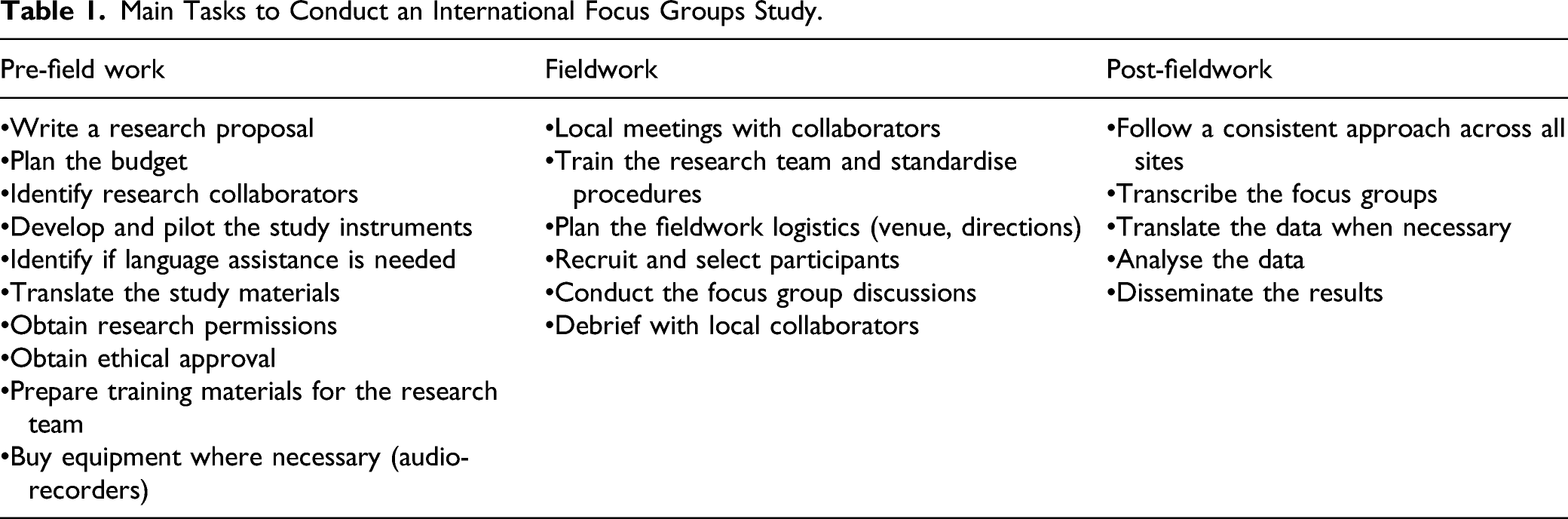
Main Tasks to Conduct an International Focus Groups Study.
Conclusion
The organisation of cross-cultural, multi-lingual, multi-country focus groups brings additional challenges to qualitative research. Recommendations to address these are setting up an appropriate research team, involved in the facilitation of the focus groups and in the analysis in their original languages, ensuring that all researchers have the required training in qualitative methods and follow a standardised approach.
Footnotes
Declaration of Conflicting Interests
The author(s) declared no potential conflicts of interest with respect to the research, authorship, and/or publication of this article.
Funding
The author(s) disclosed receipt of the following financial support for the research, authorship, and/or publication of this article: This research has been supported by the National Institute for Health Research (NIHR) Collaboration for Leadership in Applied Research and Care (CLAHRC) North Thames at Barts Health NHS Trust, the East London NHS Foundation Trust, the Queen Mary University of London and the Befriending Networks in the United Kingdom; in Belgium by the Université Catolique de Louvain; in Portugal by the Hospital de Magalhães Lemos and the Institute of Biomedical Sciences Abel Salazar at the University of Porto; and by the European Psychiatric Association.
