




Abstract
Research-creation is a growing practice in humanities that tries to balance the pace of socio-cultural inquiries with modern media advancements and qualitative knowledge construction methods. It refers to various conjunctions of “research” and “creation” (i.e., research-for-creation; research-from-creation; creative presentations of research; and creation-as-research) around an artistic component. Drawing from fieldwork with instructors in four agricultural colleges in rural Ethiopia, this article explores how a participatory arts-based serious game design process is explicable within the context of research-creation. This work’s change-oriented agenda led to developing Mela, a serious game, to educate and empower instructors in agriculture colleges to tackle sexual and gender-based violence issues in their institutions. Here, we articulate Mela’s design process, its artistic composition, and how we understand it from different angles of research-creation practices. We also offer our introspective accounts during and after the design stages, referencing culture and gender as critical concepts. Serious games are pedagogical products that are designed for a meaningful learning experience. This work deepens the understanding of how research-creation practice can benefit the serious game design field by ensuring the attention to both process and production.
Keywords
Context
The prevalence of violence against women and girls in Ethiopia remains a serious problem throughout the country despite some signs of progress (Kassa & Abajobir, 2020; UNODC Eastern Africa News, 2020). Sexual and gender-based violence (SGBV) is a concern specifically in Ethiopian post-secondary institutions (Wende, 2016). A systematic review and meta-analysis, which reviewed studies between 2000 and 2017 focused on SGBV among young females in educational institutions of five countries across Sub-Saharan Africa (SSA), reported an overall high prevalence of sexual, physical, and emotional violence, with Ethiopia as the highest (Beyene et al., 2019).
There have been a variety of ways that universities in SSA have embarked upon developing interventions and appropriately focusing on student engagement. To date, however, instructors’ engagement has been less of a focus even though, as we explore in this article, instructors could be part of the change process, specifically regarding the sustainability of initiatives. Instructors usually continue their work at the institution (while students come and go) and typically remain in their academic position even if they change their institutions. Instructors also occupy a strategic position in the colleges: they directly work with students who are typically at the bottom of the organizational pyramid, and at the same time, directly work with other instructors and the administration, who are, in the hierarchy of institutions in more powerful positions to effect change. Instructors gain knowledge about students’ issues and are close enough to the power (in personal and group meetings) to advocate for students.
This was our thinking when, as part of a large-scale study, ATTSVE 1 project, we initiated the idea of using a range of arts-based tools for participatory design of a serious game to build capacity and accountability of instructors in tackling SGBV on campus. We wanted our “designed-based research” (Jesson & McNaughton, 2020, p. 58) to lead to an interactive and culturally responsive tool that can support instructors of Ethiopian agriculture colleges in addressing campus-based SGBV. A critical question throughout the process was how such features as engagement, storytelling, and the specific content related to SGBV interact? Also, in a game with so many multimodal features, how best to frame the notion of “creation” and “research”? Furthermore, methodologically, what could we learn from research-creation practice in the context of a digital serious game design that is meant to be participatory and social change-oriented? We are interested in how the participatory development of a serious game offers a venue for merging locally co-created knowledge and bottom-up design, and how this can become central to addressing social change and arguing that the idea of research-creation is a promising sustainable approach?
Research-Creation and Digital Games; Theoretical Context
Our project draws together two broader areas: practices in research-creation and processes in participatory serious game design. Canada’s Social Sciences and Humanities Research Council (SSHRC) defines research-creation as “an approach to research that combines creative and academic research practices, and supports the development of knowledge and innovation through artistic expression, scholarly investigation, and experimentation” (SSHRC, 2020, “Research-creation” para. 1). Chapman and Sawchuk (2012) noted that in Britain and Australia, research-creation is known more as practice as research (also see Barrett and Bolt, 2007), in US it is recognized as arts-based research, and as Westecott (2020) stated, in Europe, it is known as “practice-based research.” Common among these definitions is what research-creation does in practice, which is a combination of conducting research and building a tangible and artistic outcome. Cohen (2015) identified it as disseminating knowledge through the language of practice, Springgay and Truman (2017) called it creating a complex intersection of art, research, and theory and Loveless (2015) observed it “as a changing, hybrid set of practice” (p. 41). This characteristic offers novel forms of tools for knowledge and meaning creation, which from Khoury’s (2017) perspective, was a “potential for intervention” (p. 8). Similarly, in her talk at the Thinking Communities: Celebration of Research in KIAS and Arts event, Loveless (2016) noted research-creation “as an epistemological and methodological intervention” (3:30) and pointed to scholars’ interests in learning about the contribution of research-creation practices to sparking scholarly shifts and therefore understanding justice and moving toward social change.
This article connects research-creation to participatory action research (PAR), which as Jokela (2019) stated, has inspired developing other methodologies such as art-based action research (ABAR). In “action research,” the researcher is an active agent of a change-oriented research process (Muurlink, 2018). It explores, evaluates, and more importantly, tries to find possible improvements for a context from the stakeholders’ lenses. Also, it usually deals with questions that start with “how” (McNiff, 2017), such as how to improve female participation in a male dominant class?
Although the research-creation interventionist practice might look similar to other participatory methodologies, specifically to the concept of “research-as-intervention” (Mitchell et al., 2017, p. 21), it sheds light on several different angles. Based on Chapman and Sawchuk’s (2012) definition, research-creation can take the following four forms of practices: a) research-for-creation, referring to how the researcher explores a topic and gathers data to be able to produce an artifact (e.g., sketch, film, poetry, painting, textile, or a game). Westecott (2020) interpreted this form of research-creation as a phase to address both “what” and “how” of the practice; b) research-from-creation, where artworks (such as performances or interactive artifacts) can be the means of data generation to provide a better understanding of the research subject; c) creative presentations of research, where the results of an academic study are presented through the art forms (e.g., a painting), and not in traditional ways of academic paper publications; and d) creation-as-research, where both research and creation happen at the same time, and as Westecott (2020) articulated “knowledge emerges out of the creation process itself and results in both the artifact and accompanying documentation with research as the end goal” (p. 15).
Research-Creation and Serious Games
While there are different views on whether digital games are art (Gee, 2006; Skiles, 2020), similar to Atkinson and Parsayi (2020) we consider digital games as art forms with various aesthetic aspects. Also, like Santiago (2009) in her TED Talk, we believe what distinguishes an artwork from non-art is the main element of being engaging for the audience. Digital serious games are relatively novel media forms, and it might take some time to be fully welcomed by the art world, but it does not mean that currently they are not artworks. As Martin (2007) argued, this was a similar challenge faced by other currently accepted artistic media forms (e.g., photography and cinema) at the time of their emergence. As an example of the increasingly global recognition of this concept, in 2011, the US National Endowment for the Arts recognized digital games as a form of art (Protalinski, 2011).
Abt (1987) coined the term, serious game, referring to games that pursue entertaining and educational purposes simultaneously. Dörner et al. (2016) argued that serious games are designed to entertain and achieve at least one additional goal (e.g., learning or health). The concept of serious games aligns with “action research” since it seeks improvements in specific contexts. For example, the serious game, Sandra’s Keys, aimed to increase player’s knowledge on various forms of elder abuse and improve their understanding of possible intervention approaches, particularly by being active bystanders in these situations (Lafontaine et al., 2020). The researchers of this game, called themselves “activist game designers” (p. 202) and referred to the concept of a “social justice game” (p. 189) to show the links “between activism, social justice and games studies” (p. 202).
As a game design practice, participatory design methods, with the idea of “user as partner” (Sanders & Stappers, 2008, p. 5) has been a solution for managing educational game design issues, such as the effectiveness of the game in facilitating the learning, or design requirements for disabled learners or people with special needs (Ismail et al., 2019). Mildner & Mueller, 2016 expanded the idea of the user as a partner to all stakeholders of the subject and suggest four common ways of involving stakeholders in the participatory serious game design process: a) Stakeholders as users; b) Stakeholders as testers; c) Stakeholders as informants; and d) Stakeholders as design partners.
Here, we focus on participatory serious game design in the context of the research-creation process. The concept of research-creation is relatively new concerning its potential to be applied to serious game design processes. Lelièvre (2018) stated that the description of research-creation methodology in the game design field “has not been popularized to the English-speaking community” (p. 1) and mostly has been used by French-speaking scholars. While some studies have explored expanding research-creation projects into the serious games field (see Ashraf, 2020; Goodine, 2020; Robinson, 2018), the body of knowledge in this area still suffers from scarcity in various aspects. For example, although Westecott (2020) used Chapman and Sawchuk’s (2012) four forms of practices to explore the potential of game sketching methods as a tool for research-creation, there is a very limited exploration of how an actual serious game design process can be approached based on these four forms of practices.
Research-Creation and Mela as a Serious Game
This section focuses on articulating how the research-creation process was a key feature of an innovative design for a sustainable tool, meant to address SGBV in Ethiopian agriculture colleges. We map out the applied methods and research participants, providing a brief description of the Mela game, articulating the art forms designed and incorporated in the game, and finally discussing how serious game design, and mainly designing Mela, is understandable within the context of research-creation.
Applied Methods in the Design of Mela
The first author led the fieldwork over a period of 1 year. A total of 20 instructors (including six women) from four agriculture colleges in four regions of Ethiopia (Maichew (North), Nedjo (West), Wolaita Sodo (south-central), and Woreta (North-west)) participated in the following four phases of data collection:
The first phase included individual interviews and cellphilm (cellphone+film) production with instructors in each college. In this phase, data were generated in the forms of interview transcripts and video narratives about SGBV incidents in agriculture colleges (see Sadati & Mitchell, in press). Also, as part of cellphilm production, participants in each college became involved in group discussions regarding instructors’ potential roles in addressing the SGBV issues. These conversations helped the participants in each college identify a list of potential roles, which were later summarized and integrated by the researchers to make a broad list. In the second phase, a participatory game universe design workshop was organized for all research participants. The data in this phase were stories that participants developed in group discussions and drafted on the flip charts, and then presented to everyone. The stories displayed how college instructors can create a safe space and support students (especially young women) to not be victims of SGBV on campus. As we mapped out in greater detail elsewhere (Sadati & Mitchell, in press; Sadati & Mitchell, under review), the data from interviews, and the stories created by instructors in the first two phases formed a database that helped the researchers in creating the game’s learning objectives. In the third phase, all stories were refined according to the pedagogical purposes, and a prototype version of Mela was developed. Starting from this phase, a team of eight Ethiopian young game developers joined the project to support the technical aspects of the creation process. Research participants and other experts from the fields of education, gender studies, and gaming tested the prototype and provided feedback on both the content and the gameplay (ways of interaction with the game). In the fourth phase, the extended game, Mela, was developed based on all data from previous phases. This phase also included a feedback collection process at the end using written forms.
About Mela
Mela (which means “find a solution” in Amharic) is a single-player digital game, where the player is situated as an instructor in an Ethiopian agriculture college. The game starts with an introduction stage, where the player can set a personal profile by typing/choosing college name, gender, avatar name, avatar image (replaceable by any images from their device’s gallery), and the name of a favorite course to teach. The personal profile also includes other features, such as achieved certificates and a chart for students’ grades, that are collected during the play. Mela’s story begins on the first day of a new academic year when the player (instructor) meets their colleagues and starts a course with students. Across five chapters of the game, the player faces various SGBV-related challenges (e.g., less participation of female students in the class, gender-stereotypical behavior and speech, physical and verbal sexual harassment, and assault among students) and needs to make decisions to manage them. These decisions and the ways that player tries to overcome challenges affect students’ grades and player’s success in creating a safe space on campus. Also, throughout the game, the player can collect certificates (e.g., Effective Communication Certificate or Gender Responsive Advocate Certificate), recognizing their effort in promoting gender equality or preventing SGBV in the colleges. The educational resources of Mela that have been adopted from various toolkits and guidelines, such as Mlama et al. (2005) and USAID (2009) incorporated in the game mechanics through different ways. For example, in different circumstances, the player receives emails (within the game) with educational content regarding specific gender-related subjects (e.g., power abuse and cyberviolence). The dialogues between the player and students/colleagues also contain informative material on female students’ vulnerable situations on campus and potential solutions.
Learning objectives of Mela game focus on topics such as professional classroom organization and management, professional code of practice in the college, gender-inclusive distribution of resources, supporting female students to increase language proficiency and get leadership positions, elevating self-confidence of females, learning about the significance of effective communication with students and colleagues, caring for students, taking an active bystander role, and advocating for females’ physical and mental safety. Overall, the various scenarios of Mela, its multimodal content (text, audio, and visuals), and different types of educational materials try to improve the knowledge and capacity of instructors regarding these learning objectives.
As highlighted below, the Mela game uses different artistic features to support an engaging experience for delivering learning objectives. Mela’s art forms are significant to understand its design process within the context of research-creation.
Mela’s Artistic Composition
Schell (2020) articulated four basic elements of a game as a) mechanics, b) story, c) aesthetics, and d) technology and calls this set “elemental tetrad” (p. 53). Pertinent to serious games, Kalmpourtzis (2019) offered “elemental pentad” (p. 142) by adding “pedagogy” to this list as the fifth element.
Research-creation projects combine a creative research process with an aesthetic component or an artwork production (Chapman & Sawchuk, 2012). Here, the focus is to describe how storytelling (as an art form) and aesthetics in Mela game intertwined with the research on SGBV in agriculture colleges and made multimodal elements of a research-creation and game design practice. Multimodalities refer to the combination of multiple modes of representation (e.g., text, visual images, audio, and design), which is considered a shift from paper-based education, aligning with “active pedagogy” and “learner-centered approaches” (Philippe et al., 2020, p. 422).
Storytelling
Storytelling has been called “the oldest and the newest of the arts” (p. 1), which enhances collective understanding of humans by enabling them to make sense of their world, explain themselves, and transfer their feelings and experiences (Greene, 1996). In game design, the story has been defined as a sequence of events that reveal in the game and can be either linear or non-linear/branching (Schell, 2020). The non-linear sequence of events leads to interactive storytelling (Dörner et al., 2016). Similar to cinema, theater, or literature, digital games could also be venues for storytelling. In this case, the game environment is like a theater stage, and game characters and the game player(s) are the actors (Dörner et al., 2016). Stories and storytelling are critical components of serious games and play essential roles in connecting the serious context with other gameplay elements (Kampa et al., 2016). They also help in “evoking emotion and facilitating immersion in a game” (Dörner et al., 2016, p. 47). Lacombe et al. (2020) referred to some of the fundamentals of interactive storytelling or scriptwriting in games as Universe, Characters, Trigger events, Dialogues (language), Action (decision-making and consequences), and Scene.
Mela Universe
According to Lacombe et al. (2020), to build the story universe, one needs to identify the story genre, define the universe, and maintain the story’s coherency. Mela is a Role Play Game (RPG) and its story arc follows the “slice of life” genre, which is about the everyday routine of the game characters (Chen, 2020) in an Ethiopian agriculture college with a focus on SGBV issues. Various features have been used to make the college environment convincing for the player. For example, at the beginning of the game, a narration follows a sunrise scene and informs the player about starting the new academic year: “It’s another beautiful day. The new academic year starts today.” The next scene guides the player into a college building while a question appears on the screen asking the player to type in their college name. This scene is followed by a narration that says, “You are excited to meet this year’s batch of students.” In the middle of the introduction stage, the player finds themselves in an office room (Figure 1) where the phone rings and a colleague invites the player to the teacher’s lounge. Player’s office in the Mela game.
Mela Characters
The main character of Mela is the player who emerges as an agriculture college instructor. At the beginning of the game, the player has the option to choose their avatars based on their gender (Figure 2). Avatars that the player can choose for their characters.
Other characters of the story are the “students” and “colleagues” (academic and non-academic). Students include three young women and two young men (Figure 3). They are introduced to the player in their first session of a course within the game. The game design team was inspired by instructors’ cellphilms while developing the game characters. For example, Zeritu’s character, a pregnant female student that deals with pregnancy issues, was adapted from the cellphilm The Effect of Early Marriage on Female Students in Agriculture College (see Sadati & Mitchell, in press). Student characters in Mela game.
The player’s colleagues in Mela include two females and two males who are introduced to the player gradually during the game (Figure 4). Both students and colleagues play an essential role in running various events in Mela’s scenarios. Staff characters in Mela game.
Mela Trigger Events
Trigger events are starting points of a story, where something happens, and the players’ adventure starts. They can be one or more and their presence throughout the story help to move the story forward. Some storytellers (e.g., Wolfe, 2017) believe trigger events mostly might happen shortly after the beginning of a story when player meets the main character and learns about the context. In this way, trigger events push the character to the “no return” point.
Storytelling in Mela occurs in a non-linear and “choose your own adventure” style, meaning that player’s choice on alternative options can lead to different events. There are numerous occasions across five levels of the game that the player is situated in decision-making positions each of which leads to a different branch (see Figure 5). Player’s performance in these situations leads the scenarios in different directions and, more importantly, affects students’ grades, and/or the number of player’s collected certificates. These scores remain in the player’s profile until the end of the game and are shown in player’s final performance report. In that sense, they can be defined as trigger events. For example, in chapter three of the game, the player is situated on the spot to decide between accepting a colleague’s request for a personal dinner meeting or a female student’s request for an urgent consultation meeting. Screenshot sample of story branches in Mela (made on Acrobat XD).
Mela Dialogues
Storytelling in the Mela game has been deeply established in the dialogues between the characters. These text-based conversations connect the characters to each other, help the player learn more about the game environment, and carry informative content regarding SGBV issues and their solutions. Figure 6 shows a sample of a dialogue scene in the game. In this scene, the player is out of the college (in the town) with a colleague (Ayantu) to buy some goods and as they are walking, they come across a young girl selling some grains while carrying a small baby on her back. The player and Ayantu approach the girl and learn that she is 16 and had the baby when she was 14. This prompts a dialogue about the frequency of early marriage as a risky traditional practice for girls: - Player: “This is really terrible! She’s not even old enough to take care of herself and she’s already responsible for a baby”. - Ayantu first says: “Unfortunately, it’s very common. Girls as young as ten get married.” And then continues: “A lot of families believe that it’s a big honour to marry their daughters off and have them start a family early.” Sample of a dialogue scene in Mela.
Mela Actions
Bunting (2012) described the “action” in storytelling, posing the question, “what are your characters doing?” (para. 2). Lacombe et al. (2020) noted that actions are possibilities besides dialogues to give life to a story. There can be active actions (e.g., shooting a film, dodging, and walking by player) or passive actions (situations that there is no means of acting for the player, and actions are felt, or experienced by the player as a spectator, like when the player is forced to enter a room in a game). 2 The actions are followed by visible consequences, and usually are shown as choices for the player.
The Mela game mechanics have provided a variety of “action” possibilities for the player, such as inserting information in the game (e.g., a character name, a college name, or a favorite course to teach) (Figure 7), making decisions to involve in different events or actions (Figure 8), or initiating conversations with colleagues or students. Player is given options to act. Player has the option to insert their college name.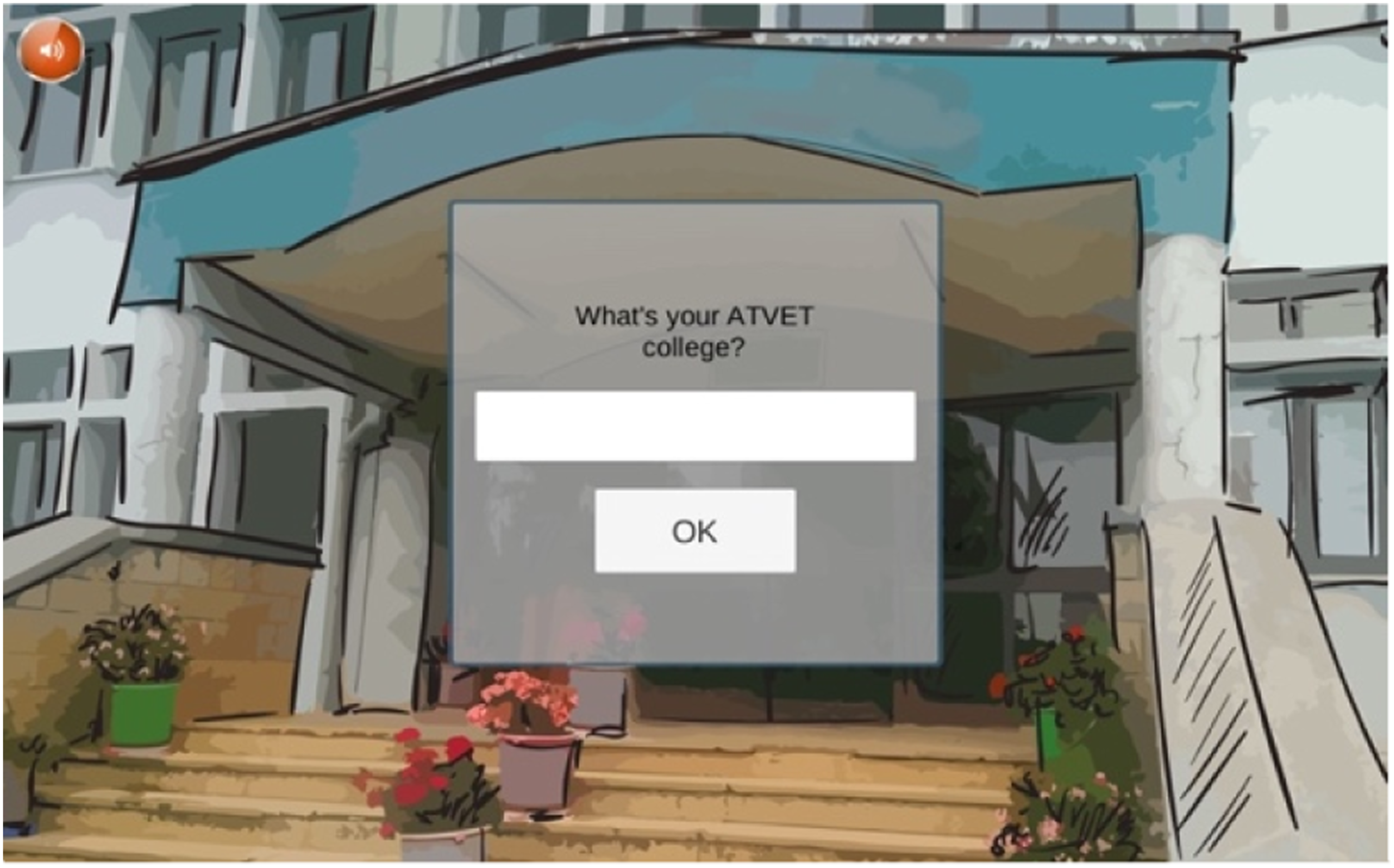

One of the ways of experiencing action in the game is the third person (audio and text) narration, which describes the setting, incidents, or timeline in the game. Figure 9 shows the text narration of an action: You and Ayantu are having lunch, but you’re still thinking about Zeritu’s presentation and the handout problem that happened 2 weeks ago. Sample of a text narration in the game that accompanies an audio.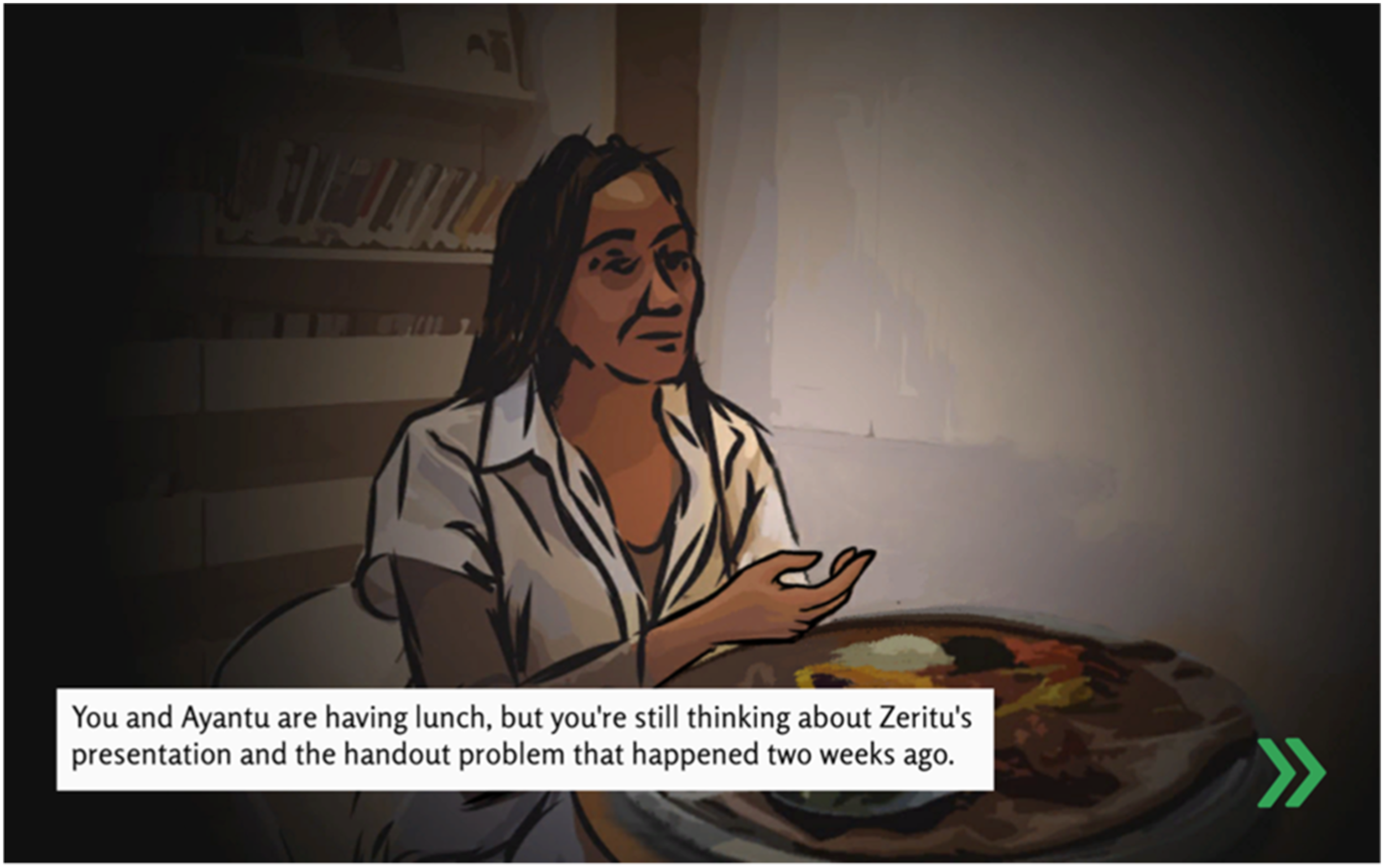
Mela Scenes
As Lacombe et al. (2020) argued, the scene is a “hallway” for other story elements to build a concrete sequence of events that brings the player closer to their goal. A role-playing game’s story arc can contain several scenes each of which “consists of an introduction, a development and a conclusion.” (Lacombe et al., 2020, p. 162). From this perspective, Mela includes six scenes: one introduction scene and five main scenes. Each of the main scenes starts in a specific period within an academic year, engages the player with few challenging situations, and concludes with a (midterm or final) examination. In designing Mela, we refer to scenes as game “chapters.”
Aesthetics in Mela
Kalmpourtzis (2019) introduced “audio” and “visual” as “the most usual and most established aesthetic forms” (p. 297) that players face in games. Various types of audio and visual have been used in Mela.
Music, Sound Effects, and Narrator Voice in Mela
Background music has been used in few places such as in the “sunrise” animation of the introduction scene. Voice-over narrations (that accompany text narrations) and sound effects exist throughout the game. As Kalmpourtzis (2019) argued, “if music offers atmosphere, sound effects offer feedback” (p. 297) and make the game seem natural. For example, once the player is awarded a certificate because of a proper decision, “victory” and “applause” sound effects accompany the animation of awarding the certificate. Other sound effects include the sound of birds in the forest, laughter in the class, clicking sound, door opening and closing, and a telephone ring. Sound effects also contribute to creating a more engaging and immersive experience, and the concept of “being there.”
Visual Elements in Mela
To make the visuals as realistic as possible for the player, images in the Mela game are mainly based on what Cho et al. (2018) referred to as photorealism style. To prepare photorealistic visuals in Mela, photographs were taken (by the game development team or the first author), converted into cartoon format and edited as needed using software (see Figure 10). In few places in Mela, the black and white style (Figure 11) also has been used, which is defined as “a style that mainly portrays characters or environments in shades of black and white” (Cho et al., 2018, p. 637). Converting real photos into cartoon using software. Black and white visual style was used in few places of Mela game.

Mela’s visuals also include other types of two-dimensional graphics (e.g., user interface icons and backgrounds) and few animations that were made by the artists. Figure 12 presents Mela’s map, as a sample of graphic design. Sample of graphics designed by the artist in Mela game.
Creating Mela’s artistic forms (stories and aesthetics) and ultimately, the game itself, was an iterative process. This artistic composite was built during a trial with constant feedback collections from research participants and subject experts (in Canada and Ethiopia). At the beginning steps of this research-creation journey, it was unclear what the final product would look like. The product emerged out of the entire process of being engaged in the research, involving research participants in multiple steps (from interviews and participatory workshops to prototype- and game-test sessions), working with a team of Ethiopian young game developers and then refining the game in collaboration with several Iranian freelance game developers. 4
Research-Creation and Innovative Design to Address SGBV
Mela’s creation process is understandable in the context of Chapman and Sawchuk’s (2012) four conjunctions of research and creation (i.e., research-for-creation; research-from-creation; creative presentations of research; and creation-as-research). Mela as a serious game has been designed to address SGBV in Ethiopian agriculture colleges. This work is firmly grounded in Participatory Game Design (PGD) (Mildner & Mueller, 2016; Romero et al., 2017) and cellphilm creation as a technique within Participatory Visual Method (PVM) (Mitchell et al., 2018). Combining these two approaches, we referred to Participatory Arts-based Game Design (PAGD) (see Sadati & Mitchell, under review), as our overarching method and a process of engaging research participants with participatory creation of multimodal artworks, which led to formation of Mela serious game. Using this method, we gathered data in the form of cellphilms or short videos, which helped the authors and game developers learn more about the everyday lives of instructors in an agriculture college. During the fieldwork, we also took numerous situating pictures from the four target colleges and their environments (e.g., pictures of buildings, gates, and town). This documentation compiled useful information that served the art-making process and the story arc of the game.
Mela aims to increase instructors’ awareness about their potential roles in promoting gender equality on the campuses and consequently improving students’ (specifically women’s) academic achievement. From this perspective, a “how” question always was pulsing at the background of every stage of the design process: How would the final product, embracing all multimodal elements and artworks, contribute to eliminating SGBV from the campus? How would it contribute to promoting gender equity in the colleges?
Mela’s Design Process, a Research-for-Creation.
By “research-for-creation,” Chapman and Sawchuk (2012) referred to any initial data collection before beginning the official production. It can include reviewing the literature, identifying main ideas and concepts, gathering collaborators, assembling needed material and technologies, testing different prototypes, and so on. This phase in Mela started with applying and receiving the Research Ethics Board of McGill University’s approval, recruiting the research participants, and administrating the fieldwork process (like gaining participants’ consents) in the four target agriculture colleges. Also, as part of the research process, a literature review was conducted on the SGBV status of Ethiopia, specifically in its post-secondary institutions and agriculture colleges. This review included reference to several previous studies related to the SGBV in the four colleges carried out as part of the larger ATTSVE project (Mitchell & Starr, 2018; Starr & Mitchell, 2018). These studies were critical because they highlighted the situation of SGBV at the four colleges. In another pre-Mela study, the students at the four colleges created cellphilms on how they observed gender equity issues and SGBV concerns (Sadati, 2018; Sadati et al., 2020). The data collection stage started with conducting semi-structured interviews (Sadati & Mitchell, in press), carrying out participatory visual technique of cellphilming (cellphone + video) and participatory game universe design workshops (Sadati & Mitchell, under review). During these phases, the initial ideas improved, main concepts were developed, and learning objectives were created to be used later in the “elemental pentad” of the Mela game.
Mela as an Example of Research-from-Creation
Based on Chapman and Sawchuk (2012), in “research-from-creation,” the creation of an artwork generates new questions and/or information for new initiatives, projects, and/or understandings. It encompasses an iterative process between creation and reflection and “the experience and knowledge gained from these collaborations and trials (are) used to develop a series of suggested research protocols and practices” (p. 16–17). Gathering the players’ feedback on a serious game and analyzing their in-game performance and decision-making patterns (e.g., in triggering events), can turn a game into a venue that generates new information for later improvements, future projects, or academic writings.
Tracking the players’ behavior in digital games and monitoring their interaction with game mechanics is a common practice that leads to generating data (see Goldberg & Cannon-Bowers, 2015). In our project, this was not the case and instead, while creating a personal game account, player is asked to answer few general questions, such as the country, gender, and age. Also, the research component drew on studying participatory approaches throughout all the phases and especially the prototype production phase. This created an opportunity to collect participants’ feedback (on the game content, gameplay, and user interface) and use the feedback in creating the extended Mela game.
Research-from-creation can take another angle to “involve analyzing different dynamics that flow from a game or creative project and may lead to the writing of more formal academic papers that are based on an experimental art practice” (Chapman and Sawchuk, 2012, p. 17). From this perspective, the overall experience of Mela creation has led, so far, to producing three peer-reviewed academic papers 3 and two guides that each contributed to generating new understandings, questions for future projects and activities and information (that could be used by the participants as well): A Guide to MELA: A Serious Game to Combat Sexual and Gender-based Violence on Agricultural Campuses (Sadati, 2019a) not only provides helpful information about the goals of this serious game, its learning objectives, the importance of addressing SGBV in agriculture colleges, the importance of working with instructors as agents of change, and the design process, it also provides external “follow up activities” based on the Mela game. For example, the document suggests how college instructors can use Mela game as a vehicle to organize other activities, such as gameplay sessions, quiz nights, and informal competitions (even with their colleagues from other colleges) and consequently make opportunities for more discussions and reflections on SGBV and its solutions in the colleges. The second guide, Serious Games as Self-Educating Tools; A Case Study to Address SGBV (Sadati, 2019b) shares learnings from the experience of Mela game creation, describes some challenges of this type of projects and, more importantly, shows how serious games can be self-educating and complementary tools for other initiatives in other fields. In brief, from the angle of “research-from-creation,” Mela game was used as a platform for generating new information for new SGBV related initiatives.
Mela as a Creative Presentation of Research
This subcategory refers to presenting “academic research in a creative fashion” (Chapman & Sawchuk, 2012, p. 18) such as various types of art forms including audio tracks, films, images, and online interactions. We believe Mela presents academic research in a creative way because its multimodal art forms carry the data generated using participatory methodologies. By engaging in an interactive game mechanics, including features such as stories, dialogues, in-game emails, and feedback system, the player of Mela travels in a playful and educational journey to learn about the problems (SGBV issues in the colleges), and the ways of addressing them. All fundamental elements of Mela game (mechanics, story, aesthetics, technology, and pedagogy) have been influenced by the research data.
Designing Mela; Creation-as-Research
As Chapman and Sawchuk (2012) argued, this subcategory is the most complex and controversial one. They defined it evolving the research from the creation process as if “creation is required in order for research to emerge” (p. 19). They provided both epistemological and ontological implications of creation-as-research. Epistemologically the “creative work can be understood as a strong form of intervention, contributing to knowledge in a profoundly different way from the academic norm.” Ontologically “creation-as-research” is also “creation-through-research,” in terms of expanding what “is” in the world by revealing new layers, permutations of reality, or “experiences to be experienced” (p. 21).
The Mela project can be viewed from a creation-as-research perspective since the research was not able to progress without the project’s creation process. Methodologically, from the first stage, creation and research were mutually dependent on each other in a way that creation was required so that research can emerge and at the same time, research was vital so that creation can proceed. For example, group discussions and brainstorming were needed to create cellphilms by participants (as visual art forms) and creating cellphilms was required to collect data on instructors’ potential roles in addressing SGBV on campuses. Group discussions and cellphilms were needed to conduct PGD workshops, and all data were needed to develop the learning objectives. Stories created in workshops were required to plan for developing a prototype of a game based on the pedagogical directions. Also, creating a prototype was essential to learn about instructors’ opinions about the serious game as a self-educating tool, and at the same time, the feedback collected from instructors was necessary to create the Mela game. As can be seen, different stages of this process were different layers of a multilayer research-creation project, and without any of them, the process could not continue to meet the project’s goals.
At the core of a research-creation process, there is an artistic form, and at the core of a serious game, there are art forms, such as storytelling and aesthetics. With this approach, we highlighted the artworks of Mela and why we think Mela’s design (particularly) and a serious game design (in general) fit in the context of research-creation. We also showed how these artistic materials are inspired and shaped by local context and by data from participatory research.
Stepping Back: Research-creation, Reflexivity, and Introspection
In this final section we go beyond Chapman and Sawchuk’s (2012) four categories to explore what they referred to as the idea of “powerful forms of introspection” (p. 12) through research-creation. It also aligns with what Akesson et al. (2014) referred to as a “stepping back” process which here is based on our back-and-forth emails, Zoom calls, reflexive writing, and in Hani’s case returning to fieldnotes. Something that is well established in arts-based work more broadly is its power to support and nurture reflexivity (Skukauskaite et al., 2021), from the significance of this work to participants, to the idea of researcher reflexivity and autoethnographic study. We offer here two accounts, one from Hani and one from Claudia of how reflexivity came into this project during and after the design stages.
Hani: The Case of Culture
As an Iranian of Azerbaijani ethnicity, who studied in a Canadian university and led the fieldwork in Ethiopian rural areas with different ethnic groups, I have been at the intersection of various “cultural texts” (e.g., languages, socio-cultural encoded symbols, and artifacts) throughout my life. My first language is Azerbaijani (Azeri Turkish), but I also needed to learn Farsi/Persian as the formal language of my home country, and English as one of the world’s leading languages to communicate, work, and study in the international context. I have grown up, witnessing how different cultural texts, such as different languages or artistic symbols in a diverse country or globally, can affect people’s communication and meaning-making styles.
The lessons I learned during the research-creation practice highlighted the cultural environment of the whole process to me again, specifically in projects that aim to contribute to social change. In creating tools to tackle social issues, like SGBV or any issue related to marginalized voices, cultural texts (semantic units of cultures) are sensitive elements that need to be contemplated.
Mela was created based on participatory research, where college instructors, who were the end-users of the game, were also key partners in providing the data and feedback. Also, a team of game developers used the data and feedback to create and modify the game. This research-creation practice highlighted that making a meaningful serious game needs the uniformity of various “texts” in both research and creation parts. Here I am trying to show how the importance of language (as a cultural text) suddenly became more perceptible—more than ever—for me during the research process. Also, how the creation process opened my eyes to the fact that the creator of multimodal texts (i.e., visual aesthetics of a game) needs having a lived experience within the same cultural texts as the end-users.
The research participants were from four different regions of Ethiopia, with a variety of three languages (Amharic, Oromo, and Tigrinya). Although the academic language of the colleges in all regions is English, communicating in English for some instructors, especially some women, was difficult. This challenge was predictable from the beginning of the research, but its real scale became visible for me in the third phase of the research. This is something that I commented on in my fieldnotes: After everybody left, (a female team member and story developer) could talk with a group of female participants, who referred to some transactional sex incidents in the colleges during the group discussions. The stories came from two female instructors that usually are silent in the discussions. It was very interesting and surprising for me. Through all previous data collection stages, I have done individual interviews, cellphilm workshops and few hours of group discussion, then I had a participatory game design workshop and group discussions with all instructors, but never they mentioned these incidents, although in all phases I was asking them in different ways to talk about these incidents. The importance of language showed up its strong face here to me! Apart from Amharic, (our female team member) also knows (a minority language name), which is the language of (region name) part of Ethiopia. She said, one of the instructors even had problem in Amharic and when the instructors of that region learned that (our female team member) knows (a minority language name), complained in friendly way that why you didn’t tell this at the first place. Then the female instructor started telling an incident story in (a minority language name). Wow! Even in Amharic, this instructor had problems sharing her ideas easily, so the only way she felt comfortable was in her own mother tongue. I can understand this since my mother tongue is also different from English. It is much easier for me to talk and express my ideas in my mother tongue (Fieldnotes, May 13, 2019).
But I also dealt with culture when it came to creating the visual aesthetics of the game. In a period of the creation stage, due to the Ethiopian illustrator’s unavailability, we asked an illustrator friend from Iran to help us with the avatar design of a female player. While we tried to set the context for him by providing all required information (e.g., visual local material from Ethiopia, and other game-related images already developed by Ethiopian artist), the first draft of the avatar illustration surprisingly was reminder of an oriental female face which is a common symbol of a female character in Iranian storybooks for children. Although the artist modified the avatar image to reach the current version as we see in Figure 2, this case highlighted the fact that the creator of an art form for a serious game, needs to have a lived experience in the cultural atmosphere of the user of the game. This becomes more important in creating the games within the “slice of life” genre, where cultural codes are important to present the life. In brief, I believe the iterative nature of research-creation practice, where research and creation inform each other continuously, provides a noble context for considering “cultural texts.”
Claudia: Whose Gaze?
As the person directing the larger project on gender equity within ATTSVE, and very familiar with the tensions around gender in the colleges, and especially tensions related to engaging both men and women, I do not think I fully appreciated the gender transformative potential of the game component at the beginning and the ways in which it could be more than “just gender responsive” to the situation of young women and the high rates of SGBV on college campuses. Gender transformative approaches seek to do more than be gender sensitive or to respond, but rather to seize on transformative potential. For example, in the course of designing the scenarios, it was so important to see how the game capitalized on the gender structures of the colleges such as gender clubs, gender focal persons, and gender activities. Critically these structures were acknowledged within the game itself.
Another key aspect of this work being related to engaging boys and men. Gender Transformative Approaches are critical when almost all the power is in the hands of men, where men dominate in sheer numbers as instructors, where even though there is a movement to have 50/50 for student enrollment, males dominate in most enrollments if not always in actual numbers but in their presence on campuses and in classroom. While I do not think the project design set out to explicitly deal with specifically masculinity, there is a strong masculinity focus across the phases. Simply by virtue of the fact that there are many more male instructors than female instructors in the colleges, it was inevitable that there would typically be more men than women engaged as participants in the design session, and that even where there might be 50/50 in the design sessions the voices of men were more likely to dominate. The content of the game itself, because of its focus on instructors in agricultural colleges, almost all of whom are male, feels like it is male centered, and the issues to be addressed inevitably involve men. Although various women researchers and gender experts were consulted, most of the design team was male, Hani is male, Even the idea of game development in a LMIC is more male at least in terms of prevailing gender norms. And while we do not have data on game-playing behavior of males and females in Ethiopia, we might realistically ask who is more likely to have the time to play a game even if it is part of professional development? I offer all of this not as a limitation of the project, but perhaps as a learning for me, a surprise outcome of research-creation, and something that has led me to reflect further on the idea of “the gaze” in creative production in this work. How do we transform the male gaze? I loved the idea, for example, that male players could, as one of their options, play the game as a female instructor. How would this change in perspective alter their views? This is the project of gender transformation in Ethiopia and so many other training contexts in SSA.
Not surprisingly perhaps, given the game’s focus on SGBV, the fact that both of us are outsiders to Ethiopia, and our own positionings, these reflexive accounts embrace culture and gender, both potential features of what Pillow (2003) termed “uncomfortable reflexivity” (p. 188). Our two accounts are meant to be illustrative of the various entry points for introspection, something we think is enhanced through applying Chapman and Sawchuk’s (2012) four categories.
Conclusion
Research-creation practices provide a useful framework, we argue, for capturing the richness of arts-based action research where there is clearly a final art production. This article offers a novel methodological understanding of participatory serious game design in the context of research-creation practice. This is an understanding (or angle) that is in line with what Loveless (2015) defined as the value of research-creation, which “not only hybridizes artistic and scholarly methodologies, it also legitimizes hybrid outputs” (p. 41).
Applied to work in the area of participatory approaches to the design of serious games, research-creation practices help to ensure attention to both process and production. At the center of the Mela project was of course the design and testing out of the game with college instructors to address SGBV. While we have focused here on method, clearly in future there is much more to be explored in relation to the impact of this work on the instructors and their attitudes and behaviors, and ultimately to the safety for female students in a post-secondary institution.
We see a number of implications for further research in relation to method. As we highlighted in the previous section, there are many entry points for reflexivity and introspection in research-creation, and our two accounts suggest that the research process itself needs to embrace ways of capturing personal learnings. Also, the design of serious games as art forms addressing critical social issues strike us as a particularly generative area because of the juxtaposition of being educational and entertaining and transformative. We highlight this angle in the serious game design process, since developing serious content for a meaningful serious game requires a systematic research process that includes pedagogy. Finally, further thought needs to be devoted to the involvement of the game designers/developers, who engage in the game design’s technical aspects in the entire research-creation process. While there is no clear boundary on which of these two practices (research or creation) should come first, a promising action could be considering the local game development team as a research partner in the creative process across all phases.
Footnotes
Acknowledgments
We are grateful to the Agricultural Transformation Through Stronger Vocational Education (ATTSVE) project (funded by Global Affairs Canada), International Development Research Centre (IDRC), Fonds de Recherche du Québec - Société et Culture (FRQSC), and McGill Faculty of Education to support the fieldwork carried out in Mela’s development. More than anything, we are indebted to the instructors in the four ATVET colleges, Maichew, Nedjo, Wolaita Sodo, and Woreta for their enthusiasm and commitment to the cause of creating safe spaces for teaching and learning. We also would like to thank D5gamecon group for their technical support in developing Mela and Arman Ahmadizad for his hard work in refining the game.
Declaration of Conflicting Interests
The author(s) declared no potential conflicts of interest with respect to the research, authorship, and/or publication of this article.
Funding
This work was carried out by the financial support of Global Affairs Canada, International Development Research Centre (IDRC), Fonds de Recherche du Québec - Société et Culture (FRQSC), and McGill Faculty of Education.
Disclaimer
The views expressed herein do not necessarily represent those of IDRC or its Board of Governors.
1.
2.
3.
Including the current article, Sadati and Mitchell (in press) and  .
.