




Abstract
This paper introduces a useful method for conducting creative social research into material objects and sensory phenomena, what we call the “pop-up mass object-elicitation stall” or “pop-up stall” for short. Our pop-up stalls involved using a curated collection of objects to elicit participant responses in commercial, community and public spaces. In the article, we position pop-up stalls as a material method that can be used within the facet methodology approach to offer strategic insights into research phenomena. We also relate pop-ups to intensive research approaches because of their rapid and voluminous production of varied qualitative data. We evaluate the pop-up stalls’ methodological effects and peculiarities, and explain for researchers things they might anticipate and consider during the planning, deployment and analytical phases of research. We propose three concepts for use in analyzing data generated by the pop-ups: situation, juxtaposition and suffusion.
Keywords
Introduction
This paper introduces a useful method for conducting creative social research into material objects and sensory phenomena, what we call the “pop-up mass object-elicitation stall” or “pop-up stall” for short. We situate the method predominantly within the facet methodology approach (Mason, 2011). The method also fits with a broader tradition in ethnographic practices of ‘focused’ or ‘intensive’ studies (Knoblauch, 2005), has clear connections to material methods (Woodward, 2020) and innovations in elicitation (Liebenberg, 2018). The pop-up stalls were part of a wider study that explored people’s practices and understandings of flavors and fragrances. To generate detailed data on these phenomena we focused on a single chemical, menthol, which is a constituent of mint flavors and smells. We were interested in the sensory for two main reasons: 1) Substantively, how people understand their own and others’ use of fragrances may be about to change due to the advent of new manufacturing techniques promised to transform how conventional botanical and synthetic fragrances are produced; 2) Theoretically, we were interested in exploring connections between senses, morals, affects, materials and so forth, and how these relations are constituted in particular ways.
Menthol is an ingredient in many consumer products often found on the hygiene, personal care and health shelves of a supermarket, which include toothpastes, chewing gums, cold remedies, shower gels, vapor rubs and so on. Menthol is distinctive for its somatic effects in that it produces a cooling (or sometimes warming) sensation on the skin and is normally associated with a minty taste. We used a variety of methods to explore how people use menthol-containing products in everyday practices. Elsewhere (Meckin & Balmer, 2019), we have described the particular practices in which menthol is primarily implicated, including its use in family care, personal health and leisure activities, and we have explored its connection to moral activities and how participants make sense of potential changes in its manufacture (Balmer et al., 2020; Meckin & Balmer, 2018).
Contemporary academic interest in creative methods points toward the importance of combining tools that draw on material and sensory stimuli to explore mundane and arguably under-researched aspects of people’s experiences and relations (Holmes & Hall, 2020; Woodward, 2020; see also Abildgaard, 2018; Pandian, 2019). Informed by this literature, our project was devised using a facet methodology approach (Mason, 2011) employing a range of object elicitation methods and data capture strategies chosen to emphasize particular elements of interest. As such, we also went on home tours with participants in their residences, produced sketches to capture atmosphere, conducted focus groups to explore diverse views, and used object-based interviews to examine personal biographies in more detail.
Our use of pop-ups involved us setting out a stall on which we laid a large variety of menthol-containing products for people to examine and interact with in a variety of public spaces. We invited hundreds of passers-by to smell, touch and taste these objects, enabling us to explore their sensory and material connections with menthol (see Figure 1).

A pop-up stall laid out with a wide selection of menthol-containing products.
When people joined in conversations with researchers at the stall, often in small groups of friends or family, we asked them about their experiences with vapor rubs and sweets and with other products they recognized on the table. People would often say how much they “loved” or disliked menthol (“it’s too strong”) and would then recount some of their memories of using these objects. A common theme around menthol vapor rubs, for example, was being ill as a child and recalling how a parent or grandparent rubbed the ointment onto their chest to help soothe their symptoms.
We recorded snippets of audio from the interactions, took photographs and videos, and made sketches and observational notes to produce a plethora of qualitative data. The public stalls allowed us to rapidly explore elements of sense-making with a wide variety of people, as well as to generate unusual methodological effects and quirks in the data that helped us to reflect meaningfully on our project’s questions. In this article, we describe the pop-ups and link them to two main methodological movements (intensive ethnographic approaches and facet methodology) and explore what we did in detail showing how, in conjunction with our other methods, the pop-ups helped broaden and deepen aspects of our research. We evaluate the pop-ups’ methodological effects and explain considerations that emerged as we made sense of the data. Finally, we make recommendations for their future use by other researchers.
Facets of an Intensive Approach
To explore menthol’s uses and meanings in everyday practices we developed our project through a facet methodology approach, which is aimed at using a range of tools to explore particular dimensions of a phenomenon or topic of interest. Each method or technique is chosen to highlight and, more importantly give insights into, different aspects of the central research object(s). Each facet is considered its own mini-investigation and is of both methodological and topical interest. Facets are simultaneously epistemological and ontological. “As an orientation, it [facet methodology] requires and celebrates researcher creativity, inventiveness, a ‘playful’ approach to epistemology, and the pursuit of flashes of insight” (Mason, 2011, p. 76). The key to this approach is to create a series of strategically illuminating methodological planes, meaning researchers must deliberately design a series of “cuts” through or across one’s object of interest (in our case the uses of menthol) to allow the sociological gaze to be enlightened by different casts of the light (the data) passing through those planes. In principle, a facet methodology approach allows for the inclusion of diverse methodologies and sets the ground for creative combinations of methods.
Facet methodology subscribes to and enacts an ontology in which lived experience is understood as “multi-dimensional, contingent, relationally implicated and entwined” (Mason, 2011, p. 78). This view, that the objects of interest are complex, messy and interconnected, further demands that researchers are creative and rigorous in designing their investigations and that, epistemologically, the pursuit of telling insight is the primary goal rather than other epistemic values such as the comprehensive coverage of a topic. A connective ontology means that methods themselves produce connections, which we detail later in relation to pop-ups and the data they generated.
We chose to focus our facets on a set of techniques that also connect with methodological discussions over the last couple of decades that have identified and explored a style of ethnographic research that is rapid and intensive. Concentrating research efforts on smaller groups and events, and for shorter periods of time, is now a well-established, complementary method for generating data and focusing on particular analytical dimensions of a study (Knoblauch, 2005; Pink & Morgan, 2013). While there are many versions and definitions of what constitutes ethnographic practice (Hammersley, 2018; Wall, 2015) and material methods we feel that, rather than get tied up in those arguments, it is most useful to focus on the themes in the literature that are concerned with intensiveness in order to consider the implications of our particular methodological choices.
Forms of “short-term,” “focused,” or “intensive” ethnographic practice have increasingly become part of formal research design, responding to changes in social research questions and, indeed, new forms of researcher-participant co-operation, as well as new theoretical, societal and structural developments. Such developments involve changes in data collection that have, in some areas, altered the way researchers do ethnographies, for example moving from time-extensive work (long periods of field observation in unfamiliar settings) to time-intensive practice (bursts of observation in familiar settings); from insider knowledge (developed from sustained engagement with non-native cultures) to background knowledge (developed from membership in the community; Knoblauch, 2005, p. 9). These emergent forms of research are:
excursions into [people’s] lives, which use more interventional as well as observational methods to create contexts through which to delve into questions that will reveal what matters to those people in the context of what the researcher is seeking to find out. (Pink & Morgan, 2013, p. 352)
Such approaches can be used especially well to explore explicitly sensory phenomena, such as in Opperman’s (2018) study of “intimacies of heat” where an anthropologist developed interesting sensory comparisons by spending short times in extreme dry and humid heat. As Pink and Morgan (2013, p. 353) argue, the focused, intensive approach is situated in wider social research trends, including the increased attention to practice and practical activity, and the exploration of the non-representational, the “unspoken, unsaid, not seen, but sensory, tacit and known elements of everyday life.” Our study of menthol took advantage of this potential, drawing on this background of intensive ethnography, but developing it in line with more long-standing object elicitation tools (Woodward, 2020).
These features of focused ethnography mean a lot of data, in many different forms, can be generated in a comparatively short time. Furthermore, in conventional ethnography, planning, experience, data collection, primary writing and analysis occur almost in parallel, whereas intensive ethnographic practices create a more sequential-episodic mode of ethnography, where design and planning, data collection and analysis, and feeding findings into the next design were arguably more separate. There was also a contextual shift in which much of the planning and analysis is done away from the field. As we explain below, this can entail a mode of connecting theory and empirical data where creative analyses involving additions and combinations can produce insights into phenomena (Balmer, 2021). Finally, what aligns our study with an intensive approach is a familiarity with the object of interest. Conventional ethnography tends toward immersion in previously unknown cultures whereas in our study we all had some experiences of menthol in practice in the cultures in which we were investigating, and further familiarized ourselves with the possibilities through exploratory and piloting strategies including supermarket and pharmacy visits, internet searches, informal conversations with friends and colleagues, and reading academic literatures. Through these strategies we were better able to design our facets as purposive investigations.
Elsewhere, Hine (2015) offers a slightly different purpose and vision to Knoblauch’s focused ethnography that, while still temporally shorter, involves awareness and reactivity to detect research objects in unexpected contexts. In her internet-inspired thinking on “cloud” and “crowd-sourced” ethnography, Hine (2015) coined the term “pop-up ethnography” to capture,
…a temporary and opportunistic development, seizing the opportunity created by a happenstance of resources such as a vacant shop, and capitalizing on a sense of immediacy, responding to a need or a cultural current which is happening just exactly now. (Hine, 2015, p. 193)
Thus, while one needs prior knowledge of a research object, insights can be inspired by events that were not planned in the research activities, which emphasizes an openness toward object-related occurrences within familiar or not-explicitly-research contexts. Resonating with our study, Hine draws on the idea of an empty retail site as an example of the pop-up approach, where shops spring up and trade for short periods, something similar to what we had in mind as we developed our mass object-elicitation tool. Indeed, many participants in our pop-ups were initially wary of whether we were selling anything since the stall looked like the kind of thing that you might find at a car boot sale or village market.
For Hine, a pop-up ethnography mindset can take advantage of the fluke of being in a particular place and time so that key insights might emerge. We agree that serendipity can be involved in most ethnographic research and add, in line with our experiences and with the literature on unconventional mixings of epistemic practices (Mason, 2011; Pink & Morgan, 2013), that it is possible to be strategic about intervening in a particular place and time and to deliberately create focused bursts of research orientated to specific insights in the hope of also encountering serendipitous moments of inspiration. Playing across the planned and the spontaneous, the familiar and alien, we will argue that the pop-up stall offers a practical and creative method to complement researchers’ investigations of a range of material and sensory phenomena, as an option for those engaged in focused ethnographies, or in broader combinatorial approaches, such as the one that predominantly framed our study, facet methodology.
The Menthol Project
Following the arguments above, the ‘menthol in everyday life’ project involved us deploying a range of methods tied to specific situations and relations, each developed and directed toward exploring particular elements of the social life of menthol, conceived as weavings or entwinements with actions, things and meanings. Broadly, we deployed the object-elicitation technique in a range of different forms and asked people to comment on sensations and experiences in four different methodological planes: We interviewed people in one-on-one, face-to-face situations. The interviews were designed to focus on people’s biographies and explore the ways they narrated and made sense of their sensory experiences of using menthol over the course of their lives. These interviews involved us bringing a range of menthol-containing products to the interviews, as well as asking participants to bring such objects of their own, to discuss their sensorial memories. This methodological plane manifested the object of menthol use within the temporal and personal. We used our range of objects in focus groups, which allowed people to interact and explore participants’ accounts of how they used or did not use the different products we provided. This interactive dimension was used to emphasize the differences and similarities between people’s sensory experiences, how menthol products became part of interactions and relations in a ‘live’ setting. We visited people’s homes and engaged in home tours, where participants showed us where menthol products ‘lived’ and how they were used, allowing us to focus on these objects in place, and to thus explore the practices in which they are implicated in their usual settings. Here we saw and discussed menthol enacted in a situation of ordinary usage. The pop-ups were designed to engage a range of people in a variety of different settings to talk about and interact with menthol-containing objects. The aims of this plane were thus to explore the diversity of experiences but also to increase the scale of our work (we wanted lots of accounts to come from these engagements) so that we could see how menthol might manifest differently in regard to different situations and with different people. We also hoped to use the pop-ups in an intensive, opportunistic fashion to strategically explore the emerging themes from the use of the more established object elicitation techniques (1–3).
The pop-ups engaged much larger numbers of people in social research than our other methods creating a mass object-elicitation tool and generating data on a scale that would not have been (temporally and financially) possible using the other approaches. It also meant we could fill in, to some degree, emerging “gaps” in our participant sample across the dimensions of age, class, gender, ethnicity and sexuality.
The pop-ups involved coordinating the research team to ensure we had a good number of people on the stall to engage passers-by, so there were as many as four of us on the pop-up stall at a time, but more often than not we found three of us was enough. We had a range of digital recording devices—smart phones, tablets, cameras—which we used to take pictures and videos. At two pop-ups a professional illustrator sketched aspects of the research scene (for more information on the sketching element, see Heath et al., 2018; Heath & Chapman, 2020), which provided stimuli for later reflection. Furthermore, with multiple researchers generating data, we created hundreds of photographs and textual notes by participants and researchers, which meant that formal analysis was almost entirely shifted to a later time when this volume of material could be properly processed. They also provided, it turned out as we went through the data, particular insights and surprises in the analytical phase, which we discuss later.
Most significantly, the pop-ups offered a novel methodological plane through their spatio-temporal qualities. They are fast, relatively easy to organize given their scale, responsive (we could run one at short notice), can be situated comfortably within a range of different environments, and although very costly on the day (travel, materials, researcher time) their benefit for that cost is great. These properties allowed us to play with emerging analytical themes from the other methods: as particular areas emerged that we wished to explore further, we could organize a pop-up with a population in a place and at a time where that theme could be fruitfully brought through. These factors of who, where and when allowed us to situate the pop-up stall to allow different dimensions of menthol products and associated practices to shine through.
Doing the Pop-Up Method
Basics
The pop-ups first involved visiting supermarkets and pharmacies and online shops to gather together several examples of each product in the various segments of consumer products in which menthol goods can be found. We carried them in a large hessian shopping bag and a huge rucksack. They included chewing gums, mints, cough sweets, lozenges, vapor rubs, inhalants, fragranced oils, muscle rubs, aromatherapy oils, balms, ointments, shower gels, shampoos, toothpastes, mouthwashes, face masks, tissues, cigarettes and more. At each pop-up we laid these on a table on a purple university branded table cloth, which clashed (perhaps fortuitously) with the predominantly green and white packaging of mentholated products. As people walked past we asked if they recognized a menthol product from the table (usually if they were hesitant we would start with vapor rub; more about why below) and invited them to smell it, eat it, taste it or rub it on their skin as appropriate. We segued into asking about their experiences of the various other products on the table and into their memories and sensations past and present. Often, because we were in public spaces, other people were enrolled into these interactions because they were interested in what they saw participants doing and joined in without explicit invitation (we discuss these relational elements of the stalls below).
Data Collection
We recorded the data through various digital, pictorial and textual, means: Snapshots of audio and audio-visual data
When participants were clearly available to talk more substantively (we became sensitized to whether people wanted to have a brief look or were more engaged and had time to kill) we would sometimes record short sections of conversation between participant and researcher on a Dictaphone. Sometimes we would record short video clips if a small group of participants was interacting with the stall in relative isolation (e.g., a group of friends or a small family unit), most especially if they were keen to sample the products. This involved the usual process of signing a consent form and an image rights form, which we got down to a relatively short explanation that allowed people to be informed about how their data would be used if it was recorded in this fashion. However, due to the hustle and bustle of the stall locations, and the overlapping conversations between researchers interacting with different participants, as well as the difficulty in distinguishing the start and end of an interactive episode, this was too difficult to achieve most of the time (more on this below). As such, the usual method of collecting, archiving and analyzing data as audio turned into transcripts was not available to us. Observations and micro interviews (that became text notes on paper)
These included small snippets of researcher-transcribed talk from conversations as people chatted to us. Or they were recalled stories or turns of phrase that stuck out from interactions written down after the participant had left. When possible we also wrote down our observations during interactions and after interactions, regarding such things as how people had approached the stall, what products they had used and how, what they had been like (affective, orientational and political elements of their interactions with us and the stall) and what the experience had been like for us (what it made us remember of our own lives, what we felt and thought and so forth). Participants gave oral consent to use of their talk in this fashion, usually before the interactions properly began but sometimes afterward. However, for these engagements we did not usually get participants to sign a consent form. No personal details beyond our own rough guesses of participants’ ages, gender and ethnicity were collected in these interactions. Photos
Taking photographs became one of the most prominent means of generating data in our project. Image rights forms were signed for every image collected. People’s momentary interactions with the products generated fascinating facial expressions, bodily dispositions, and relational events that we could sometimes capture. The photos became a form of data for analysis in their own right, and would often stimulate interesting discussions, recollections and fresh data interactions between the researchers as we began exploring our data set. Sketches
As mentioned above, Lynne Chapman collaborated with the project as a professional illustrator. She joined us at two pop-up stalls, one held in a garden center and another in a museum (see details below). She also sketched at one focus group. She produced “concertina sketches” which she drew on large unfolding rectangles of water color paper. The sketches became a useful analytical lever for analysis. We were able to ask questions of the pictures—why are these quotations pulled out? Why these products? Why does the general sense of the garden center pictures look so different from the museum pictures? We were then able to recognize that Lynne was capturing the atmospheres of the stalls, but also that she was bringing particular comments, phrases and objects together across time and place that photographs (and that we, as active facilitators and researchers,) were not able to. The same image rights forms were signed for sketches as were signed for photographs. Although we couldn’t destroy the sketched images with participants (as we could with the digital camera if there were any they did not like) we found that participants were not at all concerned about the sketches, because while they had a likeness (due to Lynne’s extraordinary skill and speed) they were not identifying in the same way as were photographs. Postcards
We also had a range of colored postcards (see Figure 1, bottom left) which we used to ask participants to record their salient ideas that they had discussed with us or that had come to mind but they had not had chance to talk about. We had different colors—yellow to record their experiences and responses; red and green to note their positive and negative reactions to menthol production, respectively, and white to note down things that had occurred to them or questions for researchers to ask, which might be further research questions or questions for future participants, or other actors brought up in the discussion (e.g., corporate actors, and so on). These latter two issues (red, green and white cards) were part of another element we were researching (see Meckin & Balmer, 2018, 2019) which we do not report on here to maintain focus.
The choice of a range of settings for the pop-ups was a key element of this facet of the broader methodological approach since it contributed not only to the scale of the project (many more encounters) and diversity of the sample but also provided different environments for the object elicitation meaning that the objects were situated differently from space to space. Indeed, we found the particular contexts in which the pop-up took place shaped the cohort of participants, but also the particular ways they engaged with our stall and performed their expectations of what the stall was about and what we wanted to know. In the next section we develop this epistemological argument in detail, showing how the data emerged in different encounters and how this was connected to the different elicitation arrangements or configurations we deployed in the pop-ups.
Practical Considerations of the Pop-Up Method
In this section we examine some further practical considerations of doing the pop-up method, and in the following section, propose three concepts (situation, juxtaposition and suffusion) that researchers could use to help analyze data generated from the method. Our project about menthol sat at the nexus of practical usage, difficult-to-articulate sensations, a connective ontology, the pursuit of insight, increasing capabilities of being able to capture and record more (digital) data in short spaces of time, and an intrusion into mundane aspects of people’s worlds. The mundanity included the temporal and routine (whether and why they brush their teeth before or after breakfast), the relational (whether or not they used menthol on their children’s bodies) and the intimate (how they maintain their physical hygiene and so forth). While the pop-ups had many advantageous peculiarities, we want to note their limitations and caveats and their integration into our wider project. We focus here on some key limitations that we (collectively) can learn from in developing the pop-up as a method in future work.
On Curating a Collection
It is important to make some comments about our collection of objects. The success of the pop-ups was partly down to the array of objects were we able to accumulate, which went some way to highlighting for participants, who often reacted with surprise to our collection, the different ways in which objects and activities could be interconnected. However, we discovered that our collection was incomplete and we were missing (at least) a perfume and a Chinese therapeutic oil. Since these were noted by participants, some of the encounters were marked by absence and exclusion rather than presence. This meant that some visitors were unable to participate, perhaps in ways that would have generated detailed, biographical data on these objects and nuances of their associated practices. Comprehensiveness and focus are two poles to consider when generating a collection for stalls.
We found that the overall collection of objects could be overwhelming for some participants. Initially, we tended to focus their attention, toward objects that we knew “worked,” such as vapor rub. Objects that “worked” were evocative for participants, meaning they were able to link them to their sensory and affective practices and found them biographically easy to narrate. They were immediate and potent, meaning that participants were often emotionally invested from the moment they saw or smelled the product, and they were able to quickly connect to their stories (see Mason, 2018). For conducting such work in the future, then, it might be helpful to pilot materials or recognize that identification of such objects is a useful angle for analysis—it helped us to realize why vapor rubs, which were out-of-place in the pop-ups, were paradoxically useful in engaging people in our research: they seemed to be linked to particular memories and experiences, which were personal, often positive, frequently involved memories of close family, but were not so intimate as to conjure awkwardness.
Another important consideration is about the size of the objects within the collection. Menthol, understood as a chemical molecule, is a tiny object. However, it is incorporated into many consumer products of varying portability but mostly aimed at being handheld. Thus, predominantly, the objects in our collection of menthol products lent themselves to the way we were able to run pop-up stalls. On the other hand, menthol practices often involve contact with intimate or normally-clothed parts of the body. This means researchers might need to be creative about working out how features of their central interests might lend themselves to this format by reflecting on what they are most interested in and, epistemologically, how best to physically and materially arrange their interests for a pop-up format.
A Stall Among Stalls
We were sometimes approached to set up a pop-up alongside other academics delivering more public engagement-oriented events. Our stall tended to appear like the other stalls that had been set up for larger events (with a table and people standing behind it, alongside a floor-standing roller-banner display) so it was sometimes difficult for participants to differentiate our data collection-focused stall from other ‘interactive’ stalls that were not about conducting research but rather about communicating research findings. For instance, at the museum family day children collected stickers of their visits and participation at various science communication stalls. Often, this involved their participation in a demonstration of some kind, whereas we were seen to be “just talking to them” rather than doing something more physical or demonstrative. In the 6th form open day, some visitors were confused because our take on molecules was experiential and phenomenological rather than chemical. We learnt, though, that it was possible to explain how we as social scientists were trying to collect data and not just talk about our project, even if it did look like science outreach to begin with. It is worth noting, then, that intensive methods can exacerbate power dynamics, where researchers have greater authority over their presentation and purpose in particular contexts (Brockmann, 2011). Indeed, in some sites, like the museum, the pop-ups were congruent with the overall event and context in which they were located. Others, not so much. We recommend thinking carefully about how to position pop-up stalls in relation to other stalls that might be at public events, e.g., at food festivals, town markets, car boots or other locations where the stall as a form already exists.
Intensively Producing Data
As we mentioned above, sometimes we generated “data fragments.” This was connected to a wider issue, which was that some of the encounters were fleeting and we were unable to build rapport and explore contradictions or other interesting threads because participants quickly moved on. This meant that we were sometimes left with ‘surface accounts’ which did not appear to help us generate insight. Unlike some of the profound moments of self-realization participants experienced in longer encounters (“wait, I don’t always brush my teeth before breakfast, at weekends we don’t…if I’ve got that wrong, what else do I tell myself?”) the pop-ups tended not to delve nearly as deeply into people’s biographies and their reasons for thinking and doing things as did our home tours and object interviews. In other words, the pop-up should not be understood as substitute for other methods and is better understood in the methodological context in which we’re presenting it: as a part of a facet methodology type approach.
As this is an intensive method we produced a large amount of data in comparatively short spaces of time. The various videos, photographs (on multiple devices), illustrations, postcards and fieldnotes all had to be labeled and collated. This produced data with which, in the analysis, different researchers were unfamiliar. At any single pop-up, it was unlikely for the researchers to participate in the same conversation for any length of time. Afterward, we communicated about what was said and what the feeling was of the encounters and discussed differences in our own experiences of the pop-up stalls. This meant that there was a good deal of analysis after the events and it is important to factor in this phase when using a mass-elicitation method such as this. It also generated a huge amount of data coding and analytical work down the line, which was very rewarding but needs to be accounted for when planning to use this tool.
The postcards were not as useful as we hoped. On a mundane level, we experienced data loss from handwriting. More profoundly, people looked uncertain when we asked them to note down what was important and so we would indicate or suggest the kinds of things they might record. Thus, some of the postcards were already partly analyzed summaries or sentence fragments of much more detailed exchanges that had played-out at the stalls, and which might have no other form of capture (or which might be tied to an audio snippet, a sketch, some images and observational notes). The upshot, most importantly, is that the postcards did not capture the richness of the encounters—we categorized many of the postcards as data fragments—and so it would be beneficial to find other ways that participants could be involved in rapid recording in future use of this tool. It will also be important for researchers to explore whether simpler ethical guidelines (condensed consent and image rights forms and so forth) could be used (with proper research ethics committee scrutiny and approval) to help the pop-up method gel more effectively with our traditional means for recording data. This brings us to a crucial discussion and the analytical focus of this paper—what epistemological and ontological factors are important in analyzing data from pop-ups and how are these entwined the practical use of the method?
Understanding Data from the Pop-Up Method
Situation: Specific Socio-Material Arrangements Produced Distinctive Data
A key strength of the pop-up method is that it allows researchers to quickly sample a large number of participants across different relational arrangements in which objects can be situated. For instance, as expected, in the 6th form open day we found ourselves engaged in conversations with friendship groups of perhaps three to five students, predominantly. In the garden center and museum, we interacted mainly with families of varying compositions. And, at the shopping center, 6th form open day and garden center there were groups but also individuals, who might work in the building and be taking a break, or were there for some other purpose e.g., a lone teacher, a shopper or a member of the public having a stroll.
These different relational encounters meant that our menthol-containing products were understood in different configurations of interaction (between parent and child in contrast to between friends, for instance) and these shaped how they were discussed, used and what we took to be going on in these encounters. Menthol seemed to take on different manifestations and be connected to different structures and practices of everyday life due to its myriad heterogeneous connections to the body, culture, practice, capitalism, and so forth. For instance, groups of teenage friends tended to focus on similarities and differences between themselves in terms of taste, style and biography, differentiating themselves from each other but also confirming their commonalities and shared interests. These conversations were more about which products were used, which brands, which were nice and which were not (see Figures 2, 3, and 4). In this way, menthol appeared within our encounters through its relationship to culture and social identity. Instead, families tended to talk about their routines and practices in which the products were used, especially with regard to health and illness and care. Here, menthol appeared within our encounters by virtue of its embroilment in social practice. In this way, there were differences in what was talked about and how that talk happened.

A group of young women laugh about different feelings about heat rub cream.

Two friends laugh about how unpleasant they both find the smell of a foot moisturizer.
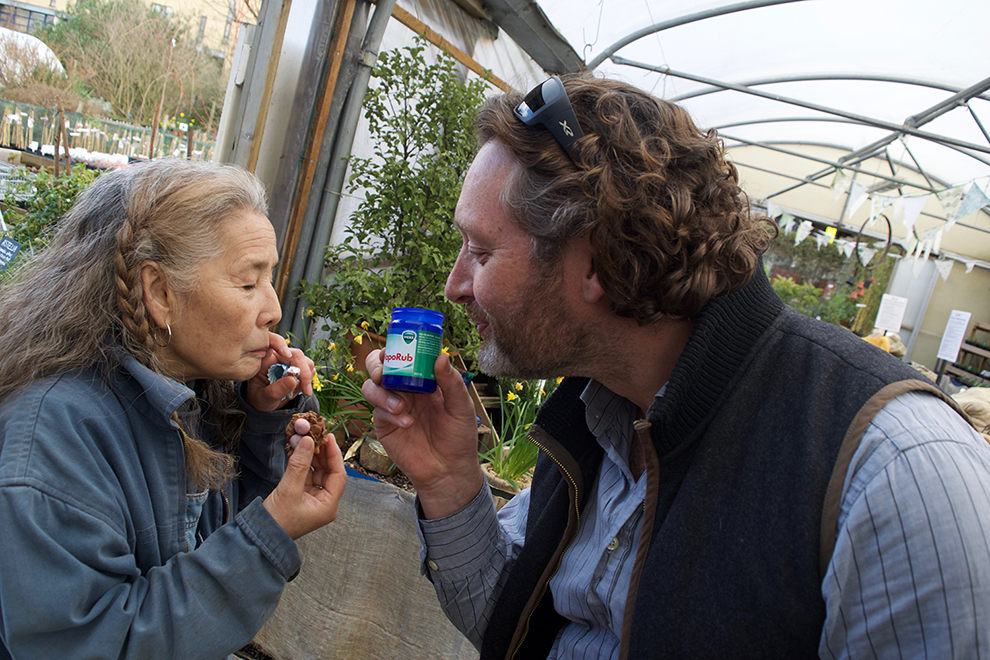
Two friends interact in a shared appreciation of the smell of a vapor rub.
But it wasn’t just talk that was done differently. The ways in which it appeared for participants extended to its material and sensory form. In this regard, how menthol manifested, its ontological character, changed by virtue of the specific methodological arrangements being enacted in the pop-up stall (location, participants, objects selected, and so forth). In one potent example, that we describe in detail elsewhere (Balmer et al., 2020), a friendship group composed of young men around 18 years old chose to play with vapour rubs in a joking fashion, leading to a game of one-upmanship (see Figure 5) in which they tried to outdo each other in being able to tolerate the burning sensation caused by menthol being liberally spread on sensitive skin and tissues (e.g., under the eyes or nose).

Young men recovering from the effects of vapor rubs put on sensitive skin.
In contrast, carers and teachers (in loco parentis) tended to encourage children and young people toward trying the most appropriate products (e.g., having a throat lozenge) and asking them to then engage in what they took to be meaningful participation, often guiding children to answer questions directly (“but what does it taste like?”) or rephrasing their answers for the researchers (“he likes it, that means he likes it.”). In this regard, ontologically, the kinds of interactions with the objects changed how those objects were experienced, depending on who was interacting in the production of talk and in what situation.
Juxtaposition: Objects In and Out of Place
This meant that the relationships participants had with each other shaped how the products became meaningful in the pop-up situation. Partly, this was a result of how the materials, the place, the people and the practices of use became differently juxtaposed across the different encounters that the pop-ups generated. This led to some of the products being out of place, and so disconnected from the usual routines and spaces in which they would be used. This is where the pop-ups departed significantly from ethnographic approaches in which being situationally ‘in-place’ is crucial. Unusual uses of menthol, like young men playing a game or rubbing heat rub onto the inside of a wrist to see what it feels and smells like, became breaching encounters, in which the normal moral and proper uses of products were visible in their absence and were thus epistemologically valuable moments. A clear example of this can be found in how people never chose to do anything with mouthwash or body wash other than sniff them, which one would rarely do at home in the regular use of those products. The sense that it would be inappropriate to swig mouthwash with nowhere to spit it out, or to take off one’s shirt and start a sort of dry shower experience was evident to all. The miming of this kind of thing by some young people (pretending to ‘down’ a bottle of mouthwash at the stall as if it was an alcoholic drink, or feigning lathering armpits) spoke to the oddness of the encounter with objects “out of place.” Humor sometimes featured as a way for people at pop-ups to navigate their more surprising encounters with these materials and reflected the hidden sensory-moral dimensions of those very spaces in which we located the pop-ups, but also of those places in which the products would more usually be found.
In contrast, people readily opened up packets of chewing gum, confectionery and lozenges to try them without any recognizable sense of this being an odd way to encounter those materials. It is quite common to use cough lozenges in a public space like a museum or a shopping center, for instance, but far less common to use toothpaste because of the usual timings, material needs (toothbrush and basin) and purposes (cleaning teeth). Furthermore, it is more common practice for people to offer lozenges and chewing gums to one another in public spaces but far less expected for strangers to proffer muscle rubs, toothpastes or shower gels. All of these, as we have discussed elsewhere, are more implicated in intimate hygiene and family caring practices. Other products seemed to lie in the middle of these extremes, like menthol cigarettes or cough syrups, which were readily opened but not so easily sampled. The pop-ups were therefore powerful because of their juxtaposition of materials, practices and spaces, producing in-place and out-of-place objects, which generated useful insights for our study (see Balmer et al., 2020).
Discussions in the garden center, for example, linked menthol to its botanical sources. There, and in the shopping center, parents were partly engaging in attempts to occupy or distract their children as a detor from the adult business of buying items; responses were often about what menthol was, memories and biographical context. In contrast, discussions in the museum took place in the context of learning, specifically about the body (bones, skin, organs and so forth), and parents would encourage this kind of response from their children, so that their data were more about how it “felt” to use, or where on the body they would use it. This meant that participants approached the co-production of data in ways that were related to the purposes of their visit or to the spaces we intervened in; their overall expectations of the event shaped their talk; how much time they found themselves with informed what they were willing to do; what other stalls, shops or activities they had visited merged with discussions of menthol products; how intriguing they found the stall itself was determined by its salience with the broader situation, and so on. Taken together, the relational, and spatial differences meant that participants encountered menthol objects that were manifesting differently depending on these shifting arrangements. The pop-up became a powerful qualitative method, when adopted using a relational, connective ontology, within a facet methodology approach.
Suffusion: The Timings of Overlapping Sensations, Feelings and Encounters
The different pop-ups also contributed a temporal dimension to our data generation, highlighting how different groups are mobilized at different times of the day or week, which further affected the contextual configuration of the data. We explore this issue through the notion of suffusion, and link this to juxtaposition, to address the temporally contingent entwinements of activities, objects and meanings immanent in facet methodology and explore how this played out in the pop-ups.
The way that participants encountered pops-ups led to different kinds of data in what we term a ‘spectrum of engagement styles’ having to do with how they timed their interactions with us. Sometimes we would get 10-20 minutes of detailed talk with a participant, exploration of multiple products, elaborate stories and interactive episodes. Equally, people might hang back, observing the pop-up but standing close to a kind of invisible line of direct participation (a hesitance was being performed for us), most likely deciding whether or not it was something that would be interesting for them or their families to engage with. This then allowed them to exit without explanation, or to ‘jump right in’ having seen how things work. This spectrum of engagement styles lent a free form to the pop-ups in that people would sometimes leap in and go with whatever we offered, while others would volunteer in ways they wanted to after they had assessed the situation and seen others’ interactions run their course. It also meant that we sometimes generated data fragments because participants might get called away by a friend or relative, or get bored, or move away to another stall, or we—the researchers—might only catch a few words of an exchange between trying to keep up with a range of groups and participants. One encounter seemed to suffuse with the next. As researchers we started to see the pop-ups not just as a space in which individuals might be engaged, but as a method for producing different relational encounters, as people, groups, spaces and times seemed to join together.
Time also shifted who we encountered and how. The university open days drew in students and teachers who would normally be in schools; the mid-week garden center pop-up included younger families, often with just the female primary carer or older people browsing plants. In the shopping center there were often families with two carers, or sometimes just one, doing the week’s shopping or “popping in for a few bits”; and in the museum there were families out for the day, for which the event was their main ‘destination’, meaning they came as a whole unit and had lots of time to spare.
Interestingly, the timing of groups and individuals visiting a specific stall would also overlap with other participants. This was especially true at the busier events, like in the museum, where individual researchers might be talking to one or more families at once. Participants would sometimes invite one another to the stall, or ask another (a known person or sometimes a stranger) for more detail. In Figure 6. Lynne Chapman’s sketching has captured the dynamic environment in which the data were collected. Participants’ bodies jumble together as they informally queue up while also trying to engage from afar. A participant calls out from behind a couple of younger participants to ask for an object as they jostle for position and space to get their hands on the products. The talk of participants overlaps and mingles with other activities in the location. A little boy engages with a dinosaur claw while his mother smells a body wash.

Participants interactions overlap and suffuse in the dynamic environment of the pop-up.
This overlapping had a profound methodological effect, where conversations across groups and across researchers meant experiences and reflections suffused across encounters, sometimes within the context of the stall, and sometimes with other situational factors. Participants in close proximity could overhear each other, meaning that they would often be talking in a sort of public register, making their talk consumable by others, often in terms of elevated expressions of sensory experience and in terms of comedic observations. In Figure 7, Lynne’s image captures the wry, funny, hyperbolic comments that participants generated for researchers but within this public-facing register of good humor and mutual enjoyment of this slightly odd encounter with the objects out of place. As one participant says “it blows your nose off” another offers “use chilli rules” whilst someone else jokes its “like marmite” (you love it or you hate it). These suffusions were methodological gold-dust because they opened up not only the interactional (as the focus groups similarly achieved) but also produced a kind of spectacle, an embodied, public encounter that played on the boundaries of the personal, creating a comedic register which we took to indicate the humor rendered by a range of more or less intimate but extremely mundane items being brought into a public museum alongside specimens of dinosaur bones and rare artifacts. The pop-ups allowed for contradictions, ironies, novel alignments and affective experiences to be witnessed, explored and created by participants during object-elicitation, making it a profoundly different scenario than we generated in our object-elicitation home tours, focus groups and interviews, and one in which humor, absence and juxtaposition played important roles. Suffusion and juxtaposition thus represent useful onto-epistemological concepts for thinking through how to analyze pop-up data. Where other methods might focus on individual actors as participants, the pop-up stall produces new epistemic objects for the generation of flashes of insight.

Participants offer their perspectives, experiences and engage with the objects as Lynne tries to capture the snippets of dialog whirling around the stall.
Conclusion
Our experience has demonstrated the usefulness of pop-ups as an intensive research technique within a project organized using facet methodology. We used pop-ups as a mass object elicitation method (a form that we could put under the broader heading of material methods) to explore the sensations and practices associated with a particular chemical. We have considered the possibilities, effects and limitations afforded by the pop-up format, particularly with respect to various relations in time and space. We imagine that the pop-up format could be adapted to explore other aspects of material and sensory practice, to eliciting other forms of responses (e.g., spoken ‘diary entries’) and using other forms of data-generation (e.g., more creative/arts-based methods).
In this paper, we chose to focus on the practical and analytical elements of this new method which we felt would be of most use should others decide to experiment with this form of data generation. There are particular avenues for researchers that might be profitable to explore from examining the method within other theoretical perspectives. For instance, researchers in sociology and related areas may investigate further the production of agency in mass-elicitation, and in facet methodology more broadly. Relatedly, scholars interested in materialist and connective theories such as some in science and technology studies may find fruit in harvesting the production of differences through the method for research seeking out ontological multiplicity. There are many further such possibilities and there are inevitably choices as to how to embed this method in projects including its relation to other methods, which will affect how it is used to generate findings.
Firstly, the pop-up format is a mobile, adaptable technique that can be used to generate and co-produce data with a wide range of participants. Once researchers have curated the elicitation materials and objects, the stall can be transported to different sites. This gives a project a ‘bandwidth’ that might not be possible with other modes of one-on-one or small-group elicitation. Pop-ups allow researchers to both ‘scan’ for diversity and the potential range of issues as well as highlighting contradictions and difference through a ‘breaching of convention’. They can therefore play a role in scoping out interview schedules or piloting focus group themes. They can also be deployed to check findings with a large number of participants that arise from complementary techniques elsewhere in a project. Thus, pop-up stalls are not only adaptable in terms of physical location or demographic usage, but also in terms of their epistemological function within a project.
Secondly, the format is especially good at generating particular kinds of relational insights within the spatial, material, temporal and sensory orders. As we have shown, as participants engaged with the menthol objects they often gave emotion-laden reactions to the smells before developing accounts about what the sensations conjured for participants about how such reactions mattered to them. To understand data elicitation at a pop-up stall, then, it is important to engage in a relational analysis that understands the materials and the interactions with those materials in terms of who is present and how they know each other, and what they are being asked to do in terms of their usual practices, but also in terms of where they are and what is not present that would usually be so when these products are used and associated practices normally activated, and finally what and who is present that is usually not so. Presences and absences are thus key to the analysis of material relational configurations during a pop-up stall. The concepts of situation, juxtaposition and suffusion offer a route into analysis of these phenomena, which we hope will be useful to other researchers in the future.
Footnotes
Acknowledgments
We want to thank all the participants for their involvement without whom such research would not be possible. We would like to thank Barbara Ribeiro and Philip Shapira other members of the responsible research and innovation group, and our colleagues in the Morgan Centre at the University of Manchester for their support, discussions and critical comments throughout the project. We would also like to thank the two anonymous reviewers who provided thoughtful and useful feedback.
Declaration of Conflicting Interests
The author(s) declared no potential conflicts of interest with respect to the research, authorship, and/or publication of this article.
Funding
The author(s) disclosed receipt of the following financial support for the research, authorship, and/or publication of this article: This research was supported by the Biotechnology and Biological Sciences Research Council (grant number BB/M017702/1).
