




Abstract
This article reflects on methodological decisions, strategies, and challenges from a recent interdisciplinary project on the relationship between “British values” and Islam. The project employed digital storytelling to access “everyday” conceptions and constructions of this contentious relationship. The research was undertaken by participant researchers recruited from Muslim communities in the UK’s East Anglia region, working with academics from media studies and political science. In this article, we offer a detailed account of key moments relating especially to recruitment, retention, and the production of digital content. It offers two contributions. First, methodological guidance for researchers interested in combining participatory research with digital storytelling. And second, rationale for so doing given the methodology’s scope for producing rich visual content with capacity (i) to deepen and disrupt established knowledge and (ii) to change the views, ideas, and aspirations of those involved in the content’s creation.
Keywords
Introduction
Recent years have witnessed expanded interest in the diverse ways in which international politics manifests itself throughout “everyday” life. This interest can be seen, first, in contemporary work on the gendered relations and norms that police the behavior and expectations of “ordinary” people (George, 2018), work which builds on long-standing feminist concern with the exclusion or forgetting of mundane, personal experiences in dominant sociopolitical imaginaries (e.g., Enloe, 2011, 2014). Complementary research on “vernacular security,” similarly, concerns itself with how “ordinary” citizens understand and experience (in)security, seeking a potentially useful corrective to the tendency within contemporary—including critical—scholarship to “speak for, rather than to (or, perhaps better, with) ‘ordinary’ people and the conditions of (in)security they experience, encounter or construct in everyday life” (Jarvis & Lister, 2013, p. 158). Related emphasis may also be found, finally, in recent work on “everyday International Political Economy,” which emphasizes “the manifold ways in which everyday actors shape their own lives and others around and beyond them whether or not they are resisting power” (Hobson & Seabrooke, 2007, p. 15).
Although theoretically, politically, and normatively diverse, such scholarship—and related interventions (e.g., Crawford & Hutchinson, 2015; Innes, 2017)—emphasizes the importance of the ways in which (international) political issues, dynamics, and relations are lived, encountered, remembered, and (crucially) storied. Such emphasis matters because it offers enormous potential for revisiting, revitalizing, and perhaps even replacing established understandings of international political life. As Luckham (2017, p. 12) argues in relation to “vernacular security studies”: “Security in the vernacular” emphasises that those who are vulnerable and insecure are not just social categories but people, groups and communities who perceive, cope with and respond to violence in ways that differ, sometimes radically, not only from the dominant state security narratives, but sometimes also from universal conceptions of human and citizen security.
To address the first limitation, this article offers a detailed methodological discussion of a recent research project focusing on public understandings of the relationship between “British values” and Islam. Central to this project—and here lies our attempt to address the second limitation—was the recruitment of participant researchers to produce original short films on this theme. In this article, we therefore focus explicitly on key methodological decisions, successes, challenges, and failures within this work, focusing—in particular—on issues of recruitment, retention, and content production. Our immediate hope in so doing is that explicit reflection on these dynamics (and our mistakes!) might prove instructive for future research on everyday (international) politics.
The article’s wider ambition is to argue that “participatory digital storytelling”—the production of digital stories by participant researchers—offers a productive and underused, if challenging, methodology for exploring nonelite understandings of contentious political phenomena. Three reasons for this are offered. First, it offers potential to broaden existing empirical knowledge by offering opportunity for research participants and their interlocutors to share and create their own stories. This might, of course, include hidden, silent, or subjugated perspectives within communities to which a research team lacks access. Second, the use of film as a medium for participant storytelling facilitates the production of richer, more complex, forms of knowledge combining linguistic and nonlinguistic dimensions. And third, by handing authorial and editorial control to participant researchers, the approach has capacity for intervention as well as invention: putting the methods literally in the hands of the participants (Gubrium & Harper, 2013) and generating opportunity for disruption, deconstruction, and challenge of existing discourses and their outcomes. The beneficiaries of this, we suggest, are potentially multiple, including the participant researchers themselves, their subjects, wider communities, and other researchers.
To make these arguments, the article proceeds in four stages. A first section situates our research within contemporary scholarship on vernacular politics. Notwithstanding the significance of this work, we argue that the emphasis on linguistic methods such as focus groups and interviews risks unnecessarily limiting its insight. A second section then introduces our project on British values and Islam. Here we pay particular attention to the situation of our research within recent developments around digital storytelling and collaborative interdisciplinary research. A thick methodological description of our research experience then follows, leading to a final section in which we reflect on the political, aesthetic, and epistemological value of our approach and its wider applicability.
Vernacular Politics and Linguistic Methods
As indicated in the Introduction, recent research into everyday or vernacular politics has offered a significant contemporary addition to the store of “critical” approaches to global politics. Much of this work, to date, has focused on the politics of security, a reaction, in part, to the state-centric imaginaries that still dominate this lexicon (see Bubandt, 2005). Gillespie et al. (2010) “shifting securities” research into the security-media-society nexus offered important early inspiration here, in which they employed a mixed-methods approach combining media analysis, elite focus groups, and interviews and a “collaborative audience ethnography” of semi-structured interviews. Related work on the war on terror’s percolation throughout social and political life has employed similar methods, including Mythen et al.’s (2009) employment of focus groups and interviews to explore how young British Pakistanis experience their construction as a “risky” population. Jarvis and Lister (2013, 2015), similarly, explored public views of the connections between security, citizenship, and counterterrorism politics through focus groups in England and Wales, while Vaughan-Williams and Stevens (2016, p. 40) pursued a similar methodological strategy to investigate “which issues citizens find threatening and how they know, construct and narrate ‘security threats.’”
Such research offers a significant conceptual challenge to the “methodological elitism” that afflicts much analysis of (world) politics (Stanley & Jackson, 2016). By pulling attention to the world-making agency of “ordinary” actors and to the intrusion of global political dynamics into ostensibly everyday, mundane existence, a far more sophisticated, layered conception of the world is offered. The use of focus group and collaborative interview techniques to this end also helps challenge established epistemological and methodological preferences within disciplines such as political science, international relations, and criminology, opening space for the collection—or co-construction—of qualitatively rich insight into public understanding and expression.
The importance of this work notwithstanding, there are—of course—limitations to focus groups and collaborative interviews for accessing the “everyday” or the “vernacular.” In the first instance, such methods inevitably prioritize the linguistic, seeking knowledge of public understandings and attitudes through what is said rather than—for instance—what is seen. When the transcripts of such research encounters are subsequently subject to content or discourse analysis, moreover, engagement even with nonverbal aspects of communication, such as body language or intonation, is again often limited. An additional limitation of such methods is the risk that these stymie the creativity of research participants, reducing involvement to what a participant feels able and willing to say in the context of an interview or group. Yet linguistic confidence, personal concerns (perhaps around safety or reputation), as well as power relations in collaborative research contexts will, of course, structure, intrude upon, or impede participation in such groups. In short, such methods risk only capturing that which participants are able to represent linguistically in a research environment typically—although not always—moderated by a researcher.
Contentious Politics, Digital Storytelling, and Participant Researchers
The project underpinning this article sought to explore how the increasingly prominent term “British values” is understood and experienced from “vernacular” vantage points within the United Kingdom (Jarvis et al., 2019). “British values,” as a concept, has deep roots in long-standing media and political fears around multiculturalism, national identity, extremism, and beyond. Its current visibility, though, owes much to the “Operation Trojan Horse” allegations around an “Islamist” plot to commandeer several schools within the city of Birmingham (see Richardson, 2015).
To explore this concept—and to build on the above research (see also Croft, 2012; Fekete, 2004; Gillespie & O’Loughlin, 2009; Mythen, 2012; Mythen et al., 2009; Pantazis & Pemberton, 2009)—our project design was structured around three research questions: (i) What does the term “British values” mean to “ordinary” people within the United Kingdom: How, where, and when is the phrase encountered, experienced, and understood in everyday life?; (ii) What do people living in the United Kingdom think of as “Muslim values”; and (iii) How do people in the UK understand the relationship between “British values” and Islam or Muslims?
The project’s geographical focus was kept deliberately narrow and restricted to four sites in the UK’s East Anglia region: Bedford, Ipswich, Luton, and Norwich. The sites were selected for three reasons. First, for their significance in contemporary debate on “British values” and Islam. Luton is home to the far-right English Defence League and has seen repeated activity by related groups such as Britain First. Such dynamics help ensure it remains a regular focus of media attention within British discussion of extremism, terrorism, multiculturalism, and integration. Norwich, too, has witnessed controversies of local and regional significance including the Reformed Church’s ban from holding a bookstall promoting “hate-motivated” literature relating to Islam (British Broadcasting Corporation [BBC], 2012). It is also home to what is widely believed to be the UK’s first indigenous Muslim community as well as significant student and resident Muslim populations. In Bedford, Bedfordshire Police introduced a high-profile anti-extremism campaign—Let’s Talk About It (n.d.)—in 2015, seeking to “challenge division and negativity in our communities.” Meanwhile, Ipswich, finally, has seen incidents of anti-Muslim hate crime as well as controversial events such as a 2013 march in memory of the murdered off-duty Fusilier, Lee Rigby.
A second reason for our geographical focus concerned the under-researched status of Muslim communities in East Anglia. Despite a burgeoning academic literature on Muslim life in Britain today, existing research has focused on major metropolitan hubs, such as London, Birmingham, and Manchester, or areas with a high density of Muslim residents, such as Bradford. This is unfortunate because regions such as East Anglia are home to diverse and heterogeneous populations with potentially differing views and experiences. Norwich alone, for example, hosts four mosques serving different Muslim communities. Moreover, the proportion of Muslims living in our four identified sites differs significantly. According to the UK’s 2011 Census, the total proportion of Muslims in England and Wales is 4.8%. This figure is matched exactly by Luton (4.8%, host to 26 mosques), exceeded in Bedford (5.5% Muslim; 10 mosques), and greater than the 2.8% of Muslims living in Ipswich (three mosques) and 2% in Norwich (four mosques). A third, pragmatic factor, finally, was the situation of the research team within the region and the potential to capitalize on existing connections with communities and their organizations.
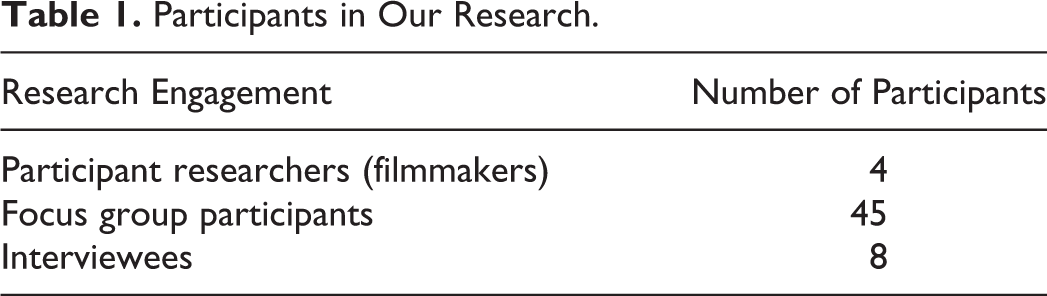
Our research into the relationship between “British values” and Islam within this region employed a mixed-method approach of three broadly consecutive stages described further below. First, digital storytelling through filmmaking, from which was generated 16 original films produced by participant researchers and totaling 180 min in duration. These films were accompanied by nine video diaries produced by members of the research team throughout the project. The project’s second stage comprised eight focus groups of Muslim, non-Muslim, and mixed participants. Forty-five individuals participated in these groups; each of which was moderated by a member of the academic research team and included the screening—partway through—of selected clips from the original films. The final stage involved eight semi-structured interviews with the participant researchers and relevant community figures. In the discussion below, we focus on our engagement with participatory digital storytelling, but reflections and findings from our focus groups and interviews are introduced to augment and make sense of that experience.
Digital Storytelling and Participant Researchers
The use of digital storytelling to access “everyday” insights and experiences is well established in disciplines including Gender Studies (Barcelos & Gubrium, 2018; Lenette et al., 2019; Martin et al., 2019; May & Macnab, 2018; Rouhani, 2019), Education Studies (Fokides, 2016; Literat, 2013; Nordmark & Milrad, 2012; Siriwatchana et al., 2019), and Health Sciences (Rieger et al., 2018). In Gender Studies, the approach is often seen to offer opportunity to challenge power imbalances between (feminist) researcher and the researched, potentially promoting social justice. As highlighted by Rouhani’s (2019) work on West African women’s experiences, participatory visual methodologies have become a crucial tool for feminist researchers to conduct research that begins with “the experiences of women and provides women with the ability to decide how they choose to represent their lived experiences” (p. 574). In Education Studies, digital storytelling is often used to support alternative ways of learning. Nordmark and Milrad’s (2012) study on the use of digital storytelling for promoting creative collaborative learning, for instance, employs the method to support alternative ways of learning about cultural heritage for school children in Sweden.
Proponents of digital storytelling tend to see the approach as combining normative and aesthetic potential, in that it is capable of recognizing and legitimizing nonelite stories and facilitating the production and sharing thereof by nonprofessionals with nonspecialist equipment (e.g., Burgess, 2006; Lenette et al., 2019). Although initially focused on the creation of very short films from still photographs (e.g., Lambert & Hessler, 2011), technological developments, and the increasing accessibility of relevant equipment, mean digital storytelling now captures the multiplicity of ways in which stories are today combined with multimedia objects (Rossiter & Garcia, 2010, p. 37) from podcasts to virtual reality environments or novels read and written on mobile telephones (Alexander, 2017, p. 3). As an emergent method in social research, digital storytelling often, importantly, aims to understand the everyday life experiences of ordinary people by adding the visual to more straightforward narrative inquiry.
Although visual research methods are not new within social scientific study (Literat, 2013), the use of such methods has become increasingly participatory, reflecting developments in fields such as feminist studies, development studies, and applied fields including public health. As Gubrium and Harper (2013) argue, visual and digital methodologies can contribute to a participatory, public-engaged ethnography. Such methods can change the traditional relationship between academic researchers and the community, building opportunities for more accessible, inclusive, and visually appealing interactions in which individuals are encouraged to reflect and engage with issues affecting their own communities. Participatory visual methodologies may be highly effective in offering possibilities for community engagement and in shifting the boundaries between researched and researcher, while allowing marginalized voices to speak for themselves about social conditions (Mitchell et al., 2017). As a community-based participatory research method, then, digital storytelling offers an opportunity to investigate individual, group, or social understanding. Indeed, the process of digital storytelling serves as much a site for analysis as its products.
Our own engagement with participatory digital storytelling began with the autoethnographic assumption that “examination of an author’s personal experience can provide explanations of political features or behaviour that would not have been possible through other, more conventional accounts” (Bleiker & Brigg, 2010, p. 792). Specifically, we were interested in accessing: meaningful, accessible, and evocative research grounded in personal experience, research that would sensitize readers to issues of identity politics, to experiences shrouded in silence, and to forms of representation that deepen our capacity to empathize with people who are different from us. (Ellis et al., 2011, cited in Fitzgerald, 2015)
Although related methods have been employed successfully in other areas of research, our project offered a first effort to allow “ordinary” Muslims within the UK opportunity to produce their own stories around “British values,” in their own voice, genre, and style. By approaching our participants as “counterpart” rather than “other” (Marcus cited in Gubrium & Harper, 2013, p. 14), we hoped to help capture and share the diversity of Muslim experiences in Britain today, offering a corrective to the essentialisms that course through debate around this term.
Working With Participatory Digital Storytelling
The remainder of the article recounts our experience of working with participatory digital storytelling in our interdisciplinary research team.
Design, Recruitment, and Retention
The digital storytelling stage of our research was designed to incorporate two filmmakers from Muslim communities in our four research sites: Bedford, Ipswich, Luton, and Norwich. Our aspiration was to work with participants from diverse demographic backgrounds in relation to gender, ethnic identity, and denominational identity to capture something of the heterogeneity of Muslim communities in the region and beyond. Although cognizant of potential challenges to recruiting participant storytellers, we drew confidence from our prior experience of working with publics on politically sensitive and salient issues including counterterrorism policy and child marriage. Moreover, our offer of financial, skill-based, and political incentives was, we believed, a potentially attractive one which included (i) the opportunity to join a major new research project attached to a prominent university in the region; (ii) training and experience in research and filmmaking skills from a team comprising academics and journalists through our research partner—BBC Voices; 1 (iii) the chance to design, direct, and screen an original film on “British values”; (iv) travel expenses and all necessary equipment; and (v) remuneration of £300 on completion of the film. 2
Our strategy for recruiting participants to the project was a multiple one, including posting items on classified advertisement and community websites such as Gumtree and Wherecanwego, framed accessibly as in Figure 1. 3

Recruitment advertisement.
This advertisement was republished multiple times (16 times on gumtree alone), with variation in the designated postcode (identified through Google Maps searches for indicators of relevant communities such as mosques) and minor textual variation. Subsequent advertisements, for instance, included alternative headlines such as “Muslim voices wanted for university research project” and “British Muslim Values: Amateur filmmakers sought for university research project—no experience req.” Other recruitment initiatives included paid advertising in The Muslim News as a specialist publication with relevance to our target demographic, press releases organized by a specialist university press office, local media interviews including on regional radio stations, snowballing through contacts in communities known to the researchers or their colleagues, distribution of leaflets and posters to targeted sites including community groups and specialist shops, project-specific social media accounts, visits to local community organizations, and a web presence with dedicated project website and social media accounts.
The initial expressions of interest we received indicated personal, social, and political motivations for participating in the project. One applicant highlighted the project’s congruity with his professional aspirations: “I was extremely excited to hear about this as becoming a filmmaker is one of my ambitions” (ML, received October 2016). Another emphasized a commitment to understanding the everyday consequences of social antagonisms: following Brexit and the rhetoric surrounding the matter with strong arguments against immigrants specifically Muslim ones, I hope to explore how this idea affects Muslims who are heavily integrated into the British society and how this relates to their daily lives and them being comfortable in their homes and local environment. (MM, received October 2016) I have experienced and observed both positive and negative aspects of being a Muslim woman in Britain and abroad. I have grown up trying to work out the balance between Muslim and British values—encouraged to behave in one way and yet needing to adapt to societies values and expectations. It has been a learning curve, a baptism of fire, which brought with it both a sense of isolation and resilience, we were made to feel exceptional but removed—it took a while to come down off that pedestal!…This project is an opportunity for me to bring my own experience to task. It is a subject I have lived, studied and reflected upon. After taking time to raise a family, I am now in a position to reconnect with this discussion and believe the project will initiate a program of research into British Muslim women, their stories, perspectives, and experiences. (QG, received October 2016)
As an attempt to maintain momentum despite these challenges, an initial training session on filmmaking and editing was organized with our partners at BBC Voices at their studio in Norwich, attended by four prospective researchers. Two of those researchers stayed for the duration of the project, ultimately producing and publicly screening their own films. The other two disengaged from the project: one for personal reasons and the other simply ceasing contact with the research team. Because of this problem of attrition (other prospective participants had also joined and departed from the project by this stage), our deadline for expressions of interest was extended multiple times, before we finally settled on an open-ended, flexible deadline. By the project’s conclusion, we had more films (16) but produced by fewer participant researchers (four) than in our original research design (see Table 1).
Participants in Our Research.
Through interviews with our participant researchers, and from conversations with potential participants to the project, it is possible to identify several sources for these recruitment challenges. First, and most obvious, is the project’s engagement with the contentious and inflamed issue of Muslim experiences of, and integration within, contemporary Britain. Although long-standing, and with multiple roots, questions of immigration, integration, and multiculturalism had become further pronounced in the duration of our project following the announcement of a June 2016 “Brexit” referendum on the UK’s membership of the European Union. This context—which contributed to more explicit public discussion of fears and hostilities around the British national identity—seems to have played an important role in deterring potential researchers from participating for two reasons. First, due to worries that participants might attract unwanted attention from diverse sources, whether the government, other Muslims, or racists. Two lengthy telephone calls with one individual possessing multiple contacts in our target communities, for instance, failed to assuage her concerns around the researchers’ statutory duties in relation to the UK’s counter-radicalization program prevent. Indeed, even researchers who completed the project noted concerns that their contribution rendered them potentially more visible and vulnerable. In the following, one of our participants, Lila, reflects on her attempts to recruit subjects within her films: everybody’s different in their way of understanding what British value[s] is but they’re also fearful that, you know, because it’s not set, this is me, I wouldn’t say it’s them, that you don’t want to say something and because it’s going to be used for research and it turns out or it’s shown as a negative, then they get the blame for it, that’s probably what people are thinking, because there’s no set rules, you don’t want to be then blamed to say, “he said this was British values” etc. (interview, December 2017) Even now I’m thinking…everybody is, we are trying to just get on with life, you know and then you’re picked up on, “What is British values? Why ask us? Why not ask everybody else?” Why just the Muslim community? (interview, December 2017)
Concerns such as these were likely augmented by the research team’s limited prior contact with the relevant communities. Although the team’s expertise (including in international politics; religion and security; and Islam, gender, and the media) and track record contributed to the project’s feasibility and interdisciplinarity, none of the academic members enjoyed strong preexisting networks with Muslim communities in the region. Nor were any of the team a practicing Muslim. Thus, the ability of our academic credentials, professional titles, and associations to mitigate this will likely have been mediated through the prior experience of potential participants with universities as well as through demographic dynamics including race, gender, and class. One meeting in a mosque, for instance, resulted in our leaving project material with a representative who offered to get back to us once he had shown the material to “uni boys” in the congregation, yet this did not materialize.
One final set of pragmatic challenges followed our very specific project design. As an attempt to combine digital storytelling with participant researchers, our project asked rather a lot of typically overcommitted individuals often already balancing work, familial, and other commitments. Although the level of commitment required became more apparent to the project team as the research progressed (discussed further below), this, too, may have deterred potential researchers from the beginning. Storying, filming, editing, and screening an original short film require continuing involvement in a project over a sustained period of time for—in our case—comparatively little financial remuneration. In this, it differs markedly from other forms of research participation such as completion of a survey or joining a focus group.
Against this backdrop of recruitment efforts and challenges, the project ultimately ran with four participant filmmakers. Two were recruited through online advertising and a third via snowballing through an existing contact with a colleague of the research team. The fourth was recruited via an individual met by two of the research team on an attempted (unsuccessful) visit to a mosque in Bedford.
Production
As noted above, the four participant filmmakers produced a total of 16 films for this project. Muqaddam’s film was structured around the reflections of three Muslim inhabitants of Norwich of ostensibly different demographic backgrounds. Prominent in their reflections was a sense that the term British values offers opportunity to understand and examine contemporary social dynamics. Mo’s film lacked any spoken narrative, instead juxtaposing written verses from the Qur’an with iconic local imagery including the Cathedral and Castle from the city of Norwich beneath an original music score. The film traced connections between these verses and the ways in which religious values are expressed within the city’s Christian architecture. As Mo subsequently reflected: I thought that if I showed the sense of heritage that was there in Britain, it might make people reflect on where we’re really at now […] I just wanted to […] look at the bigger picture and so broaden the whole scope of things beyond just the personal talking heads type thing. I thought it was necessary to show this broader scope than simply how people felt, what they valued. So that’s why I started looking at heritage and artefacts and museum pieces because essentially, why are they there, if we don’t value them why are they in the museum? Are they reflective of our values? […] (interview, June 2, 2017)
Each researcher was offered professional training on film production and editing from our partner BBC Voices. In a postproject interview, Qudra highlights the benefits of this relationship thus: I think working alongside BBC Voices has been so insightful because […] you can tell a story through video […] and look at different aspects of society. Using that medium is a great way to get stories out there and so I feel already that I’ve learned a huge amount, loads of skills from doing the film editing and the filming…(Qudra, May 27, 2017)
A second challenge concerned authorial control in the production of the project’s digital content. Our professional partner BBC Voices very generously provided filmmaker participants with training on cinematography and storytelling, which inevitably impacted on the ways in which our participants’ stories were told. Pulling in the opposite direction, though, was our attempt to cede authority to the participant researchers so that their stories reflected their own experiences, interests, and perspectives. Here, our written and oral guidance was left deliberately broad and lacking specificity. This, with hindsight, had disorienting and decelerating consequences at times, leading some of our researchers to seek regular assurance on the appropriateness of their work. As an exchange at the end of Lila’s postproject interview indicated, a wider reluctance to claim privileged expertise on the part of the researchers also contributed here:
One of the things we’re very keen to do is to […] make sure you’re aware of everything that happens with this research and to be aware of the outputs and have access to them. We’re very keen that you are the expert and your participants are the experts: We’re nothing more than reflecting on your knowledge.
I wouldn’t say we’re experts but we’re just ordinary people and we’re just trying to do life and be part of British society, that’s what we want.
Participatory Digital Storytelling: An Evaluation
Notwithstanding the above challenges of recruitment, retention, and production, our experience of combining participatory research with digital storytelling leaves us optimistic about the methodology’s potential for future work on vernacular (international) politics. In this section, we discuss four specific benefits before reflecting—in the conclusion—on its wider applicability.
A first benefit concerns the creativity provided by participatory digital storytelling for polysemous knowledge of contentious politics within a multimedia environment. Although all but one of the films produced on our project employed “talking heads” at some point, our researchers engaged with their medium in creative ways including through original music, static images, dynamic images, and intertitles. Our experiment with this method, then, saw knowledge produced that very clearly escaped the above-discussed reductionism of purely linguistic approaches to everyday political experiences, generating nondiscursive and nonrepresentational “data” for viewers and analysts (Callahan, 2015, p. 892).
Key to this is the situation of this methodology within the contemporary “visual communication revolution” (Bleiker, 2018, p. 6), in which the centrality of images to understanding global politics today has been dramatically enhanced by a democratization of their production enabled by contemporary technological developments (Bleiker, 2018). Would-be participant researchers today are already embedded in visual and digital politics as consumers and producers on smartphones, tablets, and laptops (although not uniformly or homogeneously). This method allows for a capturing of that familiarity in creative and potentially revealing ways, for, as Muncey (2005, p. 84) provocatively argues in a broader discussion of autoethnographic research: Mainstream research [is]…tied up in rules and conventions that make the results appear dull and flat, and ignoring completely the idiosyncrasies of the lived experience of the communities that it bypasses, so that in time, their stories become at best forgotten and at worst untold.
This scope for analytical richness was discussed directly by two participant researchers in our project. Qudra—whose film focused on White Muslim women in Norwich—noted the method’s capacity for documenting intra-communal heterogeneities in her postproject interview: “it was amazing to see how each person’s story is so different from each other’s and their individual life experiences really came out, again without having to actually ask any direct questions” (interview, May 27, 2017). Mo—our only participant researcher to completely eschew the spoken word in his film—used the method to visualize rather than describe the relationship between “British values” and Islam: I didn’t want it to be a talking heads [film], to have British Muslims say how they felt and what they value because I just felt…I wouldn’t get to people who would be representative enough, I could talk to individuals and stuff but the thing you face as a Muslim in this society, by the bigots, is that if you say one thing, if you say Islam is a religion of peace, they’ll say “No it’s not” and you end up with this convoluted dialectic and so what I wanted to do was immerse people into a deeper thing. (interview, June 2, 2017)
A third advantage is this methodology’s capacity for criticality: a capacity to pluralize, disrupt, contest, and oppose popular or dominant framings of sociopolitical dynamics. This potential appears to have been vital to all of the researchers on our project, whose aspirations in making their films included destigmatizing or normalizing Islam and Muslims, such that: I just felt like actually using film as a way to show the normality of what it is to be a British Muslim, I just wanted to [show] “this is what it is”, it’s like asking someone “what does it feel like to be northern?”, or Welsh. (QG interview, May 27, 2017). I think the major thing is hoping that it will have an impact, even if it’s going to have impact on five people, 10 people…[make] them to think differently and look at the Muslim perspective and say, “Okay, yes we understand that there’s a lot of radicalized people, we understand that but think about the everyday Muslim…not every single one is a terrorist, not every single one wants to harm you and not every single one wants to impose their religion on you,” which is largely the sentiment that you see out there.” (Muqaddam interview, October 3, 2017) In a way I wanted people to reflect firstly on their own identity before making a judgment about Islamic identity. I think to awaken an intrigue…I suppose I want people’s imaginations to be aroused by this and to go about thinking of how things are the same and not different. (interview, June 2, 2017)
A second—epistemological—caveat concerns the relationship between researcher and research. Although tempting to see digital stories as the product of subjects (participant researchers), those subjects are also, in part, the product of the stories they tell. The research process of digital storytelling itself likely contributes to the production of participant researchers’ identities, experiences, memories, and interests. For, as Vaughan-Williams and Stevens (2016, p. 46) argue in a different context (focusing on interpretivist focus groups), it “is not that the subject and his/her views pre-exist the situation in which the discussion takes place, but that it is via the interaction with others that this identity and knowledge are constituted.” Thus, although methods such as participatory digital storytelling provide opportunity or space for critical or disruptive knowledge, they need not necessarily do so (Vaughan-Williams & Stevens, 2016). Indeed, several of the films on our project seemed to reproduce established conceptions of “British values” and their relationship to Islam, as did the focus group discussions that followed.
A fourth, final, advantage to the approach sketched here is its potential for shaping the lives, aspirations, and values of participant researchers themselves. Several of our postproject interviews discussed this explicitly, including Qudra’s reflection on the intellectual challenge it posed—“it’s been great, just the initial thing of getting involved in the project, writing up the proposal, putting my ideas out there, getting all the cogs working, that was really exciting” (Qudra, May 27, 2017)—and Lila’s discussion of the extent to which her research generated questions with a longevity exceeding the scope of her participation: “So you’ve got me thinking more than anything and I think everybody was thinking what is it, what is it about British values? And why is it so important now?” (Lila, September 22, 2017). Such reflections, of course, require circumspection, not least for their generation in the context of interviews with the academic project team and our inability to do more than speculate on their longevity. Still, it seems clear that research of this sort has—at the least—potential value for its researchers as well as their audiences and interlocuters. 4
Conclusion
In this article, we have offered methodological reflections from a recent research project on public conceptions and constructions of “British values” and their relationship to Islam. Our focus, specifically, was on the integration of participant researchers as knowledge (co-)producers and the use of digital storytelling as a medium for knowledge (co-)production. By situating our research within a growing use of these two approaches and exploring our own key decisions, challenges, and—bluntly—errors, we argued that a participatory digital storytelling approach has four potentially important contributions for qualitative research: (i) facilitating creative, visually interesting knowledge; (ii) offering analytical richness or depth, especially through the accessing of potentially peripheral or marginal experiences; (iii) opening space for critical or disruptive research grounded in everyday lives and lived experiences; and (iv) posing capacity to change the ideas, interests, and aspirations of its producers.
In doing this, our hope is that this article serves, at a minimum, as a detailed and honest account of the evolving dynamics of a multidisciplinary research project with multiple partners. This may prove useful to researchers contemplating research on similarly contentious topics or considering the use of similar methods. As the above indicates, there are many things we might have done differently: Our flexibility was a product both of necessity and opportunity. The changes we made to our original design no doubt shaped the substantive findings of our project, although how and to what extent this was so is largely unknowable. More ambitiously, our hope is that this discussion encourages further innovation around methods such as those explored above: capitalizing on the creative, analytical, critical, and personal potential of participatory digital storytelling for generating new knowledge of significant sociopolitical issues.
Footnotes
Authors’ Note
Any errors remain, of course, our own.
Acknowledgments
The authors gratefully acknowledge the UKRI Partnership for Conflict, Crime, and Security Research for their support on this research and all those who participated in the project as filmmakers, focus group participants, interviewees, project partners, and beyond. They also thank attendees at the 2017 and 2019 annual conferences of the British International Studies Association and contributors of the UEA Qualitative Research Methods Forum for their helpful and generous feedback on earlier drafts of this article.
Declaration of Conflicting Interests
The author(s) declared no potential conflicts of interest with respect to the research, authorship, and/or publication of this article.
Funding
The author(s) received receipt of the following financial support for the research, authorship, and/or publication of this article: This research was funded by an innovation award through the UKRI Partnership for Conflict, Crime and Security Research under Grant AH/N008340/1.
