




Abstract
Visual methods, including drawn images such as comics, are receiving increasing attention in qualitative research. Indeed, comics are a highly accessible form of visual data, and through the intermingling of words and images they are well suited to convey the multidimensionality of real life. Drawing on a research project, I reflect on the potential of comic-style posters to engage participants in a workshop setting. The aim was to receive feedback on preliminary results, and the posters were very effective to fuel discussions, thus promoting social sense-making. Moreover, the process of designing the comic posters encouraged reflexivity within the research team. The work of visualizing results spurred discussions and surfaced implicit assumptions tied to methods for analyzing data and communicating results. These experiences indicate the creative potential of comic-style drawings for encouraging a more playful approach to discuss and share results of qualitative research with diverse audiences.
Keywords
What Is Already Known?
Visual media can be a powerful tool to engage research participants. However, so far the emphasis is mostly on photography, either as a tool for data collection or to communicate final research results to various audiences.
What Does This Paper Add?
Drawn visual media, such as comic-style posters, are effective to engage participants in a workshop setting, to share and discuss preliminary results. Moreover, the process of developing the posters can be used to promote researcher reflexivity.
Introduction
Qualitative social sciences tend to privilege word-based approaches, which may lead to overlooking the broad range of creative possibilities offered by visual methods. As Prosser and Loxley (2008, p. 4) put it, visual methods can “slow down observation and encourage deeper and more effective reflection on all things visual and visualisable; and with it (…) reflect more fully the diversity of human experiences.” The advantages of visual media include the ability to condense complex information and the capacity to convey strong messages, both of which can contribute to people’s issue-awareness (Nicholson-Cole, 2005).
The interest in visual methods within qualitative social sciences is increasing, not least due to the ubiquity of visual images, which is one of the defining features of the Internet-based digital culture. Indeed, with the widespread availability of high-speed wireless networks and the prevalence of smartphones, which enable users to create, edit, distribute, and consume visual content, images play an ever increasing role in online communication (van House, 2011). This visual culture increases the potential role as well as the acceptability of visual material in research (Rose, 2014). As a result, images—especially photographs—have become an important tool with which to communicate science (Rodríguez Estrada & Davis, 2014). It is noticeable that while drawn images such as cartoons and comics are a popular form of visual communication, they are often overlooked as a medium to disseminate research findings (Bartlett, 2013).
This article does not focus on the use of drawn images in data collection or in dissemination. Rather, I explore the use of comic-style posters for discussing preliminary insights with research participants and examine how the process of designing the posters led the research team to reflect on the assumptions underlying our research practice. I use examples from a research project on the resilience of family farms in Salzburg (Austria), where insights from data collected during interviews were visualized as large comic-style posters. These posters were presented and discussed with participants during workshops, which aimed at validating preliminary results, that is, ensuring that we had adequately captured and understood key issues. The posters led to lively discussions among participants, showing their potential to engage, to promote social sense-making, and to question established practices in the farming community.
Based on these experiences, I argue that using comic-style art in qualitative research offers diverse and creative possibilities, especially in the context of transdisciplinary research. I argue that comic-style posters are a way to overcome the limitations of written reports to interact with research participants and regional stakeholders and can thus increase the social impact of research (see Reed, 2016). More generally, this article seeks to contribute to the exploration of methods that enable to reach, interact with, and engage diverse audiences.
The article starts with a brief overview of visual research methods and of the specific characteristics of comics. Next, I describe the rationale for and process of creating two large (1 × 3 m) comic posters. I then discuss why the comic-style posters were so effective, how the medium shaped the message we could convey, and how the process of developing and using comic-style posters strengthened our reflexivity as researchers.
Uses of Visual Material During Research and for Dissemination
Types of Visual Material
Visual material has been used in a wide variety of ways, both during the research process and to disseminate results. During the research process, approaches differ in the type of visual material used, and how it is conceptualized, collected, and analyzed (Harper, 2012; Mason, 2005; Pain, 2012; Pauwels, 2010, 2015; Rose, 2016). Images themselves have been the object of study, for example, in the analysis of historical photographs. Images have also been used as part of data collection, either by asking participants to produce their own visual material and then comment on it (e.g., participatory photography, photovoice) or the researcher selects material and uses it to elicit information from participants. In both cases, attention is paid to the talk that the image generates rather than the image itself. Regarding the type of image used, photography is by far the most common, yet other visual materials such as time lines, diagrams, or drawings have also been used (Bagnoli, 2009).
Images are also used as part of the dissemination of research results. Visual communication in the form of graphs and figures for scientific publications has a long history (Tufte, 1997). The use of visualisations to connect to nonspecialist audiences is more recent (Rodríguez Estrada & Davis, 2014). In the context of dissemination, and especially to increase the social impact of research, images are often used to illustrate text, to convey moods in reports, and to engage the reader.
While photographs are the most widely used visual medium in both research and dissemination, academics are starting to explore the potential of comics and cartoons (Bartlett, 2013). Indeed, comic-style drawings are being used to visualize the spoken word, for example, in the form of graphic recording or visual note-taking at scientific conferences (Dean-Coffey, 2013; Rohde, 2013). They are also used as visual support for recorded presentations by scientists in animated videos (e.g., by RSA Animate; see https://www.thersa.org/discover/videos/rsa-animate). Moreover, research results have been published in the form of comic books, to better reach target audiences (e.g., Dahl, Morris, Brown, Scullion, & Somerville, 2012; Vigurs, Jones, & Harris, 2016); and the first PhD thesis has been published as a comic book (Sousanis, 2015). Even highly regarded scientific journals such as Nature have published comics (Monasterski & Sousanis, 2015). These examples show that drawn images, including comics, are increasingly used to make research accessible to a broader public and to promote engagement with the issues raised.
The Potential of Using Comics
Before discussing the potential of comics in a research context, it may be useful to briefly define comics and discuss their distinguishing features. Comics are generally understood as including graphic novels, comic strips, and single-panel cartoons. Comics have been defined as “sequential art,” that is, as usually combining pictures and text, often within panels, that are meant to be read in a deliberate sequence (Eisner, 1985; McCloud, 1993, 2006; Meskin & Cook, 2012). There are conventions governing panel placement, frames, speech, and thought balloons, but these conventions vary considerably between cultures and between comic traditions (Meskin & Cook, 2012). Others have argued that this definition may be too narrow and that the primary defining characteristic of comics is the mutual interaction of image and text in creating the story world (Wartenberg, 2012). This distinguishes comics from illustrated text, where the images serve to faithfully represent an aspect of the story specified by the written text. In comics, the text is not primary, and the illustration is not directed by the text; rather, both are equally fundamental and work together to convey the message (Wartenberg, 2012). Comics are thus a powerful way to explore the possibilities to communicate using “text immersed in image” and “pictures anchored in words,” which “relay meaning back and forth across their boundaries” (Sousanis, 2015, p. 53).
When working with a graphic artist, it is thus important to distinguish between work that aims at illustrating a text, where images serve to repeat or amplify text, to decorate, or set a mood; and work that is true to the essence of comics, that is, where the graphic artist is a visualizer, not an illustrator (Eisner, 1985). To be able to effectively visualize using comics, the graphic artist needs to be familiar with the basic “grammar” that constructs a narrative, including the arrangement of the images, their relation to and association with other images, the setup of visual analogies, the careful use of exaggeration and simplification, and the choice of expressive postures, gestures, and facial expressions to convey emotions and capture the viewer-reader (Eisner, 1985). Given the many potential pitfalls in designing visualizations (see Bresciani & Eppler, 2015), working with a professional graphic artist seems advisable.
Using comics in a research setting has a number of features in common with using other visual media, but also some specific advantages. All images have in common that they are inherently ambiguous, involving the viewer in the process of constructing their meaning (Becker, 1995). As Schwartz (1989) notes, this ambiguity is not a disadvantage, as the multiple meanings negotiated by viewers can spark discussions and yield rich data. Images are thus often selected to serve as a trigger to surface associations (Schwartz, 1989). Moreover, some types of images can lower the barrier between researchers and participants (Harper, 2012). Indeed, most participants will feel just as confident as researchers in understanding and interpreting cartoons or photographs. This is quite different to scientific graphics, which participants may be wary of misinterpreting, as they may be unfamiliar with the underlying visual conventions and may thus have trouble decoding the message.
A specificity of comics is that they tend to be associated with humor and light entertainment. In the context of research, humor can be an asset but also needs to be used with caution, so that it does not occur at the expense of others, that is, is not used to ridicule, and is not perceived as a form of bullying. Yet laughter as a response to the misfortunes of others may arise out of identification and can be used to highlight the absurdity of a situation (Critchley, 2002; Watson, 2015). That comics tend to be associated with light entertainment might also carry the risk of trivializing research results, which might damage their credibility (Watson, 2015). This may be less the case in countries with an established popular comic culture (as in France, Belgium, Japan, or the United States), but in many countries comics may seem “childish” and the use of comics to report research results may convey that the participants or their concerns are not taken seriously. Thus, while humor and lightness can be strengths, comics need to be designed thoughtfully, taking into considerations various sensibilities and ethical issues (Clark, 2013).
Despite the challenges of using images to visualize research results, their use is increasing. This is partly linked to an increasing awareness of the limits of text as sole or primary means of communicating insights derived from research. Indeed, images can capture the ineffable, the hard-to-put-into-words (Weber, 2008). Images provide an all-at-once-ness that reveals what would be hard to grasp through language and numbers alone (Eisner, 2008; Sousanis, 2015). Images show, rather than state. Ideally, they allow see what was not noticed before or to see differently by making new connections. They allow to communicate more holistically, by evoking stories. Comics have the particular strength that the verbal and the visual intermingle, allowing a “multiplicative resonance” (Sousanis, 2015). Moreover, comics and comic-style drawings are easily accessible to diverse audiences, thus lowering the barrier inherent in most academic texts.
Working With Comic-Style Posters to Validate Preliminary Results
The Broader Context of the Project
The research project aimed at understanding the resilience of family farms, that is, how they buffer shocks and how they adapt to change. As the focus of this article is on the comic-style posters, the methods used for data collection and analysis, or a presentation of the study findings does not seem useful (for details, see Darnhofer and Strauss, 2015). Here, I focus the background information relevant for the posters, that is, the data they are based on and what we wanted to achieve through the posters.
The data visualized in the posters were based on 53 interviews of farmers as well as regional actors in Salzburg (Austria). The interviews were held to capture the features of past traditions that were perceived as helpful, those that were perceived as problematic, their perception of current challenges and opportunities, and the mechanisms that they thought could contribute to strengthen farm resilience. The questions covered influences at farm level, and those perceived at the regional level, in which the farms are embedded.
The research project was based on a pragmatist approach (Poppa, Guillermin, & Dedeurwaerdere, 2015), that is, our aim was not only to contribute to advancing theory (see Darnhofer, Lamine, Strauss, & Navarette, 2016) but also to give back to the community (see Ponzoni, 2016). For participants, results are most useful if provided soon after data collection. Thus, as detailed data analysis can be time-consuming, we decided to present preliminary results. This enabled us to hold the workshops some 6 months after completing the interviews.
Through the workshops, we wanted to achieve two broad aims. Firstly, we wanted to discuss our findings and receive feedback from participants, to ensure that we had adequately captured what they had conveyed to us in the interviews, thereby validating (or not) our preliminary analysis. This was done in the spirit of transdisciplinary knowledge coproduction, as we wanted to go beyond research as diagnostics, where researchers take an external position to diagnose “the problem” and offer ways to address them, for example, in the form of promising farm-level strategies or policy recommendations. We were thus looking for ways that would allow us to engage in inclusive knowledge production, by offering an initial interpretation and inviting participants to comment, correct, and complete our representation.
The workshops were designed to give participants an active role, inviting them to identify which preliminary results they saw as relevant, to correct misinterpretations, and to add insights on processes we might have missed or whose role we might have underestimated. Secondly, we wanted to highlight the social transformation processes that we had identified and that could contribute to farm resilience. We thus wanted to encourage critical reflection by research participants, through discussions of alternative problem framings, as well as the role of social norms and of institutional structures.
The Process of Designing the Posters
To stimulate discussions during the workshops, it was important to identify effective means of engaging the participants. We decided to explore whether the preliminary results could be represented visually, and whether it would enable an effective interaction with the participants. We considered the use of hand-drawn material, also to overcome the ethical challenges linked to the use of photography, such as protecting participant confidentiality and anonymity, and gaining appropriate informed consent (see Clark, 2013). Given their specific strengths—especially their light, humorous touch—we settled on comic-style drawings. Comics traditionally come either in individual cartoons that seemed too limiting or in book format. While a book may be convenient to hand out and for people to take home and read, it seemed less suited to promote interactions in a workshop setting. Moreover, a printed comic book is likely to convey that it is a final product, and we wanted participants to see the comics as preliminary results that would be refined based on their feedback.
Appreciating how graphic recording on large-scale posters can support collective thinking and action (Dean-Coffey, 2013), we chose this large format, that is, posters of approximately 1 × 3 m. This format also opens different creative possibilities, as it allows meaning to emerge out of the arrangement of the various scenes on the poster, indicating forking paths, intersecting forces, or reinforcing mechanisms. By showing these relations visually (e.g., through the judicious use of color) and spatially on the poster, we could indicate “vicious circles” but also the changes in mental models that might enable changes in relations and in practices. Thus, to enable different relations to emerge, we did not use frames, that is, the container panels common in comic books. Moreover, the poster format would also allow us to exploit the fact that all scenes can be seen together, which allows to convey the overall “story” and to contrast alternatives. Indeed, while each scene retains its distinct identity and message, it also contributes to the whole (Sousanis, 2015). Early on, we decided that the empirical material we had collected was too rich to “condense” onto one poster, and thus decided to design two posters, one focusing on processes at the farm level and one for mechanisms acting at the regional level. 1
The posters emerged out of an intense dialogue between the graphic artist and the research team. The interactions were important as the aim was not for the artist to slavishly make visual what the researchers had written nor to produce dazzling artwork without a story. The aim was a meaningful fusing of word, imagery, and narrative over the whole poster. The work with a professional graphic artist was also invaluable to guide the overall design and composition and to fully exploit the potentials of the medium, that is, comic-style drawings and short texts.
The iterative process with the graphic artist proceeded in roughly four phases. First, the research team compiled the main insights based on the preliminary analysis of the transcribed interviews. To allow the graphic artist to see what metaphors and analogies farmers used, we included anonymized quotes from the interviews. The research team also suggested a possible overall organization of the poster (e.g., a progression from left to right, from the past, to present challenges, to future options; see Figure 1). In the second phase, the artist selected those messages that could be made visual and that would come together in an overall narrative. He proposed a layout for the overall composition of the posters, with first sketches of individual scenes. We discussed that initial proposal and suggested some adjustments, to ensure that there was a balanced representation of key research results. In a third phase, the artist refined the overall composition, drew the individual scenes, and added text. The research team then provided a second round of feedback on the text and on details of the drawings, for example, on the type of machinery used by farmers in the study area, the need to ensure a balanced number of men and women, and to avoid gender stereotypes. In a fourth phase, the posters were finalized. As the artist chose to draw on paper, he completed the original artwork, photographed it, and provided us with a digital file. For the use in the workshops, we used a plotter to print the posters in original size.
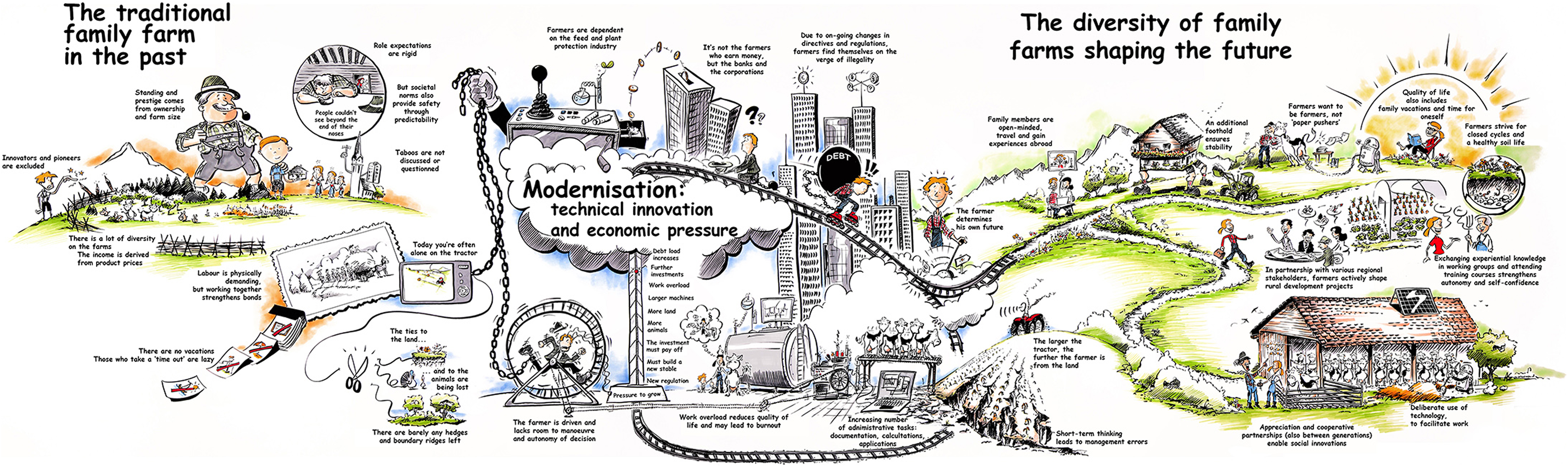
The overall composition of the poster focusing on farm-level processes, with on the left the traditional aspects of farming, in the middle the current “vicious circle” linked to farm modernisation, and on the right the possible “exit” pathways enabling a diversity of family farms to persist.
Working With the Posters During the Workshops
The work with the posters during the workshops was less structured—but more successful—than we had anticipated. We first invited participants to view and read the poster individually. We provided them with flip chart markers and invited them to add comments and to indicate where they did not agree with the message conveyed. We had also prepared sticky dots, inviting participants to indicate which scene they found most important. Following this individual work, we had planned to moderate a group discussion based on the feedback written on the posters and indicated by the distribution of the sticky dots.
However, the participants in the workshops were so taken by the posters, that they immediately started discussing with each other, often relating a scene on the poster with something they had experienced. Individual scenes thus triggered a memory, an association, making the picture meaningful, and engaging the viewer emotionally. This engagement was encouraged by the emotions conveyed through the expressive faces on people, animals, or things, typical for comic-style drawings. It was also encouraged by the fact that the graphical elements had been selected so that they would be typical for the study region (see Figure 2). These iconic referents conveyed relevance to the participants: This is about them and their region, not some generic issues, removed from their immediate context.

We used local visual referents to convey relevance to the participants, for example, the traditional maypole festival was used to visualize how various ideas (symbolized by the light bulbs) can be integrated and projects realized through cooperation between various actors at the regional level.
While we had planned to revise the posters based on the feedback from the workshop participants, in effect no changes were made as we got only very minor suggestions, for example, representing renewable energy production not just through solar panels (which are the dominant form in the region), but adding windmills. The sticky dots used to indicate which elements were particularly important, were also distributed fairly equally over the posters (Strauss & Darnhofer, 2014), so that there was no need to remove particular scenes.
At the end of the workshops, we asked for feedback using a short questionnaire. Feedback comments included: “The farmers are at the centre of attention: the work is with them, rather than talking about them,” “I like the fact that the people on the posters show emotions,” and “Pointed and humoristic presentation, texts are spot on.” The overwhelming positive feedback showed that the comic-style posters were very well received: All participants appreciated the use of comics.
An indication of the success of the comic posters may also be the fact that several civil society organizations active in the study area asked us for copies of the posters to use in their own events to spur discussions. Moreover, we were asked and provided the posters, printed on durable PVC tarpaulin, to the agricultural vocational schools of the region. Thus, while the posters were initially only planned as a tool to engage participants in workshops, they were an important output that enabled a wider social impact of the research project.
The fear that using comics may trivialize the research or convey that we did not take the concerns of interviewees seriously was unfounded, although in Austria comic books have no particular place as literary genre. This may be an indication that comic-style images have a broad appeal, independent of the place of comic books in the popular culture.
Reflecting on the Use of Comic-Style Images in Qualitative Research
Engaging Participants
There are a number of aspects that contributed to make the comic-style posters an effective tool to engage participants in the workshops. The discussions sparked by the posters highlighted that comics are a form of data that participants felt perfectly competent to decode. The posters were thus effective to reduce the power imbalance between researchers and participants, which can hinder an open, critical discussions in a research setting (Denney, Case, Metzger, Ivanova, & Asfaw, 2018; Thompson & Scoones, 1994). It also helped that comics are associated with light entertainment, as this contributed to set a lighthearted mood in the workshop.
The request to provide feedback on the preliminary results was convincing because the posters were printed on paper, and we explicitly invited the participants to write on them. This helped to convey that the posters were not a “definite” account of research results, but a starting point for discussions. A strength of the comic-style posters is that they are very obviously the visual product of a particular construction, that is, there is no pretence at realism, no sense that they accurately represent something that exists. They are clearly not a “neutral” representation of what participants have said, but the outcome of interpretations by researchers and visualization by the graphic artist. This opens the space for comments and suggestions for alternative interpretations. This may be a strength of comic-style drawings as compared to photographs, which in many contexts viewers see as documenting the reality in front of the camera’s lens, thus producing an unmediated and unbiased visual report (Mason, 2005; Schwartz, 1989). While viewers may underestimate the author’s intentions in constructing a photograph, comic-style drawings invite discussions to what extent a particular scene or the overall narrative is a valid interpretation of a situation. Thus, comics avoid the potentially implied authority of photographs or computer-generated images.
The lively discussions spurred by the posters in the workshops showed that the comic-style drawings touched participants emotionally. Indeed, the postures, gestures, and facial expressions of the characters on the posters conveyed emotions, which can be easily captured by the viewer-reader, evoking recognition and enabling an emotional bond (see Eisner, 1985, p. 100). While a similar affect may be achieved through photographs of people, the hand-drawn images permit exaggerations that can make a point more quickly.
Moreover, the use of comic-style images allowed us to take advantage of the critical function of humor. Indeed, humor can be used as a form of critical social anthropology, by defamiliarizing the familiar and inverting the world of common sense (Crichtley, 2002, p. 65). Often, humor is produced by a disjunction between the way things are and the way they are represented. Thus, by producing a novel actuality, humor breaks the bond connecting individuals to their unreflective, everyday existence. As a result, images can call attention to the everyday by casting it in a new light (Weber, 2008, p. 50).
As with jokes, a cartoon affords an opportunity to realize that an accepted pattern has no necessity (Crichtley, 2002, p. 11). It shows the arbitrariness of the practices in which we engage. By smiling at a situation, its contingency is exposed as the viewer realizes that what appeared to be fixed and oppressive can be changed. For example, the farmer in the hamster wheel (Figure 3) questions the necessity to follow the “get big or get out” dictum. The use of humor and of simplified iconic cartoon characters allowed a distancing from the situation, and thus the ability to look at it with fresh eyes, opening it for discussion.

The pressures of the markets and of modernisation make many farmers feel driven. This was illustrated by a farmer running in a hamster wheel, exerting himself but going nowhere, with a foot chained to agribusinesses, and with electrodes on his head to indicate that his thoughts are externally controlled by the dominant “get big or get out” paradigm. This image is humorous not only because of the incongruity of a human running in a hamster wheel but also because the image creates a disjunction with the common view of farmers as being their own bosses, free to manage their farm as they see fit.
The humorous nature of the comics-style drawings also enabled us to address and discuss sensitive issues, for example, gender issues or envy among neighbors (Figure 4). Indeed, because comics are associated with exaggeration, parody, and caricature, the fact that some drawings were irreverent to powers that be was unproblematic. Through the judicious use of humor, comics, and cartoons can thus be powerful means to challenge social norms, by illustrating and opening a debate about sensitive topics (Bartlett, 2013).
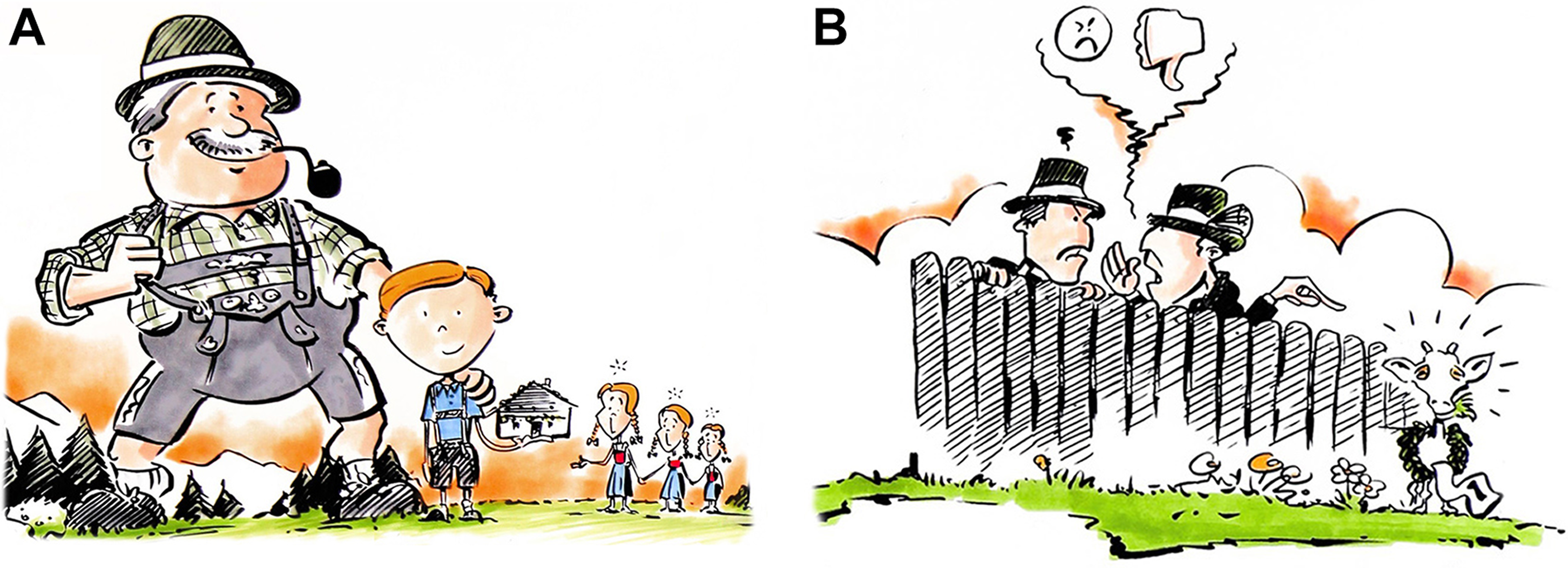
The use of humour allowed participants to discuss social norms and practices that were seen as problematic by some interviewees, for example, the gender bias inherent in the still dominant view that sons—rather than daughters—should inherit a farm (A); or that change and innovation are discouraged as new ideas are often criticized, even if they receive recognition by outsiders (B).
Importantly, we used the scenes on the posters to refer to a shared lifeworld, not to an individual actor’s situation. Several participants smiling at a scene communicated that they felt it was a valid depiction of the situation, thus enabling discussions, building on a shared background meaning, and on the implicit acknowledgment that “we’re all in the same boat.” Humor thus changes a situation in a way that is both liberating and captivating. Smiling at a situation affords a distance on everyday life, a distance that allows to take up a disinterested, theoretical attitude toward the world, and does this in an eminently practical and interesting way (Critchley, 2002, p. 88). The general association of comic-style drawings with humor as well as the careful use of humor in the scenes thus facilitated a questioning of shared practices and a joint exploration of how these could be changed.
The large size of the posters, the only brief texts, the comic-style, and the visual ambiguity of individual scenes and of different possibilities to relate a scene to others were all elements that contributed to fuelling discussions. Participants quickly realized that their individual associations evoked by a scene differed in some meaningful way. This invited the exchange of personal anecdotes and alternate interpretations, stimulating a social process of sense-making. This social dynamic contributed to framing experiences in new ways, thereby enabling the emergence of new practices to be explored individually or collectively.
The Medium Shapes—But Does Not Determine—the Message
The iterative process between researchers and graphic artist led to a number of insights about the specificity of the medium, that is, how comic-style drawings shaped what information we could convey. Firstly, the medium influenced which results we selected. As is common with other ways to report research results, it is never possible to include all insights that emerge from the interview data. But the choice to present them as comics, influenced which results we selected, as we favored issues that could be visualized and that would contribute to the coherence of the overall narrative on each poster. Indeed, as the effectiveness of a poster and its aesthetics are not independent (Healey & Enns, 2002), we had to take into account that successful graphic storytelling depends on the ability of the text, imagery, and overall composition to hold the viewer-reader’s attention.
Secondly, the medium influenced how we would visualize the results. Here, our reflection centered on how individual elements, especially people, were represented. Each representation would convey a different connotation, affecting the meaning of the individual scene as well as of the overall message. A particular challenge was ensuring that, for example, farmers are clearly recognizable as farmers, that is, conform with social representations of “farmers.” Indeed, stereotypes allow recognizing who is a “farmer” and who is an “urban tourist.” Yet the challenge was to make a role recognizable, without caricaturing it in such a way that the role would be devalued. Indeed, the emotional strength of comics partly builds on the fact that people are overdrawn; yet the graphic artist needs to be sensitive to avoid adverse reactions because a viewer identifies with a depicted situation, which is portrayed as negative or undesirable.
In our context, it was particularly important to carefully choose visual referents, for example, ensure that farmers do not systematically wear traditional costumes as this could be seen as conveying that farmers are backward. One way we addressed this challenge was to depict the various roles that farmers have in rural society at various places in the posters, using various clothes. Indeed, farmers are not just those who tend animals and work the land, they are also parents, neighbors, active in the local choir, and members in voluntary associations. These different roles allowed us to visualize farmers differently and thereby convey the diversity and multidimensionality of real life. We found that making this diversity visible was a strength of using large comic posters (as opposed to individual cartoons), as a possibly one-sided representation in one scene will be qualified by how a role is represented elsewhere on the poster.
While the medium shaped the message, it did not determine it. Indeed, no matter how carefully designed, we could not presume that a particular message would be delivered through a scene or through the posters as a whole, even as we carefully worded the text to clarify our intended meaning. While the challenge to faithfully convey research results is an issue common with other means of communication, the use of visual data is an added challenge, given the polysemic nature of images, that is, their ability to generate multiple meanings in the viewing process (see Barthes, 1964).
However, this polysemy can be a strength, as the diverse interpretations by the workshop participants are revealing for researchers and enriching for participants. For example on the transition from the rail to the path, the artist drew a few stones (Figure 5). These became meaningful for one of the participants, who remarked that indeed, the rails may give farmers few choices, but they make for a smooth journey, where a farmer does not have to think and just rolls along. He noted that walking on a path is more arduous: It branches off thus requiring active choices, and may be stony. Taking this path requires courage. This example shows that even small details, that we as researchers did not pay much attention to, may trigger relevant associations for individual viewers.

Visualization of the agency of a farmer and how she or he get may get off the railway tracks and choose his or her own path.
The scenes on the posters thus do not so much present solutions to clearly identified issues, but serve as triggers, encouraging the reader-viewer to reflect about past experiences, to put them into a broader context, and to think of implications and alternative framings. As Healey and Enns (2002) point out, the interpretation of a particular image depends as much on the viewer’s goals and expectations as on the visual stimulus. Indeed, people’s prior perceptions, experiences, attitudes, social background, cultural orientation, and behavioral dispositions influence the reaction they will have to an image and the messages they take away (Becker, 1995; Nicholson-Cole, 2005; Schwartz, 1989). Displaying visual material thus implies “relinquishing control of not only the material, but also its intended meanings and desired reactions” (Clark, 2013, p. 73).
Researcher Reflexivity
The process of selecting issues to include, how to represent them, what text to add to clarify our intended meaning, and how to achieve an overall narrative through poster design spurred our own reflexivity, that is, raised our awareness of how our choice of methods contributed to realize certain kinds of social worlds (Law, 2004; Law, Ruppert, Savage, 2011). The comic-style posters were thus also a tool for the team to engage in researcher reflexivity, that is, recognize how personal, interpersonal, political, emotional, and pragmatic issues influence our research practices and knowledge construction (Bettany & Woodruffe-Burton, 2009; Harper, 2012; Mauthner & Doucet, 2003; Pauwels, 2015). More broadly, it incited us to closely examine the unspoken ideologies of objective, scientific research (Agger, 1991; Denzin, 1994). We thus grappled with a number of questions, including those raised by Weber (2008, p. 50): What constitutes a valid interpretation of the interview material? Whose reality do the images represent? What are the relationships between images and words? How does the medium shape the message? What kinds of stories can images tell? When does imageing become theorizing?
The discussions within the research team and with the graphic artist raised our awareness of the subjectivity in selecting images to visualize an issue, and how the process was influenced by our prior assumptions (see Nicholson-Cole, 2005). We scrutinized various influences (see Mauthner & Doucet, 2003) and became aware how our individual academic biography (studies in natural-science-based agronomy and rational decision-making-based economics), our institutional context (which privileges an objectivist approach to methods), current theoretical orientation (relational approaches that emphasize that “it could always be otherwise”), and the pragmatic demands of the larger research project (with its topical focus and reporting templates) influenced our work on the posters. The individual reflections as well as the discussions within the research team and with the graphic artist brought forward unexamined influences, preconceived assumptions, normative interests, and the influence of disciplinary conventions on our understanding of interview data and what seemed an “adequate” representation on the posters.
The challenge to adequately represent issues and avoid misinterpretation of the interviewees is similar to text-based analysis, which also creates “experience, and in the process of creation, constantly transform and defer that which is being described” (Denzin, 1994, p. 296). However, selecting a visual representation made this process more obvious, as that there was no standard method to follow, no established quality criteria that would have provided a pretence of objectivity or validity in analysis. It made apparent to what extend any method is more than a technical procedure, dependent on value judgments and individual insight.
While we worked on the posters, we were aware that we not only controlled what issues we selected and how they were represented in individual scenes but also how the scenes were arranged on the posters. These choices are not innocent, as spatial proximity tends to indicate causal connection or render tensions. Yet, while compositional choices may seem to be primarily tied to the need to ensure overall narrative coherence, they also frame practices as more or less desirable, and thus clearly have a political dimension. Do we emphasize the constraints that were perceived by interviewees and depict farmers as powerless in the face of larger economic pressures, or do we emphasize their “room for manoeuvre”? By choosing to emphasize that, despite constraints, alternative projects were being realized, we had to acknowledge our underlying intent, that is, to show that there are no deterministic inevitabilities, even if at times farmers feel trapped in a vicious circle. We became aware that our choices were not only based on the interview data and influenced by the requirements of the medium but also informed by our theoretical orientation and our emancipatory intent. We had to acknowledge that we were presenting participants with a picture of a possible future, based on their ideas and on our own interpretation and imagination (see Nicholson-Cole, 2005).
As we worked on the posters and reflected on our practices, we had to acknowledge that the workshop we had planned was not an innocent, neutral part of a larger research project, a technical validation of preliminary results. Clearly, our choices were influenced by our intentions to stimulate a specific reaction by the viewer-reader (see Pain, 2012, p. 312). As such, the design of the posters and their use in the workshops, as any engagement with the world, were inevitably political and ideological (see Bettany & Woodruff-Burton, 2009).
Conclusion
Comic-style posters have distinguishing features that, if used purposefully, can be a strength in a number of research contexts, especially those committed to participatory processes and collaborative knowledge production, as well as those building on a constructivist, postmodern, or poststructural approach.
Through the process of designing the posters, questions related to the relation between the researchers and the researched come to the fore, as we had to identify research results that were relevant to the lifeworld of participants, and to find a medium that seemed suitable to engage our target audience. The comic-style posters were a suitable tool to address some issues linked to power and control in the research encounter because participants feel as qualified to decode the meaning of the images and because no interpretation is privileged. Indeed, because comic-style drawings avoid any claim of realism, they are unlikely to be seen as an “objective” representation of “reality,” or as portraying the “truth” of a situation. They are thus well suited to invite participants to question and discuss the researchers’ interpretation, not least because the drawings make clear that as a representation, they are necessarily imbued with researchers’ subjectivity. But, of course, by themselves, comic-style posters cannot fully address issues related to participatory research such as misconceived claims of empowerment or the risk of cooptation.
We found that through their ambivalence and their ability to convey multiple messages, comic-style drawings are well suited to represent the diversity, complexity, and the often paradoxical nature of human experiences. Indeed, because the images are open to interpretation, they make the undecidability of many arguments visible for all. They thus contribute to democratize science by making participants as much experts as researchers in the identification of alternative framings and of ways forward. Comic-style posters enable a joint, shared, collective viewing-reading, in particular due to their size, the limited use of text, and the emphasis on graphic elements. The emotional power of comics further promotes engagement with the represented issues, leading to lively discussions and enabling a social sense-making process.
Overall, as a form of visual communication, comic-style posters are thus well suited to situations aimed at generating knowledge through an interactive, reflective, and collective process. At the same time, we learned that experimenting with a new medium is never a clearly mapped-out process, it is necessarily unfolding, full of surprises and emergent opportunities. Thus, to fully benefit from the process, it is useful to reserve time to reflect on the research journey, and how this sheds new light not only on substantive issues but also on the research practice.
Indeed, the process of designing the comic posters can be used to strengthen researcher reflexivity. By engaging with an novel medium and a nonstandardized process, it encouraged us to look closely at our practice as researchers, to challenge the unspoken ideology of positivist scientific research, and to acknowledge that we as researchers are not disinterested or objective, and that our data analysis and presentation is not a neutral activity, not a depoliticized set of techniques.
Encouraged by the positive feedback from the workshop participants, a continued experimentation with visual methods, especially those based on hand-drawn materials seems very promising. By sharing my reflections on the strengths and limitations I identified in our work with comic-style posters, I hope to encourage other researchers to tap into the full potential of visual methods in their varied forms. As Bartlett (2013) points out, it is only by openly trialing and documenting new ways of working that more effective and creative modes of participation, engagement, and knowledge co-creation can be identified and refined.
Footnotes
Acknowledgments
The author would like to thank Agnes Strauss who conducted the interviews for the insightful discussions; and Alexander Czernin, the graphic artist, for his patience with changes and his willingness to engage in the collaborative effort.
Declaration of Conflicting Interests
The author declared no potential conflicts of interest with respect to the research, authorship, and/or publication of this article.
Funding
The author disclosed receipt of the following financial support for the research, authorship, and/or publication of this article: The comic posters were developed in the framework of the RETHINK project, which was funded by the Federal Ministry of Agriculture, Forestry, Environment, and Water Management (PJ-Nr. 100939). Open Access funding was provided by University of Natural Resources and Life Sciences Vienna (BOKU).
