




Abstract
Qualitative research with children as participants is challenging on many levels—ethical, methodological, and relational. When researching the experience of children with particular bodily vulnerabilities, these issues are further amplified. This article describes a data generating tool designed to address these challenges. It was used within the context of an ethnographic study exploring relational societal processes associated with childhood obesity in Malta. This creative child-centric method uses “me” drawings as elicitation foci during informal conversations in the field where the agentic status of the child was prioritized and their role as active collaborators emphasized. Optimizing ethical symmetry was a key concern, as was emphasis on relational ethics and assent. Using the “Draw(Me) and Tell” activity positioned the child in a realistic position of power by giving them control over the data generation process, and helped address ethical issues related to agency, privacy, and sensitivity. It allowed ethical generation of qualitative data based on the children’s reflexive commentary on their own body shapes, with the aim of exploring their embodied habitus, identity, and selfhood.
Introduction
Working with children in a qualitative research setting presents the social scientist with particular challenges. These can broadly be described along two axes: issues with collecting meaningful data that are a true reflection of their participants’ thoughts and beliefs and ethical issues related to the disparity in power and perceived authority. When you add to that the aim of exploring reflexive embodiment in children, with particular focus on their body shape within the process, then the practical and ethical challenges are amplified (Pole, 2007).
This article describes a data generating tool designed to offer a pragmatic solution to these challenges. It was used within the context of an ethnographic research design exploring relational societal processes associated with childhood obesity. This child-centric creative technique was embedded within robust relations of trust nurtured within an 18-month period in the field focusing on a topic with potential ethical, epistemological, and ontological challenges: that of exploring young children’s accounts of their sense of reflexive embodiment and concept of body shape. The account that follows will demonstrate how the use of the children’s own drawings as elicitation tools led the way to overcoming the ethical issues related to agency, privacy, and sensitivity by putting “process assent” (Dockett & Perry, 2011) at the core of the relational dynamics between researcher and child. It will highlight how it effectively led the way to cocreating qualitative data with very young children in relations rooted in “ethical mindfulness and reflexivity” (Warin, 2011; Woodgate, Tennent, & Zurba, 2017) and facilitated the children’s reflexive commentary on their own body shapes.
Theoretical Framework and Context
I have yet to locate academic literature that offers description and discussion of empirical research into young children’s experience of reflexive embodiment. Indeed, Wainwright and Turner’s (2004) comment that “much of the literature on the sociology of the body is characterized by its theoretical discussion of the nature of the body” (p. 311) still appears to hold currency. The same could be said of Davis’s (1997) appeal for theory that draws attention to the dynamic relationship of the “carnal” body with its cultural, symbolic meanings, focusing on “embodiment as experience or social practice in concrete social, cultural and historical contexts” (Davis, 1997, p. 15).
The creative, child-centered technique described in this article was designed to address this gap in the literature by facilitating the generation of empirical data that would add to the multifaceted academic arguments centered on the issue of childhood obesity, by exploring the impact of social relations on body shape, and by highlighting the child’s own sense of self and normalcy within the process of their embodiment.
Childhood obesity in Malta is an issue of sustained concern within local public health discourse (Grech et al., 2017; Grech & Farrugia Sant’Angelo, 2009). My aim was to explore lay beliefs and understandings, and aesthetic preferences, related to young children’s body shape in Malta, and the ways that these impact on the relational dynamics in the their lived experiences. A critical realist ontological stance was used to offer exploration of the ways aesthetic preferences and lay epidemiology linked to very young children’s body shape feed into the dialectical social relations that have a direct impact on the child’s body, and their sense of self and normalcy (see also Martin, 2015).
The empirical research design was grounded in an interactionist perspective with the phenomenological concept of the “lived body” driving the theoretical analysis. I set out to understand the ways that young children develop their sense of self within their day-to-day social relations, unpacking the impacts of significant and generalized others on their reflexive understanding of “me” and on the consequent agentic responses of the “I” (Mead, 1934). Bourdieu’s concept of habitus (Bourdieu, 1977; Bourdieu & Wacquant, 1992) and Merleau Ponty’s phenomenological concept of the “lived body” (Merleau-Ponty, 2013) were also cornerstones in the conceptual scaffolding of the discussion, fundamental, as they are, to Crossley’s (2001b, 2006) work on reflexive embodiment which drives the analysis. Attention is drawn to the ways that individuals are both subjects and objects within the reflexive process and to the ways that maintenance of the body and body modification are reflexive embodied practices. The important definitive character of reflexive embodiment is that it is a process that is impacted by both the collective (attitudes, behaviors, and beliefs) within which the individual social relations are rooted and the individual’s reflection and response to these. It is a “collectively rooted aspect of individual life” (Crossley, 2006, p. 4), where “[o]ne’s basic anatomical constitution signifies, and as such, shapes the way in which one is acted towards and interpreted” (Crossley, 2001b, p. 152). My challenge was to explore the relational dynamics impacting the children’s emergent embodied selfhood: to examine ongoing sedimentation of dispositions within their embodied habitus, its impact on consequent actions, and the ways that these processes are related to body shape.
One of the key conceptual challenges within the research design is related to the argument that, within the process of our own embodiment, we are our own blind spots (Crossley, 2001a , 2006; Leder, 1990). The interesting paradox is that, although all knowledge about the world I function in is gained through my bodily senses, I am not normally aware of my body during the process—“[my body] is essentially characterised by absence [and] is rarely the thematic object of experience” (Leder, 1990, p. 1). The generation of meaningful and convincing data within this study required a child-centered, ethically robust tool that would overcome the “blind spot” within the young child’s own embodiment and allow them realistic control to grant “process assent” (Dockett & Perry, 2011) and to talk about their own understandings of their body shape—an issue with potential sensitive vulnerabilities.
The research design sits squarely within the “new sociological approaches” in the study of childhood of the late 90s which set out to address not simply the absence of interest in children but by their “silence” (James, Jenks, & Prout, 1998; James & Prout, 1997; Jenks, 1992; Mayall, 1994; Panter-Brick, 1998). These approaches are best summed up as attempts to study the experiences of being a child. Rather than focusing on children in the process of “becoming,” “[t]he child is conceived of as a person, a status, a course of action, a set of needs, rights or differences-in sum, as a social actor” (James et al., 1998, p. 207). There is, however, a danger within this framework, to replace the child-as-biologically-defined, with a concept of children exclusively “created” by their social relations and cultural context “leaving little room for the body/child as a physical or corporeal entity” (James et al., 1998, p. 146). By focusing exclusively on the discourses of childhood, the danger is to gloss over the fact that social action is usually embodied action “performed not by texts, but by real, living, corporeal persons” (James et al., 1998, p. 147). Indeed, the data generation tool described here enables the exploration of the process of embodiment, self, and normalcy in relation to body shape in very young children. It puts at the forefront the essential importance of the child’s body as they explore and interact with their social environment and acknowledges the impact of the ways that “[their body is] experienced, constructed and shifted by the interpretations and translations of adults, children, nature and technology” (James et al., 1998, p. 168).
Ethicality and Research Design
Fieldwork was carried out within a school setting with children of both genders aged 5–6 years (Year 1) and 9–10 years (Year 6; n = 134), where qualitative data were cocreated using child-centric methods and triangulated with data from in-depth interviews with the children’s parents and grandparents for whom they acted as gatekeepers, and with ethnographic field notes taken within a participant observer’s role.
Approximately 500 hours were spent in the field where close and trusted relations with the children were nurtured during their everyday school activities. Particular attention is being drawn to this as it is of utmost importance to the Draw(Me) and Tell activity—the ethicality of which is based on sound trust relations and acute respect and understanding of the particular, individual child engaged in the process. Time in the field was spent in the “least adult role” (Mandell, 1988; Randall, 2012) which I nurtured by blurring the adult–child boundaries while sharing the challenges, fun, and frustrations of routine school activities.
My challenge was to establish a working relationship with the children that was credible and trustworthy and to “capture the dynamics of the children’s interactions […], to fit into children’s interpretative acts without disturbing the flow”(Mandell, 1988, p. 464). This working relationship was facilitated by multilevel institutional and individual informed consent procedure sanctioned by university research ethics assessment. Introductory parents’ meetings were held prior to recruitment where research aims, methods, and planned activities were described and opportunity offered for informal discussion. Childhood obesity, as the key focus of the research, was one that parents readily engaged with and subscribed to. It was made very clear from the outset, however, that the children would not be made aware of this specific aim and that I would be working with the selected classes collectively. This is for two important reasons: the very real danger of exacerbating stigma-related repercussions of attracting attention to overweight and obese children and, equally importantly, the essential conservation of relational exchanges which are free of normative assumptions in relation to body shape and sense of “self” and “normalcy.”
Once institutional consent was in place, and parents were briefed, it was the children themselves who acted as key agents and gatekeepers to the research process. My initial meeting with the children was in their classrooms where I explained that I was interested in learning about the ways children got on together, what made them happy or sad, their opinions, choices, and beliefs. I explained that, if they agreed, I would spend time with them, learn from the experience, and then write about it. I made it clear that this was something that they would choose to be part of and that there would not be any hard feelings or any problems at all if they chose not to. I explained that their parents/guardians, whom I had already met, needed to sign a consent form for participation to commence and handed them the form suggesting they pass it on to their parents to sign if they wished to work with me. My aim was to “democratize” the process of consent and to allow the children space “to negotiate when and under what circumstances to accommodate or resist my strategies” (Mayeza, 2017, p. 3).
It is important to emphasize that signed, informed consent from parents and guardians, though clearly necessary, was not taken to be sufficient justification for the research process to proceed. “Process assent” (Dockett & Perry, 2011) was continuously at the root of any data generation and children were frequently reminded that they were only to “join in” if they felt they wanted to.
Power Dynamics in the Field
As outlined above, the agentic status of the child was central to my research design which focused on working with children as opposed to on children (Mitchell, 2006; Tay-Lim & Lim, 2013). Placing them at the center of the research process as active collaborators, however, requires particular attention to two major issues: power relations and interpretation (Mayall, 1994, p. 11). The adult–child power imbalance is of particular relevance where research takes place in a school setting. It is important to acknowledge the way that the “spaces” of research may impact on the research process and that schools are particularly significant in this respect as they are physical and social environments over which children have little or no control (Barker & Weller, 2003). The use of the “least adult role” (Mandell, 1988) during interaction with my collaborators was an important methodological technique aimed to reflexively compensate for the physical and authoritative power imbalance that challenges the research process with children. Similarly, the preoccupation to redress the “communicative advantage” (Clarke, 1999) of the adult researcher was my central concern when considering methods of data generation.
With the Year 1 students, researcher–participant dynamics were at their best in the classroom, where the fact that most of the time was spent seated helped to blur the adult/child physical boundaries. This was much harder to do in the playground where the difference in stature was impossible to ignore and the children tended to treat me as their natural leader.
The situation was different with the older group where the height difference was only very slight. In fact, it was in the playground that the researcher/participant dynamics were at their best. The fact that I could run faster than the fastest boy during games (much to the amazement of the “very adult” teachers looking on) made me a very desirable team member—scoring the occasional goal in the football team also helped. Besides offering windows onto the children’s process of team negotiation, competition, and rivalry, sharing these fun times during recreation helped “cross over” into their world, a fact that was symbolical accentuated by the line of teachers looking over from the “other side.”
Elicitation Tool: Draw(Me) and Tell
Within the context of my fieldwork, one of the major challenges I was faced with was to create data generating situations where young children would be encouraged to think about and articulate freely on the complex relational processes at the core of their own embodiment. The challenge was to bring their “absent body” into focus and to do this in a way that maintained ethical symmetry (Christensen & Prout, 2002) and facilitated realistic conditions for process assent (Dockett & Perry, 2011). The elicitation tool “Draw(Me) and Tell,” which will be described below, was very effective in this respect.
My aim in designing this tool was to create a child-centered activity that would offer the opportunity to engage with young children on their own terms and explore an issue that is abstract and potentially sensitive. The use of visual methods has been found to be very effective when cocreating qualitative data with young children and redressing the power imbalance often present in standard adult–child interviews (Bagnoli, 2009; Gauntlett & Holzwarth, 2006; Mitchell, 2006; Morrow, 2001; Pridmore & Bendelow, 1995; Rollins, 2005; Tay-Lim & Lim, 2013).
The use of drawings for data generation is not new to health research either (see Driessnack, 2006; Rollins, 2005). Indeed, the “Draw(Me) and Tell” method described below has much in common with the “Draw-and-Write” technique (see Horstman, Aldiss, Richardson, & Gibson, 2008; Nic Gabhainn & Kelleher, 2002; Pridmore & Bendelow, 1995), it shares with these studies a child-centered visual approach, designed to be fun and accessible to even very young children where they are the key interpreters of their own art—they are the “experts” (Horstman et al., 2008) and are in control over how much or how little they contribute during the discussion of the drawing (Bagnoli, 2009). What Draw(Me) and Tell adds, however, is the possibility to focus on the particular social processes impacting on the child’s reflexive sense of self and normalcy in relation to their embodiment and body shape, while allowing optimization of process assent when working with young children.
It is important to highlight the fact that these visual techniques (in particular those where the children generate their own drawings) are so effective in facilitating graphical communication that they may raise associated ethical issues that require attention. A child may convey, in their drawing, an issue or thought that they do not want to express aloud—some children may not want to talk about their drawings at all (Mitchell, 2006) and the researcher must be prepared to facilitate nonparticipation in a way that the child is protected if this occurs. The technique may also lead to the children expressing powerful and upsetting emotions which were otherwise trapped behind their linguistic limitations. Researchers should be attuned to this possibility, especially when working with fragile or ill children, and have the experience to facilitate “emotional debriefing” and the judgment to know when a disclosure requires professional follow-up (Horstman et al., 2008; Pridmore & Bendelow, 1995).
Working within the context of childhood obesity in a school environment, with all its potential triggers for teasing and bullying, awareness of this issue was at the forefront during my follow-up conversations with the children. There were, in fact, three occasions when the children were showing signs of becoming upset and I proactively attempted to put an end to our conversation, reminding them that we could talk about something else. Interestingly, in my experience, they never chose to do so. In each situation, the children insisted they wanted to carry on with the conversation and tell me their story. None of their “stories” were of dangerous situations, but about playground taunting—a problem that was well known to the school authorities. I was not faced with any disclosure dilemmas; however, it did show just how powerful this enabling process is for the children and highlights the importance of researchers having professional debriefing facilities available in case the situation and need arises.
It bears repeating at this stage that this method of using children’s drawing as elicitation tools is built on the view of participants as collaborators with the aim of working with children as opposed to on children (Mitchell, 2006). Rather than passive objects of observation, they are active participants who knowingly allow the researcher into the relational dynamics of their everyday social environment and contribute toward the interpretation of the situations observed. It is important to recognize the potential for power stratification loaded in favor of the researcher when working with children. Fundamental to my ethical stance throughout the process of this research was my awareness of this imbalance and my commitment to facilitate process assent and to continuously place the children’s right to understand and decide to abstain, above my need to collect data.
Ethical problems may also arise because of the way drawing techniques make children’s thoughts, worries, and fears publicly accessible. Indeed, the importance to protect confidentiality and privacy of the child collaborator needs highlighting (Mitchell, 2006), as is the issue of “ownership” of the drawing and its subsequent use (Pridmore & Bendelow, 1995). The issue of confidentially is always central when handling data, but it becomes doubly important when children are involved. This is because adults tend to assume automatic rights of access into the child’s worldview, this more so within the school environment. There were situations when I had to fend off inquisitive teachers, curious to know what their students were discussing during interviews. Parents were equally eager to find out what their children felt. It was ensured that confidentiality was never breached when dealing with the teaching staff, and information was only shared with the parents after gaining permission from the child in question. Pseudonymization of the data was given careful attention. Working within a particularly small community, this required more than simply coding identities—care was also taken to avoid reference to particular information in the analysis which might lead to identification of the interviewee or the individuals they referred to.
“Draw(Me) and Tell”: Playing at Work?
The drawing activity was carried out as a group activity in the classrooms once my participant observer role in the field was well established. The children were well accustomed to me being part of their routine school activities with the explanation that I was there to learn and that I was working on a long project and would be writing about what I learned while I was with them. They were told that I wished to show my “professor” what they looked like, however, instead of taking a photo I would show their own drawings of themselves which would be more interesting. In this way, the children were aware from the start that the drawings would be shown to other people and that I would be keeping the drawings after the exercise.
I explained that the aim of the activity was for the children to draw themselves in a way that would make them recognizable. I asked them to conceal their name under a corner flap, so that I could try to guess the identity of the child before checking with the name. This was very effective in getting the children to think about what visual clues they should include that would link to their personal identity. They were encouraged to think hard about what they looked like before they started to draw, and it was suggested they include details like hair color and height as an example of identifiable characteristics.
The session was very well received by the children in both age groups; the older children, especially, took great care to include personal visual detail. Some of the children were concerned about not being able to draw well enough to deliver what was requested. Their confidence was restored after I demonstrated a quick drawing of myself on the whiteboard—my blatant lack of artistic skills was the source of much amusement.
As one of my key research challenges was to explore the children’s sense of reflexivity, concept of “self,” and reflexive embodiment, I included another phase in the drawing activity. After drawing “themselves,” the children were asked to draw their best friend on the flipside of the sheet of paper. This was done with the aim of providing useful comparative drawings to help fix perspective and facilitate potential discussion of “how friends see me” during follow-up informal one-to-one interviews. The aim was to make it possible for the young child to engage with and articulate about the complex process of reflexivity in relation to their embodied self.
It is important to emphasize two points related to the ethicality of this stage of the activity. The choice of “best” friend rather than any friend is important to flag in this respect. It was considered that the trust and safety within the relationship would be an important buffer against any potential taunting or unkind drawings. It would also create a comfortable space for discussion in the follow-up conversations with the children. In my experience, most of the “best friends” had, in fact, already shown each other their drawings—just as best friends would, and there were no incidents at all of insinuated taunts. (It is important to emphasize, however, that the use of this second drawing requires acute proactive sensitivity to the dynamics in the field.) The second important issue to flag is that the follow-up conversations with the individual children only took place after many months in the field, within very robust relations of trust, and only with children who chose to discuss their drawing with me.
I collected 134 sets of drawings in total and had follow-up conversations (recorded with their permission) with the vast majority of them at various stages of my 18 months in the field. In my experience, the reflexive commentary was more focused in the 10-year-old age-group. Conversations with the 5-year-olds were fleeting and erratic, however, often provided useful data on reflexive embodiment by virtue of what was absent in the conversation rather than what was said.
Telling It How It Is
It bears repeating here that no attempts were made to interpret the drawings visually—that was not my aim. Rather, I used the drawings as an “icebreaker” during our conversations (Bagnoli, 2009) and as what has been termed “illuminative artwork” (Rollins, 2005) which was then used primarily as a communication tool. This was the particular strength of this technique as it allowed a conversation that was initially about the drawing and only progressed to the child talking about their own body if and when they felt comfortable to do so. Reference to their actual body was made tentatively by asking them to comment on how accurate the drawing was. Focusing on the children’s drawings created a comfortable displacement of attention away from their “actual” bodies, to what they had produced in the drawings and gave the overweight children the opportunity to talk about their real body shape if they wanted to.
Interestingly, the 5-year-olds, whose drawing skills were mostly rudimentary, diligently included details such as spectacles, eye, and hair color but paid little attention to body shape. This was, indeed, congruent with the observational and interview data that indicated that the 5-year-olds, at the start of their school year, were unaware of “fatness” in their classmates—until the process of labeling seemed to set in at toward the end of their first scholastic year.
There was one 5-year-old child, YB, however, who did give her body shape more thought and attention. I chose to follow-up with a request for a second drawing toward the end of my time in the field and then had a conversation with her about both the drawings. By this stage, we had developed a relaxed and complicit relationship which reflected very positively on the quality of our exchange.
so we have this one [“me” drawing] that you did last year (Figure 1) and this one that you drew this year…(Figure 2)
[giggle]
which one do you prefer?
this one [indicating second drawing]
the second one…this year’s…and why is that?
because it is thin [laughter]
because it is thin?…and here [indicating drawing I]…how did you draw it?
fat…
why do you think you drew her fat…?
because I didn’t know how to draw…but then I was going to draw another one…
ah [I see]…but…were you really like this?
aha [yes] but then I became thin…
when were you like that?…I can’t remember
in winter when I used to eat lots of sweets…
and…what did people use to say then?
how fat you are!
who used to say that?
my aunt…
but…did she use to say that with a smile on her face? Did she say you were beautiful?…
…she used to say that I was ugly…[gentle laugh]
[gentle laughter] did she say that?…and what about your Mum?…what did she use to say?
beautiful
so your mum used to say you were…
beautiful [gentle laughter]
and did you ever tell your Mum that your aunt said you were fat?
[nodding]”
and what did she use to say?
she used to tell her not to keep saying that […]
and…who did you use to believe?…your aunt or your mum?
my Mum…[giggles].

YB self-drawing aged 5 years.

YB self-drawing aged 5 years and 10 months.
This conversation brings two issues into focus—the clearly negative value within this young child’s worldview linked to “being fat” or “having a fat body” and the precedence of the mother over other adults in the primary group as the significant other in the child’s process of reflexive embodiment. My data repeatedly showed that while still within their mother’s domain of influence, the very young overweight child is well protected against negative verbal or social sanctions connected to their body shape. There was also clear evidence in the data of a good degree of positive attention that the very young overweight child tends to attract. This ranges from the affectionate use of language described in the adult interviews (“how sweet you are—I just want to hug you!” kemm int ħelu—għandi aptit nagħfsek!) to the observed privileged role status during playground interaction where their weight (often combined with height) leads to a physical advantage over peers during “pretend” role-play games. The implicit protective strategies of the mother together with the positive interactive dynamics linked to the “symbolic capital” of the chubby young child influence their dynamic self-perception and reflexive embodiment. The relational dynamics between “self” and “others” is the key sociological issue here, where the reaction of “others” to the child’s overweight body shape has important consequences on their reflexive embodied habitus (Crossley, 2001b , 2006; Mead, 1934).
One important finding in my interview and observational data is the marked difference in this respect, in the two age groups in the study. In the younger group, “being fat and having a fat body” is almost a nonissue—it goes by almost unremarked by the peer group and tends to have positive affective consequences during interaction with the adults. It appears that overweight children in this group have not yet been exposed to the negative labeling that occurs in the “adult” world.
The situation observed in the 10-year-old group was dramatically different. Here, in contrast with the younger group where it was almost absent, teasing and social exclusion as a result of being overweight or obese was frequently observed in the field and often referred to by the children during interviews.
The use of “me” drawings as elicitation tools during conversations with the 10-year-olds was particularly effective in generating data about their sense of embodied reflexivity and selfhood, and data generated this way attenuated the validity of the observational and adult interview data. The key finding here was that these older children, who were certainly capable of including body shape details, consistently drew slim figures when drawing “themselves.” The conversations that focused on these “me drawings” led to rich data on the child’s reflexive sense of embodied self, almost invariably describing how they drew themselves “as they would like people to see them” or “as they wish to be.”
RB, a shy 10-year-old obese girl, who was subject to frequent verbal taunting, was particularly articulate in describing her perspective this respect. She was very sensitive about her body shape. Using her “me” drawing as the elicitation tool during, our conversation made it possible for her to take the lead and only cross over from talking about the drawing, to talking about herself when she felt comfortable and safe.
tell me about the drawing…how did you draw her?
well…more like myself. you know. …I don’t know how to explain it…erm…I drew it as I feel…always OK…kind of excited…you know…drawing…as if somebody is drawing me…like…it is not me…like…it is not me drawing…somebody is drawing me…as he sees me…not as I see myself.
so…that is how others see you…and…how did you draw it then?…what do you think other people see in you then?…because that is what it comes to isn’t it?
exactly yes…a girl. not always quiet [gentle laughter] erm. always the type who... kind of normal, you know…she doesn’t like to talk about her feelings to everybody. if she tells, it is to one person and that’s all. a bit shy
and…what about the appearance of this girl?
I don’t always wear the same style of clothes…I sometimes wear one style…and sometimes another…
aha [yes]…you like to be original […] and what about the figure of this drawing?. have you drawn it correctly?
[emphatic] No! [laughter]
[laughter]…how should it be then?
first of all…I never wear skirts…and…my tummy should be bigger [laughter] and…lots of colours…in the clothes…
and…can you explain how come you drew her as thin?…or was it just the way the drawing turned out?…or did you think about it?
because…I am very shy about my figure…
you are shy because you are a bit…
overweight (qawwija)
overweight?…does it affect you?
because once…with the one I was sitting next to…because I used to sit in two different places…but then I got fed up next to this boy. he was always getting at me…so then I changed my place…
what did he used to say when he was getting at you?
oh he would call me a bankuncin
bankincin? What is that?
oh it is a type of small cupcake [forced gentle laughter]
and how did you feel when he used to tell you this?
it would make me feel very sad and upset…the boy next to me calls me “blob of fat” (cappa xaham) and…yes…it upsets me…
of course it upsets you! And what do you do when they call you this?
oh I stay on my own…[what else can I do?]
don’t you tell them anything? Do you try to laugh? Or do you get angry?
I try to change the situation…you know…
My conversations with RB were always very complicit. We were both very fond of each other, and she often sought me out in the playground to chat. Our conversations were usually light banter—she would love to talk to me about music and give me handwritten lyrics of her favorite songs, but she never talked about herself. When, however, I asked if she would like to talk about her “me” drawing, the conversation, as transcribed verbatim above, took a different turn. By focusing on the drawing, she was able to take me to a conversation about her body shape in a way that allowed her a good degree of control. It allowed her to talk about the root cause of the taunting and name-calling she often experienced at school and to talk about her experience of fat-related stigma framed within a discourse of agency.
This conversation also allowed me to explore the process of reflexive embodiment underpinning RB’s daily-lived experience. Like the vast majority of her overweight peers in the study, she consciously drew herself as a slim girl as (she wishes that) “somebody would see her—not as she sees herself.” The rich data gathered during our follow-up conversation show how reflexivity is clearly central to her sense of “self.” RB is acutely aware of what her peers think of her body shape. She has internalized this normative aesthetic perspective and this, in turn, determines her own comparative self-evaluation. This draws into focus the process of reflexivity that lies at the root of her embodiment. “It highlights the dynamic interchange of cognition and perception that leads to her symbolically disowning her own [true] body shape” (see also Martin, 2015, p. 52).
In situations where I was confident that the “best friend” relationship was robust, and when the child requested, the corresponding “flipside” drawing was shared during our follow-up conversations. It is important to emphasize that this process of commenting on their friends’ drawings is one that requires responsible and careful attention, very robust relations of trust, and lucid understanding of the relational dynamics within the group of child collaborators. I did not encounter any negative repercussions in my experience, in fact the best friends’ drawings were predominantly a source of pride and joy. The vast majority of the children simply passed cursory comments of appreciation about their friend’s drawing. In some cases, however, it led to some interesting data.
GP was very reserved when talking about his own self-drawing (Figure 3). In fact, he clearly was not happy to let the conversation develop into one about his own body. When asked if there was anything he would change in the drawing to make it more accurate, his simple answer was “nothing”—and the conversation about that drawing ended there. He was, however, more inclined to reflect on his own body when focusing on the drawing by his best friend J. (Figure 4)
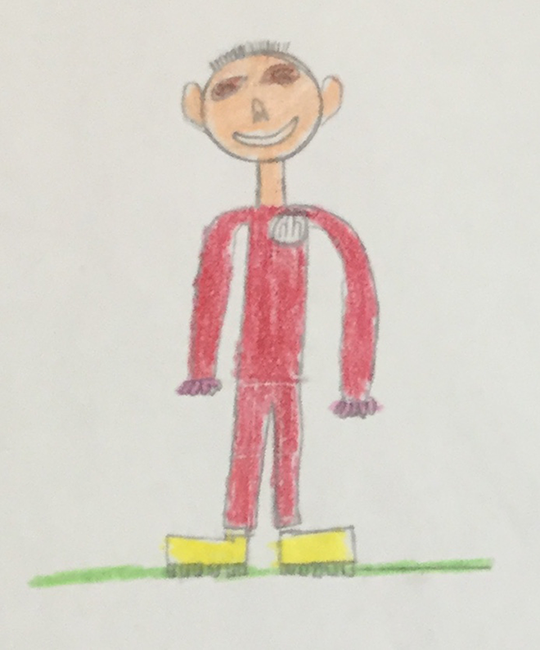
GP self-drawing.

GP by J.
[looking at both drawings] what’s the difference between them G?
[laughter] maybe because I am wearing green? [laughter]…and…he didn’t give me ears!
your ears are under your hair [laughter]…and…what do you think of the shape G?
It’s different
and which is more accurate in your opinion?
this one [indicating drawing by friend J]
ah. so…this is interesting G…when you drew yourself…is this how you are?
how I would like to be
…and when you see J’s drawing…what do you think?
I don’t get offended. he drew me as I am
and why do you think you would like to be like [his own “me” drawing]? Why would it be better?
because in football I would get to be a player instead of being put in goal each time
I see, so you would be able to run better? anything else?
that’s the main thing.
This exchange highlights the process of reflexive embodiment where GP acknowledges that his best friend drew him “like he really is” and that he drew himself “as he would like to be.” Like the vast majority of the overweight or obese 10-year-old boys in the study, not being able to run fast was one of the key reasons they gave for wanting to be thinner. GP’s oblique reference to potentially “taking offence,” however, is clear evidence of the negative symbolic value related to his overweight body shape and its potential for associated stigma. It also draws attention to the powerful impact of reflexivity on selfhood and embodiment.
This particularly rich seam of data would have been inaccessible without the “me drawing” as the elicitation tool. The conversation that the drawing elicited was one safely embedded within very strong relations of trust nurtured within many months in the field where GP led the way, picking carefully through sensitive issues related to his overweight body shape that he symbolically disowns.
Conclusion
Multifaceted research and engagement with the issue of childhood obesity retain their traction, relevance, and momentum in academia, especially so in Malta where the rates of obesity are a cause of concern to public health authorities. My main motivation for this research was to add to the debate by bringing into focus the social dynamics impacting the young child’s embodied habitus and the impact of body shape, and associated norms, within this process. The challenge, when generating data, was to design a child-centric creative method, which would bring the child’s “absent body” into focus in a way that prioritizes relational ethics and facilitates process assent.
The “Draw(Me) and Tell” technique offered a pragmatic route to generating rich qualitative data from very young children in a way that accords agency and control to the young collaborators. When firmly embedded within robust relations of trust, forged within ethnographic fieldwork, it enables a realistic possibility for process assent and optimizes ethical symmetry in a research context where the child is embedded within top-down school-based authoritarian power. The use of “me” drawings as a focus of conversation enables the young children to think reflexively and to share their thoughts about their bodies in a way that avoids any inference of normative expectations. It facilitates engagement with the complex and abstract concept of reflexive embodiment in a data generating situation rooted in ethical mindfulness.
Footnotes
Acknowledgment
I am very grateful to the three anonymous reviewers for their constructive comments.
Declaration of Conflicting Interests
The author(s) declared no potential conflicts of interest with respect to the research, authorship, and/or publication of this article.
Funding
The author(s) disclosed receipt of the following financial support for the research, authorship, and/or publication of this article: The research was part-funded by the Malta Government Scholarship Scheme.
