




Abstract
Visual stimuli are increasingly used in formal communications and as a qualitative research method, reported to generate a ‘different’ and ‘richer’ response than text or language alone. However, the parameters by which this occurs are underexplored. In our research we use images and text as interview stimuli in a project exploring personal wellbeing to compare differences in communication process and outcomes. A visual tool expressing concepts of human needs and aspirations and comparable text was presented on cards. Forty-five people participated in a sorting process and interview. Participants were presented with the text cards or images first in blocked order and asked to select cards relating to their wellbeing. The process was repeated with the alternate mode. A subsection of six participants were presented with text-image combination cards. Thematic analysis was used to find common themes in participant responses and their experiences of the two modalities. Image and text cards both facilitated communication and rapport but elicited different types of responses. Images more commonly provoked emotive responses, tacit knowledge and greater personal involvement leading to cognitive elaboration and richer narrative. We found that participants more easily selected visual themes and considered images more engaging and open to interpretation than text, which were considered fixed in meaning. When visuals were presented with text, the text dominated the meaning. This paper presents a novel form of researcher generated visual elicitation stimuli, to be called ‘exploratory visuals’; depicting abstract concepts and narrative scenes to aid communication and understanding of complex information. It proposes an analytical framework combining social semiotic, contextual and cognitive perspectives to understand perceptual differences between words and images and the range of responses elicited.
Introduction
Visual methodologies in qualitative research can be used with almost any population by encouraging participants to express their thoughts and feelings via their interpretation of visual artefacts (Margolis & Pauwels, 2022). Visual methods are commonly reported to generate ‘richer’ e.g., (Guillemin & Drew, 2010) and ‘different’ data than verbal methods alone (Pain, 2012). Visuals that prove to be meaningful to the respondent can provoke engagement, generate more projective comments and deeper exploration about its meaning in relation to the respondent’s interests or needs (Gauntlett & Holzwarth, 2006), revealing unique insights into the way people experience and make sense of the world. (Literat, 2013; Pauwels, 2015).
Visual perception is a primary source of information gathering and a key driver of most perceptual, cognitive, and behavioural process (Kristjánsson & Egeth, 2020; Mansell, 2020). People have a cognitive preference for and enhanced capacity to engage with picture-based, than text-based, materials (Kiefer et al., 2011; Shaw & Bagozzi, 2017; Stiller et al., 2009) The mechanisms by which visuals engage and synthesise what is seen and communicated lie in biological and social processes (Cohn & Magliano, 2020; Kress & van Leeuwen, 2020; Loschky et al., 2020; Rensink et al., 1997) involving conscious and unconscious processes (Kiefer et al., 2011).
Compared to traditional interview-based research methods participatory visual elicitation methods offer a number of benefits for researchers and participants, first they draw out conscious and unconscious thoughts, such as a person’s unique tacit knowledge which may be difficult to capture or represent in explicit form (Dampney et al., 1969; Meo, 2010; Roger & Blomgren, 2019). Socondly the process balances power asymmetries as participants express themes, thoughts and perspectives in their own way (Meo, 2010; Orr et al., 2020). Third, the coproduction of knowledge is insightful and provides an opportunity for researchers to understand and articulate multiple views, perspectives, and meanings (Gubrium et al., 2022; Kolar et al., 2015; Montag, 2019). Finally, as prompts visuals provide a concrete object or inference to anchor conversation and facilitate exploration of ideas, contributing to trustworthiness (Bagnoli, 2009; Pain, 2012). These traits aid communication and understanding, fostering rapport with hard to reach groups or people who find it difficult to articulate their thoughts and feelings, such as children and young people (Drew et al., 2010).
The use of sorting methods provide participants with an opportunity to think about the visuals’ meanings as they consider reasons for selection and rank visuals to identify priorities (Fincher & Tenenberg, 2005, p. 90). The introduction of novel visuals in the elicitation process encourages introspection, concurrently synthesising new ideas and relationships with existing knowledge in the generation of meaning. This method represents an epistemological shift towards a more collaborative mode of knowledge production, rapport and communication (Pauwels, 2015).
Researcher Generated Visual Stimuli
Creating or commissioning drawings, collages or photographs for visual elicitation research can be complex or time consuming (Margolis & Pauwels, 2022) and requires resources and training to develop, use and analyse (Crilly et al., 2006). Additionally, each artefact has a distinct origin with multiple meanings, creating potential analysis challenges (Metcalfe, 2016; Reavey & Prosser, 2012).
This research introduces a novel form of researcher-created elicitation stimuli we call exploratory visuals; My Story Cards are a comprehensive set of illustrated images communicating specific concepts, which participants assess in relation to their own knowledge and circumstances. Once developed, the material is simple to use and analyse as it is of known origin and a consistent stimulus for use with multiple audiences. The artefacts act as both a “data collection method and a form of data analysis” (Glaw et al., 2017). Being new to participants, they present situations and themes that participants might not have otherwise considered, leveraging the intuitiveness of the visual language with additional insights and perspectives about their experiences.
To be effective, visual materials need to be engaging and resonate with participants personally (Kress & van Leeuwen, 2020; Newbury, 2022; Pauwels, 2015; Petersen & Posner, 2012), and be task relevant in communicating intended concepts. Pauwels (2015) notes that poorly selected visual materials or those lacking context have the potential to disrupt or distort the research process by being irrelevant to the issue studied, by being ill-adapted to the respondent or by creating an all too suggestive, one-sided or incomplete picture of the phenomenon or event considered.
In spite of the conceptual evidence and increasing interest in visual techniques for qualitative interviewing (Glegg, 2019; Pauwels, 2015), there is a paucity of studies that aim to systematically study the process by which visual language generates meaning. This study investigates two forms of elicitation stimuli; visually represented concepts and the same concepts in text form. It compares how each mode facilitates narrative and conceptual understandings of wellbeing. Of interest are the participants’ reactions to each mode during the elicitation process.
Conceptualising Wellbeing Using Text and Images as Interview Stimuli
This project originated from identifying a lack of evidence about the type of information generated during the visual elicitation process and how responses differ from other communication modes. Our intention was to explore the process and differential effects of using a prompt (text only) and images via a novel tool (My Story Cards) in identifying themes and generating meaning during qualitative interviews. Our approach to understanding how visual elicitation generates meaning is at the interface of cognitive perception, contextual and social semiotics. These three dimensions shaped the conceptual framework of this project.
The Visual Tool - My Story Cards
My Story Cards were originally developed as a therapeutic tool by the author (Page, 2006). Each of the 20 images represents a specific concept relating to wellbeing. The depiction of abstract concepts and narrative scenes in simple and aesthetically appealing forms aids communication and understanding of complex information e.g., (Loschky et al., 2020) and allows for the expression of abstract thought, awareness, and self-conscious reflection (Kiefer et al., 2011; Margolis & Pauwels, 2022). The use of simple, recognisable elements with sophisticated visual design intends to quickly and intuitively represent the intended meaning so that communication of the meaning can take place.
The images were designed with the premise that meaning is derived via a combination of perceptual and social processes. Firstly, decoding involves attentional selection to guide object and scene perception to extract the relevant image cues (Loschky et al., 2019). Salience (the quality of being particularly noticeable or important) and the purpose of selection influence attentional selection (Loschky et al., 2020). The physical properties of the images themselves such contrast, orientation, colour, and motion guide attention and cue target features (e.g. objects and scene grammar) (Boettcher et al., 2018; Bruce & Tsotsos, 2009; Kalantzis et al., 2016) to arrive at the image (or concept’s) commonly understood meaning (the denotation).
Viewers then combine image features with their personal and cultural understandings (the connotation). For example, a picture of a house is commonly understood by viewers, but its relationship to the viewer cannot be assumed. The viewer selects some ‘signifieds’ from a range of meanings to describe it, and ignores the rest, depending on cultural norms and context. Image features act as prompts to explore broader meanings in a personal and metaphorical sense, interacting with specialised knowledge that is unique to the individual and the context in which it is viewed (de Haas et al., 2019; Veale et al., 2017; Kress, 2010, p. 51). These dimensions explain both the commonly understood and multiple related meanings that can be generated from the same image. Importantly, unlike language, the ability to recognise objects and scenes does not correlate with general intelligence (Sunday et al., 2021), providing universality in approach.
Participants select and prioritise personally meaningful images and discard others, depending on the purpose of viewing and on the context. This step is partly intuitive - the viewer does not have to notice or interpret all the elements to understand the image’s meaning. In fact, the reason for selection may not initially be apparent and information is generated during the interview process, as conscious and unaware thoughts and connections are elicited. Articulating this reflective process and integrating tacit knowledge into a personal narrative facilitates a holistic understanding of the participants’ thoughts and experiences.
The selection of concepts was based on human needs, motivations and aspirations e.g., (Doyal & Gough, 1991; Ryan & Deci, 2017). Needs incorporated physical, social, emotional and cognitive needs. Engaging a cartoonist in the development of the exploratory images was an important contributing factor to conveying concepts and context without the need for words as cartoonists are adept at visual thinking and visual presentation (Eisner, 1990). The use of learned patterns and symbols was minimised to appeal to a broad audience.
A unique feature of exploratory visuals such as My Story Cards is the use of scenes, metaphors, analogies and various degrees of graphic abstraction to communicate concepts. Visual metaphors aid understanding by representing one domain (a person, concept, place, idea, or thing) in terms of another -an analogy or association (Peterson, 2019), thus providing a concrete ‘vehicle’ to structure our understanding of abstract ideas, cued by the image (Kövecses, 2017), for example, ‘time flies’; ‘I smell success’ or ‘heart of stone’. Metaphors reflect how people perceive, think, and act (Lakoff & Johnson, 1980).
An example of an image from My Story Cards depicting the concept ‘future’ is shown in Figure 1. The use of icons, metaphors and narrative scenes help the viewer intuitively understand what the image is communicating. The image offers the illusion of moving forward as indicated by the child pointing and body posture. Motion is communicated by the sun rising or setting at a horizon and walking forward. Physical lines provide a path towards a destination without obstacles and the travellers appear to look forward. Sophisticated design features aid and add nuance to understanding and engagement for all visual forms – aesthetics plays a role in appeal (or not) which is an essential precursor to decoding meaning and continued engagement with the artefact (Rodriguez Estrada & Davis, 2015). Composition influences communication, amplifying or simplifying features; colour plays a role in salience – the degree in which an element draws attention to itself is due to its size, place, its tonal values, sharpness of definition, and other features (Kalantzis et al., 2016). (a) Illustration representing sense of future. My Story Cards, (Page, 2006) and (b) Text card expressing the same concept.
The connection with the viewer occurs both naturally and unconsciously (Forceville, 2016; Lakoff, 2008), they understand that the visual metaphor is not a straightforward representation of the information, and they start thinking about its possible meaning (McQuarrie & Mick, 1999; Phillips & McQuarrie, 2004). This connection potentially elicits a rational or emotional response in the viewer such as ambiguity, hope or even fear. For Figure 1, the viewer may consider how the concept relates to their own future and with the people they hope will travel with them on the journey.
To date, little is known about conceptual properties of visually presented abstract concepts. Getting from a concept to a spoken word relies on access to specific cognitive systems that support different types of knowledge. Conceptual knowledge is represented in multimodal systems (Barsalou et al., 2008; Dove, 2011; Thill & Twomey, 2016), for example thinking of a concept, seeing a visual image, or reading a comparable written word access knowledge in different ways (Mackenzie-Phelan & Roberts, 2018).
All concepts are multimodal, but research with words suggests some similarities and differences in the representation of concrete and abstract meanings. Some are more strongly associated with sensory and functional modalities than others (Reilly et al., 2016) and often involve subjective experiences, such as cognitive processes and emotion (Barsalou & Wiemer-Hastings, 2005; Katja Wiemer-Hastings & Xu, 2005). Some scholars suggest a more nuanced consideration of concepts than in terms of concreteness/abstractness and propose that sensorimotor, inner, linguistic, and social experience have different weights in characterizing different kinds of abstract concepts (Barsalou et al., 2018; Villani et al., 2019). These perspectives support the study framework; that the interaction of internal factors, social experience and the context in which an image is viewed form commonly understood and personal meanings, generating multiple representations of views.
Participant Recruitment
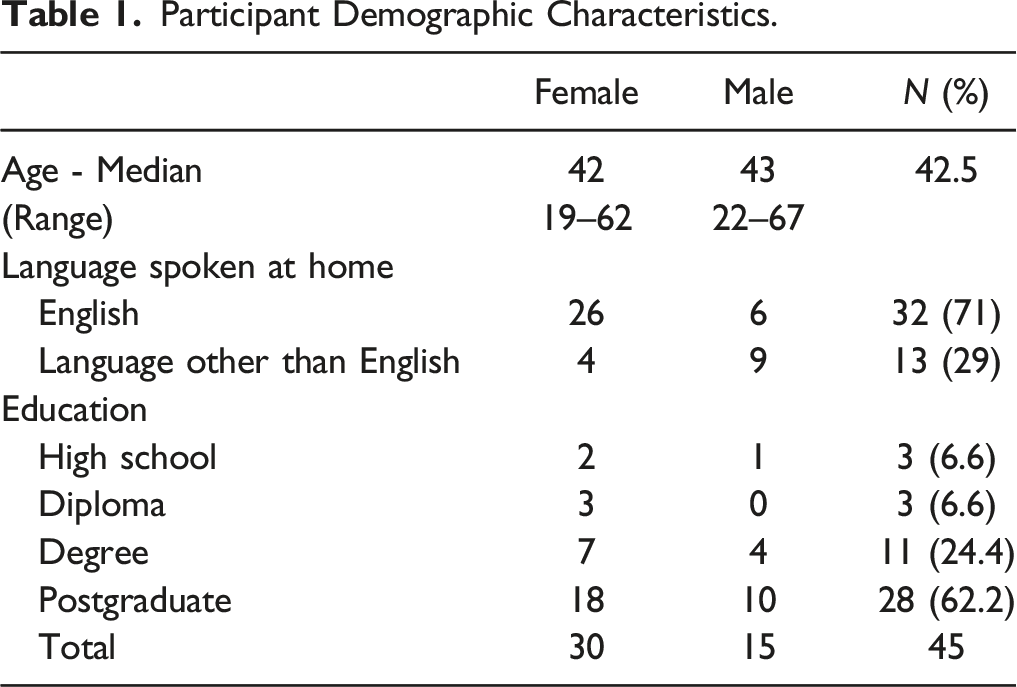
Participant Demographic Characteristics.
Interview Protocol
The qualitative design of face-to-face, in-depth interviews was shaped around a semi-structured interview guide. Semi-structured interviews help guide the conversation and allow participants to elaborate on their responses and explore new ideas and tangents (Bryman, 2012; Leavy, 2014). Importantly all participants were asked the same questions as the outcomes of interest were selection of concepts, the participant’s response to the stimuli and perceptions about the process. This method allowed for open-ended responses from participants, time to reflect and share more in-depth and personal information.
The aim was for the participant to conceptualise wellbeing in their own way using the text and image stimuli during interview. For example, interview questions included: “Which image stands out the most in relation to your wellbeing and what does it mean to you?” and “How does the word relate to your wellbeing?” Interviews were recorded, transcribed and imported into NVivo 12 software. A short sociodemographic survey was conducted online with participants prior to commencing the in-depth interviews. The interview questions and process were pilot tested prior to this study to ensure questions were understood by the respondent and able to obtain the intended answers based on the research objectives. To assess the acceptability of the images, the interviewer kept field notes about the comments and interpretations of individual images used during the interview session. Research ethics approval was obtained from the relevant academic institution (University ethics approval HC180857).
Data Analysis
The data were analysed through a qualitative thematic approach drawn from interpretative phenomenological analysis (IPA) (Bartoli, 2020; Smith & Osborn, 2015). IPA serves a dual purpose: to explore the participants’ perceptions of their world, whilst integrating the researcher’s interpretation of that world (Pietkiewicz & Smith, 2014). A research-driven deductive approach was used to identify themes in the data in which the researchers use their own conceptual framework as a guide (Braun & Clarke, 2006; Vaismoradi et al., 2013). A preliminary list of themes was generated based on the study’s theoretical framework, and the relationships/associations between numerous codes formed a theme, which was assigned a label with a definition. The coding frame was independently applied by the second author who proceeded with a data driven inductive approach; the emerging associations identified among codes was compared and refined to form agreement between coders. This technique ensured code homogeneity and thus internal validity.
The Wellbeing Exploration Activity
Participants were firstly asked to rate their individual wellbeing verbally on a scale between 1 and 10, encouraging thought about the topic of interest at a cognitive level (Aknin et al., 2022). Individual wellbeing is defined here as an evaluation of one’s quality of life (QOL), viewed as people’s “perception of their position in life in the context of the culture and value systems in which they live and in relation to their goals, expectations, standards and concerns” (WHO, 2012). Participants were placed in one of three groups with each study group conducted in a blocked order: The first group of 10 received text cards first, the next received image cards first and the third received image-text combination cards first. Participants were told they would be shown the same concepts in visual and text form. We presented one mode first and then repeated the process with the alternate mode (text or image cards only) to ascertain if priming of words influenced participants’ approach to the images or vice versa. Participants were presented with the respective sets of cards and asked to select five cards from a set of 20 that resonated with them in relation to their wellbeing. Participants were interviewed about the selection process and how their choices related to their wellbeing.
The card-sorting technique was intended to evaluate meaningfulness and prioritise images or text in order of personal importance. This novel method of card sorting, as a knowledge elicitation technique is based on the idea that ‘the way in which participants categorise entities externally reflects their internal, mental representation of those concepts’ (Fincher & Tenenberg, 2005, p. 90).
The group assigned the image-text combination cards consistently reported that the text with the image constrained their thinking or limited the meaning they might associate with the image. For this reason, the sub-study was removed after six participants.
Following the interview, participants were asked to articulate the differences between the two modes in the selection of concepts (cards) and the exploration process. The card selection and interviews were conducted by the first author and typically lasted between 25 and 30 minutes (range 22–90 min).
Results and Discussion
Prompts as Useful Starting Points
Part of the appeal of card sorting lies in the simplicity of the procedure for both researchers and participants (Lobinger & Brantner, 2019). Participants reported the prompts as helpful anchors to structure narrative. It gives you a starting point… to draw a discussion (Int 15) … the images are good as an opener, yeah…. I can talk about this. But maybe I wouldn't be able to do that without the prompts (Int 43)
Participants indicated the prompts provided options for themes they may not have considered and simplified competing thoughts and expression: It would be hard for me to probably express how I was feeling but the opportunity to just choose five out of many actually made it a lot easier for me to work out… it’s also just a really simple process that’s not overwhelming. Whereas if you just said, “What are the things going on in your life?” I probably would be overwhelmed, I didn’t know where to start (Int14).
For some, images were concrete and relatable representations: I think I would prefer images. This gives me some concrete thing there. For example after seeing my girlfriend I printed her picture and put it on my bedside. I wouldn’t print our WeChat messages (social media). I wouldn’t print the really sweet words...I wouldn’t do that, nobody would do that.... This [image of relationship] really represents a beautiful experience because you can see it… (Int 32).
Prompts enabled a process to identify personally relevant themes and a structure to communicate thoughts and feelings in an open and less confronting way than verbal interviews alone. Images were often considered more relatable than text prompts and facilitated communication.
Salience and Expression of Tacit Knowledge
The appraisal process assessed which words or images attracted the viewer’s attention and engaged (Kress & van Leeuwen, 2020). Several participants described selecting images as easier than selecting words because some ‘stood out’, ‘were drawn to’, ‘it was easier to choose between the images’, or ‘it flowed’. The images were easier; it felt like it flowed a lot easier, whereas the words…I had to really think about it (Int 47) ...that’s why I definitely chose that ...picture, to me, is what it’s like being around my friends (Int 24).
Some participants were drawn to features without consciously knowing why. I‘m not sure why I chose that, but it kind of reminds me of me and my boyfriend on weekends. (Int 13) I definitely think it sparked new things (Int 27) Subconsciously, I think I was able to follow a protocol which I don’t think I did when I was reading the words … and there was nothing to motivate me to speak more, but with pictures I think there was some connect which made me change my choices as well (Int 19)
Pauwels describes the ‘multi-interpretable aspects of the image, which can generate both factual and metaphorical responses’ (Margolis & Pauwels, 2022). These responses were reflected in some interviews. … it is an excellent exercise because I see that the cards on which only words are written they are just blank, white paper, which as compared to colourful cards, these pictures give a contrast and quite opposite to each other, so that helps (Int 19) I chose the words very quickly based on the ideas I already had (Int 11) I had to really think about it…with the pictures, you look at it and you go, yeah actually that’s how I’m feeling, that’s described it well … and I can just talk to what this picture says to me and why it’s resonating with me, whereas you just look at these words and the words are just like, all right, how do I feel about relationships? (Int 45).
Visuals facilitated expression of personally meaningful knowledge which may be difficult to raise without the visual prompts. I can see myself there…yeah. Cause I can see myself here and here (points to pictures) and I can talk about it and describe it more than with the words. I guess I can see that he doesn’t look happy and that’s actually how I feel.…and the colours I guess as well. Yeah I think that’s where I am…yeah it definitely is how I am.….it’s easier to describe the things that matter. (Int 48) They were different…the images put me in a situation where I could visualise…how they impact on my life. The words just gave me a list of priorities. So I was able to look at the images and think yes these are friends, these are family. Where if I look at the words they were just family, friends…so the images in fact were more powerful…they had more of an impact (Int 36)
Branthwaite et al., describes visuals as revealing often subconscious or difficult to articulate information by circumventing cognition, rational thought, and normative responses (Branthwaite, 2002; Greenbaum, 2022). Relative to text cards, visuals engaged participants and accessed presumably hidden content and emotions, providing an opportunity to explore and communicate thoughts that may otherwise be difficult to access.
Promotes an Emotive Response
The use of images is a widely acknowledged method for inducing emotional states (Pauwels, 2015; Siedlecka & Denson, 2019), of cognitive or physical origin (Robinson, 1995) such as surprise e.g. (Lobbestael et al., 2008). The pictures brought the emotion with it that the words didn’t necessarily bring (Int 10) …Some of the pictures helped break out (emotion) more describing the lack of connection at work. I found it easier in those, it helped bring it out. (Int 48) …it opened up a more emotive and thoughtful engagement with images (Int 19)
Emotional connections were associated with the type of image and the context in which they were appraised. One participant projected aspects of a current disagreement with their partner. …there were a lot of ones (images) that seemed to be quite nice relationships but this is the one that shows two people angry with each other…seething. They do have their backs to each other…two people living separate lives seething at each other (Int 27)
Some found images provoked emotions and encouraged participants to select a personally relevant meaning from multiple potential meanings: … the images, it’s a lot more provocative and it’s a lot more, for me,…..it paints a lot more of a picture; it’s very direct…put yourself in the moment. So, for instance, you’ve got a picture of people talking and smiling and sharing, and friends and support could mean a few other things, as well. It could be financial support, it could be if you are sick, people look after you. It kind of puts a different spin on the meaning of the words (Int 17)
Conversely, text cards were described as more rational and one-dimensional: The words – they are very rational…. I’m thinking more rationally when I look at the words (Int 39) I think you can convey a whole lot of sentiment, emotions…that kind of stuff in a picture. A word on a piece of paper is kind of…ummm…not dull …umm…you have to be a lot more imaginative to fill in the gaps (Int 25)
Images were described as being more open or ambiguous in meaning whereas text was described as known or predefined. I’m a word-based categorical kind of thinker, so I find it easier to just write a list than to have pictures. So that would be my natural tendency to go that way. But it’s kind of nice to have the ambiguity and the pictures….the pictures can mean what you want them to mean and they can mean more than one thing (Int 41) Looking at words you have your own ideas and definitions about words, the connotations and associations, the pictures helped open up my creative mind … my emotional mind, and maybe the words were a bit more rational, one dimensional (Int 2)
Communications are most effective when they reach people on an emotional as well as a rational level, relate to people’s lives and contexts and are interactive (Lang & Bradley, 2010; Neuhauser & Kreps, 2003). This study found an emotional response was commonly associated with images but not text. Participants described the rational dimension of words communicating relatively fixed meanings and images broadened the dimension with open meaning, emotion and creativity. The mechanism by which some visual stimuli trigger emotional ‘memories’ has been reported to occur at a deeply unconscious level (Tooley et al., 2019) and can draw out ‘unconscious emotional aspects’ of a person (Diem-Wille, 2001, p. 119; Kearney & Hyle, 2004). Importantly this process does not aim to trigger emotions but can guide perception and engagement by privileging stimuli that are especially emotionally relevant (Kiefer et al., 2011; Szczepanowski et al., 2013). Conversely text stimuli provided fewer features to trigger an emotional response and connection and induced a more rational, logical thought pattern. (Joffe, 2008; Shome et al., 2009; Winkielman & Gogolushko, 2018) Low descriptor words may be less inclined to trigger emotions on their own but hold potential in the context of discussion and further exploration.
Promotes Reflective, Higher-Order and Relational Thinking
One of the ways visual elicitation methods produce ‘rich data’ is thought to be the recall of thoughts and feeling prompted by the image e.g. (Pain, 2012). We propose that exploratory visuals do not just retrieve stored memories and associations but facilitate higher-order and relational thinking. The pictures I found interesting, they meant something to me at first, then they mean something different as I thought about it more (Int 12) I still made associations with the words that I’ve chosen but I think the images help me think more about possibilities (Int 44)
Participants expressed thinking ‘differently’ and more broadly. The visual helps you think about what it actually is about …. I was able to process the thoughts more’. ‘In some ways it did influence my thought process, it made me think differently’, ‘The pictures make you think about it more [Int 8] I think this is different because it made me think about things that I might not have said … I maybe wouldn’t have thought about it in that way (Int 13). I think reading images is more open. It provides you more opportunity to describe, evaluate and interpret what’s going on in your mind. The words, they put you into boxes and control or constrain your sense of feeling a little bit. So I personally prefer the images (Int 39) When it came to the pictures I think it was more difficult to assign my preconceived ideas of what I want to be or what I want.…. I think the words to me are more idealistic…… the things that I wanted. The pictures, maybe they were a little more realistic (Int 11)
Images encouraged participants to think deeply, consider theimage’s potential meaning and integrate with their own thoughts and experiences. I can see more ambiguity in the pictures in terms of – everyone interprets them differently, for me I have such strong associations for specific words, whereas I think with the images I … had to think what does this mean for me? (Int 29) I think the images helped shape up more what I was kind of thinking. They are probably easier to define the difference between them versus the words which are kind of…. quite similar… I can describe a bit more, like the cross roads, it crystallised where I’m at more than the words. I can see myself there (Int 48) ….I guess...my associations with the words were much more fixed because I have ways I interpret these words on a daily basis. So when I see family I’ve got a whole lot of associations that are fixed. These images, when I looked at them…ummm….there was a more complex process I had to go through to actually work out what the image meant to me (Int 49)
These findings suggest visuals triggered thoughts and associations which participants assessed and integrated with their own knowledge and experiences. For some, meaning developed or evolved as they thought about what the image meant to them now as well as future possibilities. Revealed knowledge was assessed, synthesised and consolidated to form a narrative. Relative to text-only cards, visuals induced deeper thought, broader associations and engagement with the meaning of the image in relation to the participant’s life, providing a logical rational for the ‘different’ and ‘richer’ thinking generated by images compared to text only.
Facilitates Communication
A rationale for choosing visual elicitation methods is to aid thought and expression, contributing to meaningful engagement and building of rapport (Pain, 2012). Participants commonly described more open communication and enagament using visual stimuli compared to text: There was definitely a different flavour of dialogue going on.... I think it gives a quicker route to communicating what’s actually going on, or how the cards actually made me feel, than perhaps just talking about a word (Int 16) I think the process…..I fall short of vocabulary, but I think it (using images and text) contrasts and that helps (Int 19) It was a safer environment, because I think if we didn’t have the (image) prompts, we would just be sitting at the table staring at each other, which can be quite confrontational (Int 23)
Participants reported a connection with the visual content, placing the focus on the visual rather than the interviewer. The process balanced power dynamics, facilitated shared understanding and trust as participants assigned their own interpretations. I think pictures kind of fill the gap… like, it accelerates the connection with you and the person you are speaking to (Int 4) When it came to the words I think that, well they definitely elicit less emotions…and I think that one of the consequences of that is that there is a little less rapport…I felt the word cards as more of a task (Int 11)
The image became a helpful bridge between interviewer and participant to convey thoughts and feelings in a reflective manner. Although fluent in English, nearly one third of the cohort were non-native English speakers. Communication and genuine understanding with people from different cultural groups is a common challenge among researchers and helping professionals. This group all reported preferring images to text. Consistent with elicitation research, visual prompts improve communication with people who may not share the same language and culture as the researchers e.g., (Barley & Russell, 2018; Vecchio et al., 2017). The process contributed to rapport and understanding of the participants’ lives and foundations of identity and cultural behaviours, consistent with the richness of information often associated with visual elicitation methods (Glaw et al., 2017; Pain, 2012; Pauwels, 2015).
A Preference for Text
A few participants were more comfortable using text cards and were less comfortable or confident with the more open meanings of images. Importantly no difference was found between this group and others concerning salience (images easier to select), personal involvement with the images or eliciting emotion. Looking at words you have your own ideas and definitions about words, the connotations and associations (Int 19) I feel like with words I’m more analytical. I… feel like because it is in words and I think in words, not in images, and like you read papers as opposed to looking at a picture. So I feel like words are really dominant and because of that I think I do tend to be a little more analytical (Int 23) I think, I can see more ambiguity in the pictures in terms of … everyone interprets them differently, for me I have such strong associations for specific words, whereas I think with the images I kind of had to think what does this mean for me? Whereas I see the word family and I know what I mean by family…. I think to be honest I find images a bit overwhelming…..I think this is a language that I resonate better with the words rather than the visual (Int 29)
Others found the text cards narrow in meaning and less stimulating than images. There were lots of options, it makes you work harder…because words are kind of limited, I felt the word cards as more of a task….you know the meaning of the words (Int 13) I think the words by themselves are a bit empty, like they don’t tell you very much, I guess. They are kind of labels and those require you to fill out a lot more of the detail around that, whereas the pictures kind of capture, you know, more of that context, I suppose (Int 45)
Some (older and highly educated) participants felt more comfortable with the language of words, others found words less stimulating than images, indicating a personal preference or attitude that may be associated with familiarity of words and the specific word itself. As Refaie points out “while language is perhaps more precise in expressing some areas of meaning, other meanings may be shown more easily and more effectively in images rather than words” (Refaie, 2003:85)
Preference for the Use of Images then Text or Vice Versa
Participants commonly reported a preference for a two-step process (images and then text or vice versa) to identify and explore important personal themes. I think going through it once and then coming back with a slightly different prop allows you to explore it more deeply or more roundly (Int 25) I think words were really useful at the beginning. I think I kind of liked them together (Int 10) I think they both have value actually (Int 35)
There is insufficient data to determine if the order in which text and visuals were presented influenced the preference. However, it is plausible that the two-step process, using different modes provided an opportunity to not only explore the same theme in two ways but integrate insights into perspectives of their own wellbeing. (Refaie, 2003) suggests an image is able to convey a complex message in a more immediate and effective manner than a verbal description. Images are also more open compared to the range of known meanings provided by text. The two modes are also perceived via different cognitive pathways and access knowledge in different ways. For example, images may access tacit knowledge via salient features and trigger emotional connections (Barton, 2015; Glaw et al., 2017; Lang & Bradley, 2010). Participants valued the opportunity to make connections and think about meanings via multiple modes, providing a more considered and nuanced view of the topic of discussion.
Study Significance
This study, which used elicitation interviews to compare participants’ experiences of the inter-related visual, verbal, and text, makes a key contribution to how each generates meaning and elicits tacit knowledge and insights. This is the first study to use exploratory visuals and provide an explanation for the reactions and types of information generated from images and text during the elicitation process. The study contributes to the growing body of knowledge of visual communication and visual elicitation as a qualitative research method and contributes to a more complete understanding of the interaction between social semiotic, contextual and cognitive perspectives to understand perceptual differences between text and images, cognitive processes and understandings that can result from the elicitation interview. Importantly, this study demonstrates the utility of an evidence-informed visual tool that is reliable, simple, acceptable and effective in provoking thought and articulating insights in the elicitation process. The same visual material can be used in multiple interviews, making use and analysis relatively consistent.
These traits support potential applications of the tool in identification, exploration and discussion of personally relevant themes with people who find it difficult to communicate such as young people, people with low literacy or persons from different cultural backgrounds.
Limitations of the Study
Designing abstract concepts that will be understood by all is a limitation of this study. Different levels of complexity, design features and different social understandings and experiences may result in images being misunderstood, overlooked or having lesser appeal. This is less likely to occur with black and white text with known meanings. Some concepts expressed visually were universally understood and others were more open in communicating concepts. Further analysis is required to understand associations of design elements and personal characteristics. This study population included a high proportion of participants likely to have greater literacy and language ability than the general population, including a significant proportion of people from non-English speaking backgrounds. It was expected that this highly literate group would be more able to articulate the meaning of concepts and access executive knowledge compared to the general population. Further research with a low textural literacy cohort is required to understand if there is an association with literacy and understanding of concepts and their relationship to wellbeing via this form of visual.
Despite the potential benefits that visuals offer researchers, care must be taken to ensure that the design is fit for purpose and used appropriately. Participants offered personal information which at times provided new insights to them. Care was taken to respect personal reflections, not judge or impose views and to provide a supportive and safe environment.
Summary and Conclusions
The present study aimed to identify differences in information obtained and the range of reactions generated using exploratory visuals and text as elicitation stimuli. Beginning with a sorting process, the greatest difference between the two modes was ease of identifying personally meaningful themes and emotional connection with images. Salient images were often selected without conscious awareness and the participants commonly shared their thought processes as they explored their reactions, potential meanings and associations while generating a narrative to fit with their personal construct. Emotional responses were commonly associated with images but not text and contributed to greater psychological involvement and cognitive elaboration. These traits in turn mediated the extent of participant engagement when interpreting the concept’s meaning. Qualitative data that are rich in detail lead to a deeper understanding of the phenomenon of interest — in this case individual wellbeing. The opportunity for the participant to select and explore themes, to pose questions and share thoughts and narrative, fostered rapport and understanding between the participant and researcher.
While relatively little systematic evaluation of sorting methods has been carried out, there are apparent strengths to this approach, such as the provision of a broader range of options at a more meaningful level than the participant may have otherwise considered. It also provided a structure to the interview, simplifying the process and cognitive load for both the interviewer and participant. Participants reported being able to immediately think of around three themes that influenced their wellbeing. However, when offered visuals, their selection was broader and often different, surprising the viewer. Themes selected by text and image also differed slightly. This suggests different cognitive processing which may involve accessing a broader range of associations cued by image features and triggered memories, sometimes without conscious awareness. The broader range of themes, new insights and relational thinking generated via images has important implications for conducting qualitative interviews with people who find it difficult to articulate their thoughts or perspectives and with people of a cultural or social group different from that of the interviewer, as is often the case in qualitative research. Participants described the process as powerful and interesting and were keen to explore themes and share insights, creating both an enjoyable and insightful activity.
The different types of experience reported by participants for the two modes can be partly explained by the types of words and images used. While words can move people emotionally and have multiple meanings, the words used in this study generally described abstract concepts rather than being descriptive such as ‘terrific’, emotional (‘threat’) or visual (‘bulky’). Used alone, without sentences the words were not found to be as emotionally impactful as some of the pictures and more rational meanings were described. In contrast, images engaged the viewer’s more directly; they linked the viewer to a context via visual elements, providing a perceptual basis to abstract concepts and thus their subjective experiences were more tangible and easier to articulate. Visual language such as colour, object placement and aesthetics influenced viewer engagement and the visual representation of abstract concepts facilitated more introspective, social and personal information than descriptions of abstract words. By relating image features to their own experiences and context, participants were able to select a meaning that suited the purpose and their situation.
When images and text were combined, interviewees reported constrained thinking and the method was stopped early in the study. This response could be explained by the combination of text and image providing two forms of input with words dominating the images’ ambiguity. Perceptually text usually uses the same visual/pictorial channel initially and exerts extraneous load on working memory, potentially limiting emerging connotations. Among fluent readers the text cues direct attention and authoritatively impose meaning on the image.
Some images in the visual tool were more effective at communicating concepts (assessed in an unpublished study) or generating emotional responses than others. This may be in part due to the level of abstraction, for example ‘making decisions’ can be challenging to communicate to a broad audience visually. Similarly, ‘health’ is a complex and multifaceted concept perhaps more easily communicated via text. Conversely, images such as ‘children’ or ‘friends and support’ were easily understood and more emotionally impactful as images than words. The order of presentation (image or text) did not appear to influence the viewer’s perception or ‘prime’ interpretation of meaning, suggesting each mode was perceived relatively independently. In fact, participants indicated a preference for the two-step process of using image and word cards, which enabled them to more fully explore themes and provided opportunities to think about meanings from multiple perspectives and then integrate the synthesised knowledge into their narrative.
Few studies have described the thought processes involved in the visual elicitation process. As the exploratory visuals were newly introduced to participants, the process of generating meaning was articulated as it occurred, firstly on a rudimentary level – the ‘known’ or commonly understood meaning, and then in relation to the participant’s life and context, along a predominantly rational or emotional path. For example, the image of a family was firstly described as a ‘family’ and then more broadly in relation to the viewer’s personal and social relationship with their family. Participants who formed a personal connection to the characters tended to become more involved and or elaborated on personal meaning or generated further associations. The provision of visual cues to access contextual knowledge helped participants communicate their thoughts and feelings, particularly those who expressed difficulty communicating. The process of eliciting meaning to the text form of ‘family’ tended to provide a unidimensional descriptive path of the reasons a family is important in the participant’s life or people’s lives in general.
This research has both theoretical and practical implications; it builds on the knowledge of researcher-generated visual elicitation methods as a sophisticated cognitive-social hybrid which is accessible, fast and supports the generation of rich, partly categorised data, simplifying data analysis. It demonstrates a new perspective – the use of images and text to convey abstract concepts with an empirical explanation for the emotional involvement, introspection and range of meanings and associated information elicited with exploratory visuals. It encourages researchers to become more conversant with exploratory and narrative visuals and the interface between social semiotics and cognitive science as a collaborative mode of knowledge production. Further research is needed to assess the effects of visual stimuli among a broader range of concepts and among people of lower literacies or with affective disorders such as anxiety and trauma.
Footnotes
Declaration of Conflicting Interests
The author(s) declared no potential conflicts of interest with respect to the research, authorship, and/or publication of this article.
