




Abstract
In the last three decades, there has been a growing interest in listening to children’s voices in child health research. Ensuring an appropriate level of dialogical engagement with children calls for participatory methods. Auto-driven photo-elicitation interviews (PEIs) are a powerful approach to obtain rich data from children. This article discusses the opportunities and challenges of using auto-driven PEIs in a health-related child-centered constructivist grounded theory study conducted in a poor-resourced country. Our experience shows that while the approach is effective for facilitating co-construction of data with children and for addressing the ethical and methodological issues associated with child-centered research in the context of a developing country, it is narrow on its own. Broadening the term to “picture-elicitation interviews” to allow for the inclusion of other forms of images would make the method more adaptable and inclusive. This would give children the flexibility of choosing pictorial options that best suit them and also help child participants and researchers address the practical and cultural challenges associated with the use of auto-driven PEI in a poor-resourced country.
Keywords
In constructivist grounded theory, the researcher–participant interaction creates the data that are generated. The interaction becomes the site for the co-construction of knowledge by the researcher and the participants, suggesting the importance of an equal and reciprocal relationship to reveal depth, feelings and reflective thoughts (Mills, Bonner, & Francis, 2006). Therefore, engaging in constructivist grounded theory requires thoughtful considerations about the data collection methods employed to facilitate data construction. As constructivist researchers attempt to understand the subjective worlds of people, qualitative interviewing has become a standard data generation approach (Birks & Mills, 2011). The contemporary discourse underlying the philosophical assumptions of qualitative interviewing makes it a site for active interactions, providing outcomes that are contextually bound, mutually created, and negotiated between the researcher and the participants (Fontana & Frey, 2005; Mills et al., 2006). Qualitative interviews, therefore, fit particularly well with the constructivist grounded theory approach (Charmaz, 2014).
However, ensuring the appropriate level of dialogical engagement with children in interviews to co-construct data might pose challenges. Children sometimes find it difficult to articulate their experiences if they need to rely exclusively on words (Ford et al., 2017). Their level of verbal skills and cognitive development combined with the inherent power dynamics between adult researchers and children and the question-and-answer format means that interviews can be particularly challenging for children (Ford et al., 2017; Kirk, 2007). This challenge might limit the depth of inquiry. However, children have been found to have sufficient life experiences and understanding to communicate their views and perspectives, and qualitative interviews have been used in several child-centered constructivist grounded theory research (Chilton & Pires-Yfantouda, 2015; Close, 2007; Hill, Gleadle, Pulvirenti, & McNaughton, 2014; Smith, Dawson-Rose, Blanchard, Kools, & Butler, 2016; Thannhauser, 2014). Nevertheless, there is a paucity of literature on how researchers negotiate the co-construction process to engage and support children’s views and the expression of these perspectives.
This article critically reflects on how constructivist interviews with children were facilitated, using auto-driven photo-elicitation in constructivist grounded theory research conducted in Ghana, with the purpose of facilitating and enhancing interaction with the children to ensure co-construction of data. The article discusses some of the issues related to auto-driven photo-elicitation that were considered in both the design and the conduct of the interviews and presents the opportunities and challenges of using this method in child-centered constructivist grounded theory research, particularly in a resource-poor country.
Engaging Children in Research
In the last three decades, there has been increasing interest in involving children in research that aims to explore their perspectives, which has been influenced by the sociological discourses on childhood and the international legislation on the rights of children (James, Jenk, & Prout, 1998; United Nations International Children’s Emergency Fund, 2009). These discourses identify children as active social actors who are experts on their own lives, with a right to participate in decision-making related to their lives (Keller & Ding, 2004; Kirk, 2007). Within this broad area of agreement, there are uncertainties and tensions related to promoting the inclusion of children in research while ensuring their safety (Ford et al., 2017), which raises critical methodological and ethical issues that are important for adult researchers to consider throughout the research process. Children’s dependence on adults, their lack of economic and political power, and inherent difference from adults create a power differential between them and adults (Kirk, 2007; O’Reilly, Ronzoni, & Dogra, 2013).
The tensions and uncertainties surrounding children’s inclusion in decision-making and research are acutely marked in the Ghanaian context where the study was conducted. Ghana is a “gerontocratically structured” society, where adult–child relationships are age-dependent (Adu-Gyamfi, 2014; Salm & Falola, 2002). Children are at the bottom of the social status hierarchy. Therefore, they have no power to participate, make meaningful contributions, and influence decisions that relate to their lives (Adu-Gyamfi, 2014). Indeed, adults have the absolute power to make decisions on behalf of children, including deciding about children’s involvement in research. Although Ghana has been a signatory to the United Nations Children’s Rights Convention since 1999 and has recognized in law children’s rights in having a voice and the capability to express their views on matters that relate to their lives, this has been slow in shaping sociocultural perspectives and policies concerning children. This is because of the conflict between children’s rights and the customary laws (Sarpong, 2013), which has implications for promoting children’s engagement in research. Therefore, as adult researchers, our responsibility was to consider the social construction of childhood in Ghana when selecting methods that would encourage child participants’ engagement and acknowledge their unique abilities and perspectives to facilitate co-construction of data.
Auto-Driven Photo-Elicitation
Photo-elicitation interviews (PEIs) were adopted as a data generation approach to address the inherent power differential to increase the children’s engagement in the research. PEIs are known to shift the power differential, empower children in research, and stimulate conversation to expand their participation beyond traditional interviews (Epstein, Stevens, McKeever & Sylvain, 2006; Harris, Jackson, Mayblin, Piekut, & Valentine, 2014). Because our study was interested in children’s interpretations of their lives, they were encouraged to take their own photographs. Participant-produced photographs or auto-driven photography is commonly used in research with children and highlighted to be a more advantageous means of generating detailed, rich, and relevant data from children (Clark-Ibanez, 2004; Ford et al. 2017; Meo, 2010). Auto-driven PEIs enable researchers to access children’s worlds through photographs that reflect what matters to children (Cook & Hess, 2007; Fargas-Malet, McSherry, Larkin & Robinson, 2010; Woodgate, Zurba, & Tennent, 2017). This task-oriented technique can make interviewing more exciting and fun, give children a measure of control over the agenda, and choice on how to relate their perspectives, as well as help them to talk more about sensitive, complicated, and abstract issues (Punch, 2002; Thomas & O’Kane, 1998). Despite the importance and usefulness of auto-driven PEIs, they carry some ethical challenges in child-centered research. Consent appears to be a complex issue particularly in research involving children where adults act as gatekeepers (Close, 2007; Miller, 2015). Gatekeepers may view auto-driven PEIs as an invasive method for collecting data from children and raise issues about confidentiality, anonymity, and copyright, especially if the photographs are to be used as research data (Close, 2007; Miller, 2015; Wiles et al., 2008).
The Research
Our study involved children aged 12–17 years with sickle cell anaemia in Ghana. The study aimed to construct a theory to explain sickle cell disease–related fatigue in adolescence. During recruitment, all eligible participants were offered the opportunity to take photographs of anything that they felt represented their fatigue experiences. They were encouraged to use any camera device available to them, either theirs or those of their family and friends. Although previous researchers (Clark-Ibanez, 2004; Meo, 2010) have provided child participants with disposable cameras to capture their images, with the researchers subsequently developing the films for the interviews, disposable cameras do not offer children the opportunity to preview their images after taking them and to determine which they would want to share with the researchers prior to the interviews. We, therefore, chose not to provide disposable cameras to give the children power over the images they choose to take and share with us, as well as the flexibility of choosing the interview approach they preferred (PEIs or standalone interviews).
During the design of the study, we were aware of the possible influence of parents, siblings, and friends on the taking of the images, by guiding, directing, editing or prioritizing which photographs to share with us (Ford et al., 2017). However, all the photographs shared with us, according to the children, were either taken or directed by them. Some children presented photographs in which they were involved in staged activities, and they were captured by other people under the child’s direction. For example, some of the children staged their fatigue-related self-management strategies such as sleeping, reading, or drinking water and asked others to capture these moments. The children wanted their photographs to be as real as possible, and therefore, preferred others to photograph them instead of taking selfies: I wanted the photos to be very real that’s why I asked my sister to take a picture of me sleeping instead of lying on the bed and taking a selfie of myself sleeping. (Cute baby, aged 13)
Ethical Issues
Our study intended to use participants’ images anonymously during dissemination because once images are in the public domain, they are permanent. Therefore, even if children readily consent to their photographs being used without anonymizing, their perspective may change in the future (Ford et al., 2017). The children and their parents were fully informed of the implications of the use of children’s pictures, how the photographs would be stored and utilized in the future, and anonymization of any identifiable features in their photographs. We asked the children to obtain verbal permission from any nonparticipants (family and friends) appearing in their photographs, where safe, practical, and appropriate to ensure the autonomy, anonymity, and safety of both participants and nonparticipants captured in the images (Ford et al., 2017). These ethical measures empowered the children to shape the data by giving them the freedom to capture images of people important in their fatigue experiences. Because of these ethical measures, our decision to use auto-driven PEIs did not lead us to experience delays and obstacles experienced by other researchers in their attempts to gain ethical approval for their child-centered research (Close, 2007; Miller, 2015).
Photo-Elicitation or Picture-Elicitation?
Deciding not to provide the children with camera devices appeared to give them flexibility regarding how to capture their images, and it appeared to have empowered them to represent difficult issues important to their experiences. For instance, some of the children chose to capture their images through drawing, although we did not request drawings from them. Drawing was not considered as a data collection method in the study because it may be unappealing to some children who may feel they lack the skills to draw or older children may view it as too “babyish” (Fargas-Malet et al., 2010). However, drawing enabled some of the children to capture sensitive and delicate situations and events. These were events involving adults who were important in the children’s fatigue experiences that they felt were impossible for them to photograph due to their social position and responsibility within the Ghanaian context (see Figures 1 and 2).
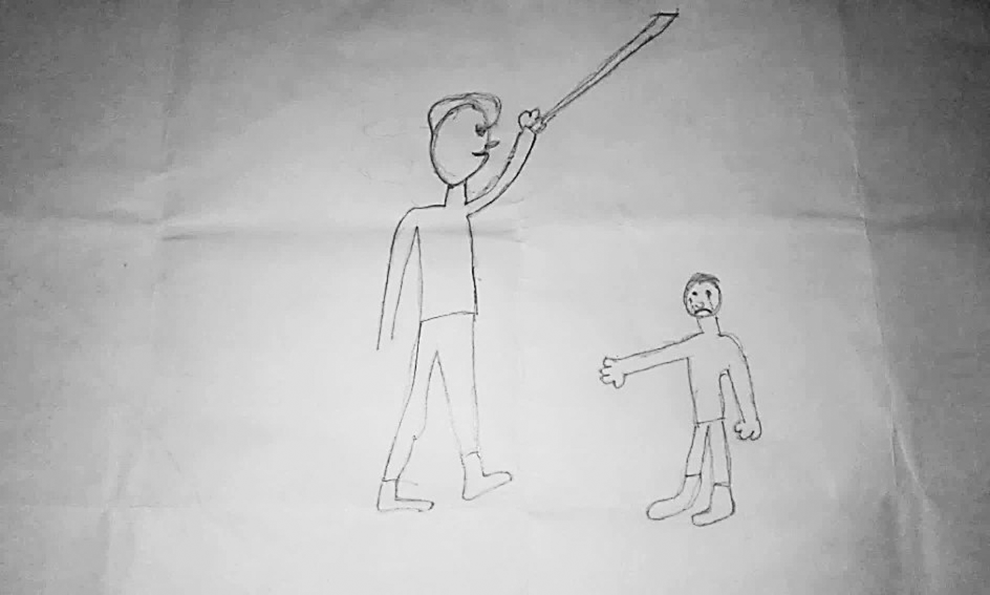
Henry Ford’s drawing.

Mute boy’s drawing.
In Ghana, respect and obedience are central to adult–child relations and at the core of what constitutes childhood. Children in Ghana are trained and required to respect and obey all adults and be humble toward adults. This focus on respecting adults receive further support from the African Charter on the Rights and Welfare of the Child, which stipulates that children have a responsibility to respect parents and elders at all times (African Charter on the Rights and Welfare of the Child, 1990, Article 31b). Children are not expected to challenge adults and certainly not expected to question what they are told to do. Adults are authority figures, commanding respect and are expected to be “feared” by children (Twum-Danso, 2009). Any sign of disrespect toward an adult will incur severe admonitions or punishment. Indeed, respect and obedience in the Ghanaian context are synonymous to fear, which has implications on the rights of children to express their views or even report cases of abuse (Twum-Danso, 2009). The children in our research, therefore, used drawing to capture the intimate and delicate territories of their experiences that they felt intimidated to photograph. Drawing helped them to represent their experiences in a “safe” way. In expressing how they felt about taking photographs involving an adult, one child narrated: You can’t just take out your phone and take a picture of an adult if they have not asked you to. It’s unacceptable. You can get punished for that. (Barca, aged 14)
Indeed, without drawing, some of the children would not have been able to articulate certain significant aspects of their experiences. Aside from enabling some of the children to capture relevant issues, drawing also enabled some of the children from poor-resourced homes to represent their experiences pictorially. It was notable that some of the participants, who did not have camera devices and had not thought about drawing, had still thought about the photographs they would have taken. Therefore, if drawing has been offered as an option for capturing intended images, it appeared that most of the children would have produced images relevant to their experiences for discussion.
The use of auto-driven photo-elicitation in child-centered research in the Ghanaian context posed two main challenges. First, many of the children despite their interest in photography lacked the means to capture the images they intended to photograph due to resource constraints. Secondly, due to children’s position in the Ghanaian sociocultural context, some children found it impossible to photograph their intended images, particularly events/situations involving adults. While these difficulties were related to the research context, they are also inherent to the method. These challenges, therefore, call for a more inclusive and flexible approach to capturing images if a researcher plans to use auto-driven PEIs in a similar context. Giving children the flexibility of, for example, using both photography and drawing to capture things relevant to their experiences in auto-driven PEIs would give them more freedom, control, power, and confidence in overcoming difficulties of producing images significant to their experiences, which has the potential to deepen the richness of data constructed during auto-driven PEIs. Thus, auto-driven PEIs could be viewed more as auto-driven “picture-elicitation interviews” to allow for the incorporation of other visual methods to make them more inclusive, flexible, and adaptable. In the study, both types of images—photographs and drawings—served the same elicitation purpose in the interviews, and both proved effective in accessing and co-constructing data with the children.
Access to Data and the Co-Construction Process
Despite the disempowering cultural context, the pictures appeared to shift the power to the children, giving them an active role in the construction of data. This was evident by how the children’s level of comfort to express their perspectives was enhanced when the images were used to guide the interactions. The images also enabled them to accommodate the interviewer’s gaze (Rollins, 2005) as they did not have to make eye contact or talk directly to the researcher, enabling them to display “respect” as culturally expected while facilitating the conversation. Respect in the Ghanaian context is construed as being passive, shy, not initiating conversation with adults or even looking adults in the eyes. These behaviors underline adult–child interactions. Ghanaian children view respect for all adults at all times as their essential responsibility in return for their rights (Kwarteng, 2012). Nonetheless, the children’s ownership and knowledge of their images enhanced their authority (LeDantec & Pool, 2008), and they were able to direct the conversation “respectfully,” which facilitated the co-construction process and resulted in much richer data.
The children involved in the PEIs expressed that the interactions were as close as possible to their everyday social encounters. Given the growing levels of ownership of smartphones and similar devices, children in resource-poor countries, like their counterparts in the West, are growing up now as an “image-saturated” generation (Porter et al., 2012, 2016). Images have become significant tools in how children communicate and express themselves. Capturing images, sharing, and talking about them characterize children’s everyday social interactions. Therefore, to the children engaged in the PEIs, capturing images important to them and talking about them with the researcher was more familiar to them and felt like their normal social interactions with friends, which made the co-construction process unintimidating and friendly compared with the stand-alone interviews.
The PEIs required that the children reflected on their experiences and captured the images relevant to their experiences before the interview appointments, which appeared to initiate some degree of self-interpretation of experiences by the children. This prior reflection and self-interpretation enabled the children to engage fully in the co-construction process to generate richer narratives. The images served as a third party in the co-construction process and helped to elicit more extended conversations. Discussions of the pictures created deeper understandings and insights, resulting in rich data that were only accessible through the pictures. They offered the children a unique channel to communicate aspects of their lives while serving as a tool for the researcher to expand on questions.
Importantly, the images also helped to make sense of data generated from the standalone interviews that would have been difficult to interpret without them. For instance, images produced by some of the children enabled them to pictorially illustrate and describe in depth the intangible nature of the fatigue they experienced, likening fatigue to lack or loss of a machine’s energy (see Figure 3). Comparing children’s interpretations of the images with data generated from the stand-alone interviews revealed the influence of fatigue on how the children constructed their bodies, which was fundamental to the construction of the grounded theory.

Photograph by Lawrence, aged 16 years.
Indeed, like verbal language, the images were very communicative, expressive, and generative; serving as a visual language with the same subjective and interpretive potential as words (Chaplin, 2005; Close, 2007; Moran & Tegano, 2005). They facilitated the researcher–participant interaction and the co-construction process. However, PEIs can pose some methodological challenges, particularly during theoretical sampling in grounded theory.
PEIs and Theoretical Sampling
Theoretical sampling is a strategy fundamental to grounded theory, and in constructivist grounded theory, theoretical sampling means seeking pertinent data to develop the emerging theory (Charmaz, 2014). The primary purpose is to elaborate and refine the categories constituting the emerging theory. While in auto-driven PEIs, the images shape the direction of the interviews and dominate the interviews, in theoretical sampling, emerging concepts are usually prioritized. If participants’ narratives about their images have no direct bearing on the emerging categories, it can be challenging to facilitate theoretical pursuit. It was therefore difficult at times to be responsive to the children’s developing narratives about their images and at the same time pursue issues of theoretical relevance. Asking questions unrelated to the picture to generate data on emerging categories can shift the control from the participants, making their images and agenda seem irrelevant, and possibly make it difficult to support their dialogical engagement. Although it might be possible to direct participants to focus their pictures on phenomena that relate to category development as part of theoretical sampling, this risk imposing the researcher’s agenda, accentuating the power differential, and limiting co-construction.
In our experience, images produced by participating children in auto-driven PEIs conducted during the theoretical sampling phase did not appear to be directly related to the emerging concepts. However, the children’s narratives about the images served as a mirror to reflect and sensitively ask more direct questions to bring the interaction along the pursuit of phenomena relevant to theory development. For instance, one child drew a classroom event (see Figure 2). His narrative about the drawing focused the interaction more on his schooling. While the data generated were significant in helping to co-construct the meanings fatigue held for his education, future, and social interactions, the researcher aimed to focus the discussion on collecting data on “identity.” By asking one direct question in the context of the image, “what does this drawing mean when it comes to who you are?” the researcher was able to direct the conversation toward exploring the category.
From the child’s response to the question, the picture was found to have a significant bearing on the concept of identity, which steered and guided the conversation toward the furtherance of the concept. Indeed, the discussion about the drawing generated rich and in-depth insight into the child’s perceived personal and social identity. The image introduced a concept of striving and seeking to present the “true” self. The image highlighted other dimensions of identity that needed to be pursued in further interviews. Thus, although there were challenges in using participants’ images as interview tools during the theoretical sampling phase, the images were found to be valuable in facilitating the co-construction of data about theoretical concepts.
Conclusion
Constructivist grounded theory’s emphasis on the researcher–participant interaction and the co-construction of data alerts researchers to the role they play with their participants in shaping the data. Constructivist interviews challenge researchers to create a balance between asking significant questions and encouraging participants to reflect on their experiences during an interview in fruitful ways for advancing theory construction (Charmaz, 2014). Language, therefore, plays a crucial role in the researcher–participant relationship, and thus constructivist researchers need to pay attention to the language used during the dialogical engagement. Children growing up now, irrespective of context, have become an “image-saturated” generation such that images appear to be a language used by children and young people globally. Therefore, images have become a dominant feature in children’s social life, which has implications for how this and future generations of children express themselves and consequently how data should be collected and generated in child-centered research.
In our experience, auto-driven PEIs facilitated the co-construction process and enriched the data generated. The method helped to address the cultural and ethical issues that confront child-centered research in a resource-poor context. The task-oriented approach significantly empowered the children and encouraged their active participation in the study, despite the prevailing cultural context that disenables and disempowers children. However, the method posed some important practical and cultural challenges, which were not only context bound but inherent to PEIs. Broadening auto-driven PEIs to auto-driven “picture-elicitation interviews” may make PEIs more inclusive and help researchers and child participants to address and overcome any practical or cultural challenges, by giving them the flexibility of incorporating other visual methods that can make auto-driven PEIs easily adaptable to different contexts.
Footnotes
Declaration of Conflicting Interests
The author(s) declared no potential conflicts of interest with respect to the research, authorship, and/or publication of this article.
Funding
The author(s) disclosed receipt of the following financial support for the research, authorship, and/or publication of this article: The first author is funded by a University of Manchester’s President’s Doctoral Scholarship.
