




Abstract
Active, participatory netnography, in contrast to passive netnography, is essential if researchers are to gain rich rewards from the rigorous collection of qualitative data. However, researchers should be aware of the ‘netnographic slog’; “the blood, sweat and tears” associated with eliciting quality data and encouraging active participation in online communities.
This article examines the – Supporting Nutrition for Australian Childcare (SNAC) – online community of practice, established to support healthy eating practices in early childhood education and care settings. To ensure research rigour, Kozinets’ netnographic steps were employed. Garnering member participation in this online community was a slog; most community content was contributed by few members, although accessed by many. The success (and failure) of the creative elicitation strategies implemented by the researchers to promote participation are discussed, and examples provided that could be used by other netnographers in online communities. A key consideration, however, appears to be the waning success of web-based discussion boards as an effective platform. Future netnographers should carefully consider the effort required to attract new community members and encourage participation. While SNAC is a unique resource, presenting an ideal platform to launch further initiatives, other more effective social media platforms that can support healthy eating in this key setting should be considered. If participatory netnography is to be successful, budding netnographers must be prepared to invest the blood, sweat and tears required to nurture emerging communities of practice.
What Is Already Known?
Active netnography is an immersive research method used to cocreate rich data in and about online communities. When undertaking an active netnographic study, it is important to follow the netnographic processes developed by Kozinets (2010) to ensure and demonstrate research rigor. In online communities, typically a small number of members create the content that is accessed by the majority.
What This Article Adds?
Despite all manner of creative elicitation strategies, there is laborious “slog” involved in garnering participant activity in online communities. This “netnographic slog” often precedes the emergence of vibrant communities and needs to be hands-on, consistent, and constant. If netnographers can maintain this momentum, even when members themselves are (still) not actively engaging, they can benefit from the hard work invested “behind the scenes.”
Introduction
Netnography, as a qualitative methodology, is often understood as online ethnographic research, involving the systematic observation of groups or cultures. Essentially, it was Kozinets (1998, 2002, 2010) who adapted the well-established “participant-observer” stance of ethnography to suit computer-mediated social interactions. In 2013, Loanzon, Provenzola, Sirriwannagkul, and Mallak provided a useful historical review of how netnography has evolved since Kozinets first coined the term in 1995. Their review is particularly pertinent to this article because it identifies the rapid changes that occurred in computer-mediated environments and technologies. They capture the input of key scholars, such as Professor Steven Jones, in order to demonstrate how “virtual communities” dominated the online communications research space at the time. We add to this historical account by referring to the likes of Rheingold (1993), Watson (1997), and Wellman, Haase, Witte, and Hampton (2001). These authors, among others, expanded the definitions and understandings of online community to concepts which demonstrate: personal relationships with “sufficient human feeling” (Rheingold, 1993, p. 5), intimacy or communion between members (Watson, 1997), and “the subtle reality of community ties” (Wellman et al., 2001, p. 130). These theoretical perspectives have influenced our own netnographic experiences by providing us with a trajectory to progress the tradition of online community research, even though Loanzon et al. (2013) note that new social networking platforms have continued to change the way in which netnographers conduct their research. Even Kozinets (2015), in his most recent manual, emphasized that netnography should be hinged upon active participation in social media, in particular, and other online spaces. While it is important for netnography to “move with the times” in order to ensure that it remains relevant to new and dynamic online phenomena, “it will [for now at least] continue to be a predominant research method for online communities” (Loanzon, Provenzola, Sirriwannagkul, & Mallak, 2013, p. 1578). Hence, our mandate and contribution to the field of netnographic research is characterized by a unique insight around the opportunities and challenges implicated in online communities, some of which are exacerbated by the new social media players such as Facebook, YouTube, and Instagram. While some of our research has incorporated these newer platforms, we have specialized in “using” netnographic techniques to build online communities “from the ground up” for specific population groups characterized by health inequities, which is quite distinct from netnography’s roots in consumer behavior and market research.
In his latest book, Kozinets (2015) does, however, urge for “all of us” to develop our own netnographic interactive research websites (NiRWebs). He posits that this provides an “elegant solution” (p. 185) to some of the ethical concerns surrounding online territory invasions by netnographers. He described how these NiRWebs unveil netnographic intent and facilitate the cocreation of meaningful data. While we advocate for this approach alongside Kozinets, it is quite distinct from developing an online community intended to address particular needs; in many cases, these are needs that potential members either do not want or have not yet realized the benefits they bring. In fact, providing solutions to unmet needs or wants underpins our field of health promotion, seasoned by social marketing principles. It is in this capacity that we have used netnography to build online communities—as a way to address a health need or want by providing an intervention or social product. To our knowledge, only a handful of researchers have taken this approach.
A commercial brand blog, set up by Ducati Motor with researchers in Italy, is one example of how purpose-built communication platforms can be used to attract and build community online (Marchi, Giachetti, & de Gennaro, 2011). Although they were interested in user-led innovation—ultimately to drive profit—their findings are provocative in the context of this special issue, primarily because they conclude that community managers should stimulate conversation online (by prompting engagement through other communication channels) with committed members in order to facilitate the exchange of innovative ideas. Later, the findings of our article also reveal the range of creative and persistent communication channels that we used to do just that. The Ducati study was designed as a “non-intrusive” (p. 356) netnography—premised upon Kozinets earlier commentary from 2002. While it is unclear why they chose this “hands-off” (passive) approach, they may have been able to reap even more reward in terms of the innovative (creative) inputs they were seeking from their netnographic efforts if community managers immersed themselves (actively) in the community.
In keeping with our public health context, however, Bartle, Avineri, and Chatterjee (2013) developed the cycology website that incorporates travel maps and interactive features in order to investigate how informal information is shared in terms of travel behavior. Ultimately, their research had important implications for promoting sustainable travel, which we also consider an important public health issue. However, they did not specifically describe the use of netnographic techniques to build a community in their online space nor did they consider their approach as naturalistic. We consider that our conscious effort to supply an online space to specific health consumers is a creative application of netnography, one which cocreates (naturalistically) a solution to an unmet needs.
The notion that building and recruiting participants to join a bespoke online place or communication platform may be non-naturalistic or inauthentic is a valid argument, particularly in terms of our own qualitative convictions. In defense, we take our lead from the philosophical standpoint of our public health mantra, one which is spearheaded by the pursuit of social justice brought about by empowering people to increase control over their own lives. Although there are all manner of social networking sites that people “produce” (Bruns, 2008) naturalistically and, as a result, portray and develop their identities as a type of “digital double” (Kozinets, 2015, p. 139), they are netnographically useful in terms of unveiling or exposing the lived experiences of everyday people. Our research takes this one step further by seeking to build capacity where inequities in health are revealed. In saying this, we could (and perhaps should) attempt to enter those existing online places in order to interrogate inequities and champion change for the good in our public health roles. In our target populations, however, people are often unwilling or uninterested in public discussion on the topics we propose nor are they aware of the need for change. More likely, that they are unable to change their own behaviors in the face of restrictive socioenvironmental forces.
Some topics lend themselves well to naturalistic engagement with existing social media. For example, Wandhofer et al. (2012) used social media platforms for e-participation in policy-making. While they purpose-built a tool kit for policy makers to engage with citizens, they were acutely aware of the sociocultural forces at work that potentially antagonize citizens through this type of engagement. Controversially, at least from a netnographic stance, a research article contributed by Tambouris (2013) asserts that social media can be exploited for more efficient policy-making.
The “snackscapes” research, conducted by Syrjälä, Luomala, and Autio (2017), resonates with our approach, primarily because it aims to promote healthier snack consumption in everyday life but also because they describe it as “unlike typical netnographies” (p. 763). Although they do not describe the nature of the online environment—other than referring to it as an online community—they set out to recruit participants to engage in a new online space. This application of netnography requires a number of creative human-centered solicitation strategies, ones that we aim to explicate in this article.
On page 181 of his 2015 text, Kozinets cited some research published by Witney, Hendricks, and Cope (2015) as a “negative example” of a purpose-built netnographic research website (www.breastcancerclick.com.au). He seems to have understood that these researchers may have made a website to “ensnare” (p.182) members of this community in order to investigate why people might fake an illness online—referred to as Munchausen’s syndrome, the subject of Witney et al.’s paper. Kozinets acknowledged that while he was unaware of the details of their research, he hoped that those researchers paid due diligence to ethical issues around consent. This article provides a particularly opportune avenue to respond to his concern.
The Witney research referred to by Kozinets was, in fact, borne from a broader research project funded by the Australian Research Council (ARC) in partnership with Breast Cancer Care WA); and one which was co-supervised by Costello (the second author of our article) and led by Green (Professor of Communications at Edith Cowan University). The BreastCancerClick website (“The Click,” as it was known) was specifically designed to provide support for breast cancer patients. At the conclusion of this research, Witney, the PhD student working on this project at the time and a trained nurse, repositioned her PhD thesis in the School of Nursing and Midwifery at Edith Cowan University. Witney and her new colleagues subsequently published the Munchausen paper as an unexpected outcome from the project, as reflected in the data. That someone would fake an illness online was not a focus of the research. The Click website itself was founded on ethical netnographic techniques and fully informed participant consent. A number of publications report the positive health and social support outcomes of the original ARC-funded research (see Bradshaw, Witney, Green, & Costello, 2012; Costello, Witney, Green, & Bradshaw, 2012; Witney, Green, Costello, & Bradshaw, 2013). These papers (among others) showcase an ongoing involvement in netnographies that rely on building online research environments rather than entering or intruding into digital communities that already exist. This new paper, with Wallace as first author and lead netnographer, extends the netnographic work undertaken by Costello and her colleagues since the mid-2000s. It demonstrates that active, creative engagement is both necessary and challenging where researchers seek to develop a sense of community online.
Our 2017 paper—also published in International Journal of Qualitative Methods (IJQM)—argued that netnographers are missing the opportunity and potential reward when they engage in passive, rather than active, participation, both in terms of its ability to elicit rigorous qualitative data and in its ability to sustain narratives in online places (Costello, McDermott, & Wallace, 2017). That same paper concluded by asserting that active netnographies are a real “slog” and require “blood, sweat, and tears” (p. 9), which can result in rich rewards—both for netnographers and for the communities in which they participate. This current article continues the story by describing that this slog often requires many varied and creative strategies to reap those same rewards. In so doing, we return our attention to the field of health promotion, primarily because many health promotion programs and interventions can use online environments to deliver health and social benefits which are inherently “good” for individuals, communities, and indeed, for humanity and our planetary health more broadly.
From the late 1990s, the emergence of Web 2.0 increased opportunities for content generated by members, such as sound and vision, which promoted increased interactivity between members and enabled the cocreation of value (Costello et al., 2017). Since then, the Internet has enabled a rapid increase in the type and availability of communications platforms, social networking sites, and social media genres. These technological advancements and widening Internet accessibility mean that online settings can also be used to deliver health education and support services to “hard-to-reach” audiences. This also means that netnography could be used to build rapport with audiences through active participation, especially ones that use social media and other social platforms to engage with participants; this is particularly important for new health interventions but equally important to maintain interest and to sustain online interactions. In turn, this active participation means that health netnographers can collect and analyze research data to evaluate the success of their interventions or research objectives. This will be more successful if netnographers enter with “eyes wide open” by preparing themselves for that netnographic slog—one which often requires creativity.
We aim to share some of our experiences and the creative efforts that formed part of our netnographic slog by drawing on a specific online health promotion intervention (known as SNAC) developed by a team of researchers at Edith Cowan University in Australia. SNAC (www.snacwa.com.au) provides nutrition resources, tools, and discussion boards for those who work in early childhood education and care (hereon abbreviated as ECEC) settings; ultimately, so they can deliver healthy eating environments for the children who attend these services. The SNAC website was developed because literature has identified that food served at Australian ECEC centers was of poor nutritional quality (Sambell, Devine, & Lo, 2014), that staff may not be effective role models (Erinosho, Hales, McWilliams, Emunah, & Ward, 2012), or lacked confidence to teach children about healthy eating (Kim, Shim, Wiley, Kim, & McBride, 2011). During formative research conducted in Stage 1 of the SNAC study, staff employed in this field reported they struggled to deal with things like fussy eating and difficult parental requests, especially because they could not identify nor access credible nutrition education resources, and indicated a desire for regular and ongoing nutrition training (Wallace, Devine, & Costello, 2017).
In light of these barriers, the SNAC website was built on the preface that an online community of practice could help nurture and encourage discussion, ongoing interaction, learning, and support for staff working in ECEC settings. Communities of practice are defined as “groups of people who share a concern, a set of problems, or a passion about a topic, and who deepen their knowledge and expertise in this area by interacting on an ongoing basis” (Wenger, McDermott, & Snyder, 2002, p. 4). Hence, they also make ideal places for netnographers. Although there are few examples of online communities of practice in the Australian ECEC sector, and none specific to healthy eating, research supports their effectiveness, with members of overseas communities citing benefits such as social support, convenience, and immediacy of responses (Lynch & Batal, 2011).
It is important at this juncture to consider the type of platform chosen to house the SNAC online community. Indeed, Kozinets (2010) acknowledged the numerous forms of emerging online activities such as blogging, tweeting, videocasting, podcasting, social networking, and virtual environments. The “Internet of things” had evolved, where ever-present media devices connect people 24/7—to each other and to the Internet (Bodker & Browning, 2013). However, given the rapid emergence of numerous social media platforms, there was little research evidence to indicate which particular platform would be best utilized by our intended audience (ECEC staff), thus the choice (an interactive website) was based on formative research from Stage 1 of the SNAC study (Wallace et al., 2017).
Our article describes how the SNAC community developed, how the netnographic slog was experienced, and where creative strategies were employed to elicit the active participation needed. We do this by first describing the netnographic processes followed—those which have been previously prescribed by Kozinets—and by providing specific examples to illuminate the journey that netnographers need to prepare for: which was often like “pulling teeth” for the primary netnograper (and first author) of this article.
The SNAC website was launched in 2013 and now boasts a membership of 2,200 + members from Australian ECEC services, of whom the majority are female, aged > 36 years, and holding senior positions. They were our primary targets for this intervention because they act as conduits to our ultimate targets: the children they educate and care for. Promoting healthy eating and establishing good food habits in young children provides vital nutritional support for growth and development during critical periods (Briley & McAllaster, 2011). Given the increasing reliance on ECEC services among Australian families (Baxter & Hand, 2013), it is essential that staff are supported to provide and promote a healthy eating environment, and SNAC was developed to offer that support.
However, it is well-known that initial recruitment, engagement, and ongoing participation are potential barriers to the success of an online community, given most members contribute little, leave quickly, and never return (Ren et al., 2012). This is where netnography can provide that double-edged solution explained earlier, by enhancing participation and sustaining involvement. The research objective was to recruit participants not known to each other, who were geographically distant but experiencing the same workplace issues. Hence, it was vital to identify creative recruitment and participation strategies while also maintaining research rigor to nurture new participants and seed the SNAC community, similar to the strategies employed by Bonniface in 2006 (now Costello, coauthor of this article) which have also contributed to the accumulation of knowledge and strategies reported here. Hence, while our research aim for SNAC was to increase nutrition knowledge and confidence among ECEC professionals, the purpose of this article is to examine the various innovative strategies used to elicit member participation in the SNAC online community. This serves to illuminate the ‘netnographic slog’ required to assure the success of the community.
Method
The netnographic methodology adopted for this study allowed the researchers to engage naturalistically with SNAC website participants. Considering the goal was for SNAC to “become” a successful community of practice, it was only natural that the researchers—who were also content-matter experts in public health—would want and need to enagage (actively) with members.
Our recent IJQM paper posits that a participatory, active netnography provides “an ideal mechanism for co-creation” (Costello et al., 2017, p. 9), and Kozinets (2015), himself, advocates for actual human presence in netnography to develop and sustain vibrant and viable online communities.
In their recent paper examining the specific use of social media in netnographic methods, Reid and Duffy (2018, p. 8) surmise that there are many diverse approaches to netnographic research, and instead assert that: “....both the method and units of analysis develop, as technological possibilities advance and unfold. Researchers are led by the data available to them to address their research questions, along with their ability to collect and immerse themselves in the data […] and the ability to analyse this data (p. 8).”
The active and participatory netnographic method we describe as “naturalistic research” has its roots in ethnography as one of the oldest and most respected qualitative methods. Using netnography meant that we could be guided by the specific steps and principles that have been refined by Kozinets (most recently in 2015) since its inception, including: entrée, data gathering and analysis, trustworthiness, ethics, and feedback (Kozinets, 2010). These are described in terms of the SNAC research in the following sections.
Entrée
Entrée is a technique typically used to identify an online community of interest, by considering its relevancy, activity and interactivity levels, and critical mass (Kozinets, 2010). However, as the purpose of this study was to develop rather than examine an established community, this procedure was deemed inapplicable; SNAC began with only the research team as its founding members. Nevertheless, the goal of Kozinets’s entrée stage—to gain trust, build rapport, and win acceptance in the online space—was still highly applicable to attracting participants to join the SNAC site. Hence, entrée techniques were critical for targeting appropriate audiences and to cocreate a culture that would be attractive to the intended participants (Kozinets, 2010). “Build it and they will come” is a common misconception in the developmental stage of online community construction (Resnick, Konstan, Chen, & Kraut, 2011, p. 9). With this in our minds, elicitation strategies were seen as critical drivers for participation and to build the critical mass required to seed the community. These strategies are highlighted in Table 1, and their effectiveness discussed in the Findings section of this article.
Elicitation Strategies Implemented.
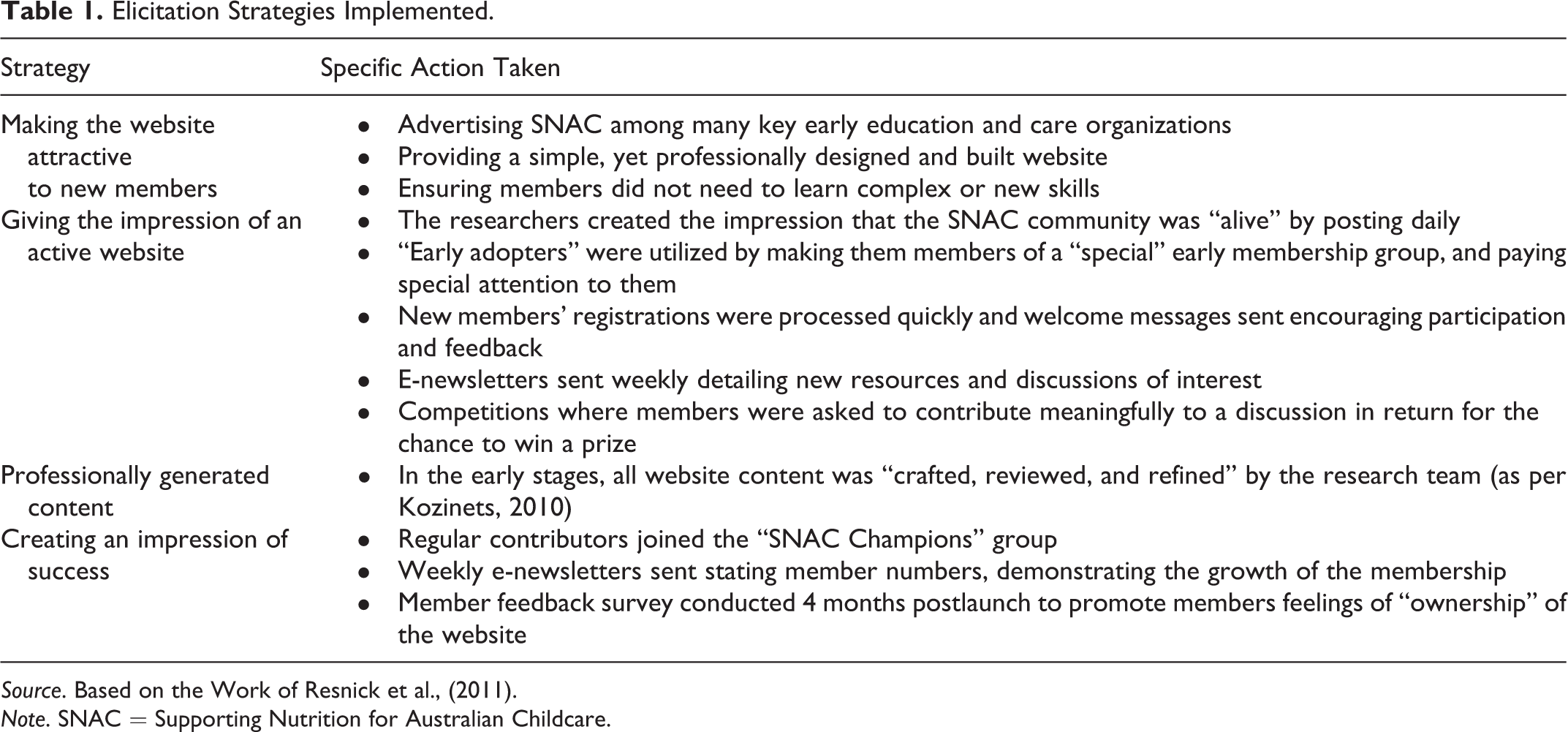
Source. Based on the Work of Resnick et al., (2011).
Note. SNAC = Supporting Nutrition for Australian Childcare.
Firstly, from a sampling frame of all center-based ECEC services in Western Australia, an invitation to register for SNAC was e-mailed to each director and resent several times in the months that followed for nonresponders. This purposive sampling technique ensured that a targeted sample (in our case, staff working in early education and care) accurately represented the context of the study (Jensen, 2008a).
It soon became obvious that service directors acted as the “gatekeepers” of correspondence and tended not to share these invitations with their staff, thus further strategies to increase reach were needed. Other key ECEC stakeholders and professional associations agreed to promote SNAC via their e-newsletters. As an incentive, professional development workshops were offered to services in the Perth metropolitan area, and other media coverage helped to drive initial recruitment for this incentive.
Data Gathering and Analysis
Data gathering is a vital netnographic component, relying on communication with and between members of the online community. This can occur in many different forms, but ultimately, it is the individual members and the community, not the website, with whom these connections need to be forged (Kozinets, 2010). Furthermore, multiple data collection strategies are recommended to ensure rigor, both in netnographic (Kozinets, 2010) and more broadly in qualitative studies (Baym, 2009), to ensure multiple participant perspectives are gathered. For example, a 3-year study of a single online community comprising 1,000 members gathered data from a number of sources, providing an in-depth understanding of how consumers participate in, and are influenced by online social information networks (De Valck, Bruggen, & Wierenga, 2009).
During the entire research project, a clear audit trail was maintained, allowing for a transparent research process and ensuring credibility (Jensen, 2008b), and rigor, which according to Kozinets (2010, p. 173) is the degree to which the research “recognises and adheres to standards of netnographic research.” This audit trail was used to record the many recruitment and participation strategies employed, including additional strategies not originally thought to be necessary, assuring dependability of the data (Jensen, 2008c).
As part of the SNAC registration process, members provided brief demographic data, agreed to the terms and conditions, and were encouraged to utilize available resources and participate in online discussions with other members. For a period of approximately 15 months, online netnographic data were collected from conversation threads, posts, and comments (n = 1,179). Spontaneous participant observations were also gathered via visits to the ECEC centers, and notes were recorded for relevant e-mails and telephone conversations; this is a strategy consistent with ethnographic approaches but also adds value to netnographies (Kozinets, 2010). Furthermore, in-depth, semistructured qualitative exit interviews were conducted with SNAC members which expedited the collection of rich, descriptive data representing participant viewpoints and providing flexibility to gather unexpected data (a strategy also undertaken by Bryman, 2012). These interviews were audio-recorded (with participant consent) for later transcription; interviewing continued until saturation was reached (n = 42). These multiple data collection points, which extended beyond those generated online, ensured that many and multiple participant perspectives were gathered, a strategy known to enhance credibility (Rothbauer, 2008). Where applicable, these data were also triangulated with quantitative web analytics collected via the SNAC website (Table 2).
Data Collection Points.

Note. SNAC = Supporting Nutrition for Australian Childcare.
Data were imported into NVivo and integrated into one rational pattern for analyses, observing the netnographic concept of coherence (Kozinets, 2010). This integration facilitated a unified interpretation of the results, assuring confidence in their quality. Data were coded, and a concept-driven approach was adopted to develop themes as suggested by Gibbs (2007). These broad themes were then refined into subcategories to provide a rich and trustworthy description.
Trustworthiness
Demonstrating trustworthiness, without forcing descriptions into quantitative terminology, is imperative in qualitative research (Given & Samure, 2008). Although trustworthiness is usually discussed in terms of transferability, credibility, dependability, confirmability, and authenticity (Lincoln & Guba, 1985), this quality measure is enriched by a number of specific netnographic practices, which are illustrated throughout this article.
Ethical Research
Ethics approval was granted by the Ethics Committee at Edith Cowan University (ECU; # 8727) to conduct this netnographic study. It is classified as human subjects research in ethics codes (Kozinets, 2010); therefore, explicit informed consent was obtained from all SNAC members as they registered for the website. Specific care was taken to protect the identity of SNAC members and the information they supplied through the use of unrelated pseudonyms. All data were analyzed, disseminated, and stored according to ECU’s Responsible Conduct of Research policy.
Providing Opportunities for Feedback
Twelve months postlaunch, the SNAC website had 1,045 members and had accumulated 1,179 posts/comments and more than 56,000 page views (Wallace, 2016). It appeared that SNAC was now viable, where members had the opportunity to cocreate content online (see Costello et al., 2017) and learn from each other. Apart from this cocreated content on SNAC at that point in time, the researchers developed specific content for resources, which was checked by participants—to ensure it met their needs and was relevant—before it was assimilated into more formal site features such as fact sheets, which provides the important feedback opportunities posited by Kozinets (2010).
Findings
Elicitation Strategies—What Worked?
Remembering that online communities rarely evolve by themselves, and without help from a few key players, meant that netnographic elicitation strategies were practiced in order to stimulate participation and nurture a sense of community for members.
Two weeks after SNAC was launched, 75 participants had joined, although this initial cohort represented a very small percentage of the ECEC workforce. At this stage, we needed to attract more members to join in order to build a critical mass and to inspire community participation.
To enhance recruitment and stimulate participation, 20 professional development workshops were provided for Perth metropolitan services. These were designed to increase health literacy for staff and to showcase the SNAC website and discussion boards. The response from staff attending these workshops varied from enthusiasm to unequivocal disinterest. At most, there were only one or two new member registrations after these workshops, and no apparent increase in participation, translating into a somewhat unsuccessful elicitation strategy. A more successful strategy was afforded when we were able to convince other ECEC organizations to promote SNAC in their e-newsletters and during their staff meetings. Two large ECEC organizations endorsed SNAC, via electronic industry newsletters, which sparked considerable interest in the sector, resulting in 579 new members over a 3-week period. While this strategy also extended the reach of SNAC Australia-wide, and did increase discussion board participation to some degree, the community still lacked vibrancy.
An important entrée procedure is to constantly “hone and re-hone” the way the community is approached (Kozinets, 2010, p. 79). Given the participatory nature of this study, the primary netnographer was constantly interacting on the website’s discussion boards, and through other media channels, so that the site appeared more active than it really was. New material was posted daily to give the impression that there was “somebody out there” and to seed online discussions. At 4 months from launch, however, activity was still low; essentially the community was far from “buzzing.” In desperation, a plea was posted on the SNAC site: It has been pretty slow going, trying to get SNAC users on here every day and to start sharing their stories, thoughts, offer some support, have a chat, have a laugh, whatever you want to do!! So this is my heartfelt plea for your help to get this community off the ground and flying high!!! Come and talk to me and your colleagues! Be a champion!! Be a pioneer!! Be a leader not a follower!! (Wallace—as primary netnographer) Excellent site, and useful in many ways. I will endeavour to visit more often, though it will more likely be a fortnightly visit due to my many other commitments. Hope we can get a few more regular members…. Keep up the good work.
Hence, additional netnographic elicitation strategies were employed to stimulate more robust activity within the community. In order to create the impression of an active and successful online community (Resnick et al., 2011), weekly e-newsletters were sent to all members, including information such as growing membership numbers, the availability of new resources, competition details, and other relevant news items pertinent to the ECEC sector.
The competitions, where members could win prizes, were advertised in e-newsletters, and participation was dependent upon posting comments on the discussion board. These creative activities were designed to drive participation and increase interaction with the SNAC community. For example, in early autumn, when pumpkins were in season, members were asked to post their favorite pumpkin recipes on the community discussion boards. Nine recipes were posted and subsequently collated and published as a pdf recipe book on the SNAC website, an example of the content cocreated by SNAC members (Figure 1).

The “Great Little Pumpkin Cookbook” housed on Supporting Nutrition for Australian Childcare.
One of the most successful competitions in terms of creativity was the Picasso Cows competition. Miniature cow painting kits were donated by an industry partner and distributed to services who responded to the competition flyer. Children decorated the cows, and staff used this nutrition education activity as an opportunity to discuss the importance of dairy foods as a core food group. Twelve centers participated, resulting in 40 comments being posted and photographs of the children’s work shared on the discussion boards (Figure 2). While the response was modest, perhaps in comparison to other more active online communities, it was one of the more creative and successful strategies employed, seemingly enjoyed by staff and children alike. Katie’s comments were typical:

Photographs of painted Picasso Cows Posted by Supporting Nutrition for Australian Childcare members.
We love our [Picasso] cows!…. I found the photos of the kids painting those the other day, they were lovely, I loved the cows!
These novel approaches not only exposed members to authentic learning experiences about nutrition but also enhanced participation in the SNAC community. While we did not consider the Picasso Cow competition as a form of gamifying participation, Harwood and Garry (2015) concluded their research on gamification and customer engagement experience by citing Rao (2011) that games have the potential to provide “playfulness and conversation.” While this assertion is anecdotal, it does ring true in terms of the sense of fun experienced with the Picasso Cows and indicates the potential for more meaningful dialogue and education in terms of nutrition. The netnographic application of gaming is provocative and thought provoking. However, these same authors conceded that their gamified environment did not result in the high-quality engagement they had hoped. Still, their study was based on a commercial market, Samsung Nation. It may be that play could render more creative engagement in other noncommercial audiences, especially ones like SNAC which are typically time poor and reluctant to engage in “boring” or “static” professional development and education.
A further elicitation strategy was to process registrations quickly to ensure new members had immediate access to the community. New members received a personalized welcome message that encouraged participation and requested feedback. “Early adopters”—those who contributed to the community soon after joining, were added to a “VIP” group; they received additional e-mails in recognition of this early participation, including early notification of competitions and newly available resources (Figure 3).

VIP e-mail.
This individualized approach was adopted between February and May 2014, but it was not possible to maintain this time-intensive approach in the longer term. In any case, eventually the responses to these personalized e-mails dwindled, and it became important to find other more time efficient strategies to maximize interaction. We were also cautious about sending what might be perceived as “nuisance e-mails,” especially given their association with increased workloads and a failure to recognize quality information (Benselin & Ragsdell, 2015).
This section has summarized the netnographic elicitation activities implemented in an attempt to stimulate the level of interaction required to grow a successful online community. While the level of success (or failure) has been discussed from a qualitative viewpoint in this section, as a means of triangulation, and thus assuring the rigor of this study, the following section draws on the web analytics (i.e., quantitative data) to demonstrate how SNAC members engaged with the fledgling online community.
How Did Members Use SNAC?
Although this was a netnographic study, and therefore qualitative in nature, web analytics helped paint a picture of both the extent, and nature of members’ interactions with each other, the researchers and the community as a whole. The subsection of the SNAC website with the most “hits” was “nutrition,” which housed recipes and menu plans (31.5% of page views), somewhat predictable, given the overarching aim of the project was to support healthy eating in ECEC settings. To our surprise, this was followed closely by members’ visits to the “community” section of the website (27% of page views), which housed the discussion boards, indicating that many SNAC members read the discussion board content even if not actively contributing material themselves. However, by December 2014, although there were 1,279 comments posted, few SNAC members could be classified “regular contributors” (Table 3).
Number of Comments per Supporting Nutrition for Australian Childcare Member.

Only 94 SNAC members (9%) contributed by posting content on the discussion boards, rendering the majority of the membership (n = 837, 80%) as “passive-active” (van Varik & van Oostendorp, 2013, p. 456) members, those who visited the website, downloaded resources, and read comments, without actually contributing content themselves. There were also 114 SNAC members (11%) who did not revisit SNAC after their initial registration.
Typically, only a small number of online community members will become active members (Preece, Nonnecke, & Andrews, 2004; van Varik & van Oostendorp, 2013). Indeed, Nielson (2006) noted in a typical online community, only 1% of members will be very active, and 9% tend to be intermittent members, referring to this phenomenon as “participation inequality” (p. 2). While the number of active SNAC members was not substantial in comparison to other online communities, such as Beyond Blue, the distribution between passive-active/nonreturning members (91%), intermittently active members (8%), and active members (1%) was comparable to the 90-9-1 participation inequality rule described by Nielson (2006) and others (Van Mierlo, 2014). In response to these low participation levels, an audit of other relevant websites/discussion boards was conducted to determine whether any direct competition (not previously identified during our formative work) to SNAC existed. Only two sites relevant to the ECEC sector were identified, and although both were very active, neither was specific to healthy eating. While the “busyness” of these two discussion boards suggested ECEC staff felt comfortable in an online environment, it was unclear why they were less engaged with the SNAC discussion boards.
Was Critical Mass Achieved?
It is widely accepted that achieving critical mass in an online community is essential for the sustained success of that community (Raban, Moldovan, & Jones, 2010); therefore, at this point, it was important to consider whether this had been achieved. How, how critical mass is measured remains contentious, and there are differing opinions about how this concept can be operationalized (Raban et al., 2010; Solomon & Wash, 2014). For example, early measures of critical mass relied on numbers alone (Hiltz & Turoff, 1985), whereas more recently, Solomon and Wash (2014) posited applying a linear model to the complex relationships between member populations and member postings may not present a true picture of how interaction occurs within online communities. While determining whether critical mass has actually been achieved is difficult, some researchers have used their “subjective perceptions of critical mass as a construct for estimation” (Lim, 2014, p. 271). In light of these contrasting opinions, albeit some 30 years apart and perhaps reflective of how online communities have evolved, it was critical to contemplate the patterns of activity on SNAC in terms of community success.
Our reflections about the “netnographic slog” required to build a critical mass of members demonstrated reflexivity, an important netnographic quality control measure (Kozinets, 2010). The primary netnographer, in particular, was becoming more aware of her critical role, one that saw her immersed in the construction of this new online community of practice as a member, but also a moderator and administrator. Moreover, these reflections also highlighted the decisions she made about critical mass were subjective; that is, it could only truly be measured as a product of the blood, sweat, and tears invested by her (on a daily basis) for the previous 2 years. Excerpts from her research diary suggested that SNAC can be described as an “emerging” community…[although]…the majority of content is provided by me rather than other SNAC members. The term “netnographic slog” seems wholly appropriate in terms of the amount of effort exerted in cajoling, persuading, pleading and offering incentives to encourage actively participation.
The subjectivity around critical mass is easily recognized in these reflections. For example, the “buzz” implies busyness in numbers, but could also imply excitement or engagement, a measure suggested by Bateman, Gray, and Butler (2011). Moreover, these reflections recorded the laborious nature of building up a critical mass of members and activity; indeed, it might have been easy to surrender and admit defeat in this regard, by concluding that a critical mass was too difficult to achieve and ultimately unsustainable. Nevertheless, it is important to remember SNAC’s uniqueness as the only food- and nutrition-oriented online resource and community of practice specifically designed for the ECEC industry. It would, therefore be inequitable to measure SNAC’s success alongside other “busy” sites such as Beyond Blue, given they service lay populations affected by unique circumstances or interests rather than professional audiences (i.e., ECEC staff).
So What?
So what did the sum of these creative elicitation strategies produce? While the lead netnographer in this study did not initially believe that the community was beginning to blossom, the web analytics painted a different picture. Hence, it was important to interrogate the success of the elicitation strategies used for SNAC in terms of community success, perhaps measured by critical mass, or by some other measure.
It is clear that a few active SNAC members produced the majority of community content, therefore appearing to contribute most to the development of the SNAC community. However, the corresponding interaction between active members, inactive members, and the netnographers provided valuable content that was accessed or read by the whole community. At this point, it is useful to consider the “write-once read-many” (WORM) concept originally coined by Information Technology (IT) researchers: “WORM” storage technology permits data to be written only once on a particular location of a storage medium. The content cannot be altered, but can be read as often as required. Because of these characteristics, WORM storage is very appropriate for archival purposes. (Lasher, Ives, & Jarvenpaa, 1991, p. 555).
Motivating participation and engagement within online communities is often continuous and laborious. Some members may continue to participate online for reasons different to those that prompted them to join initially, while others discover it was not what they desired or required, and never return (Lampe, Wash, Velasquez, & Ozkaya, 2010). Despite utilizing netnographic strategies considered to be both best practice (Bonniface, 2009; Kozinets, 2010) and creative, the SNAC community had (still) not yet fully evolved. This study demonstrates that the “netnographic slog” that often precedes the emergence of vibrant communities is vital and illustrates that ongoing, hands-on “active” netnographic approaches are needed to drive sustainability of such sites.
Some may consider web-based communities accessed through discussion boards (as per SNAC) as outdated. They have been described “like ‘walled gardens’; they are carefully constructed and can look very inviting, but they have rigid boundaries, limited admission, restrictive rules of use, and more often than not they are empty of visitors!” (Wandhofer et al., 2012, p. 23). SNAC has a comprehensive registration requirement that may have appeared to potential members as a barrier, and the need for existing members to login each time access was required may have also restricted participation.
While there are swathes of discussion around public versus private online research platforms, our research has, thus far, tended toward the provision of private, password-protected portals where members can “safely” engage in loosely moderated conversations. Still, we consider the creative strategies, employed through the netnographic slog, relevant to broader public discussions that occur online. This necessitates a shift in ethical thinking because the intent of our platforms (such as SNAC) are explicit: Our objective is steeped in a type of “communal caging” where we empathetically engage and seek to empower our target group. If these creative strategies are extended to existing online spaces, researchers will need to weigh up how they will communicate intent in order to avoid their creative endeavors being perceived as forceful or coercive.
We concur that the popularity of Facebook and other “rapid” social media platforms may be more attractive tools for stimulating online communities, primarily because people are already using and are familiar with them (Wandhofer et al., 2012). The activity we (as researchers) are trying to stimulate can then be built into normal day-to-day activities, thus reducing “surplus activity” (Charband & Navimipour, 2016, p. 1140). One assertion is that a combination of both online discussion boards and social media platforms provides the most efficient approach, at least in terms of emotional support (Taimenen, 2016). Perhaps a better way to construct this is to consider these choices along a continuum rather than in isolation or any given combination. This would allow researchers to move along the continuum for different research topics, target groups, and, potentially, at different stages of the netnography. This would also provide more reflexive and empathetic ethical reasoning at different points in time and a more methodical assessment of the pros and cons of private versus public dynamics.
Even so, we have learned valuable lessons from this research, namely, that it is hard work to recruit and engage participants in this forum; the key message, however, is that if you want to reach hard-to-reach groups you have to keep on slogging. Ultimately, it may be that using a web-based community as the primary netnographic platform is no longer viable and that the integration of other more rapid and accessible platforms (such as Facebook, Snapchat, or Instagram) will be valuable at different destinations along the journey.
In fact, the research team recently extended the SNAC website to include educators who work with children in “Out-of-School-Hours Care (OSHC),” a unique subsection of the ECEC sector often overlooked by health promotion practitioners (Branscum & Sharma, 2012). This research study was facilitated by an ECU Honours project (Forde, 2018). Rather than using the more traditional discussion board format to stimulate community interactivity, this study utilized a closed Facebook page, specifically developed for the SNAC_OSHC study. There was rapid uptake of participation in a short period, perhaps indicative of the preference for social media platforms discussed earlier by Wandhofer et al. (2012) and by Charband and Navimiour (2016).
Despite the success of the SNAC_OSHC project, this article reveals that the number of participants alone does not necessarily predict the success of an online community (Raban et al., 2010; van Varik & van Oostendorp, 2013). In the case of SNAC, it is perhaps more important to build up a bank of resources and information that members find valuable, rather than building up member numbers, especially if those members are not going to contribute anyway. It is also important to maintain a balance between attracting new members and stimulating activity or interest. Indeed, despite all manner of creative elicitation strategies, it appears that building successful online communities is more about a consistent and constant netnographic slog to engage participants.
It is, therefore, essential to develop creative elicitation strategies that can be implemented to ensure new members continue to register for SNAC, that the content provided is updated regularly, and that existing members are stimulated to continue or increase their contributions to the community. While creative strategies to increase ECEC workforce engagement with this emerging community are still needed, it is encouraging to see that the efforts of a few members can support those other members who do not actively engage. But, what happens to the few? What rewards do they reap and how might they be encouraged to stay and continue their valuable contribution? This is an important area for ongoing research.
For SNAC, despite the netnographic slog required to build an online community of practice, it is regarded as a unique resource valued by the ECEC sector. At this time, it presents an ideal platform from which to launch further initiatives, which utilize other social media tools to support healthy eating in a key setting. Ultimately, this is what motivates us to continue our work—as sloggish as it may be—in order to support those who are working at the coalface.
Footnotes
Authors’ Note
Ethics approval was granted by the Ethics Committee at Edith Cowan University (ECU; # 8727) to conduct this netnographic study. It is classified as human subjects research in ethics codes (Kozinets, 2010); therefore, explicit informed consent was obtained from all SNAC members as they registered for the website. Specific care was taken to protect the identity of SNAC members and the information they supplied through the use of unrelated pseudonyms. All data were analyzed, disseminated, and stored according to ECU’s Responsible Conduct of Research policy.
Declaration of Conflicting Interests
The author(s) declared no potential conflicts of interest with respect to the research, authorship, and/or publication of this article.
Funding
The author(s) received no financial support for the research, authorship, and/or publication of this article.
