




Abstract
In this article, we develop a child-centered network approach to attachment during middle childhood. Following monotropic ideas, current attachment research focuses on parental attachment figures despite the expansion of the children’s social environment during middle childhood, failing to generate a comprehensive and structured overview of all individuals who ensure the children’s feeling of safety. Relying on quantitative methods, these studies are also dominated by an adult perspective, limiting the children’s contributions. While there have been theoretical drafts of attachment networks during childhood, this article constitutes the first practical implementation. Using photo elicitation interviews and participant observations, we developed an innovative assessment strategy that allows children to exhaustively identify and characterize all their attachment figures on sociostructural and functional dimensions, thus positioning the children at the center of their comprehensive attachment networks that collectively contribute to their feeling of security. We combine qualitative and quantitative data to assess the children’s own understanding of their feeling of security and to locate the individual attachment figure on context-specific social dimensions, thus making the research setting, a clan in Cameroon, an inherent part of the methodological development. The data are translated into multidimensional network diagrams to visualize the children’s perception of their attachment environment and the emerging patterns of their selection. We present an exemplary network, supplementing it with observational data to discuss the ecological validity of our approach.
What Is Already Known?
Attachment research focusing on middle childhood has demonstrated the importance and the impact of parental attachment ties on the children’s psychosocial development, positioning these individuals in the top tier of a hierarchy of relevance. However, it has both been acknowledged that other individuals gain attachment responsibilities during this development stage and that previous samples and methodological strategies have been limited to Western contexts, potentially restricting the validity of these patterns and the applicability of current methods in other cultural settings. To overcome the limiting monotropic and dyadic perspective on attachment, a broader network perspective on attachment has been suggested to investigate all individuals providing children with a feeling of security. Due to its structural flexibility, this approach also possesses cross-cultural applicability, not imposing a research focus.
What This Paper Adds?
This article constitutes the first empirical implementation of this network perspective on attachment, positioning each child at the center of the entirety of their attachment figures to generate an exhaustive and structured overview, using photo elicitation interviews (PEIs) to facilitate this broad perspective and to make the growing complexity of the children’s psychosocial development visible. This article highlights the necessity of an ethnographic and ecologically informed approach that makes the distinct setting an inherent part of the research strategy to understand the context-specific adaptivity of the children’s selection. It also demonstrates the importance of combining qualitative and quantitative data to generate a profound understanding of the children’s own perception of childhood.
Assessing Attachment: A Critical Overview
Current Methodological Approaches to Attachment During Middle Childhood
Attachment constitutes one of the most omnipresent and fundamental concepts of psychology used across all areas of psychological research to conceptualize close relationships and their impact on the individual’s psychological health but also to investigate children’s psychosocial development. Conceived as long-lasting emotional bonds with an evolutionary foundation, attachment relationships provide reassurance during distress and a continuous feeling of security and comfort, enabling exploration in all other situations (Bowlby, 1969; Cassidy, 2016; Thompson, 2016).
While many developmental stages have reached a status of methodological consensus, with studies of infancy and early childhood mostly relying on the strange situation (Ainsworth, Blehar, Waters, & Wall, 1978) and investigations of adult attachment most often conducting adult attachment interviews (George, Kaplan, & Main, 1996), attachment research focusing on middle childhood uses a large range of various instruments, most of them associated with a specific group of researchers (Kerns & Brumariu, 2016; Kerns, Schlegelmilch, Morgan, & Abraham, 2005).
Since children are exceedingly able to verbally reflect their attachment experiences due to their continuous cognitive advancements, most studies investigating middle childhood ask children to directly rate their attachment experiences in questionnaires or interviews (Gullone & Robinson, 2005; Kerns, Aspelmeier, Gentzler, & Grabill, 2001). However, there are also projective methods (Green, Stanley, Smith, & Goldwyn, 2000) and analyses of family drawings (Gernhardt, Keller, & Rübeling, 2016). To identify attachment figures, children are confronted with preselected imaginary situations assumed to trigger their attachment system (e.g., feeling sad or scared, being away at a summer camp, and having a fight with a friend) and asked to state to whom they would turn (Seibert & Kerns, 2009).
Resulting from the idea of monotropy, assuming that children only have one major attachment figure in the beginning and ascribing the most impact on children’s continuous development to this tie and its stability (Bowlby, 1969, 1973; Cassidy, 2016), attachment research in middle childhood mostly focuses on attachment ties to parents, understanding them as “primary attachment figures” in a hierarchy of relevance, explained by the assumed stability of these ties (Kerns et al., 2005; Raikes & Thompson, 2005). Even though it is acknowledged that parents do not constitute the only attachment figures, even in earlier developmental stages (Cassidy, 2016), and that others, both peers and nonparental adults, continuously gain relevance in their attachment roles in the children’s lives due to the social expansion and the resulting growing complexity of their development environment (Kerns & Brumariu, 2016), most studies largely exclude these individuals from closer examinations, considering them to be restricted to a position of context-specific and temporary substitutes for parental attachment figures, not serving as full-value attachment figures (Ainsworth, 1989; Kerns & Brumariu, 2016; Mayseless, 2005). With many studies focusing on individual child–parent dyads (Kerns & Brumariu, 2016), most available data describe the quality of attachment relationship to parents (Kerns et al., 2001; Kerns, Tomich, & Kim, 2006) and focus on the impact of parental attachment ties on cognitive and social outcome variables (Thompson, 2016). Studies aiming to identify children’s attachment figures also follow the idea of a hierarchy of relevance and impact of attachment figures, oftentimes restricting the number of identifiable individuals (Kerns et al., 2006). Up until now, only one study has enabled children to freely identify the entirety of their attachment figures during middle childhood (Seibert & Kerns, 2009). All these previous studies of children’s attachment patterns during middle childhood thus far only encompass Western settings (Chen, 2015).
We conclude that these methodological approaches exhibit several limitations to adequately asses the complexity of the children’s attachment environment during middle childhood across settings: A restricted research focus on a small number of dyads, a neglect of contextual influences, and a limited agency of the investigated children.
Focusing on the individual impact of a few, mostly parental dyads, attachment research during middle childhood lacks to generate a comprehensive overview of all individuals who impact the children’s feeling of security (Lewis, 2005), only focusing on parents for their assumed omnipresence across all life settings and the assumed stability of these ties. This does not only fail to depict the continuous social expansion that is considered to be characteristic for middle childhood (McHale, Dariotis, & Kauh, 2003) but has also been criticized for its Eurocentric nature. It has been highlighted that this methodological perspective reflects interactional units of individualistic cultures and Western care systems of tightly knit nuclear families, consequently being incapable of assessing and representing the interconnectedness and the social networks of relational cultures and the widely spread systems of shared care (Kâğıtçıbaşı, 1996; Keller, 2016; Weisner, 2005; Weisner & Gallimore, 1977). While attachment research focusing on middle childhood has developed a growing awareness that previous findings on behavioral patterns and the selection of attachment figures could be culturally biased due to samples and methodological constructs being limited to Western contexts and ideals (Chen, 2015; Kerns et al., 2006; Seibert & Kerns, 2009), thus acknowledging the influence of the developmental setting and the resulting adaptiveness of attachment to distinct ecocultural conditions on a conceptual level (Keller, 2014, 2016; Weisner, 2005, 2014), this has not yet have any impact on the empirical research strategies. Thus, most researchers continue not to include the distinct developmental environment of their Western samples in their research in order to investigate the contextual influence on their data with published papers on attachment during middle childhood also lacking in-depth descriptions of the ecocultural setting of the sample.
Additionally, children’s contributions to the research of their attachment ties continue to be limited. Most current methodological approaches are dominated by an adult perspective on attachment, neglecting the children’s own thoughts and ignoring the age gap between the researchers and those being researched, which is known to handicap the reciprocal understanding (Weiss, 1993). Despite attachment research acknowledging the children’s increasingly active part in constructing and negotiating their attachment relationships and their growing ability to reflect their attachment ties (Raikes & Thompson, 2005), children are restrained to a position of research objects, oftentimes only reacting to adult thoughts and reflections. When investigating attachment figures, most researchers preselect these individuals based on theoretical developments and normative ideas of family structures (Gullone & Robinson, 2005; Kerns et al., 2001) or, as described, prelimit the number of freely identifiable individuals (Kerns et al., 2006; Kobak, Rosenthal, & Serwik, 2005). The only exception allowing children to identify all their attachment figures opted for an indirect identification task, preselecting situations and affects assumed to constitute attachment-relevant events for children, referring to Bowlby’s reflections on infant behavior to substantiate their selection, neither including a consideration of the growing complexity of attachment during middle childhood nor a verification of this selection from the children’s own account (Seibert & Kerns, 2009). When examining behavioral strategies or relationship quality, children are left to rate statements on Likert-type scales that have been phrased by adult researchers without their consultation (Gullone & Robinson, 2005; Kerns et al., 2001). Generally relying on highly structured and quantitatively oriented interviews and questionnaires, attachment research refrains from using qualitative and child-centered methods, failing to assess a genuine account of the children’s detailed thoughts on their attachment environment.
An Alternative Perspective on Attachment
To address the limitations of restrictive dyadic research approaches that mostly investigate individual pairs of a child and their caretaker and to generate a comprehensive overview, network concepts have been drafted for attachment research (Heinicke, 1995; Lamb, 2005; Lewis, 2005; Weinraub, Brooks, & Lewis, 1977). This network perspective has also been repeatedly suggested as a universal template for attachment research across cultural settings since it facilitates an exhaustive investigation of the individual’s embeddedness in their entire context, independent of the distinct setting, and its social units (Keller, 2014; Lamb, 2005; Lewis, 2005; Weisner, 2005). The idea of a broad focus on the extended social environment shaping childhood and children’s development, moving beyond the limited focus of the immediate developmental environment of a nuclear family, has been virulent in developmental psychological research for decades (Bronfenbrenner, 1986; Furman & Buhrmester, 1985). Concerning the appropriateness of a network concept in non-Western relational cultures (Keller, 2016; Weisner, 2005), this suggestion has even found approval from within the mostly dyadically oriented mainstream attachment research (Mesman, van IJzendoorn, & Sagi-Schwartz, 2016). Yet methodological strategies across the various developmental stages lack a practical implementation of this network idea.
Network analysis is generally used in social sciences to systematically assess, differentiate, and comprehend complex social relations, assuming that these social networks shape individual behavioral patterns, positioning the individual at the center of their entire social environment (Schweizer, 1996). In order to investigate this embeddedness of individuals, the concept of egocentric networks has been developed, assessing personal networks from the individual’s own perspective, with the ego identifying all “alters,” that is, the members of the specific network (Hogan, Carrasco, & Wellman, 2007; Marsden, 2011). Network studies either assess all social relationships or limit their focus to a specific relationship type (Hollstein, 2011).
Most network studies follow a multidimensional approach, selecting specific dimensions to differentiate and consequently allocate these alters in the network, oftentimes by employing qualitative approaches. These qualitative network concepts allow for an exploratory access to networks and the individual ties, used when little to no previous research exists in a specific area. They assess the individual perception of the participants, who are free to use their own frame of reference in their descriptions, which is specifically important when this system of meaning is not shared by the researcher and the person being researched. Qualitative network approaches are also valued for their adaptability and their low threshold due to the resemblance to everyday conversations (Hollstein, 2011), both relevant in research with children (Montgomery, 2009).
A central aspect of network research constitutes the concluding multidimensional visual translation of the assessed data, using the spatiality of networks to make social structures visible and thus easily accessible (Freeman, 2000; Marsden, 2011).
Based on the presented considerations, we aim to introduce a network approach to attachment research during middle childhood, addressing current methodological limitations. We will now outline the objectives of our work.
Generating an exhaustive and structured overview
Since it is widely acknowledged that children during middle childhood possess a diverse social environment and construct new attachment relationships, we assume that attachment during middle childhood needs to be understood as a collective resource distributed across this growing network of individuals who jointly provide children with a feeling of security, even if their impact and their range vary. Overcoming ex ante exclusion, we aim to establish an exhaustive assessment of all relevant attachment figures. After identifying the relevant individuals, we aim to follow a multidimensional network approach, thus characterizing and structurally allocating the alters in order to investigate the overall composition and to depict the complexity of the children’s selection and the resulting networks.
Including the developmental context
Following the idea that attachment patterns are adaptive to the distinct developmental setting (Keller, 2014, 2016; Weisner, 2005, 2014), we aim to include this context in our methodological strategy. The suggested ecologically informed research strategy to attachment encompasses both an exploratory in-depth investigation and description of the developmental conditions using ethnographic methods in order to reflect the context specificity of the observed patterns and the inclusion of indigenous concepts (Keller, 2016; Weisner, 2014). Thus, we aim to assess the specific environment of middle childhood in the selected setting to discuss the adaptiveness of the children’ attachment networks and to include concepts of social interconnectedness of the context to make the ecocultural environment an inherent part of the methodological strategy.
Working from the children’s perspective
We consider it necessary to employ a child-centered strategy to assess the children’s own perspective, reducing our own restrictive input, not sharing the same age or potentially even cultural background, and strengthening the children’s agency in attachment research. As children during middle childhood have an active role in forming their overall social environment (Montgomery, 2009), they need to be considered as experts of their attachment ties and empowered to illustrate their personal attachment experiences, to explain their opinion, and to autonomously characterize their network, generating a deeper understanding of the children’s own attachment concepts.
Combining quantitative and qualitative data
We also aim to integrate qualitative data into our methodological approach, following the call for a combination of qualitative and quantitative data when investigating context-specific patterns of childhood and attachment (Keller, 2014; Weisner, 2014). This allows us to statistically investigate the children’s selection of attachment figures and to assess data comparable across settings but also to adapt an exploratory perspective, abstaining from a priori restrictions and reducing the influence of culturally restricted normative concepts, thus allowing children to use their own frame of reference when characterizing their ties, again strengthening their position.
Developing and Implementing a Network Approach
Step 1: Selecting a Research Context
We decided to select a relational research context with a system of shared care since these ecocultural settings are built on interconnectedness and exhibit network structures as their basic social unit (Kâğıtçıbaşı, 1996; Keller et al., 2006). This allows us to accentuate the problems of a normative dyadic and monotropic methodology during middle childhood since previous attachment studies during this developmental stage have mostly been limited to Western and therefore individualistic and autonomous cultural contexts (Chen, 2015).
Consequently, we conducted our research with the Nseh, a clan in the northwest of Cameroon. Our choice was based on their excluded position as a small clan surrounded by more powerful clans, with this situation preserving distinct concepts of care, family, and childhood (Becke & Bongard, 2018).
The presented study was part of a larger transdisciplinary project on childhood structures and attachment in the village of Nseh. Data were collected by the first author during two research trips of altogether 11 months in 2014 and 2015.
Step 2: Selecting the Methodological Repertoire
Following our research objectives of developing an innovative network approach that explores attachment beyond a dyadic and monotropic perspective, that actively integrates children into the research context and that considers the context-specific adaptiveness of attachment while assessing qualitative and quantitative, we decided to combine the following two methods.
Participant observations
Since we aim to assess the developmental context in order to investigate the adaptiveness of the observed patterns and to include indigenous concepts of social interconnectedness in our methodological strategy, we selected the ethnographic method of participant observations, assessing the general setting and the cultural frame of reference of the clan (Spradley, 1980/2016), specifically focusing on childhood. The participant observations allow us to identify relevant social dimensions to allocate the identified individuals in their position in the distinct setting but also to assess additional observational data to validate the emerging personal networks (Hollstein, 2011).
Photo elicitation interviews
To assess the children’s attachment networks, we selected to conduct photo elicitation interviews (PEIs) (Clark-Ibáñez, 2004). Up until now, social networks have often been assessed using surveys (Wasserman & Faust, 1999), interviews (Hollstein, 2011), or immediate visualizations (Moreno, 1953), focusing on adult samples. Only a few studies have assessed children’s social networks thus far, mostly relying on methods that use paper-pen-based maps (Antonucci, 1986) or spatial arrangements of objects as representatives for important individuals (Gehring & Wyler, 1986), both of which result in an immediate visualization. Most of these methods provide categories of potentially relevant individuals during the identification phase, thus prestructuring and limiting the children’s responses.
Based on the idea of creating an innovative access to attachment that assesses the children’s own perspective, we decided to cross-disciplinary boundaries and combine the psychological concept of attachment with a cultural anthropological methodology. By selecting this approach, we would be exploring a method that is commonly used in child-centered ethnographic studies, but that is new to both attachment research and network assessment. PEIs are valued for positioning children as experts, bridging seniority-based gaps, and using an active and fun way of participation, which enables children to express their own perspective (Barker & Weller, 2003; Cappello, 2005; Luttrell, 2010), thus allowing us to directly assess their own attachment experiences. It has also been highlighted that PEIs assess more affectively relevant data compared to questionnaires (Samuels, 2004).
PEIs feature a two-phase model of data collection. During the first phase, children take pictures based on a given task. During the second phase, they explain and discuss their visual responses in follow-up interviews guided by these photographs. This methodological selection allows for an exploratory and unrestricted assessment of the children’s perspective, overcoming the described limitations of current methods used in network and attachment assessment that narrow the children’s ability to freely reflect and portray their experiences, while also minimizing the influence of the normative ideals and preconceptions held by the researcher, especially relevant in cross-cultural research (Samuels, 2004).
Their open character allows for the simultaneous assessment of qualitative data, with children responding to open-end questions on their attachment ties, and quantitative data, differentiating the selected individuals on set dimensions using ordinally scaled categories. This combines advantages of exploratory qualitative approaches with a structured network assessment (Hollstein, 2011).
With the assessment process allocated in children’s real-life settings, PEIs confront threats of lab-based methods, for example, the commonly observed cognitive biases and memory distortions in retrospectively assessed network data (Bernard, Killworth, Kronenfeld, & Sailer, 1984). We assume that this reality-based character of PEIs and their resulting ecological validity consequently improves the accordance between the assessed data and the children’s actual attachment experiences.
Step 3: Selecting the Dimensions of the Attachment Networks
By selecting the dimensions of the network, we decide how we aim to characterize, thus allocate the identified individuals in the network, in order to investigate the influence of these dimensions on the children’s selection. Following common approaches in psychological network analysis, we included both sociostructural and functional dimensions (Feiring & Lewis, 1989; Fiori, Smith, & Antonucci, 2007).
Sociostructural characterization
By characterizing individual attachment figures on context-specific sociostructural dimensions according to their affiliation and relative status in the overall group, a differentiated structural analysis of the composition of the children’s attachment networks can help to analyze who is contributing to the children’s need for attachment and how the availability and the selection of attachment figures are shaped by preexisting social dimensions and interactional norms of a specific developmental setting. Up to now, studies identifying children’s attachment figures rely on a small number of a priori selected social categories to differentiate these individuals, mostly only focusing on the dimension of age, oftentimes assorting them into the two broad categories of “adults” and “peers” (Gullone & Robinson, 2005; Kerns & Brumariu, 2016) missing to examine the real-life relevance of these categories in structuring social interactions. Based on our participant observations, we selected social dimensions that structure interactions and social relationships in the distinct setting at large, identifying kinship, age, and gender as fundamental interactional concepts of the selected clan.
Since we aim to facilitate statistical analyses of the children’s selection across the assessed sample, investigating the significance of the sociostructural dimensions of the setting for children’s attachment networks, these dimensions were translated into ordinally scaled variables, each encompassing distinct categories. These categories were also derived from our participant observations in order to systematically characterize the alters based on the structural norms of the distinct setting.
Social structures of the clan are firstly based on the concept of seniority, directly influencing how people feel and act around others; a common pattern in many sub-Saharan cultures (Oheneba-Sakyi & Takyi, 2006). Seniority translates into respect and obedience toward all superiors in the resulting age-based hierarchy. The Nseh explicitly differentiate three developmental stages of childhood (“wàn,” “wánlè,” and “wánlè ngòn/wánlè nsùm”) and one stage of social maturity (“lumen/wiíj”), each one of them defined by behavioral norms and demarked by distinct thresholds (Becke & Bongard, 2018).
Kinship constitutes the second dimension structuring the clan and all interactions at large, while also shaping the residential units. The relevance of kin ties in similar contexts has been demonstrated many times, with closeness of kinship translating into sociability and social obligations (Hahn, 2012). On a large scale, the clan is divided into lineages that are divided into increasingly smaller units of kinship and residence, resulting in five categories that describe a decreasing degree of kinship (“elementary family,” “heart family,” and “compound family,” “lineage ties,” and “no kin ties”). As kin proximity translates into physical proximity, we are able to allocate someone in the physical setting of the children’s developmental context by determining the kin tie.
The clan thirdly exhibits gender-based differences in their behavioral norms, ascribing different responsibilities in the family life and beyond to women and men.
Functional characterization
Characterizing attachment figures concerning their functionality, thus focusing on the respective responsibilities of each tie concerning the children’s feeling of security (Lewis, 2005), and assessing the context dependency of these patterns can further the understanding of how the children’s need for attachment and security is met in individual relationships in a distinct context, how different aspects of security are distributed across the array of attachment figures, and how the group of attachment figures thus collectively establishes a general feeling of security. This functional aspect has previously been identified as lacking in current attachment research during middle childhood (Kerns, 2008). Since we assess the children’s own understanding of functionality, these categories are not reconstructed based on the setting at large but are developed based on the children’s responses. Combining these qualitative data with the quantifiable sociostructural characterizations, statistical analyses of the relation between individual sociostructural traits like age and the perceived functionality of a tie become accessible.
Step 4: Implementing the Methodological Strategy
Conducting participant observations
The participant observations took place in several families and their immediate surrounding neighborhood. We combined observations and informal interviews.
After receiving consent by the clan’s leader, adult guardians and children individually gave written consent in accordance with the Declaration of Helsinki to voluntarily participate after receiving information on the study. Children were informed that the assessed data would be processed anonymously, highlighting that their statements would not be discussed with other clan members, demonstrating our goal to protect their personal data. The study was carried out in accordance with the recommendations of the ethical guidelines of the German Association of Psychology. The overall protocol was approved by the ethics committee of the Department of Psychology of the Goethe-University Frankfurt.
To assess and understand the children’s own perspective, we adapted our approach to the distinctive setting of development in the selected context. Following the seniority-based order of the clan, children during middle childhood hold a subordinate position, having to comply to all demands and norms set by adults. While they already have to contribute to their families’ income, they hold little to no formal power or agency in the overall social setting with behavioral concepts also restricting most interactions with older clan members. However, this is counterbalanced by groups of same-aged peers, an important setting of children’s socialization, offering a free and mostly unrestricted climate and the possibility to experience agentic positions in this self-regulatory microsetting (also Nsamenang & Lamb, 1994, for a comparable context). Thus, we explicitly asked children to introduce us to their lives and their peer groups, openly expressing interest in their activities and their understanding of the context. We participated in their daily routines throughout the entire 11 months of both research stays, joining individuals and groups of children in their lives, following them to school and their homes, participating in their games and their chores, and highlighting their position as experts and our position as a novice. This attitude also counteracted their expectations and behavioral concepts of hierarchical interactions between children and adults. Thus, children were already well acquainted with us and our research project when we started conducting PEIs.
Conducting PEIs
The adaptation and implementation of our methodological strategy include two consecutive phases: firstly, identifying individual networks members, and secondly, characterizing them on selected sociostructural and functional levels.
Identification phase
During the first phase of data assessment, children exhaustively identified all alters of their individual attachment network by photographing them. Introductory sessions and interviews were conducted in Pidgin English and Lamnso, the local language. We developed our identification task based on theoretical reflections that the feeling of security constitutes the main function of the attachment system, with this feeling ascribed to all attachment relationships across the varying developmental stages, independent of the growing complexity of the behavioral patterns of attachment (Ainsworth, 1989; Ainsworth et al., 1978; Hazan & Shaver, 1994; Sroufe & Waters, 1977), assuming that anyone contributing to this feeling of security and comfort and enabling exploratory behavior from the children’s own perspective constitutes a relevant attachment figure. Thus, we asked the participating children: Now you have your own camera. Please take pictures of anyone that is important to you, anyone with whom you feel safe, comfortable and at ease.
The children were provided with instructions regarding how to use a camera and we presented the identification task, highlighting that they were free to use as many pictures of their film as they needed without feeling obliged to use all of the film. We explained the possibility to photograph representative objects to include attachment figures not currently present. Since children were taking pictures in their own time, we were not present while the data were being collected. Most children, however, decided to continuously inform us about their progress. Cameras were collected after children had indicated that they had finished taking their pictures, mostly after one week.
Characterization phase
During the second phase of data assessment, children characterized their alters in follow-up interviews. This included a context-specific quantitative sociostructural and a qualitative functional level of differentiation. Since we aimed to translate our data into egocentric networks, categories were labeled describing the relative position of an alter to the child in question.
In order to sociostructurally differentiate their alters, children were asked to individually characterize them in accordance with age concepts of the context, resulting in four categories of younger peers, same-aged peers, older peers, and adults. Children were then asked to describe their kinship relation to the individual network members based on shared residential units and lineage ties, using five categories of kinship proximity of elementary family, heart family, compound family, lineage ties, and no kinship ties. If children did not use gender-specific kinship terms in their description, we asked them to specify their statement to include the individual’s gender.
Since we also wanted to include an analysis of the perceived functionality of all individual ties, children were asked to explain their selection and state how the individual makes him or her feel safe, comfortable, and at ease. Using ethnographic strategies to detect data-immanent patterns (Spradley, 1980/2016) combined with a shortened approach to grounded theory (Corbin & Strauss, 2015), these responses were analyzed to identify emerging patterns and to develop a context-specific coding system with four functional categories emerging: nutritional care, assistance, kinship, and affection. After developing these categories, all individuals were classified concerning their functionality based on the children’s statements in the follow-up interviews.
After the interviews had been conducted, children received all their pictures since we aimed to highlight their responsible and agentic role in our research and their position of control over their own contributions.
Step 5: Developing a Network Visualization
In the next step, we translated the existing data of all individual attachment figures and their functional and sociostructural classification of each child into individual egocentric networks to visually display the complexity of all available information, taking advantage of the spatiality of networks and their ability to portray multiple dimensions and combining the identification and the differentiation of children’s attachment figures (see Figure 1). These multidimensional visualizations have long been an important part of network analysis with researchers translating all selected dimensions of the network into visual features. Since visual translations can be considered as a joint analysis of all data from an individual ego, they do not only portray the individual alter in their position in the overall group but also depict (emerging) groups and clusters (Freeman, 2000).
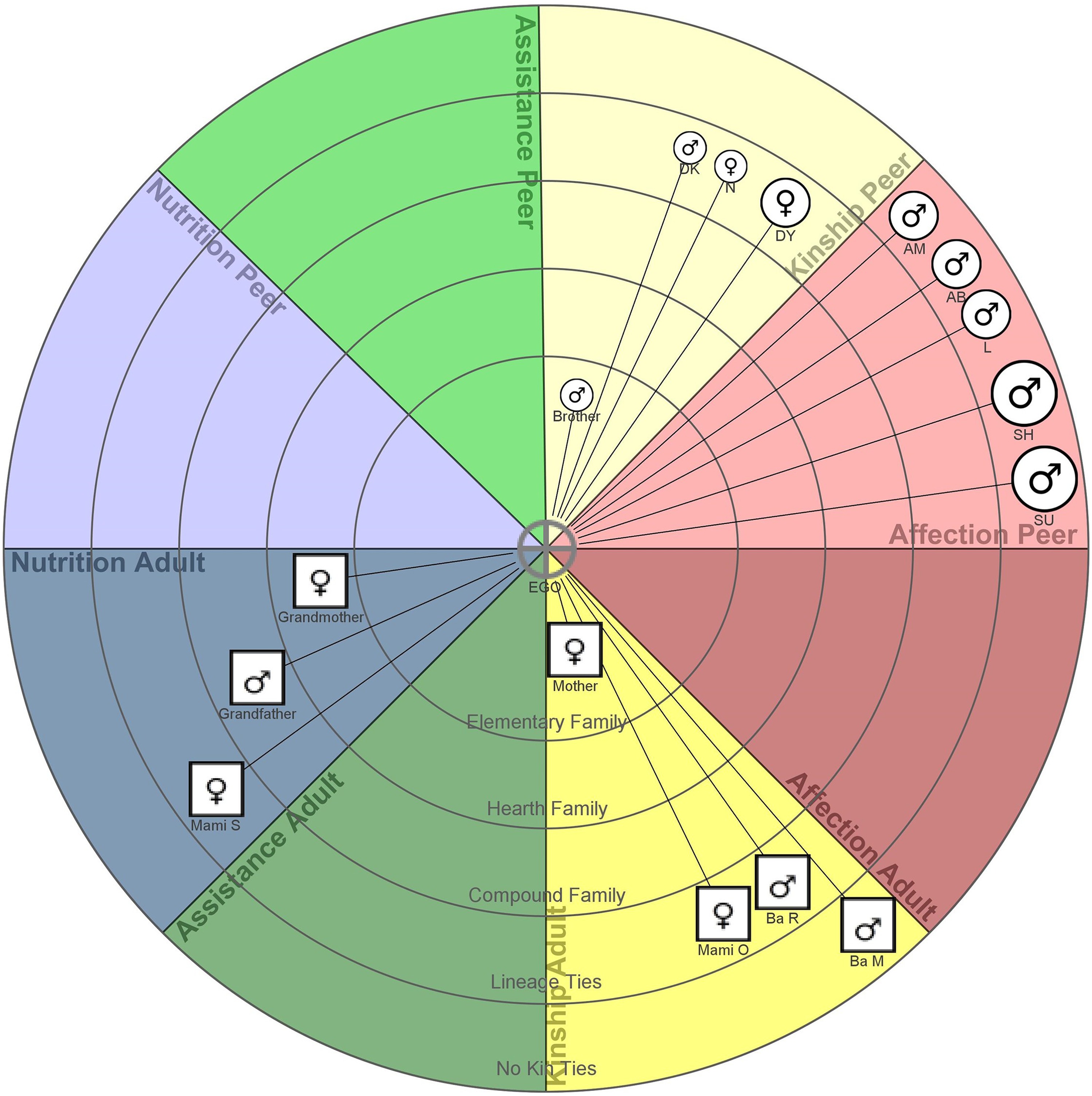
Shamnyuy’s network of attachment figures (□: adults; ○: peers).
In our visual translation, the individual child constitutes the center as we portray their personal network. The identified attachment figures are illustrated as nodes, with the individual symbols representing their gender. The ties are all unidirectional with the ego describing the relationship as providing security in their perception.
Categories of spatial proximity are often translated into closeness in networks (Freeman, 2000). Since kinship and residency coincide, the sociostructural dimension of kinship describes both decreasing spatial and kin proximity. As a consequence, we translated these categories into concentric circles so that individuals with close kin-residential ties are also positioned closely to the child in the personal network.
The sociostructural dimension of age is illustrated by two different aspects of the networks. Since most previous studies compare between peers and adults and since seniority establishes the strictest border between adults and all stages of childhood in the observed setting, the broader age groups of peers and adults are plotted against each other, further simplifying a direct comparison of both groups across other dimensions. The growing age in the three categories of peers is translated into an increasing size of their symbol.
The functional dimension of perceived functionality and its categories form different segments of the overall network. These segments are mirrored along the border between peers and adults to enable a direct comparison between these two broader age groups.
Case Study
To further demonstrate the implementation of our methodological approach, we will now present a case study (see Figure 1). Informed written consent of the child and his guardians was provided to present his data in this article, the name has been changed to secure anonymity.
We will contextualize the data with a description of the specific developmental setting to reflect on patterns of adaptiveness and with observational data of the selected case to discuss the ecological validity of our approach.
The Developmental Setting
The Nseh are a clan of subsistence farmers, with both female and male clan members responsible for different aspects of farm work. Men take over rather infrequent, yet strenuous tasks on the farms, while also being responsible for traditional rites and rituals, connecting them with their ancestors. Excluded from this aspect of the clan, women are responsible for the daily farm work and childcare, thus excluding the male clan members from close relationships to infants (Becke & Bongard, 2018). The economic situation of the clan is rather critical with the limited nutritional supply being an omnipresent theme. The social order of the clan is based on the described lineages that are traced back to the historical narrative referencing a mystical common ancestor and several founding families (Ndze, 2008). Children during middle childhood already have a thorough understanding of their kin ties. During this developmental stage, they are an active part of both the workforce and the system of shared care, being responsible for their younger siblings. Both in their compound and the clan, they have to follow strict behavioral norms and take a subordinate position to adults, resulting from the age-based hierarchy of the clan, separating children from adults. Being raised in a large and diverse social environment, they now spend most of their time in peer groups, moving beyond compound boundaries. These peers are now also responsible for emotional support, following a transformational period after weaning that sharply reduced the adults’ care responsibilities, especially concerning overt emotionality (Becke & Bongard, 2018).
The Network
Shamnyuy is an 8-year-old boy. The majority of his attachment figures are peers, coming from all developmental stages of childhood. The selected adult attachment figures exhibit close kin-residential ties to him, while the majority of peers do not share a lineage or a residence with him. Shamnyuy shows a clear preference for peers of his own gender, while not making this gender-based difference concerning his adult attachment figures. He distinguishes between peers and adults in their perceived functionality. Most peers, especially same-aged and older ones, are valued for their emotional relevance, while adults mostly cater to his need for nutritional supply. Kinship, however, is a relevant category for both peers (mostly the younger ones) and adults.
His selection of attachment figures seems to be influenced by both the seniority-shaped structures of his environment and the resulting separation between children and adults and the restrictions of adult care responsibilities during middle childhood, mainly selecting peers as responsible for his feeling of security. The closeness of kin, a concept forming interactions in the clan at large, only restricts his selection when it comes to adult attachment figures. Concerning peers, he rather focuses on children without any kin ties, following the unrestricted structures of peer groups. The differentiation of peers and adults concerning their perceived functionality can possibly be traced back to the different resources and roles of children and adults in a clan based on subsistence farming and a care system during middle childhood that transfers responsibilities of emotional care to peers.
Observational Data
In order to further illustrate his attachment ties, we will now supplement his data with more elaborate information assessed in participant observations. Shamnyuy lives in the compound of his maternal grandparents together with his mother and his younger brother. The grandparents constitute the providers of the family, as referenced in their perceived functionality, with his mother only working a low-paying job, thus depending on her parents. His grandmother has always been his most important caretaker since infancy, still showing an overindulgent and emotional care in contrast to his mother, restricting the functionality of his mother to that of a kin-based one. His older sister and his father, living rather far away and mostly without contact from infancy on, are not represented in his network. He is a responsible caretaker for his younger brother and other young relatives who he regularly supervises in his compound and who are identified in the network. The family is closely connected to compounds of the same lineage, receiving and providing kin-based social obligations, a pattern he also shows in his network. However, around adults from outside his compound family, Shamnyuy behaves rather reclusive and distant, thus including only a few of them in his attachment network. In his free time, he mostly plays with a steady group of boys outside his compound, represented in his network and their perceived functionality.
His network data were translated into a network diagram using VennMaker 1.5.3.
Discussion
In this study, we described the development of a methodology that introduces a network perspective to attachment research during middle childhood, aiming to include the children’s own understanding of their attachment setting and the distinct developmental environment in the assessment process.
We selected PEIs to not only investigate the size of the children’s array of attachment figures but also illustrate the distinct structure and the functionality of the emerging networks. This requires the introduction of qualitative data into a research area mainly dominated by quantitative methods. This article demonstrates the advantages of an approach that combines qualitative and quantifiable data. As a consequence, the research strategy can not only locate an individual attachment figure on sociostructural dimensions but also provide access to the children’s concepts of security and attachment. As a consequence, the presented research strategy can assess the diversity of the children’s attachment figures and the distribution of attachment responsibilities. Thus, our approach constitutes a methodological contribution to the reorientation of attachment research toward a comprehensive network understanding of attachment, overcoming the monotropic and Eurocentric limitations. The network perspective in general and the presented method constitute important analytical tools to investigate attachment as a collective resource and to also explore the complexity of children’s attachment networks on multiple dimensions, not only helping to understand who is contributing to the children’s need for attachment but also how this feeling is jointly established.
The presented ecologically informed and ethnographic approach to childhood research also helps to illustrate the adaptivity of attachment to the distinct conditions of middle childhood by making the specific setting an inherent part of the methodological development. Following a transdisciplinary strategy, psychological concepts can be investigated in their context-specific translations, highlighting the variability of childhood.
Since attachment research investigates children’s social ties, their perception constitutes the most important source of data, making PEIs the ideal method to implement our research strategy, enabling children to actively guide the data collection. With the data assessed in their real-life settings and the photographs making the children’s experiences immediately visible during the interviews, generating vivid and detailed data that contributes to a shared understanding despite cultural and age-based gaps, this strategy exhibits remarkable ecological validity, as demonstrated in the case study.
However, future research will need to further examine the validity of this approach by also including systematic observational data and by assessing other social ties, for example, those fulfilling the need for companionship, to illustrate that the observed attachment networks only constitute a selected excerpt of the entire social environment. Additionally, the included sociostructural dimensions need to be reflected and potentially expanded, to also include relationship stability, in order to empirically investigate previous reflections on the importance of this relationship trait and its assumed limited validity, only applying to parental attachment figures. Yet the open character of a network perspective generally allows for a flexible configuration of the characterization of children’s attachment ties, with this approach easily adapted to any research question at hand.
To tap the full potential of a network perspective on children’s development, future research also needs to move beyond the mere unidirectional consideration of attachment relationships as presented in this article by also including the opposite perspective, allowing children’s attachment figures to reflect on their perception of the tie. Using multiple perspectives could further improve the ecological validity of assessed networks, thus generating an even more comprehensive depiction of the complex interactional structures of the children’s developmental environment.
While this study focuses on an interconnected relational cultural context, the developed methodology can be applied across cultures because the implementation is adapted to each context and its sociostructural concepts. This applicability across contexts will need to be demonstrated by assessing the children’s attachment networks in an autonomous cultural context. The resulting comparative data across cultural settings, ranging from settings based on an extended social environment to those relying on tightly knit nuclear families, will not only help to broaden the empirical evidence on the adaptivity of the structure and the functionality of children’s attachment networks. Future research can also extend the presented strategy and develop a typology of attachment networks across contexts (Fiori et al., 2007). Additionally, the network perspective can be advanced by assessing the quality of each tie and by thus investigating the joint impact of the entire network on the continuous psychosocial development.
Overall, introducing PEIs into attachment research allowed us to develop an exploratory and child-centered methodology that facilitates an exhaustive and context-specific understanding of how and by whom the children’s feeling of security is established and maintained, extending attachment research beyond the impact of parental ties and making the growing complexity of children’s development visible.
Footnotes
Authors’ Note
The raw data supporting the conclusions of this article will be made available by the authors, without undue reservation, to any qualified researcher.
Acknowledgments
We are grateful to Hans Peter Hahn for his useful advices on our research. We wish to express our thanks to the leader of the participating community, H.R.H. the Fon of Nseh, as well as Victor Taniform, our research assistant in Nseh, and the families of Nseh for supporting our project.
Declaration of Conflicting Interests
The author(s) declared no potential conflicts of interest with respect to the research, authorship, and/or publication of this article.
Funding
The author(s) disclosed receipt of the following financial support for the research, authorship, and/or publication of this article: The study was funded by a scholarship of the German National Academic Foundation.