




Abstract
In its classical form, ballroom dancing constitutes heterosexual dance couples enacting conservative forms of masculinity and femininity. A normative focus, both in scholarship and in practice, on the classical form in competitive ballroom dancing (also known as Dancesport) excludes the lived narratives of LGBT + dancers practicing the sport outside of the mainstream. Equality Dancesport is one such example, with dancers performing in diverse partnership typologies and adopting less gender-segregated dance roles and movements. Drawing on the photo-elicitation exercise, embedded within in-depth interviews, conducted as part of a broader ethnographic study on the equality Dancesport scene in the United Kingdom, I demonstrate how the strategy informed a ground-up emergence of a queer theoretical framework for understanding masculinities and femininities across the sex, gender and sexuality categorical divides. Four key opportunities afforded by photo elicitation are identified, namely (1) invoking new queer knowledge which blurs the binary divide in how concepts of masculinities and femininities are investigated in existing dance scholarship, (2) facilitating the development of more egalitarian researcher/participant relationships, (3) enabling affective, detailed and fluid narrations of lived experiences of dancing, and (4) positioning interviewees as dance spectators and inspiring reflections on the community. The paper concludes with three recommendations for negotiating the pitfalls of using a photo elicitation technique in dance studies. First, researchers need to recognise the limits of inclusivity offered by photo elicitation and practice sensitivity towards participants. Second, integrating photographs with other visual methods such as videos can enable researchers to leverage the strengths of different visual tools to inspire talk about broader topics. Third, before using the method, researchers need to develop mental strength for coping with negative talk, to achieve more holistic understanding of participants’ sentiments and motivations and as a duty of accountability towards them.
Keywords
Queer(y)ing Dancesport Through a Turn to Embodied Knowledge
The last two decades witnessed a growing interest in the use of visual methods in qualitative social science research to gain access to embodied, emotional and sensory experiences excluded in positivist approaches (Goopy & Kassan, 2019; McNiff, 2018). Visual methods provide alternative ways of knowing and interacting in the investigation of social phenomena (CohenMiller, 2018), encouraging the acknowledgement of reflexive, sensory (Jay, 2011) and affective (Koivunen, 2010) knowledge as credible. A diverse range of visual materials (films, photographs, maps, drawings, cartoons, symbols) have been used across a broad range of visual methods (Weber, 2008). In sociology, visual methods were adopted in the study of a broad range of social phenomena such as social movements and activism (Neumayer & Rossi, 2018; Hardbarger & Maguire, 2018), collective identities, ethnic conflicts, work and organisations and urban environmental use (Zuev & Krase, 2017; Shortell & Brown, 2014). Despite its ability to contribute richer and deeper insights into diverse subject matters, visual methods remain underutilised in studies on physical culture, in particular on leisure activities “involving expression through physicality” and “physical movement occurring within recognised cultural domains such as sport, dance” (Phoenix, 2011, p. 1). Existing sociological research on dance using visual methods are focused on photographs, such as Picher’s (2012) investigation of the image management of female erotic dancers in night-time industry, and Martin-Wylie and colleagues’ (2022) work on the subjective well-being of older adults doing creative dancing. This focus on photography may be attributable to photo-elicitation interview being the most common strategy among visual sociologists (Harper, 2002), constituting using photographs either produced by researchers or participants to extract information that would be difficult to collect without visuals (Rose, 2016; Zuev, 2006).
The purpose of this paper is to advocate the inclusion of visuals in sociological studies on dance, by highlighting how its use in the study of competitive ballroom dancing (Dancesport) generated new embodied knowledge which queers the idealised, conservative forms of masculinity and femininity endorsed by mainstream Dancesport bodies (Marion, 2008, p. 148) and documented in existing scholarship. Yamanashi Leib and Bulman (2009, p. 603) aptly describe the performance space of traditional ballroom dancing as one where “costumes, songs, and gestures coordinate seamlessly to produce traditional images of aggressive, domineering males and delicate, sexually receptive females.” This amplification of Judith Butler’s (1993) “heterosexual matrix” in mainstream Dancesport supresses wilful transgressions enacted through equality Dancesport, a home space offering more latitude between gender binaries (Sloop, 2004) and alternative displays of sexualities through gender-neutral dance partnerships. Despite the three-decade long history of equality Dancesport, and growing visibility of same-sex dancing through reality TV programmes such as Strictly Come Dancing and Dancing on Ice (Wong et al., 2021), queer knowledge, experiences and theories remain under-represented in qualitative studies on Dancesport. Intersectional scholarship on the social aspects of gender, sexuality, race and class in Dancesport (Ericksen, 2011; Harman, 2012; Marion, 2012; Meneau, 2020) 1 focus on heterosexual partnerships where traditional forms of masculinity/femininity are performed and embodied. Other studies examining the dynamics of dance partnerships (Majoross, et al., 2008; Harman, 2012) exclude the circumstances of queer subjects. Leib and Bulman (2009) and Lányi (2013) are the only two studies discussing same-sex dance partnerships, albeit with a limited focus on the deconstruction of traditional femininity through female/female dance partnerships, as such indirectly reinforcing the essentialist attribution of traditional femininity to female dance followers. This paper argues that embedding photo-elicitation into a broader ethnographic study on the lived experiences of LGBT + equality dancers contributes to queer knowledge which disrupts the essentialist framing of the classical dance form.
Dance is unique to many art forms in that it is expressed in and through the human body. In Dancesport, dancers move through space as couples, using touch, bodily postures, movements, stillness and other bodies to convey culturally patterned notions of genders, sexualities and moralities. This sharing of knowledge through intercorporeal understandings (Allen-Collinson & Hockey, 2016) suggests that dancers are not just embodied subjects, but also individuals embedded within the socio-cultural context of their bodily performances. Embodied knowledge generated through photo talk can provide a holistic understanding of the socio-cultural context within which dancers’ experiences are situated. Wissman’s (2008: 14) study on young people’s embodiments through the medium of photography finds that it provides “a medium of seeing that is shaped by the social context, by identity, and by experience”. Drawing on Merleau-Ponty’s (1968) notion of intercorporeality in which the living body is conceived of in terms of its interactions with other bodies, I argue that a holistic understanding of dancers’ body work should encompass an examination of how they perceive, experience and feel other dancers. Since dance is a visual art form, photography provides a useful means for generating critical dialogues about the body, enabling an understanding of how dancers perceive the body work of others and reflection on their embodied experience of materialising gendered and sexual dancing bodies.
Engaging dancers through photo talk is effective, since dancers are familiar with photographs (Marion, 2010) due to the presence of photographers at equality competitions. Photographs go beyond being dance memories, acting as tools for dancers to reflect on their performances, as well as being a conversation point for them to share opinions of the event. With talk about photographs being an everyday activity in the lives of dancers, using pictures as prompts for the reflexive sharing of embodied and emotional experiences can increase the inclusiveness of the study design (Liamputtong, 2020; Rose, 2016). Unlike videos which can channel dancers ‘attention towards a technical analysis of dance performances, the brevity of viewing a photograph and the more focused nature of a still image can channel attention towards dancers’ reflexive sharing of embodied and sensory experiences in relation to their own bodies. This paper achieves two key aims: (1) highlight how photo-elicitation facilitated the generation of queer, embodied knowledge through a discussion of findings emerging from the exercise, and (2) reflect on challenges encountered in the field to inform three productive ways for negotiating the limitations of photo-elicitation in dance studies.
Photo Elicitation as a Visual Method
Photo-elicitation constitutes the use of photography in research, described by Harper (2002, p.13) as “based on the simple idea of inserting a photograph into a research interview”, to “invoke comments, memory and discussion” (Banks, 2007, p. 65). There are two common ways of incorporating visuals into interviews, one is where participants generate the images for study (Balomenou & Garrod, 2016), the other where researchers provide the photographs for discussion in interviews (Rose, 2016), the latter is used in this study. Hugh-Jones and Gibson (2012) point to gathering richer data through incorporating photo elicitation in interviews, compared to interviews alone. Integrating photographs into in-depth interviews inspires dialogue about the multiple meanings and memories participants attribute to images, in the process generating new knowledge which challenges the ‘objective truth’ (Harper, 2003) and stereotypical constructions of gender and sexuality in dance. Leavy (2015) reports that visual methods open up new ways of “knowing” and “seeing.” Photo-elicitation creates possibilities for a knowing of equality dancing through the perspectives of LGBT + dancers, with this process of re-seeing facilitating a shift away from the essentialist framing of Dancesport in existing scholarship.
Due to its ability to engage and empower participants to critically reflect on and make sense of the self, photo-elicitation is increasingly used as an inclusive strategy in research on sensitive issues (Rose, 2016; Wagner, 2011) exploring sexuality (Craig et al., 2020; 2021; Joy & Numer, 2017; Nguyen et al., 2018), sex work (Smith, 2015) and youth identities in post-conflict areas (Leonard & McKnight, 2014). In Craig et al.’s (2021) constructivist grounded approach to examining resilience among sexual and gender minority youth, photo-elicitation strengthened the voice of youths and increased accessibility to diverse participants. Joy and Numer (2017) integrated researcher generated photographs into focus group interviews to examine participation in queer student advocacy group and found that photo-elicitation facilitated self-reflection and in-depth exploration of topics which contributed to thematic development. Similarly, Leonard and McKnight (2014) reported that the use of researcher-generated photographs as interview prompts with young people triggered memories and emotions which revealed the complexities of youths’ everyday urban practices in post-conflict areas, while giving researchers some control over the discussion topic. The above studies demonstrate that incorporating photo-elicitation into interviews can generate richer insights, as photographs engage participants more effectively by becoming a medium of communication between researcher and participant (Clark-IbáÑez, 2004). Images represent society through a visual language, facilitating an understanding of vision in both the physiological and cultural aspects (Rose, 2016), a dimension key to the study of dance which is both physically and culturally constructed. Grady (2004, p. 18) adds that since “images usually represent complex subjective processes in an extraordinarily objective form,” it can form the basis for asking questions about how society shapes the interpretations of images. Photo-elicitation opens up rich conversations about how dancers visualise the artform and others, and how they feel about others and themselves, enabling a holistic understanding of not just the visual aspect of physical movements and appearances, but cultural readings of the self and others within the Dancesport context.
Albeit not new to dance studies, visual methods have only been used in a limited number of studies on Dancesport (Ericksen, 2011; Marion, 2010; 2012; Meneau, 2020). However, rather than as a tool for eliciting embodied knowledge from dancers themselves, these studies used visual methods for a cultural analysis of Dancesport. Marion (2010, p. 25) utilised photography as a “social and cultural passport” into the field of Dancesport and reflected on its cultural practices through a photographic analysis of self-produced images. Similarly, Meneau (2020) conducted a visual analysis of the video performances of six top-level couples to conclude that the Dancesport culture perpetuates a “heterosexist vision of love” and codifies sexual violence as love. For Ericksen (2011), photographs served as an artistic and visual tool to complement and enhance her narration of the ballroom story. Harrison (2002: 858) distinguishes between research mobilising the visual as “topic” and “resource,” the formal focusing on the image as the “subject of investigation” and the latter drawing on the visual to assess data in other aspects of research. Existing dance studies use photographs and videos as Harrison’s (2002) “topic” since the representational language of these depictions is the key focus. Whilst the use of photographs to think, write and present arguments in existing Dancesport scholarship enhances the clarity and strength of ideas (Grady, 2004), there is need to look beyond using images as text and evidence, to consider how photographs can be used to question the very social constructs it constitutes (Knowles & Sweetman, 2004). This paper builds on the visual methods and dance studies literature by highlighting how visuals can be mobilised as “topic” and “resource” through photo-elicitation in-depth interviews, proposing an innovative approach to investigating genders, sexualities and dance bodies.
Methodology
Photo-elicitation is conducted as part of a broader ethnographic study investigating LGBT + dancers’ identity construction and embodiment in equality Dancesport using two strategies, in-depth interviews with photo-elicitation and auto-ethnography through embodied fieldwork. Charmaz’s (2008) constructivist grounded theoretical approach was adopted in the study for two reasons, the lack of scholarship on LGBT + equality dancers, and my intention to approach the topic with as little predefined concepts as possible, in view of my positionality as an insider researcher. Scharp and Thomas (2019) advocate for social science scholars to examine how their own experiences and positions can influence their interpretation of narratives. With this in mind, I acknowledge that my lived experience as a non-binary ballroom dancer and photographer with 8 years of involvement in the equality and mainstream Dancesport scene in the United Kingdom can influence the shaping of this study. I am inclined towards perceiving masculinity and femininity as key concepts underpinning dance practice, albeit understood differently in the mainstream and equality dance contexts, the latter giving much scope for diverse expressions. Reflecting on my preconceived understanding of dance led me to question whether masculinity and femininity are as much a concern to other dancers as they are to me. This line of questioning informed my development of a photo-elicitation strategy, to encourage open discussions which might hint at the relevance of these concepts to interviewees, without my explicit use of these terms in the interview questions. This paper focuses on the contributions of the photo-elicitation strategy towards facilitating the querying of concepts and theoretical developments in the field.
I first situate the photo-elicitation exercise within the broader in-depth interviews conducted with 35 LGBT + equality dancers, each lasting 60–150 minutes with an average length of 100 minutes. Interview questions were ordered into five categories drawing on Charmaz’s (1994) framework, beginning with short fact-sheet questions in the form of factual information about participants’ dance activities and general comments about Strictly Come Dancing, followed by informational questions about their dance background. Photo-elicitation is introduced after the informational questions, often within the first 20–30 minutes into the interview, enabling adequate time for interviewees to get comfortable with the interview setting. Since interviewees are familiar with me through my involvement in the dance scene, several of whom I developed close friendships with, most demonstrated a good degree of ease and comfort when sharing their thoughts and feelings about dancing.
Photo-elicitation was introduced at an early stage of the interview to inspire discussion on concepts participants find complex to explore through words, since dance is a visual rather than textual language. In several cases, participants discussed extensively about their dance background and encountered challenges illustrating certain aspects requiring a visualising of dance. I opportunistically introduced photo-elicitation into the conversation as a tool to help with their narration. For most participants, a stack of 10 A4-sized printed photographs were presented in the same order, after which participants were invited to talk about any ideas which came to mind when they see the photographs, whether it could be things they like or do not appreciate, things they identify with or memories which these pictures may have triggered. Interviewees were informed that they do not have to comment on all the photographs and can look through them in any manner and order before making comments. Following from the photo-elicitation activity which lasted an average of 20 minutes, reflective and feeling-type questions were used to invite interviewees to reflect on their experiences of identity construction and performance in their dancing and describe the emotions they felt in the process. The interview concluded on a positive note with ending questions encouraging participants to reflect on what they learnt about themselves through equality dancing and how it contributed to their gender and sexual identity construction. Concepts of masculinity and femininity which were elicited during the photo-elicitation exercise were explored further in the reflective, feeling and ending questions which constituted the latter half of the interview.
Data was collected across the period of a year. Most participants are based or danced in London, where equality dancing in the United Kingdom originated. Participants are cosmopolitan and represented a diverse age group between 28–68 years, representative of the United Kingdom’s LGBT + equality Dancesport scene. A balanced representation of participants across age groups was recruited, with 17 older dancers above the age of 50, and 18 younger dancers. Attempts to recruit a balanced representation of gender identities was less successful due to trans* dancers being a minority group, particularly so in the small population of LGBT + equality dancers I sampled from. Out of 35 participants who were requested to self-identity, 17 identified as women, 13 men, one edging towards non-binary and 4 (trans) non-binary. Diverse sexualities were represented, with 13 identifying as gay, 12 lesbians, five bisexual/pansexual, two queer, one homosexual, one heterosexual and one unlabelled. 2 No racial demographic data was collected, although knowledge drawn from my field observations suggests that interviewees were predominantly white, which is reflective of the ballroom dance industry (Bosse, 2007).
Photographs were provided by the researcher who obtained them from Pauwels’ (2011, p. 7) “artefacts with known provenance” rather than from “researcher’s data”. Reflexivity guided the selection of images consisting of a mix of pictures taken by me published on websites or in newsletters, and photographs archived from news reports and websites. All images were created for reportage photography in dance competitions. Using pictures by different photographers reduces bias embedded in my photographic lens, ensuring that a broader range of narratives were presented to participants for discussion. I practiced self-reflexivity by ensuring that the subset of 10 images depicted a range of ballroom dance practices and experiences, not just performances and aesthetics that I appreciate, so as to gather more encompassing narrations from participants. I included mainstream and equality dancers performing different aesthetic stylisations (adorning the classical dance aesthetic to various extents) and movements (ballroom and Latin dances and movements depicting joy, strength, intimacy), and dancing in diverse partnership typologies (same-sex and mixed-sex) (see Figures 1-5 for elaboration). I acknowledged my lack of appreciation for the classical dance aesthetic in mixed-sex coupling, and ensured such a depiction was not excluded from my curation of images (Figure 2). A couple in the Women’s Latin category of the 10th Gay Games in Paris performing a dip Photo credit: Lucas Bariolet/Sports-Fra-Gay-Games-2018 via Getty Images. Standard dance couples in the 2016 British National Dance Championships. A male/female couple is in the foreground, and a male/male couple in the background Photo credit: Oli Scarff/Britain-Entertainment-Lifestyle-Dance via Getty Images. A female/female ballroom dance couple in film Hot to Trot Photo credit: Chris Phan/After Ellen (https://hottotrotfilm.com/press/). Couple in the Women’s Latin category in the 10th Gay Games in Paris performing a Rumba Photo credit: Self/The Pride LA. Couple in the Men’s Latin dance category in the 10th Gay Games in Paris performing a Jive Photo credit: Self.

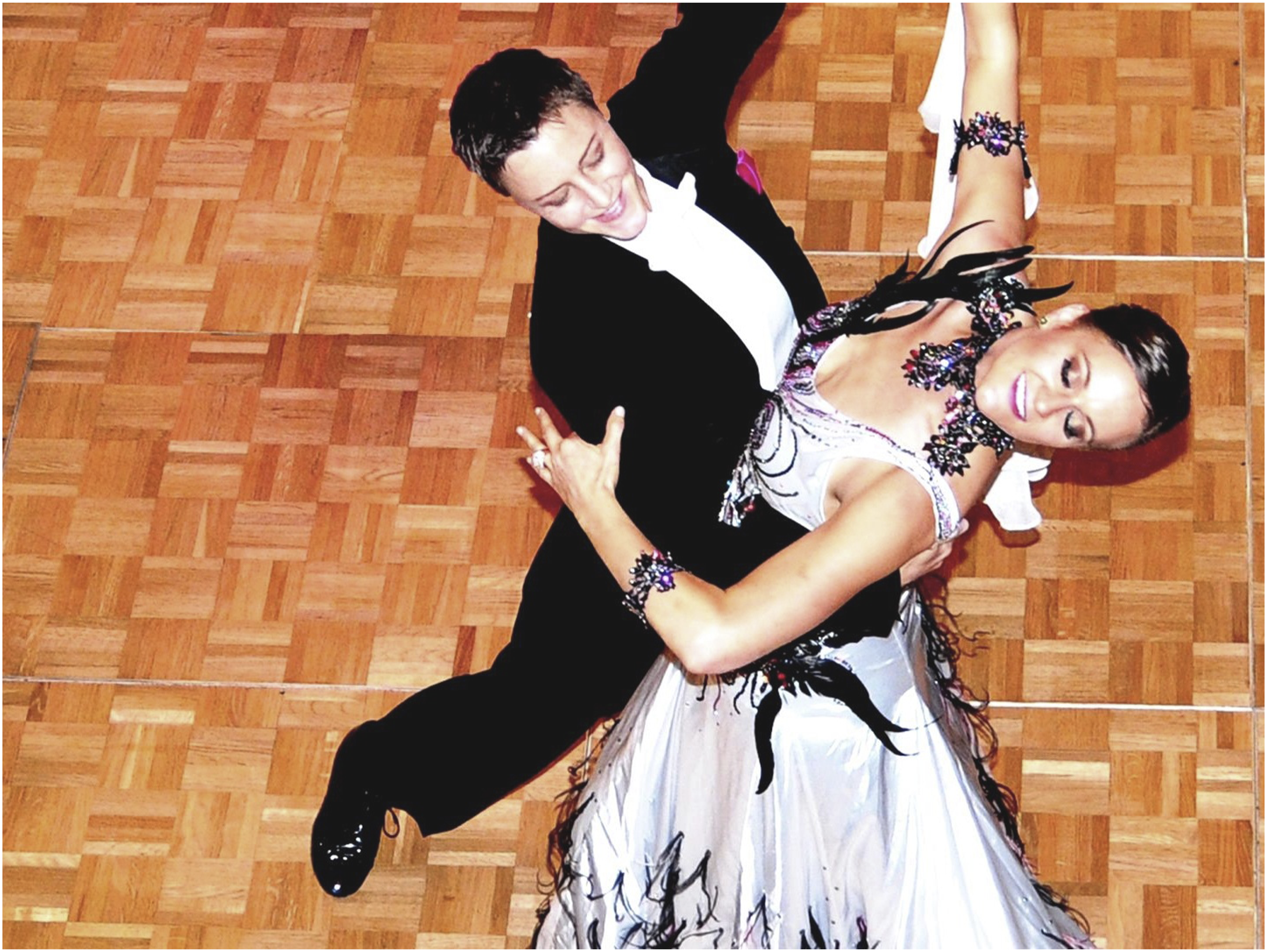


The decision to use researcher curated photographs is motivated by four key benefits. Firstly, using already published pictures avoids issues of privacy and confidentiality in the General Data Protection Regulation (GDPR) relating to the use of photographs with recognisable individuals. Secondly, including some self-generated photographs transcended the need to request for permission from photographers to reproduce photographs for research purposes. Editorial permissions were acquired from Getty Images for other photographs. Thirdly, including self-generated photography opened myself up to multiple perspectives, many of which challenged my visual perspectives and helped me reflect on preconceived notions I may have brought into the research (Harper, 1998, p. 35). For example, what I depicted and celebrated as queer representation disruptive of homonormativity (Figure 5) was to some interviewees a controversial and uninvited change, and to others perpetuating a stereotypical image of a female dance follower. Photo-elicitation supported my constructivist grounded approach, helping me to come to terms with my preconceptions and acknowledge my positionality as an insider researcher. Hearing participants talk about my photographs challenged me to reflect on the subjective processes in which they were produced (Grady, 2004) and recognise my interpretation as one of multiple realities, enabling me to approach the topic with a less biased lens. Fourthly, using artefacts as opposed to participant-generated images ensures consistency across interviews, enabling comparative analysis of perspectives essential for a grounded theoretical approach to data analysis.
Strengths of Photo-Elicitation
First, photo-elicitation was particularly useful for invoking new knowledge about whether and how equality dancers conceptualised masculinities and femininities in ballroom dancing. Whilst interviewees had much room to direct the photo talk towards their areas of interest, discussions often centred around reflections on individual experiences of elements they appreciated or did not identify with, with concepts around masculinity and femininity elicited in the conversations, inviting further exploration of how these concepts are understood and how they shaped dancers’ competitive performance and spectatorship. Allowing participants to shape the content and flow of the discussion facilitated a ground-up emerge of masculinity and femininity as familiar concepts to dancers (Bates et al., 2017). Glaw et al. (2017, p. 1) stated that photo-elicitation enabled extra layers of data to emerge, which reinforced existing data and contributed new insights. In my study, photo-elicitation not only reinforced data I already gathered through autoethnography about the significance of masculinity/femininity concepts in framing the dance thinking of LGBT + equality dancers. It also contributed to the development of new insights around these concepts, in particular distinctions that equality dancers make in relation to traditional and alternative forms of masculinity/femininity, and its perceived relationship to one’s gender or sexual identity.
For example, in Ryan’s (early 40s, male, gay) narration of a photograph (Figure 3) featuring a couple in the female/female dance category, he not only used the terms masculinity and femininity to describe the featured dancers, but provided further elaboration on his conceptualisation of these terms: “I look at this picture and think, great, you got masculinity and femininity, but very traditional roles. Some leaders do identify as being very masculine, or being, I don’t know how these people define their gender or their sexuality.”
Ryan compares the performance of these dancers to the classical dance form to suggest that they are emulating traditional forms of masculinity and femininity. What troubled Ryan’s association of this couple with the traditional is the sex of the dancers and his personal knowledge of them as a female/female partnership. This troubling of the perceptibly traditional led Ryan to further reflect on and unpick the concept of masculinity, in the process decoupling sex from masculine presentation and suggesting that gender and sexuality can also inform different approaches to the materialisation of masculinity. Ryan’s interesting elaboration prompted me to pursue more in-depth questioning throughout the interview about particular characteristics he considered to be traditional forms of masculinity/femininity, whether he perceived there to be alternative/non-traditional forms, what the characteristics of alternative forms could be and whether he felt these were embraced by LGBT + equality dancers on the dancefloor.
Investigating and unravelling the complexities behind individual understandings of masculinity and femininity would have been challenging without a visual medium, not least because these intricate connections which were brought up during photo-elicitation between sex, gender and sexuality may not emerge, The above is evidenced in Sanders’ (2020) study of masculinities and femininities in an Australian football team which reported that presenting participants with photographs through photo-elicitation made the body visible for the exploration of embodiment and affective experiences around sex and gender. Hoskins (1998, p. 6) highlight the affective power of photographs through connecting the viewer to “images, feelings, sentiments, desires and meanings” and life as experienced. In my study, photographs became the interlocutors through its representations of queer aesthetics and non-normative bodies, challenging the “objective truth” (Harper, 2003) established by dominant representations of the classical dance form, which invoked emotions among participants.
For Ryan, perceiving subjects in the photograph as disrupting the normative associations of sex, gender and sexuality invoked feelings of uncertainties and inspired critical thinking on these concepts. This process of critical reflection contributed to new ways of “knowing” and “seeing” (Leavy, 2015) masculinity in LGBT + equality dancers. Initiating a discussion of masculinity and femininity in terms of sex, gender and sexuality in interviews can appear overly academic, potentially resulting in negative consequences of widening the perceived knowledge gap and power dynamics between researcher and participant. Photographs function as Harrison’s (2002) “resource” in terms of widening access to information in different but related subject areas. Visuals create opportunities for participants to identify and bring forth other topics of interest for discussion, with the introduction of these perceptibly complex and scholarly concepts by participants themselves making them more accessible for exploring in interviews, leading into a second advantage of the strategy in enabling a more egalitarian relationship through reducing participant/researcher knowledge differentials (Van Auken et al., 2010).
Photo-talk facilitated in-depth exploration of masculinities and femininities through terminologies initiated by participants themselves, creating opportunities for me to echo their language as I invite them to engage in knowledge co-production of what these concepts mean within the context of equality dancing. Photo-elicitation opened up opportunities for me to “try to figure out something together” with participants (Harper, 2002, p. 23), bringing about a “negotiated understanding” (Heisley & Levy, 1991) through involving participants in knowledge co-construction within a researcher/participant relationship which is less hierarchical than traditional interviews alone. However, I recognise that despite efforts to design a photo-elicitation process which seeks to redistribute power within the researcher/participant dynamic, my control over the study design as a researcher (deciding when photo-elicitation should be introduced, which images to use, how the interview and research questions are framed) can limit the degree to which I centre the interviewee as expert, an aspect Kantrowitz-Gordon et al. (2016) considers to be integral towards minimising the researcher/participant power differential.
Participants were particularly enthusiastic about doing photo-talk, which made conversations flow easily without much prompting from me and allowed for richer discussions. This enthusiasm was particularly pronounced in cases when photographs were introduced at the point where participants hinted at difficulties faced in verbalising dance. Interviewees almost immediately selected a photograph to represent what they were attempting to describe earlier in words, supporting findings (Harper, 2002; Meo, 2010) that visual information triggers different parts of the cognitive system than verbal information, thereby inspiring longer conversations and more interesting interviews. Photographic images invoke viewers to position themselves in relation to the visuals, a phenomenon described by Pinney (2001, p. 158) as “the sensory embrace of images, the bodily engagement that most people…have with art works”. Sensory knowledge invoked by photographs helped my participants to verbalise their embodiments. Further engagement with the rest of the photographs not only facilitated the flow of conversations throughout the interviews, but also motivated participants to refer back to several strands of earlier conversations, pointing out how specific photos depicted those ideas with further elaborations and reflections on their identities and bodily practices.
For example, Laura (late 20s, female, lesbian) described herself to prefer Standard (Waltz, Tango, Quickstep, Foxtrot, Viennese Waltz) rather than Latin (Cha-cha, Rumba, Jive, Samba, Paso Doble) dances, pinpointing the reason to herself having a more reserved personality upon further questioning. However, in the photo elicitation which followed shortly after, Laura was inspired by a photograph (Figure 4) to revisit her comment about preferring Standard dances, further elaborating on the specific qualities of Latin dancing which made her feel less well-acquainted with the dance form: “I mean I guess this [relating to Figure 4] is a really good example of how I say I don’t really enjoy Latin dancing. I think that it is very, like taking up a lot of space, I think that is something that I, like I am still uncomfortable with, the taking up a lot of space in dancing, and being very physically sexy, very exposed. And then the leader as well, very masculine dominant I think, yeah”.
Here, photographs inspired embodied vocalisation (Edwards, 2019), as Laura is not merely verbalising the content of the picture but weaving the descriptive into her personal experience of dancing, highlighting the specific aspects represented in the picture of Latin dancing which she finds challenging to embody. Laura’s narrative presents another example of how photo-elicitation opened up further conversations on masculinity and femininity without prompting from me, this time embedded within self-reflexive narratives of identity expressions. For Laura, feelings of mis-embodiment relating to needing to be overly expressive and physically alluring as a Latin dancer was recognised, acknowledged and verbally expressed after being presented with a visual representation of a Latin dance couple. Laura’s example demonstrates the potential for photo-elicitation to “tap hidden emotions that would otherwise be missed” (Curry, 1986, p. 205), enabling researchers to gain access to information that would not have been revealed through interviews alone. This unique visual aspect that photographs possess which interviews do not (Gauntlett & Holzwarth, 2006), facilitates an interrogation of the complex ways in which dancers think about, sense and construct their social worlds (Rose, 2016), Last but not least, photo-elicitation inspired interviewees to move beyond reflecting on their bodily practices, to question and articulate their assumed knowledge of ballroom dancing as spectators. Researchers (Clarke-Ibañez, 2004; Holliday, 2000; Becker, 2002) point to the power of visual imagery in inspiring rich and open dialogues and reflections about the community. Interviewees in my study found it much easier to discuss, describe and place their personal value judgements regarding styles of movements and costuming through the use of visuals. For example, Sasha (early 30s, non-binary trans, pansexual) was better able to articulate their resistance against heteronormativity through describing what they appreciated in photographs, referring to a photograph portraying a female/female couple in dresses as a style they appreciated: “I love the two dresses, because for me, especially in the Ballroom, we have this look of tailcoat for the leader, and big gown for the follower. You know those couples still look like really classical heteronormative, so it is really nice seeing that”.
Visual imagery facilitated Sasha’s articulation of what they considered to be a distinctive departure from the heteronormative look, that which gives voice to the femme identity and disrupts the binary classical look of ball gown and suit. Similarly, photo-elicitation created room for Raven (late 20s, male, pansexual) to elaborate his perspective on costuming and explore what he meant by himself being “not a fan of heteronormative clothing”. Identifying a picture (Figure 3) of a female leader adopting the classical look as a case in point, Raven added that: “wearing the shoes is really trying hard to be masculine, I think in the clothing. Because this is man’s shoes. But you don’t need to be you know, you can always wear a suit, and then you can have women’s shoes.”
Raven relied on visual imagery to unpick different aspects of the dancer’s costuming choice and make suggestions regarding how further disruptions of heteronormativity could be enacted. Photo talk contributed to thematic development, as the notion of heteronormativity became a theme which was further investigated in later interviews in the study. Photo-elicitation presents a useful tool for the production of queer dance knowledge, as the visual element and open, unstructured nature of the process affords for more holistic understanding of the diverse ways equality dancers understand, enact and embody performances of masculinities and femininities, and its relationship to sex, gender and sexuality.
Negotiating the Challenges of Photo-Elicitation
Despite the multiple advantages offered by photo-elicitation, various limitations prevail, which dance researchers can negotiate to ensure more effective mobilisation of the technique. First, photographs which are produced and curated by the researcher can perpetuate idealised and regulated norms (Bordo, 1993) of ballroom dancers, potentially biasing how dancers perceive the positionality of the researcher and their willingness to share about bodily practices which may deviate from the photographic images provided by the researcher. In my study, I drew on insider knowledge to ensure I selected photographs which were broadly representative of diverse practices and actors in the field. I practiced self-reflexivity to identify preconceived notions and limit their influence on my photography selection (see methodology section). To achieve diverse representations of knowledge from participants, researchers need to adopt a reflexive approach in their curation of photographs or consider other avenues such as participant generated images which presents participants with a photo voice.
Another limitation relates to photography being a limited medium in providing a comprehensive perspective of depicted dancers. Participants commented that photographs only captured a single moment in time and did not illustrate events which followed, making it difficult for them to understand the dance dynamics between the couple. Some participants suggested that videos may be more effective for illustrating and discussing partnership dynamics, as opposed to photographs. The above may explain why most interviewees discussed costuming and dance movements at lengths during photo talks, but focused less on partnership dynamics, which points to photographs being effective only as prompts for investigating the intercorporeal aspects (Allen-Collinson & Hockey, 2016) of partnering. The challenge here extends beyond choosing photographs which promotes the reading of Hagendoorn’s (2004) “apparent motion” such that “an instant photographed can only acquire meaning insofar as the viewer can read into it a duration extending beyond itself” (Berger & Mohr, 1982, p. 89). Participants are not critiquing the lack of a perception of movements in still images, but rather the unknowability of the complete choreographic dance movement through still images, and hence the inability to comment on relational dynamics between dance partners. For example, when analysing the relationship between a dance couple, Alan (late 20s, male, gay) acknowledges his opinion to be based on a single still image and hence may not be a fair judgement of the couple’s performance: “Obviously I am judging from a picture, like one snapshot. But I want more connection.” Whilst Alan pinpoints the absence of an emotional connection between the dance couple as a noticeable weakness, he acknowledges that his evaluation is made based on a specific moment of the performance, a captured moment which may not be entirely reflective of the actual dynamics of the couple across their minute and a half long performance.
Similarly, Sasha (early 30s, non-binary trans, pansexual) identified an uneven power dynamic between a dance couple in one of the photographs but suggests that what is portrayed in one still image may not be representative of the relational dynamics of the couple, since power dynamics between equality dancers can change throughout the choreography. Commenting on a dip movement performed by a female/female dance couple (Figure 1), Sasha states that: “the thing with a photo is you never know what happens in the next minute. You know, maybe in the next minute, they drop them, you don’t know. So it is really hard to have just one step”.
Sasha attributes the dip in dance routines to uneven power dynamics, since the step is traditionally performed with a stronger partner (traditionally male leader) supporting the physically smaller (traditionally female follower) partner who is positioned in an inclined position which attributes more power to the leader. Whilst expressing less appreciation of the perceptibly unequal power dynamics in the dip movement of the photographed couple, Sasha acknowledges that this instance is not indicative of the entire performance, and that there is possibility for a role reversal which would negate their initial judgement of the couple. Photographs have their limitations in facilitating a good judgement of, and hence discussion on partnership dynamics in dance, especially in equality partnerships where dance roles and power dynamics are constantly evolving and interchangeable.
To negotiate this limitation, researchers should be aware that photographs only document a moment in time, and that what happens before, after, or in-between the captured moment is often lost (Persohn, 2015). Since photographs are stills, movements often exist as an interpretation of the viewer than as an element captured in the images (Luttrell & Clark, 2018). Whilst having the potential to facilitate more detailed narratives, researchers need also be aware of the potential loss of affective, embodied information in still images, such as Persohn’s (2015, p. 509) “thoughts, behaviours, emotions” happening across the process of the dance performance. To use photo-elicitation effectively, researchers can constantly reflect on the missing information and question how best ideas can be represented through photography to inspire talk beyond that of physicality, to encompass that of sociality and affect across time. Researchers may consider using a series of photographs depicting dancers across intervals to provide participants with a more holistic perspective, potentially generating more detailed narratives. Garcez et al. (2011, p. 250–251) states that “the proper use of moving image, coupled with the audio, allows capturing aspects that may go unnoticed when other resources are used”. It may be useful to consider integrating other visual methods such as videography when exploring issues relating to partnership dynamics where more movement and dynamism in visual representation is necessary. Blikstad-Balas (2016, p. 512) suggests that video allows for recorded events to be “decomposed” into digestible units, while Garcez et al. (2011, p. 252) add that video is more manipulatable as it allows researchers to replay, skip or freeze moments in time. Rather than relying on photography as the only medium for visual representation, researchers can consider leveraging the strengths of both photographs and videos to elicit more detailed talk, especially when investigating queer partner dancing which is diverse, unique and challenging to capture in single images.
A third challenge I faced in the use of photo-elicitation was the handling of negative comments about known individuals in the equality dance community during and beyond the interview, into the data analysis and reporting phases. During the interview, I sometimes found it challenging to further explore the source of negative comments when these were explicitly made of known individuals in the photographs. Whilst feeling the need to identify the reasons behind these value judgements, I also felt it inappropriate to speak negatively about other dancers without their knowledge and within a research context. This conflict between my desire to question the emotions around negative comments and the ethics of engaging participants in negative talk of known individuals made photo elicitation difficult as an insider researcher. Apart from the interview event, finding a balance between eliminating negative comments in reporting and achieving an accurate, unbiased representation of participants’ opinions was not an easy feat. For example, a negative comment was made about the costuming choice of an individual in a selected photograph: “I think I found it a little uncomfortable, not necessarily entirely the outfit. I didn’t think it did her any favours from her figure perspective, I just thought, no you are showing too much really. So I didn’t like that look myself. But I think a lot of it was to do with I just didn’t think it looked good on her”.
Even though the participant qualified it as their personal opinion, the comment may be considered insulting for the portrayed individual, as such my hesitancy over engaging in further discussion on the issue. However, I also felt it important to understand how such a perspective developed, as I did not feel this to be a case of fat shaming, which is unusual within the equality dance scene. Further exploration revealed two key ideas informing this perspective: (1) perceived heteronormativity of the costuming style which the interviewee was not intrigued about, and (2) a second wave feminist ideology which considered such style to be catering to a male gaze and hence unattractive. Despite the difficulties faced, an unpicking of the participant’s motivations behind making such a comment contributed significantly to better understanding of their viewpoint, a confirmation of the absence of malicious intent, and thematic development during data analysis.
To avoid compromising researcher welfare during photo-elicitation, researchers need to develop mental preparedness and strength in coping with negative talk. Cronin and Gale (1996) draw our attention to how photographs can trigger memories and emotions, while Reavey (2011) points to the use of photography in interviews as having the potential outcome of awakening embodied states of one’s past. Researchers need to be aware of the deep emotions that photographs can evoke, so they can engage interviewees with a non-judgemental stance. Rather than avoiding or negating negative comments of photographic depictions, researchers need to value them as emerging from participants’ embodied experiences, tactfully unpicking and examining the motivations behind participants’ value judgements, regardless of whether they align with the researchers’ viewpoints. The above is necessary also as a duty of accountability towards participants. It is through the acknowledgment of both positive and negative opinions, sentiments and experiences that photo-elicitation can provide a holistic picture of the social phenomenon in question.
The fourth and final challenge relates to the unpredictability of successful engagement with participants through photo elicitation. Across my 35 interviewees, photo elicitation was much more successful than traditional interviews in evoking detailed narratives from some than others, and this depended on interviewee characteristics. Several participants who found photo elicitation difficult identified two key challenges: (1) the open-ended nature made them feel at a loss and uncertain about what they should focus on or comment about, and (2) they are not someone who appreciates photographs and find it difficult to visually analyse and verbalise about images. With these participants, I flexibly transited back into the traditional interview which they were more comfortable with, as I consider it important to engage in an interview style preferred by participants to enable some control over the process and a comfort zone to share personal experiences. Persisting on photo elicitation would be futile since it was unable to fulfil its purpose of evoking thorough narratives.
Despite presenting a creative approach to inclusive research (Rose, 2016; Wagner, 2011), researchers need to be realistic about what the inclusivity afforded by photo-elicitation encompasses. I illustrated how photo-elicitation was a double-edge sword, offering greater inclusivity to some and exclusion to others who may not have developed similar visual processing skills or comfort with unconventional strategies. Existing studies documented the unsuitability of photo-elicitation for some individuals, such as those who communicate with means other than verbal language (Cheak-Zamora et al., 2016; Eisen et al., 2019; Nicholas et al., 2019), or find it challenging to represent ideas or relationships in images (Ha & Whittaker, 2016; Shumba & Moodley, 2018). Researchers need to be sensitive towards the diverse capabilities of participants, integrating photo-elicitation with other methodologies such as traditional interviews to ensure individuals are not excluded due to discomfort with unconventional methodologies, either by researchers or through self-exclusion.
Conclusion
This study presents novel insights into the affordances of integrating photo elicitation into in-depth interviews in dance studies. Drawing on findings from and reflections on the photo-elicitation aspect of my ethnographic study on LGBT + equality dancing in the United Kingdom, I demonstrated how the strategy enabled me to develop multiplicities of in-depth perspectives (Nash, 2014) on dancers’ experience of their dancing and spectating bodies, which supported my constructivist grounded approach. Queer knowledge co-produced during photo-elicitation informed the ground-up emergence of themes (e.g. masculinity, femininity, heteronormativity, costuming, second-wave feminist) which disrupted the binary masculinity/femininity divide emphasised in existing Dancesport scholarship. Relating back to Harrison’s (2002) distinction between “topic” and “resource,” this study demonstrated how photographs not only facilitated an examination of the visually documented subject of body work among LGBT + equality dancers (topic), but also inspired conversations around other topics of concern to dancers themselves (resource) such as heteronormativity, partnership dynamics, queer intimacy and the male gaze. Using photographs in dance research demonstrates efforts by researchers to connect with dancers through tools they are familiar with, potentially facilitating the development of more egalitarian researcher/participant relationships. Blurring the boundary between researcher and researched promotes fluid narration of the embodied and performative dimensions of genders and sexualities which inhere in participants’ lived experiences of dance. Since visuals have the power to connect viewers to other senses beyond the cognitive, participants’ narratives are often detailed and affective, contributing to rich data for theoretical development in grounded theory. Last but not least, photographs position dancers as = spectators which inspire reflections on the dance community and other dancers. Such reflections promote an understanding of the intercorporeal, in particular of performances, practices and perspectives which are valued, providing a holistic understanding of the socio-cultural context within which gendered and sexual bodies are materialised. This study highlights the potentials of photo elicitation in supporting knowledge production through the lens of dancers and acknowledging the more diverse gender and sexuality expressions in our contemporary dance world. In view of the benefits, I call for greater integration of visual methodologies into dance studies which is not strictly about queer subjects, researchers or topics.
I propose three recommendations for the effective mobilisation of photo-elicitation. First, researchers need to recognise the limits of inclusivity offered by photo-elicitation, practicing sensitivity to ensure participants are comfortable with the strategy and flexibly switching to other methodologies such as traditional interviews when participants struggle with photo talk. Second, researchers might consider integrating photographs with other visual materials (e.g. video) when investigating intercorporeal aspects of dance partnership dynamics, which are diverse, everchanging and challenging to capture in individual images. Researchers can then leverage the strengths of different visual tools to inspire detailed talk across a broader range of topics. Third, researchers may consider training to develop mental preparedness so that they can explore both positive and negative opinions, sentiments and experiences during photo-talk, to enable holistic understanding of the lived experiences of dancers.
Footnotes
Acknowledgments
I thank Prof. Carolyn Pedwell (University of Kent) for comments on the manuscript. I would also like to extend my thanks to equality dancers in the United Kingdom who have generously contributed rich narratives of their lived experiences of becoming a competitive equality dancer.
Declaration of Conflicting Interests
The author(s) declared no potential conflicts of interest with respect to the research, authorship, and/or publication of this article.
Funding
The author(s) disclosed receipt of the following financial support for the research, authorship, and/or publication of this article: This work was supported by the UK Research and Innovation (ESRC Case ES/X007014/1).
