



Abstract
The field of ecopsychology focuses on the affective relationship between individuals and nature that is based on the premise that what individuals love and care for, they will protect. There is however a methodological gap within the field of ecopsychology that relates to the qualitative exploration of the human-nature nexus. Elicitation techniques are a popular method used for exploring subconscious processes or to engage participants in a subject that might seem abstract such as affect towards nature. Currently, there exists no methodological guideline on how to develop a picture elicitation technique to explore the human-nature nexus and there is no technique to assist with this exploration. This article describes the methodology used to develop the Nature Nexus Elicitation Technique to enable the tacit exploration of the affective relationship that individuals have with nature. Six phases of the elicitation technique development are explained. The phases included a Systematic Literature Review, parallel study conducted online (N = 43), emergent category validation, technique visual development, feasibility testing (N = 5), and technique use (N = 44). The results show the technique development processes as well as the output which is a range of cards that cover human-nature expressions that include intimacy, empathy, engagement, ambivalence, apathy, and alienation.
Introduction
Visual research methods (VRMs) are psychologically constructed procedures that use a visual representation in order to unearth the depth of a specific phenomenon contained within the psyche. Elicitation methods have been used in psychology following the work that Freud conducted on paranoia in 1911. Since then, the development of elicitation methods has notably included the Rorschach Ink Blot Test and the Thematic Apperception Test (Boddy, 2005; Donoghue, 2000). An elicitation technique is defined as a set of visual triggers that use an indirect approach to elicit responses from participants that potentially have an unconscious source (Will et al., 1996). An elicitation technique aims to access unfiltered perceptions and feelings by projecting it onto images which enables the researcher to explore hidden meanings not accessed in everyday life (Donoghue, 2000; Porr et al., 2011). Elicitation is seen to provide different insights compared to interviews that use the spoken word alone (Pless & Katznelson, 2020; Roger & Blomgren, 2019). There are different types of visual elicitation techniques: association (picture impressions), completion (picture completions and mind mapping), expression (drawing) and collection (collect pictures and comment) techniques (Comi et al., 2014).
Individuals increasingly have difficulties in expressing their feelings about nature due to the growing disconnect from nature in society. The disconnectedness from nature is due to aspects such as westernisation/economic development (Lovelock, 2006; Pope, 2011; Roszak, 1992; Shepard, 1982), repression (Adams, 2005; Yunt, 2001), dissociation (Swim et al., 2009), sensory deprivation (Kaza, 1993), religion (Gifford & Nilsson, 2014; Pike et al., 2008), individualism (Frantz et al., 2005), psychological distance from the climate crisis (McKinnon, 2009) and colonisation (Salih & Corry, 2020). There is a need for a VRM elicitation technique when studying the human-nature nexus in order to make it easier for researchers to access information and feelings related to nature that might be hidden in the depth of the psyche within the unconscious.
Elicitation Techniques
A psychologically constructed elicitation technique has the main benefit of using a visual representation in order to unearth the depth contained inside the psyche and help individuals make sense of complex or abstract ideas where words alone cannot express or explain the phenomenon (Copeland & Agosto, 2012). Other benefits are the ability of these techniques to explore hidden attitudes and feelings (Donoghue, 2000), allows for multiple interpretations (Basu, 2014), encourages participants to express their experiences, allows for emotional engagement (Comi et al., 2014), reduces social desirability, increases cognitive access (overcomes bounded rationality) (Bond & Ramsey, 2010), is less intrusive for participants in that they are under less pressure compared to direct questioning (Will et al., 1996), interviews tend to be richer (Meo, 2010), it allows for the expression of values, provides access to sensitive topics (Donoghue, 2000), provides an organising framework for data analysis (Comi et al., 2014), and has the ability to activate memory recall (Wheeldon & Faubert, 2009).
Although there are benefits to using elicitation techniques, they are said to have questionable psychometric properties (Lilienfeld et al., 2000). To address this issue, Comi et al. (2014) maintain that the data collected from elicitation techniques are complex and should be integrated with information gained from an interview in order to ensure accurate interpretations. Therefore, the interpretation of elicitation techniques can be seen as subjective, and therefore it needs to be combined with participant commentary to understand the meaning for the participants and to reduce misinterpretation by the researcher (Copeland & Agosto, 2012), which in turn increases validity.
Another shortcoming is limited methodological information on how to develop a visual elicitation technique. Westphal (2007) described developing a clinical projective test aimed to assess experience of attachment in middle childhood. The process started with pencil drawings inspired by scenes from children’s books and then trialled for their appropriateness and effectiveness. The data were used to build a coding framework grounded in theory, and then the pictures were amended based on their ability to elicit internal representations. Thereafter, the technique was piloted with a non-clinical and clinical sample (Westphal, 2007). Porr et al. (2011) developed an elicitation technique in four phases to facilitate the design of a logo. Their phases consisted of emotional exploration by open-ended questions with embedded images, a sentence completion task, development of themed visuals around the emergent information and finally collation of all the information into the construction of symbolic visuals from which a logo emerged. Other studies generally demonstrate the use, rather than the development of elicitation techniques, such as graphic elicitation (Copeland & Agosto, 2012), participant-directed photo elicitation (Pless & Katznelson, 2020 and participatory visual approaches (Roger & Blomgren, 2019).
Understanding People’s Connection to Nature
The affective relationship that individuals have with the natural world is varied (Baillie, 2003; Hinds & Sparks, 2009) and critical in shaping beliefs, values and attitudes towards the environment and impacts behaviour (Kollmuss & Agyeman, 2002; Ojala, 2012). Although there are studies that explore one’s connection to nature (Capaldi et al., 2014; Clayton et al., 2013) and quantitative measurements (Frantz et al., 2005; Perkins, 2010), one existing gap is the in-depth exploration of nuanced differences in ‘connection to nature’ that surpasses concepts linked to attitudes and behaviour. Current cognitive and affective quantitative measures include commitment to the environment (Davis et al., 2009), connectedness to nature (Mayer & Frantz, 2004), emotional affinity toward nature (Kals et al., 1999), environmental identity (Clayton et al., 2013) and inclusion of nature in self (Wesley Schultz, 2001). Some researchers have identified different types of relationships, but they are reductionistic and attitudinal, structured around prioritising self versus others versus nature (Kortenkamp & Moore, 2001; Liu & Lin, 2014; Wesley Schultz & Zelezny, 1999). There is a need for a qualitative elicitation technique that could be used to understand the deeper affective processes involved in different types of relationships individuals have with nature.
Research Aims
To address the dearth of methodological information regarding the development of a visual elicitation technique to explore the human-nature nexus, the aim of this article is to demonstrate the process of technique development using deduction, followed by its application. The next section will describe the methods used during the six phases of the elicitation technique development: Systematic Literature Review (SLR), parallel qualitative online study (N = 43), emergent category validation, technique visual development, feasibility testing (N = 5) and technique use (N = 44).
Method
Ethical clearance (number H15/11/15) was granted unconditionally by the University’s Human Research Ethics Committee (non-medical). A concurrent triangulation method was used as it allows the researcher to validate the findings generated by each phase through using evidence produced by one phase to inform the next phase. Figure 1 shows the analytical framework used for the six phases of the study. Summary of the overall deductive approach to develop the Nature Nexus Enabling Technique.
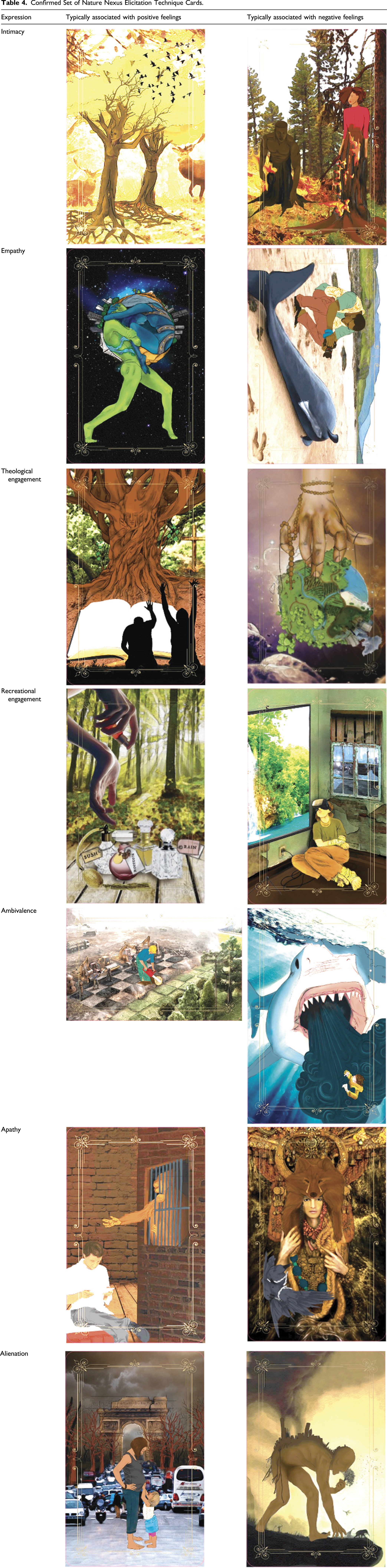
The research process started by conducting the first two phases (SLR and a qualitative study) in parallel. The SLR identified six categories, namely, intimacy, empathy, engagement, ambivalence, apathy and alienation. At the same time a qualitative study was conducted online with 43 participants that gathered initial participant data to compare and validate the emerging SLR categories, as well as provide textual and symbolic data to be used for visual card concept design. The third phase included category confirmation, reduction, or expansion and identification of visual representation for each category. Based on these findings, phase four included the development of 14 pictures through numerous iterations. A new set of pictures was developed (rather than using existing ones) in order to ensure no copyright infringement and that they each had the same expression, style and colour scheme to avoid participants choosing a picture that might be clearer or printed brighter. In this way, each elicitation picture had the same chance of being chosen by the participant. Phase five consisted of a quantitative feasibility survey that included open-ended questions amongst five environmentally oriented psychologists/practitioners in order to test the ability of each picture to be descriptive, usable, understandable and able to elicit relevant affect. Based on their feedback, 10 pictures were confirmed, two were amended, two were deleted and two new replacement cards developed. Phase six consisted of using the final set of pictures during 44 qualitative interviews that explored individual’s relationship with nature in order to test the enabling ability of the technique.
Phase 1: Create Categories and Themes using a SLR
A systematic literature review was used to find relevant literature in a transparent, unbiased and rigorous manner (Ropret Homar & Knežević Cvelbar, 2021) to create categories. The scope of the review was to understand the human-nature nexus from an affective, cognitive and intrinsic perspective. A five-stage grounded theory SLR method (define, search, select, analyse and present) proposed by Wolfswinkel et al. (2013) was used as a guide since it is inductive, allows salient concepts to emerge from the literature, insights can be taken to the next level of research and is at an overall level concept-centric. While using this specific grounded theory SLR method, PRISMA guidelines were consulted (Fleming et al., 2014; Liberati et al., 2009).
Literature Search and Selection.

Categories and Sub-Categories.

During the SLR, an overlap emerged between the idea of intimacy and empathy in relation to nature. They were often described as integrated concepts because they contained similar constructs in that to be intimate with nature, one could assume that there was a degree of empathy present. However, an intimate relationship with nature emerged more strongly as containing interdependent and selfless qualities versus empathy, which in comparison emerged as more dependent and potentially non-altruistic. Herbert (2014, p. 30) described the difference between empathy and intimacy as: ‘It is easiest for us to recognize consciousness in the forms of life with characteristics most familiar to us, but the reach of intersubjectivity can extend far beyond our anthropocentric perceptions of consciousness’. In transcendental phenomenological work, the idea of subjective self-awareness intimacy is described as state of intersubjectivity and interdependence where there is a lack of experienced boundary between the person and nature (Herbert, 2014; Martin, 2004; Silvia, 2002). Intimacy with nature coincides with Wesley Schultz’s (2001) self-expansion theory, ecological self (Bragg, 1996) and Shamanic ideology which recognises that there is an inclusion of nature in the self-concept and social identity (Winkelman, 2013) that shows commitment to nature. The category of intimacy emerged under the condition that nature was sacred and with spiritual value (Kamitsis & Francis, 2013; Martin, 2004; Trigwell et al., 2014) as can been seen in some Indigenous cultures (Salmón, 2000). This aligns with Puhakka (2014, p. 12) who described intimacy as ‘that mysterious, delightful, at times dreadful interweaving of two that are of one essence’ and which elicits the awe emotion (Yang et al., 2018). Included in this concept is that humans are part of an intricate system and that there is a sense of oneness and emotional closeness with nature, with embodied experience that recognises the sentience in animals, plants, landscapes and air (Herbert, 2014).
Dispositional Empathy with Nature is a tendency to understand and share an emotional experience with the natural world (Tam, 2013) and can be characterised by moral expansion (Crimston et al., 2016). People with an empathic relationship with nature are likely to show compassion towards and possibly anthropomorphise nature and animals (Lumber et al., 2017; Tam, 2013). Anthropomorphism has the potential to influence conservation behaviour (Lokhorst et al., 2014; Maguire et al., 2020; Tam, 2013) because it involves the attribution of human characteristics, emotions or intentions to nature and animals (Martin, 2004; Wesley Schultz, 2001). This affinity towards nature can evoke feelings of guilt or anger towards others that degrade the environment (Kals et al., 1999). Empathy is not induced by self-other merging (as in the case of intimacy) and rather is explained by perspective-taking that is to say, to put yourself into the place of the other (Wesley Schultz, 2001). Perspective-taking is associated with feelings of compassion, tenderness and sympathy but could also be described as non-altruistic in that being concerned about the protection and survival of nature could at the same time indicate concern about one’s own survival (Cialdini et al., 1997).
Martin’s (2004) category of travelling through nature emerged in the category of recreational engagement that included a degree of concern that was not necessarily empathic nor altruistic, but a concern to protect nature for the benefit of oneself and a sense of moral obligation. This relationship was categorised by having an interest in nature that motivated experiencing nature and gathering knowledge, but it was neither intimate nor empathic (Kals et al., 1999). A second theoretically emerging category was theological engagement that described man and nature as separate creations of God and was entrenched in Cartesian dualism (Capra, 1996). Hoffman and Sandelands (2005) created a concept called Theocentrism, which is an environmental expression of religion that advocates values such as humility, respect for God’s creation and responsibility. This type of relationship was categorised by population growth encouragement and also to engage with nature as a creation of God. One has to respect nature because it is created by God and also one can connect with God through experiencing nature. Religion may be negatively associated with feelings of connectedness to nature (Vess et al., 2012).
Ambivalence emerged as a relationship with nature that was inherently contradictory where humans were seen as from nature, but at the same time superior and separate (Hoggett, 2020). Ambivalence was also expressed through binary antagonism (Baker, 2013) which is that the earth is experienced as generous yet vindictive. This relationship with nature was expressed by the view that humans were both part of and yet isolated from nature while perceiving the ‘otherness’ of nature (Pointon, 2014). In order to deal with the anxiety experienced by this ambivalence humans split, deny, repress, project or destruct. Splitting occurs when one thing that is known in a part of the mind is unknown to the other, and later the splitting progresses to a state where things that are connected are experienced as disconnected (Randall, 2005). This category was characterised by, for example, the denial of the relationships between consumerism and depletion of natural resources. It could also be expressed when people attribute the environmental problems as caused by somebody else or that somebody else will solve the problem (Randall, 2005).
Apathy towards nature is where a person is conscious of what is moral and right but lacks the empathy to adjust their environmentally destructive behaviour (Puhakka, 2014). The ego-centric view of self-enhancement could describe this category in that people with this type of relationship to nature did not define other people or other living things within their boundary of self and therefore had less biospheric concerns (Wesley Schultz, 2001). Therefore, there was disinterest, abandonment or lack of concern as seen in their emotional distance from nature (Simms, 2014). The idea of Nature Deficit Disorder is one that overlaps with both apathy and alienation (Louv, 2012). Individuals with an apathetic relationship with nature were likely to show behavioural intent, only in instances where they would directly benefit from their actions (Warner & Diaz, 2020).
Disconnection from nature at its most extreme could be called alienation or isolation (Martin, 2004) characterised by extreme dissociation (Swim et al., 2009), chronic distraction, sensory shutdown and objectification of self and others (Puhakka, 2014). This degree of disconnection was reflected in anthropocentric ways of objectifying nature, spending most of the time indoors and forming complex relationships with man-made objects (Herbert, 2014). This lack of connection was linked to narcissistic traits such as exploitativeness, entitlement and objective self-awareness (Frantz et al., 2005). The self was experienced as autonomous with no emotion towards nature (Silvia, 2002). The experience of the natural world is likely to be alien as the person would be unable to understand the consequences of his/her actions (Stone, 2014).
Following the SLR a qualitative study was conducted online to validate the emerging categories and to explore visual and textual expressions of the relationship that individuals have with nature.
Phase 2: Exploring the Human-Nature Nexus
In order to be able to test the validity of the emergent SLR categories as well as gain an understanding of visual expressions for the cards, primary data were collected using an online research tool (https://www.surveygizmo.com) to source both textual and visual data. Participants were recruited primarily using social media. As remuneration for time and effort, participants who completed the questionnaire were entered into a lucky draw, which formed part of a larger study.
Participants were asked to complete demographic questions and then upload one picture that represented ‘what they think, believe, feel, and how they see nature’. This question was positioned first to get a spontaneous visually representative idea of their relationship to nature. After uploading the picture, participants were asked to describe in words their thoughts, beliefs, visualisations and feelings that they associated with nature in the picture they chose to upload.
In total, 43 responses were gathered of which 34 completed both textual and visual responses, eight participants provided only textual responses (included in analysis), and one participant only provided a visual response (excluded from analysis). 25 participants were female and 18 were male. Most participants were from Johannesburg, Cape Town, and Pretoria (all large metropolitan cities) and surrounding areas with the majority of participants (81.4%) indicating they were Christian.
Phase 3: Validate Categories
Phase 3 consisted of combined textual and visual content analysis (Mayring, 2000) of the data gathered in phase 2 and then matching it to the emergent categories from phase 1. Deductive category application was applied by using the derived categories and connecting them with the text and visuals. All pictures and texts were analysed and assigned by looking at the emergence of the most codes in a particular category. Not all codes had to be present for a text and visual to be allocated to a particular category.
Based on the analysis, there emerged two overarching dimensions that underpinned the categorisation. These were the degree to which people were connected to nature and whether they saw nature as being/subject or doing/object. These two dimensions were used to develop a matrix on which to plot the emerging visual themes. The matrix provided a visual analytical tool to understand what the pictures and ideas had in common and also assisted in collectively suggesting a unified idea for the development of visual expressions for that category. Figure 2 shows the matrix (phase 3), grouping some of the pictures from participants (phase 2) and categories (phase 1). Connectedness to nature matrix, pictures, categories.
This analysis showed that the six emergent SLR categories were confirmed and as suspected, the engagement category produced two dimensions, namely, theological engagement and recreational engagement. The qualitative study also showed that each category can have a positive or a negative expression that needed to be considered during the development of the set of pictures.
Phase 4: Develop Set of Pictures
A set of pictures were then developed using creative inputs, namely, the categories (phase 1), pictures and text that emerged from the participant data (phase 2). The visual groupings in the matrix confirmed that both positive and negative aspects emerged for each category where associated emotions, experiences or relationships needed to be considered. As such, the card categories were developed to have both a positive and negative expression to provide the participants with more options for self-expression relating to their relationship with nature.
An independent artist was commissioned to artistically design the set of elicitation pictures using the categories and sub-categories, matrix, and participant visual and textual data as a guideline. The artist was briefed to design two pictures per category with one picture representing a positive expression of the category and one picture representing a negative expression of the category. Unlike the other categories, engagement had two sub-sections (recreational and theological engagement) that had to be briefed as two separate categories for card development because the underlying components emerged as distinct. The artist provided the primary researcher with artistic impressions which were evaluated across four iterations and amended based on (1) their ability to express the categories in a manner that incorporated aspects of the participant data; (2) their ability to be interpreted in different ways; (3) being creative and distinctive and (4) ability to elicit a meaningful affective response.
After the iterations and cross-checking creative outputs with categories and participant data, 14 cards were finalised for the next phase of the research.
Phase 5: Test Feasibility of Picture Set
Following the development of the pictures, an additional survey with professionals (N = 5) in South Africa, Italy and Uruguay (psychologists working in environmental and ecopsychology) was conducted to test the ability of each picture to be descriptive, usable, understandable and enabling. Based on these results, pictures were confirmed, amended or deleted from the set.
Cards Deleted and Amended.

Confirmed Set of Nature Nexus Elicitation Technique Cards.
Phase 6: Using the NNET
The final phase consisted of in-depth interviews that were conducted (N = 44) in order to test the usability of the cards to elicit responses regarding the relationship that individuals had with nature. The NNET usability was determined by its ability to get participants to talk about the abstract concept (their relationship with nature), its ability to displace the focus of the interview onto the external stimuli, and to surface ideas that might often be implicit (Barton, 2015).
Participants volunteered to participate in in-depth interviews as part of a larger mixed methods project. The interviews were on average an hour in length.
Cards Chosen during Qualitative Fieldwork.

The main finding from testing the usability of the NNET in the in-depth interviews was that although each card was developed from an emerging category (which was used to develop the set initially), these categories were not absolute since a card that was developed to represent intimacy might represent alienation for a participant when listening to their verbal elicited response. This was often the case for individuals who had an intimate connection with nature. Because of their affect and connectedness to nature, they were aware of how they are also alienated from nature because of being a human. For example, one participant said: Participant: I suppose it is an individual. Researcher: Tell me about that... Participant: Look, I’m under no illusions on the impact that I’m having on the world...like no ilusions whatsoever. I’m hugely wasteful doing very little to actually do anything positive about it. Researcher: Could you describe what you see? Participant: It’s sort of an individual, I suppose who’s caricatured as civilisation; a human figure bending over with sort of a mass of factories and civilisation blowing smoke off his back while he’s busy consuming sort of the natural world beneath him. I fear that’s me, in a nutshell. I don’t really do enough about it. I live in a block of flats. The only way I can touch the ground is by every morning, I go out and walk in a park. Otherwise, I buy all my food in plastic. I don’t grow any of my own food. I’m not a vegetarian, by any stretch of the imagination. Unfortunately, I don’t really have enough money to be able to buy, basically, reared meat. Whether there’s sort of any logic in that statement itself is another story. I’m a mass consumer like everyone else.
The interviews also showed that the NNET was able to assist participants in making meaning about their relationship with nature as is the case with one participant who chose theological engagement: Researcher: What does it tell us about your relationship with nature? Participant: Here it talks about people who are appreciating nature and then what God gave them. So, they are giving thanks to Him. They are praying. They’re saying ‘Thanks for this universe. Thanks for the trees that you gave us. Thanks for everything that you gave us, because, even, these buildings and stuff is the wisdom that has been impacted on the people to do it and to create and everything. These are trees that give them the shade when it’s sunny. That’s where they need to appreciate and thank God for it. Maybe, also, if it has fruits, it gives them fruits. If it’s raining, then, it’s still going to give them the shelter. Researcher: How do you feel about nature? You’ve chosen this card with the Bible and the tree. When you think about your relationship with nature, what comes to mind? Participant: Sometimes you look and then wonder ‘how did this happen? How did God create this?’ Having those questions. It gives you this thing of saying ‘You need to be very thankful for everything’, and it’s amusing. It makes you wonder how this happened, because even when you look at the creepiest animals, or the creepiest things that are crawling, and the things that are in the ocean, you say ‘and, this one, and He chose, specifically, to do this one, also’. It’s, just, amazing.
Ambivalence would be a topic that participants would normally find difficult to express (Will et al., 1996), but using the NNET, one participant was able to describe the relationship as: Participant: I think this one I identify very strongly to nature because it links to a lot of what I feel in terms of, obviously, the right-hand side with the beautiful nature area is something that I’m drawn to. That’s something that’s quite precious. It looks kind of like where I grew up in terms of the forest, and the grain fields kind of, and, obviously, the other side represents the way we live now, and is it sustainable and, maybe, the guilt in terms of what’s going on. There’s a lot going on there, but it wouldn’t be enough for an individual, like myself, to make any difference in that picture, necessarily, unless, I tie myself to a tree. Researcher: What more comes up for you? Participant: Then, obviously, the contrast and the follow-on between the two and, maybe, anxiety from that because of the pace of the left-hand side, and of being, I mean I think they’re fine in terms of their impact. Down in [x] where I grew up in a small town, there is the forest which was planted, though, to be cut down eventually by the [x] Recycled Paper Pulp Factory. They tend to be fine, I think, in terms of their environmental impact. Anyway, where I grew up, there was a factory with lots and lots of different huge trees, and lots and lots of different smoke and steam coming off it, literally, next to the forest which they cut down. So, I personally identify with it, as well. There are various sort of things I can interpret why I identified with this, probably, for the reasons, I just said. Researcher: Would the [x] Forest be nature? Participant: I’d say so, because, although, they were constructed as such, there’s nothing going on in there besides when they come to chop down the trees, necessarily, but, they do [have] quite a lot of vegetation. There’s nothing going on there that wouldn’t, maybe, it’s curated nature, but, it’s pretty natural. I know that they have wildlife in there, very quiet, and lots of bird life in there, that sort of thing. It’s more about the contrast between it’s going to get influenced at some point versus, still, maybe, at some point.
Through focussed probing, the interviewer was able to move from asking a question to elicitation using the NNET as a methodological guidepost bringing responses and probes back to the NNET and moving backwards and forwards towards and away from the technique throughout the interview.
The results show that all cards in the NNET had the ability to be selected by participants to elicit responses regarding their relationship with the natural world. Interestingly the empathy and apathy cards were least often selected to represent a relationship or the opposite relationship. This could just be an artefact of the sample. Using the NNET in in-depth interviews showed that participants were able to use the cards to explore their relationship with nature.
Conclusion and Discussion
Discussion around elicitation techniques is few, especially on how to develop them in a methodologically rigorous way (Barton, 2015). The aim of this article was to demonstrate the development of an enabling technique (using concurrent triangulation) that could be used during in-depth interviews to explore the human-nature nexus. The article builds on existing methodological knowledge (Alshenqeeti, 2014; Creswell, 2003; Lamont & Swidler, 2014) by describing the in-depth process that can be followed for the empirical development of a visual elicitation technique in the field of ecopsychology, that to our knowledge has not been published before. The value in following the process described in this article is that it is rigorous, transparent, uses different streams of methodological information and is developed with a specific phenomenon in mind. This phased process also demonstrates the difficulty in exploring the human-nature nexus as it is an abstract concept that often invites trite answers such as to profess to be environmentally conscious when individuals actually aren’t. Exploring the human-nature nexus is a complex task that requires methodological innovation.
The NNET also has the potential to add methodological value to the interviewing process as it enables the researcher to move beyond socially desirable answers that do not address underlying components (affect, childhood experience, subconscious conflicts, antagonism, etc.) that influences the human-nature nexus. The technique also provided a grounding position for reflecting and redirecting the discussion during the interviewing process.
Although the NNET has the potential to be an important methodological tool for researchers hoping to elicit deeper and more subconscious processes related to the human-nature nexus, some limitations need to be considered. The NNET, although tested with international experts, will need to be validated with the general public in other countries before it is used as a research tool to ascertain cultural and other population nuances. Furthermore, there is a need to conduct a comparative study with a control group that does not have access to an elicitation tool in order to establish the degree to which the NNET is able to provide deeper and more meaningful insight, acknowledging that the accompaniment of an in-depth interview is needed for interpretation of the NNET. On a more practical level, individuals who are colour-blind or struggle to see form could find the use of the NNET challenging.
Finally, researchers would benefit from following our methodological process for the development of an elicitation tool because of the rigorous approach and testable outputs. This process adds to methodological literature as it explicitly describes how to develop a tool of this nature which currently is missing in the literature (Barton, 2015; Copeland & Agosto, 2012; Pless & Katznelson, 2020; Porr et al., 2011; Roger & Blomgren, 2019).
Footnotes
Declaration of Conflicting Interests
The author(s) declared no potential conflicts of interest with respect to the research, authorship, and/or publication of this article.
Funding
The author(s) received no financial support for the research, authorship, and/or publication of this article.
