



Abstract
As scholars in social sciences and humanities explore new methods for studying increasingly digitized societies, electronic research methods—such as email interviews—have moved from marginal complementary activities to, depending on the purpose of the study, potentially becoming primary methods. However, while there is no lack of discussion on the advantages and disadvantages of such methods, there is little guidance in the literature in terms of how electronic methods can be used effectively and productively in qualitative research. This article adds to the existing body of literature by outlining a strategy for email interviews. The argument of the article is that email interviewing can be fruitfully combined with explorative interviewing, offering the researcher a way to strategically work with the extended time frame that asynchronous interviewing brings with it. This gives the researcher an opportunity to work with open-ended introductory questions, follow-up questions, and cross-fertilization of multiple interviews carried out simultaneously. The article brings forward the argument that a methodological strategy that combines email interviews and explorative interviewing can help the researcher draw the moment of surprise closer together with the moment of analysis and thereby challenge existing theories and knowledge of the study object. The argument is illustrated through examples from an ethnographic study with no in-person elements. Additionally, the article acknowledges that email interviewing is necessary for some significant research tasks and in some cases even a more suitable option than traditional in-person methods due to the study’s objective and the nature of its participants.
Introduction
For contemporary researchers, a range of different methodological options are available when developing their research design—including electronic research methods. Electronic research methods have become even more relevant for researchers in the context of the COVID-19 pandemic (Lobe et al., 2020; Teti et al., 2020) and of climate change. In the light of such conditions, some qualitative researchers are re-thinking research that includes in-person meetings or traveling, while others strive to conduct “sustainable science” (Santana et al., 2021) through a more resource-effective research design. Additionally, the societies that social sciences and humanities study are increasingly taking place in digital environments and, in such studies, in-person research methods might not always be ideal. These conditions point toward the need to further explore electronic research methods, not only as complementary to more traditional methods (e.g. Flick, 2020) but as methods that are valuable on their own merits.
In the literature on electronic research methods, there is little discussion of strategies for how to use such methods effectively and properly for certain research purposes (Airoldi, 2018; Caliandro, 2018). For example, it is rare to come across guidance for how to develop approaches for, and practically engage in, electronic research methods. Little is also known about how such methods might be applicable in relation to different purposes of qualitative studies. This is important since a study’s methodological choices and objectives are interdependent. To shed light on some of these raised concerns, there is a need for reflexive accounts of researchers’ experiences of using solely electronic research methods.
This article adds to the existing body of literature on electronic research methods by zooming in on email interviewing, and outlining a strategy for how email interviews can be used to generate in-depth and rich qualitative data, specifically in explorative studies. The argument of the article is that email interviewing can fruitfully be combined with explorative interviewing, offering the researcher a way to strategically work with the extended timeline that comes with asynchronous interviewing. Outlining a strategy that utilizes open-ended introductory questions, follow-up questions and cross-fertilization of multiple interviews carried out simultaneously, the article argues that email interviewing can be a viable option for researchers seeking to generate qualitative in-depth data through electronic research methods. By challenging the idea that only in-person methods can meet a gold standard for in-depth and trustworthy data (Lo Iacono et al., 2016; Weller, 2016), this article entertains the argument that we need to start taking electronic research methods more seriously and further explore their potential for future studies.
Email Interviewing
Electronic research methods are becoming a more recognized way of generating qualitative data (O’Connor & Madge, 2017), and researchers with experience of electronic research methods have stressed such methods’ equivalence to traditional in-person methods (Deakin & Wakefield, 2014; Ratislavová & Ratislav, 2014; Weller, 2016). It has also been argued that the quality of data generated by electronic research methods need not differ compared to data generated by more traditional methods (Denscombe, 2003), and that such methods can improve more traditional research methods (Archibald et al., 2019; Braun et al., 2017; O’Connor et al., 2008). In relation to email interviews, researchers have specifically pointed to the fact that they can be used when conducting in-depth interviews (Meho, 2006), and can generate rich qualitative data (Costello et al., 2017; Illingsworth, 2006; McCoyd & Kerson, 2006).
Taking a closer look at experiences of email interviewing, researchers have illustrated how email interviewing can capture the complexity of social practice on the internet (James, 2016) and how the responses from participants can result in well-written, rich and informative accounts (Bowker & Tuffin, 2004; Gibson, 2010; James, 2007; Mann, 2016) that are carefully formulated (Ratislavová & Ratislav, 2014). In asynchronous interviewing, the timeline offers the participant both an opportunity to reflect over the questions asked and give them a better chance of owning their narratives (Pell et al., 2020). Another advantage is that email interviews are already transcribed (Ayling & Mewse, 2009). Moreover, email interviews can offer benefits in studies where the participants are technologically savvy and prefer, or are comfortable with, communicating in written text (Bampton & Cowton, 2002). Researchers have also noted that such participants may be technologically reachable in that they might respond to emails and other electronic communication quickly (Bowden & Galindo-Gonzalez, 2015; Ingley et al., 2020). In studies where the researcher and the participants are in different time zones, email interviews might be the only option to reach a particular group (Opdenakker, 2006). In such cases, email interviews can make research internationalized and cost-effective, because travel can be reduced. In certain cases, email interviews can also enable the inclusion of participants that would not otherwise be able to participate in the research for various reasons. Further, email interviews can offer a possibility to research communities that are otherwise hard to reach (Bjerke, 2010; Kaufmann & Tzanetakis, 2020). Consequently, email interviews can allow a more flexible choice of participants (Valdez & Gubrium, 2020).
Additionally, in terms of disadvantages, researchers have pointed to that email interviews can be more time consuming than in-person interviews (Fritz & Vandermause, 2017), and that the researcher cannot observe body languages cues (Burns, 2010). Email interviews would therefore not be a suitable option in studies where visual cues are significant (Santana et al., 2021). On the other hand, for some studies, email interviews might even be more suitable than traditional methods. This could include cases where the researcher does not want to show their reaction to things. Another identified disadvantage is the risk that participants give short and superficial responses, which is more common in writing than when speaking (Jemielniak, 2020). Researchers have experienced that participants responded shorter in email interviews when given all the questions at once (CohenMiller et al., 2020). With email interviews, it is also easier for participants to withdraw their participation at any time if communicating in text, by simply stopping to respond and dropping out (Kivits, 2005). Additionally, the verification of identities can potentially pose problems for some studies (Chen & Hinton, 1999; Gibson, 2010).
Although email interviewing might be a well-known interview type, it has been overlooked as a method. It therefore remains to be discussed how email interviews can be developed (Hine, 2015, 2020). While the advantages and disadvantages of email interviewing are frequently discussed in the literature (e.g., Bowden & Galindo-Gonzalez, 2015; Fritz & Vandermause, 2017; Hawkins, 2018; James, 2016), discussions on how email interviews can be rendered analytically productive for social research are still wanting. Additionally, much of the literature primarily covers researchers’ experiences of combining electronic research methods with more traditional research methods. In this aspect, email interviews as a sole research method need to be more thoroughly investigated. In what follows, I discuss how I have worked strategically to generate in-depth data using email interviewing.
The Strategy: Combining Email Interviewing With Explorative Interviewing
The decision to combine email interviewing with explorative interviewing was loosely inspired by the corpus of studies that have approached the interview as an interactive process between the researcher and the participant (Gubrium & Holstein, 2004; Hester & Francis, 1994; Holstein & Gubrium, 2016; Roulston, 2011). Such approaches rely on insights from ethnomethodology, recognizing the interview as a social encounter through which knowledge is generated (Garfinkel, 1967). That is, the researcher and the participant are thought of as co-contributors in knowledge construction in interviews. Pushing such notions, researchers have developed interview techniques such as collaborative interviews (Ellis & Berger, 2003), analytical interviews (Kreiner & Mouritsen, 2005), and interactive interviews (Corbin & Morse, 2003). Such interview types are typically explorative in their style, stretching back to Spradley’s (1979) ethnographic interview. The suggested strategy in this article shares with such a body of scholarship a general view of the interview as a shared and situated accomplishment.
To illustrate this strategy, I will draw upon my experiences from an internet ethnography. The study example—outlined in further detail below—was explorative in that it sought to challenge existing theories and add new knowledge about the study object, pushing the state-of-the-art beyond already established information and taken-for-granted understandings. To practically achieve this in the interviews, I tried to resist, rather than accept, first impressions and general assumptions of the study object and thereby take seriously what might first appear as uninteresting or insignificant for the study. Additionally, by not getting too familiar with the practice (by not accepting first assumptions), a scepticism of how the studied practice or phenomenon works could be maintained.
This can be accomplished by methodologically trying to bring two key moments in the qualitative research process closer together throughout the data collection process, namely: (a) the moment of surprise, and (b) the moment of analysis (see Figure 1).
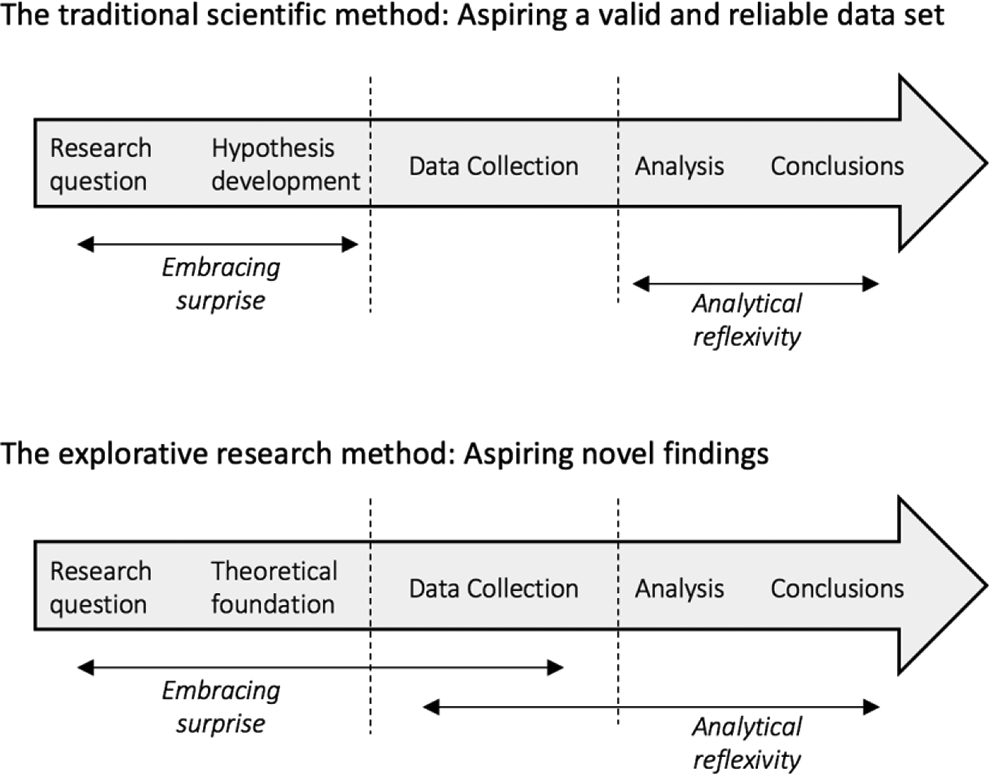
Organizing analytical reflexivity and surprise in the research process.
Here, email interviewing can inform explorative interviewing by offering an extended time frame, which creates an opportunity for the researcher to strategically work with maintaining moments of surprise and analytical reflexivity throughout the data collection process.
To put this strategy to practice, I began the interviews with (1) an open-ended introductory question that was descriptive in nature (Spradley, 1979). This put focus on the response from the participant, staying open to what the participant regarded as important, instead of re-directing the conversation back to a set of questions that the researcher has defined beforehand. I saw my role as providing guidance and creating space for the participants to bring up and describe what they consider significant. I wanted to let the participants “tell their story as they see it, feel it, experience it” (Corbin & Morse, 2003, p. 339) and focus on how they understood their practices (Atkinson & Coffey, 2003). I then worked extensively with (2) follow-up questions based on that first individual response from a participant. The aim here was to feed a tentative analysis, moving beyond what might—to the participants—appear as self-explanatory or routine. Due to the nature of asynchronous interviewing, I had time to consider how I wanted to take the interview forward. Here, I had time to go back to notes and observations. In the second round, I would again create follow-up questions based on the incoming response from the participants. The work with follow-up questions was followed by the work of (3) cross-fertilizing interviews. Cross-fertilization of interviews created an opportunity to connect and synthesize information from different interviews—making multiple interviews interact. Insights into the events that one participant described could thereby be fed into another, already ongoing interview, to extend the understanding of the played-out events. To benefit from the cross-fertilization of multiple interviews, it may not be feasible to take on too many interviews at one time. As other researchers have experienced, there are challenges when it comes to coordinating and organizing email interviews (Hershberger & Kavanaugh, 2017). Keeping more interviews ongoing at the same time could cause loss of participants attention and delay the researcher’s response time.
The strategy of combining email interviewing with explorative interviewing is designed to utilize an extended time frame, offering participants time to think and reflect before getting back to the researcher. Likewise, the researcher has time to analyze the data during the interview. Here, the researcher is given the opportunity to return to the literature and to plan ahead, which is more difficult, if not impossible, in an in-person interview.
This interviewing practice was not a strategy designed at the outset of my study, but an outcome of multiple methodological decisions made during the study as I gradually became aware of what seemed to work (and not), in order to generate in-depth qualitative data through email interviews. The suggested strategy is specifically suitable in situations where asynchronous interviewing matches(1) the nature of the study’s participants (for example, participants who are technologically savvy/reachable and comfortable with electronic communication) and, (2) the study’s objectives (for example, in explorative studies or in studies where the researcher wants to reach a group that is geographically spread out).
Main Lessons
The main lessons learned from this interviewing strategy were:
By beginning the interview with a single open-ended question, lengthier and more individual responses from the participants can be generated. The responses from the open-ended introductory question can provide insights that enable the researcher to develop more personalized interviews. Such individual responses can then be built on further through the work with follow-up questions.
By continuously building the interview on the participant’s previous response, the researcher shows an interest in what the participant is saying. This can in turn encourage the participant to go deeper into their analysis. This may not only increase the participant’s engagement in the interview but can also help the researcher maintain their element of surprise throughout the data collection process.
When conducting email interviews, it is possible to engage in several interviews at the same time. By doing so, the researcher can benefit from making multiple interviews interact. Cross-fertilization can invite a participant to enter into new terrain by drawing on information given by another participant. Such cross-fertilization of interviews can generate richer accounts from a set of parallel interviews.
Taken together, the methodological strategy of combining email and explorative interviewing—by working with open-ended introductory question, follow-up questions, and cross-fertilization of interviews—can make it possible for the researcher to draw the moment of surprise closer together with the moment of analysis, and thereby challenge existing theories and knowledge of the study object.
About the Study Example
The study from which the examples used in this article are taken was an internet ethnography that took place between April 2014 and November 2017. The discussion forum was the Gallifrey Base—a forum where people can discuss the British television series Doctor Who. The study’s field work consisted primarily of observations of the interactions on the forum and interviews with 70 of the forum’s members. The ethnography did not include any in-person interactions between the researcher and the study’s participants for two main reasons: (1) the study’s objectives, and (2) the characteristics of the study’s participants.
The study’s objectives were to explore an internet practice, rather than a culture or community, to better understand how the participants of the forum understood their practice. The focus of data collection was therefore aimed at the practice that was taking place online, through text. The studied discussion forum in question was international, with members from the US, New Zealand, Australia, the UK and different parts of Europe. When attempting to research a population that is geographically dispersed across multiple time zones, it can be difficult to conduct in-person interviews (Gaiser, 2008; Karchmer, 2001; Meho, 2006; Robinson & Shulz, 2009). For my study, the selection of participants was primarily based on their engagement in certain practices on the forum. Given this condition, in-person interviews were not an ideal method.
Early in the study, I experienced that participants were hesitant to being interviewed in-person; they reported that they felt more secure and comfortable expressing their views and thoughts through text. They explained that this was one of the reasons why they had chosen to be active on an internet forum in the first place. Interviewing electronically and by email was initially seen as a complementary method to in-person interviews (in cases where this would have been possible). However, in the light of this insight, I switched to solely offering participants electronic interviews. As the participants were well-accustomed to electronic interaction—since that is the way that they communicate and interact on the forum—email interviewing made use of a means of communication that the participants were familiar and comfortable with. It was also noticeable in the interviews that the participants were skilled at expressing themselves in text. In some interviews, participants expressed that being interviewed via email had been a positive experience and that they appreciated having time to think and reflect before responding, something that researchers before me also have experienced (Fox et al., 2007; Hooley et al., 2012; James, 2007; Wilkerson et al., 2014). Having participants that were both geographically spread out, that favored electronic communication, and whose practice was exercised through text, made email interviews a suitable choice in my case.
The Strategy at Work
Since the interview strategy was a result of multiple methodological decisions and not designed at the outset of the study, I can compare my initial plan to the strategy developed later. Working with open-ended introductory questions, follow-up questions and cross-fertilization was consequently a result of the outcome of the initial interviews I conducted. In the following sections, I will describe the methodological decisions that led me to develop the strategy and demonstrate how I put the strategy to practice.
Open-Ended Introductory Questions
In the first interviews I conducted, I had created an interview guide which had several open-ended questions to encourage the participants to describe their experiences and interactions on the forum in their own words. The results, however, were not satisfying. The participants politely answered each of the questions with a couple of sentences or even bullet lists. Here is an example of a typical response I received as a result of these initial interviews (text in quotes has not been copy-edited and is presented as written by the participants).
• Run a thread about the Bechdel Test: Discussing the representation of women in the programme • Catch up on the latest spoilers, speculation and news about the show • Keep up to date with the latest controversies • Rate the episodes after airing
To the same question, another participant gave me this response:
Going forward, I took on a different approach and started each interview by asking the participant one single question:
Another participant responded to the same introductory question as follows (excerpt of their response):
When I started with the open-ended introductory question, the participants would no longer give me the type of short answers I received in response to the more direct questions in my initial approach. With the new approach, the responses were more personal, lengthier, and reflexive. For the study to benefit from such individual responses, I now needed to develop a strategy for tailored follow-up questions that could continue the exploration (embracing surprises) while keeping the study focused (initiating analysis).
Follow-Up Questions
The purpose of the follow-up questions was to understand how participants understood the practice they engaged in. This does not mean that I left it to the participants to carry out the study’s analysis, but merely points to how an interview can be designed to study the participants’ reflections upon their own experiences. The next example is an excerpt from one participant’s response to the open-ended introductory question. The participant started to tell me about what they do on the forum and continued with a story about how they had experienced boundaries and social norms there. The excerpt comes from the end of the response to the introductory question.
In another example, a participant told me that discussion threads could be moved to other parts of the forum, or even be merged with other similar discussion threads. This led me to go back to the forum and search for such threads. When doing so, I noticed that people often stopped posting in threads that had been moved, and that the thread seemed to die quickly after being moved. As a follow-up question, I told the participant about my observation and asked if they recognized this. This is an excerpt from their response.
The examples presented above illustrate how the researcher, by asking follow-up questions, can motivate participants to go deeper into analyzing their interactions. The follow-up questions were explorative in the sense that they connected concerns with how the practice was enacted and what it is to be audience, with curiosity and continuous exploration of what the participant brought up in the interviews. Such insights could not be generated by following an interview guide. The researcher instead carefully attends to moments of surprise and engages with analysis throughout the interview process. By asking questions that allow the participant to elaborate on their interactions in unforeseen ways, encouraging them to explore unexpected things, the researcher is presented with the possibility of generating new findings and thereby being able to challenge and develop existing theory and knowledge. However, when working with follow-up questions based on the participant’s response, it is important for the researcher to continuously keep the study’s research purpose in mind, in order to keep the research focused.
Taken together, the empirical examples presented above generated insights about how the practice was structured and what was at stake, which was a result of the extensive work with follow-up questions. By picking up and continuing the interviews based on what the participants brought up, the moment of surprise could also be maintained since the researcher continued to further explore the participants’ stories. Because I carried out multiple interviews at the same time, the process of formulating follow-up questions soon revealed another opportunity: the potential of cross-fertilizing multiple ongoing interviews.
Cross-Fertilization
Work with tailored follow-up questions can be combined with cross-fertilization of the interviews in order to stimulate the conversation further. Previously, there have been discussions in the literature on how interviews can be stimulated by using “real-life” vignettes (Sampson & Johannessen, 2020) and other stimulus texts or images (Stacey & Vincent, 2011). To stimulate the interviews, I brought interpretations of my observations on the forum into the interviews, as shown in the previous section. I also conducted multiple interviews simultaneously and took information from one interview into another interview, and by doing so, cross-fertilized the interviews. All participants were anonymous to each other. It would not have been possible for the participants to recognize another participant through the examples from other interviews. I did not quote what a participant had told me in another interview and present that quote to the next participant; I described briefly what I learned in another interview. I was careful not to include any details that could have identified another participant.
This was a way to invite the participants to not only to reflect upon events that took place on the forum, but also to encourage them to describe other similar experiences. This allowed me to observe different reactions and thoughts about a particular event and thereby gain a more nuanced understanding of the practice. The cross-fertilization primarily served as a way to side-step pre-established narratives and thereby support the participants’ reflexivity about their practice.
The following example illustrates how I discussed with one participant what another participant had told me. The first participant had described to me that they thought a lot about the forum while watching the TV series, and that they thought about what others might write on the forum about that episode. I sensed that this might be significant to analyze further and therefore asked another participant I was interviewing at the time if they recognized this. Here is the participant’s response.
In another case, illustrated in the following excerpt, I presented a participant with what another participant had told me about having the right and wrong opinions on the forum. The participant responded that they did recognize this, but more interestingly, they started to tell me about a different aspect of right and wrong opinions.
I continued to explore this new insight in coming interviews and other participants developed this line of thought further. Here are two additional excerpts from interviews that further nuanced the insight.
Challenges of Email Interviews
Researchers have expressed difficulties with building rapport and maintaining access when using electronic research methods (O’Connor et al., 2008; Orgad, 2006; Seitz, 2016). One disadvantage of electronic interviewing is the increased risk of absenteeism (Deakin & Wakefield, 2014; Seitz, 2016). The researcher constantly risks losing participants at any time during the correspondence. This is especially true if the researcher and participant have never met (Bertrand & Bourdeau, 2010). Also, participants can forget to answer, drop out of the study, or just stop responding. Maintaining access is always an ongoing process (Riese, 2019) that requires active work throughout fieldwork (Czarniawska, 1997; Lancaster, 2017), and for researchers conducting electronic interviews it poses additional challenges (Hooley et al., 2012; Salmons, 2015; Wilkerson et al., 2014). When building rapport and maintaining access, I worked with multiple methods. Somewhat surprisingly, working with follow-up questions was one way to build rapport. Continuing the interview based on what the participant was telling me seemed not only to motivate the participant to engage in the interview but also to trust the researcher.
O’Connor and Madge (2017) suggest that one way to build rapport in online interviewing is to identify shared characteristics and experiences between the participant and the researcher. As it turns out, it can also be an asset to have little in common with the participants. For example, I indicated my newness to the forum practice and to the topic that was discussed on the forum. I found that because I was a novice the participants were very patient in explaining things to me. This sometimes also led the participants to describe things in detail that to them was most likely self-evident.
To avoid the risk of absenteeism, I responded to the participants within 48 hours. This gave me time both to reflect on the response I received from the participant and to decide how to take the interview forward. Out of the 70 participants, 2 stopped corresponding before we had agreed that the interview was ended.
Conclusions
I have in this article discussed a strategy for email interviews, specifically designed for explorative research projects. Working to methodologically draw moments of surprise and analytical reflexivity closer together during the data collection process, email interviewing has the capacity to work systematically with theoretically informed follow-up questions and cross-fertilization of multiple interviews. The purpose of this is to move beyond already established information or taken-for-granted understandings. With an attentiveness to elements of surprise and analytical reflexivity during the data collection process, the suggested strategy can make email interviews suitable for studies that seek to develop new ideas and challenge existing theories. Consequently, email interviewing has the capacity to create an understanding of the study object’s complexities in the light of new and unforeseen concerns.
The article suggests that email interviewing can produce data that is both necessary and sufficient for some significant research tasks and should therefore be part of the qualitative researcher’s methodological toolbox. Email interviewing can even, in some studies, be a preferable option to traditional in-person methods, considering the study’s objective, its participants and their communication. Considering the increasing significance of interactions in digital environments in contemporary society, it has never been more relevant for social sciences and humanities to explore different strategies for email interviews in qualitative research. The methodological potential for email interviews in the social sciences of a global age remains to be further explored.
Footnotes
Author’s Note
Emma Dahlin holds a 3-year international postdoctoral position at TEMA T (Technology and Social Change), Linköping University and the Department of Anthropology, University of California, Santa Cruz, funded by the Swedish Research Council. Dahlin earned her PhD from Stockholm University in 2018. Her PhD thesis was an internet ethnography where a methodological approach was developed, adjusting traditional qualitative research methods to fit digital environments.
Declaration of Conflicting Interests
The author(s) declared no potential conflicts of interest with respect to the research, authorship, and/or publication of this article.
Funding
The author(s) received no financial support for the research, authorship, and/or publication of this article.
