




Abstract
Arts-informed approaches in qualitative research are gaining more recognition as being a critical research approach in the social sciences. Using arts in research is most commonly seen in the data collection process and in data representation, however, very little is written about how to use arts-informed approaches in data analysis. There are no “how-to” guides and researchers who engage in photovoice research often implement traditional qualitative methods for analyzing their data. The purpose of this article is to merge creativity with rigor to illustrate alternative means to analyze photovoice research data. This article serves as a practical and systematic guide for interpreting photographic and interview transcript data from photovoice projects. Various tables illustrate organizational strategies, and collages serve as a metaphor for the analysis process and themes. The benefits of using arts-informed analysis methods include cross-disciplinary study, innovative ways to interpret data, enhancement of trustworthiness and rigor, and building creative mediums as a form of knowledge.
What Is Already Known?
Despite that there have been a large number of qualitative studies using photovoice methodologies, there is limited discourse in the academic literature on how to analyze data that emerges from photovoice research studies.
What This Paper Adds?
The data analysis process outlined in this article contributes to the academic discourse and knowledge supporting the power of arts-informed analysis and creative methods of analyzing data.
A number of photovoice research studies have been conducted in nursing, public health, anthropology, education, social work, and sociology, and other fields. However, there is limited information on how to analyze data that emerges from photovoice research studies. Many researchers rely on standard forms of qualitative data analysis to analyze transcript data, utilizing qualitative data analysis software, while photographs are added as an afterthought to the reports of the findings. Visual art is often thought of as a potential source of data or as a creative means of representation, however, the usefulness of art and other tactile approaches can extend into the realm of analysis and interpretation (Leavy, 2009). This article focuses on a data analysis process, without the use of data analysis software and informed by the arts. This process was used to interpret photographic and interview data from a photovoice research study with sex workers. The creation of art while analyzing data also serves to deepen the meaning of the findings and expand the possibilities of interpretation. The purpose of this article is to provide guidance on practical, systematic, and creative approaches to analyzing data from an eclectic arts-informed research framework.
Arts-Informed Research Framework
For the past two decades, qualitative research has expanded to include arts-informed methods to represent stories and voices that are traditionally silenced and marginalized by textual and linguistic data collection and analysis methods (Knowles & Cole, 2008). What distinguishes arts-informed research are the multiple, creative ways of representing experiences and the different representational forms (medium) of expression that can effectively enhance the understanding of the human condition and experience. These creative genres include literary techniques (e.g., fiction, poetry and autoethnography), performance (e.g., dance, ethnodrama, and theater), visual art (e.g., painting, photographs, collage, sculpture, and art installations), new media (e.g., video, blogs, and zines), and folk art (e.g., quilts). Mitchell (2011) discusses the meaning of objects in our research sites and challenges what counts as evidence in social research. She argues that a variety of tools can be used as research evidence ranging “from socio-semiotics, memory work, and working with photographs to such arts-based approaches as installation and performance” (p. 35).
Arts-informed research makes use of the diverse ways of knowing and experiencing the world (Finley, 2011), paying attention to process. This is particularly useful when engaging with the interpretation of data and the process for uncovering meaning in the words and images of the participants. Incorporating art into the analysis stage of research has the potential for offering ways of revisioning the process that is simply not possible through descriptive linear language or computer-assisted qualitative data analysis strategies.
This research study and corresponding data analysis process was informed by visual arts-based research, which is a form of qualitative inquiry that emphasizes constructivism, critical interpretation, and contextualism (Sullivan, 2010). Rather than using a comprehensive qualitative data analysis software program (such as Nvivo, QSR, HyperRESEARCH, NUD*IST, and Atlas.ti) to assist with the data analysis, data were engaged in a tactile manner, through visual art (collage) and the creation of various charts and tables (juxtaposed and turned into a drawing of a tree). While qualitative data analysis software programs offer the promise of integrating visual images in analysis, Gerstenblatt (2013) highlights how the tactile process of creating visual art, specifically collage, involves a distinct “multisensory experience and offers creative latitude for the researcher, informant and academic community” (pp. 11, 12) that software programs cannot offer. The arts-informed processes are defined by an openness to the extensive possibilities of the human imagination. Butler-Kisber (2008) states that there is growing interest in using arts-informed inquiry to “counteract the hegemony and linearity in written texts, to increase voice and reflexivity in the research process, and to expand the possibilities of multiple, diverse realities and understandings” (p. 268). The potential for gaining a deeper, embodied, and more nuanced understanding of the research data was the inspiration for incorporating the arts in this analysis process.
Art as a Way of Knowing
Eisner (2008) discusses four contributions of the arts to knowledge. First, the arts address the qualitative subtle differences of situations. For example, art has the potential to address what is subtle but significant about the world that one might not notice if one didn’t know how to look. A second contribution relates to emphatic feeling. Images created in artistically expressive forms generate a type of empathy that makes action possible. A third contribution that the arts make to knowledge is the fresh perspective they have to offer, so that our old habits of mind don’t dominate our reactions with typical, collected responses. The arts offer new ways in which to perceive and interpret the world that would otherwise go unknown. Finally, the arts tell us something about the capabilities of individuals to experience the affective responses to life that the arts evoke. Eisner (2008) articulates, If the arts are about anything, they are about emotion, and emotion has to do with the ways in which we feel. Becoming aware of our capacity to feel is a way of discovering our humanity. Art helps us connect with personal, subjective emotions, and through such a process, it enables us to discover our own interior landscape. (p. 11) What does art seek to express?…I think every work of art expresses, more or less purely, more or less subtly, not feelings and emotions the artist has, but feelings which the artist knows; his insight into the nature of sentience, his picture of vital experience, physical, and emotive and fantastic. (p. 91)
Providing the Context for the Photovoice Data Analysis
Photovoice is an arts-informed, qualitative method with participatory features (Mitchell & Allnutt, 2008) that combines health promotion principles and community-based approaches to documentary photography. The process of photovoice entails giving cameras to individuals who use photography to identify, represent, and enhance their communities (Wang & Burris, 1997). The three main goals of photovoice are (1) to enable people to record and reflect their community’s strengths and concerns, (2) to promote critical dialogue and knowledge about important community issues through large and small group discussions of photographs, and (3) to reach policy makers and others who can be mobilized for change (Wang & Burris, 1997, p. 370; Wang, Cash, & Powers, 2000, p. 82). In traditional photovoice research studies, a participatory approach is taken with regard to the data collection and analysis process. After taking their photographs, participants engage in a group dialogue session to discuss their photographs and collectively identify themes that emerge from their picture taking process. These themes are often displayed through community art exhibits to mobilize action for change.
However, when implementing this method with marginalized groups where confidentiality may be an issue for a particular community (in this instance, sex workers) or where time constraints prevent group dialogue and a collective analysis process, some researchers implement photovoice method with participants individually.
Analysis of photovoice data typically includes traditional qualitative analysis methods such as inductive thematic analysis (Latz, 2017), and there is limited discourse on analytic methods of photovoice data in the literature. However, there are some notable examples of scholars engaging in a discussion of this topic. Wang and Burris (1997) proposed a participatory method for analyzing photovoice data, which they called VOICE, an acronym for “Voicing Our Individual and Collective Experience” (p. 381) and focused on the participants contextualizing and codifying the data. More recently, Wang and colleagues (i.e., Wang et al., 2000; Wang, Morrel-Samuels, Hutchison, Bell, & Pestronk, 2004; Wang & Pies, 2004) discussed the use of the SHOWeD analytic tool, as part of a community-based participatory research methodology. SHOWeD was developed by Shaffer (1983) and has been used extensively by TeenNet research in their health promotion efforts (Norman & Skinner, 2007). SHOwED (Shaffer, 1983) asks What do you See here? What’s really Happening here? How does this relate to Our lives? Why does this problem, concern, or strength Exist? What can we Do about it?
Tinkler (2013, pp. 193, 194), also discussed tools for analyzing photographic data and proposed steps to be completed by the researcher(s) that were less of a participatory approach to analysis and included the following: Look (What do participants see?) Contextualize (How do the photos fit into the participant’s lives?) Listen (What is said? What is not said?) Juxtapose (How does the talk compare to the visual?) Watch (How do the participants interact with the photographs?) Trace (In what ways is the total narrative irreducible to the discrete narratives based on individual photos?)
Latz (2017) discussed using a constructivist grounded theory approach blended with participant involvement (such as utilizing SHOwED) for her analysis of photovoice data.
Our article focuses on the data analysis process of implementing individual dialogue sessions (interviews) with sex workers who took photographs of their lived experiences and were interviewed individually to discuss their images. Informed by a transformative paradigm that posits the purpose of knowledge construction is to aid people to improve society (Creswell & Poth, 2017) and a social justice approach to research that involved the participation of the participants themselves in the research process, the purpose of this study was to gain a deeper, more complex understanding of the needs and aspirations of female sex workers through the artistic medium of photography (see Capous-Desyllas, 2013 for the methodological details of this photovoice study). 1 Then, using this knowledge and the participant-generated photographs, the aim of this study was to collectively bring together the participants to discuss their images and their plan for engaging in social action.
In this U.S.-based west coast city where the research took place, there were no services or supports for sex workers, so this study aimed to merge photovoice method with a phenomenological approach to research in order to highlight the visual voices and lived experiences of female sex workers. After individual interviews were completed, the photographs and voices of the participants were featured in a series of community art exhibits in order to raise awareness of important issues and to understand the service needs of sex workers.
The research questions were: What do sex workers identify as the needs of their communities? What are the aspirations of sex workers? How do sex workers make meaning of their needs and construct their experiences in photographs as the creators and interpreters of their own images? How do sex workers make meaning of their aspirations and construct their experiences in photographs as the creators and interpreters of their own images?
This research was informed by intersectionality theory and feminist theories. An intersectional lens examines how social identities (race, class, ethnicity, gender, age, ability status, sexual orientation, religion, nationality, and citizenship status) intersect to inform people’s lived experiences of privilege, power and oppression (Crenshaw, 1991). Social locations are created by the intersections of multiple identities (Murphy, Hunt, Zajicek, Norris, & Hamilton, 2009). An intersectional theoretical framework suggests that the unique lived experiences of sex workers are informed by the intersections of their multiple identities and social locations. Feminist theories maintain that knowledge is situated (based on our social location) and multiple “truths” exist (Harding (2004). They value the importance of relationships and interconnectedness. They place narratives, dialogue, and consciousness-raising at the forefront of research. Feminist theories attend to language, power, and meaning, while maintaining that the personal is political (hooks, 2004). Both intersectionality and feminist theoretical frameworks guided every step of the research process including the analysis process in order to make meaning of the participants’ voices.
In this research study, after approval by a university internal review board, 11 women working in diverse aspects of the sex industry were recruited to participate. Each woman was given her own 35 mm camera to take black and white photographs of her needs and aspirations. Individual and group dialogue sessions were held with participants to reflect and discuss their images as well as plan for a community art exhibit to share their visions and voices. During the individual dialogue session with each participant, each woman was given a guide from which to address questions about her photographs associated with each letter in the PHOTO acronym. The acronym PHOTO (Hussey, 2006) asked the following: Describe your Picture? What is Happening in your picture? Why did you take a picture Of this? What does this picture Tell us about your life? How can this picture provide Opportunities for us to improve life (with regard to sex workers’ lives)?
While each participant discussed her photographs, they were engaged in a dialogue centered on her photographs. For some participants, this questioning guide provided a way to focus on the specific stories and experiences portrayed in the photographs, while moving toward thinking about ways to improve their life conditions. It served as a way to contextualize the meaning of their photographs. While this guide was encouraged, it was not enforced in order to maintain the natural progression of dialogue and to maintain creativity and freedom of expression. It is interesting to note that those participants who chose not to refer to the guide while explaining their photographs still provided rich, contextual descriptions for each of their photographs, while addressing these questions in their own way. After discussing each photograph, each participant was asked whether she would like to say anything else about the photograph (that might not have been captured by the five questions). In addition, some women were asked what was missing, if anything, from each photograph taken. In the individual dialogue sessions, each participant discussed all 36 photographs that she took and created captions and titles for her photographs. After the completion of the project, the sex workers came together to curate a series of community-based art exhibits in order to share their visual voices with the general public and to initiate social and political change.
Additionally, the sex workers created their own artist biographies for the community art exhibits which featured their photographs. Specifically, each participant was given the option to write her own artist biography or verbally provide their biographies during the individual dialogue sessions. It is interesting to note that the artists had multiple opportunities to make revisions to their biographies and many chose to make various changes, additions, and omissions more than once prior to the art exhibit. This spoke to the fluidity of their identity and it is possible that their sense of self (and self as artist) may have changed over time. Perhaps, as the women took more ownership of the project, their perceptions of themselves as artists transformed.
Arts-Informed Data Analysis Procedure
Given that the project was on the lived experiences of sex workers and the meanings that they assigned to objects, people, places, and events in their everyday lives, as expressed through their photographs, techniques were used from phenomenological approaches to analyze the transcript data from the individual dialogue sessions. Specifically, tools from interpretive phenomenological analysis, as described by Smith and Osborn (2008), were used to explore how participants made sense of their personal and social world and the particular situations they were facing by focusing on the meanings that various experiences, events, and states held. The analysis was concerned with trying to understand what their world is like, from their point of view. Also borrowing from the processes of Creswell (1998) and Rieman (1986), the data analysis involved sustained engagement with the text and a process of interpretation aimed at understanding the content and complexity of the meanings. From an arts-informed approach, the process also included the creation of collage as a technique to “conceptualize a phenomenon by fleshing out different facets in order to get a nuanced understanding of it” (Butler & Poldma, 2010, p. 4). The use of collage for the analysis can be compared to Mitchell’s (2011) discussion of a researcher-created composite video, which may include complex layers of narrative, samples of visual data, participatory videos, and drawings and might serve as a reflexive tool. Mitchell (2011, p. 162) argues that “opportunities for working reflexively within our research teams are critical, and the production and use…of these composites can be part of that reflexive process”.
The analysis of data involved three major parts: (1) a within-case analysis of each participant’s transcript, (2) a cross-case analysis comparing all of the participants’ transcripts together, and (3) creating visual art to gain a deeper understanding of the transcript data and corresponding photographs. The analysis took several forms, which included reviewing each photograph and its description produced by each participant (to answer the first and second research questions), identifying common themes for each participant based on her dialogue session (to perform a within-case analysis of each transcript), and then comparing and synthesizing all of the participants’ themes together (to perform a cross-case analysis of all dialogue sessions in order to answer the second research question). The data collected included 36 photographs taken by each participant (for a total of 396 photographs, along with their titles and captions), field notes, and journal entries.
Various visual tables were created to organize, account for, and ground all of the data to help with the analysis, in addition to the creation of art for analysis. The steps of the analysis for each transcript are represented in multiple tables that build upon one another in order to proceed into deeper meaning. An overview of this process is discussed in this article, to provide guidance to other researchers wishing to replicate this technique.
While the first table served to organize and provide a foundation for the data, the sequential tables represented the progression of the analytic themes (associated with the dialogue, captions, titles, field notes, and journal entries), their connections, and the meaning created from the transcripts and photographs. While this analysis process was systematic and rigorous, many of the rich details of the participants’ lives and their stories were collapsed and compartmentalized into categories and themes, a commonality in traditional text-based analysis processes. Thus, it was critical to take the visual representations further and engage in visual art and collage in order to represent the richness of the stories shared.
Within-Case Analysis of Individual Transcripts
The audiotapes of each dialogue session were transcribed verbatim. The first step in the analysis process involved initial contact with the data and immersion in the photos, captions, biographies, field notes, and journal entries, focusing on one participant at a time. What was interesting or significant was noted on the right-hand side of the margin of the transcripts in pencil (Creswell, 1998; Smith & Osborn, 2008). Initial comments were related to the participants’ use of language and sense of herself. Similarities, differences, amplifications, repetitions, pauses, and contradictions in what each participant said were noted. Each participant’s transcript was divided into sections corresponding to the different photographs discussed; a horizontal line above each sentence that started a discussion of a new photograph was drawn in pencil. This was done in order to visually organize and link the dialogue text in the transcript with each photograph taken and discussed.
Development of Four Tables for the Photovoice Data Analysis Process
Next, a preliminary analysis procedure table was created to organize the interpretation of the data, to provide an overview of how each photograph was discussed by the participant (Table 1). Documenting how the experience happened, how it was talked about and experienced by the participant is referred to as “structural description” (Creswell, 1998). Structural description is the process of seeking all possible meanings, varying the frames of reference about the phenomenon, and constructing a description of how the phenomenon was experienced.
Preliminary Analysis Procedure.

The preliminary analysis procedure table noted above was completed for every photograph or group of photographs (with the same subject matter, idea or story) that corresponded with each participant’s transcript. On the back of each table’s page, the participant’s caption and/or title for each photograph, along with researcher comments and perspectives were noted.
After completing approximately 36 preliminary analysis procedure tables for each photograph taken by the participant for the whole of the first transcript, starting at the beginning of the transcript, the emerging themes were documented in the left-hand column. Initial notes on the right-hand margin were transformed on the left-hand margin into concise phrases (themes) for each photograph in order to capture important qualities found in the text of the transcript (Smith & Osborn, 2008). Through this procedure, the themes moved to a slightly higher level of abstraction. The themes documented in the left-hand margin were grounded within the stories and descriptions of the photos that the participants gave and could be directly traced back to the text.
Next, another table, titled connecting themes was created to document the themes found in the left-hand margin of the transcript to cluster and organize themes (Table 2). For each photograph or group of photographs, the themes that emerged in the left-hand margin of the transcripts were typed in the first column, in chronological order “based on the sequence with which they came up within the transcript” (Smith & Osborn, 2008, p. 70). All clusters of themes were given a name to represent a superordinate theme. These superordinate themes signified what stood out as most reflective of the clustered list of themes. An overall description of the meaning and the essence of the experience was represented in each superordinate theme that emerged (Creswell, 1998; Rieman, 1998). During this process, certain themes were dropped; those which neither fit the clusters of themes or those that were not very rich in evidence within the transcript.
Connecting Themes.

A third table titled individual analysis summary was created for the participant in preparation for a cross-case analysis of all participants (Table 3). This table built upon previous ways of organizing and categorizing the data and incorporated: (1) how the participant identified her photo(s) as a need, aspiration or both, (2) the number of photos taken to depict her need, aspiration or both, (3) what the photograph depicted—categorized into one of the five categories—things/objects; people; places/location; animals; or self, (4) the superordinate themes from the analysis process, and (5) whether the participant described the need or aspiration as personal (micro), communal (meso), or societal (macro).
Individual Analysis Summary.

After representing analytical findings in the individual analysis summary table, any information about the participant’s subjectivity (if she referenced herself at the beginning of dialogue session or at the end), her description of any photographs that she may have wanted to take but did not, her feelings around the photovoice process, journal notes and field notes related to interactions with her, was noted. The intent was to have a holistic, written illustration of each participant in the form of a detailed table to accompany her 36 photographs for use in the visual cross-case comparison between all participants. This was also a way to continue to create tables that build upon one another; all connected and rooted in the data. Finally, all of the participants’ superordinate themes were listed on a sheet of paper in order to be cut into strips of pieces to be moved around for a cross-case analysis.
To prepare for the cross-case analysis of (1) the participant-identified themes of their needs, aspirations, or both based on their photographs and (2) the analysis of themes based on the transcripts and photographs, the data tables were condensed even more for each participant. This allowed for the organization and distillation of the participant-identified themes of needs, aspirations, or both and to link those themes to their corresponding photographs. A final categories table was created and each participant’s photographs were numbered and listed under a category (needs, aspirations or both), as determined by each participant (Table 4). Then, depending on how each participant spoke about her needs and/or aspirations in her photographs (as a personal micro, communal meso, and/or societal macro) each category was color coded.
Final Categories.

Visual Cross-Case Comparison and Synthesis of Themes
The visual cross-case analysis among all participants involved the comparison and synthesis of (1) significant statements made by the participants (regarding self-identified needs, aspirations, or both), (2) formulated meanings of experiences that were identified for each participant as expressed in the superordinate themes that emerged, and (3) all of the photographs taken by the participants.
The significant statements of the participant-identified needs/aspirations listed in the final categories table were placed on three different colored pieces of paper according to each category. Each statement was cut up into strips of paper and moved around on the floor into various piles of association. The significant statements of the participant-identified themes were spatially grouped according to the patterns of ideas and associations that emerged in each pile. All of the participant-identified themes were placed in distinct clusters that illustrated their needs and aspirations in various aspects of their lives.
Similarly, the superordinate themes for all of the participants were cut into strips of paper that were moved around and spatially positioned and repositioned for the cross-case analysis. Various clusters between all of the participants emerged that expressed how participants were making meaning of their needs and aspirations as creators and interpreters of their own images. All of the photographs taken by each participant were labeled and numbered on the back according to how each participant defined the subject matter in her transcripts. The photographs were also moved around and placed into various categories (i.e., photos of self, animals, places, community members, drugs and alcohol, work) and positions to see what might emerge visually and spatially. All of the women’s photographs formed into unique clusters that were not mutually exclusive, thus overlapping into various categories of associations. This systematic analysis process provided the framework from which to symbolically represent the themes that emerged from the photovoice project.
Creative Representation of Analysis Process Using Art
The Visual Analysis Diagram in the Form of a Tree for Within-Case Analysis
To depict the within-case analysis process for each participant in a visual manner, a tree was drawn and mini replicas of the various tables were placed on different parts of the tree (i.e., underground roots at its base, trunk, branches, and leaves; see Figure 1). This tree was a map of the analysis process and the tree illustrated how the data were organized by data tables. This was a way of illustrating an organic process of working with each participant’s data over time. In this drawing, the soil illustrates the multiple forms of data that were collected prior to beginning of the analysis (the photographs and their captions, the transcripts, the participant biographies, the research journal, and field notes).

Visual representation of analysis process.
The initial contact with the data is represented by the roots that developed. These roots symbolize the impressions when reading the transcripts, looking at the photographs along with their captions and titles, and comparing field notes and research journal entries. The tree trunk is used to symbolize the foundation of the understanding of the data through the analysis process. It also represents the growth of working with the data, the strong relationships between the information collected, and steps of the analysis process.
The tree branches represent the connections between the themes that allowed for the superordinate themes to surface. The emerging themes presented a solid foundation for understanding how each participant was making meaning of her experiences while the analysis continued to build upon itself. The miniature photographs at the top of the tree, attached to the branches, represent the leaves of a tree. These “leaves” symbolized the power of the visual image in the form of a photograph, to express additional layers of understanding, representation, and liveliness of experiences.
The photographs were also representative of leaves on a tree since they would be detached from the data in the visual cross-case analysis and further explored for visual patterns and additional insight. While the textual data provided an understanding of the meaning that particular experiences held for the participants, each participant’s photographs offered an additional layer of expression and depth of perception. It was critical to the research process to create the visual representation of the tree to map out and physically situate the different types of data to be analyzed because this was in-line with the first author’s method of organizing and conceptualizing the data as an organic, multilayered, and systemic process.
The methodical analysis process provided the framework from which to symbolically represent the themes that emerged from the photovoice project. It also influenced the creation of drawing another tree (Figure 2) to represent the themes across all cases (interviews). This second tree diagram was created to visually depict the interconnections between the themes that emerged from all of the interviews. The use of art to represent these themes provided the opportunity to gain a deeper understanding of the relationship and intersection of these themes to the participants’ lives.
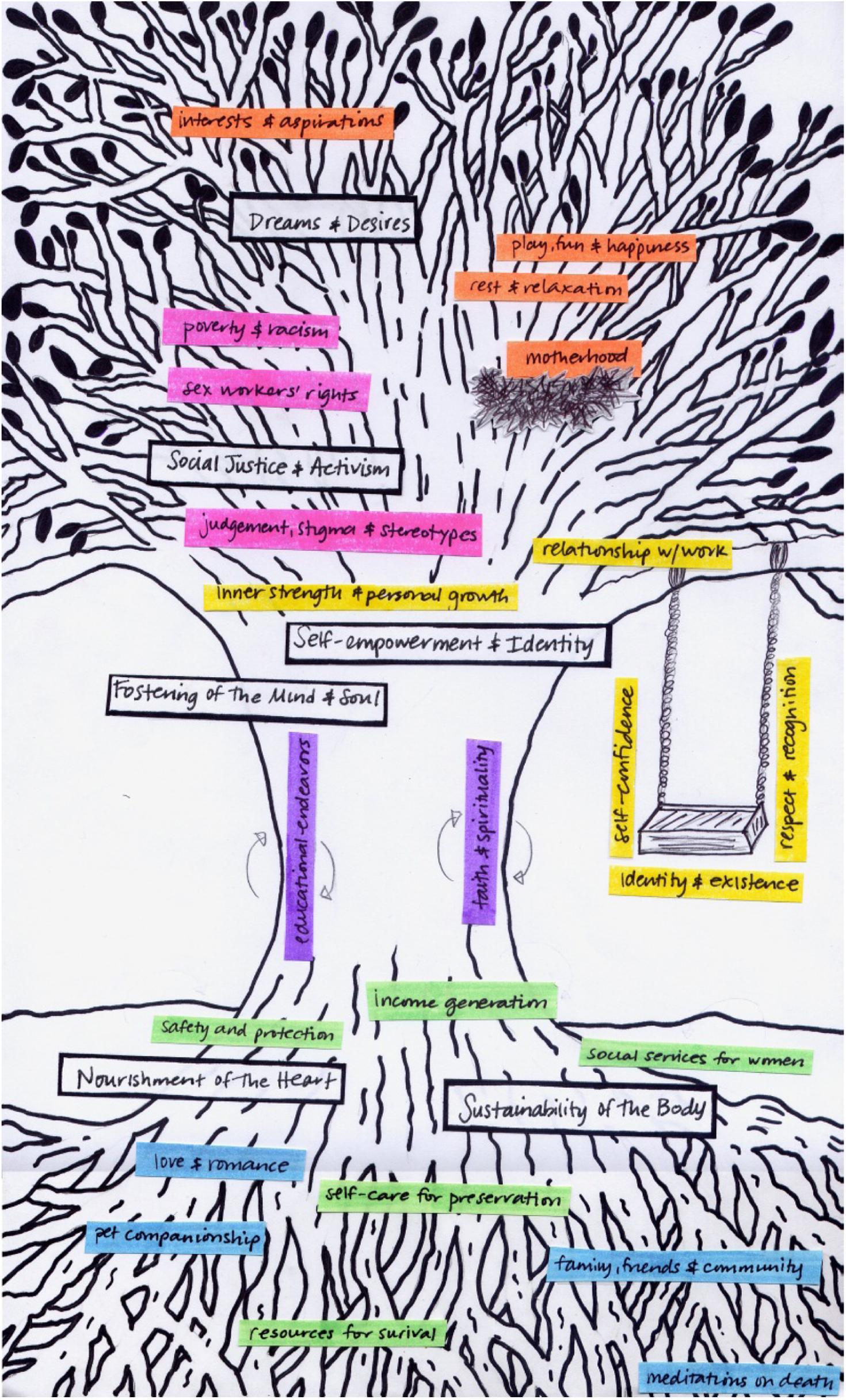
Visual representation of the themes of needs and aspirations.
Creating Collages to Assist With the Data Analysis Process
Collage has been used in qualitative research as an analytic tool for memoing, contextualizing, and categorizing (Davis & Butler-Kisber, 1999). Butler-Kisber and Poldma (2010) identify three attributes of collage in research: “as a reflective process, as a form of elicitation, and as a way of conceptualizing ideas” (p. 3). In this research project, the use of collage in these ways during the analysis process allowed for an added dimension and depth to the analysis and interpretation of the photovoice data, thus depicting the complexity of the participants’ lives (Gerstenblatt, 2013). The decision to use collage as part of the analysis process, mirrored Jongeward’s (2009) rationale, as she described her arrival at creating visual art while working on data analysis, categorizing interviews and reflecting on participants’ journal writing. While Jongeward felt close to her research participants’ attitudes and perspectives, she thought the process of segmenting and coding data diminished her image of the whole person (Gerstenblatt, 2013) and their multilayered, complex lived experiences. Similar to the sentiment expressed by Gerstenblatt (2013) in her research, who felt like her participants’ experiences were “packed away” (p. 12), the visual art allowed for a better understanding and facilitated the capturing of the complexity of the stories that the participants shared that accompanied the photographs that they took; something wasn’t possible with using traditional methods of analysis. The interview transcripts, the photographs and their captions, the participants’ biographies, the research field notes, and journal entries all provided a rich source from which to proceed with incorporating collage art in the analysis process.
Influenced and formed by other arts-informed researchers who merge the roles of artist and researcher (Leavy, 2009; Pinar, 2004), a series of collages were created. The art form of collage was chosen over other artistic mediums because the process of creating collages closely mirrored the interactive and tactile analysis process of moving images around to understand and formulate meanings from the data. Creating collages allowed for the use visual images to represent the various levels of researcher experiences; to move from intuitions and feelings to thoughts and themes that reflected the lived experiences of the participants.
The artistic process of collage entails collecting, piecing together, and juxtaposing images and quotes from multiple sources in order to create connections and to express thoughts and emotions (Vaughan, 2005). Creating a collage is more than just cutting, moving, and pasting images on a surface. La Jevic and Spinggay (2008) describe the collage process as “the placement of spaces, meanings and subjectivities together in a rhizomatic sequence, and from this fluid, hesitant and non-linear arrangement, multiple meanings ensue” (p. 85). Gerstenblatt (2013) articulates the nature of collage work when she states “piecing together fragments to form a whole serves as a corollary to the process of qualitative analysis that involves various data points, including interview transcripts, research memos, visual and archival documents, and reflective notes” (p. 12).
This process of composition was fluid and entailed assembling images, adding new pieces and rearranging them intuitively until a schema was achieved. The “intuitively known content,” situated with other images, allowed for the “appearance of unexpected new associations” (Davis & Butler-Kisber, 1999, p. 4) and connections that may otherwise have remained unconscious. Similar to Gerstenblat’s (2013) experiences with collage, the creation of collages during the analysis process allowed for a multisensory interaction with the photovoice research data.
The collage entitled, The Wait, I Carry, (Figure 3) was completed by the first author during the analysis process. Four pieces/parts were included in the collage, as one cohesive piece of work, to represent the cross-case analysis process of working with the data and the various themes that emerged. This collage was also representative of the interpretation of the data, emotional responses to the participants’ narratives, and experiences of the research process (for a more extensive discussion of the creation of collages as a form of reflexivity, see Capous-Desyllas, 2014). Pieces of wood were painted in an orange clay-like tone to symbolize the organic process of working with the data in a physical manner (i.e., moving around the photographs and the linguistic themes on strips of paper). The painted orange color reflected excitement with having collected such a wealth of data and the immersion in the information gathered. Based on the interview data, the first author found images that represented the stories that were shared during the data collection process. These images reflected the lived experiences of the participants and were juxtaposed on each wood panel. The act of shifting and altering the positions of the cutouts, then leaving them in different arrangements to see what connections would emerge over time was part of the exploration and meaning-making process.

Collage: The Wait, I Carry.
While searching for images that captured meaning, the first author was drawn to media portrayals of femininity, representations of sexuality, and images that reflected confidence, strength, and power. The images were sought and taken from the first author’s own personal, large collection of vintage National Geographic and fashion magazines from the 1950s–1970s. These images, which made up the collage (Figure 3), also reflected particular stories that stood out in the transcripts and reflected in the analysis, while the butterflies infused in each of the four pieces characterized the transformative aspects of the multiple self-portraits presented by the artists 2 in their photographs as well as the researcher’s own transformation throughout the study. By linking the content of this collage piece to journal notes and interpretations of the data, the potential of collage as an analytic memo was realized. Davis and Butler-Kisber (1999) discuss the use of collage as a contextualizing analytic strategy that emulates “memoing” in ways that opens up the data for further insight. Upon closer look at the images in the collage and linking them to the content in the journal and reflexive notes, a few points stood out in relation to the data. The images of women represented in the collage depicted various aspects of the human condition that emerged in the analysis, for example, laughter, fear, power, love, playfulness, safety, and spirituality. These expressions were reflected in the analytic themes that surfaced among the artists’ photographs and stories.
Trustworthiness and Rigor
Creating collages also contributed to the trustworthiness of the data. Several steps were taken to ensure the trustworthiness and rigor in this study. These included prolonged immersion into the data and in the field, extensive member checking, triangulation of the data through multiple sources of data collection and data analysis, analytic and reflective journal keeping, peer review of analytic procedure, and expert review throughout the study process. This multifaceted approach and continual immersion in the data contributed to the increased rigor of this research. The constant comparison method was used to check categories, themes, constructs, interpretations, and conclusions. The 396 participants’ photographs were categorized multiple times, arranging and rearranging them visually and spatially.
The triangulation of the data contributed to the thoroughness of the analysis process and the credibility of the study (Lather, 1991). Multiple and different sources of data were collected, including the transcripts from the individual and group dialogue sessions, the photographs, the participants’ biographies, research journals, and field notes. Since this study involved participatory aspects and multiple stages, there was prolonged engagement with the participants.
In addition, a community partner who cofacilitated this photovoice study analyzed the data independently, using her own process, so that coding schemes and findings could be compared to ensure similarity in the themes that emerged. She reviewed the data analysis process and there was reflexive dialogue around analysis steps, tables and collages, and thought process throughout. A peer reviewer read through four complete transcripts with (handwritten) codes along with the accompanying photographs and the multiple tables depicting the initial and superordinate themes. She was chosen to review and audit the analysis based on her experience and knowledge of qualitative research and her status as someone who was not directly involved in the data collection or other parts of the study. While the analysis processes between the first author, the community partner and the peer reviewer were all slightly different, the findings and analysis outcomes were similar.
Participant checks also occurred at different stages of the study and with all of the different pieces of data collected and presented. All 11 participants had the opportunity to either write their own biography or review the biography that was written. All of the participants were involved in choosing the photographs to be included in the art show. Before the art show, three participants changed the quotes that accompanied their photographs and also asked that these changes be made in their transcripts. The women were invited to review their transcripts and make clarifications to their statements and ideas. Only four participants chose to reword what they said in some areas, omit parts of their transcripts, or further elaborate their thoughts. The participants made changes to their transcripts prior to the start of the analysis. After the analysis of the data, participants were invited to review the themes that emerged. The use of a validation process for assessing the accuracy of the findings as best described by the researcher and the participants, is a strategy used by Creswell and Pott (2017). Engaging in artwork that took into account the voices, stories, and lived experiences of the participants allowed the first author to examine the experience of the participants from their own perspectives (Gerstenblatt, 2013). Curating and hosting an art show that involved the input and participation of the participants contributed to trustworthiness and rigor of the analysis process since the artists had the opportunity to confirm the findings and the ways in which their visual voices would be represented in a public space.
Contributions of Arts-Informed Approaches to Data Analysis
Given the multimodal materials that ensue from photovoice research data, there are various contributions of using arts-informed approaches to analyze data. Creating visual art brings forth the themes of the research in a pronounced way, “adding another layer of vision” to convey participants’ stories (Gerstenblatt, 2013, p. 12) that is memorable. In particular, collage art presents an opportunity to use visual art to represent themes and concepts that may be difficult to convey in words, thus expanding the ways in which we represent knowledge and lived experiences. Arts-informed approaches to data analysis work to counter the dominant forms of representation produced within social science research and support the use of art to deepen meaning, expand awareness, and enlarge understanding. Creative forms of data representation promise to increase the variety of questions that we ask about the phenomenon we study since they present new ways of seeing and new settings for their display. Building on the work of Gerstenblatt (2013), for the first author, engaging in this process offered the opportunity to be positioned as “researcher-as participant observing the data collection phase of the project as well as the researcher and artist during the data analysis and data display portions of the project” (p. 295). This provided a deeper understanding of the participants’ lived experiences, needs, and aspirations, through these intertwined roles and multimodal creative immersion of the research data. Rather than the research data being “packed away” and removed from the researcher, engaging with the research through various artistic means allowed for the first author to employ an additional layer of analysis that would include their perspective as a visual artist.
Using visual art in the analysis process also allows the researcher to utilize their individual skills and abilities, while also democratizing the process of creating art. Gerstenblatt (2013) highlights the appeal of collage as an art form, since it does not require previous art experience and goes on to state how “novices cutting and pasting images, using text from interviews, and experimenting with different materials to include have the potential to produce an equally representative collage portrait as those with art backgrounds” (p. 12). Thus, visual art forms like collage offer researchers the venue for producing research that is accessible to diverse populations and conveys meanings beyond verbal representations and the constraints of language (Gerstenblatt, 2013). Engaging in arts-informed approach to analyzing photovoice data also contributes to interdisciplinary approaches to research. Creating art to analyze research findings also increases the possibility for examining the data in multilayered ways. Creative mediums as forms of knowledge are more memorable to people and also have the potential to inspire, evoke deep emotion, and push the boundaries of teaching and learning.
Conclusion
The data analysis process used in this study sought to contextualize the analysis through a visual representation of how the findings from the data built upon itself to illustrate the creation of new knowledge about the lives of the participants in the study. Incorporating arts-informed approaches in the data analysis process has the “potential to support and enliven the analysis of otherwise dry and detached interview data, thus producing new knowledge and interpretation” (Gerstenblatt, 2013, p. 12). Using both emotion and cognition, a multilayered, multidimensional, and embodied analysis process was used.
Despite the inseparable nature of analysis to knowledge-making, Leavy (2009) points out that all too often analysis and interpretation are often hurried or not fully disclosed in research studies. When searching for a way to analyze the data from this photovoice study, a systematic process for analyzing images and text was not easily accessible in the qualitative research literature. Thus, given the vast amount of data produced by this photovoice study, it was imperative to create a rigorous and systematic manner to represent and interpret the data collected, while also creating art throughout the analysis process. Through the use of multifaceted analysis processes, paper systems for this (multiple hard copies of tables, printed photographs, spreadsheets, word phrases, and image cutouts)—although considered somewhat old-fashioned and laborious by some researchers—can help to develop an intimate knowledge of the data through creativity (Pope, Ziebland, & Mays, 2000) and an embodied way of engaging with images and text from photovoice studies. During the analysis process, it became vital to visually represent the stages of the analysis process through figures, tables, charts, images, and collages so that it might be seen differently during multiple interpretive moments. It was also critical to create visual art in the form of collages to allow for the themes of the research to emerge and to “see” the data in new ways that were more nuanced and complex.
Footnotes
Declaration of Conflicting Interests
The author(s) declared no potential conflicts of interest with respect to the research, authorship, and/or publication of this article.
Funding
The author(s) received no financial support for the research, authorship, and/or publication of this article.
