



Abstract
To conduct a phenomenological study, researchers often follow the principles from either the descriptive or interpretive phenomenological schools of thought. This constrains researchers within the domain and limits the potentials of their data set. This paper introduces the Trans-Positional Cognition Approach (TPCA) as a novel synthesised phenomenological research method for conducting qualitative research to address this challenge. The TPCA synthesises the principles of the descriptive and interpretive phenomenological schools and helps to bridge the divide occasioned by polemical arguments between them. At the heart of TPCA is the process of trans-positional cognition or, in simple words, ‘stepping into the participants’ shoes’. TPCA, within the phenomenological tradition, proposes a structured methodological approach as a way to reduce the complexity of the extant methods, which novice researchers associate with phenomenology. The purpose of TPCA is not to pit one phenomenological research approach against another but to elucidate an inclusive approach to phenomenological research that can serve as a methodological alternative. A set of dimensions is used to compare TPCA with extant descriptive and interpretive phenomenological approaches in order to demonstrate its distinctiveness. Furthermore, an implementation study illustrates the use of the TPCA. Hence, the TPCA, by bridging the divide between the phenomenological schools of thought, could potentially help sustain the growing interest of researchers in phenomenological research.
Keywords
Introduction
The phenomenological tradition is rich at a philosophical level, and much has been done on the methodological side in various disciplines, particularly in psychology. In our native field, the management and organisation studies, however, phenomenological studies are rare and typically conducted by experienced senior scholars. Although many doctoral students express interest in conducting phenomenological studies, as they are interested in the lived experience, once they get to apply phenomenology, because of the complexity of extant methods, they often decide to revert to a variant of grounded theorising (usually the Gioia method, see e.g. Gioia et al., 2013). Even those who would put up with the complexity often give up as they need clearer guidelines. Scholarly papers reporting on phenomenological studies usually provide just enough details to ensure the transparency of the argument, but these are insufficient to serve as a guide for new studies. Some books offer advice, but these are mainly philosophy books, clear on approach but less on the specific steps; these need to be dug out of what is often perceived as a quite exotic philosophical text. Added to that are the issues of being aligned with a particular phenomenological school of thought and how to effectively undertake various forms of bracketing that ensure their works were conducted within the phenomenological tradition.
In this paper, we address many aspects of the above problem. We offer a new phenomenological approach, which synthesises the two dominant traditions, and we offer simplified guidelines for conducting research using this approach. We do not aim at reducing the necessary complexity of the phenomenological approach, as we regard it to be essential to studying the ‘lived experience’, which is at the heart of any phenomenological framing. However, we try to reduce the unnecessary complexity of explanation and provide reasonably easy to follow yet not overly prescriptive guidelines for those who are seriously considering phenomenological research, particularly if they are relatively new to phenomenology.
The above highlighted the issues which motivated the introduction of Trans-Positional Cognition Approach (TPCA) and also implicitly deter and restrict phenomenological studies, particularly as the two dominant phenomenological schools, namely the descriptive and the interpretive approaches, maintain unreconciled philosophical and methodological differences. Previous authors have noted the need to resolve the dichotomy. Authors like Ricoeur and Savage (1970), Hans-Georg Gadamer (1977) and Finlay (2009, 2011) had at different times pointed out that description and interpretation form a continuum where each study may be more or less descriptive or interpretive. Langdridge (2008, p. 1131) also suggested that there are no clear-cut boundaries between description and interpretation in phenomenological practice because ‘such boundaries would be antithetical to the spirit of the phenomenological tradition that prizes individuality and creativity’. Also, while we acknowledge the availability of some structured methods, such as Paul Colaizzi (1978), Amedeo Giorgi (1986), Max van Manen (1997b), Clark Moustakas (1994), amongst others, we see the need for further analytical frameworks that offer easy-to-follow guidelines for structured steps.
In this paper, we introduce the Trans-Positional Cognition Approach (TPCA), a novel synthesised approach to conducting phenomenological research. TPCA utilises the principles of descriptive phenomenology to analyse the interviews (and other qualitative material) to enable the emergence of the study participants’ themes that are wholly descriptive and of interpretive phenomenology in order to enable the researchers’ interpretation of the study participants’ themes. TPCA also facilitates further idiographic explanations within context (Dasein and Lebenswelt).
This paper starts by providing a brief background to TPCA by reviewing the relevant phenomenological literature. Then we introduce TPCA in three steps, examining its philosophical underpinnings, exploring the nature of bracketing and explaining its design in terms of structure and process. This is followed by a systematic comparison of TPCA to the descriptive and interpretive phenomenological approaches. Next, we provide guidelines for applying TPCA in terms of six phases and 16 steps; using an illustrative example where TPCA was used. Subsequently, we discuss TPCA in light of the extant literature to flash out its advantages and unique features. The paper concludes with an outlook on the usefulness and future of the TPCA in research practice and looking into its implications for undertaking phenomenological studies.
Background to Trans-Positional Cognition Approach
At the beginning of the 20th century, phenomenology was introduced by Edmund Husserl in response to the use of methods borrowed from natural sciences, what he termed ‘psychologism’ (Husserl, 1936, p. 201 ff), in an attempt to understand and describe the essence of lived experience (Pivčević, 1970). In this sense, Husserl’s approach was, from the outset, fundamentally anti-positivist (Dörfler & Stierand, 2021). As Gadamer (1989, p. 236) suggests, Husserl followed the transcendental direction of Kant, that considers objectivism naïve. The fundamental notion underlying phenomenology was that humans sought meaning from their lived experiences and the lived experiences of others (Husserl, 1936). The philosophical grounding of phenomenology enables researchers to seek to understand a person’s experiences rather than to seek a causal explanation of those experiences. For Husserl, phenomenology was the description of the events occurring in the world in so far as a subject was aware of them; his approach was to reduce the world to phenomena as they occurred to consciousness and to use language to describe what appears in this way to the attentive consciousness (Kaelin, 1988). Furthermore, Husserl inherited the interest in intentionality from his mentor Franz Brentano (1973) and saw it fundamental to understanding the lived experience. Subjectivity, as an aspect of experience, and intentionality come together in the notion of ‘personal’ posited by Michael Polányi (1962a, p. 316), which transcends the objective-subjective divide and is not simply passively subjective, but also driven, intentional and passionate.
Husserl’s initial conceptualisation subsequently evolved through the works of philosophers such as Martin Heidegger (1927, 1975), who shifted the focus of phenomenology towards the hermeneutical and existential traditions (Finlay, 2008). Heidegger’s work supported the view that the meaning of phenomenological description as ‘a method lies in interpretation’ (Heidegger, 1927, p. 61). To put it differently, knowledge of the lived world can only be gained through interpretation. For Heidegger, there is no distinction between consciousness and existence, and therefore interpreting is a way of understanding what is given in our pre-ontological being in the everydayness of the Dasein. The phenomenon we aim to reveal must be disclosed in our act of discoursing upon our relationship with our worlds (Kaelin, 1988, p. 79).
Nevertheless, Giorgi et al. (2017, p. 180) note that ‘Husserl had said that the phenomenological method was descriptive based upon the intuition of the given, despite the claim by Heidegger, that the true phenomenological method was interpretation’. These divergent beliefs caused a division amongst phenomenologists that has remained unresolved to date. Our belief is perhaps somewhat more nuanced. We note that, for example, Dörfler and Stierand (2021, p. 784) claim that reading the original German version of Husserl’s work for them made the view of the founding father of phenomenology clearer; similarly to them and Gadamer, we believe that Husserl embraced subjectivity, which suggests that the description noted by Giorgi may be subjective; thus, allowing for a more interpretive consideration. However, if a researcher is studying the lived experience of the participant, then who is allowed to interpret it and when? This aspect sometimes becomes difficult to assess, and this is at the centre of TPCA. In any case, phenomenology is widely accepted in various academic disciplines as a philosophical and methodological approach of choice for studies that focus on the ubiquity of lived experiences within a particular group (Creswell, 2013) and enables the study of the individuals as themselves (Heidegger, 1927; Husserl, 1900).
Finlay (2009) acknowledged this development in her work, noting that many different research methods are practised under the banner of phenomenological research. Most of the phenomenological works follow either descriptive or interpretive philosophical underpinnings and corresponding methodological design. Descriptive phenomenological works include those from the Duquesne school promoted by Giorgi (1985, 2009, 2014), studies aligned with Moustakas’ (1994) Transcendental (descriptive) phenomenology and others (Moerer-Urdahl & Creswell, 2004). Then, there are those from the hermeneutic school promoted by van Manen (1997a, 1997b, 2014) and others, based on the University of Utrecht ‘hermeneutic phenomenology’ tradition, which highlighted the importance of the researcher’s perspectives on interpretation, building on ideas of interpretive phenomenologists, such as Heidegger (1927, 1975) and Gadamer (1975, 1977).
Over the years, authors have initiated variants of the descriptive and interpretive phenomenological methods. Some specific examples include Critical Narrative Analysis (Langdridge, 2007), a descriptive phenomenological approach; Interpretative Phenomenological Analysis (IPA) by Smith and Osborn (2008), where researchers attempt to make sense of the participant’s attempts to make sense of their own experiences; thus, creating a double hermeneutic. Some others include Moustakas’ (1994) method of Transcendental Phenomenology; and the ‘Relational Approach’ (Finlay, 2011; 2013; Finlay & Evans, 2009) that enables the researcher to uncover themes in the data through a process that involves dialogue with other researchers.
There have been also attempts to bridge the gap between the descriptive and interpretive schools of thought, such as Colaizzi’s (1978) Existential-Phenomenological Alternative and Dahlberg and Drew’s (1997) Lifeworld Paradigm. In recent times other attempts include the Intuitive Cyclic Phenomenology, which brings the intuition of the researcher into focus (Dörfler & Eden, 2014, 2019); and the Phenomenology-based Ethnography (vom Lehn, 2019), which draws on the ‘Social Phenomenology’ by Alfred Schütz (1967, 1970), who brought together sociology and phenomenology.
Indeed, beyond the unresolved polemical arguments, the goal of both the descriptive and interpretive phenomenological schools of thought was to understand and describe the essence of lived experience, which often in practice requires both description and interpretation for making sense of the study phenomena (Pivčević, 1970). The process of phenomenological research does not ‘break down’ the experience that is being studied; instead, it provides ‘descriptions’ that are ‘rich’ (Colaizzi, 1978; Giorgi, 1985, 2014; Husserl, 1913a, 1913b, 1936) and ‘full of interpretations’ (Crotty, 1998; Heidegger, 1927; van Manen, 2014; Merleau-Ponty, 1945) that reveal what it means to be a person in the particular world being observed.
The above elucidation of the major schools of thought in phenomenology prepared the ground for introducing the TPCA, which recognises that both descriptive and interpretive phenomenological fundamentals can contribute to our knowledge of organisational, business, management practices and other human inquiry and synthesises the two approaches to achieve a more complete understanding.
Introducing the Trans-Positional Cognition Approach
This section introduces the TPCA as a method, using four dimensions, the philosophical underpinnings, the bracketing, the structure and the process.
Trans-Positional Cognition Approach Philosophical Underpinnings
As all phenomenological approaches, TPCA is concerned with exploring the lived experience of the individual within its context. TPCA facilitates the interpretation of the experience uncovered from the study participants through the process of trans-positional cognition or what can be termed metaphorically as ‘stepping into the participants’ shoes’ and providing an interpretation of the study phenomena from their perspective. As illustrated in Figure 1, phenomenology initially conceptualised by Husserl (1913a, 1913b) enabled researchers to explore and describe the lived experience of a phenomenon. The purpose of descriptive phenomenology promoted by Giorgi (1975, 1986, 1997) and others was to provide a description of a lived experience in all its purity, avoiding any external interference by way of interpretations. The descriptive phenomenologist was restricted to ‘making assertions which are supported by appropriate intuitive validations’ (Mohanty, 1983 as cited in Giorgi, 1986, p. 9); to us this formulation suggests that the descriptive and interpretive traditions may not be as far from each other as it may seem. TPCA synthesised phenomenology underpinnings.
Conversely, van Manen (1997b, 2014) suggested that the interpretive school of phenomenology initiated by Heidegger (1927) was of the opinion that understanding is always embedded in the world of language and social relationships and thus cannot escape from its historicity. Heidegger (1927, p. 61) succinctly elucidated that ‘the meaning of phenomenological description as a method lies in interpretation’. Maurice Merleau-Ponty (1945) clarified that interpretations of the study phenomena are made from the researchers’ perspective. Sartre (1956) noted that the meaning-making process in phenomenological research is an activity that unfolds as we engage with the study participants’ world. Importantly, the interpretive tradition emphasises the interpretation by the researcher.
So, although we do have an ongoing debate between the two philosophical traditions, we do not see that the two positions are as far from each other as the length of the debate and the enthusiasm of the debaters may make it feel. The descriptions in the descriptive tradition are provided by the research participants; thus, including the participants’ interpretations, while the researcher’s intuitive judgement justifies the assertions made. Accepting a researcher’s interpretation is not an extraordinary leap from this point, particularly considering that as the researcher engages with the participants’ world, the meaning-making process evolves in the interaction. However, we do appreciate that the descriptive traditions insist on being true to the participants’ take on their own lived experiences. In TPCA, we try to accommodate both significant viewpoints as phases of one phenomenological research design.
As illustrated in Figure 1, the TPCA is influenced by ‘idiographic principles’ to achieve its epistemological objectives (Burrell & Morgan, 1979, p. 6). This view of idiosyncrasy, however, does not imply that no general learning can be achieved from this type of phenomenological inquiry; while the findings are idiosyncratic, what is learned through the researchers’ interpretations can be of more general value (Dörfler & Stierand, 2019). In the TPCA, the descriptive dimension is concerned with collecting concrete descriptions of experience from study participants in order to gain a basis for a deep understanding of the study phenomena (Olekanma, 2018).
In the interpretive dimension, through the process of trans-positional cognition (i.e. ‘stepping into the participants’ shoes’), the researcher engages with empirical materials and provides interpretations that are framed or expressed in the form of metonymy (Indurkhya & Ojha, 2013, 2017) within the context that reflects participants perspective. This means that interpretation in TPCA goes beyond conceptual logic or what Merleau-Ponty (1945) refers to as interpretations made from researchers’ perspectives. While clearly, the researcher cannot adopt the participant’s mind, the researcher, as suggested by Sartre (1956) does engage with the participant’s world, and instead of using the researcher’s own perspective, adopts the position of the participant – the interpretation is still the result of the researcher’s mind, but adopting a different viewpoint. Together with the bracketing described in the next section, this can get the researcher close to the phenomenal essence of the lived experience – which is what any phenomenological approach tries to achieve in the first place.
Because idiographic principles influence TPCA, the focus is on the in-depth exploration of the lived experience of study participants in context. Burrell and Morgan (1979) termed this obtaining first-hand knowledge of the subject of interest. This action accentuates the need to be open and sensitive to the meaning that the individual participants ascribe to the phenomena of their everyday world. Similar to other phenomenological methods, the idiographic dimension ensures that users of TPCA: • Attempt to gain an insight into the study participant’s world (Olekanma & Elezi, 2021). • Take an ‘insider’s perspective’ (Evered & Louis, 1981; Stierand & Dörfler, 2014). • Interpret things (Heidegger, 1927), from the study participants’ perspective or particular people, in a particular context (Smith et al., 2009).
Bracketing in Trans-Positional Cognition Approach
Bracketing is key in any phenomenological study, and so it is in TPCA as well. In TPCA, the trans-positionality, underpinned by the idiographic principles, is one side of the coin and bracketing is the other. In the former, the researcher tries to achieve a viewpoint as close to the participant as possible, which is why, for instance, the insider view is regarded as highly beneficial, for obtaining the lived essences (the qualia). The latter, in a sense counter-acts the previous shift, attempting to bring the insights out from the very specific narrow context; thus, being in service of producing the theorised essences. Metaphorically, we could say that we step into the participants’ shoes and then we step out and learn lessons from it.
In the phenomenological research tradition, phenomena are regarded as idiosyncratic and contextual, requiring that the researcher engages consciously with an open mind, without prejudice and uncritical assumptions. Nevertheless, researchers do not come into studies ‘empty-headed’; thus, bringing to the fore the importance of bracketing in the research process (Dörfler & Stierand, 2021). There are numerous conceptualisations of bracketing, there is a generic agreement about its paramount role, but there is not much agreement about how to practice bracketing. The purpose of bracketing is to ensure that researchers are disciplined and open to hear what the study participants are saying, as what participants say about their own experience is their personal ‘truth’. In his foundational work, Husserl distinguished three forms of bracketing: (1) the epoché or phenomenological attitude puts the research participant’s lived experience in focus, the researcher just listens/observes, without judging or explaining; (2) the phenomenological psychological reduction focuses on the meaning of the participants, while the researcher still refrains from judgement; and (3) in the transcendental phenomenological reduction the researcher attempts a ‘God’s eye view’, that is, through a complete indwelling to attain the essences of the phenomenon (cf Husserl, 1936, p. 152; Polányi, 1962b). Unsurprisingly, the first and partly the second were promoted by positivists as a way of getting rid of any subjective components – but in our view, such approach is inconsistent with Husserl’s original work.
In analysing phenomenologically relevant material, Husserl suggested that all preconceptions, prejudice and preunderstandings should be ‘put out of play’ so that the researcher can refrain from judgment (Husserl, 1913a; 1913b; 1936; Moran, 2000). Thus, enabling the meaning that is implicit in the experience to be discovered (Dahlberg & Drew, 1997). This view connotes ‘pure bracketing’, linking closely with the positivist take on Husserl, and is often advocated by descriptive phenomenologists. In our view, while it is impossible to achieve pure bracketing, it is useful to attempt it, simply by being open-minded. The notion of bracketing in TPCA is not about getting rid of subjective components and removing preunderstandings, but raising awareness of them so that the ‘insiderness’ can be the source of insight, an enabler of a better interpretation, rather than a distortion of reality (Dörfler & Stierand, 2021). Similar to many other approaches, in TPCA, bracketing also helps avoid premature explanations, conceptualisations, judgments and suspend any knowledge of the phenomenon to ensure a ‘return to the unreflective apprehension of the lived, everyday world’ (Finlay, 2008, p. 3).
Adopting an appropriate phenomenological attitude ensures researchers focus on the meaning of the situation as it is given in the participant’s experience descriptions (Finlay, 2008, 2011, 2013). Todres and Holloway (2010, p. 181) explained that ‘personal sensitivity can bring humanity to the study, while bracketing (phenomenological attitude) can bring a certain discipline and rigour that realises fresh insights beyond the preconceptions of the researchers’. Besides, in the Lebenswelt (lifeworld) research, preunderstanding and bias are both viewed as ways of expressing one’s involvement with the world (Merleau-Ponty, 1945). According to Gadamer (1989), researchers who are aware of what they bring to a study in the way of preunderstandings place these beliefs and values in abeyance, so that they can engage in true and open questioning as well as formulate research questions that seek insight rather than a confirmation of prior beliefs. In a sense, bracketing as conceptualised by Dörfler and Stierand (2021) goes a step further, it does not only become means of engaging with the participants’ world, and it is not only acceptable, but it is of great value as means of better interpretation. This makes this variant of bracketing fully aligned with and instrumental to the purpose of TPCA.
Hence, the bracketing approach employed in TPCA involves personal reflexivity focused on suspending judgement and premature explanation in the process of gaining ‘study participants descriptive themes’, that is, accounts of their lived experiences. During the interpretation of the descriptive themes, transpersonal reflexivity is employed. This involves co-researchers interviewing the researcher that conducted the interview and obtained the descriptive themes. The purpose of practising transpersonal reflexivity was to shed light on the interviewer’s intuitions and to raise the awareness of presumptions, previous knowledge and beliefs, of which the interviewer might not be aware. Dörfler and Stierand (2021) also explained how bracketing could be practised through personal and transpersonal reflexivity, using preunderstandings as a source of insight while keeping the participants’ viewpoint in focus. This approach to bracketing has been adopted in TPCA, as it is fully compatible with ‘stepping into the participants’ shoes’ to ensure rigour and credibility of emergent themes.
Trans-Positional Cognition Approach Structure and Process
TPCA Six Stages and Sixteen Analytical Research Steps.

The TPCA structure comprises six stages: data collection, data transcription, text analysis, data display, data validation and idiographic explanation. These six stages were further broken down into 16 methodological steps for clarity and transparency purposes (Table 1). Our intention is to make the process of TPCA transparent, thereby increasing the credibility of its findings. In our view, if a researcher rigorously applies the outlined steps, TPCA will facilitate a deep understanding of the study phenomena.
Comparison of Trans-Positional Cognition Approach With Descriptive and Interpretive Methods
Comparison TPCA with key phenomenological approaches.
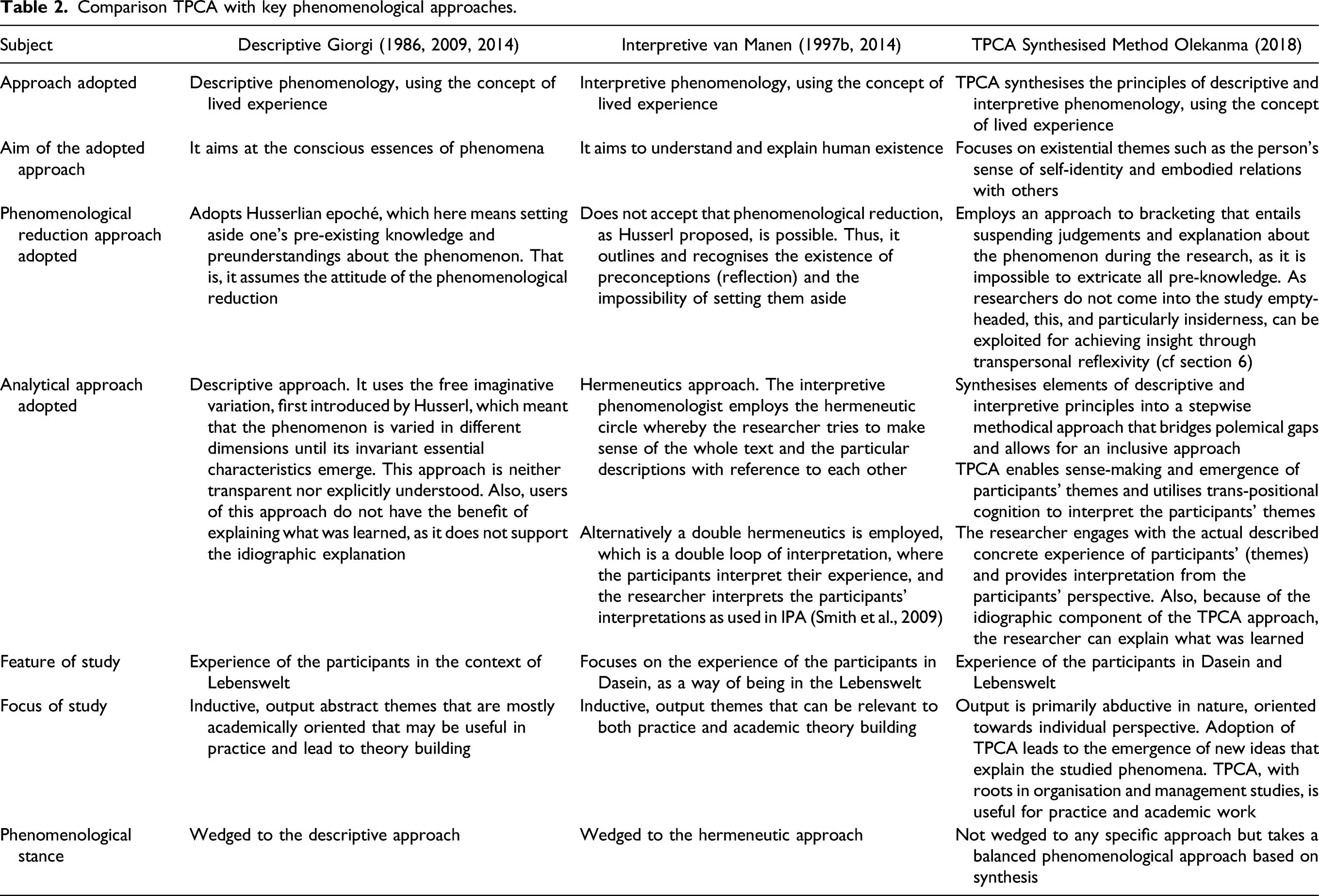
The TPCA entails obtaining first-person accounts of experience descriptions. Thus, its data collection and initial data analysis are similar to the descriptive and interpretive variants of phenomenology. The three approaches rely on the insights of the researcher who worked through all the data to get a sense of the whole and then discriminated them into meaningful units of description (descriptive), or significant words, phrases and sentences (interpretive) or ideas (TPCA).
The descriptive phenomenologist seeks to ‘encounter an instance of the phenomenon that one is interested in studying and then use the process of free imaginative variation in order to determine the essence of the phenomenon’ (Giorgi, 2006, p. 354). In other words, the dimensions of the phenomenon are varied until its invariant, respective essential characteristics emerge, and the researcher ‘carefully describes the essence that was discovered’ (Giorgi, 2006, p. 354). However, the interpretive phenomenologist employing the hermeneutic cycle provides interpretations, which in some instances are endless (van Manen, 1997b). Other interpretive variants such as the Interpretive Phenomenological Approach (Smith et al., 1997; Smith & Osborn, 2008) employ the double hermeneutics, which entails interpreting the study participants’ interpretations.
In contrast, the phenomenologist adopting the TPCA, through the process of trans-positional cognition, engages with the participants’ themes derived from their described experiences and ‘independently’ provides interpretations. TPCA does not indulge in endless interpretation like the hermeneutics (van Manen, 1997b), nor does it necessarily involve participants in the interpretation process like double hermeneutics of IPA (Smith et al., 2009). However, themes that emerge as the researcher’s interpretations are further interpreted at a higher level of abstraction to allow for the emergence of an overarching narrative that epitomises the essence of the study phenomenon.
Applying the Trans-Positional Cognition Approach
We illustrate the use of TPCA with a study (Olekanma, 2018) that explored knowledge workers lived experiences in a financial setting. As TPCA is a qualitative method underpinned by an interpretivist philosophical position, the purpose of the study was to facilitate an in-depth exploration of a subjective phenomenon of interest, which focused on ‘cognition of the participants’ (termed official knowledge workers in the study).
In this section, we use the six stages and 16 steps of TPCA to illustrate its application using a case. To avoid repetition, we only refer to context-specific procedures to focus on the application of the TPCA and do not again explain the features included in the section Trans-Positional Cognition Approach Structure and Process.
Data Collection
Step 1: In the underlying study (Olekanma, 2018), a purposive method was used to select 16 participants from the research setting. Prior to and during the data collection, the researcher assumed bracketing. Semi-structured face to face interviews were used to gather empirical material from the study participants. All the interviews were audio-recorded.
Data Transcription
Step 2: To transcribe the audio recording, the researcher practised bracketing, which introduces a level of discipline that ensured ‘what was heard from the recording was what was transcribed’. Step 3: Each of the 16 participants’ interviews was transcribed verbatim. Step 4: Each of the participants’ text was read over thrice while listening to the audio recorder playback to ensure accuracy and to get a sense of the whole phenomenon.
Text Analysis
The TPCA text analysis stage comprises steps 5 to 13. We briefly describe the application of these nine analytical steps for the case study.
Step 5: Each participant’s study text was broken down into units. Each unit could be a statement, sentence, phrase or paragraph, each of which contained only one unit of a meaningful idea. Step 6: Next, the researcher discriminated the units by highlighting and coding those that contain ideas relevant to the study research objectives in each participant’s study text. Step 7: After that, the colour-coded units of ideas in each participant’s text were grouped into types matching the research objectives. Step 8: The coded units of ideas were reviewed to identify those with similar ideas within each type. Those containing similar ideas were identified and aggregated.
Step 9: Following the coding, a further examination of the units with beneficial ideas was carried out to identify and eliminate any repetitions. The emergent units of meaningful ideas represent structures of the participant’s lived experience of the study phenomena. After analysing each participant’s study text, the researcher practised bracketing before engaging with the next participant’s study text to avoid any perceived notions being imported from the previous study text. The above process led to the emergence of the individual participant’s themes.
Step 10: The process of developing the study participants’ themes started with creating a typology that allowed the themes from the 16 different participants’ text to be combined into similar types. Subsequently, the themes in each type were carefully reviewed to identify repetitions, types containing similar meaningful ideas were combined into clusters, then the clustered types were aggregated. This resulted in a typology in which each type contained only themes common to all participants in the clusters. Finally, all the themes in each type were converted from their first-person characteristics into third-person characteristics without altering the meanings as ‘lived’ by the participants. What emerged following the preceding procedure is the participants’ themes mostly in the ‘language of the participants’, as only minor modifications were undertaken during the conversion of the combined unit of ideas from the first-person format to the third-person format. Hence, the study participants’ themes that emerged were wholly descriptive in nature. The 21 participants themes that emerged from the study (Figure 2) represent the structure that characterises the official knowledge workers’ lived experience of service productivity in the research setting. Adapted from Olekanma (2018) study themes data display structure.
Step 11: To start the process of interpretation of the study participants’ themes, the researcher assumed bracketing once again to guard against any perceived notions prior to interacting with the study participants’ themes. Step 12: The process of trans-positional cognition led to the emergence of five themes, each expressed as phrases or labels in the form of a metonymy (Langacker, 2008; Nishimura, 2008), which highlighted the common trends or patterns embedded in the study participants themes. The themes include: • Highly regulated workplace, • Unfriendly operational environment, • Dysfunctional service operations strategy, • Knowledge gap and • Subjective deposit mobilisation quantitative assessment criteria. The labels that emerged represent the researcher’s interpretations of the participants’ themes (PT) which in the underlying study was designated ‘Ri-PT’, where R is the researcher, i refers to interpretation and PT means participants’ themes. The trans-positional cognition process of interpreting the participants’ themes was not a linear process but rather an iterative one, and it involved alternation between reading over the PTs within each cluster, reflecting on what was read, and multiple rewritings of the formulated meanings (cf undertaking nuanced examination, telling apart and interpreting the study themes, in Trans-Positional Cognition Approach Structure and Process). This process was repeated for all clusters of the participants’ themes (Figure 2) to achieve the researcher’s interpretations for the complete typology. It is important to highlight that during steps 11–13 the researcher did not conduct fresh reflection about the study participants’ experiences but undertook a nuanced examination of the PTs, to notice, tell apart and provide interpretations within the context of themes. Thus the interpretation is focused on the study phenomenon and not on self (Laverty, 2003; Lopez & Willis, 2004). Bracketing in the form of transpersonal reflexivity (Dörfler & Stierand, 2021) was also undertaken by the authors in steps 11–13 to further ensure rigour and credibility of the emergent themes.
Step 13: To allow for the emergence of the study essence, the researcher, through a further process of trans-positional cognition, combined and cognitively engaged with the five second-order themes at a higher level of interpretation. The process led to the emergence of a third level or overarching theme, the ‘service capacity deficit’ that typifies the study essence, serving as a basis for constructing a narrative that explains the participants’ experiences.
Data Display Structure
Step 14: Following the text analysis, the researcher constructed a data display structure that organised the findings (themes) that emerged in such a way that facilitated further research (Figure 2).
The data display structure shows the 21 study participant themes, five researcher’s interpretations and one theme that represented the ‘study essence’.
Data Validation
Step 15: The data display structure presentation of the study themes facilitated a better comprehension of the study output and validation by the participants. Thus, the themes that emerged from the study were sent to eight purposively selected participants using the data display structure format. All the eight selected participants confirmed that the study outputs presented in the data display structure represented their experiences.
Idiographic Explanation
Step 16: In the underlying study (Olekanma, 2018), a ‘discussing the findings’ section was used to write up the narrative from the second level themes and the study essence. The write-up was supported with quotes from the individual participants’ interview text that illuminated the social, cultural and historical aspects of the study participants’ Dasein. In the study, the idiographic explanation write-up utilised a conceptual model derived from study output, metaphors and metonymies (Indurkhya & Ojha, 2013; 2017; Langacker, 2008; Nishimura, 2008). It also utilised established knowledge such as the viable system model (Beer, 1979) to better explain the study findings within context. The study concluded that the service capacity deficit related factors impaired the capability and potentiality of the study participants, with implication for the solvency prospects of their banks.
Discussion
In the section Comparison of Trans-Positional Cognition Approach With Descriptive and Interpretive Methods, the TPCA method was compared with the Giorgi’s descriptive and van Manen’s interpretive methods that belong to the two major phenomenology schools of thought. Reflecting on the outcome of the comparison in Table 2, we note the similarities between the two schools and their differences. Hence, it is our opinion that viewed from how problems are solved in practice, descriptive and interpretive approaches are potentially two sides of the same coin that need to be taken together if a problem is to be solved from a wholistic standpoint.
In other words, we view the interpretive method as a continuation of the descriptive method. Without first obtaining descriptions of experiences and establishing a coherent view of the phenomenon from a wholly descriptive themes perspective, there is nothing to interpret. Heidegger (1927, p. 37) hinted implicitly about this when he noted that ‘the meaning of phenomenological description as a method lies in interpretation’. We believe that viewed from strictly solving a messy phenomenological problem of an individual or group of persons, methodologically it is plausible to suggest the utilisation of a method that enables the researcher to explore the nature of the knower’s knowledge as well as the nature of being, the context of how the experience was lived, its historicity.
Research output that incorporates these elements, we think, can be abductive in nature, more detailed and informative with potential for better comprehension of the study phenomenon by users/readers/decision-makers than studies that do not. Therein lies the strong motivation for initiating the TPCA synthesised phenomenological approach. The TPCA is useful as it facilitates the development of a deep understanding and new knowledge that is all encompassing about an individual’s or a group’s lived experiences. This is an aspiration that aligns with Husserl’s main epistemological concern, which is to provide a foundation for knowledge through the study of Lebenswelt (Husserl, 1936).
This approach is supported by Dilthey (1989) comments cited in van Manen (1997b, p. 181), which make clear that ‘we can grasp the fullness of lived experience by reconstructing or reproducing the meanings of life’s expressions found in the products of human effort, work, and creativity’. Put differently, the study of human phenomena requires interpretation and understanding, or as van Manen puts it, ‘human science is the study of meaning; descriptive-interpretive are studies of patterns, structures, and levels of experiential and textual meanings’ (van Manen, 1997b, p. 181).
One distinctiveness of the TPCA lies in implementing its data analytical process structure outlined in the section Trans-Positional Cognition Approach Structure and Process and in Table 1 that comprise six stages and 16 methodical steps. Furthermore, in TPCA, the usefulness of preunderstanding is also acknowledged through the adopted mode of bracketing. However, this comment is situational and circumscribed by specific conditions; for instance, a former banker is researching lived experiences of bankers working in the financial sector. With some insider knowledge of the social and cultural historicity of the participants’ community, the researcher may connect better to the participants as well as use it to find ‘correct’ interpretation of the raised issues. For example, when dealing with the participants during sampling/selection of participants for the study, dealing with issues of access and arranging interviews with participants requires some knowledge of the community norms and idiosyncrasies, like understanding the usage of the participants colloquial (language) in their Lebenswelt, which can be challenging. Excluding such pre-knowledge can have a negative impact on the quality of data collected from participants and its analytical process with potentially detrimental implications for the relevance of the study outcome; therefore, in TPCA bracketing is employed to raise awareness and make use of such pre-knowledge. We experienced this first-hand during our study that involved top bank executives, as the lead author was a former bank executive.
The other issues that differentiate TPCA and which, in our view, constrict our knowledge and full understanding of researching phenomenology include: 1. The issue of contextualisation. We agree with Heidegger (1927) that accepting self-consciousness as the dominant element of the subject is not sufficient to determine the self-understanding of the subject because self-understanding is always determined by way of the Dasein’s mode of being the context. 2. Adopters of the TPCA researching phenomenology are not aligned to any of the two major phenomenological schools. TPCA method synthesises the principles of the descriptive and interpretive approaches to achieve its epistemological objective; thus, bridging the polemical gap and ensuring methodological inclusivity. 3. Output from the study adopting the TPCA method is abductive in nature. It leads to creating new ideas that best explain the studied phenomenon (Olekanma, 2018; Olekanma & Elezi, 2021; Olekanma & Soomro, 2020) in lieu of most extant phenomenological methods.
Ultimately, the usefulness of the TPCA, as highlighted in Table 1, stems from its easy-to-follow step-by-step approach that provides structure and facilitates the gathering of concrete descriptions of experiences from study participants, analysis of data and interpretation of themes, as well as helping to elicit an understanding of studied phenomena. The synthesised nature of the TPCA ensures that the researchers using it in their work are not aligned to any phenomenological school of thought. The methodical process of the TPCA thus supports the researcher’s capacity to interpret the participants’ emergent themes that ‘point to something’ within context (Gadamer, 1977, p. 68).
Concluding Remarks
Phenomenology is both a philosophy and a methodological approach for undertaking qualitative research. However, the polemical arguments around the philosophical underpinning of phenomenological research practiced by the descriptive and interpretive schools of thought create confusion. Hence, researchers often follow the principles from either the descriptive or interpretive phenomenological schools to conduct a phenomenological study. This extant approach constrains researchers within the domain and limits the potentials of their data set. TPCA aims to address this issue and provides pragmatic support to researchers interested in phenomenology. The TPCA (a form of ‘stepping into another person’s shoes’) synthesises the principles of both descriptive and interpretive phenomenological schools. As a result, researchers adopting TPCA in their work utilise a more inclusive approach instead of being aligned to either school.
The other notable differences of TPCA compared to other extant phenomenological methods include the approach to bracketing as explained in the section Bracketing in Trans-Positional Cognition Approach and its six-stages structure and 16-step process. Also, the TPCA analytical process considers the nature of the knower’s knowledge and the nature of being, which is the context of the lived experience and its historicity. Thus, it accounts for the Dasein as well as the Lebenswelt of the study phenomenon. We believe that output from such a study would make it easier for readers/users to understand the studied phenomenon. Additionally, we note that ‘stepping into the participants’ shoes’ principle has been used as a research method in several works from other approaches (see e.g. Greenwood, 2015; Heggstad, 2018). However, TPCA is the first to apply it in this way and in a synthesised phenomenological approach.
There are a number of implications for undertaking phenomenological research that emerges from this paper. First, taking a more pragmatic approach to dealing with the extant ‘strict’ descriptive and interpretive philosophical dichotomy of phenomenology proposed in TPCA can help resolve some of the polemical arguments within the domain. Second, as illustrated with the Olekanma (2018) study, TPCA can help researchers operationalise the complex philosophical underpinnings of phenomenological inquiry with abductive reasoning leading to practical application. Third, this paper highlighted and applied bracketing as explained in the section Bracketing in Trans-Positional Cognition Approach, which we believe is attainable by researchers wanting to adopt a phenomenological method for their studies.
Although TPCA is presented as a novel synthesised phenomenological approach worth exploring and as an alternative to the extant phenomenological methods, it is important to emphasise that the purpose of this paper is not to pit one phenomenological research approach against another. Many researchers moved back and forth between descriptive and interpretive phenomenology during their research without an explicitly formulated framework. Our purpose is to provide such a framework, which could help sustain extant interest, encourage and attract further researchers to phenomenology. The TPCA can also provide practical tools to help novice phenomenologists develop new skills and perspectives. Furthermore, as Baker et al. (2004, p. 169) suggest, the ‘purpose of academic discourse is not only to describe and explain the world but also to change it’. With this in mind, the purpose of introducing the TPCA into phenomenology provides an opportunity for reflection and change.
Footnotes
Acknowledgements
The authors will like to thank Dr. Benjamin Fisher, Associate Dean, Research and Innovation, Teesside International University Business School, for initial review and comments of this article. Also, thanks to Dr. Efe Imiren, Lecturer, Entrepreneurship and Enterprise at Suffolk Business School, UK and Mr Jonathan Munby, Principal Lecturer at Teesside University International Business School for the initial proofread and editing of this article.
Declaration of Conflicting Interests
The author(s) declared no potential conflicts of interest with respect to the research, authorship, and/or publication of this article.
Funding
The author(s) received no financial support for the research, authorship, and/or publication of this article.
