




Abstract
Photovoice is a powerful method for centring participants’ perspectives in research and policy. It can provide a platform for marginalised groups to share their stories and inform policy change. However, its application to studying dyadic relationships, in particular labour relations, is limited, as multi-perspective designs are largely absent. Moreover, methodological clarity, especially in relation to analysis, is often lacking. This article presents an extended and relational photovoice design, developed from a project in Accra’s informal food service sector, to address these shortcomings and outlines methodological implications. Our approach offers tools for bottom-up analysis that help bridge the gap between first-hand testimonies of lived experience and abstract theorisation. We propose practical steps to strengthen reliability, validity, and credibility; make participants’ involvement in decision-making processes more transparent; and provide extensive field materials to support replication and adaptation. Key contributions include: (1) the simultaneous inclusion of employers and employees; (2) rigorous sampling through careful operationalisation, field visits, and a mini-survey in a challenging data-scarce environment; (3) integration of individual semi-structured interviews and audio diaries to explore photographs, labour relations, and work histories; and (4) the combined use of thematic and interpretative phenomenological analysis to investigate and compare lived experiences while also embedding them in theoretical frameworks. Although we acknowledge its limitations, this design enhances methodological rigor and participatory integrity, making previously unexplored areas and relational dimensions more accessible to photovoice research.
Keywords
Introduction
Photovoice is a participatory action research method. By asking participants to take photographs of their experiences, participants’ perspectives become the heart of the research. Through a multi-stage group process, photovoice aims to identify community strengths and concerns, facilitate critical dialogue, and reach policymakers for social change (Wang & Burris, 1997). It has been used widely across the social sciences and beyond, from public health (e.g., Catalani & Minkler, 2010; Halvorsrud et al., 2022) to research with indigenous people (e.g., Anderson et al., 2023; Vining & Finn, 2024). Given its emancipatory goals and unique power to reveal different and often invisible viewpoints, photovoice is frequently used with marginalised groups, for example groups identified by a relatively rare common characteristic such as a disability (e.g., Chinn & Balota, 2023; Dassah et al., 2017), and particularly in the Global North (in a review of 21 articles, 19 were from North America and two from Africa, see Evans-Agnew & Rosemberg, 2016).
There are, however, five major blind spots in the photovoice literature that this paper addresses. First, to the best of our knowledge, photovoice has never been used with simultaneous groups of structurally opposed parties, nor to study their relationships. As a result, the methodological implications of such multi-perspective designs remain unexplored. Many relationships are marked by structural power imbalances and economic inequalities, making a relational approach a particularly fruitful addition to the photovoice literature. This is especially true of informal wage employment, which often remains invisible in policy discourse, unions (Kabeer et al., 2013), and official statistics (Rizzo et al., 2015). Second, photovoice projects in labour studies and on working conditions are uncommon (for an exception, see Surchat et al., 2024). Third, photovoice has hardly been applied to study the workings of the informal economy, where the majority of the world’s population (and nearly 90% of the sub-Saharan African workforce, see ILO, 2023) make their living in often highly precarious conditions. 1 Fourth, photovoice is rarely applied in sub-Saharan Africa (McMorrow & Musoke, 2023). Fifth, there is a shortfall of methodological transparency in the photovoice literature, especially in relation to analysis which remains a widely neglected area (Milne & Muir, 2020). Indeed, it has been argued that the literature on participatory visual methods has been ‘over-celebratory […] and has eluded discussion of the methods’ limitations or tensions’ (Switzer, 2018, pp. 189–190). Given photovoice’s participatory and emancipatory aims, there is a tendency to downplay the researchers’ role and assume that participant-generated data speaks for itself. The critical intermediary steps between data collection and the development of findings are thus frequently overlooked (Milne & Muir, 2020). Many current photovoice designs are insufficient to address these blind spots because they tend to focus on easily identifiable (or even pre-existing) groups but have little to say on how to recruit, combine, and theorise possibly opposing positions of the same relationship, particularly if it is unstable, as illustrated by high worker turnover rates in the informal economy.
To address these gaps, we present an extended and relational photovoice design and systematically examine its methodological implications from setup to analysis, highlighting both its benefits and limitations. We demonstrate how photovoice was adapted and applied to study informal labour relations in sub-Saharan Africa, characterised by pronounced power imbalances between employers and employees, unregistered businesses, high worker turnover, irregular yet long working hours, low education levels, and scarce available data. This challenging context provides a valuable case study to illustrate how photovoice can be further developed to address the above blind spots in practice. Our design is extended in four regards: in perspectives (including both employers and employees), in recruitment/sampling (including sampling through business units using a mini-survey), in data generation (including individual semi-structured interviews and audio diaries), and in analysis (including a combination of participatory and researcher-led analysis). This article addresses three methodological research questions: (1) How can the extended and relational photovoice design be applied in practice? (2) What are the design’s benefits and limitations? (3) What do these findings imply for the emancipatory potential of the method?
To answer these questions, we present methodological reflections and lessons learnt from our own project and contribute to wider methodological debates in the photovoice literature. We discuss in detail our extended sampling procedure, the structure and content of group workshops, participant involvement, and the role of analysis in connecting first-hand testimonies to abstract concepts. Extensive field materials are provided as Supplemental Material to support adaptation and further development by other researchers. While our design is resource-intensive, it offers a valuable tool for studying the economics and politics of labour from the bottom up and for linking lived experience with theory. More broadly, it provides a transparent and systematic methodology for conducting photovoice projects in challenging contexts and within complex social relationships.
We tested our design in a photovoice project of Ghana’s informal food service sector, contributing to the call for more photovoice research in sub-Saharan Africa (McMorrow & Musoke, 2023). The project aimed to investigate the everyday work experience of informal wage workers and employers in Accra’s food service sector and to explore prospects for worker empowerment and collective action. This was operationalised through three main research questions for the whole project: (1) What is the prevailing labour regime characterising Accra’s informal food service economy? (2) How do wage workers and food operators in Accra’s informal food economy experience their everyday work? (3) What are their main demands and how is collective action articulated at the grassroots level? Our project is thus very much in line with the photovoice spirit, empowers some of the most invisible workers to share their stories, and explores avenues to improve informal working conditions. Moreover, it also shows how photovoice can be applied to common, mundane experiences of people that, rather than having an unusual trait or belonging to a small group with a shared identity, are very much part of the vast reserve army of labour in the Global South. Here, we focus on the methodological aspects of the project, while empirical results will be published elsewhere.
Project Setup
As a community-based participatory research method for social change, photovoice includes community leaders, advocates, and/or policymakers at some stage in the project. This may be at the design stage in the beginning and/or towards the end for a policy dialogue (Sutton-Brown, 2014). Given our interest in worker empowerment and collective action, we pursued collaboration with a union, the Informal Economy Workers’ Forum (INFORUM) Ghana, as a practice partner for this project in addition to the research collaboration between ETH Zurich and the University of Ghana. INFORUM is an umbrella trade union body for organisations and individuals operating in the informal economy, including wage workers, self-employed workers, and informal employers. INFORUM was essential in recruiting union members and engaging in the transdisciplinary policy dialogue.
Photovoice processes are time-consuming, and the nature of informal employment relationships demands a particularly complex design and careful methodological, administrative, and logistical planning. The role of research assistants is crucial (e.g., support in accessing research sites, recruiting participants, conducting interviews and workshops, as well as in event organisation). Although research assistants shape the research process in critical ways, their contributions remain often invisible (Caretta, 2015; Deane & Stevano, 2016; Turner, 2010). It is thus important to acknowledge their role, to train them in the required methodological skills, and to adjust field activities according to their observations and continuous feedback.
In addition to the various university staff members who supported this project, we had three main research assistants (two women, one man) who each coordinated one of the groups, conducted individual interviews alone or together with the first author, and acted as workshop facilitators. 2 They are all native speakers from Ghana and possess relevant local and cultural knowledge that was invaluable in implementing this project. Two of them, Caleb Owusu Kwaku Acheampong and Louisa Ntiri-Ateseh, co-authored this paper.
Before beginning fieldwork, we conducted a two-day training with our research assistants, covering the following key areas: photovoice method; sampling and recruitment; qualitative interviewing; workshop facilitation; research ethics and safety; interpretation, translation, and transcription. In addition, we conducted interview practice rounds as well as some photographic exercises to train visual literacy and to familiarise the research assistants with the photovoice assignments for the participants.
Access and Recruitment
By bringing together a small number of people with similar lived experiences and working with community representatives, photovoice projects are usually place-bound. Researchers go and meet participants in their lifeworlds, not the other way around. In doing photovoice with informal workers, it is important to select locations that offer nearby space for group activities as informal workers tend to have low incomes, long working hours, and poor transportation facilities. We identified two research sites that feature union activity and the required spaces and that illustrate two rather contrasting but typical locations of informal restaurants (so-called chopbars or food joints) 3 : a large, busy, and dense marketplace with chopbars squeezed between market stalls, bus stations, and housing structures (Agbogbloshie market), as well as a suburb with chopbars scattered along major roads (Kwabenya). Our empirical paper compares the findings from these two locations (Illien et al., 2026a).
Our extended and relational photovoice design proposes a more systematic and elaborate recruitment process than most photovoice projects to overcome key challenges specific to research on labour and informality. First, employment is a dyadic relationship between employer and employee and thus requires inclusion of participants at both ends of this relationship (Illien & Pérez Niño, 2026). Second, recruiting through informal enterprises instead of individuals adds another element. Researchers need to define exactly which establishments qualify, locate these businesses, manage informal hierarchies and networks, and access a workforce with high turnover and irregular working hours. In contrast to many photovoice projects, we did not build on pre-existing groups or rely on participant self-selection by advertising through flyers, but created a specific sample based on a careful operationalisation of our research questions. The following outlines the measures we took to address these challenges and produce a meaningful sample.
Inclusion criteria and operationalisation.
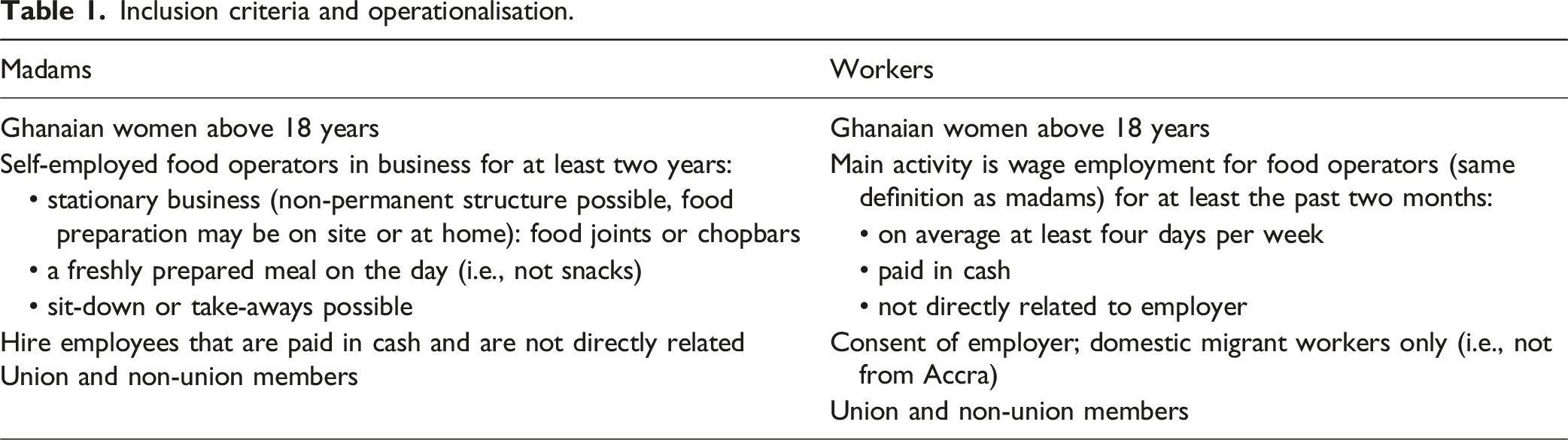
Participants were recruited in person. At each site, we used a mixture of random walks (i.e., convenience sampling) and snowballing to visually identify establishments that might fulfil the purposive criteria. We then approached the madam and introduced the project. If she was interested and able to participate in the project, we would conduct a mini-survey with our smartphones using the KoboCollect software (questionnaire available in Supplemental Material S1) to collect relevant background information and verify whether the recruitment criteria were fulfilled. Sampling employees was more challenging. Since participants were asked to take pictures of their work and since they were missing work to participate in workshops, it was essential to obtain the employers’ consent as well and to compensate not only employees but also employers for the lost working days (see below). To recruit workers, we therefore first approached their madams, introduced the project, and asked for consent for one of their workers to participate in the project and take pictures of the establishment. Only if they consented would we talk to their workers and conduct a similar mini-survey, as we did for the participant madams, to ascertain eligibility (questionnaire available in Supplemental Material S2). Often, the madam or worker was not around or too busy, requiring us to come back later. This could involve multiple revisits, sometimes only to find out that the worker was not eligible in the end. The entire recruitment process proved even more complex than anticipated and took a full workweek to complete across both research sites, involving outreach to numerous madams and workers. The recruitment protocols for madams and workers are available in Supplemental Materials S3 and S4, respectively. Participants only signed their consent forms at the end of the introductory workshops once they were able to fully grasp what participation entailed. Importantly, we never recruited a worker and madam from the same establishment. We decided that this would be too risky given the power imbalance between the two groups and prevailing cultural norms. Including both employers and employees from the same establishment could inhibit the workers’ free expression, as they might fear repercussions from the madam if they were seen publicly discussing certain issues or denouncing certain work practices.
Final sample.

Our extended recruitment procedure is methodologically innovative in at least three ways: First, to our knowledge, photovoice has never been used with both employers and employees. We argue that this is an important innovation as it allows insights into different experiences of work, different pathways of collective action, and into employment relationships that are dyadic by nature. Second, in addition to employers and employees, our study involved a third aspect absent in most projects: the notion of the business establishment (the food joint or chopbar) was crucial and had to be carefully operationalised. Third, we conducted site visits and a mini-survey to implement a rigorous bottom-up sampling process, able, on the one hand, to overcome the uncertainty and lack of data in the informal economy, and, on the other hand, to remain independent of potential clientelism among policymakers or community organisations, which might lead to the exclusion of less well-connected or marginalised people.
The Extended and Relational Photovoice Process in Practice
Photovoice as a participatory action research method was developed in the 1990s by Wang & Burris (1997) building on documentary photography, the Freirean approach of empowerment education for critical consciousness, and feminist theory (Breny & McMorrow, 2021). Wang & Burris (1997) postulated three goals of photovoice: identifying community strengths and concerns, facilitating critical dialogue to promote critical consciousness, and reaching policymakers for social change.
Each photovoice process is unique but generally includes introductory workshops, group meetings, and an exhibition. To this, our extended and relational design adds an employer consent/recruitment meeting, including a mini-survey (as opposed to participant self-selection), individual semi-structured interviews, and audio diaries. Audio diaries in particular are an underutilised but promising qualitative research method (Williamson et al., 2015) and, to our knowledge, have never been used with photovoice.
6
They can be useful in photovoice projects because they allow participants to capture the immediate thoughts, feelings, and sensory experiences they encountered when taking the picture or wanting to take one but failing to do so. In addition, audio diaries can help participants who are uncomfortable with the intimacy and social dynamics of interview or group settings to prepare their thoughts in private and at their own pace (Gibson et al., 2013). Figure 1 outlines the procedure followed separately for the three groups, culminating in a joint exhibition and transdisciplinary workshop. Fieldwork lasted from March to May 2024. An extended and relational photovoice design.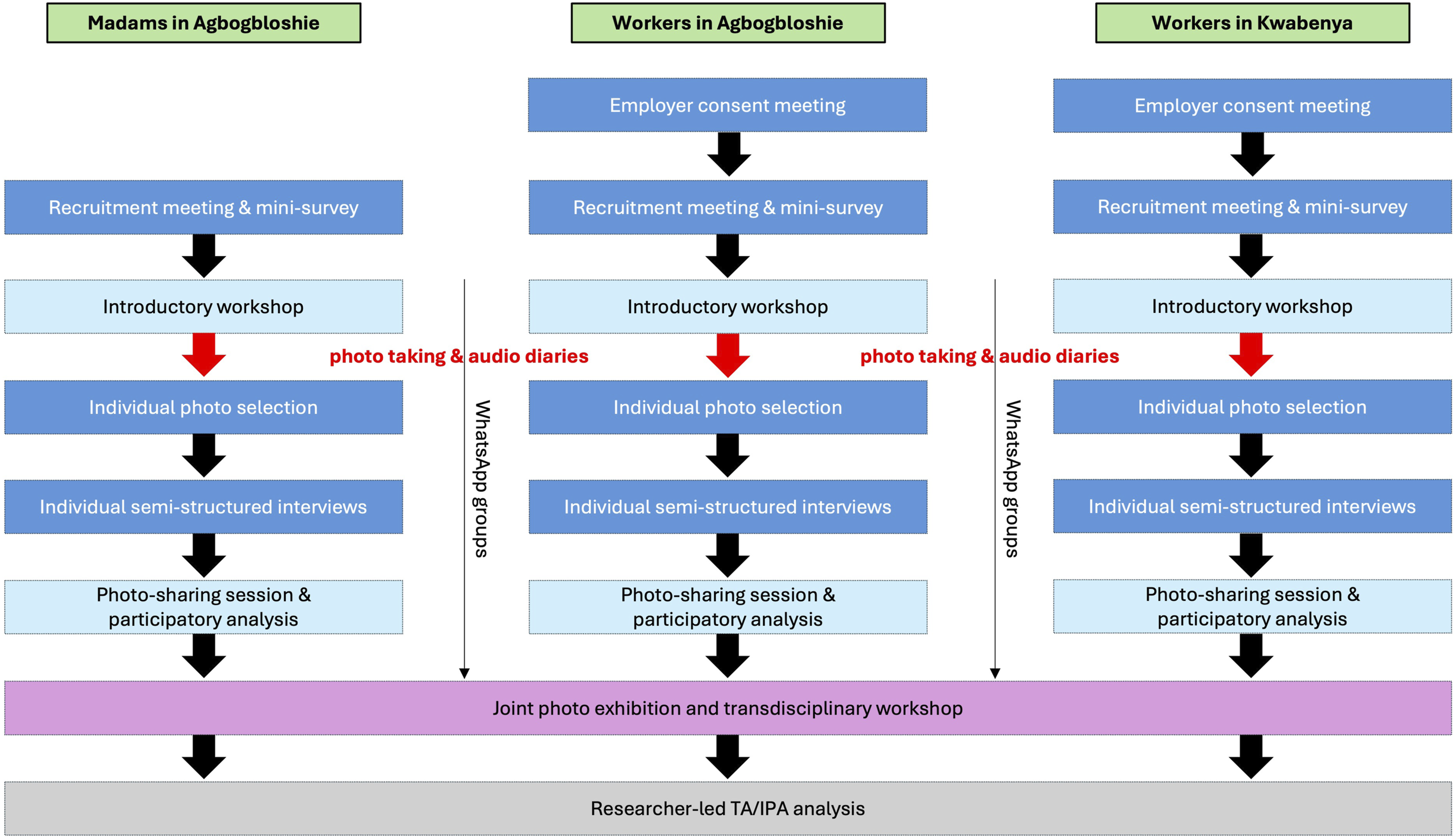
Introductory Workshops
The introductory workshops consisted of the following main elements: • a • a • an • a joint • an • a • a discussion of the •
The workshops lasted a bit longer than half a day and included breakfast and lunch. Gathering all participants at the same time is a major challenge in the informal economy because hours and sales are irregular and unpredictable. Many participants cannot be away for too long, as business moves fast, problems may arise, and personal relationships matter. Previous in-person visits, fair compensation, and easy access to the workshop location (i.e., close to their places of work) were thus crucial. Photography training during the introductory workshop. Credit: Amasah Blankson, NDH Media Consult.
Photo Selection and Individual Interviews
Following each introductory workshop, participants had about seven days to go about their daily lives, take photos, and record audio messages. We organised WhatsApp groups for each of the three groups, where participants could exchange messages and facilitators could send reminders and answer questions, thereby accompanying participants throughout the process. If needed, we also followed up with individual phone calls. Voice messages were directly sent to facilitators in private chats. After the seven days, participants were asked to send eight meaningful pictures (ideally four showing positive and four showing negative aspects) to the facilitators who then printed them out and brought them to the individual interviews. Semi-structured interviews were conducted by the respective group facilitator in the local lingua franca (Twi). The first author of this paper, who required interpretation by the facilitators, joined two interviews per group to learn about the context and to ensure quality and comparability across groups. Conducting interviews in the local language with culturally knowledgeable research assistants facilitated free and open expression among participants. We discussed the four selected pictures using an adaption of the PHOTO mnemonic (the interview guide is available in Supplemental Material S7). 10 Additionally, the interviews also covered background information, selected labour market and work aspects, as well experiences with and views on collective action. All interviews were audio-recorded. The four pictures were stored by the interviewers and brought to the group sessions, after which participants could keep them. The four non-selected pictures were left with participants after the interview.
Group Sessions
Once the individual interviews were completed, each group reconvened for a group session. We began by recapping the photovoice procedure and ground rules and gathered feedback on the process thus far. Next was a photo-sharing session whereby each group member presented two of her four selected pictures along with a key message she wanted to convey, followed by comments and questions from the group. We then conducted a participatory analysis, explained below. Finally, we prepared for the exhibition and introduced and filled the photo release forms (Supplemental Material S8). These forms gave participants full ownership: they could choose which photographs to make available for public use, which to display at the exhibitions, which name or pseudonym to use as credit, and whether to add a portrait of themselves or to blur any faces. Repeated group sessions were not possible. This was due to limited project resources and limited time of participants. The latter is a key feature of the informal food sector with long and irregular working hours and sometimes unpredictable business cycles, thus requiring almost constant availability of workers and employers alike.
Public Exhibitions and Outreach
In line with the method’s transdisciplinary and advocative goals, we organised several outreach activities and two public photo exhibitions: one at the University of Ghana in Accra and one at ETH Zurich in Switzerland.
11
We showcased two pictures per participant, each with a caption and her portrait (if she agreed).
12
In Ghana, we invited all photovoice participants along with their guests to the opening together with representatives from the university, INFORUM, and the media (Figure 3). This was followed by a transdisciplinary workshop where madams and workers voiced and discussed their demands. At ETH Zurich, we organised an accompanying panel discussion with representatives from academia and implementing organisations, along with a student tour of the exhibition.
13
Partners from the University of Ghana and INFORUM attended in person to represent the research collaborators and participants, respectively. Finally, we published a policy brief (Illien, Asiedu, Fabry, Freeman, & Meemken, 2026) and are preparing several academic articles based on the outcomes of the project. Photovoice participant explaining her picture to an exhibition visitor in Ghana. Credit: Amasah Blankson, NDH Media Consult.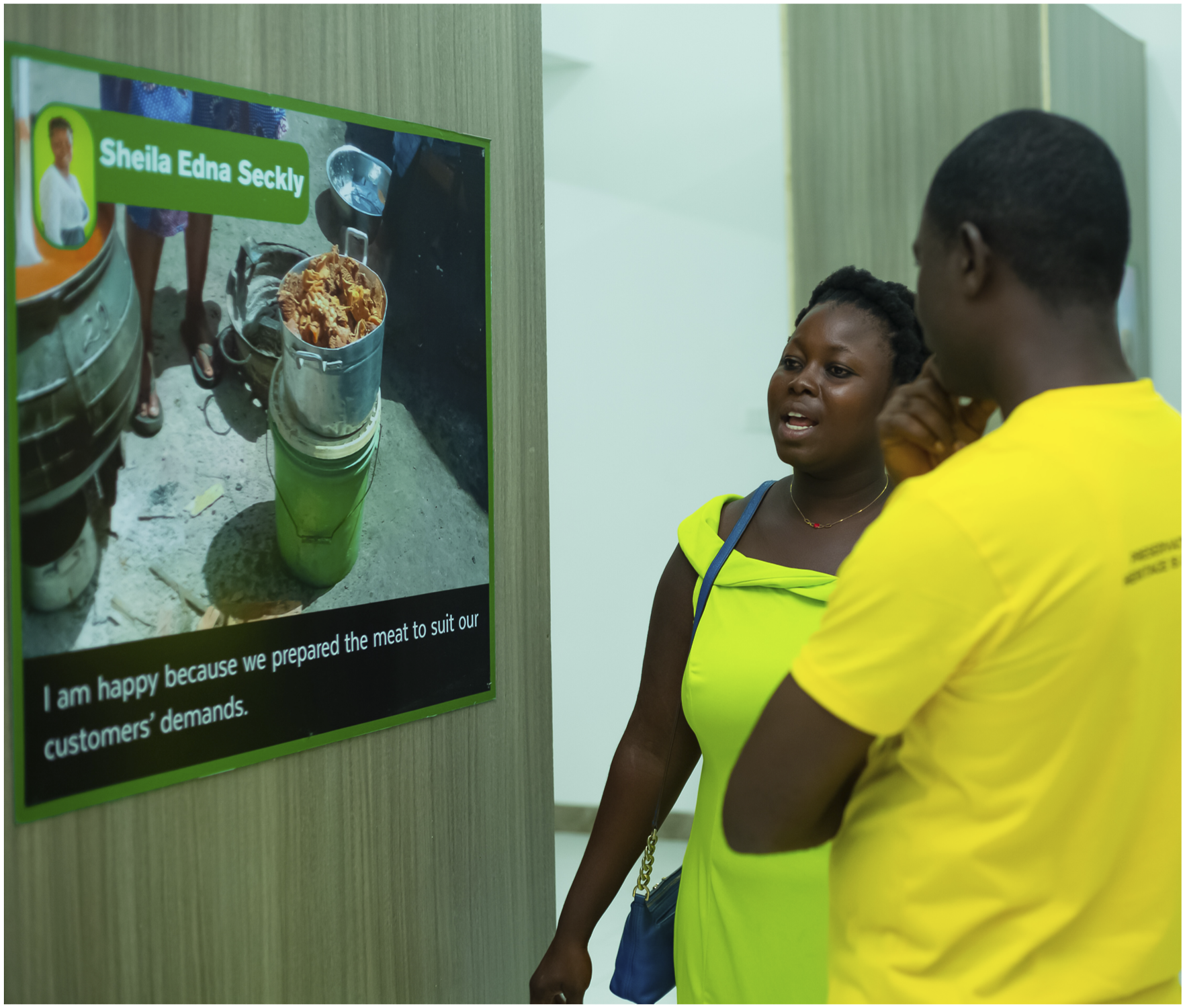
Data
The extended photovoice design produced a rich and diverse array of data: recordings from individual interviews, voice messages, and the three group sessions (introductory workshops were not recorded) form the heart of analysis. Then, there are the photographs and captions made by the participants. Finally, we have the main themes and ranked list of key demands developed by each group in the participatory analysis. In addition to this core photovoice data, we conducted interviews with union leaders, government representatives, and other stakeholders. This helped us understand the governance of the informal economy and the complex institutional union landscape (for a systematic analysis based on stakeholder interviews from this project, see Gallmann, 2024). For comparison, we also conducted two interviews with male food workers (one in Agbogbloshie and one in Kwabenya). And finally, as part of the reflexive practice adopted for this project, the first author maintained detailed, often daily, fieldnotes documenting numerous observations, interactions, thoughts, doubts, and questions throughout the research process (Maharaj, 2016; Phillippi & Lauderdale, 2018). This resulted in an extensive field journal of over 40,000 words, which proved invaluable in supporting both the analysis and writing processes: it provided rich contextual information that might otherwise have been forgotten and allowed the tracing of methodological decisions made in the field.
Analysis
Data analysis is often glossed over in the photovoice literature (Capous-Desyllas & Bromfield, 2018; Milne & Muir, 2020). Taking participants as co-researchers and focusing on participatory analysis, photovoice tends to regard the participants’ answers to the PHOTO questions (see footnote 10 ), their photo captions, and thematic clusters as the endpoint of analysis. This makes sense from an action research perspective wanting to be as close to the participants’ accounts as possible. It is also sensible for NGO projects who seek to identify and address community problems. We argue, however, that there are two problems with this approach that our extended photovoice design seeks to address.
At the methodological level, it is often unclear how exactly such a participatory analysis was produced. How were captions and group themes generated? What was done with the answers to the PHOTO questions? At a more fundamental level, however, we argue that this unnecessarily obscures the role of the researchers. First, researchers in one way or another always influence the project and its participants. Building on Fine (1992), Braun & Clarke (2022, p. 56) write that “We cannot simply give voice, because who we are always shapes what we notice about our data and the stories we tell about them.” This is not to mention our physical presence and influence in shaping the research design and recruiting participants. In group sessions, particularly if participants are not familiar with each other or struggle to identify themes and messages beyond the immediate descriptive and personal levels (as in our case), the role of facilitators can be crucial. Accordingly, it is more constructive to practice reflexivity and be transparent about our role in the photovoice and analysis process (see below). Second, research is grounded in theory, in an epistemic community, and in academic literature to which photovoice participants usually do not have access to. As soon as we write an academic article connecting participant statements and photographs to abstract concepts and theory, we intervene in the participatory process. Researchers not only intervene with theoretical constructs, but we also do “something” with or to the textual and visual representations of the participants. This “something” is an important analysis step that is best made transparent. This does not need to be a bad thing as much as more participation also does not necessarily produce better insights. Indeed, it can be helpful to make connections and build arguments that go beyond the immediate and descriptive level common in participatory analysis. Conversely, if photovoice is used as an empowerment rather than social research method, the resulting theoretical analysis and explanatory power may be relatively thin (Tsang, 2020). A useful way of overcoming these challenges is by applying Drew & Guillemin’s (2014) interpretive engagement framework that emphasises three stages of meaning-making: through participant engagement, through researcher-driven engagement, and through re-contextualisation (see Cluley et al., 2021, for a recent application). This thus renders the researcher’s role explicit. Indeed, previous studies show that researcher-led content analysis can add more nuance and identify latent meaning, thereby enhancing credibility (Faucher & Garner, 2015). To this effect, photovoice can be fruitfully combined with standard qualitative analysis methods, e.g., phenomenological analysis (Plunkett et al., 2013; Tsang, 2020), thematic analysis (Whitfield et al., 2023), content analysis (McKinsey et al., 2021), or grounded theory (Taylor, 2023), each adding their own methodological challenges (see, e.g., Lee et al., 2025, for an overview of challenges when combining photovoice with phenomenological analysis). In the extended design we propose here, a transparent analysis of the individual interviews is indispensable and cannot be done in the group setting. Moreover, researchers should clarify what data exactly was analysed and how this is integrated with participatory analysis. This is what we turn to now.
In our project, recordings were simultaneously translated and transcribed into English. 14 Recordings of individual interviews and audio diaries (voice messages) were transcribed in full using a clean verbatim style (see transcription guidelines in Supplemental Material S9). For group sessions, an abridged clean verbatim transcript was created as only relevant parts needed to be transcribed (see transcription guidelines in Supplemental Material S10). 15 The selected participant photographs were added to the corresponding section of the interview transcripts and referred to in the analysis process, but the photographs themselves were not coded or analysed as visual data. This is the case in most photovoice research, where visual data is often secondary (Breny & McMorrow, 2021). 16
For the participatory analysis in the respective group sessions, we gathered all the presented photographs on a table. Participants had to identify and label main themes and sort the pictures accordingly. For each theme, we asked several questions (e.g., In what ways is this topic important? How do you feel about this situation? How could this be addressed? See also Supplemental Material S10). Participants were then invited to identify and rank the key messages or demands they would like to communicate to policymakers and stakeholders. These policy demands did not emanate from the themes directly (i.e., there is no neat correspondence between themes and demands), but from the questions and intense but constructive discussions around them that strengthened critical consciousness. Indeed, the group themes only partially cover the breadth of experiences communicated by participants over the project and were not always well described. Some important points elaborated in the groups (or in individual interviews) had not been captured in pictures and were therefore not identified in the group themes based on picture sorting. This highlights the limitations of a purely participatory analysis and the benefits of a combining it with a researcher-led analysis. We therefore not only used the abridged group session transcripts to contextualise and understand the meaning of the group themes and messages, but also included them in the researcher-led analysis.
Individual interview and group session transcripts were analysed by the first author in the qualitative analysis software ATLAS.ti through reflexive thematic analysis (TA, according to Braun & Clarke, 2006, 2022) and interpretative phenomenological analysis (IPA, according to Smith et al., 2022). TA was useful for understanding the local labour regime and the potential for collective action because it enables cross-case comparison. This is particularly important for our extended design, which includes the analysis of dyadic relationships. Furthermore, TA allows not only inductive but also deductive coding based on existing theoretical frameworks. IPA, on the other hand, is an idiographic approach and remains closer to the individual case. It was helpful to understand the lived experience of everyday work in Accra’s informal food economy from a phenomenological perspective. In qualitative research, different parts of a dataset or the whole dataset can be analysed with different methods to answer different research questions with different epistemological positions (Braun & Clarke, 2022; Clarke et al., 2015; Spiers & Riley, 2019). During the familiarisation phase, all material was read closely and annotated with initial observations that included phenomenological, interpretative, and interrogative notes as well as personal reflections. Once all sections directly related to the TA research questions were marked, the remaining TA was conducted on this partial dataset. This related to the mobilisation and organisation of labour or to collective action and typically did not include the interview sections based on the PHOTO questions, where participants interpreted their selected pictures. In contrast, IPA often centred on participants’ interpretations of the photographs, as these narratives – participants’ stories and reflections about their images – directly speak to their lived experience. The findings of these researcher-led analyses built on and complemented the outcomes of the participatory group process, enabling interpretation and conceptualisation beyond the immediate empirical material.
Method Validation
Benefits
Our extended and relational photovoice design provides a transparent and systematic method to undertake photovoice projects in challenging contexts (informal economy) and on challenging relationships (employer–employee). Here, we highlight ten elements that worked particularly well in our extended design and strengthened the reliability, validity, and credibility of our research, three important quality criteria of qualitative research (see Flick, 2022). General benefits of qualitative research and the photovoice method need not be repeated here.
First, working with local researchers was important to practice non-extractive research, to navigate the complexities of the informal economy, and to implement our demanding recruitment process in a context-appropriate manner. Second, the inclusion of both employers and employees was not only novel but also necessary to better understand relational employment aspects and the functioning of the informal labour market. This adaptation has far-reaching consequences. Third, and related, given the power differential and associated fear of retribution, it was crucial to recruit employers and employees separately, i.e., not from the same businesses. It was equally crucial to conduct group sessions separately for employers and workers to provide a safe space for sharing experiences, identifying common concerns, and fostering critical consciousness. We only brought the employer and worker groups together at the exhibition and transdisciplinary workshop, where the conflictual nature of their relationship was revealed (see below). Fourth, when recruiting workers, it was imperative to first obtain the consent of their employers before approaching the workers. This was not simply a sign of respect. We wanted workers to be able to take photographs at/of their workplace and to be able to attend our workshops during their working time (most workers work five or more days per week). We therefore also had to compensate their employers for the lost labour power (see above). Fifth, careful operationalisation of key concepts (e.g., “chopbar” or “relevant employment experience”) and inclusion criteria was necessary to design the mini-survey and create a sample in line with our questions. Sixth, in-person recruitment visits were instrumental because it allowed us to visually confirm the suitability of the establishment, build rapport, explain the project, and conduct the survey. This was particularly crucial for workers, where we first needed the employers’ written consent and could answer any questions if needed. Similarly, continuous follow-up with participants (individually or in WhatsApp groups) kept them engaged and facilitated the collaboration with them. Seventh, the mini-survey was useful as it enabled us to quickly and systematically check the selection criteria and collect demographic information. Eighth, individual interviews were extremely valuable as they provided rich data beyond what was accessible in group sessions. This allowed us to probe in more detail individual employment histories and relational aspects. It also created space to share things that participants were not able to photograph or willing to share in the group session. Interviews therefore help overcome one key limitation of participatory photography: visual distraction, i.e., a possible bias towards taking photos of what is visible and easily accessible, as well as a possible bias towards selecting photos that are seen as beautiful or presentable to a public audience, or that may solicit help or business, as opposed to photos that are more meaningful to participants (for example, one worker remarked, “When you put this picture on the wall and people see the way we prepare our soup, or the way we serve people, they will come and buy the food”). The added benefits of individual interviews should, however, not replace the group elements which are a powerful, if not defining, feature of photovoice and revealed information not shared in individual interviews. Ninth, making professional portraits of the participants, framing them in large size for them to keep, and giving the option to attach them to their photographs was highly appreciated, made participants feel valued, and increased their sense of pride and ownership. Tenth and finally, the combination of participant- and researcher-led analysis steps was valuable because it enabled triangulation and a theoretically informed analysis while remaining centred on participants’ experiences and priorities.
In short, what stands out in our extended and relational design is the importance of the recruitment procedure, the inclusion of different perspectives, the centrality of individual interviews, as well as the combination of participant- and researcher-led analysis. This provides an effective tool to undertake participatory research on labour and informality. It may thus be used to bring a fruitful participatory perspective into “fieldwork economics”, i.e., “the study of economic systems and socio-economic relations based on concrete field-based observations” (Mezzadri, 2020, p. 91).
Limitations
Due to the complexity of labour relations and informal settings, our design is necessarily demanding and subject to limitations. Photovoice is not shy in celebrating its successes for it is not only an evocative but also an advocative tool, often needed to convince funders. The downside is that the discussion of its limitations is frequently muted. We try to counter this trend and critically and transparently reflect on five limitations of our design.
First, it is more time- and resource-intensive at all levels: in preparation (training of research assistants to be able to deal with the additional requirements), recruitment (conducting a mini-survey, recruiting at the workplace in person, going through employers), data collection (conducting individual semi-structured interviews and collecting audio diaries) and analysis (adding a fully-fledged researcher-led qualitative analysis procedure to the participatory analysis). Second, the photographs did not work as well as we had hoped as prompts for individual interviews. 17 On the one hand, they worked wonderfully for the group process, helped in creating dialogue and critical consciousness, and were an effective communication tool both in group sessions and in outreach activities. Furthermore, they increased participant ownership and empowered participants to tell their own stories as they gained new skills and were actively choosing their subjects.
On the other hand, though, the narratives centred around the photographs were not as rich and reflective as we had hoped. Following others’ negative experiences with the SHOWED questions (e.g., McIntyre, 2003; Surchat et al., 2024), we chose the PHOTO approach instead, adding questions about feelings in line with our phenomenological research question (see interview guide in Supplemental Material S7).
18
Yet, the PHOTO-inspired questions often did not work either and yielded thin and repetitive answers. Most participants described the picture and maybe why they took it (e.g., a problem they wanted to show) but did not have much more to say and therefore kept repeating the same point. This is an interview excerpt from a participant that had just described a picture to show that the space for the customers is uninviting: I: Why did you take a picture of this? P: I took it because I can say something about it. I: What can you say about it? P: As I said the first time. If it was something better and the place was neat, we would get more customers [repetition]. I: So, you want that to improve? P: Yes. I: What does this picture tell us about your life? P: [After a long pause] What the picture says about my life is that... [sighs]... As for that… I: As for that you can't say? I'll go on then. How can this picture provide opportunities for us to improve life? P: To improve life? I: If you think it will not provide opportunities, you are free to say it [no reply]. I: What is the message you want others to see when they look at the photo? P: What I will say about it is: as I said, if we made… As I said the first time, if someone wants to open a food joint, the person should make sure that where customers will eat… those who work at the food joint will entertain the customers, and the way the environment is will make the person want to come back. So, if someone has plans to open a chopbar or restaurant, the place customers sit and eat must be important [repetition].
In particular, asking separately “Please describe your picture for me” and “What is happening in your picture?” as well as “What does this picture tell us about your life?” and “How can this picture provide opportunities for us to improve life?”, as suggested by the PHOTO scheme, was unhelpful because the questions are too similar. Moreover, participants often struggled to come up with suggestions for improvement and depending on the picture/theme, this question is not warranted. The questions “What happened before/after this picture was taken?” also rarely yielded interesting insights. Further, while it was useful to ask for pictures of positive and negative aspects to make participants think about both, trying to identify pictures as positive or negative in the interview was not helpful since many had multiple or neutral meanings.
In general, we were surprised to find that rather than opening and making hard-to-grasp topics accessible, the photographs narrowed the range of experiences significantly. Many participants focused on the food or the cooking process and described very literally what they were doing. While this created useful phenomenological insights, such as the extreme discomfort in cooking with fire, most participants did not visualise issues around work relations and conditions or make use of symbolic pictures to illustrate more abstract issues. One reason for this may be the visual primacy and immediacy of the photograph, making pictures of intangible or invisible aspects generally harder to conceive of. If we wanted participants to focus on that in particular (as opposed to leaving it open), we would have had to change the prompt and train these aspects more extensively. Crucially, the standard semi-structured interview tended to produce richer narratives and more affective insights than the photographs. Questions about temporal and relational aspects were particularly powerful. Moreover, insights about collective action and key aspects of the work experience such as pain management or the extreme working hours would have been almost completely missed otherwise. Indeed, many of the key messages emanating from the group discussions (e.g., employer abuse or inadequate accommodation) hardly featured in the photo narratives. We argue that integrating guided thematic questions with participant photographs in individual interviews as a part of the larger photovoice process is an effective tool that will provide richer insights than the classic SHOWED or PHOTO schemes can. As much as participatory analysis is not necessarily better analysis, photo-based interviews are not necessarily better interviews.
A third limitation we encountered was captioning. In addition to the short caption (title/message) provided for each photograph, we envisioned adding a narrative paragraph explaining the meaning and implications of the photograph in more detail to the audience. We did not simply want to take an interview excerpt relating to that picture but hoped for participants to create their own paragraph targeted at the audience. We started doing this as part of the individual interviews but had to quickly abandon the effort as it proved too cumbersome for participants. They often repeated the short caption or their interview answers. We had hoped that the one-to-one attention in individual interviews, where we could probe individually, help write, or simply record the paragraph for the audience, would be beneficial; however, this was not the case. Including narrative captions in a project without repeated interview or group sessions is challenging. We could have included interview excerpts where participants describe the picture. Even if participants approved the excerpt, however, the selection would still be done by the researchers and is therefore not ideal in the spirit of this method. In longer running projects, two individual rounds could be conducted: one for a semi-structured interview without photos and one for an interview focused solely on the photographs and writing narrative captions. Alternatively, captions could be created in separate group sessions as is commonly done.
Fourth, while we believe audio diaries to be an enriching and underutilised research method that could be maintained in future photovoice projects building on our extended design, they did not work well in our case. Most participants only produced a small number of short and relatively superficial recordings, largely limited to greetings, well-wishes, and project logistics, as well as short statements about coming home from work (e.g., being tired) or how the day went (typically good if they sold a lot or closed early, or bad if they did not). Some voice messages, however, contained interesting and informative narratives as in the case of the following audio entry: Good evening. Please how are you doing? I trust you are doing well just as I am. Thank God for taking us out and bringing us back safely. One thing which is very painful at work is that, for instance, if there are three workers at work and two are absent on a day. It's left with just you and the madam and you both work the entire day. Assuming each of the three workers takes 30 cedis, it would be nice to add a bonus to the worker who did all the work because she was present. But that is not the case, you will be paid the same 30 cedis after doing all the work. It is very painful, and you can't complain because you may lose your job.
Occasionally, they also provided access to the immediate lived experiences and feelings of the participants, as in this example: Madam, please this is the suffering I am in. Waking up and standing on your feet for 16 hours, still we haven’t closed. We stand on our feet... there’s no light and she could have said we should close and go and rest and sleep, but we are still working. By the time I close, it will be ten getting to eleven. When we close, we also have to sweep and mop the place and wash the aprons we use before I go and bath. By the time I finish bathing and put my head down to sleep, it is almost twelve. As I am talking now, we are still at work.
Still, almost all insights gained from audio diaries were also captured in the individual interviews and therefore not quite worth the substantial additional time and resources needed for producing and transcribing them. Overall, we think that the short recording period and short succession of audio recording and interviews, as well as the participants’ lack of familiarity with the method, overburdened participants with the task. While some appreciated learning how to send voice messages and were happy to hear their own voice, others mentioned struggling to find time and/or recorded themselves at the end of the day when they were exhausted. Moreover, it seems that the prompt was too open. Many participants are not used to freely speak their mind, or being asked their opinion, and therefore struggled to come up with a reflexive and personal narrative. Given this, the audio training component was insufficient. We believe that this method is better suited for longer project timelines with multiple training sessions, where the audio diary could be introduced later in the project and could include a practice round over multiple days.
A fifth and final challenge (though we would not call it a limitation) was by design, namely the structurally opposed role of employers and employees. This power imbalance was felt in working with our participating workers as they often faced pressures and sometimes jealousy from their non-participating employers as well as other non-participating co-workers. Compensating these employers was thus an important mitigating mechanism but could not fully resolve that tension. Relatedly, while it is crucial to include both employees and employers as participants, so is separating them to provide safe spaces. Nevertheless, it is also important from a relational perspective to bring all participants and stakeholders together in the final transdisciplinary workshop to discuss possible solutions. In a typical photovoice project, one group with some shared interests (e.g., people with disabilities) may meet policymakers to discuss their priorities. In our design, the participants already include groups with differing, and sometimes opposing, interests, which invariably leads to tensions. These came to light in the final workshop where each group presented their main messages. Employers felt defensive by some of the allegations of the worker groups and in turn also voiced complaints about workers. The presence of union representatives and researchers was helpful because these divisions must be considered for policy design. It also allowed us to take a mediating role, acknowledging everyone’s pain and trying to steer the discussion to some common goals. Larger projects could use this as a productive tension to implement concrete union and policy actions with and for both employers and employees.
Emancipatory Potential
Photovoice has strong emancipatory goals, but is not automatically emancipatory (Fricas, 2022; Liebenberg, 2018; Milne & Muir, 2020), and significant ameliorative or transformative social justice impacts from photovoice studies are rare (Sanon et al., 2014). Therefore, validating our design also requires a discussion of its emancipatory aspects. What exactly emancipation could mean depends, among others, on the project resources and goals. Clearly, a small-budget research-oriented project like ours cannot be expected to achieve far-reaching social change. Yet, despite clearly communicating goals and limitations, participatory projects tend to raise expectations that they cannot fulfil, and ours was no exception. For example, one participant asked, “After the project, are you going to assist us or maybe give us some advice?” Another said, “These pictures are the ones we are not happy about, and we hope some change can come through you.” Addressing these concerns requires frank conversations between researchers and participants and finding other means to increase ownership and express appreciation as shown throughout this paper. Moreover, what a small-scale project like ours can do is empower participants to identify subjects on their own terms and to make their lifeworlds visible. In one participant’s view, the pictures “should go all around the world.” Another commented: “It makes me feel very good that for the first time in my life I have done something or been a part of something that, when I am asked, I can say something about it.” Finally, experimenting with and developing the method might allow future projects to have a greater impact.
Participant engagement is imperative for photovoice, but it alone cannot be a marker of success. The role of researchers remains crucial for good reasons, for example in sampling and analysis, and project constraints dictate certain framework conditions. While photovoice can be emancipatory and is uniquely positioned to reduce the power imbalance between researchers and participants, it would be wrong to pretend that this imbalance no longer exists or has been reversed. This is particularly the case in our design, which requires a more complex recruitment procedure, includes relatively marginalised groups as well as groups that are not strongly organised or do not know each other yet, and is focused on research (as opposed to implementation) with minor direct economic benefits. Rather than making grandiose but vague claims of community participation, we find it more meaningful to outline decision-making throughout the photovoice process (done in Supplemental Material S11) to overcome the noted lack of transparency in the photovoice literature (Evans-Agnew et al., 2022; Milne & Muir, 2020).
Indeed, emancipatory photovoice is more than about participation and extends to project structures, processes, and outcomes (see Evans-Agnew et al., 2022, for an overview and checklist). Emancipation is a spectrum, and we took the following steps to make our project as emancipatory as possible within overall constraints: careful recruitment, compensation, and consent procedures; a focus on collective action, a strategic tool for emancipation; the inclusion of a practice partner with local knowledge; an open and ubiquitous research topic (work) without any limitations attached; efforts to leave as many decisions about data generation, anonymity, and content as possible with the participants (see Supplemental Material S11); group facilitation by local researchers; provision of new photo device and training, giving the same starting point for everyone; anticipation of ethical challenges and counter-measures (e.g., group discussion and role-play, provision of contact cards to be distributed if needed, individual follow-up); extensive reflective fieldnotes; different formats to communicate results (public exhibitions, student tours, news contributions, policy brief, scientific publications); and centring of participant voices in outreach activities. Areas where the project fell short of emancipatory ideals include limited power of participants over research design (see Supplemental Material S11), limited timeframe and stakeholder engagement to implement social change, and lack of resources for long-term organisation and succession of leadership.
Conclusion
Photovoice is an important participatory and potentially emancipatory research method. It is especially powerful for rendering marginalised people and their lived experiences visible, and is thus suited to groups with shared experiences of exclusion (for example, related to health or identity). Its applicability to structurally opposed dyadic relationships, such as labour relations, is less straightforward but no less compelling. However, the method’s lack of attention to multiple perspectives is unfortunate. This paper presents an extended and relational photovoice design to address these gaps. We argue that this design can help undertake photovoice projects in challenging contexts and on challenging relationships in a rigorous, transparent, analytical, and participatory way. Through careful operationalisation and workplace recruitment of both employers and employees, individual semi-structured interviews, and a combination of participatory and researcher-led analysis, it provides a powerful tool for linking lived experience with theory.
Our design is particularly useful for photovoice projects with a research focus and/or a longer time horizon. Future studies could explore opportunities to include employers and employees from the same establishments in different contexts. They should also examine the role of analysis in photovoice more closely and experiment with using audio diaries to capture participants’ immediate reflections on the subjects or situations they photographed or wished to but could not visualise. Finally, other visual qualitative methods may also be promising for exploring relational aspects, both in the workplace and beyond. Examples include visual ethnography (Pink, 2021) and various forms of participatory drawing or mapping, such as timeline interviews (Adriansen, 2012), body mapping to examine the sensory dimensions of work (Jager et al., 2016; Komposch et al., 2024), and tools like relational mapping (Boden et al., 2019) or the Pictor technique (King et al., 2013), which enable participants to visually represent social relationships and experiences.
Supplemental Material
Supplemental Material - An Extended and Relational Photovoice Design: Methodological Reflections
Supplemental Material for An Extended and Relational Photovoice Design: Methodological Reflections by Patrick Illien, Edward Asiedu, Anna Fabry, Caleb Owusu Kwaku Acheampong, Louisa Ntiri-Ateseh, Eva-Marie Meemken in International Journal of Qualitative Methods
Footnotes
Acknowledgements
We gratefully acknowledge our practice partner Deborah Freeman from INFORUM Ghana as well as Prof. Akosuah Darkwah, Rita Abraham-Mumuni, Dorcas Odoley Sowah, Faustina Bechaiyiri and Isaac Quayson from the University of Ghana and Sarah-Andrea Hertli from ETH Zurich for supporting our project throughout. We thank Amasah Blankson for providing engaging photography trainings and the wonderful curator team at the University of Ghana for making the exhibitions possible: Dr. Gertrude Aba Mansa Eyifa-Dzidzienyo, Dr. Daniel Kumah, Dr. Mark Seyram Amenyo-Xa, Gideon Agyare and Michael Nii Dodoo Darku. Further thanks are due to Joseph Gallmann, Lisa Furger, Moritz Egger, Dr. Mélanie Surchat and Philipa Birago Akuoko for helpful inputs as well as Nina Bili Rossi for supporting the exhibition in Zurich. Finally, we sincerely thank all research participants for their valuable time and contributions and three anonymous reviewers for their constructive comments.
ORCID iDs
Ethical Considerations
This research received clearance from the ETH Zurich Ethics Commission (EK 2024-N-05) as well as from the University of Ghana Ethics Committee for the Humanities (ECH 201/23-24).
Consent to Participate
All photovoice participants gave informed written consent to participate in this study. In the case of employees, their employers also gave written consent for the employees to participate in this study.
Consent for Publication
All photovoice participants gave informed written consent for their selected photographs and exhibition posters to be published.
Author Contributions
Funding
The authors disclosed receipt of the following financial support for the research, authorship, and/or publication of this article: This work was supported by Eidgenössische Technische Hochschule Zürich (ETH) for Development through an ETH4D Pilot Grant as well as an ETH4D Visiting Scientist Grant.
Declaration of Conflicting Interests
The authors declared no potential conflicts of interest with respect to the research, authorship, and/or publication of this article.
Data Availability Statement
All recordings and transcripts are confidential. Photograph posters selected for the public exhibitions (Illien et al., 2026b) are available on the ETH Zurich Research Collection at  .
.
Supplemental Material
Supplemental material for this article is available online.
Notes
References
Supplementary Material
Please find the following supplemental material available below.
For Open Access articles published under a Creative Commons License, all supplemental material carries the same license as the article it is associated with.
For non-Open Access articles published, all supplemental material carries a non-exclusive license, and permission requests for re-use of supplemental material or any part of supplemental material shall be sent directly to the copyright owner as specified in the copyright notice associated with the article.
