




Abstract
Appropriate data generation methods are key to a successful research project to attain rich and relevant data. When doing research with children, the methods selected should be age appropriate and enable them to contribute their ideas in the research process. However, data generation with children is not “child’s play”—it is a challenging task that requires careful design on the part of the researcher. We conducted a study in South Africa with children between the ages of 9 and 14 who were orphaned and rendered vulnerable by HIV and AIDS in order to explore if, and how, the use of participatory visual methods might enhance resilience. In this article, we provide a reflective account of the research process and discuss lessons learnt from our experiences of using drawings and collage as data generation methods when doing research with children. This article contributes to the literature on the use of participatory visual methods as data generation strategies with children highlighting some caveats and offering insight into how challenges could be circumvented.
Keywords
Introduction and Background to the Larger Project
We think it is necessary to provide a short overview of the research process, so that the reader will understand our perspective. The overall study used action research as a methodology informed by the transformative paradigm (Mertens, 2009), but this article only focuses on the second cycle of the study where we used drawings and collages when doing research with children.
The participants in the study were isiXhosa speaking children who could be classified as orphans and/or vulnerable children1 who either lived with their foster parents, relatives, or in children’s homes. IsiXhosa is one of the languages that are spoken in South Africa where this study took place. The school where we recruited participants was convenient because it was one of the schools we had a good relationship with as we had worked with the teachers in previous projects unrelated to this one. In addition, the principal, in our informal discussions, had hinted that there were many children facing adversity in the school whom teachers found it very difficult to support emotionally. In this cycle, we worked with 15 children between the ages of 9 and 14 (see Table 2 for more information on the participants). The aim of this study was to explore how engaging with folktales could help children to enhance their resilience (Mayaba & Wood, 2015).
When we embarked on the data generation process, we had already developed a rapport with the children since we had spent time reading 24 stories to them once a week. It is important to spend as much time as possible with child participants in order to gain their trust and to form a relationship (Punch, 2002). We were aware that the children probably regarded us as figures of authority, similar to their teachers because of us being adults. Burke (2008, p. 27) puts it this way: “The frame of reference that the researcher brings, that children are experts and knowledge producers does not sit comfortably alongside their own expectations of themselves as school children.” We minimized this by ensuring that children could ask us questions in a language they felt comfortable with; constantly explaining the purpose of the research and assuring them that their drawings and collages were not going to be assessed but would be used to learn about the results of this study and that their views would be foregrounded.
Before commencing with the research, we approached community members and asked them to tell us folktales they had heard as children who made them feel strong. The stories were then translated into English and given to a multiracial panel of psychologists to judge which ones contained the most resilience enhancing factors (Wood, Theron & Mayaba, 2012). The number of stories that were used for this study was 24 (n = 24) which were read once a week, for 10–15 min, depending on the length of the story. In this second cycle of the study, they had to choose their favorites and engage in story game (Veale, 2005) by retelling the stories to one another in groups. Thereafter, they engaged with folktales through drawings and collages as reflected in Table 1. We wanted the children to produce the drawings and collages as a stimulus for their thinking around how the content of the folktales related to their lives as children living in high risk contexts (Cluver & Gardner, 2007). In terms of resilience, we wanted to explore how this exercise might support children’s positive coping responses. Data were generated through the use of the draw-and-write technique (Òzden, 2009), collages (Williams, 2002), drama (Podlozny, 2000), focus group discussions (Greene & Hogan, 2005), and reflective diaries (Niewenhuis, 2010).
How Drawings and Collages Were Used in Study.

Participants in This Study.

We generated data for this article from our reflective diaries (Niewenhuis, 2010) in which we captured our observations about moments that seemed significant in the data collection process. Since we had individual field notes, we compared our insights to come up with consensual themes from the data (Creswell, 2009). To ensure trustworthiness, we then discussed the themes that we had identified as individuals and used literature as control for our findings. We ensured that the ethical requirements pertaining to research with children were adhered to (Swartz, 2011). For instance, children gave assent, whereas the school and the district office gave us consent to conduct research. The university ethics board also adjudicated the study as ethical (H08-EDU-ASE-024).
In this article, we respond to James (2007) critique by reflecting on our experiences of using drawings and collage as data generation methods during a project that aimed to explore how engaging with folktales could help children to enhance their resilience. Our research question is What could we learn from critically reflecting on our use of participatory visual methods with children? The focus of this article is to reflect on the process and the lessons learnt when we used drawings and collages as data generation methods with children, rather than to report on the findings of the larger project. This article contributes to the literature on the use of participatory visual methods with children, in particular highlighting challenges and offering suggestions of how they can be diminished. In the following sections, we critically discuss current literature on the use of participatory visual methods such as drawings and collages as data generation methods, before outlining the theoretical framework in which this study is situated. Thereafter we discuss the lessons learnt from using drawings and collages, identifying some caveats, before presenting some conclusions that might help others who work in similar ways with children.
Participatory Visual Method
Data generation methods are key to a successful research project, as they determine the quality of data generated during the research process (Creswell, 2009). When doing research with children, literature warns against methods that constrain the expression of feelings or make them feel intimidated or pressurized (Literat, 2013). While quantitative studies are important, they do not aim to capture children’s “voices and insights” (Darbyshire, MacDougall, & Schiller, 2005, p. 420). There is a growing body of literature which reports on participatory visual- or art-based methods as suitable and appropriate when doing research with children (Greene & Hogan, 2005; Mitchell, Theron, Stuart, Smith, & Campbell, 2011; Morgan, Gibbs, Maxwell, & Britten, 2002; Tay-Lim & Lim, 2013; Thomson, 2008). One of the benefits of these methods is that they enable children to have a say in the production of knowledge (Coad, 2007). Children should be viewed as active participants in matters that concern their lives (Clacherty & Donald, 2007; Einarsdottir, Dockett, & Perry, 2009) and should be given space to “express their views” (Tay-Lim & Lim, 2013, p. 66). Participatory visual methods allow “the voiceless a chance to tell their own stories” (Finley, 2008, p. 97) the way they have experienced them (Thomson, 2008). The promotion of children’s agency is important to us as researchers and we use visual methods for this reason (Greene & Hogan, 2005; Mannion, 2007). Children’s agency is defined as “the philosophical belief that children are capable of making sense of their views” (Tay-Lim & Lim, 2013, p. 66).
We agree with the underlying principles of the Charter on the Rights of Children (Harcourt & Conroy, 2005) that position children as legitimate decision makers about matters that affect them, while still being under the care and protection of adults (United Nations Children’s Fund, 2004). This charter challenges researchers to ensure that children are involved in every aspect of the research process. Children should be regarded as responsible citizens (Steele, 2005 cited in Mannion, 2007) and given ample opportunity to participate and to coconstruct knowledge (McTavish, Streelasky, & Coles, 2012). Children’s perspectives, responses, and experiences constitute valuable contributions to the research (Driessnack & Furukawa, 2012). However, Mannion (2007) tells us that this is the exception rather than the rule in research, and for this reason, we chose data generation strategies that would promote opportunities for children to express themselves, thus allowing their voices to be foregrounded in terms of the development of their own resilience.
Yet, authentic involvement of children in research is not an easy task and depends on how researchers facilitate the process (Waller & Bitou, 2011). It is often not the research in itself that empowers children, but the opportunity to discuss the meaning of what they are doing with the researchers and other participants (Mannion, 2007). This requires the researcher to design the research process carefully, so that “children are given space to fully engage” (Gallacher & Gallagher, 2008, p. 502). In addition, power relations have to be carefully considered when doing research with children (Holt, 2004; Spyrou, 2011). Children may feel that they are obliged to engage in research and may not be bold enough to drop out of the study from fear of being reprimanded by adults who have signed consent on their behalf (Morrow & Richards, 1996). It is therefore vital that the researchers ensure that they do not dominate the process. Many children are not used to adults asking for their views and are hesitant to share with people, who they perceive as figures of authority (Einarsdottir et al., 2009). James (2007) also criticizes the general lack of critical reflection on methods that promote children’s voices in research.
The use of participatory visual methods therefore seems to be appropriate in doing research with children. In the next section, we discuss literature on the use of drawings and collages as data generation methods that are suitable when doing research with children.
Drawings and Collages as Data Generation Method
Drawings as a method of data generation have been used in a number of studies (De Lange, Olivier, Geldenhuys, & Mitchell, 2012; Guillemin, 2004; MacGregor, Currie, & Wetton, 1998; Mitchell et al., 2011; Òzden, 2009; Wood, Theron & Mayaba, 2012) that highlight the different approaches and purposes of using this strategy with adults, young people, and children. The technique we adopted is commonly known as the “draw and write” approach (MacGregor et al., 1998; Mitchell et al., 2011; Òzden, 2009; Wood, Theron & Mayaba, 2012). We adapted it to also allow the children to talk about their drawings, since their writing skills were rather undeveloped. The format of this technique is explained by Mair and Kierans (2007, p. 122) as follows: First, participants respond to a research prompt with a drawing. Second, participants are asked to elaborate on their completed drawing through written or oral explanations to further describe and clarify the content meaning of the picture for them. For example, in educational research studies, drawings have been used with teachers to evaluate an intervention program for teachers affected by HIV and AIDS (Theron, 2008), to examine primary student teachers’ ideas of atoms and molecules (Òzden, 2009), and to assess how adults evaluated and perceived themselves as parents (Smith, Meehan, Enfield, & Castori, 2005). Other studies on the use of drawings with children revealed how they could be used as a method to understand children’s perception of literacy (Kendrick & McKay, 2004) and to examine how rural children picture life (De Lange et al., 2012). Drawings have also been used as a method to evaluate what children think about HIV and AIDS (Mutonyi & Kendrick, 2011).
The draw-and-write/talk technique is not only a means of data generation, it is an intervention in itself with cognitive and psychosocial benefits. For example, some studies document that drawings help with language development, as they serve as a guide or scaffold for learners’ writing and thinking (Òzden, 2009). This benefit is relevant for the majority of learners in South African classrooms, such as the participants in this study, who by virtue of learning through a language that is not their mother tongue may have limited language abilities (Taylor & Vinjevold, 1999). Drawing as a research method provides researchers with a window into the lived experiences of the children and a means to understand how they make meaning of them; they also provide a powerful intervention to engage children in the construction of alternative realities that may have more life enhancing outcomes. The process of doing the writing and explaining the narratives can be cathartic and healing, but it can also induce negative feelings and thus the process has to be handled carefully and sensitively by the researcher (Mayaba, 2013). Another caveat on the use of drawings refers to how children position themselves in relation to the adults in the research as they may tend to produce what they think is acceptable in that particular context, rather than authentically reflecting on the discourses that affect them (Backett-Milburn & McKie, 1999). Table 1 indicates how we used the strategy in this study.
Collage has also proven to be an effective data generation strategy with children (Chikoko & Khanare, 2012; Leitch, 2008; Williams, 2002) with similar benefits to drawing. Since the composition of a collage, which consists of choosing and arranging ready-made pictures might be less intimidating than producing an original drawing from scratch, we thought it would be good to use it as another source of data generation. As teacher educators, we are aware that pictures are among a broad range of visual texts that are used as a teaching aid to allow insight into how people interpret the world based on what they see in the visuals (Swain, 2010). Making a collage of pictures thus seemed an appropriate way for the children to communicate their moods, feelings, and ideas (Edmiston, 2007) and their visual responses to the folktales in terms of how they related to their lives. We also assumed that the children might be familiar with using texts such as magazines and newspapers, since they are common teaching aids and so would not see it as something new or intimidating. For instance, pictures from magazines and newspapers are used to explore children’s attitudes on certain issues and as prompts to teach students how to read certain words and comprehend and recall certain information (Canning-Wilson, 1999).
The Theory Behind Our Research Design
The main study in which we used the participatory visual methods was underpinned by a resilience framework. Resilience is generally defined as a process of recovering from, adapting to, and/or remaining strong in the face of adversity (Masten, 2001). Literature states that there must be a presence of risk which predicts negative outcomes and positive adjustment to that risk for resilience to be inferred (Luthar, Cicchetti, & Becker, 2000). In this study, we were informed by the social ecological perspective of resilience which recognizes that individuals who are facing adversity can draw strength from a number of support systems available in their ecologies which have a duty to facilitate children’s positive adjustment to adversity (Ungar, 2011). We used folktales because they teach “resilient values and attitudes” (Joseph, 1994, p. 135) and can positively influence how people view their current situations (Ndofirepi & Ndofirepi, 2010). Thus, they would be of potential benefit to children living in adverse circumstances. In order to gain deeper insight into the reality of the children’s lives, the risks they are faced and how they adjust positively, and most importantly how folktales can enhance positive adjustment, we used drawings and collages as stimuli for engaging with folktales.
Discussion: Lessons Learnt From Using Drawing and Collage
The themes that emerged exposed our faulty assumptions about several aspects of the data generation methods: level of difficulty of task, the importance of language issues when using visual methods with children, and the necessity to take context into consideration when designing research protocols for these methods. In the next section, we discuss each theme and the lessons learnt from our reflections on the data generation process.
Scaffolding Is Important When Using Visual Methods With Children
During the process of data collection, we observed that most children were hesitant to draw. This was despite the fact that we had assured them that how well they drew was not important. When we enquired informally from them why, some indicated that they had never done such an activity before in their classrooms. Although there is evidence that a draw-and-write technique has been used successfully in schools with children (Wetton & McWhirter, 1998), learners in this study were not familiar with this approach, therefore it cannot be assumed that all learners are comfortable with drawings and explaining them. As teacher educators, we use scaffolding (Vygotsky, 1978) to support students’ learning, but it became obvious that we also needed to use it as researchers. Scaffolding is described in Gibbons (2002, p. 10) as the “temporary assistance by which a teacher helps a learner know how to do something, so that the learner will later be able to complete a similar task alone.”
In order to scaffold the process, we had to make several adjustments to our research protocol. We had to explain the purpose of the study again and assure the children that their drawings were not to be assessed for marks as this might intimidate them (Punch, 2002). When children finally made their drawings, we noted that many were not related to the prompt, so we had to re-explain the task (see prompt in Table 1).
For example, Participant 4 (see Figure 1 below) drew a picture which represented the characters in the story but did not tell how this drawing makes him feel strong and how it relates to his life. We had to probe deeply and ask him to first tell us the story that he likes, to identify the characters in the story, to tell us what each of the three pictures meant to him, how it makes him feel good about himself, and what this story reminds him of in his life. After we had asked these questions, we were able to discover the feelings and thoughts the story evoked in him. His oral explanation of the drawing then was: I like this story for it helps me to realize that as people we ought to help one another as nobody knows when they would need help themselves. I stay with my grandparent and she helps me with a lot of things. Initial drawing by Participant 4 with no narrative.
This explanation provided us with rich data in relation to the social ecological theory of resilience and the importance of developing protective resources (Ungar, 2011). Without this additional support, we would not have been able to access such rich data, thus endangering the validity of our findings and the success of the research. We discovered that although his drawing was very simple, scaffolding his thinking by asking simple questions helped us to understand how the messages he derived from his interpretation of the folktale related to his life. We learnt that data generation cannot be rushed; it needs time and we have to be able to spend time with each participant rather than just give a blanket instruction and assume that they understand.
We also discovered that age is a significant variable, in terms of being able to follow the prompt. For example, Participant 11 (14 years old) also drew a simple picture labeled “sun means happy” (see Figure 2). However, he was able to give a much more detailed written explanation. This information helped us to answer our research question as we were able to identify from the child’s narrative some of the protective resources he could relate to in his favorite story.

Drawing by Participant 11.
The difference between Participants 4 and 11 in terms of how they responded to the prompt is related to children’s different cognitive development stages (Donald, Lazarus, & Lolwana, 2010). As teachers, this is obvious to us, yet as researchers we did not really take it into consideration when designing the study. According to Piaget (cited in Donald et al., 2010), the process of cognitive development takes place over different stages, for instance children over 11 years old tend to think abstractly compared to children from 7 to 11 years. Hence, Vygotsky (1978) suggests that children need to be actively helped in order to acquire the cognitive tools that will assist them to construct knowledge. In teaching, the process of scaffolding is well-known as teachers provide guidance for learning to take place. We learnt in research, the same process needs to be considered and extra time has to be built in to work with younger participants.
Some of the children also opted to not give written explanations to their drawings. We asked them if they would agree to tell us about their drawings, but many of them were hesitant. Since we did not want to send a message that they could not write, we decided to ask everybody a few questions in relation to their drawings. This is important because as researchers our goal is not to embarrass the children and to find fault with their work but to encourage them to be co-constructors of knowledge in research. We were aware that we needed to be sensitive to the feelings of each child. This approach seemed to work as the children who were initially hesitant to tell us clearly felt at ease when everybody had to say something about their work. What seemed to help the most was that participants already had drawings which served as a stimulus for their thinking and explanation. As indicated earlier, we applied the same technique as we did with Participant 4. As Darbyshire, MacDougall, and Schiller (2005, p. 428) note, research with children demands a level of flexibility on the part of the researcher.
Another activity that children had to do was to create a collage which depicted their chosen stories, how those stories made them feel, and how they related to their lives. Our assumption was that cutting pictures from magazines and newspapers would be an easy task to do, as the pictures were already there and the children simply had to select those they needed to use. Initially we gave this task to children as homework, since it was before the holidays. When the schools reopened, we discovered that only a few had done as asked, citing the difficulty of the task as they had never done a collage before. A handful of children mentioned that they did not have magazines or newspapers at home; therefore, they did not even attempt the task. We thus had to supply them with these, although, initially we did not want to, in case our choice of magazines might influence their choice of pictures. We soon realized that the magazines we finally had to bring were very limited in terms of what the participants might have been interested in. Yet, we had no other means of overcoming this, as they did not seem to possess any magazines.
As they were creating their collage, we noted that they were simply cutting single pictures such as the one shown in Figure 3 below and labeled them as collages:

Collage by Participant 12.
Again, we realized that our assumptions about their familiarity with such pedagogical strategies were faulty. It was clear that they did not have much opportunity to express themselves creatively in class, since the teachers mostly just used the “talk and chalk” approach of direct instruction. Again we had to model what we expected them to do. We placed the magazines and newspapers on each group table and we explained the prompt again by clarifying the three questions they had to respond to (see Table 1). Then, we created a collage as an example of what it could look like based on one of the stories that the children engaged with during the research process. The following is an example (see Figure 4) that we showed to the children.
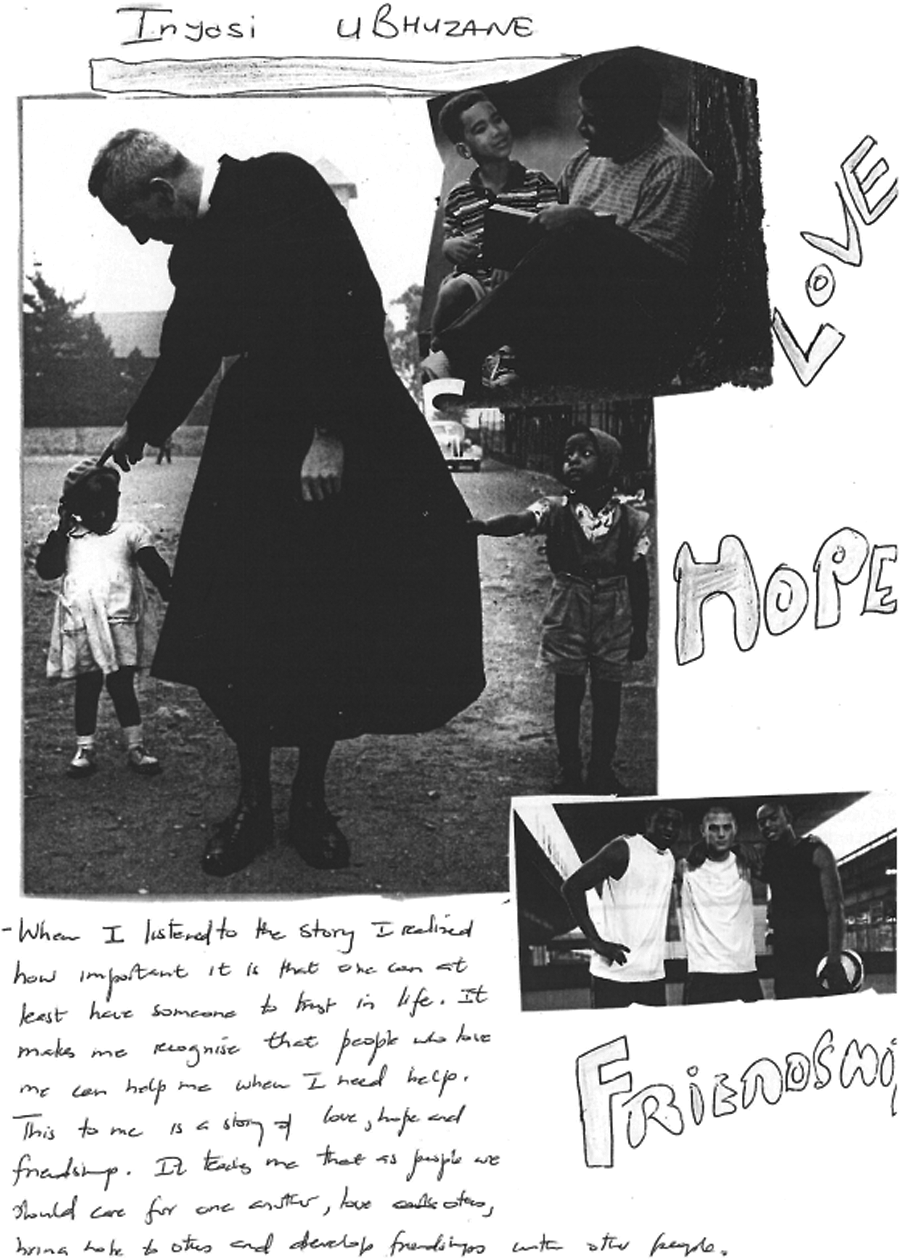
Example of a collage we created.
Our explanation of the collage is “When we listened to the story, we realized how important it is that one can at least have someone to trust in life. It makes us recognize that people who love me can help me when I need help.” When the children then attempted the task again (see Figure 5), they were able to produce visual artifacts with narratives that provided us with ample data. Participant 6 explained her collage as follows: I have learnt that caring for God’s animals will lead one to being rewarded. I like what is happening today, people caring for important things such as animals, people, and plants/flowers). When asked to further elaborate on her collage, she said that the story she chose relates to caring for one another and therefore believes that it is important that she is also cared for by her relatives and friends.

Collage by Participant 6.
Our experiences illustrate the issues that researchers should be aware of when using drawings and collages with children. It may happen that some of the children may not feel skilled enough and their feelings of inadequacy therefore may lead them to not be willing to talk about their artifacts during the activities. However, Ungar (2008) notes that children and youth can learn from their experiences and failures and develop self-efficacy which is an “individual belief that he can perform a task successfully” (Bong & Skaalvik, 2003, p. 6). Hence it is important that researchers scaffold the research process by checking with each participant and listening to each one of them.
We also learnt that it is important to be sensitive about the emotional reactions that the exercise could elicit in children. For instance, Participant 1, during the discussion based on his collage, said “when I was cutting the pictures, I cut a picture of a person—when I looked at that picture, I thought about my mom.” As researchers we need to follow-up on the child participants as the activities may invoke negative feelings that could be harmful if left unattended. Our experiences confirm the finding that such creative methods are not easy to employ with children (Backett-Milburn & Mckie, 1999).
Language Issues Can Impact on the Quality of Data Generated
Heary and Hennesy (2002, p. 48) note that in focus group discussions, children are often likely to provide responses that have been provided by an earlier speaker. However, using methods such as drawings and collage afford children an opportunity to explain their images both orally and verbally and independently from others (MacGregor et al., 1998; Kenrick & McKay, 2004; Guillemin, 2004). However, we noted that the data generation methods were more successful when we allowed them to use isiXhosa, their mother tongue, in spite of the fact that in their school English is the language of learning and teaching (LOLT). We observed that some of the children did not talk freely to us in English, but when we told them they could speak their mother tongue, there was a sense of relief in the room. In the foundation phase, the home language of the learners is used as the LOLT (Department of Education, 2009), so the 9-year-olds in this study were in Grade 3 and not taught in English. The 10- and 11-year-olds had just switched over into English and were thus not comfortable in the second language (Heugh, 2002). Moreover, in second language contexts, most teachers tend to teach in the mother tongue and code switch to English frequently in the class (Webb & Mayaba, 2010). Using English only as the language of discussion and interaction during the study would not have facilitated the production of rich data.
As much as we had translated and verbally explained all the prompts into the children’s home language for ease of understanding, we soon realized that many children still had difficulty in translating the prompt into action. This was evident when some of the children would request us to further explain orally what they were expected to do in the activities. The first author needed to use the mother tongue in order to make the message much clearer. This suggests that generally researchers need to be able to use the language of the participants, as the drawings and collages might be unfamiliar methods in some contexts.
We noticed that the older children chose to write and speak in English, although it was evident that they were not fluent in English, in both their writing and speaking skills. The children who opted to write in English were able to explain to the first author in isiXhosa the areas we could not understand in their writing. Those who chose to draw/do collage and talk used their home language to explain what their visuals meant. This emphasizes the importance of being able to communicate in children’s home languages when doing participatory research with them. In order to deal with translation challenges, we first verified with the participants the meanings of their written articulations and then gave them to an isiXhosa moderator experienced in teaching and writing books in the language to translate into English. There were instances where the moderator thought that it was difficult to translate some of the nuances in isiXhosa to reflect the intended meaning and so we had to accept that perhaps some of the meaning of the data was lost.
Importance of Taking Context Into Consideration
Our experience of collecting data in an under resourced school setting taught us the importance of working closely with the teacher, since as researchers we do not necessarily understand the day–to-day challenges of the contexts in which we do our research. It is important to constantly communicate with the teacher in terms of what we were doing and how children were responding to the research process. Since visual methods take time, we had to schedule sessions when children could focus on this without disturbing their lessons or after school transport arrangements. This was sometimes difficult to do as the timetable in the school consistently changed and we had to reschedule time for data generation.
Although the teacher was not directly involved in the research process, she communicated our messages to the participants (e.g., if we could not come on a set date). We also had to explain to her the rights of children who chose to no longer participate in the study as she was sometimes concerned about the attrition rate of participants. According to her, the participants who were in her class were showing “signs of improvement in terms of confidence since they started engaging in this project,” hence she was not happy with the inconsistent attendance of some of the participants (Mayaba, N. N. & Wood, L. A., personal communication 12 August 2011). Although this comment indicated the positive influence of our visual methods, it had the potential of causing problems in terms of ethics. On the one hand, we realized that we were contributing to the learners’ learning, whereas on the other hand, we had to accept that children had the freedom to withdraw. We had long discussions with the teacher about this to prevent her from telling the children to attend.
Conclusion
Our research question was What could we learn from critically reflecting on our use of participatory visual methods with children? Looking back on the process of using drawings and collage as data generation methods, we realized it was not easy to do in practice—indeed, it was not “child’s play.” Although we found that using drawings and collages can produce rich data as well as prove to be beneficial for participants in other ways (see Author, 2015, for an explanation of the academic and socioemotional benefits), we found that using these methods with children requires researchers to be able to scaffold the interventions according to the ability of the children, to be able to be conversant in the home language of the participants, and to be aware of the implications of context in which they are doing research. Using visual strategies requires more time, patience, and flexibility on the part of the researcher than more traditional and less participatory methods, and if researchers do not accommodate these needs, then the data generated will suffer in terms of quality and validity. We believe that the lessons that we learnt when using visual data generation strategies could benefit other researchers who use similar methods with children.
Footnotes
Declaration of Conflicting Interests
The author(s) declared no potential conflicts of interest with respect to the research, authorship, and/or publication of this article.
Funding
The author(s) disclosed receipt of the following financial support for the research, authorship, and/or publication of this article: SANPAD funding received for the Read me to Resilience project.