




Abstract
This article is premised on the understanding that there are multiple dimensions of the case–theory relation and examines four of these: theory of the case, theory for the case, theory from the case, and a dialogical relation between theory and case. This fourth dimension is the article’s key contribution to theorizing case study. Dialogic engagement between theory and case study creates rich potential for mutual formation and generative tension. The article argues that the process of constructing and conducting the case is theory laden, while the outcomes of the study might also have theoretical implications. Case study research that is contextually sensitive and theoretically astute can contribute not only to the application and revision of existing theory but also to the development of new theory. The case thus provides a potentially generative nexus for the engagement of theory, context, and research.
Introduction
Case study is a prominent approach in the social sciences and one that is, in our experience, especially popular among postgraduate students (Rule, Balfour & Davey, 2011). Despite this popularity, the approach has been the subject of critique and confusion in this journal and elsewhere. Van Wynsberghe and Khan (2007) draw attention to the anomaly that, despite regular use of case study, irregular and poor definitions abound. Verschuren (2003) points to the ambiguity and lack of clarity regarding the object of study and the way that this object is studied. Flyvbjerg (2006) engages with and debunks five common misunderstandings of case study research. A closer examination of these misunderstandings shows that all pertain to relationships between theory and research at some level. Conceptual frameworks that help researchers navigate these multiple relationships between theory and case study are thus needed.
Thomas argues that the terms “theory” and “induction” are not appropriate for the specificity of the insights that case studies generate and should be replaced by “abduction” and “phronesis” (Thomas, 2010). We argue that theory, despite its limitations in the social sciences, is an important and necessary aspect of case study research. Indeed, many well-established theories in the social sciences have arisen from small-scale studies, but the specifics of the singular continue to challenge the generalities of theory.
This article attempts to “re-imagine” the relations between theory and case study research. We begin by examining the nature and key features of theory and posit a set of relations among theory, research, and practice. We argue that all case studies are based, implicitly or explicitly, on a theory of the case. We consider two existing approaches to linking case study and theory, an inductive, theory-building approach (theory for the case) and a deductive, theory-testing approach (theory from the case), and propose a bidirectional dialogic approach. By way of illustration, we draw on an analysis of individual case studies primarily from our field, educational research, both our own and others, which engage with theory in different, and at times multiple, ways. We conclude by considering ways in which multicase studies might engage dialogically with theory. Such dialogic engagement between theory and case study creates rich potential for mutual formation and generative tension.
What is Theory?
Our discussion here uses Dimitriadis and Kamberelis’ (2006, p. vii) definition of theory from their book Theory for Education as a starting point and then elaborates three key aspects of theory. They define theories as: abstract sets of assumptions and assertions used to interpret and sometimes to explain psychological, social, cultural, and historical processes. Theories are tools to help us think about things in new ways. Good theories are useful.
Theories are abstract. This is a strength of theory. The removal of theory from specific concrete realities means that it is possible to generalize theory to more than one context. Good theory is able to move between and across a range of contexts. However, the danger is that the abstraction of theory leads to its uncritical application in contexts that are unsuitable or where the theory requires substantial recontextualization in order to be applied effectively. An associated danger is that the context from which the theory arises is ignored.
Theories help to interpret and explain phenomena. The power of theory lies in its ability to provide interpretive and/or explanatory insights into phenomena and the relations among them. In educational contexts, this might include, inter alia, classroom processes, curricula, educators and learners, management, and governance policies and processes. Theories act like lenses that afford different ways of seeing and understanding phenomena.
Theories are thinking tools. The use of theory requires not only a detailed understanding of the theory itself, an application of the theory, and an interpretation of the phenomena in the light of the theory but also critical reflection on these processes. In this way theory, as an abstract noun, can reveal itself as a verb, a process of theorizing.
Good theories are useful. The extent to which theory illuminates phenomena is the extent to which it is useful. This illumination could contribute simply to understanding a phenomenon in a more comprehensive or integrated way. It could also move beyond understanding and contribute to improved practice. However, theory also entails the danger of obscuring certain aspects of the phenomena, since the “tint” of theory may distort them or even render them invisible.
A dialogical approach to theory understands that “theory” itself is a nominalization of a process: Someone theorizes about something in a particular context. Rather than being a monolithic and monological set of ideas, theory arises from the dialogue between a theorist and antecedent theories, contexts, problems, cotheorists, and so on, and a theory develops through processes of testing and experimentation (dialogue with research) and of practical application as theorists apply and reflect on the theory (dialogue with practice) and as they elicit and respond to critique (dialogue within a community of scholarship).
Theory, Research, and Practice
We understand the relations among research, theory, and practice as potentially dialogic and multidirectional, depending on the nature and purpose of the research and the context in which it is situated. This can be diagrammatically represented as a triangle in which theory, practice, and research are all dialogically related to each other (see Usher & Bryant, 1989). They can develop each other and are potentially mutually reinforcing. On the other hand, because they are different spheres of human activity with different purposes and priorities, there is an inherent tension among them which can be both challenging and generative. In Nikulin’s dialogic terms, these tensions are not necessarily resolved (consensus) but might persist in productive conflict (allosensus; Nikulin, 2006). The particular relations among theory, practice, and research will be shaped by the context in which they are located. This could include factors such as the actual situation, the purpose of the activity, the people involved, and the resources available. Depending on one’s research purpose, one can begin with any one of them and then move to the others, as Figure 1 indicates.

Relating theory, practice, and research.
An advantage of this approach is that it sees both theory and research as relevant and beneficial to, but also challenged by, practice. This is often a concern of postgraduate students who adopt a case study approach in order to investigate a context of practice with which they are familiar (Rule, Balfour & Davey, 2011). In dialogical terms, practice may posit a question or a problem statement to which research and the “answers” that it generate are a rejoinder. On the other hand, a practitioner can do research and test or generate theory that can actually develop practice. Here theory asks the question and practice responds. Theory is therefore not only the domain of academic theorists and research does not belong to scientific researchers, but both can inform and be informed by practice.
Theory might challenge practice by questioning the coherence of its assumptions and how they relate to each other and to the wider context. For example, a teacher might answer the question, “Why do you teach in the way that you do?” with “Because that is the way I was taught.” This response might be challenged regarding how it relates to the needs, contexts, and policies of the present. On the other hand, practice can challenge theory by questioning its relevance and usefulness to practice. “How can this theory help me in my particular practice? Does it work in practice? What are its advantages and limitations in practice?” The practitioner can contribute to developing, modifying, or refuting the theory from the perspective of practice. This is particularly important in contexts of the South, where theories are often imported from foreign contexts and applied uncritically as if they would automatically fit local conditions.
Research is a useful way of structuring a dialogue between theory and practice. Our argument in this article is that this structuring can happen in different ways. A practitioner could design a research process that would enable him or her to test or apply a theory to practice or to generate theory from practice. The research design would help him or her to relate theory and practice in a systematic way that can be recorded and assessed. There are a range of research approaches that can help practitioners relate theory and practice, including action research, participatory rural appraisal, and case study. In the subsequent section, we examine theory in relation to case study research.
Theory and Case Study Research
Theory has preoccupied a number of authors in the case study literature, with a range of conclusions about the nature of the relation between theory and case study (Eisenhardt, 1989; Simons, 2009; Stake, 2005; Thomas, 2010; Westerman, 2011; Yin, 2009). These responses may be attributed partly to differences in understanding of the ontology of the case and the epistemology of the study as a social science enterprise. Simons (2009, p. 3), for example, sees case study as “a study of the singular, the particular, the unique” and exemplifies this approach with reference to Katherine Mansfield’s detailed and nuanced descriptions of incidents in her short stories. She sees in the particularity of the case the potential to recognize a universal truth. This is based on a view that the particular encapsulates the universal: the One is present in the one and may be recognized through careful and sensitive research, much as a work of art may reveal essential truths about the human condition. From this ontological basis, Simons dismisses as a myth the contention that “You cannot generate theory in case study research” (Simons, 2009, p. 168). She identifies three types of theory that arise from the case itself: grounded theory, which involves generating concepts from the data themselves through a process of coding and categorization; building cumulative theory through cross-case analysis of a number of cases; and developing a theory of the single case itself that explains or interprets it. From Simons’ ontology of the case as both unique and universal arises an epistemology of generating universal truths and insights from the particular. Eisenhardt (1989, p. 548) notes that theory “developed from case study is likely to have important strengths like novelty, testability, and empirical validity.”
Stake (2006, p. 8) argues that single “case studies and multicase studies are usually studies of particularization more than generalisation. One can use a case study or multicase study as a step towards theory.” Stake here sees case study research as serving both theoretical and practical purposes. When the purpose is to go beyond the case, Stake calls this an instrumental case study as opposed to an intrinsic case study where the case itself is the primary interest. Stake (2005, p. 448) argues that “Damage occurs when the commitment to generalize or theorize runs so strong that the researcher’s attention is drawn away from features important for understanding the case itself.” Multicase study, a feature of Stake’s (2006) work, serves instrumental and theoretical purposes, and here the researcher faces a dilemma in terms of balancing attention to the complexity and particularity of individual cases and the generality and generative potential of the whole.
For Yin (2009, p. 18), a case study is “an empirical inquiry that investigates a contemporary phenomenon in depth and within its real-life context, especially when the boundaries between phenomenon and context are not clearly evident.” For Yin (2003, p. 32), the goal of case study research is analytical generalization rather than statistical generalization. Yin prioritizes a theory-first approach to case study. This is evident in the second part of his “technical definition,” where he contends that case study inquiry “benefits from the prior development of theoretical propositions to guide data collection and analysis” (Yin, 2009, p. 18). He advises that case study researchers construct “a preliminary theory” related to the topic of the study. This prior construction of theory distinguishes case study from grounded theory and ethnography. It is an essential part of the design phase, “whether the ensuing case study’s purpose is to develop or to test theory” (Yin, 2009, p. 35). Thus, Yin would not concur with Simons’ views about the potential of case study to generate theory using a grounded theory approach or to develop a theory of the single case. For Yin, the ontology of the case is not singular or unique.
A limitation of this theory-first approach is that, while it might generate a strong research design, a clear focus for data collection, and a program for data analysis, it might also obscure unanticipated findings and suppress the potential sources of surprise and challenge within the case. It also does not allow for a study of a case that is intrinsically interesting for its own sake, for what it might produce out of its own richness, as opposed to cases that instrumentally serve the purposes of theory testing or theory development.
Given the potential pitfalls of the theory–case relation, one might question, with Thomas (2010), whether theory is a useful category at all in case study research. Thomas argues that the social sciences broadly, presumably unlike the natural sciences, are unable to produce generalizations through induction. He thus offers an epistemological objection to the status of theory in the social sciences. Case study, unlike other approaches, does not disguise this limitation. What case studies can do is produce what Thomas terms “exemplary knowledge” or “phronesis” through “abduction.” This is not indisputable theory but rather “a fluid understanding that explicitly or tacitly recognizes the complexity and frailty of the generalizations we can make about human interrelationships” (Thomas, 2010, p. 577).
The term phronesis derives from Aristotle and means “practical knowledge, craft knowledge, with a twist of judgement squeezed in to the mix” (Thomas, 2010, p. 578). It also has connotations of “practical” or “tacit” knowledge which requires the exercise of contextual discernment as to its local applicability. Thomas’ critique of “theory” in the social sciences is provocative and insightful, but we wish to retain the term, acknowledging its limitations in relation to the contingency and unpredictability of social reality, in arguing for the multiple dimensions of its relation to case study. This is because “theory,” despite Thomas’ objections, has a currency in social science research and theories and, if used prudently, can serve as valuable resources for understanding and engaging the social world.
We argue that both theory-generating and theory-testing approaches have value within case study research, that both these approaches are predicated on a theory of the case, and that the relation between theory and research is often more complex and dialogic in practice. We illustrate these arguments as we examine four dimensions of theory in case study research subsequently.
Four Dimensions of the Theory–Case Relation
Theory might relate to case study in a number of ways. First, there is theory of the case which informs how the case is constructed and selected. Second, theory for the case: here cases might test or apply theory. The researcher might begin with the theory and see how the case does or does not fit. This might lead one to confirming, revising, or rejecting an existing theory. Third, theory from the case: one might begin with the case and generate new theory from it. This links with a grounded theory approach that seeks to generate theory from concrete data through processes of careful bottom-up analysis. We propose that a fourth, theory–case interaction approach could see the relation between theory and case as dialogical: One might draw on theory to define, select, and problematize the case but also use the case to develop new theoretical perspectives. Thus multiple relations between theory and the case might conceivably exist within a particular study.
Theory of the Case
A theory of the case is perhaps a neglected aspect in discussions of case study and theory. The “case” does not just exist as a “case” in itself but has to be constructed as a case for study. This entails the researcher conceptualizing what the “bounded system” of the case is; what constitutes the case; what it includes and excludes; and what it is a case of. In this sense, the very act of constructing the case—what Bassey (1999, p. 24) calls “the imagination of the case and the invention of the study”—assumes a theory of the case. Creswell (2003, p. 133) acknowledges this theory-informed beginning in qualitative research when stating “no qualitative study begins from pure observation and that prior conceptual structure composed of theory and method provides the starting point …” We argue that this “conceptual structure” extends to the construction of the case itself as a particular unit of analysis.
In another sense, a case study might involve uncovering the “theory” or “theories” of the case that exists among participants and stakeholders: How they understand the case and its relation to context. Here the participants’ theory of the case might be revealed by the case study itself and might inform the development of theory from the case (see third section). Typically, participants’ “theories of the case” arise from insider experience of and practices within the case, whereas researchers’ “theories of the case” arise from perspectives of theory and literature, and these may or may not coincide. The metaphors that participants use to describe the case can be revealing in this regard. While the researcher might see a phenomenon as an “organization,” for example, insiders might describe it as a “family” or a “community” (Figure 2).

Constructing “the case” in case study research.
We believe that it is important to acknowledge this notion of “theory of the case” in case study, as it is a neglected aspect in discussions of case study and theory as pointed out earlier. Many case study writers refer to the confusion that abounds regarding what is a case, what it is a case of, and what is not a case. Stake (2006), for example, argues that only entities such as programs and organizations should be considered cases for study, and the “functionings” such as learning or mentoring should not be treated as cases. What Stake is doing here is what we argue as proposing a “theory of the case” which entails the researcher conceptualizing what the ‘bounded system’ of the case is; what constitutes the case; what it includes and excludes; what it is a case of.
For an example of theory of the case, consider the following title of a case study, “Communities of learning and action?”: a case study of the Human Rights, Democracy and Development Project in rural KwaZulu-Natal, 1999–2005 (John, 2009). The process of constructing this case as a bounded system reveals the researcher’s initial theory of the case which serves to provide thematic focus and design delimitation. The title reveals theoretical foundations in setting up an educational project as a potential “case” of social learning and community action. Here the researcher’s underlying theorizing of the case provides a thematic focus for the study. The theory of the case at this initial stage in the research also carries spatial (rural KwaZulu-Natal) and temporal (1999–2005) delimitations that reflect the researcher’s deliberate framing of the case under study. This is another way in which the researcher constructs the case, what Bassey (1999, p. 24) calls “the imagination of the case” and involves theoretical assumptions about the case and what it is a case of. We often overlook or take for granted as “common sense” such implicit theorizing of the case which we engage in during early conceptualization and design stages of case study research, but it is predicated on particular assumptions about what constitutes the particular case under study and cases in general.
The theory of the case in research might therefore arise from the tacit knowledge associated with practice or from the formal knowledge of theory or some interaction between the two which the research process initiates in the “imagination” of the case. A student might select a research “case” from his or her practice as a teacher (a class, a program, and a group of learners) and then relate the case to existing literature or perhaps identify a focus for a “case” from literature and theory (“the resilient school”). Figure 2 indicates the nexus of theory–practice–research within which the construction of the case might arise.
Theory for the Case
Deductive theory: Testing theory through case study
Deduction moves from the general to the specific. This is common in quantitative research which sets out a general theory (a hypothesis) and then tests the theory in practice. However, deductive designs can also be used in qualitative or mixed-method case studies. This approach is often adopted in instrumental case studies (Stake, 2005), where the case is selected not for its own intrinsic interest but rather to provide insight into an issue or to test a theory.
Often explanatory case studies and instrumental case studies begin with a particular theory and seek to apply it to one or more cases and sometimes in different contexts. For example, Sims’ and Sinclair’s (2008) study of the Instituto Costarricense de Electricidad in Costa Rica draws on transformative learning as a theoretical lens to understand farmers’ learning on environmental programs. From this theory, they use the concepts of instrumental and communicative learning to analyze the learning and transformations of farmers and find that “learning was rarely exclusively instrumental or communicative” (p. 164). Such a case study helps to determine the cross-cultural relevance of a theory emanating from a Western context.
This theory-first approach is useful for applying and developing theories in new contexts. The theory might drive the case in the sense of selecting the case or cases for the purpose of testing the theory, or the case might, by its nature, suggest the use of a particular theory or theories. In both of these strategies, preexisting theory is applied to the case (Figure 3).

A theory-first approach to case study.
These kinds of studies often adopt a case-as-argument structure where the case is chosen for its instrumental value in advancing theory. Yin (2009, p. 177) refers to this as a “theory-building structure.” In dialogical terms, research posits a rejoinder to the questions posed by theory.
Theory From the Case
Inductive theory: Generating theory from the case
Inductive reasoning moves from the specific to the general. This is common in qualitative research that focuses on specific instances and may then, based on these instances, make tentative generalizations, which would require further research for confirmation or refutation.
Some approaches to case study, for example, exploratory case studies, do not aim to test or apply existing theory but rather to generate theory. Such approaches to theory include grounded theory and phenomenology. Regarding case study research, both approaches would attempt to generate theory from the ground up, rather than impose it on the case from above, as it were. Often this approach is adopted in intrinsic case studies (Stake, 2005), where the focus of interest is on understanding the case itself in its own right, rather than using the case to test a theory.
Is it possible to approach a case without any theory at all? Phenomenology is an approach that attempts to lay aside preexisting assumptions and to look at “the phenomenon” as it is actually experienced and to describe it in detail. The phenomenologist “brackets” his or her assumptions: This means acknowledging these assumptions, naming them and setting them to one side so that they do not impede one’s view of the phenomenon, or to use another metaphor, color one’s perception. By doing this, phenomenologists strive to gain a new view and generate fresh insights into something, which might be seen in conventional old ways. Of course, phenomenology is itself a philosophical approach that is made up of various theories.
For example, an educational researcher might deliberately set aside his views on teaching, learning, and curriculum and try to observe a classroom in order to see what actually happens there. This might involve spending some time in the classroom and observing very closely everything which might have been taken for granted or categorized according to preexisting concepts. Habitual and conventional ways of seeing might blind a researcher to important factors. What do people actually do and not do? What do they say and not say? How do they behave, dress, gesture, and interrelate?
Grounded theory is an approach to research that was developed by Strauss and Corbin (1990). It seeks to develop theory about a phenomenon inductively from a study of the phenomenon. The theory emerges from a systematic collection and analysis of data about the phenomenon. In the data analysis phase, the data can be coded in different ways. Open coding involves asking questions about the data (e.g., What is the main idea in this paragraph? What is going on in this paragraph?) and developing a category that captures this and then making comparisons with other parts of the data to see whether the category fits in elsewhere. Axial coding involves putting the data back together in new ways after open coding by making connections between categories. A third type of coding is selective coding. This involves identifying a “core” category and relating it systematically to other categories. The researcher keeps detailed memos throughout the process of analyzing the data which assist in developing theory (see also Babbie & Mouton, 2001).
Two kinds of theory can emerge from a grounded theory approach. Substantive theory is a “description and abstraction of what goes on in a particular kind of social setting” (Fouche, 2002, p. 274). This is a kind of “local theory” that does not claim to explain phenomena in other settings. Formal theory is a more general and purportedly generalizable kind of theory. It consists of abstractions and hypotheses developed from the study that can be tested in other settings (Figure 4).

A theory-building approach to case study.
A few years ago, we were involved in a study that was investigating how HIV and AIDS affects schooling in Richmond, KwaZulu-Natal, a province on the eastern seaboard of South Africa. Richmond was an area characterized by political violence in the 1980s and 1990s (John & Rule, 2006). Our initial analysis in this study indicated that an understanding of the context, particularly Richmond’s violent past, was central to an understanding of HIV and AIDS and schooling. In the process of developing such an understanding, we generated a theory of context using a grounded theory approach. Through a process of inductive analysis, we theorized context using the metaphor of “ground” and applied this theorization to the case of Richmond. This theory-building approach to case study, providing a contextual understanding of Richmond as a geographic and sociohistoric space, as a community and as a discursive space. We explained the purpose and value of this theory building to the case study in the following terms: In developing a new theorisation of context, we move beyond the conventional understanding of context as a background of key processes, events and developments. We add the notion of context as foreground, which accommodates the continuing effects in the present of historical factors as well as new developments. We included an analysis of discursive context as liftground and underground in an attempt to capture the public discourses of the media and politics, as well as the often submerged discourses of ordinary people. This nuanced approach to context provides framing perspectives through which to explore the socially embedded nature of HIV/AIDS in education and suggests wider applications in education. (John & Rule, 2006, p. 183)
This study of the case of HIV and AIDS in relation to education in the Richmond community thus generated unanticipated theory regarding context that might be generative in other contexts. A study might, on the other hand, explicitly set out to develop theory from a particular case or cases, as in a grounded theory approach. In dialogical terms, research generates questions that provoke a theoretical response.
Between Theory and Case
A dialogical model
Both the deductive, theory-verification model and the inductive, theory-building model suggest a linear progression, either from theory to research or from research to theory. Yin (2009) argues that it is misleading to assume that case study does not involve a prior consideration of theory. As indicated in the first dimension mentioned earlier, the very act of selecting a case assumes a “theory of the case”—that is, what constitutes the case and what it is a case of, as explained earlier.
A fourth way of understanding theory and research within case study is to see them as interacting dialogically throughout the research process (Rule & John, 2011). The term “dialogue” comes from the Greek compound word dialogos which signifies “conversation” or “discourse”. The prefix ‘dia’ signifies “two” or “apart,” thus indicating that difference is pivotal to the notion of dialogue, a presupposition for the engagement that occurs (Rule, 2004). Dialogue also signifies an open-ended interaction between contextually situated participants in a quest for understanding. Dialogue helps us to reconceptualize “theory,” ”practice,” and “research” and the relations among them as distinct and situated processes involving participants: Someone theorizes about/practices/researches something in a particular context for particular purposes. This someone engages in dialogue with self and others in the process of theorizing/practicing/researching. This dialogue might take place within and across chronotopes of time, place, and axiology (Bakhtin, 1984). The dialogue of research might generate working solutions to research problems, as theory sheds light on research practice and vice versa. It might also generate new problems and unresolved tensions in the creative process of research, what Nikulin terms an allosensus—a productive conflict within dialogue—as opposed to a monologizing consensus or an antagonistic dissensus, which he sees as the end of dialogue (Nikulin, 2010, pp. 78–79). The inherent unfinalizability of dialogue (Bakhtin, 1984; Freire, 2000; Rule, 2011) means that the relations among theory, practice, and research are never resolved once for all, but continue to generate new collisions, possibilities, and insights.
Such a dialogic approach thus acknowledges that theory infuses research in all its aspects, including the identification and selection of the case, the ethics and power dimensions of the case and its study, the formulation of research purposes and questions, the survey of literature, the collection and analysis of data, and the presentation and interpretation of findings. On the other hand, research in all these phases can have implications for developing and modifying or revising theory. For example, the process of identifying a case of a “resilient school” or a “learning organization” might challenge the way that these terms have been understood and defined in the literature and have implications for theories of resilient schools and learning organizations.
Westerman (2011) uses a theory-building case study approach to investigate the tenets of interpersonal defense theory. Here, he starts with a theory (interpersonal defense theory) and applies it to a particular case, using the case to test its tenets. This is thus explicitly a “theory-first” or “theory for the case” approach. However, as he proceeds, Westerman finds that his observations from the cases suggest ways of refining and elaborating interpersonal defense theory. From this, he generates new tenets of the theory. He thus argues that theory-building case study can be used both to validate existing theory and to develop it further: With regard to theory validation, [case study] can provide an especially compelling kind of confirmation of theoretical tenets. With respect to theory development, it offers a method that can lead to refining and elaborating a theory. (p. 452)
This illustrates the dialogical potential within the case–theory relation: Theory informs case study but is in turn informed by the case or cases in a way that can further develop the theory.
Hoadley’s (2006) study of pedagogic practice in South African primary schools is a good example of the dialogic approach between theory and research. Hoadley’s research began with an application of Bernstein’s theory of classification and framing for analyzing classroom practice. In this sense, the study initially adopted a theory for research approach. However, in the analysis process, Hoadley (2006, p. 30) encountered instances of “pedagogic breakdown” which could not be accommodated by Bernstein’s theoretical categories, leading Hoadley to propose the extension of the scale by including a new value to record instances where the researcher is unable to observe the pedagogic code for instructional discourse. Eisenhardt (1989, p. 548), in an early contribution on theory-building case studies, calls this “framebreaking insights.” The Hoadley example illustrates the dialogic two-way relationship between theory and research. Hoadley explains the necessity to extend the scale in order to make Bernstein’s theory more suitable for research in the South African context with its greater range of pedagogic forms. She aptly describes a dialogic approach: “In this way the original theory begins to open up both the possibilities and the exigencies for further theorizing. However, it was necessary to start with a sound theory in order to make this visible” (Hoadley, 2006, pp. 30–31).
In this example, Hoadley’s analysis and interpretation of data revealed a lacuna within existing theory and suggested theoretical elaboration and innovation. Similarly, other stages of the research might engage interactively with theory (Figure 5).

A dialogical approach to theory in case study.
One advantage of this approach is that it sees research as a recursive process. There is a constant backward and forward motion between theory and the practice of research as well as between the different stages of the research process. For example, the survey of literature might draw researchers to theory, as they consider an appropriate theoretical framework for the study or key concepts that might help them to clarify the focus and purpose of the study. The stage of collecting data might pull them back to case study theory as they consider what precisely the case is and what its boundaries are and to the research purpose and questions in the light of unexpected problems or opportunities in data collection. Similarly, the stage of analysis and interpretation of data might draw them back to theory—reading more around grounded theory, perhaps, or formulating theory by writing notes about concepts emerging from the data. A dialogical model suggests that theory and research are not as easy to separate as linear theory research or research theory models indicate.
Within case study research, there are two particular theory–case dimensions, which are worth further dialogical elucidation. The first is the dialogue between the “case” and the “study.” The “case” indicates the objective aspect of the research in the sense that the “case” constitutes the “object” that is investigated. The “study,” on the other hand, indicates the subjective aspect: a person or persons who “study” the object. Theory in case study always involves a continuing dialogical engagement between the “subject that studies” and the “object that is studied,” whether the subject is generating theory from the case or applying theory to the case or both. The particular disposition of the subject toward theory (“I am a Grounded Theorist / phenomenologist / critical theorist,” etc.) will strongly inform his or her understanding and treatment of the “object.” The object, on the other hand, and its particular relation to context, data, and prior theorizations will inform and constrain the subject’s possibilities for theorizing. In addition, the “subject” might occupy a range of complementing and/or contending positions in relation to the case. In addition to being a researcher, he or she might be or have been, for example, a participant (e.g., a teacher researching her classroom) or a beneficiary (a graduate of a program). “Case study” thus involves a dialogical compact between the researcher and the object of research which is inherent in the case study approach.
This compact between the researching subject and the researched object has applications to qualitative research beyond case study. Although case study requires particular attention to the construction of the case as a case of something, a unit of analysis, any qualitative research has to identify an object to be researched, and consider the relation of the researching subject to that object in a reflective and reflexive process (Alvesson & Sköldberg, 2009). In the unfolding research process, the researcher questions his or her own subjectivity and subject positions as a researcher, the nature of the research object that he or she has constructed, and the relation between the two. Such reflexive questioning might change the way that the researcher sees himself or herself and the object of research, particularly (but not only) when his or her own story is the unit of analysis as in autoethnography. The continuing subject–object dialogue in qualitative research is thus at the heart of this reflexivity.
The second theory–case dimension is between “the one” (the particular case) and “the One” (the class of cases to which it belongs). This relation is theoretical in the sense that the one might bear several different relations to the One. It might be a typical case (e.g., an “average” school regarding performance, demographics, and socioeconomic profile), an extreme or deviant case (a nonperforming school and an outstanding school performing “against-the-odds”), an influential case (a “model” school), or a study might select a diverse range of “ones” in order to shed various lights on the One. Each relation will have particular theoretical implications regarding how one theorizes and what one uses to theorize. The theories of the One (e.g., “the resilient school”) will inform how one constructs and understands the one (the particular “resilient school” being studied) and the findings from the study of the one might, in turn, inform theorizations of the One.
Again, this has broader implications for qualitative research, as researchers ponder the ontology of their object of research (whether constructed as a case or not) and how it relates to that of comparable objects and the epistemological status of the claims they make about this object. A case study approach arguably sharpens this dialogue by explicitly delimiting the case as a case of something and so with a particular relation to that something, but all qualitative research would implicitly involve a discourse of the relation between the one/ones studied and wider phenomena, whether this is formulated in terms of, inter alia, “analytical generalizations” (Yin, 2009, p. 15), “fuzzy generalizations”(Bassey, 1999, p. 54), or “abduction and phronesis” (Thomas, 2010, pp. 576–578).
These dialogical dimensions of case study and theory are framed within the broader nexus presented earlier of research–theory practice within a particular context. The case bears a dialogical relation to these aspects that might change over time as the case and/or its context changes and as the researcher’s understanding of the case changes.
Theory in a Multiple Case Study
A dialogical model of the theory–research relation is suggestive for multicase studies. The multiple-case study on distributed leadership in schools (Grant, 2010) provides an example of how case study design can accommodate various relations to theory. The study initially adopted a theory-first approach as represented in Figure 6. The study examined teacher leadership in seven schools and one further education and training college. Specifically, it used the theory of distributed leadership as a conceptual framework for the study and a tool for analysis of the data on the enactment of teacher leadership in various contexts. Drawing on Gunter’s (2005, p. 51) categories of “authorized, dispersed, and democratic” distributed leadership, the multiple-case studies allowed for the development of 33 portraits of teacher leadership.

A theory-first approach to a multiple-case study.
This approach is also known as a collective or comparative case study, “where the focus is both within and across cases” (Punch, 2009, p. 119). It is instrumental in the sense that cases are selected in order to test a theory and explanatory in its use of a theory to explain the leadership situations in each case.
One advantage of multiple-case studies is that they provide some basis for generalizability. While single case studies might at best yield “fuzzy generalizations” (Bassey, 1999)—that is, tentative statements about the relations among factors that might be applied to other contexts—multiple-case studies provide greater scope for generalization. If the same phenomenon is evident in a number of different contexts, it is possible that it may reveal a broader trend that is significant on a wider scale. Yin (2009, p. 38) refers to this type of generalization as “analytic generalization”, which occurs when “a previously developed theory [e.g. theory of distributed leadership] is used as a template with which to compare the empirical results of the case study.” If, in a multiple-case study, the results from several cases support the theory, “replication” may be claimed.
The same multiple case study shifted from a theory-first approach that applied theory to the cases to a theory-building approach that moved through a process of data analysis and interpretation to revise existing theory or, when the theory was found not to be useful, generate new theory (Grant, 2010). The study was able to interrogate the relevance of the characterizations of distributed leadership in the South African schooling context and confirmed use of a “leadership as disposal” category (Grant, 2010, p. 1). Figure 7 illustrates how the analysis and interpretation of the data from the case studies provided material for critically reviewing the theory of distributed leadership. This indicates that the same case study might have various relations to theory, either simultaneously in the dialogic engagement of theory and research or sequentially as the case study moves from one stage (e.g., theory application) to another (theory revision/generation).
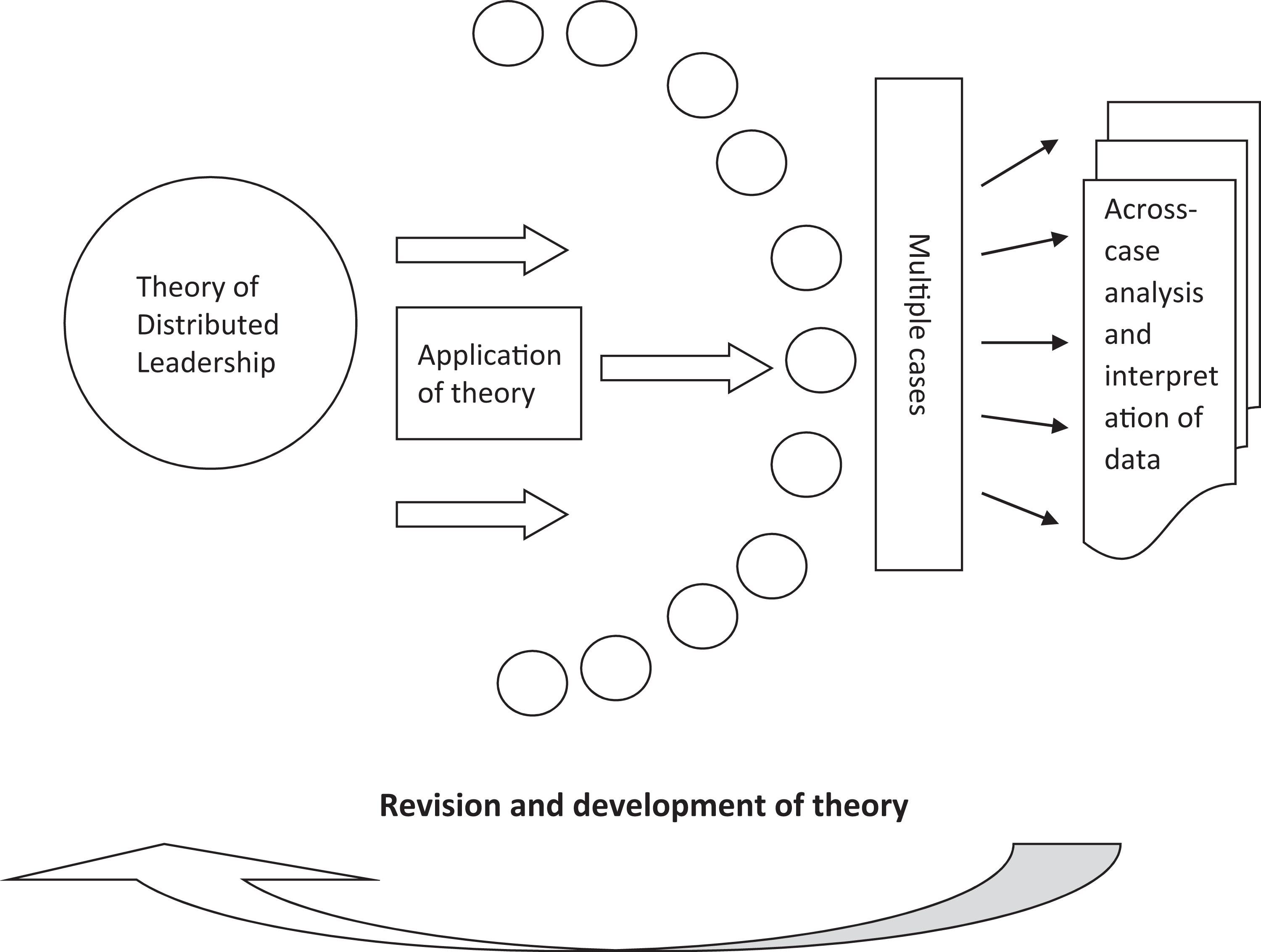
Across-case analysis and theory development.
Conclusion
Case study is a widely prevalent approach within educational research but has been criticized for its lack of theoretical depth and rigor. This article attempted to provide a basis for addressing this weakness by critically examining four dimensions of theory within case study research. The conventional theory-testing and theory-building approaches to case study are both predicated on a theory of the case that implicitly or explicitly constructs the case as an object of inquiry. In the recursive practice of research, case study can involve a dialogic relation between theory and research, and case study might engage with theory in different ways at different stages of the study. This also entails a dialogic relation between the “case” (object of research) and the “study” (subject researching) and between the particular case (the “one”) and class of which it is an instance (the “One”). Whatever the study-specific variations in the relations between theory and the case/cases, the dialogic engagement between theory and case study entails the rich potential for mutual formation and generative tension. This can be realized through greater attention to the articulation between theory and research within case study. Crucial to this is the exercise of creativity, critical discernment, and sensitivity to local contexts.
Footnotes
Declaration of Conflicting Interests
The author(s) declared no potential conflicts of interest with respect to the research, authorship, and/or publication of this article.
Funding
The author(s) received no financial support for the research, authorship, and/or publication of this article.