




Abstract
The aim of this paper is to analyze the dual contribution of action research (AR) both for research as well as business practice, and how this methodology puts into practice a win-win collaboration between researchers and practitioners. In order to get this, we define three specific objectives: first, we develop an evaluation framework to assess the contribution of AR methodology for research and practitioners in the field of management. Second, we use this framework to evaluate the dual contribution of AR in the specific field of operations management (OM) through a systematic literature review, which allows to analyze a set of 62 papers. Third, we identify opportunities and challenges to enrich the dual contribution of AR studies in OM. Main findings show that the evaluation framework developed represents a tool that may be useful to assess the dual contribution of any study based on AR in the field of management. Besides, the analysis of AR in the field of OM highlights that most of the papers identified are focused on “theory building” (research) and “implementation” (practice) as there are studies that have used AR to develop contributions based on “theory testing” and “theory elaboration,” and also in terms of “diagnosis” and “proposals.” Finally, this study signals that, with the aim to assure research rigor and relevance of practitioners’ contribution of AR studies, it is relevant to give one step ahead and to develop actions such as the use of AR as a metamethodology, to highlight those relevant findings in the whole AR cycle and to develop tools and mechanisms that strengthen its dual contribution, in terms of both research and practice.
Keywords
Introduction
The contribution of operations management (OM) research to managerial practice has been a key concern in articles reviewing the OM research agenda since the early 1980s. Buffa (1980) highlighted that OM was in the process of becoming a “functional field of management” and he emphasized the need for relevance by including the manager’s point of view in the development of research. T. J. Hill (1987) also noticed that in a highly practical area of management such as OM, academics should align their research contributions with the needs of business practice. Meredith et al. (1989, p. 297) suggested “a new research agenda with an integrative view of operations’ role in organizations, a wider application of alternative research methodologies and greater emphasis on benefit to the operations manager.” Holmström et al. (2009) proposed a design science approach to bridge practice to theory rather than theory to practice in OM and explored in particular the ways in which problem-solving research and theory-oriented academic research can complement one another. More recently, Toffel (2016) highlighted that OM research needs to be more relevant to the world outside academia and encouraged scholars to conduct research that is more valuable to managers and policy makers. Stentoft and Rajkumar (2018) highlighted the importance of keeping the right balance between the two dimensions of relevance, i.e. between its theoretical and practical facet.
The aim of building bridges between managers and researchers in the field of OM has furthermore helped to reinforce empirical research (T. Hill et al., 1999). Craighead and Meredith (2008) also stressed that while OM research has actually evolved toward a more direct observation of the phenomenon being studied, it was necessary to reinforce those efforts through such research methods as case and field-based studies, experiments and action research. In the field of purchasing and supply chain management Knight et al. (2016) highlighted this need for research with a greater impact on policy and practice, and the need of working with novel methodologies. In this sense, a set of collaborative methodologies have emerged in the management literature, such as collaborative management research (Shani et al., 2008), action research (Coghlan & Brydon-Miller, 2014), design science research (Collatto et al., 2018) or intervention research (Radaelli et al., 2014).
In this paper, we focus on one of these research methods: action research (AR), which is a research approach that came out of social psychology, in which the researcher acts as a change agent (Chein, 1948; Curle, 1949; Lewin, 1946). It is a method aimed at solving problems of a social nature, in such a way that both the researcher and organizational agents actively participate in the situation being analyzed. The research should produce relevant information to help solve practitioners’ real-life problems. AR develops an action based on an agreement and promising change for all agents involved, which is subject to evaluation, comment, and modification.
However, there are many views and definitions of AR. Shani and Pasmore (1985), Brydon-Miller et al. (2001), and Altrichter et al. (2002) analyzed and defined this method in detail. They described AR as a form of an inquiry process that participants undertake to improve social or educational practices, or to help organizations analyze real problems. This requires simultaneously involving both practitioners and researchers in the inquiry process, and they suggest that AR is a research methodology based on relationships of collaboration and co-inquiry. Therefore, AR’s potential for a dual contribution to both research and managerial practice, as well as fostering collaboration between researchers and practitioners are two of its main characteristic features.
The use of AR in OM has been analyzed since the 1980s and early 1990s. Benbasat et al. (1987) and Flynn et al. (1990) already proposed AR as a research methodology for OM studies, but it was Westbrook (1995) who described the main benefits of AR for the OM community. He stated that academic research must have three features: first, it has to be useful for managers; second, it should help integrate university and industry; and third, it should contribute to theory. This author, therefore, argued that AR should be a very prevalent methodology in OM research. Following these ideas, Coughlan and Coghlan (2002) analyzed the relevance of AR as a methodology that solves a problem for a firm while at the same time makes a relevant contribution to theory, because it represents application of the scientific research method to practical problems and needs active collaboration between researchers and firms. Boyer and Swink (2008) included AR in the section of “other primary data collection methods” in an editorial about why multiple methods are essential for quality research in OM.
This paper is based on the idea that research rigor and relevance are not mutually exclusive concepts but, on the contrary, OM research needs both rigor in the research approach and relevance in the managerial contribution. Based on this premise, the general aim of this paper is to analyze and explore the dual contribution of AR for both research and practitioners. We set three specific objectives: (1) To develop a framework to evaluate the dual contributions of AR studies in management, (2) to use this framework to evaluate dual contributions of AR in OM, and (3) to identify opportunities and challenges to enrich the dual contribution of AR studies in OM. Based on these goals, we defined the following research questions: RQ1: What kind of framework could be used to evaluate the dual contribution of AR studies in the field of management? RQ2: Which are the specific characteristics of the dual contribution of AR studies in the field of OM? RQ2 (I): What kinds of research approaches are used in published AR articles in OM? RQ2 (II): What kinds of practitioners’ benefits predominate in AR articles in OM? RQ3: Which opportunities and challenges exist when aiming at enriching the dual contribution of AR in the field of OM?
Figure 1 shows the structure of the paper and the main content of each section. So, second section highlights the main features of AR methodology and develops a conceptual framework to classify and evaluate both the research and practitioner’s contributions (RQ1). Third section describes the methodology to build and analyze the database of 62 AR papers in the field of OM published between 2000 and 2017. Fourth section is devoted to the analysis of the findings from the database analysis (RQ2). Based on these results, fifth section reflects and exposes a set of arguments in order to put into practice the opportunities and challenges associated to the enrichment of dual contribution of AR studies in the OM field (RQ3). Finally, in sixth section we discuss how the conclusions derived from the analysis of the dual contribution of AR in the field of OM may be generalized to other fields of management and also offer suggestions for further avenues of research.

Structure of the paper.
AR Background and Evaluation Framework
This section first describes the main requirements of AR in terms of its dual purpose (academic rigor/contribution to research and relevance/contribution to practice). Then we develop an evaluation framework to classify AR papers according to their type of contribution.
Dual Purpose in AR Studies
A crucial aspect of rigorous research design is a proper description of the unit of analysis. One aspect that differentiates AR studies to that extent is that the unit of analysis is treated as an active agent that is part of the research group. The outcome of an AR study is, therefore, both action and research (Coughlan & Coghlan, 2002), where research is used to inform practice, and practice is used to inform research (Näslund, 2002). Consequently, as emphasized by Coughlan and Coghlan (2016), before selecting AR as a research approach, the researcher needs to carefully evaluate the needs of practitioners, the research field and the research issue. In this way, we can properly frame the dual contribution of AR based studies.
Besides, AR projects are cyclical by nature, and actually go through a spiral of phases (cycles) of planning, action, observing, as well as overall analysis and reflection as a basis for new planning and action phases (Ballantyne, 2004). The researcher is involved in the research project, and then needs to step aside to meticulously reflect on and analyze what happens in the organization (Daudelin, 1996). Thorough understanding and analysis are key requirements for taking new action.
The collaborative nature of AR is also mentioned extensively in the literature. It is another key aspect of AR and directly related to its dual purpose (Coughlan & Coghlan, 2016). In the research process, researchers and practitioners collaborate in all the AR cycles by sharing ideas and reflections. The involvement of the organization studied in the cyclic research process will increase the authenticity and reliability of the research findings. Thus, research rigor is achieved in a collaborative manner.
Due to the requirements of the collaboration between researchers and practitioners, the features of the relationship between the two will affect the success or failure of an AR study.
First, the team should naturally consist of both academic researchers and members from the participating organization(s). Such a collaborative team-based approach can enhance both the theoretical and practical knowledge for all members, as it explores the tacit knowledge of employees, their work experience, skills and know-how (Raelin & Coghlan, 2006).
Second, from a research point of view, a team-based approach with more than one researcher and with different profiles working on the same phenomenon is also recommended (Baskerville & Wood-Harper, 1996), as this can increase the rigor of data collection and analysis, as well as reduce the risk of bias (researcher triangulation).
Third, it is crucial that both researchers and practitioners have specific skills that facilitate their relationship during the project. As Coughlan and Coghlan (2002, p. 233) emphasized: “AR is a challenging approach to research because it requires confident and experienced researchers to cope with the uncertainty of the unfolding story and to be able to work as researchers exposed to the reality of organizational change in real-time.”
Figure 2 summarizes the main requirements that an AR study should consider in order to achieve the dual contribution that this kind of research approach can produce.

Main features of AR that assures dual contributions.
Evaluation Framework Proposed (RQ1)
This section develops a framework (Figure 3) for the analysis and classification of the dual contributions of AR studies (i.e., research and practitioners’ contributions), addressing RQ1. So, we explain how we have defined the dimensions of research and practitioner contributions.

Framework of the paper.
Research contribution approaches
Extant research allows classifying the research contributions of AR studies. First, there is the distinction between theory building and theory testing, which has been extensively used for classifying the theoretical contributions of empirical articles (e.g., Colquitt & Zapata-Phelan, 2007; Snow & Thomas, 1994; both in the strategic management field). Second, Fisher and Aguinis (2017) describe theory elaboration as an actionable research approach for addressing current challenges to theory development.
Therefore, we establish three types of research contributions for our framework: theory testing, theory building and theory elaboration, as it follows:
Theory testing: The driving force in conventional theory testing is deduction, the explicit development of hypotheses from a previously selected underlying theory (Ketokivi & Choi, 2014). As Spens and Kovács (2006) stated, research starts by reviewing existing theory; then, logical conclusions are drawn from this theory in the form of general laws presented as ex-ante propositions and/or hypotheses which are then tested empirically with the data collected. In other words, this kind of study follows the hypothetic-deductive model and uses theory to formulate hypotheses before testing them with observation. General conclusions are made based on the empirical corroboration or falsification of the propositions and/or hypotheses. This type of study clarifies or supplements existing theory or introduces relationships and constructs that serve as the foundations for new theory (Colquitt & Zapata-Phelan, 2007).
Theory building: The knowledge of a general theoretical framework is not necessarily required as a starting point. Propositions and/or hypotheses are produced on the basis of empirical studies instead of before observations (Spens & Kovács, 2006). Theory building is often described as inductive. The premise is that in the context of the specific research question and empirical setting, explanation (theory) derives from exploration (analysis; Ketokivi & Choi, 2014).
Theory elaboration: Fisher and Aguinis (2017, p. 438) state that “theory elaboration is the process of conceptualizing and executing empirical research using preexisting conceptual ideas or a preliminary model as a basis for developing new theoretical insights by contrasting, specifying, or structuring theoretical constructs and relations to account for and explain empirical observations.” As Ketokivi and Choi (2014) stated, in contrast to theory testing and theory building, theory elaboration is based on the researcher’s ability to analyze both the general theory and the context in a balanced manner. Efforts of theory elaboration emphasizes an abductive reasoning approach that involves modifying the logic of the general theory in order to reconcile it with contextual idiosyncrasies (Ketokivi & Choi, 2014). The abductive research process starts with the observation of a real-life phenomenon. The researchers initiate a creative, iterative process of “theory matching” and “systematic theory combinations” in an attempt to develop a possible theoretical framework or to extend the existing theory used prior to this specific observation (Spens & Kovács, 2006).
The use of AR for theory testing may generate doubts and criticism by some scholars. It is assumed, however, that there are also valid arguments to consider this methodology adequate for theory deduction or testing. Although published in a non-management journal, Titchen and Binnie (1994) recognized AR as a strategy for theory generation and testing. Furthermore, AR is a multidisciplinary approach that involves the simultaneous (joint) use of various (multiple) qualitative and quantitative methodologies or instruments. Barratt et al. (2011) considered that case studies can be used for deductive purposes, and this argument could be extended to include action research as well. Likewise, Spens and Kovacs (2006) signalized that AR has specific features to develop abductive studies.
Practitioners’ contribution approaches
In order to classify contributions for practitioners, we define three types of contributions that firms can get from an AR study:
Implementation: A contribution may be classified as implementation when the organization dealt with in the AR study has already realized a proposed solution and the results achieved are reported as well. In AR studies classified in this category, researchers usually develop a specific tool, methodology or model for the issues the practitioners face. Furthermore, the contributions for the practitioners are quantified and there is a description of the implementation phases that have been carried out.
Proposal: A contribution may be classified as a proposal when the AR team recommends specific actions to the practitioners to improve the situation. These recommendations can come in very different forms (e.g., a strategic plan or a change program), however, no actual implementation of any solution is reported in the paper.
Diagnosis: AR studies contribute a diagnosis to practitioners when they describe and analyze a particular issue, but neither make recommendations about how to improve the situation, nor provide or implement specific proposals. The primarily aim of the AR study is to identify root causes for the issues at hand.
This typology is based on a conceptual approach. There are no research references (to the best of our knowledge) that use the typology “diagnosis,” “proposals” and “implementations” to analyze dual contributions. Therefore, this classification may be considered disruptive, as AR is usually linked primarily to implementation, the reason being that implementation implies “action.” Though, our typology is in accordance with the fact that AR projects are cyclical, as the research projects go through a spiral of cycles (Ballantyne, 2004; Coghlan & Brannick, 2001). The spiral of cycles implies that different degrees of contributions for practitioners can be considered in terms of the intermediate outputs in the cyclical stages, adding “diagnosis” and “proposal” as relevant outputs for the practitioners. In this sense, Gummesson (2000) stated that a relevant contribution of an AR study is to define a new reference framework, based on the fact that AR aims at developing a holistic understanding during a research project, while at the same time, help to recognize its complexity. This complexity can also justify classifying the practitioner’s contributions not only in terms of “implementation” if not also in terms of “diagnosis” and “proposals.” These may specially happen when AR studies are framed in doctoral theses (Zuber-Skerritt and Fletcher (2007) or long-term projects where multiple outputs may be obtained (Coghlan & Coughlan, 2006). Therefore, we consider that strong arguments exist for our proposal to evaluate contributions for practitioners in AR studies in the three categories of “diagnosis,” “proposals” and “implementations.”
Method
In this section, we describe the stages of the systematic literature review and the descriptive analysis of the 62 papers of the database obtained.
Systematic Literature Review Stages
We followed the systematic literature review (SLR) methodology, as described by Tranfield et al. (2003, p. 209) since it is a replicable, scientific, and transparent process.
Figure 4 illustrates the different steps we followed to select the final 62 papers for analysis: (1) to define the objective and scope of the literature review in terms of relevant journals and time period, (2) to identify papers based on title, abstract and keywords, (3) to filter the identified papers in order to select those that represent AR empirical studies, (4) to codify the selected papers and to build the database, and (5) to classify the selected papers in a systematic way in terms of our evaluation framework.
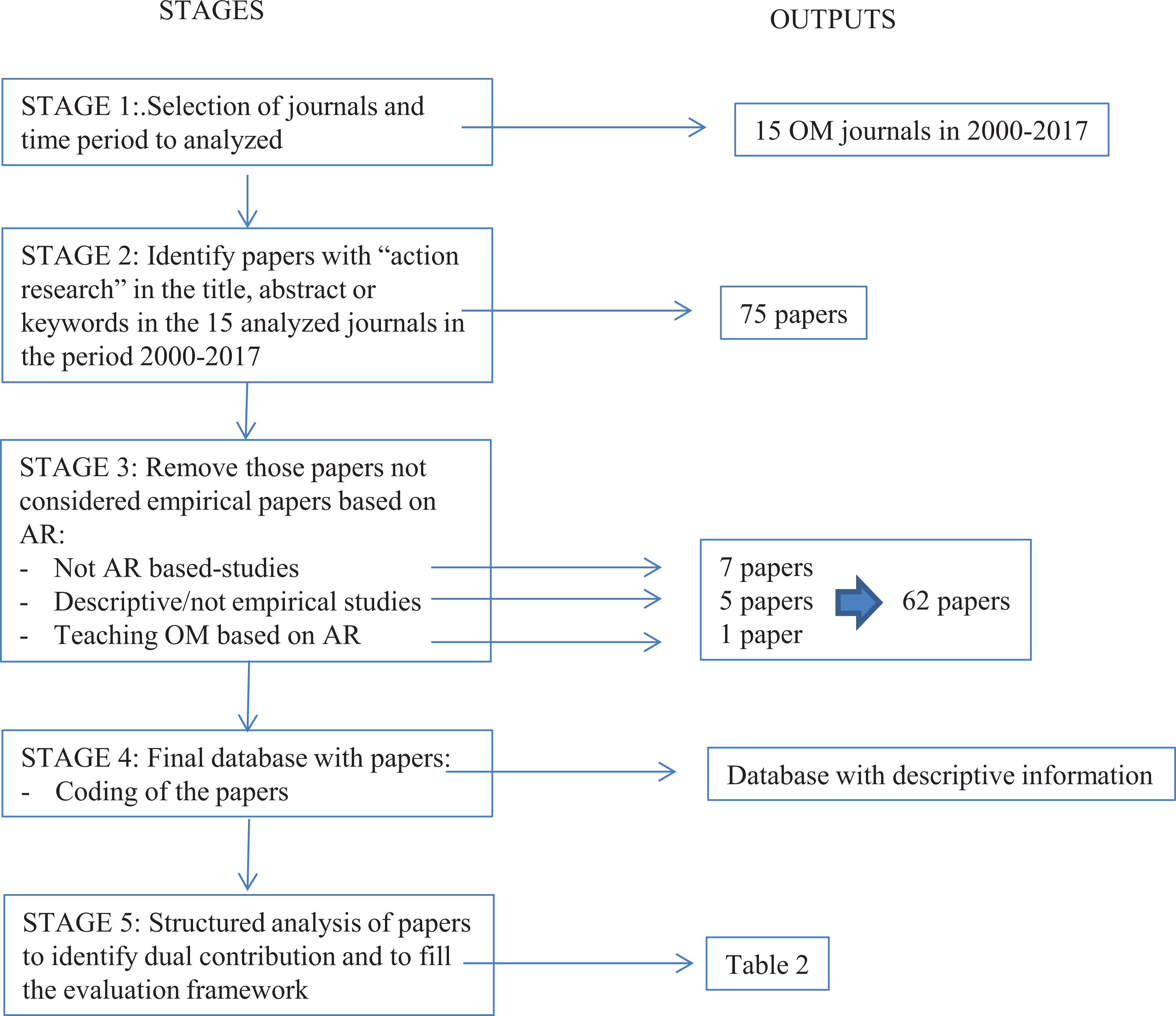
Selection of papers.
As it can be seen in Figure 4, the first step of our search strategy consisted on defining the journals where to look for AR papers in OM field. In this sense, even most SLR searches were carried out on databases, there are SLR studies whose search was based on specific journals such as Chatha and Butt (2015) and Danese et al. (2018). The selection of journals was based, first, on studies that carried out literature reviews in the field of OM based on the analysis of specific OM journals, such as Chase (1980), Swamidass (1991), Dangayach and Deshmukh (2001) or Pilkington and Meredith (2009). Second, we also considered those studies that have analyzed the relative importance of OM journals or have ranked OM journals according to their perceived quality and relevance for OM research, such as Barman et al. (2001) and Olson (2005). This allowed us to finally identify 15 reputable journals (listed in Table 1).
Number of Papers in Terms of the Journal.

The literature search was carried out for the years 2000 to 2017. This process started in 2000 as AR was not cited as an influential methodology in OM until mid-90s and early-00s (Coughlan & Coghlan, 2002; Westbrook, 1995). Therefore, we cover a research period that allows us a representative analysis of the dual contributions of AR papers.
Our initial search in the 15 selected journals was for articles that included the word “action research” in the title, abstract or keywords. We discarded: (a) seven papers because they do not describe the use of AR methodology, (b) five papers on AR that were purely theoretical or descriptive in nature, and (c) one about teaching OM based on AR.
Approach of Analysis
The analysis of the 62 AR studies was carried out as follows. First, each author analyzed the same set of five articles to determine their primary academic and practical contributions according to the framework described. As the three categories of each type of contribution are not mutually exclusive, the results were then compared, and if there were disagreements between the authors about the classification, there was a joint discussion to refine the criteria. As a result, a template was created with detailed criteria that allowed the authors to classify the papers in a distributed manner (i.e., one paper-one “reviewer”). This procedure is detailed in Online Appendix 1. When there were questions about the classification of an article, the other co-authors were consulted to agree about the primary category for it.
The reference and the classification of each of the 62 analyzed papers is available in Online Appendix 2. It provides a detailed description of the research and practitioners’ contributions for each paper, and their classification in terms of both research contribution and practitioner contribution, according to our dual framework.
Descriptive Analysis by Year and Journal
This section presents the findings related to (1) trends in the number of published papers, and (2) the distribution of the analyzed papers in terms of the journals in which they were published.
Figure 5 shows the chronological appearance of the papers from 2000 to 2017. More than 50% of analyzed papers were published in the last 7 years (2011–2017). As such, the number of papers is low in the whole period, and the weight of AR in the field of OM can therefore be considered as residual.

Chronological summary of papers analyzed (2000–2017).
Table 1 details the number of analyzed papers for each journal where at least one AR study was found. It shows that five OM journals include 82% of the built database. IJOPM papers represent 37% of the published AR studies, and IJPE, PPC, IJPDLM and JPSM together cover another 45%.
Dual Contribution Description (RQ2)
In this section, we determine whether the evaluation framework is valid to analyze and classify contributions of AR studies. In fact, Table 2 shows the number of papers assigned to each category of the dual framework.
Distribution of Papers in Terms of Dual Analysis.

It can be observed that the most frequent combination is theory building-implementation, which represents 43% of the analyzed papers. Theory testing-implementation and theory elaboration-implementation also have a relevant importance. At the same time, the results reveal a low number of diagnosis and proposal contributions. The main findings of our analysis (now focused in answering both RQ2 (I) and RQ2 (II) are described below.
RQ2 (I): What Kinds of Research Approaches Are Used in Published AR Articles in OM?
Figure 6 shows the number of papers classified according to the three types of research contributions during the period of analysis (2000–2017). Seventeen of the 62 papers used a theory testing approach, 33 studies were defined as theory building, and 12 were classified as theory elaboration. Four of the papers classified as theory testing were published before 2009, and 13 were published in the period 2010–2017. While it is true that theory building is the predominant research approach, the number of AR papers in OM journals that use both theory testing and theory elaboration approaches is significant, which leads to the conclusion that the AR approach is applicable to all research contributions from our framework.
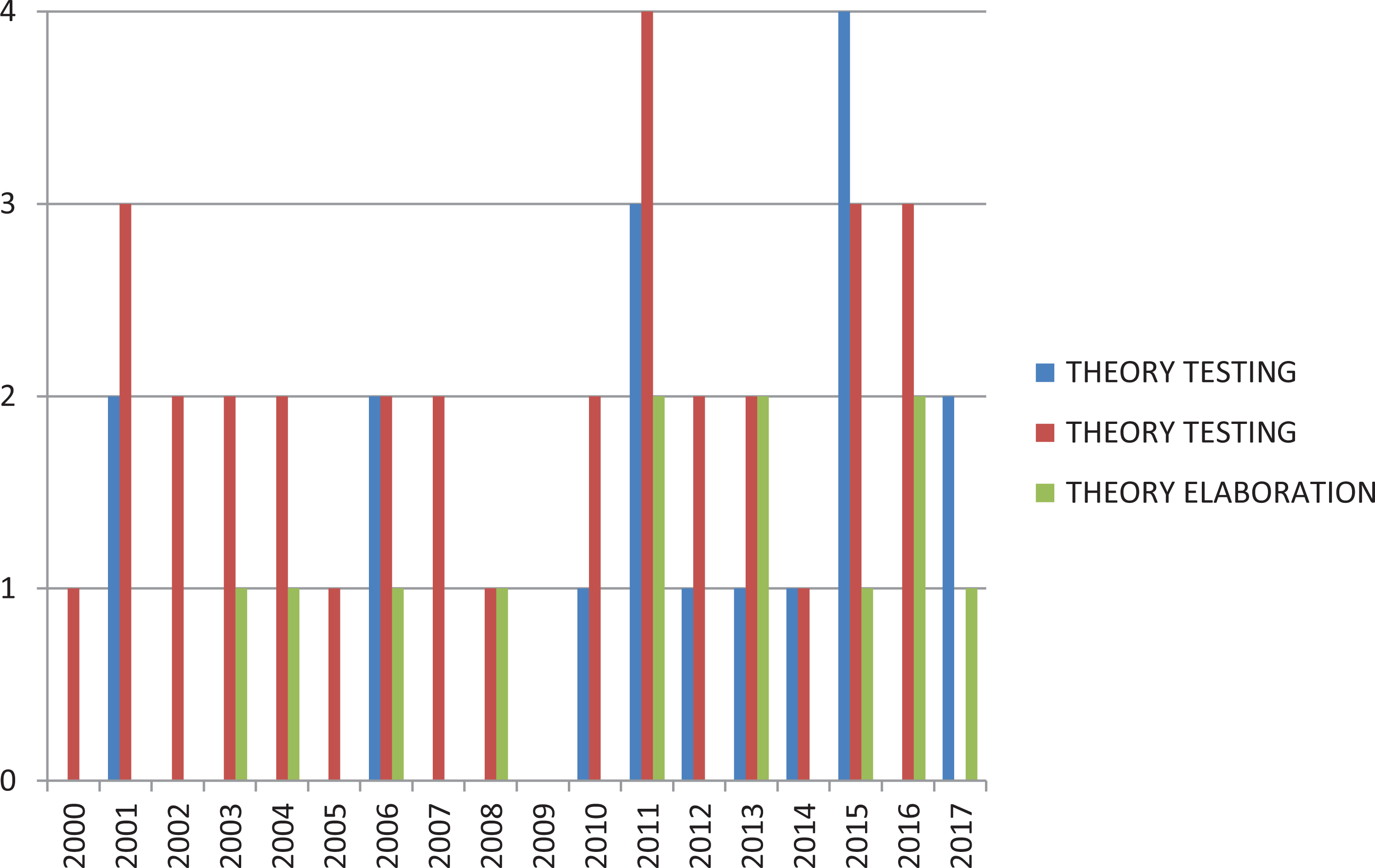
Trend of AR papers in terms of research approach.
Being conscious that linking theory testing with AR may be considered controversial (as mentioned in second section), the analysis focuses on how AR is used for this purpose. In this sense, Table 3 shows 9 papers that have been classified as theory testing in terms of their main contribution to research. It can be observed that most of these papers focus on determining factors that influence an operational decision/issue and to refine an existing framework in a specific context.
Examples of Theory Testing Papers.

RQ2 (II): What Kinds of Practitioners’ Benefits Predominate in AR Articles in OM Research?
Figure 7 shows the number of studies classified according to the three types of practitioner contributions during the period of analysis (2000–2017). The majority (51) of the papers used an implementation approach, 3 studies were proposals, and 8 were classified as diagnosis.
It is important to emphasize that authors often had to classify practitioner’s contribution based on a few scattered sentences in the article, in which the authors summarized their contribution to practice, as there typically were no specific sections reporting practitioner’s contribution in a more detailed manner.

Trends of practitioner’s approach in terms of chronological order.
The analysis of practitioners’ contributions confirmed that our framework based on diagnosis, proposals and implementation is justified. Papers for each approach were found, although the first two were much less common. This dominance has even increased in recent years, often with detailed reporting about very specific contributions of AR studies for the case companies. For example, Baker and Jayaraman (2012) reported a 27% inventory reduction thanks to an AR project. Similarly, Cagliano et al. (2005) reported a 5% lead-time reduction at the company they collaborated with. Visintin et al. (2017) reported the results of developing and implementing a surgery room scheduler at a hospital; the study compared the performance before and after implementation in terms of resource utilization, complexity of surgeries and bed utilization.
In some other cases, for example, Adebanjo et al. (2013), the description of the implementation is more general, such as the reorganization of the supplier selection process, and no specific results are reported.
In the proposal category, the main contribution for practitioners in the three identified papers were recommendations about specific improvements to be carried out in the company. In Neely et al. (2000), for example, the recommendation was a workbook that provided guidelines for the process-based design of a performance measurement system. Shaw et al. (2001) developed a framework that aimed to become a model of good practice for new product (or process) development (NPD) in the fine chemicals industry. Finally, Braz et al. (2011) focused on presenting a proposal to improve an energy company’s performance measurement system.
Many of the diagnosis papers appear to follow a similar conceptual approach. Based on the analysis of one or more specific case studies, the articles then developed a more general methodology. A representative example of this is Dey et al. (2015), as this research proposed both leading and lagging factors for supplier evaluation and developed a model based on the diagnosis of the strategic evaluation of suppliers in a company. In this study, the contribution for practitioners is not about the implementation but rather the framework to diagnose how to implement a model combining quality function deployment and the analytic hierarchy process. Hales and Chakravorty (2006) studied the critical factors that influence how Deming’s style of quality is implemented in a plastics company. This study is especially significant because the diagnosis outcome was produced after the implementation stage, but the main report is not about how the action was carried out but rather to describe a diagnosis of a specific issue related to the implementation, and this is also a significant outcome of the AR project.
How to Further Develop the Use of AR in Management: RQ3 Analysis
As advanced in the introduction, answering the third research question is about determining the main opportunities and challenges to enrich and reinforce the dual contribution of AR in the field of OM and, with that, the role of AR in OM research itself. Specifically, taking into account the analysis of the 62 AR studies in OM, and our own reflections, the ultimate aim of this section is to determine how the most common (traditional) purpose of AR for theory building and implementation can be developed further. In other words, the goal is to provide answers to the challenges that researchers face when developing AR studies in the field of OM, and to leverage all the possibilities that the different types of contributions from AR studies offer. Figure 8 graphically shows the main opportunity that the use of the evaluation framework has permitted to identify.

Main opportunities of AR in the field of OM.
The challenge of taking AR in the field of OM one step forward can be summarized in two crucial headlines: “rigor in research” and “relevance in managerial practice.” Rigor and relevance are not new issues for the implementation of AR in OM and the key point is that they should not be considered as mutually exclusive. Näslund et al. (2010) developed a comprehensive framework to assure both rigor and relevance of AR studies. The authors emphasized three crucial steps of the AR methodology: design, data collection and data analysis. In the following two subsections we propose how to reinforce the rigor and relevance of AR when aiming for the dual contributions of AR in OM. In this sense, we have checked that the problem identified by Näslund et al. (2010) holds because authors do not explain in a detailed way the practitioner’s contribution.
In this way, Figure 9 illustrates that the starting point to get achieve this full potential is to extend the use of AR to theory testing and theory elaboration in terms of research contribution and to produce both diagnosis and proposals with respect to the practitioners’ dimension.
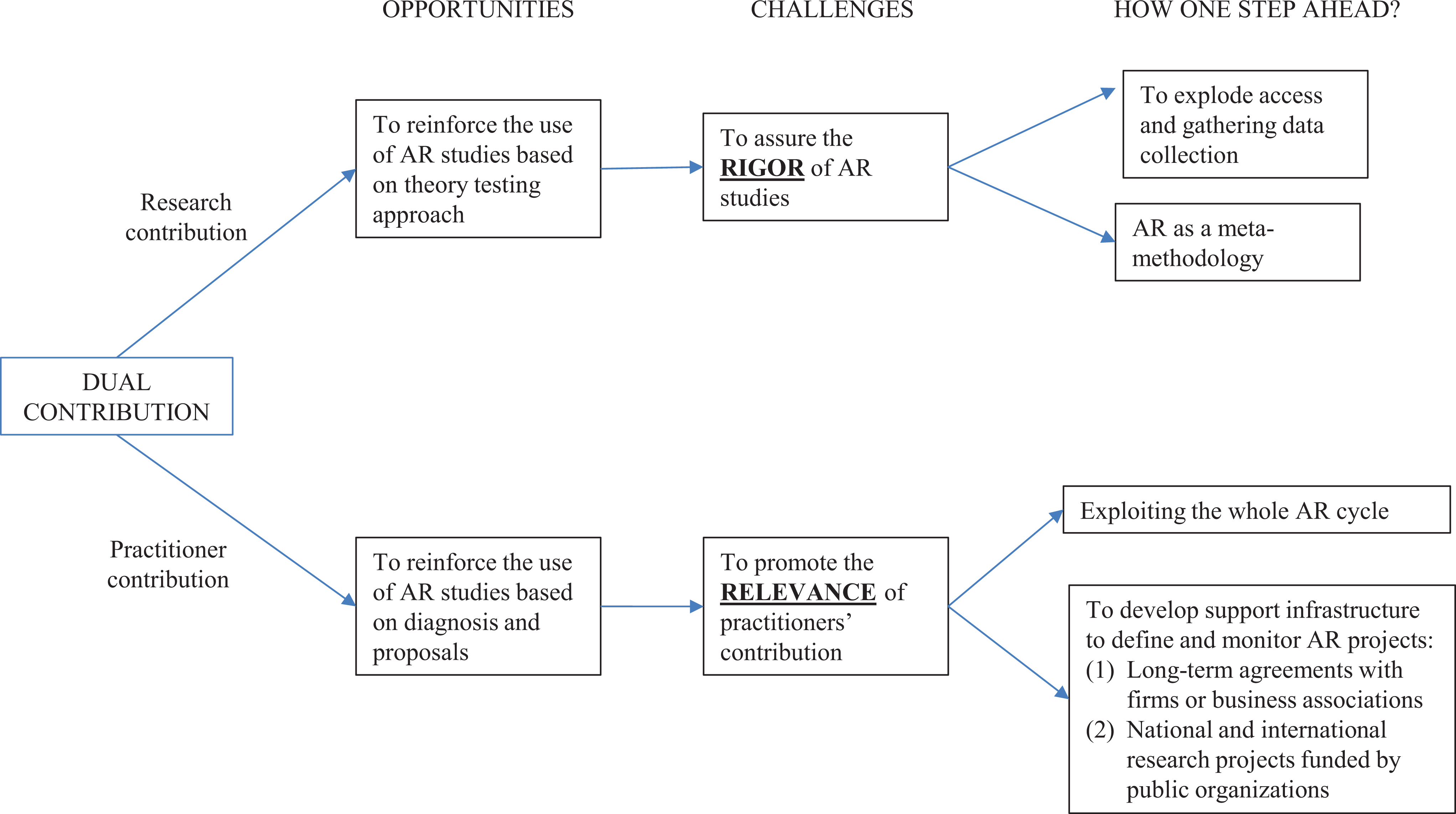
Opportunities and challenges to reinforce the dual contribution and the role of AR in the field of OM.
Rigor as the Key Requirement to Enrich Research Contribution of AR
As McNiff (2016, p. 51) stated, “demonstrating methodological rigor in action research implies following the action steps of a project: (a) identify issues and raise research questions, (b) monitor practice systematically to generate data, (c) describe the action (gather data), (d) generate evidence to explain the data and make knowledge claims, (e) test the validity of knowledge claims, (f) make your AR methodology public and (g) disseminate findings and communicate the significance of knowledge claims.”
As shown in Figure 9, in the context of our interest, two aspects are crucial to enrich the research contribution of AR: (a) to exploit/to explode access and data collection and (b) to use AR as a meta-methodology.
Study access and data collection
The element of (information) access is of significant importance for AR (Gummesson, 2000). Access opens the door to information and data about the phenomenon being studied. Access is also necessary in order to tap into the tacit knowledge of employees. While interviews and observations tend to be the predominant data collection methods in case studies, the opportunity to use multiple data collection methods, including the potential to combine both qualitative and quantitative methods, provides one of the main advantages of AR (Coughlan & Coghlan, 2002; Silverman, 1993/2006).
Using multiple data sources and integrating practitioners in the information gathering can significantly increase the rigor of the project. Triangulation broadly signifies the use of multiple approaches to “zero in” on the answers to a research question (Singleton & Straits, 1999) and various triangulation approaches increase the rigor of research by reducing a number of potential biases, such as methodological/instrument bias, data bias, and investigator bias (Jick, 1979). Further, using multiple data sources may lead to discoveries which would not have been made otherwise. McNiff (2016) propose the following data gathering techniques for conducting an AR project (and then generating evidence from the data): logs and diaries, observation methods, questionnaires, interviews and case studies.
AR as a meta-methodology
Dick et al. (2015) used AR as a meta-methodology—that is, a process that can subsume multiple sub-processes and under which contradicting demands can be satisfied. According to the authors, and because of those reasons, AR can be described as an “umbrella process.” Moreover, AR is a collaborative method (Cordeiro et al., 2017; Denis & Lehoux, 2009), which facilitates its use with other quantitative and qualitative methods. Its flexibility also helps to include different methods in the corresponding phases. In particular, because it is iterative, the process of AR is flexible and cycles may be nested to provide cycles within cycles (Dick et al., 2015).
Conducting research using a meta-methodology offers several advantages. For instance, it facilitates cooperation in an interdisciplinary team as it helps researchers to interact with others. At the same time, AR contributes to mutual understanding between research participants (Ponzoni, 2016). In fact, several scholars highlight the fact that AR is an umbrella methodology that contributes to the integration of other methods. To cite an example, Maestrini et al. (2016) proposed AR as a suitable interactive method that could complement other methodologies. They applied it in the field of purchasing and supply chain management, but, in their opinion, AR can complement other methodologies in other fields. As a result, AR can be implemented jointly with other methodologies and scholars should take advantage of the potential of this multidisciplinary approach. Two recent papers highlights this feature of AR. On the one hand, Erro-Garcés and Alfaro-Tanco (2020, p. 8) concluded that “AR is a multidisciplinary approach that involves the use of various qualitative and quantitative methodologies/instruments and, consequently, enables the implementation of other quantitative and qualitative methodologies.” On the other hand, Sankaran et al. (2021) used action research as a meta-methodology through the mix of case studies and surveys in order to investigate collaboration in project management research.
Need for Relevance as the Basis to Enrich Practitioners’ Contributions
Meredith et al. (1989) defined AR as an ongoing cycle of research stages. Similarly, Susman and Evered (1978) referred to the “cyclical process of action research.” Thus, during the life cycle of an AR study, many cycles of diagnosis, planning, actions, results and diffusion occur. In this way, relevant outputs for both researchers and practitioners may be found. In this vein, the intermediate results form part of the AR spiral or cycle, although AR studies do not complete (or do not include) the complete cycle and manifest themselves in diagnosis or proposals.
The first identified opportunity is a better learning during and after each of the AR cycles illustrated, i.e. to really exploit the whole AR cycle. The goal should be to generate different outputs from the different AR stages, that is, diagnosis, proposals and implementation. This means that an AR study do not have always to imply “action” outputs (implementation) as long as the main requirements of AR hold: dual objectives, collaborative relationship in all the stages, rigor in methodology and relevant results for both academics and practitioners.
However, there is a relevant challenge associated to this opportunity: the need that AR projects are defined, managed, monitored and funded in a specific context. As Coughlan and Coghlan (2002) emphasized, monitoring and managing the interactions between researchers and practitioners along this cyclical process of an AR study might be critical to achieve the dual objective of such studies. In this way, it is crucial to develop “support infrastructures” that allow establishing a collaborative framework that lets the researchers develop the project from inside the organization. These “support infrastructures” permits practitioners to participate, interact and be more proactive and they can get continuous feedback during the process. Likewise, managers can use their experiential knowledge to reframe their understanding of situations they are close to. They need to consider the impact of organizational politics on the process of inquiry, who the major players are, and how they can be engaged in the process (Coghlan, 2001).
As it is shown in Figure 9, three types of support infrastructures for the development of long-term AR projects are proposed: (1) long-term agreements with firms or business associations, (2) national and international research projects funded by public organizations, and (3) educational programs.
With respect to the first option, Avella and Alfaro (2014, p. 195) explained how a business chair”—an agreement between a university and an external organization (firm, association of firms, public institutions, other kinds of organization) to manage and finance activities usually related to teaching and research”—can be a useful infrastructure for developing AR research projects in the field of OM. The role of such chairs is very important in terms of their dual contribution, because they are very much interested in getting both types of contributions—research and practice—in order to justify their existence. As such, a committee of business chairs encourages both practitioners and researchers to report all the contributions, including the intermediate outputs, which is a way of enriching the dual contributions. In addition, this infrastructure usually has an objective to develop research projects with dual contributions, which is the right scope for developing the AR methodology.
Secondly, one example of the development of long-term AR projects within the framework of national or international publicly funded projects is the study by Coghlan and Coughlan (2006), which forms part of the results of CO-IMPROVE, a European Union (EU) funded project. This study provided a design and implementation framework for a combined action learning and action research program (ALAR, as coined by Zuber-Skerrit, 2003), which aims to address collaborative improvement in the extended manufacturing enterprise. Moreover, this paper forms part of wider research, which has also received financial support from the European Commission. It describes an AR initiative with two objectives: (a) to facilitate continuous improvement of operations practice and performance through collaborative action learning in a small number of firms, and (b) to develop a contingent approach to address this need, which could be replicable both in Ireland and throughout Europe.
Thirdly, there are several studies about the benefits of using AR methodology within educational programs that promote AR projects based on doctoral theses or final course projects in master’s programs. Zuber-Skerritt and Fletcher (2007) highlighted the quality points for a doctoral thesis under this methodology and Coghlan (2007) presented the characteristics of a doctoral thesis using AR, where the PhD student is a manager who is both researcher and practitioner at the same time. A doctoral thesis is a rigorous piece of long-term learning and research in which there are at least two researchers, the doctoral student and the thesis advisor, who must request periodic reports and results.
Along these lines, the AR literature has looked at the role of “insider action research” (Coghlan, 2001, 2007; Coghlan & Brannick, 2001) when managers are engaged in action research in their own organization. This can also be applied to master’s programs that promote the development of projects based on a dual contribution and that involve both researchers and practitioners as supervisors of the project carried out by the master’s student.
Conclusions
Action research is a method to analyze practical problems and to provide dual contributions: enrich theory but also offer practical solutions to the problem studied. Furthermore, in AR studies researchers and practitioners actively participate and collaborate in the research process. During an AR study, there may be multiple contributions and the development of the evaluation framework in this study permits to classify them and, in this way, to assess the dual contribution of AR studies.
This study signals that it is important to make both OM researchers and practitioners perceive AR as a powerful methodology that permits them to develop win-win relationships, and in this way, for AR to enhance empirical research in the field of OM. Because of this, it is crucial to develop tools and mechanisms that strengthen its dual contribution, in terms of both research and practice, such as the “support infrastructures” that appear in the fifth section.
Progressing toward the deployment of AR projects, and specifically, undertaking insider AR projects, will give further momentum to leverage the full potential of the AR methodology in management research. But it also will require to further explore the potential of AR in the field of management research in general, and OM in particular. In terms of research approaches, we show as the value of AR in the field of OM can be extended beyond the traditional scope, to include theory building as well as implementation.
Implications for the Field of Management
Operations management is the field of management in which AR is mostly used (Erro-Garcés & Alfaro-Tanco, 2020). But as there are studies that highlight the relevance of AR in other fields of management, such as marketing (Kates & Robertson, 2004), human resources (Githens, 2015), information systems (Baskerville & Wood-Harper, 1996) or project management (Sankaran et al., 2021), some of the findings of this study can hopefully be valuable for other fields of management. More specifically, the evaluation framework developed represents a tool that may help to assess the dual contribution of any research study based on AR and not only in the field of OM. Furthermore, the identified challenges can be extrapolated to other areas of management in order to reinforce the role of AR as a meta-methodology that helps to link better the interests of the university with the needs of companies.
Further Research
This paper opens different avenues for further research. First, regarding the database, a more extensive and detailed analysis of the descriptive information could allow us to elaborate an article about the state-of-art of AR in OM. In this way, the identification of research groups and to determine the main topics, countries and industries would help to analyze AR in OM in a deeper way and it could offer valuable insights. Second, to analyze not only the practitioners’ contribution if not taking into account the managerial implication of AR studies, that is to say, in which way the results can be generalized to other firms and sectors; to emphasize this point would help to enrich the contributions of AR studies. Third, traditionally, AR studies have contributed to “both science and practice” but, as explained with RQ2 (II) the practical contributions have mainly been focused on “implementations.” Thus, if further AR studies in the field of management actually use our framework, then the framework will be able to be validated. Finally, another possible line of research could be to test the framework in other fields of management, such as marketing or human resource management.
Supplemental Material
Supplemental Material, sj-pdf-1-ijq-10.1177_16094069211017636 - An Evaluation Framework for the Dual Contribution of Action Research: Opportunities and Challenges in the Field of Operations Management
Supplemental Material, sj-pdf-1-ijq-10.1177_16094069211017636 for An Evaluation Framework for the Dual Contribution of Action Research: Opportunities and Challenges in the Field of Operations Management by José A. Alfaro-Tanco, Lucía Avella, Philip Moscoso and Dag Näslund in International Journal of Qualitative Methods
Supplemental Material
Supplemental Material, sj-pdf-2-ijq-10.1177_16094069211017636 - An Evaluation Framework for the Dual Contribution of Action Research: Opportunities and Challenges in the Field of Operations Management
Supplemental Material, sj-pdf-2-ijq-10.1177_16094069211017636 for An Evaluation Framework for the Dual Contribution of Action Research: Opportunities and Challenges in the Field of Operations Management by José A. Alfaro-Tanco, Lucía Avella, Philip Moscoso and Dag Näslund in International Journal of Qualitative Methods
Footnotes
Declaration of Conflicting Interests
The author(s) declared no potential conflicts of interest with respect to the research, authorship, and/or publication of this article.
Funding
The author(s) disclosed receipt of the following financial support for the research, authorship, and/or publication of this article: This study was supported by Business Chair Volkswagen Navarra - University of Navarra, Ministerio de Economía y Competitividad (ECO2015-68257-R), and Eurest-IESE Chair of Service Excellence.

Supplemental Material
The supplemental material for this article is available online.
References
Supplementary Material
Please find the following supplemental material available below.
For Open Access articles published under a Creative Commons License, all supplemental material carries the same license as the article it is associated with.
For non-Open Access articles published, all supplemental material carries a non-exclusive license, and permission requests for re-use of supplemental material or any part of supplemental material shall be sent directly to the copyright owner as specified in the copyright notice associated with the article.
