




Abstract
Case study design is often characterized as a poorly applied and understood approach to conduct research into information systems. This literature review examined 28 empirical studies of Learning Management Systems (LMS) that were self-declared as case studies. This paper’s main aim was to establish whether these studies actually applied case study techniques or simply utilized the term “case study” as a label of convenience. Alarmingly, more than one-third of the examined articles contained little or no justification for adopting a case study design and did not meet the established criteria for identification as a case study as outlined in this review. The lack of an appropriate discussion on the characteristics and applicability of the case study approach to empirical discovery brings into question the robustness of a study’s stated methodology. It is not sufficient to assume that the label “case study” by itself will portray a universal understanding of the research design of an empirical LMS study. This paper proposes that a robust description of what constitutes a case study in a LMS context will assist in ensuring that future studies on LMS (or other information systems) research that intend to adopt a case study approach, adequately present appropriate justifications for adopting this methodology. It is hoped that our definition and description of LMS case study methodology will serve to inspire further reflection on the characteristics of this robust research approach that might lead to a set of guidelines for applying this methodology to information systems research.
Introduction
There are many views on the characteristics of case studies and how they should be employed to investigate a research problem. Case study research seeks to answer the “what,” “where” and “how” questions of a research problem, much like the questions formulated in constructing an experiment (Kyburz-Graber, 2004). Both qualitative and quantitative methods can be employed within a case study framework. The preferred paradigm for the case study methodology is realism (Perry, 1998). A realist approach assumes that knowledge is acquired through the researcher’s senses and is aptly suited to the task of examining phenomena within identifiable constraints. This raises the question of how to define a case? Gerring (2004) describes a case as being made up of several relevant dimensions constructed from single or multiple observations from which an understanding of a larger class of observed phenomena can be extracted. The design of a case study can include a single case or multiple cases. The advantage of multiple cases is that the identification of commonalities between cases strengthens the validity of emerging theory from the individual case studies (Tellis, 1997b). Cases can be categorized in three ways: (1) exploratory case studies where exploration of the phenomena is of interest to the researcher and needs to be discovered; (2) descriptive case studies that lead to the development of a narrative of the phenomena with reference to extant literature; and (3) explanatory case studies that ask the “why” questions about the observed phenomena which may lead to the establishment of theories (Zainal, 2007). Another interesting consideration is the motivation to study a case. Stake (1995) presents a motivational dichotomy which he calls intrinsic and instrumental. Intrinsic cases are those which are pursued solely to develop a deeper understanding of a phenomenon or situation by itself, whereas an instrumental case study involves investigating a particular case to develop a broader appreciation or understanding of more general problems or issues (Stake, 1995). Undertaking case study research is not an easy endeavor, and researchers should possess a basic toolkit of skills before undertaking case study research. Yin (1994) includes questioning, listening, adaptability, background knowledge of the phenomenon investigated, and an unbiased attitude as essential skills for researchers. The main strengths of developing theory from case study research are: (1) the likelihood of generating a novel theory; (2) emergent theory is likely to be testable with constructs that can be easily measured; and (3) the resultant theory has a high chance of being empirically valid because the theory building process is intimately tied with the evidence used to construct it (Eisenhardt, 1989).
In conducting case study research, triangulation is an important technique to apply to the research design. The concept, derived from navigational triangulation where a location was determined by the intersection of two points with the observer’s position, is used in research to examine issues or arguments from different perspectives (Simons, 2009). Tellis (1997a) confirms the importance of four types of triangulation: (1) data source triangulation which means that researchers look for similar patterns or themes in multiple types of data; (2) investigator triangulation when more than one researcher examines the same phenomenon; (3) theory triangulation that applies different investigator perspectives to the same phenomenon; and (4) methodological triangulation when different approaches and techniques are applied to the same phenomenon. The main objective of triangulation is to enhance the validity of case study findings by providing two or more sources of evidence that confirm emerging explanations for observed phenomena (Heale & Forbes, 2013).
Not all researchers agree that case study methodology is a robust research approach: “Case studies often lack academic rigor and are, as such, regarded as inferior to more rigorous methods where there are more specific guidelines for collecting and analyzing data. These criticisms stress that there is a need to be very explicit about the choices one makes and the need to justify them” (Meyer, 2001, p. 348). More recently, there have been claims that case studies are characterized by poor generalizability, take too long to conduct, produce large amounts of unreadable documents, and are often confused with case study teaching strategies used in disciplines like business (Gaikwad, 2017). There have also been claims that the case study methodology lacks the rigor of other approaches and cannot be considered a scientific method. Flyvbjerg (2006) identifies (and debunks) five misunderstandings of case studies that may impugn the selection of a case study methodology for an intended study: (1) theoretical knowledge has greater value than practical knowledge; (2) case studies cannot be generalized beyond a single case; (3) the effectiveness of case studies is in hypothesis generation, not hypothesis testing; (4) case studies have a tendency to validate a researcher’s preconceived ideas about a study; and (5) specific case studies are difficult to summarize and synthesize into general propositions and theories. However, Flyvbjerg is a proponent of the value of case study research in certain circumstances, particularly when used in conjunction with studies that involve large random samples of entire populations. He concludes with the comment that “In this connection, it is worth repeating the insight of Thomas Kuhn that a discipline without a large number of thoroughly executed case studies is a discipline without systematic production of exemplars, and that a discipline without exemplars is an ineffective one. In social science more good case studies could help remedy this situation” (p. 27).
Given the oft-cited “pros and cons” of case study methodologies, this paper seeks to investigate whether research projects related to the use of educational technology that purport to use case study methodologies, actually do so or merely use the term case study as a general descriptor for the research activity. To narrow the focus to a manageable area of educational technology, empirical studies of Learning Management Systems (LMSs) were examined to find out if the methodologies employed were consistent with established characteristics of a case study methodology. Turnbull et al. (2019) provide the following definition of LMSs: “Learning management systems can be defined as web-based software platforms that provide an interactive online learning environment and automate the administration, organization, delivery, and reporting of educational content and learner outcomes” (p. 1). In this COVID-19 environment, interest in LMSs has increased significantly as universities and schools continue to adapt their course offerings to online delivery (Huang et al., 2020; Moorhouse, 2020; Raza et al., 2020). Therefore, it is logical to assume that more research in this area will be forthcoming in the future. To better inform future studies in LMSs on the appropriateness of case study methodologies in research designs, this literature review examines the methodologies of prior “self-declared” empirical LMS research to determine which paper’s methodologies exhibit characteristics consistent with case study design, and what explanations, if any, are provided to justify methodological choices.
This paper is structured as follows. First, the approach taken to review the literature is outlined, including the databases used, the rationale for their selection, and explicit inclusion and exclusion criteria adopted for article selection. Next, the findings are presented with tabular overviews of three categories of studies based on the degree to which they adhered to popular principles of case study design. This is followed by a discussion section that prescribes a definition for case study methodology within the context of LMS research but with applicability to other information systems too. This paper’s conclusion emphasizes the need for research projects that explicitly declare the use of case study methodology and adequately address how their research designs align with the characteristics of case study practices.
Method
The approach taken in this review of relevant LMS empirical studies is to adopt a narrative approach to reporting the use of case study design in LMS research, while applying some of the rigor of systematic review methodologies to the selection and inclusion of relevant peer-reviewed studies. There is a precedence for this hybrid approach to conducting literature reviews in information systems-related fields, such as social media (Best et al., 2014; Chugh & Ruhi, 2018; Sarmiento et al., 2018), online learning (McCutcheon et al., 2015; Sinclair et al., 2016) and human-computer interactions (Boyle et al., 2012; Fleischer, 2012). The result is a more easily digestible overview of important issues and constructs that have appeal to both an academic and professional audience.
A pilot search was conducted using Google Scholar to test possible search terms and their synonyms. By process of trial and error, a search string was developed that was likely to capture the most relevant results. The search string applied to the databases in this study was: (“Learning Management System” OR LMS) AND “Case Study” AND (Impact OR effect OR improve* OR benefit) AND (learner OR student).
The main limiters applied to this search string were the abstract field, full text, and peer-reviewed. The year of publication was constrained to the range: 2008 to 2019. The abstract field limiter was deemed necessary to maximize the chance that each extracted paper dealt explicitly with LMSs, used a case study methodology, and was related to learning effectiveness in some way.
The following data sources were used in the search: Scopus, EBSCOhost, and Gale. The databases accessed by these systems covered a wide range of topics that had a high chance of including peer-reviewed articles on LMS research. The application of the search string to each data source yielded 30 Scopus articles, 34 papers from EBSCOhost, and two items from Gale. After removing duplicate entries and discounting results that did not include an accessible PDF file, the final tally of included papers was 28. These studies are presented in the following section.
Results
Table 1 provides a summary of the 28 studies in this review.
Overview of Case Studies.

A distinction needs to be made here between a study that encapsulates the output of a research effort within boundaries that are meant to define a phenomenon under investigation, and a study that actually uses case study methodology. Alpi and Evans (2019) propose that research articles that include detailed clarifications of the data collection methods, clarification of the role of the investigator, and contextualized analysis of the results are more likely to have the characteristics of case studies whereas the absence of these qualities relegates the publication to the status of a report. The papers that did not include a description or discussion of case study design were further examined to determine whether they exhibited the characteristics of a case study and accordingly could be classified as such.
In order to do this, every study that included a description or discussion of case study research design was labeled “Yes” and those that did not were labeled “No,” as shown in the third column of Table 1.
The studies presented in Table 1 that did not contain a description of how case studies were applied (classification: “NO”) were further examined to see if they could be regarded as case studies in their own rights. To be considered as a candidate case study, the paper had to contain an adequate methodology section with clear explanations of how the study was conducted. Papers that met this condition were then further scrutinized against the following three case study inclusion criteria: the unit of study was adequately identified; the boundaries of the case(s) were identified and explained, and triangulation techniques were applied to each study. This led to the segmentation of the 28 studies into three categories, as shown in Table 2.
Case Study Categories.

Figure 1 displays all 28 studies as segmented according to the classification in Table 2.

LMS empirical studies and their case study classification.
Non-Case Studies
As indicated in Figure 1, there were 11 papers in this review that did not meet the criteria for inclusion as case studies. One of the most important reasons for rejecting a study was the lack of a clearly laid out methodology section as was the case with the studies by Cantabella et al. (2019), Lata and Luhach (2014), Segrelles et al. (2017), Paľová et al. (2018), and Company et al. (2017). The study on online role play by postgraduate students was considered not to meet the criteria of a case study because it was not a study of actual phenomena but rather a description of a controlled event (Beckmann & Mahanty, 2016). Chowdhurya et al. (2015)’s proposed study utilized case studies as a learning tool but did not identify case design as their preferred methodology. Liu (2009)’s paper described their study as “a series of controlled experiments” (p. 519) with no reference to case study design. Özdağoğlu et al. (2019), Hasan (2019) and Sheeba and Krishnan (2019)’s papers made an attempt to describe data collection and analysis procedures but failed to situate these in any chosen methodology.
Case Study Methodology Defined or Explained
Of the 28 empirical studies in this review, only nine explicitly identified case studies as an approach that drove their research design. It is interesting to note how each study incorporated case study characteristics into their research designs. One dimension that was considered was the number of cases to be included in the study. Tay and Low (2017) specified that their research design was based on a single case structure that followed standard procedures for conducting such a study. Given the intent of the study, i.e. an examination of the transformation of written learning materials into electronic form, this design is appropriate for this single phenomenon. While not using the word single to describe the research design, Teräs and Kartoğlu (2018)’s examination of authentic learning in vaccine management is also depicted as a single case study by reference to the research design as being based on a “complex phenomenon” (p. 21). Reference to the bounded phenomenon as a characteristic of case studies that lead to the selection of this methodology was also made in the study of learner support services for postgraduate students (Asamoah, 2019). This is also supported by McGuinness and Fulton (2019) who additionally highlight the focus of case study methodology on contemporary phenomena in realistic contexts as a useful attribute to integrate into research designs. By contrast, multiple case study design was used to describe the research design of the study into geography, veterinary science and geography courses offered online (Bosco & Rodriguez-Gómez, 2011). Clearly, the three distinctive subject areas are good candidates for a multiple case design.
Exploratory case study design was another descriptor used to specify research design. The methodology section of Soon (2011)’s study on E-Learning and M-Learning justified this approach by claiming that the phenomenon to be observed had an unfamiliar context but readily definable boundaries. Feuer (2011, p. 14) described their research design as an “exploratory, descriptive, quantitative case study.” This description appropriately identified the studied phenomenon as an exploratory case utilizing quantitative methods in a descriptive context. Langley et al. (2008) also make use of the term “exploratory case study” to describe the research design of their study into 1st-year student behavior in an open assignment submission regime. However, the term is only used in the abstract and is not expanded upon in the methodology section of the study. The final description of case study design identified in this paper is an “interpretive qualitative case study design” (Altunoglu, 2017, p. 99). This description aligns with the purpose of their study: to investigate student perceptions of first-time use of a LMS.
Case Studies Meeting Classification Criteria That Did Not Include Discussions on Case Study Design
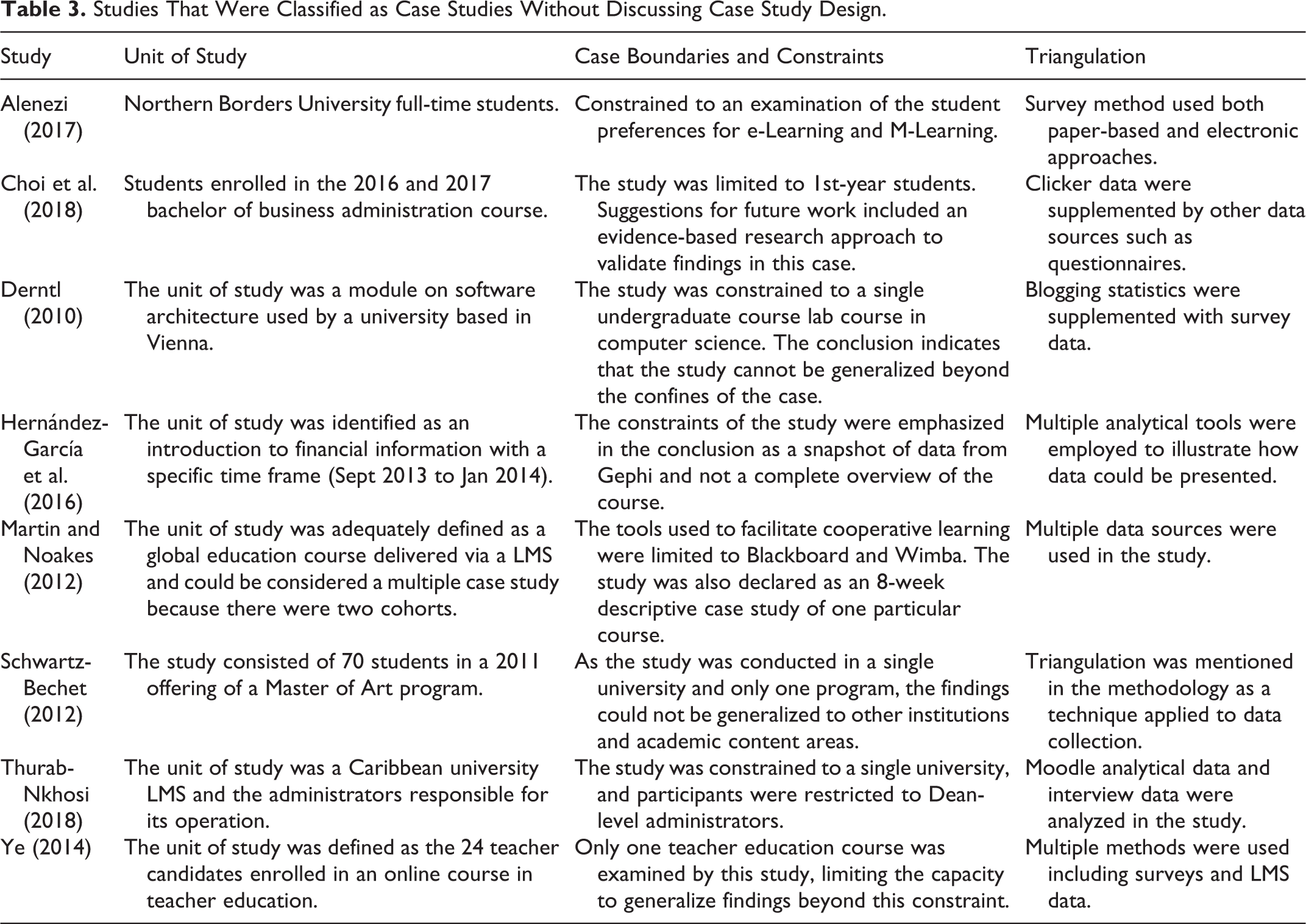
The remaining eight papers did not discuss case study design in the methodology sections, but they exhibited characteristics consistent with the three inclusion criteria. Table 3 lists these studies and how they meet the inclusion criteria:
Studies That Were Classified as Case Studies Without Discussing Case Study Design.
Discussion
Clear descriptions of the type of case study employed in research projects add credibility to methodological descriptions. Of the nine papers that discussed the use of case study design, the terms used to describe the case study approach include: “interpretive, qualitative”; “multiple”; “explorative” (twice); “exploratory, descriptive, quantitative”; “qualitative case study approach”; and “classic.” Descriptive words add credibility to the choice of case study design and enhance the methodology section of the study. This is particularly so when the description is aided by a discussion of the merits of case study design, as was the case with Teräs and Kartoğlu (2018), Tay and Low (2017) and Soon (2011). The methodology sections of the 11 papers that did not explicitly address the use of case study design, but exhibited the characteristics used in this review to classify a study as a case study design, could have been enhanced by a discussion of the merits and limitations of case study application. In fact, failing to explain the choice and application of a research design as distinct from research methods can lead to poor evaluation of designs (De Vaus, 2001). Creating a methodology section that considers the research design separately from the data collection and analysis methods employed would also assist in defining the context and parameters of a study.
The eight papers that did not meet the criteria of a case study as set out in this review appear to have applied the label of “case study” to the underlying research without due consideration for the characteristics and suitability of case study design. The use of the term "case study" as a label of convenience rather than a rigorous research design can be misleading to readers who have an appreciation for the robustness and characteristics of the approach. As Swanborn (2010) puts it: “Writing and speaking about case studies, one experiences some frustration: the label ‘case studies’ seems to be used for many purposes” (p. 10).
A central cause of the misuse of the term “case study” may lie with the lack of consensus on the definition of a case study. Thomas (2011) outlines some of the discipline-specific perspectives of case study design. These include (1) sociology, education and psychology’s interpretivist view, (2) a regard for the identification of variables within a case by business and political disciplines, and (3) the medical and law fraternity’s use of case study design to highlight both new and typical phenomena. However, the lack of consensus among researchers on a unified definition of the case study approach is not an excuse for failing to clarify its application to a particular study. Given this lack of clarity, a more robust definition of case study characteristics in the context of LMS research could be beneficial to future studies. As a first attempt, this paper proposes a definition of a case study in the context of LMS research which also has applicability to information systems in general: A LMS case study is an investigation into single or multiple instances of observable complex phenomena that can be constrained by clearly identifiable boundaries. Case study approaches to LMS research involve a careful dissection of all bounded phenomena to identify discrete units of analysis. Examples of units of analysis could include LMS system components, LMS subject-matter content, the LMS user community, and host institutional policies and procedures. LMS case study research does not dictate the use of specific data collection or analysis methods but instead focusses on defining a workable framework for the conduct of a research project.
Conclusion
The term “case study” is often used as a label of convenience in LMS research, rather than a descriptor of a rigorous approach to research design. Designing studies within a case study framework is a well-established approach to conducting research in diverse areas such as medicine, law, and engineering. Nevertheless, in the specific field of LMSs, this term is often an inappropriate label for the methodologies employed in empirical studies. This review found that 11 of the 28 examined studies claimed to adopt a case study approach without justifying how this framed the methodology of the study. Moreover, from further examination, these studies did not appear to exhibit the characteristics usually attributed to case study design which include as a minimum the recognition that a proposed study is a contemporary phenomenon existing within a real-world context (Yin, 2018). Of the remaining 17 studies, the methodology sections of eight papers demonstrated that there was sufficient justification for accepting that they could be considered as case studies. However, there was no explicit discussion of why this approach was chosen against competing methodological options. The remaining nine papers provided clear justifications for the choice of a case study framework, evidenced by appropriate references to established literature.
Moving forward, this paper proposes that a clear description of the characteristics of a case study as applied to empirical research into LMSs would be of assistance to future research projects in this field. A possible definition of what might constitute a LMS case study is clearly laid out in the discussion section of this paper. However, given this study’s limitations to LMSs and English language publications, much more needs to be done in this area—particularly if this paper’s proposed definition of LMS-related case study research is to have wider applicability to other information systems-related projects. Hopefully, this study will inspire other researchers to reflect on what constitutes a convincing case study research project.
Footnotes
Declaration of Conflicting Interests
The author(s) declared no potential conflicts of interest with respect to the research, authorship, and/or publication of this article.
Funding
The author(s) received no financial support for the research, authorship, and/or publication of this article.
