




Abstract
The purpose of this paper is to describe the methods used in a phenomenological study aimed at understanding students' perceptions of volunteer experiences from the viewpoint of their existential meanings. In Japan, as volunteer activities have just been recently introduced to youth education, it is necessary to verify the effect of the activity on the students. The authors present phenomenological reduction, which is a fundamental concept in phenomenology, as a health care research method to elucidate the essence of people's lived experiences. The 22 statements presented from volunteer students' group discussion after their practices were redescribed by phenomenological reduction, a method of valid interpretation based on their embodiment and desire. The phenomenological approach allows us to understand the essence of students' perceptions in terms of their purpose in life, which suggests that educators could inspire the students to realize existential growth by participating in volunteer activities through practical communications with others.
The Purpose of This Study
Volunteer activity has been regarded as a source of practical learning in social welfare for junior and senior high school students. However, because of considerably standardized school education in Japan, volunteer activity tends to be limited to formal and superficial learning without genuine will, as students often feel that it is mandatory and participate unwillingly.
To clarify the actual significance of volunteer activities, it is necessary to know how students perceive the activities they experience. The method of phenomenology allows us to understand the essence of students' experiences from the viewpoint of their existential meaning. First, we will give an overview of the history of the volunteer movement in Japan, which helps the understanding the course to today's educational volunteer activities. Then we will discuss the meaning and procedure of the phenomenological method used in our study to elucidate the essence of students' volunteer experiences.
The volunteer movement in Japan
The concept of volunteering is a Western idea adopted by Japan but with a slightly different meaning. Understanding the Japanese concept of volunteering, therefore, requires some description of the history of the volunteer movement in Japan.
Before the Second World War charity-related activities in Japan such as the establishment of orphanages had already been in practice but were limited primarily to projects organized by a very few religious persons or organizations (Okamoto, 2005). In the 1960s newspapers reported on high-society women visiting nursing homes and young people taking underprivileged children on camping trips. It was around this time that the word volunteer (pronounced “bolantia”) first appeared in the Japanese dictionary (Meguri, 2004).
In the 1970s and 1980s, the government, for the first time, began promoting volunteer activities for older, married women and young people. This policy was mainly to fulfill personal obligations or to contribute toward community welfare. In the 1990s some companies began to provide so-called “volunteer holidays,” which encouraged employees to devote personal time to volunteer activities. Thus, volunteering was becoming more widespread in society than previously.
In the winter of 1995, the Great Hanshin Earthquake struck Japan, and 1.5 million people volunteered their efforts, continuing the increasingly popular trend of volunteering (Nishiyama, 2005). After that, volunteering became a regular part of Japanese daily life, including activities such as offering assistance for the physically or mentally disabled and volunteering as museum guides. In 1998 the first volunteering law was enacted, the Law to Promote Specific Nonprofit Activities. This entitled nonprofit organizations (NPOs) to corporate rights and approved them as corporate bodies, enabling them to offer social activities or services officially. In addition, the Law of Social Welfare was revised in 2002 with the provision that volunteers were one of the major social supporters for the disadvantaged (Ministry of Internal Affairs and Communications, 2008).
In the same year, volunteer activity was first introduced as a supplementary elective subject in elementary and junior high schools. The following year, it was introduced in high schools. In 2007 social service, including volunteer activity, became a compulsory subject in public high schools in the Tokyo area.
The spread of volunteer activities in schools has also bolstered volunteer activities in community welfare. The Japan National Council of Social Welfare has worked on various volunteer programs for community welfare since the 1970s, and student participation has increased considerably in these 5 years (Okayama Prefectural Council of Social Welfare, 2007).
As shown above in the history of the Japanese volunteer movement, the development of volunteer activities in Japan can be characterized as follows: national cultivating (1970s–1980s), citizens' spontaneous action (1990s), and youth education (2000s). It shows that in Japan governmental promotion has often been a trigger for the volunteer movement. By comparison, in Western countries, volunteering has a history beginning with volunteering either for a sacred war or as charity practice for agape (fellowship). As our history of volunteer activities in Japan differs from that religiously rooted in the West, so does our concept of volunteering. It is necessary to be aware of these historical differences in the cultural context to discuss an international comparison of volunteering.
Previous studies on volunteering
As volunteer activities have become widespread in Japanese society, there have been more research and studies on volunteering. The major themes of the studies have been
in sociology the social role of volunteers, public welfare, and so on (Li, 1998; Sato, 2002);
in psychology motivational factors to volunteer, and so on (Arakawa, Hozumi, & Yoshida, 2006; Kawamoto, 2000);
in economics the effect of voluntary work on the industrial economy, NPOs, and so on (Matsumoto, 2007; Matsunaga, 2007);
in marketing the efficiency of personnel management of volunteers, and so on (Mega, 2004; Sakurai, 2001); and
in education the effect on volunteer education for professional students in training, and so on (Fujita, 2005; Yoneyama & Yamagushi, 1998).
Although volunteer studies discussing educational issues have increased lately, most involve quantitative research using questionnaire surveys.
Globally, the number of studies on volunteering using qualitative approaches such as case studies (Kenwright, 2000) and interpretive research (Smith, 2005) have increased compared to quantitative ones (Clary, Synder, & Ridge, 1992; Eley, 2002). However, even among qualitative studies, few have dealt with volunteer experiences regarding their existential meaning to the participants. One study dealt with hospice volunteers' experiences using a phenomenological hermeneutic method, but it was mostly concerned with hospice volunteers' management efficiency (Andersson & Ohlen, 2005).
To clarify the educational significance of youth volunteer activities, it is necessary to understand the perceptions of students who actually participated in the activities through exploring the existential meanings of their volunteer experiences. That was why we decided on a phenomenological approach, which we will now discuss.
Method
Sampling and interviews
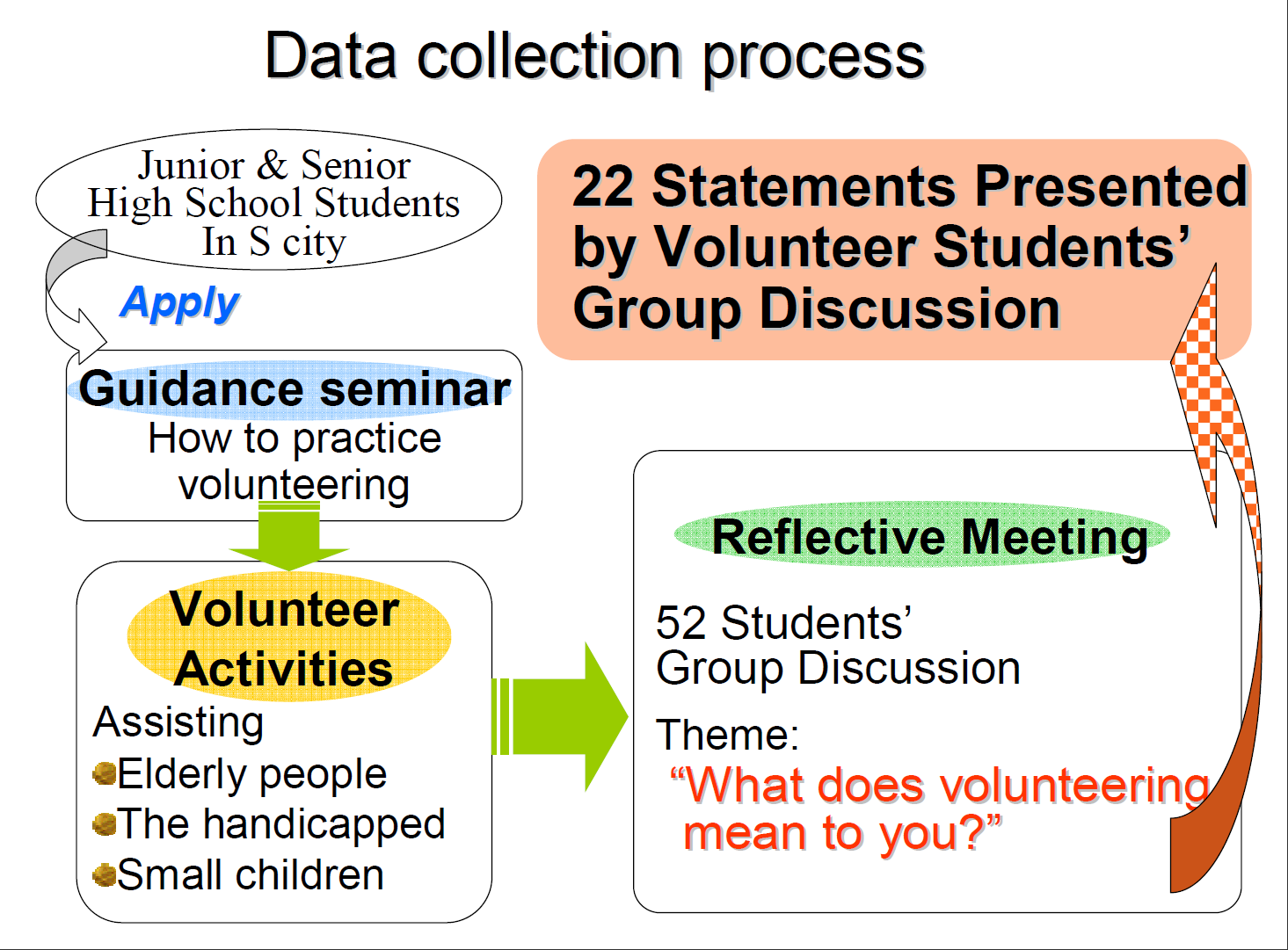
The local office of social welfare in S city offered volunteer activities to junior and senior high school students during their summer holiday. The students who applied were given a preguidance seminar to learn how to participate in this activity and then practiced volunteering for a period of 3 days to 1 week by helping those who needed assistance in their community, such as the elderly, individuals with disabilities, and small children. Some students visited a nursing home to talk with elderly residents and took them for a walk. One student assisted mentally handicapped men making handicraft items to sell. Others cared for infants by playing with water in a kindergarten.
After the students had completed their activities, the office held a meeting so that the students could look back and reflect on their experiences. Fifty-two students participated in the meeting and discussed their volunteer activities in six- to seven-member groups. We joined one of the groups as moderators, whereas the staff of the local welfare office presided over the entire meeting. The theme was, What did the volunteer activities mean to you? The students compiled their opinions in groups and recorded them on a large presentation paper. They then relayed their individual group's comments to the group as a whole.
Prior to the volunteer activity, the researchers explained the purpose of the study to the students and the office staff, and they consented to cooperate with in for our research. During the entire process of the research, even with participants' informed consent, we aimed to keep as natural a situation as possible for the students to obtain the actual mental state of the students because the study was intended to describe students' volunteer experiences as they are, or their lifeworld (Lebenswelt), as expressed by Husserl (1984). The approach with group discussion among students was considered to be the most natural method to bring out their real intentions rather than individual interviews by researchers. We adopted the words on the paper they presented, which had been derived from their natural situations and processes (Figure 1).
Data collection process
Phenomenological reduction
The study findings are derived from 22 statements presented by volunteer students' group discussion in their reflective meeting. Phenomenological reduction was the method used to reveal the essential meanings of the 22 statements. The fundamental idea of phenomenology is that the essence can be taken from the phenomenon through phenomenological reduction (Husserl, 1984). When this idea is adopted in health care studies, phenomenon means “the participant's individual experience” and essence means “the participant's genuine meaning” of the experience. Thus, the word essence is considered to represent the participant's existential meaning based on his or her purpose in life.
The procedure of phenomenological reduction as a research method to reveal the essential meaning is shown below. This method of thinking refers to Takeda (1993), who has explored the significance of phenomenology in Japan.

The procedure of phenomenological reduction in this study
Bracketing (for researcher to avoid stating personal opinions and evaluate in an unbiased manner),
Consideration of the object's essential meaning through his/her “embodiment” and “desire,” and
Rewriting their statements according to point 2.
The idea of “bracketing”
In step 1, the word bracketing refers to the suspension of judgment, which is known as epoche, to get an accurate perception of phenomena. This concept shows a change in researcher's attitude from natural to phenomenological, a prerequisite condition of phenomenological reduction.
Concerning the purpose of this study to inquire into the existential meaning of students' volunteer experiences, it was thought that our “natural attitude” would be the way of unconsciously looking into their experiences through the following lenses.
Educational aim of volunteer activity by government guideline for teaching. Volunteer experiences will contribute to students' social skills and their independence as today's students do not have enough opportunities to mix well with others because of a declining birth rate, smaller families, and disorganization of community life.
Conventional wisdom for youth volunteering. Participation in volunteer activities will help students' development because volunteering is a virtuous action.
Traditional theory of volunteering in Japan. The traditional theory is based on three volunteer principles:
to do without being paid,
to do spontaneously (as a free action), and
to do not for oneself but for others and society.
Our practice of bracketing enabled us ultimately to suspend our unconsciously presupposed knowledge, stereotypes, and traditional principles on students' volunteer activities. In other words, we attempted to deliberately identify our natural attitude on the above points and to continue this in every process of the study.
Embodiment and desire of the volunteer students
In step 2, embodiment represents the individual's situations, which bind him or her physically, socially, and mentally. Desire represents what the person wants to acquire or to become through the phenomenon. According to Takeda (1993), these two ideas are fundamentally required for phenomenological reduction.
To deeply understand the embodiment and desire of the students, researchers had participated in their pre-guidance and actual volunteer activities to observe them and to talk with them in a natural condition. Through our lived perceptions of the students and their situations, the contents were produced as follows.
Embodiment
○ Students actually experienced volunteer activities.
○ They are young and immature in speech expression.
○ They voluntarily participated in the activities.
○ They have been introduced volunteering as a worthwhile behavior because it benefits others.
○ These activities are recommended by teachers, but are not mandatory.
Desire
○ Students would want to reconfirm what they have been taught - that volunteer activity is worthwhile.
○ They would want to mature through volunteer activity for the above reason.
Example of reduction
An example of reduction will be explained below, using a statement from one of the volunteer students' groups to the question, “What did volunteering mean to you?” The group's statement was, “It's give and take.”
It is considered that there are two antagonistic reductions of this statement. One is based on affirmative interpretation, and another is negative. According to the affirmative one, the meaning of this sentence is considered to be an expression of the students' gratification; namely, they were taught that volunteer activity is a worthwhile deed and voluntarily participated in this program. After they concluded the activity, they stated their gratification with the experience. The other, a negative reduction, explains that although they were taught volunteer activity as a worthwhile deed and partook in it, one student was disappointed that he could not find any affirmative meaning, contrary to his expectation. So the words give and take were interpreted to express his negative feeling.
If one agrees with the viewpoint that the student expressed his genuine feelings, believing this activity worthwhile, and voluntarily devoted himself during the 3-day activity, however, one might find it hard to adopt a negative interpretation.
The conclusive reduction is as follows.

This is an example of reduction to reveal the essential meaning of the students' statements.
Results and discussions
Reductions of the statements, meaning codes, and categories
Using the method of phenomenological reduction, the essential meanings of individual groups' statements were disclosed. In Table 1, the groups' statements are in column 1, and their reductions are in column 2. The reductions were categorized into eight meaning codes: five categories and three types of perception. In Table 1 they are listed, respectively, in columns 3, 4, and 5, ranging from more specific on the left to more general on the right.
Statements by group discussions in a reflective meeting of students' volunteer activities Theme: What did volunteering mean to you?

View of students' volunteer desires
The volunteer activity in this study involved others in need of assistance in addition to the will of the students. From the viewpoint of students' desires to volunteer (volunteer desire), the interactions between self and others are explained in the Category column of Table 1. The categories in Figure 2 show the differences in how students' volunteer desires changed in practice.

“Volunteer desires”: Interactions between self and others
Category A: General ideas
The students had carried out in practice their volunteer activities but did not recognize the true value of volunteering. As the students did not find the existence of others, they could not yet reach the process where they could change and develop by facing up to others.
Category B: Dissatisfaction and self-demand, and
Category C: Justification of self-centered desire and defiant attitude
Although the students might have come in contact with others through their volunteer activities, their volunteer desires would superficially return to themselves without genuine interaction. This means their desire would be limited to self-centered desire for volunteering.
Category D: Positive emotions for themselves, having practiced volunteer activities
The students in this category would have met others through the activities and the outcome of their desires would have been expressed as pleasure or surprise. They might realize genuine communication between themselves and others, but it could not be determined whether their volunteer desires could progress or not.
Category E: Essential consideration on how they should interact with others
Volunteer desires of students would have been regenerated through facing up to others in this category. They would have realized their self-centered thoughts, and as a result they could achieve renewed desires. They started to desire existential communication with others and through this achieved their ideal.
Thus, the viewpoint of volunteer desire clarifies how the students interact with others and how their desires progress. A genuine experience in volunteer activities would be achieved only when desires had been renewed through awareness of care for others.
How students realize the essential awareness of others
In Figure 3 we show the inferred process for volunteer students to attain understanding of others. The volunteer students might have self-centered desires, first, for self-gratification or for self-advancement, and would face difficulties in helping others, and then struggle to find the proper way to help others. If students are able to find a way to help others, they will attain the pleasure in satisfying them. Through these emotional experiences, they might achieve awareness of the equal importance of the relationship between self and others.

Inferred process for volunteer students to attain understanding of others
Toward achieving a genuine experience
For a better education, the students' perception of volunteer experience should be genuine. Volunteer experiences often tend to be superficial because students often feel it mandatory and participate unwillingly, but if the experience could be genuine, it can develop their desires from self-centered to aiming for co-existence. Results of the study suggest that their teachers and promoters should inspire them to have genuine experiences during the activities.
Among most Japanese educational researchers, it has been emphasized that volunteering should be primarily spontaneous, especially in youth education, suggesting that students who volunteer spontaneously might achieve a genuine experience. However, we have to reflect on the meaning of the word spontaneity in youth, as most educational activities are compulsory for the students. This study indicates that the meaning of spontaneity in these educational volunteer activities is for students to feel the activity is for their own pleasure and self-worth. This meaning also refers to awakening their existence; that is, their purpose in life.
Study summary
Volunteer activity in education could bring the awareness of co-existence to the students in Japan; in other words, living together with others in a way that preserves the dignity of human life. The phenomenological approach allows us to understand the essence of students' perception in terms of their purpose in life. The awareness of coexistence would be conducted by existential communication between students and people who were assisted by the students. Educators should support students to experience volunteer activities for their own pleasure, not as a hardship, so that through the volunteer activities the students could realize existential growth.
Conclusion
The majority of phenomenological studies in health care have dealt with the vivid description of people's lived experiences. In this paper we have presented phenomenological reduction, which is a fundamental concept in phenomenology, as an alternative phenomenological method that elicits the essence of phenomenon. Through the reduction, existential meaning of object's words will be disclosed based on his or her embodiment and desire. Therefore, we could deeply understand the object's essential meaning by “reduction” even with concise or simple responses given by object. Using this method, we have attempted to explore the meanings of students' volunteer experiences.