




Abstract
Since the late 1970s, phenomenology has been widely used in nursing, education, psychology, and other disciplines. As one should have expected, its increasing popularity made this methodology vulnerable to criticism. Various authors began to question the credibility and usefulness of phenomenological research. Among the arguments, the vagueness of central concepts is the most notable. Indeed, concepts such as reduction have been interpreted in different ways, including many misleading interpretations. This article is an attempt to define reduction in phenomenology in the face of reductionism. Employing van Riel’s definition of reduction, I argue that reduction in phenomenology fits well within the boundaries of reductionism. I further explain that reduction in phenomenology is a reduction of a phenomenon, but not a reduction of an experience. That is, the phenomenon, partially accessible through experience, is reduced to its essence, and the essence should be understood as the necessary and sufficient qualities of the phenomenon. In addition, a structural examination of the many moves of reduction that were described by Husserl and van Manen is presented, contrasting them to the types of reduction in phenomenology, which are also described. These are: first-person and second-person reduction. Furthermore, the modalities through which these types are experienced are explored. In conclusion, I argue that reduction in phenomenology is by itself a lived phenomenon. Therefore, this paper can be regarded as a reduction of the phenomenon of reduction.
Introduction
In many methodological articles, we observe researchers describing their experiences of employing phenomenological methodologies during their doctoral studies (Alsaigh & Coyne, 2021; Heinonen, 2015a; Horrigan-Kelly et al., 2016; Land, 2024; McManus Holroyd, 2007; Sinfield et al., 2023). Recently, I started pondering… but why? After some thought, I decided that it must have something to do with the fact that learning the underlying philosophy of phenomenology is by and large a frustrating and time-consuming experience. After several years of distress, a systematic understanding finally emerges. Watts (2011) famously said that everything is completely obvious, once you already know the answer. Faced with this ‘obviousness’, a post-doc may want to contribute to the literature by presenting his or her own ‘clearer’ account of what phenomenology, or a particular branch of it, is.
This distress is partially caused by many misconceptions surrounding the central concepts of phenomenology, most of all, reduction. I have learned that different researchers often have different understandings of what it means. But that should not come as a surprise. The famous critic of phenomenological research, Paley (2016), goes on to say that even the three major methodologists of phenomenology (Amedeo Giorgi, Jonathan Smith, and Max van Manen) fail to provide clear definitions of the central concepts, including but not limited to reduction. Although reduction is often cited as a central methodological tool, it is rarely defined or applied in a consistent manner. An example of this could be the article of Wertz (2023), who states that ‘phenomenology is above all a method featuring an “epoché” and “reduction” that aims to provide true knowledge of experience’, without providing a clear definition. Most empirical articles applying phenomenology, however, fail to follow the urge of Giorgi (1997) and do not explain how reduction was pursued at all (Al-Sheikh Hassan, 2023). Cudjoe (2023) even speculates that such superficiality in phenomenological research may be due to the lack of interest in the philosophy of phenomenology from the part of researchers.
I agree that reduction is central in phenomenological research. However, employing a concept without a clear definition serves no function in research except to confuse the reader. Therefore, the purpose of this article is to provide a systematic understanding of reduction in phenomenology. For this, I will apply several explication techniques: historical contextualization, comparison, typology exploration, and graphical representation.
Origins of Reduction
The word ‘reduction’ comes from the Latin ‘reducere’, which literally means to ‘bring back’. It has been used in both everyday and philosophical language. The Oxford dictionary describes 6 contemporary senses of what it means to ‘reduce’. Only the fifth meaning speaks of ‘restoring to a proper position’, which more or less aligns with the literal translation from the Latin. So, when faced with reduction, a learner is often perplexed: ‘to bring back what?’, and ‘to bring back where?’. In the context of phenomenology, this can be answered quite simply: reduction means bringing back the phenomenon to its essence.
This response necessitates further elucidation; but first, let’s explore some common examples from ancient philosophy where reduction was employed outside of phenomenology. Thales of Miletus is widely recognized as the first philosopher in Western history. The questions he posed were metaphysical: what is the origin of the world, why is nature the way it is, or what makes the nature act the way it does. Thales was a pioneer in thinking that there must be some rational explanations for the phenomena that people observe in nature. In a deductive manner, Thales hypothesized that all matter on earth can be reduced to water. He believed that everything was made up of different forms of water. He had reason to believe it was so, because he observed every living being needing water to survive and water itself having the ability to take on different forms, i.e., solid, liquid, and gaseous. In the current state of natural sciences, we know that Thales was wrong. But the important contribution was the philosophical: the works of Thales are the first recorded acts of reduction in Western philosophy. Thales attempted to bring back observable objects to their common fundamental substance. In simple words, he decided that we see more than there really is, and that this essence is more important than its expression which we observe.
Another example is that of Socrates. Socrates was a person who would go out into the streets, stop strangers, and ask them odd questions like ‘Could you please help me understand something? You see, I’m an ignorant person and I don’t know what justice is. Would you be so kind and explain it to me?’. And then, after being given an imperfect description of what justice is, he would pick up on some detail and delve deeper. Something like: ‘But why is it like that?’ or ‘Who decided it to be so?’. Such behaviour may sound strange at first hearing, but it fits in well with Socrates’ main idea that we cannot know anything for certain, and that a wise person is always open to changing his opinion if confronted with a good counterargument. By asking all sorts of odd questions, Socrates was trying to reduce difficult concepts such as ‘justice’, ‘love’, or ‘truth’ to their essence.
In a similar way, Pluto tried to get to the essence of common everyday objects, such as a rock or a tree. But instead of explaining everything in terms of a single substance (as Thales did), Plato tried to distinguish the essential qualities of each object. What makes a tree a tree? How do we know that a tree is not a dog? What is this treeiness? To be fair, Plato failed to reduce these concepts to their essence: he was unable to provide the necessary and sufficient qualities that allow an object to be described. Instead, he theorised that any object in the real world is merely a representation of an ideal form of that object that exists outside the tangible world.
Reconciling Reduction in Phenomenology With Reductionism
Coming back to phenomenology, we must recognize that the researcher is working with different phenomena than Thales, Socrates, or Plato were. Instead, phenomenology deals with subjective phenomena as they are perceived or experienced by a person (in the case of phenomenological research – a research participant). To put it in simple terms, for a phenomenologist ‘justice’ is not a logical investigation into the meaning of the concept, but rather the direct experience of justice in an everyday life. Nevertheless, phenomenology is interested in the essence (or eidos, a Greek term used by Husserl (1976)) that makes a phenomenon what it is.
One might think that by shifting the focus of research to the subjective experiences of a given phenomenon as expressed by research participants, we will only reveal the diversity of perspectives regarding the phenomenon. How, then, will this diversity help in the quest of describing the essence of the phenomenon? The answer is that among the many different manifestations of the phenomenon in the minds of the participants, there must always be some commonality. Otherwise, we would not be dealing with a single phenomenon, but with a set of similar phenomena. The primary aim here is to describe the necessary and sufficient qualities which make the phenomenon what it is, and which allow it to be distinguished from other similar phenomena. Only later do we strive to provide a rich, emotionally engaging description of these qualities, as van Manen (2023) advocates.
Husserl, often considered the father of phenomenology, soon recognized that the act of interpretation when facing a phenomenon deflects from arriving at its essence. The mind is always full of preconceptions, prejudices, and expectations, which are clouding the view of the phenomenon in question. For example, a person describing his experience of love will start by explaining his understanding of love and how that, what he has experienced, echoed with this preunderstanding. But how does one truly experience or directly perceive love?
An attempt to answer this question will be made in the next section, but first it is necessary to address the often-heard distinction between reduction in phenomenology and reductionism. For example, van Manen (2023) states that ‘the meaning of the word reduction can be misleading since the phenomenological reduction is ironically directed against reductionism (abstracting, codifying, and shortening)’ (p. 357). If these concepts are so different, it really does not help to give them the same name. Why would Husserl ever do that? Fortunately, van Manen explains what he meant by reductionism – abstracting, codifying, and shortening. This notion suggests that the whole is less important than the parts, and that by explaining the parts, we are also explaining the whole. Reduction in phenomenology will always be opposed to this sense of reductionism, because here reduction means distinguishing the essence from the ‘background noise’ (the non-essential sensations surrounding a phenomenon) which is not seen as the whole. However, I argue that reductionism is a much broader concept that allows for the inclusion of reduction in phenomenology.
For this, I borrow van Riel’s (2014) definition: ‘The concept of reduction reconciles diversity and directionality with strong unity, without relying on elimination’ (p. 29). Of course, this definition requires explanation. Van Riel argues here that in reductionism, the whole and the parts are fundamentally equal. However, they are equal from a particular perspective, while different perspectives allow for a variety of reductions. van Riel (2014) takes the substance of water as an example and shows why it can be reduced to H2O. One must recognize that H2O does not enable the everyday experience of water. Yet, these concepts are one and the same when viewed through the lens of a chemist. From a phenomenological perspective, however, we recognize a strong experiential difference between water and H2O, but this only means that we need a different reduction to be performed. A phenomenologist might reduce water to its smell, taste, the sensation of swallowing it, and so on. Despite the fundamental differences between these reductions (notice that reduction is both a process and an outcome), they both fully encompass water. That is, there is a unity between water and a chemist’s reduction or a phenomenologist’s reduction. Except that this unity only holds true from the specific perspective. Moreover, directionality in this definition implies that the parts explain the whole, which is experienced as a separate entity, and not vice versa. However, the identification of the parts does not eliminate the whole as existing separately. Returning to the example of H2O and water, H2O is the parts and water is the whole. Therefore, water can be reduced to H2O, which explains the chemical properties of water, but H2O cannot be reduced to water. Water exists separately from H2O and H2O is only one of the reductions of water. Just to consolidate what has been said, the essence of a phenomenon is the reduction of that phenomenon from a phenomenological perspective, therefore, based on van Riel’s definition, the essence is equal to the phenomenon itself.
In reconciling reductionism with phenomenology, I must also illuminate the distinction between phenomenon and experience. An experience is always more than a phenomenon, but it also never encompasses the phenomenon in full (see Figure 1 for a visualisation). So, what should be considered the ‘whole’ that is to be reduced? It is a common misconception to think that the whole is the experience. Yes, we might be filtering (procedurally narrowing focus of) the experience down to the phenomenon, but this is not reduction. It is a step that is taken in any qualitative study, not just a phenomenological one. Remember that there must be a relative unity between the whole and the parts. This unity is observed between the phenomenon, which is the whole, and its essence, which is the parts. This idea is grounded in the very foundations of phenomenology; that is, phenomenology allows ‘seeing’ the phenomenon in its actuality, prior to conceptualization. As Husserl (1976) explained, consciousness never has complete access to a phenomenon (the experience is partial), but somehow it perceives the phenomenon in full. A Visualisation of the Distinction Between Phenomenon and Experience
A practical example of how this should be understood can be found in the article by Žydžiūnaitė et al. (2022). The phenomenon around which the study was conducted was non-art teacher creativity. Therefore, the researchers were filtering the broad practical professional experience of non-art teachers down to the phenomenon in question. It is obvious that not every professional experience of a teacher is an example of creativity. Also, there are always some aspects of an experience where teacher creativity was lived through, that are unrelated to teacher creativity itself. Figuratively speaking, the researchers needed to separate the wheat from the chaff. However, there is no reduction in asking the study participants to concentrate on the topic of interest. Reduction in phenomenology is a step that allows explaining the phenomenon in its necessary and sufficient qualities. In a logical sense, reduction of a phenomenon is subsequent to filtering the experience, but in practice, reduction occurs before, simultaneously with and after the filtering. The result of reduction in the study of Žydžiūnaitė et al. (2022) was 18 structurally presented themes, such as being exploratory, leading, or being authentic. There is a unity between the 18 themes (the essence) and the phenomenon of non-art teacher creativity, provided that the reduction is considered from a phenomenological perspective.
It’s really not the concept of reduction that pits reductionism against phenomenology, but the concept of phenomenon. From a scientific point of view (referring to the natural attitude or reductionism), a phenomenon is any object (physical, psychological, social, or spiritual) that can be sensed using our senses or perceived consciously. Although this term was popularized only in the 18th century by Immanuel Kant, objects, as they appear to the senses, have been a subject of interest since antiquity. However, rather than evaluating the truth or error of sense perception, phenomenologists focus on how perception is structured in lived experience. It is the subject that is important, not the object. Therefore, for a phenomenologist, a phenomenon is not the object itself, but the direct and pre-conceptual experience of that object. In the words of Heidegger, the phenomenon only comes into being when there is a subject experiencing it. For example, Dhamija and Dhamija (2025) studied ChatGPT-generated assignments in higher education. A naturalist view to this object would be to identify what qualities make these assignments different from the other ones, taking for granted that ChatGPT-generated assignments exist. However, a phenomenologist considers that phenomena, in this case ChatGPT-generated assignments, only become what they are when a consciousness experiences and identifies them.
Achieving Reduction in Phenomenology
Let’s return to the question I posed earlier: how does one truly experience or directly perceive love? How is it ever possible to reduce love to its essence? It is here that the famous term ‘epoché’ or ‘bracketing’ comes in. We should note that the terms ‘reduction’ and ‘epoché’ are so often presented together that many authors describe them as being one and the same. For example, Heinonen (2015b) states that ‘reduction is the technical term that describes the phenomenological device of bracketing/epoché <…>’ (p. 36). Another example is that of Mickūnas (2017). He explains that ‘phenomenological reduction is the bracketing of the natural attitude and the disclosure of the phenomena that allow the natural attitude and the diversity of entities it contains to appear as they are, without any obstacles.’ (p. 33). Even though some authors refer to epoché as phenomenological reduction (e.g. van Manen, 2023), I refuse to accept that reduction and epoché are one and the same and instead consider epoché to be a move (or a technique) of reduction in phenomenology. Please note that instead of talking about phenomenological reduction in this article, I refer to it as reduction in phenomenology. This is done deliberately to avoid confusion with the epoché.
We have already established that reduction is the outcome of a phenomenological study – an essence. However, reduction in phenomenology is also a process. It is the active part of inquiry that the researcher goes through to arrive at the essence of a phenomenon. Reduction is so central to phenomenological research that if someone were to ask a researcher what they were doing, they could easily reply with ‘I am reducing’. In the remaining part of this section, I will argue that this is not limited to the stage of data analysis. The same answer could be given at the literature review stage, the interview stage, and even the writing up stage. In my opinion, distinguishing a separate data analysis stage is not even mandatory. Some phenomenological studies do well without it. This is because the analysis in phenomenological research is the reduction itself (Giorgi, 2009; van Manen, 1997).
Firstly, what is the purpose of a literature review in an article based on a phenomenological study? Some argue that by exploring the existing literature, we are clouding our perception of the phenomenon as it is. As if we will start applying our knowledge throughout data analysis. This is a reasonable argument. One that was brought to the scientific debate by Glaser and Strauss (1967), the pioneers of grounded theory methodology. However, no one is ever devoid of preunderstandings. Our perception is always clouded, no matter what phenomenon we are dealing with. This is the reason why the stance of Glaser & Strauss has been heavily criticized. By the time Giorgi introduced phenomenology as a qualitative research method (Giorgi, 1971), these criticisms had already been voiced and have never been seriously reconsidered. Therefore, in the context of phenomenological research, a literature review stands as a systematic attempt to bring preunderstandings and prejudices to the surface. This attempt can be further enhanced by conducting a ‘bracketing (or epoché) interview’, that is, answering the interview questions yourself prior to interviewing the participants (Thomas & Sohn, 2023). Husserl was in favour of explicitly listing preconceptions, because it allows identifying that what clouds your vision.
Let’s perform a thought experiment. Imagine yourself traveling in a spaceship to a distant planet. You know nothing of the planet, only what qualities other planets have – some have mountains of dust, some oceans, and some are made of gas. And a time comes when the pilot announces it is possible to go to the observation room and take a close look at the surface of the planet. You are able to observe that everything – rocks, forests, and even rivers – has a dark green colour. An immediate and pre-theoretical realization occurs – just like trees on Earth make use of their greenness to produce oxygen, the same is happening here in… well, in everything. Only later do you find out that the glass of the observation chamber has a green layer to protect your eyes from something. It is the same with the literature review: only by acknowledging what clouds our vision will we be able to see the phenomenon clearly.
Following the acknowledgement of preunderstandings of the phenomenon either by reflection and listing of them, by performing a bracketing interview, or writing a literature review, the researcher should set them aside (in other words: put them in brackets or apply epoché). The nature of phenomenological research requires that this is done prior to entering the world of the research participant. Having done that, the researcher begins an interview. The mind of the researcher continues to provide predictions and contextualizations, but being conscious of his or her preunderstandings, the researcher avoids them. Even more, the researcher continuously reminds him- or herself to maintain the state of wonder (heuristic move of reduction).
A phenomenological interview has some unique qualities that distinguish it from a regular interview (Bevan, 2014; Høffding & Martiny, 2016). It is mainly because a phenomenological interview is in itself a technique of reduction: the researcher, aware of the concept of preunderstandings, guides the participant to the essence of the phenomenon in question. Both the researcher and the participant are collaboratively reducing; however, the interview focuses only on the experiences of the participant.
If epoché were the only tool for achieving reduction in phenomenology, we might agree that those two concepts are equivalent. But Husserl himself, early on, described another, completely different technique to arrive at the essence of a phenomenon. He named it imaginative (eidetic) variation. This technique is not unique to reduction in phenomenology. In fact, it can be employed in any kind of reduction. Simply put, it is the imaginative alteration of certain qualities of a phenomenon in order to arrive at those that are necessary and sufficient. An example of it can be found in the article by Matikainen (2024). She applied imaginative variation to arrive at the essence of the phenomenon ‘transformative way of becoming a teacher’. The author described her thought process performing imaginative variation as follows (bolded by me to highlight the idea of necessary and sufficient qualities): First, for there to be transformative learning there had to be something that transforms. I defined that transformative way of becoming a teacher transforms especially student teachers’ meaning systems related to learning, teaching, and education. Secondly, transformative way of becoming a teacher was essentially a process. I deduced that there had to be a starting point to the process that included the student teachers’ meaning systems as they were before the transformation. After the starting point something needed to crack the pre-existing meaning system and begin the actual process. Next the process seemed to include ambivalence with both regressive and progressive interests. <…> (Matikainen, 2024, p. 385)
As has been said, reduction, performed through different practices, is not exclusive to a single research stage, be it literature review, data collection, or data analysis. Rather, reduction continues into the stage of writing up. It is by writing that we are able to collect our thoughts and insights. Even more, writing allows us to observe our thoughts visually and reflect on what is written. After all, the researcher engages in what could be termed a second-person phenomenology. Unlike the research participant who performs the reduction on their own lived experience, the researcher operates indirectly. Lacking direct access to the original experience, the researcher’s reduction becomes a more complex endeavour: it involves discerning the essence of a phenomenon not through immediate analysis, but through the mediated account provided in an interview. This necessary second-person approach raises a fundamental question about the nature and rigor of phenomenological research. Can the essence of a lived experience be truly grasped and reduced when mediated through another’s articulation?
For instance, Husserl’s foundational phenomenology primarily concerned the direct investigation of consciousness in relation to physical phenomena from a first-person perspective. Later phenomenologists like Heidegger expanded the scope to encompass more inherently interpretive phenomena such as psychological and social experiences. Yet, despite his existential and hermeneutic approach diverging from Husserl’s, Heidegger too maintained a focus on the first-person perspective.
Let’s illustrate first-person phenomenology of a psychosocial phenomenon with an example. It is an excerpt from an article by Maharaj (2020), framed as phenomenological reflection. The author investigated her experience of translating Latin poetry: My introduction to Vergil’s Aeneid was first in Latin. <…>. I approached the text not yet having read any of the English translations. I found myself carefully attempting to preserve Vergil’s word order and lexical choices, almost to the point of being too literal in my translations. My overly timid approach to translation stemmed from an awareness of the magnitude of Vergil’s work as well as a nagging fear about changing the meaning of his poem. If I were too liberal in my lexical choices, I would be distorting the meaning of the poem. I would be re-writing the poem rather than producing a translation. My assumption here was that translating a text amounted to faithfully preserving the words as if they were butterfly specimens under glass. (Maharaj, 2020, p. 592)
This reflection has a different foundation than typical phenomenological research. While reduction in interview-based phenomenological research is often a time-consuming, arduous process, requiring more and different techniques, the perception of the essence in first-person phenomenology often occurs immediately and pre-rationally (provided that the subject has the right attitude, namely phenomenological).
I will give an example to illustrate how writing up is too a process of reduction. It is this article that you are reading. Remember that the purpose of this article is to provide an understanding of reduction. Isn’t it understanding that we seek through reduction in phenomenology? I’ll be honest with you; the structural account of reduction as presented in the following section emerged through reflexive engagement during the writing process — an act of reduction itself. That is, I did not have a clear picture of this structure until I attempted to write it down. It took many unsuccessful attempts to arrive at this structural portrayal. It is the same with all phenomenological research. Additionally, I would like to emphasize that it was the visual representation that not only simplified the communication to the reader but also aided the reduction itself.
Phenomenology is a research methodology that cannot be compared to any data collection or even data analysis method. Phenomenology dictates the very way of inquiry and shapes every stage of research. I believe that this approach requires the researcher to take every step of reduction described in this article personally. I strongly discourage the division of the research labour among the researchers. Instead, I advocate that a phenomenological study requires a central researcher. One, who is involved at every stage. This is especially important between the stages of interview and writing up (or data analysis, if you prefer).
A Structural Explanation of Reduction in Phenomenology
How should we understand structurally the relationship between epoché, imaginative variation, and reduction? Husserl (1976) referred to epoché and imaginative variation as different forms or modes of reduction, while van Manen (2023) calls them moves of reduction. But this is by no means an exhaustive list. In his many writings, Husserl also erratically described psychological, epistemological, and transcendental reduction. Summarizing the advancements in the field, van Manen (2023) also speaks of heuristic, hermeneutic, experiential, methodological, ontological, ethical, radical, and originary reduction. Just to remind the reader, it is not the purpose of this article to explain each and every move of reduction in detail. Rather, this article is an attempt to provide a systematic and logical framework for reduction in phenomenology and its varieties. Returning to van Manen’s notion about epoché and imaginative variation being moves of reduction, it must be explained that van Manen positions reduction above the other two. Put simply, these moves of reduction are but different practices that phenomenologists employ in different contexts. They are the ‘good practice’, some helpful considerations in attempting to achieve what Merleau-Ponty (1945) describes as ultimately unachievable, namely reduction. But these moves of reduction are certainly not types of reduction. If they were, then walking (go along) interviews, as described by Bartlett et al. (2023), or taking a personal walk after an interview, as described by Beattie and Zihms (2024), could also fit into this category. These moves are far from a classified or even classifiable system of reduction. However, I argue that there exist types of reduction as well as moves.
Reduction in phenomenology can therefore be classified into two types: first-person reduction and second-person reduction. The first type is later divided into two modalities: direct reduction and retrospective reduction. In this context, the term modality should be understood as a particular way that reduction is experienced. The first modality is experienced when consciousness suddenly lets go of the obstacles that block the way to the essence of the phenomenon, while the second one is experienced subsequently. Retrospection is very different from direct perception, mainly because it modifies the intentionality of consciousness relating to the phenomenon. However, that should not be considered a weakness. In fact, retrospection reveals different dimensions of experience that are not available in the present moment (Minkowski, 2013; Ricoeur, 1985).
Classification of Reduction in Phenomenology
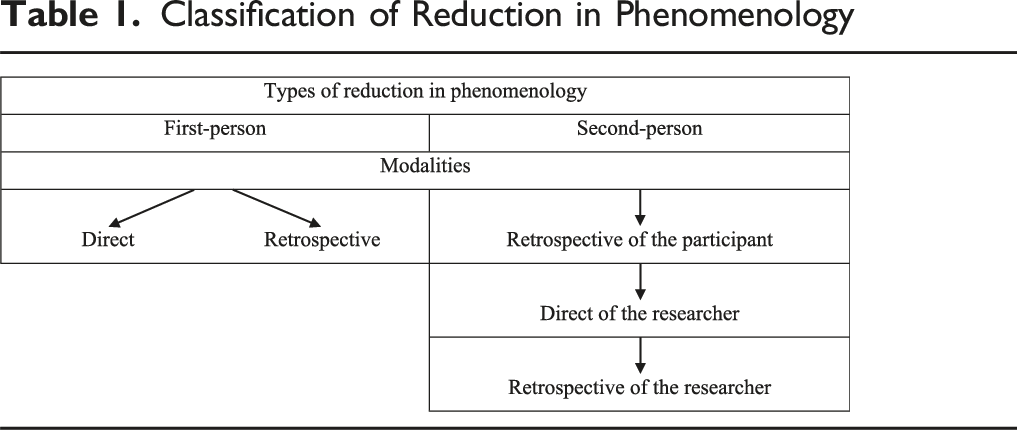

Notice how I’m using the phrase ‘to experience a modality’ when describing the process of reduction. By doing so, I am trying to reveal reduction as being a phenomenon by itself. As with any other phenomenon, a person experiencing reduction in phenomenology has many preconceptions that cloud his or her view. And since the act of reduction is, what Zahavi (2003) calls, consciousness turning back upon itself, the exact process of reduction is of interest to phenomenological inquiry. It is evident that many researchers experience reduction differently when conducting a phenomenological study. Nevertheless, there is an underlying essence, a structure of the phenomenon of reduction in phenomenological research. This structure is shown in Figure 2. A Structure of the Phenomenon of Reduction in Phenomenological Research
Understanding the underlying structure of the process of reduction in phenomenological research involves identifying its necessary and sufficient qualities. This allows demystifying reduction and offers an opportunity to ensure methodological rigour: rather than using the vague term ‘reduction’ in the data analysis section of an empirical article, I suggest delineating the exact process that has been undertaken to arrive at the essence of the phenomenon. By choosing to follow this advice, scholars would avoid gaps in epistemological logic and ensure methodological rigour.
In Figure 2, I depict three different worlds that are present in phenomenological research: the researcher world, the participant world, and the interview world. In my opinion, interviews are separate entities that have their own being. Employing Gadamer’s (1960) terms, the interview world could be understood as an emergent space of meaning that arises from the fusion of researcher’s and participant’s horizons. Interviews come into existence when the researcher and the participant meet but continue to have being through memory. My reasoning for placing interview in such an elevated position is based on differences in access: the participant has access to the experience, but the researcher only has access to the interview. It is the entity of interview that provides the possibility of the reduction of the researcher, whether the reduction takes place during the interview or after. In other words, the interview world serves as a bridge between the researcher and the participant, and, through imagination, allows the researcher to create a representation of the experience in his or her mind. Yet, apart from being an entity – equal to the researcher and the participant – an interview is also a phenomenon.
As stated before, an experience is always more than a single phenomenon, but it also never fully encompasses the phenomenon. This means that different people who have experienced the same phenomenon may share some nuances, but there will inevitably be some differences too. The reader may recall that in a number of places in this article I have referred to the essence as ‘the necessary and sufficient qualities of a phenomenon’. But what if a person, who has experienced a phenomenon, was not able to experience all the necessary qualities of it? Doesn’t that contradict my own definition of the essence? This is precisely where we see a clear distinction between an experience and a phenomenon. A phenomenon is experienced by subjects, and it is subjects that allow for the very existence of a phenomenon, but the phenomenon exists separately from the subjects. Husserl (1976) calls this intersubjectivity. It is the idea that objective reality is constantly being built by merging together subjective accounts. As an individual, I am affected by the subjectivity of the other and it shapes the way I see the world. Therefore, it is only natural to expect that one essence is extracted from various experiences across subjects.
Conclusions
In the current state of phenomenological research, reduction itself has become a phenomenon to be studied. Different researchers and philosophers have slightly different approaches to this concept, but there also exist many misconceptions about it. These misconceptions mainly arise from the metaphorical use of the word ‘reduce’. However, this vague term also offers the possibility of bringing under one umbrella concepts from different categories. These include attitudes, tools, techniques, or even competences. But what is reduction, really? As promised in the title of this article, I have attempted to get to the essence of the phenomenon of reduction. Ironically, the title itself can be seen as answering to its own question – reduction in phenomenology (not to be confused with epoché) is, in fact, an attempt to get to the essence of the phenomenon, employing many diverse, some clear and some vague strategies or practices. In our context, essence should be understood as the necessary and sufficient qualities that make up a certain phenomenon. Apart from clearing off some misconceptions, I have also provided a framework for reduction in phenomenology. Two types of reduction are distinguished: first-person and second-person reduction. Each is experienced through different modalities, depending on when the reduction takes place and who is reducing.
Footnotes
Acknowledgements
I am very grateful to have had the opportunity to learn from Prof. Vilma Žydžiūnaitė. She is the one who inspired me to study phenomenology. I will be thankful forever.

Funding
The author received no financial support for the research, authorship, and/or publication of this article.
Declaration of conflicting interests
The author declared no potential conflicts of interest with respect to the research, authorship, and/or publication of this article.