




Abstract
Many scholars have drawn on youth voice as a way of learning about educational inequity from the perspective of those closest to it. Yet, methodological engagements with youth voice tend to elide considerations of how coloniality and raciality operate in the very interpretive strategies leveraged to represent youth voice in academic knowledge produced about inequity. Following anticolonial black feminist critique and method-making, the inquirer turns to a radical reading practice for engaging youth feedback at a summer achievement program dedicated to promoting racial and educational justice and reversing summer learning loss. Key to this radical reading practice are methodological and analytical moves that: (a) pivot from earlier interpretations of youth feedback; (b) trace raciality in educational text to demonstrate how the text relies on modern signifying strategies that hide Man, his descriptive statements for existence, and the attendant power structures that facilitate global capital; and (c) consider how youth feedback illustrates coloniality and raciality at work within the out-of-school program. In all, the paper demonstrates how a black inquiry approach complicates educational equity’s federally mandated, state-monitored, and locally enacted pursuit at an out-of-school program to collectively consider alternatives to our current ethical-political education demands, and how we might engage the task of posing those alternatives.
Keywords
“Contrary to popular belief, it is disingenuous to argue that the system is failing its ‘disadvantaged,’ ‘marginalized,’ ‘historically oppressed and excused populations’ and/or ‘low-income students.’ … The system is working because of the fact these students are erased and excluded from school.” -Ebony Rose, 2019, p. 33 “We must now undo their narratively condemned status.” -Sylvia Wynter, 1994, p. 15 “… the colonial and the racial have always been and remain integral to the functioning of global capital” -Denise Ferreira da Silva, 2016, para. 12
Over the last few decades, the Elementary and Secondary Education Act of 1965 (ESEA) has been reauthorized with an intent to address educational inequities for economically and racially subjugated children in U.S. public schools. Notably, educational scholars have argued that the reauthorizations resulting in No Child Left Behind (NCLB) and the Every Student Succeeds Act (ESSA) enliven neoliberal market rationalities—or rationalities that favor autonomy as well as deregulation between private and public entities—and allow educational service providers to operate on public dollars (Saltman, 2014). Given their data collection on performance and accountability measures, these educational service providers have made inroads into local education markets as out-of-school achievement programs, data analysis platforms, software services, and more (Burch, 2009) that monitor and intervene on academic achievement. Neoliberal rationalities, coupled with standardization and accountability, relegate students to educational experiences that inscribe them and their learning from a deficit perspective in curriculum and pedagogy (Patel, 2016; Rose, 2019; White, 2015). That is, there is a primary focus on raising test scores and relying on standards that prescribe particular ways of knowing and being as measures of college and career readiness (Flores & Rosa, 2015; Hursh, 2007). After several decades of educational research under NCLB and ESSA, we know that educational laws primarily target economically and racially subjugated students who are bearing the heaviest weight of neoliberal education reform (Picower & Mayorga, 2015).
The neoliberal approach to education reform is particularly jarring because of the ease with which its political and symbolic systems make space for circular debates about the objective of educational reform (equality vs. equity) and employ terms like the educationally disadvantaged—both of which hide and operationalize the white logic inherent in a private-public approach to education reform and justice under modernity (Rose, 2019; White, 2015). Therefore, the purpose of this paper is to demonstrate that—as designed today—the pursuit of educational equity depends on creating and maintaining a political and symbolic system under which students can be “perceived, and therefore behaved towards, only as the Lack of the human, the Conceptual other to being” educationally advantaged (Wynter, 1994, p. 2, emphasis in original). I argue that this neoliberal approach runs on capital accumulation and the political economy of race. It also relies on a social scientific apparatus in which economically and racially subjugated children are consistently written as the necessary objects of educational reform. I make this argument by applying anticolonial black feminist critique 1 (Ferreira da Silva, 2022) in radically re-reading youth voice at an out-of-school learning program.
An Invitation to Complexly Re-read Youth Voice
Toward a more complex reading of voice, inequity, and economic and racial subjugation in the neoliberal education reform context, I draw on the theorizing and method-making (McKittrick, 2021) of anticolonial black feminist critique. Sylvia Wynter and those who have theorized with Wynter support an analytical practice for making clear how “Western European mythology establishes itself as a founding category by using its own culture as a measuring stick of humanness and claiming that this criterion has always existed and will always exist” (Rose, 2019, p. 30). Beyond the inclusion/exclusion binary or “shifting the question from a consideration of how exclusion and differentiation contradict the modern ethical embrace of the universal” (Chakravartty & Ferreira da Silva, 2012, p. 370), I also draw on the philosophical project of Denise Ferreira da Silva. In engaging Ferreira da Silva’s critique, I show how the political-symbolic architecture of public education—as engineered by ESEA and the legal, economic, and ethical rationalities that accompany its reauthorizations—thrives “on the construction of modern subjects who lack mental (moral and intellectual) capacities” (Chakravartty & Ferreira da Silva, 2015, p. 370). I apply Wynter’s and Ferreira da Silva’s interventions for a black approach to educational inquiry given how their methodological and analytical practices gesture toward “the conditions of possibility for upsetting epistemic, ontological, and axiological foundations that structure western knowledge production and Black existence, and imagining Black futures” (Okello et al., 2023, para. 3). Their scholarship is key to radically re-reading youth feedback in a research project I conducted at a summer achievement program, Teaching for the 21st Century (T4C), which is dedicated to promoting racial and educational equity by reversing summer learning loss. This project, as informed by Wynter and Ferreira da Silva, exposes and unsettles coloniality and raciality in the program and in my initial interpretations of youth feedback.
In 2018, I designed and conducted a youth-informed, participatory study to learn more about feedback for improving T4C. As a director and returning staff member at the program site in Milltown, I was impressed with the organization’s coordinated effort to collect student feedback in the previous summer. I sought to learn even more from students by designing a richer feedback data collection protocol, which I discuss in more detail below. I share how the youth-informed T4C project served as a major pivot in my own understanding of anti-blackness in one of its subtlest expressive modes in knowledge production. I also demonstrate a methodological and analytical engagement 2 that aims to unsettle how I unintentionally operationalized white logics and methods when originally analyzing student feedback for promoting equity at T4C. With a critique of educational equity’s perceived benevolence, this paper invites readers to consider alternative ethical-political education demands. This paper also invites us to collectively consider how we might engage the task of posing such alternatives. I make this offering also acknowledging that we are living and working toward black liberation in the wake of colonial-racial terror (Sharpe, 2016), neoliberal education reform, police brutality in schools, climate change, and the lingering COVID-19 pandemic (Ladson-Billings, 2021). Concurrently, we find ourselves on the precipice of encountering more consequences related to overconsumption, overextraction, and the overrepresentation of Man as the Human itself (Wynter, 2003).
In the forthcoming sections, I consider why and how scholars have drawn on youth voice in the era of neoliberal standardization and accountability education reform before turning to a different analytical engagement with voice informed by anticolonial black feminist critique. The literature review makes clear that youth rarely have opportunities to intervene on the knowledge of knowledge makers and policy actors before considering the ontological in educational settings—that is, “how the entanglement of school architecture, bodies, discourses, affects, and discursive practices is collectively producing the enactment of particular modes of being” (Zembylas, 2017, p. 1410). In seeking to address the terrain that educational scholars of the ontological turn do not often traverse, I draw on Wynter’s (1994) radical reading practice and Ferreira da Silva’s (2007) critical methodological strategy of tracing raciality to consider how youth feedback exposes the racial logic of educational equity.
The Turn to Voice: Learning from Those who Experience Educational Inequity
When drawing on youth voice to inform educational research, practice, and policy, scholars suggestions cohere around several practices: theorizing dialogue, highlighting approaches for interpreting student feedback, sharing outcomes of student initiatives, and sustaining efforts. Many emphasize theorizing dialogue with youth by drawing on the work of Freire (1970) to stress the importance of dialogue, trust, and social justice praxis to build student critical consciousness (Akom, 2008; Akom et al., 2008; Cammarota, 2016; Cook-Sather, 2002; Emdin, 2009; Robinson & Taylor, 2007). Further, researchers discuss approaches for highlighting and interpreting student perspectives such as drawing on students’ experiences and feedback via surveys, interviews, and photo elicitation (Caraballo, 2012; Flutter & Ruddock, 2004; Plank et al., 2014; Stauber, 2017). Through these methods, researchers identify equity issues and suggest changes to curriculum, pedagogy, and school-wide practices. Additionally, when drawing on youth voice or apprenticing them as researchers, scholars discuss positive actions and outcomes of these initiatives (Boston Student Advisory Council, 2012; Brown & Rodriguez, 2017; Caraballo et al., 2017; Watson et al., 2020). For example, researchers argue that students gain critical research, pedagogical, and presentation skills through participation in Youth-led Participatory Action Research (YPAR), which allows students to shift deficit narratives about themselves and their peers (Cammarota & Fine, 2008; Ozer & Wright, 2012; Scorza et al., 2017). YPAR also surfaces possibilities for programmatically building with the “knowledge, perspectives, and questions” of Black youth researchers (Watson et al., 2020, p. 24). In sharing how to sustain efforts, scholars propose that adults ensure students have the resources, structures, and support to continue seeking and making change (Mitra, 2003, 2007; Morrell & Collatos, 2002; Yonezawa & Jones, 2007).
However, many challenges arise when centering youth feedback to suggest classroom-level and school-level changes. Mitra (2006) argues that students are given numerous opportunities to provide feedback via surveys compared to leading their own student voice projects. Additionally, scholars suggest that adults’ distrust of students pervades hierarchical educational environments and makes collaborative and non-hierarchical research activities difficult to implement with youth leaders (Brown & Rodriguez, 2017; Cook-Sather, 2002; Irizarry & Brown, 2014; Winn & Winn, 2016). Students in pervasively top-down school environments often face heavily regulated learning spaces and disciplinary measures more than they are asked to lead (Caraballo & Lyiscott, 2018). Therefore, pursuing change is also stunted by the prevalence of standardization and accountability practices, which can “co-opt” the emancipatory aims of projects that center youth voice and leadership (Caraballo et al., 2017, p. 238).
Student voice scholars suggest removing barriers to student participation by securing funding, dedicating meeting time, and providing student stipends (Anderson, 2020; Morrell & Collatos, 2002). They argue that these practices can support researchers to implement youth voice projects—and resulting feedback—as they navigate federal and state education mandates. They also suggest focusing on measurable goals and outcomes (Mitra, 2007; Morrell & Collatos, 2002; Yonezawa & Jones, 2007). However, the challenges presented are more difficult to eliminate than suggested and the proposed solutions can alienate emancipatory aims of research with youth (Anderson, 2020; Fielding, 2004). For example, measurable results-oriented solutions are entangled with neoliberal education reform rationalities. Fielding (2004) highlights this issue when discussing how student voice project teams are often asked to prove their value in terms of accountability measures. He argues that teams are regularly asked to create goals aligned with “high performance approaches” (p. 211) that lead to measurable results given the neoliberal frameworks schools use to guide educational investments and innovations. Yet, if researchers uncritically take up such solutions, they align research aims and practices with deficit notions of learning. In response to similar traps, Dillard (2000) intentionally advances an endarkened feminist epistemology to counter and “unmask traditionally held political and cultural constructions/constrictions” by offering “language which more accurately organizes, resists, and transforms oppressive descriptions of sociocultural phenomena and relationships” (p. 662). Patel (2016) also outlines the consequences of uncritically taking up solutions that lead to deficit practices in her call to exercise answerability in educational research.
More recently, Jocson and Dixon-Román (2020) call for ontoepistemological shifts in education research that complicate the tendency to seek quick solutions to the challenges we encounter. That is, in seeking immediate solutions to the problems we identify in educational settings, we often elide greater consideration of material-discursive forces, such as how policy shapes our interpretative approach and what is readily apparent to us in educational contexts (Brown, 2009; Jackson & Mazzei, 2012, 2013; Nxumalo, 2020; Taguchi, 2012). Zembylas (2017) also suggests that ontological analysis “pays attention to the changing socio-historical roles of entities and relations in social and political lives” and addresses “the web of practices” that make an event “knowable” to us (p. 1402). Moreover, Jackson and Mazzei (2012) complicate traditional approaches for reading participant voice. They encourage researchers to investigate how voice constitutes and is constituted by actions, encounters, and nonhuman forces such as power dynamics, places, objects, and more. Yet, while they offer practices for expanding an analysis of voice, ontological and new materialist approaches to education research often elide critical discussions of sociopolitical entanglements related to coloniality and anti-blackness, prompting scholars like Nxumalo (2020) to carefully put new materialism in conversation with black studies and black feminist thought. In my reconsideration of youth voice and feedback, I take up anticolonial black feminist critique to expose and trouble how colonial-racial power structures are deeply implicated in social scientific approaches for drawing on voice.
Anticolonial Black Feminist Critique and Method-Making
Anticolonial black feminist critique complicates the idea of the human by theorizing and analyzing the persistence of anti-blackness and coloniality. The critique informs this study’s black inquiry approach, which applies and moves beyond ontological and new materialist analyses. In discussing the tensions of bringing these analytical practices together, Nxumalo (2020) explains that Black and Indigenous feminist analyses attend to “the ways in which feminist new materialist disruptions of humanism can universalize Euro-Western epistemologies of the human and leave unexamined ongoing material, embodied and discursive dehumanization enacted through anti-Blackness and settler colonialism” (p. 36). Further, while ontological and new materialist theories critique the centrality of humans and speaking subjects at the level of analytical engagement, they tend to set humans in a dichotomous relationship with nonhumans for analyzing how an action, encounter, or event becomes knowable to us in its assemblage (Phillips, 2006). Further, while ontological and new materialist approaches to analysis in educational research prodded this current study to explore the web of policies, artifacts, and discourses that helped me render student feedback more complexly, an anticolonial black feminist critique adds framing for this study to consider how the human, Man (Wynter, 2003)—or to borrow from Ferreira da Silva’s (2007) ontoepistemological rendering of the transparent “I”—facilitates modern subjugation through coloniality and raciality. Wynter and Ferreira da Silva are key to the black inquiry approach advanced in this paper given their “series of comprehensive analytical frameworks—both critical and utopian—in the service of better understanding and dismantling the political, economic, cultural, and social exploitation of visible human difference” to further the project of black studies (Weheliye, 2014, p. 4). They have manufactured a critical arsenal with tools and analyses that study and trouble the racially violent and global capitalist world as we know it by inciting us to critique (McKittrick, 2021) rather than disinterested spectatorship. Below, I briefly engage with those who have both theorized with Wynter and applied her thinking to the system of public education in the U.S. and the Global South. Afterward, I discuss Ferreira da Silva’s contributions to tracing modern representation in global projects for justice as a way of moving toward the task of radically re-reading youth feedback at T4C.
The Anticolonial Thought of Sylvia Wynter
In an intentional gesture toward anticolonial thought and critique, McKittrick (2021) lifts the work of Wynter, writing that, “our starting point must be one of disobedient relationality that always questions, and thus is not beholden to, normative academic logics” (p. 45). McKittrick foregrounds Wynter’s practice of challenging taken-for-granted ways of thinking that structure knowledge production about the idea of black abjectness. Encouraging readers to engage in a radical reading practice that dislodges Man from its privileged position, she also states several lessons from Wynter: First, … read differently (from a third perspective, from the perspective of struggle, …) and observe how our present system of knowledge, a biocentric system of knowledge upheld by capitalist financing, is a self-referential system that profits from recursive normalization; and, second … read and notice the conditions through which self-replicating knowledge systems are breached and liberation is made possible. (McKittrick, 2021, p. 43)
Reading public education and its attendant school curriculum from a third perspective, Rose (2019) draws on Wynter’s tracing of the descriptive statements of Man to demonstrate how education perpetuates a knowledge system that is self-referential and working exactly as designed. Rose demonstrates how the “American figure of Man… engages in a form of coloniality of being—a sphere in which power is articulated around the creation of proper human subjects—that is congruent with the social goals and state of being under Man2” and “a coloniality of knowledge, where power is transmitted and valued as authoritative knowledge in our schools” (p. 33, emphasis in original). Rose’s application of Wynter in this context illustrates the dominant Eurocentric school curriculum; the violent disciplining of Black children; the imposition of English and erasure of Indigenous language practices in the Global South; and the attempted eradication of African Indigenous scientific philosophies.
Beyond noting the suffering that accompanies the education system’s processes of indoctrination, Rose incites readers to follow Wynter’s “quest to move beyond the present epistemological order by proposing a new culture system, a human praxis, rather than another bio-genetic—man as rational natural organism—epistemological system. … in the struggle for non-Western-humanism-as-praxis” (2019, p. 39, emphasis in original). Elaborating further on the project of being human as praxis, McKittrick (2015) makes clearer that Wynter’s call for praxis: Signals not a noun but a verb. Being human is a praxis of humanness that does not dwell on the static empiricism of the unfittest and the downtrodden and situate the most marginalized within the incarcerated colonial categorization of oppression; being human as praxis is, to borrow from Maturana and Varela, ‘the realization of the living.’ (pp. 3–4)
Wynterian thought pushes methodologists of Black inquiry approaches to unlearn the west’s colonial ways of knowing to forge “an entirely new epistemological system” (Rose, 2019, p. 40), one that does not rely on rearticulated notions of our supposed inferiority in a social order with Man at the apex—and one that does not rely on hierarchal ordering, for that matter.
The Anticolonial Thought of Denise Ferreira da Silva
For Ferreira da Silva (2015), Wynter’s philosophical thought is a catalyst for “systematically considering colonial domination” (p. 97) and how it features in systems of knowledge and power in ways that postmodern philosopher Foucault (1994) does not grapple with. Yet, Wynter’s emphasis on the “Human … as an ethical concept” (Ferreira da Silva, 2022, p. 67) and her proposal to forge a new science—a move which could “complete the natural sciences” through neurophysiological study (Wynter, 2003, p. 328)—are points of departure for Ferreira da Silva’s (2015; 2022) critique of modern representation. In Toward a Global Idea of Race, Ferreira da Silva (2007) offers: A critique of modern representation guided by the desire to comprehend the role the racial plays in modern thought. … In other words, I provide a mapping of the analytics of raciality: a description of its context of emergence, its conditions of production, and the effects of signification of the conceptual arsenal generated in scientific projects that sought to discover the truth of man. (p. xviii-xix)
From this perspective, Ferreira da Silva offers a metanarrative—or a narrative of the modern narrative which distinctly breaks with the logics of post-Enlightenment thought and reason—of modern representation and she interrogates how modern productive tools of science and history, namely “philosophical, scientific and national statements,” illustrate “the signifying strategies that have produced man and his others” (p. xviii). Ferreira da Silva begins by examining philosophical statements foundational to the post-Enlightenment pursuit of knowledge through universal reason. Further outlining her metanarrative of modernity, she challenges the transparency thesis, or the idea that universal reason can be produced from the rational mind of man (see also Carter & Jocson, 2022a).
Then, arguing that the fields of science and history are the “productive weapons” (p. xix) of universal reason, Ferreira da Silva (2007) exposes the analytics of raciality, “a modern political-symbolic arsenal, which transforms human bodily and social configurations into signifiers of the mind” and “produces the global as a modern ontological context” (p. 166). In naming the analytics of raciality as the mode of modern representation, she makes clear how the transparent “I” regulates the bounds of science, law, and economy in its own image and interest, which includes violently engulfing and intervening on the “others of Europe” (p. xviii). Ferreira da Silva’s project of uncovering how the racial is deployed as a strategy of power to shape our modern ontological context is also radical in its questioning of Critical Race and Ethnicity Scholarship’s embrace of cultural difference and exclusion for explaining “racial subjection” (p. 7). She challenges how these explanations unintentionally rely on transparency and requests for inclusion, but are seldom, if ever, comprehended by the law in ways that confront racial violence. Without attending to Ferreira da Silva’s (2007) discussion of how “subaltern subjects emerge in representation” (p. 2), dominant narratives about race relations, racial justice, and inclusion, tend to invigorate rather than refuse the modern grammar of transparency and universal reason by embracing a socio-historic logic of exclusion: This formulation rehearses transparency, the modern ontological presupposition, when deploying universality and historicity as the privileged modern ontological descriptors: it suggests that racial emancipation comes about when the (juridical and economic) inclusion of the racial others and their voices (historical and cultural representations) finally realizes universality in postmodern social configurations. (Ferreira da Silva, 2007, p. xxiv)
By taking modern representation to task for the ways in which ethical outrage does not ensue from the several centuries-long reign of colonial-racial terror, Ferreira da Silva (2015) pushes readers to consider how the analytics of raciality are caught up in our political context. She clarifies: The products of the “biocentric code” (the social categories that are aligned with racial, gender, and sexual difference) have been integrated into the political text, as proper political signifiers whose inclusion would/will fulfill modern democratic claims. That is, these power/knowledge effects are here to stay insofar as they are encoded in juridical texts. (p. 103)
At issue is that the “racial, the scientific signifier” (Ferreira da Silva, 2007, p. 10), already constitutes a modern strategy of power in how we conceive of justice in the current political landscape. Thus, when seeking to include youth voice in shaping knowledge about educational (in)equity, we must be mindful about the ways a sociological view of race relations, cultural difference, and sociohistorical exclusion figure in the very strategies we use to pursue equity.
Thus, I specifically draw on Ferreira da Silva’s (2014) outlining of “scientific knowledge as a major productive site of power” (p. 10), her deliberate shift to the problem of racial violence, and her explication of how racial violence provides the conditions of possibility for global capital accumulation (Robinson, 2020). She explicitly discusses the violence of constructing racial others (symbolic violence) and the violence made possible by this categorization (total violence). Ferreira da Silva’s (2007) engagement with race as a modern strategy of power has provided this study with an inquiry practice for problematizing the ways educational equity is pursued through recalling the “genres of being human” (Wynter, 2003, p. 281). Put another way, equity is pursued through articulating categories of race, ethnicity, gender, home language and more to signal whose lives and learning should be subject to educational intervention and neoliberal reform in the name of justice. To avoid repeating these moves, I situate educational equity as an object of study to show a different view of its design. I also re-read youth feedback for moments that opened further consideration of raciality through the economic, juridical (legal), and ethical (moral) registers that constitute the main axes of modern thought, as proposed by Ferreira da Silva (2007) and Chakravartty and Ferreira da Silva (2012).
Methodological and Analytical Approaches to the Data
I am preoccupied with being “vigilant about how” I produce the object of my “analysis, critique, or alternative politics” (Asher & Wainwright, 2018, p. 36) as I apply anticolonial black feminist critique for radically re-reading youth feedback. For example, education scholars have made abundantly clear how racially and economically subjugated students bear much of the burden of the neoliberal approach to educational reform (Picower & Mayorga, 2015). As such, these scholars have called on us to practice refusal by actively exposing the political economy of race in our education system (White, 2015); the colonial legacies in present-day knowledge production (Patel, 2016; Tuck, 2009); and the school as a site of ongoing suffering for Black youth (Dumas & Ross, 2016). For me, anticolonial black feminist critique takes seriously the task of engaging these multi-constitutive points of reference for ethically considering “Black people at the nexus of research and educational contexts” (Okello et al., 2023, para. 7). As an approach to critical methodological and analytical engagements, anticolonial black feminist critique also encourages us to turn the research lens on ourselves (Madison, 2005) to unsettle our colonial-racial gaze in producing the object of our analysis (Rashid, 2024). As I flip the research lens toward myself, my actions, and the social scientific apparatus that is used to interpret youth voice, I actively pivot to confront practices that rely on narrating economically and racially subjugated students as predisposed to summer learning loss because of their school district’s performance status. I also challenge the presupposition that students undoubtedly benefit from participating in educational interventions and sharing feedback to improve interventions. To loosen the grip on these analytical assumptions that are often operationalized through white logic, this section situates educational equity as an object of study to investigate its insidious design, which is held up by the legacies of coloniality and raciality. The central questions I am asking in the study are: 1) How are educational and sociopolitical entanglements designed to promote educational equity? 2) How do educational and sociopolitical entanglements of pursuing educational equity shape student feedback in an out-of-school-context? I continue by sharing more about the study site, me and my inquiry partners, and my methodological and analytical engagements.
Study Site
Teaching for the 21st Century (T4C) is a pseudonymous organization that seeks to prevent summer learning loss for rising fifth- through eighth- grade students. Summer sites are coordinated in collaboration with local school districts and housed in local school buildings. At the time of this study, Milltown, the school district partnering with T4C and of focus in this paper, was subject to state takeover. The school district has contracted with T4C for the past 8 summers (2017–2024) to produce a several weeks-long summer program. Located at one of the Northeast sites in the summer of 2018, the Milltown site consisted of 4 professional educators serving as leadership staff, 5 professional educators serving as academic coaches, 28 high school and college-aged teachers, and 115 students who were rising fifth- through rising eighth- graders in Milltown.
The Inquirer: An Assemblage of Shifting Locations and Practices
In 2018, I served as the director of T4C Milltown when the youth feedback portion of this project was conducted. During this time, I was not able to take my director hat off in any setting. I was always moving between spaces of self, director, and researcher. 3 Even when caught up in the flow of inquiry with the four youth co-researchers, there were moments when I had to pause our conversation(s) to address other programmatic, staff, and student concerns. Amongst the inquiry team’s conversations, there were moments when I interjected to emphasize expectations for working collegially with one another. My role was entangled in the programmatic goals for students’ summer academic growth, as well as in my being a black educator and a budding education scholar/black feminist methodologist. I returned to students’ feedback to more thoroughly attend to how I was entangled in T4C’s programmatic practice and the larger pursuit of equity in public education. This return has allowed me to generate ethical and methodological questions about staying with moments that trouble or haunt me (Dixon-Román, 2017). I contemplate these moments and allow them to perpetually shift future approaches.
Inquiry Partners
Students’ Self-reported Demographic Information.

Yet, my inquiry partners are more than can be captured in a table. I remember Ana’s interest in robotics, coding, and acting. I also remember her radical vulnerability (Nagar, 2019) in sharing how events with family and friends shaped her approach to caring for peers. I remember Angelo’s interest in sports and his expressiveness about the activities he enjoyed. I remember him always saying what came up for him. I remember Elijah’s deep admiration for his friends, peers, and basketball. I also remember his sharp societal critiques. I remember Elijah and Matthew’s brotherhood. Their respect and love for one another. I remember Matthew’s leadership in a crowd, his taste for good food, and always being in motion with a basketball.
Gathering Youth Feedback
My initial questions were: What are the experiences of middle school students attending Teaching for the 21st Century (T4C)? How do student experiences and feedback inform potential changes for the end-of-summer student survey and program itself? To answer these questions, I drew from participatory methods for the purpose of involving youth in the design of the research project and supporting them to gather data about their experiences. T4C’s 2017 and 2018 end-of-summer student surveys primarily used Likert scale questions and several open response questions. To expand options for sharing feedback about the program, we incorporated photo elicitation, focus group interviewing, and cognitive mapping, or drawings. Ana, Angelo, Elijah, Matthew, and I met over the course of the last 3 weeks of the 5-week student program to familiarize ourselves with the project and one another as a research team. Knowing that I was the Director, I took the following steps to acknowledge and address the power dynamics between me and students in this figured world of achievement (Caraballo, 2012): I met with students three times to contextualize the project, answer questions, and build our team before collecting data; students had space to create, discuss, critique and change photo prompts for the project; and, in every interaction with students, I led with consent or a request for students to opt into or out of recording photos or their voices. We also met to devise a photo elicitation protocol for our focus group interview.
Initial Data Analysis & Findings
After collecting data, I used a grounded theory approach to analyze the data (Corbin & Strauss, 2015). Once the focus group interview was transcribed, I reviewed the transcript by applying codes to each student’s comments and compiled a list of 69 unique codes into a codebook. I uploaded students’ photos, survey responses, the focus group interview transcript, and cognitive maps into Dedoose, a cloud-based, computerized data management system. I applied the codes to the data sources in Dedoose and started analysis by reviewing the most frequently occurring count of codes. Dedoose also produced a tab of code “co-occurrences,” denoting the number of times a code was applied to an excerpt and co-occurred with another code. I explored code co-occurrences higher than 8 through writing memos, and I worked with recurring concepts in the development of core categories from the data. Several techniques were used to collapse the data and identify major concepts such as questioning; making constant comparisons; and examining meanings of a word, emotions expressed, metaphors, and similes. Student feedback explicitly named food, student to student conflicts, elective choices, learning activities, friendships, and sports as contributing to their experiences. Through writing memos or notes to track data analysis, I developed two core categories to describe the experiences and feedback of the middle school participants at Teaching for the 21st Century’s summer achievement program: (a) doing what you love and (b) playing roles. However, implicit in the events and stories that shaped their feedback were decisions made about the program and its operations long before students arrived. In the following sections, I discuss two analytical engagements. I introduce how I applied Ferreira da Silva’s (2007) critical strategy of tracing raciality, then I discuss how I re-read the photos, feedback, and drawings gathered in this study. I purposefully frame my inquiry practices as analytical engagements to challenge western social science conceptions of data analysis.
Analytical Engagement: Tracing Raciality
Ferreira da Silva (2007) prods readers to trace raciality, a critical strategy for mapping the productive effects of the analytics of raciality (see Carter & Jocson, 2022a for a previous tracing exercise). She writes: We need to trace every and each articulation of raciality, including those that profess its irrelevance, trace at each moment how it rewrites the racial subaltern subject in affectability, producing statements that not only excuse the violent effects of this rewriting but also redeploy the transparency thesis. (p. 267)
Documents Examined for Analysis.


Educational Equity’s assemblage of racial logic.
Analytical Engagement: Treating Youth Voice-As-Effect
In their discussion of voice-as-effect, or what voice does, Jackson and Mazzei (2012) question how voice functions and recommend that researchers analyze participant data by “‘seeing’ voice” (p. 747) through out-of-field experiences. That is, they refuse a “singular speaking subject” (p. 748) through contextualizing participant voice in multiple spaces beyond the site of the research. Furthermore, they suggest that researchers pay attention to the other of the true and authentic voice to examine the complexities and textures of voice. While I consider these practices a jumping off point, I stray away from seeking an other voice. Instead of treating the students’ voices as other—as Wynter and Ferreira da Silva teach—I pay attention to their comments, gestures, choices, and speculations. For the current analysis, I asked the data “what else might the youth be saying or alluding to?” and “in what ways does that thing expose and trouble raciality?” These questions supported my thinking and helped me take my analytical focus from searching for the authentic T4C student experience or its other. In “re-turning” students’ feedback (Barad, 2014, p. 168), I considered voice-as-effect by examining how silence, speculation, and the mundane figured in our conversations and work together, pointing to raciality. When re-reading youth voice, I share my previous analysis of each moment or related moments that went unnoticed, then I expand the frame to share more context about the action, event, or encounter students are discussing. Then, pivoting, I unfix my previous analysis and offer a new analysis by demonstrating how the expanded frame reveals raciality in its economic-ethical-juridical assemblage.
Radically Re-Reading Youth Feedback
When tracing raciality, I treated the documents reviewed as educational text situated in globality, or as written statements that rely on historic and scientific signification strategies from the collection of post-enlightenment constructions of racial difference. Those signification strategies have written economically dispossessed youth of color as affectable—and doubly affectable (Ferreira da Silva, 2007) when considering Spillers’s (1987) and Morgan’s (2018) reading of partus sequitur ventrem 4 and the Moynihan report. Spillers’s examination of the report and its white, western logic helps me demonstrate how black mothers are constructed as the cause of their children’s supposed low achievement, which narratively locks black children into a fundamental cultural difference that is always already assumed as destined for academic failure. Such a formulation then provides the ethical and moral rationale to easily describe students as disadvantaged and in dire need of intervention, which is heightened in national reports such as A Nation at Risk (National Commission on Excellence in Education, 1983) and the ESEA's (1965) reference to “educationally deprived children” (Title II). The effects of labeling students as affectable (disadvantaged) is excused with the argument that intervention is a logical choice for closing achievement gaps and promoting a high-quality education. State Education Agencies’ (SEAs) juridical mechanisms are assembled and used to meet these goals, requiring that students perform the labor needed to assess their academic progress and address academic diagnoses. These mechanisms are facilitated by economic entities, or educational service providers that have the tools to assess, measure, diagnose, and correct the educational disadvantage that students cannot help but inherit. The educational facts of academic achievement and growth become proof that interventions work (or do not) for the so-called educationally disadvantaged no matter how much harm students must endure to accomplish such proof.
Tracing raciality offers a different view by showing that the efforts of educational equity are problematically designed. The pursuit of educational equity—as informed by raciality in educational text—is designed to symbolically obliterate mental and moral deficiencies that obstruct college and career readiness. Additionally, when tracing raciality, educational equity efforts are not as innocent as corporations, nonprofits, SEAs, Local Education Agencies (LEAs), and the US Department of Education would make them seem. The pursuit of educational equity depends on carrying methods, classifications, legal justifications, global economic structures, and interventions that were created in service of conquering Indigenous lands and enslaving laborers for the accumulation of capital on those lands (Ferreira da Silva, 2022). Educational equity also depends on raciality’s creation of the educationally disadvantaged, a modern subject whose registers “refer to the three main axes of modern thought: the economic, the juridical, and the ethical” (Chakravartty & Ferreira da Silva, 2012, p. 362). In Figure 1, I outline a fractal pattern of educational equity’s assemblage of racial logic, which is informed by my tracing raciality in educational text and the axes of modern thought.
The Ethical-Juridical Assemblage at T4C: Interrupting the Endless Play of Expression
In this section, the ethical-juridical axes’ racial logic is considered through the relationship between how the ESSA constructs a description of the properly educated student—or the difference between low and high academic achievement—and puts measures in place to improve achievement. The SEA is the ethical-juridical body that follows the rules of the ESSA to monitor educational equity in LEAs across the state. For example, the partnering LEA in this study contracted T4C in response to being designated as a “chronically underperforming” school district, meaning it was classified in the bottom five percent of academic performance across the state. The SEA also appointed a superintendent to oversee Milltown for the duration of its state takeover. In this role, the appointed person or educational entity,
reports directly to the [SEA] commissioner and is held accountable for improving the education in every school in the district for the benefit of the students. [SEA website]
5
The ESEA (reauthorized as the ESSA) is the ethical (moral) domain in which the proper student is constructed according to indicators of academic achievement as well as college and career readiness. According to the ESSA, schools and students who are targeted for academic support must show adequate academic progress to eventually exit such a designation (juridical, legal). As an educational service provider, T4C plays an important role in adhering to the ethical-juridical axes by supporting the LEA to comply with an SEA-certified academic support plan, which includes strategies for raising academic achievement. At T4C, the ethical-juridical body (SEA) is present in the program’s incentives to do well on the end-of-summer assessments. T4C uses growth scores on math and reading tests to prove its effectiveness in reversing summer learning loss. Students are incentivized to do well on the test by participating in once-in-a-summer rituals. Beyond the rituals, the students’ feedback highlights how their play of expression is continuously curtailed when encountering the overbearing presence of the ethical-juridical assemblage of racial logic at T4C. Before examining this further, an explanation from Chakravartty and Ferreira da Silva (2012) is helpful in further outlining the ethical axis of modern thought: In the post Enlightenment era, once universality and historicity became ethical descriptors of the properly human, then the task of justifying how rights such as life (security) and freedom had not been ensured for all human beings required that human difference—which could be registered only as mental difference—become irresolvable. Expropriating or killing the native or the slave would not be morally tenable if they could claim the same self-productive (mental) capacity as conquerors, settlers, and masters. (pp. 369–370)
The authors argue that the writers of modern reason could justify colonial conquest, enslavement, and other systems of death and torture only by writing the others of Europe and their social configurations as unable to fulfil the destiny of Sprit, which made the transparent “I” of the European social configuration a favored thing. Those who did not belong to Europe’s social configuration and who did not operate as the transparent “I”—or Man, the figure at the center of modern thought—were assumed to be mentally deficient and in need of the transparent “I’s” tools to lift them up from their unfavored position, even if it amounted to immediate or eventual obliteration. According to Ferreira da Silva (2007), this logic has been consistently transported into the ethical domain, or what becomes morally right given how universality (the notion of humanity) is constructed in law and rights (ethics, morality). Below, I demonstrate how the ethical-juridical axes—which design educational equity’s racial logic—show up at T4C. My analytical engagement illustrates how students’ actions are shaped by the imperative to obliterate disadvantage through distinct practices that tightly manage time, class schedules, academic content, and pedagogy for the oppressed. The moments I discuss illustrate how many actions and encounters are foreclosed in the pursuit of equity at T4C or where the play of expression (Ferreira da Silva, 2014) is interrupted by the pursuit of educational equity.
Students’ Interrupted Plays of Expression
In my original analysis of the moments below, I interpreted Ana’s comments—which responded to Matthew’s photo of classroom rules (see Figure 2)—as addressing the student role for maintaining a supportive learning environment:
Ana: Yeah…I know teachers are like strict. But there will be… I don’t know how to say it but … people should be like more Elijah: Calm? Or patient Ana: Yeah. Like the kids need to be … more patient. Say like when I was in Engineering someone was telling someone to hurry up. And…in my head I was thinking ‘Maybe you should just give them…more time to think about what they’re going to do.’ In this exchange, the participants make it clear that students have a role in expressing their needs and interests while maintaining a supportive learning environment for one another. For the participants, fellow students are to follow directions and be patient with their peers as they learn. For the students, discussion about the role of students, also brought up discussion about the role of teachers in enforcing the rules. Class Bill of Rights poster.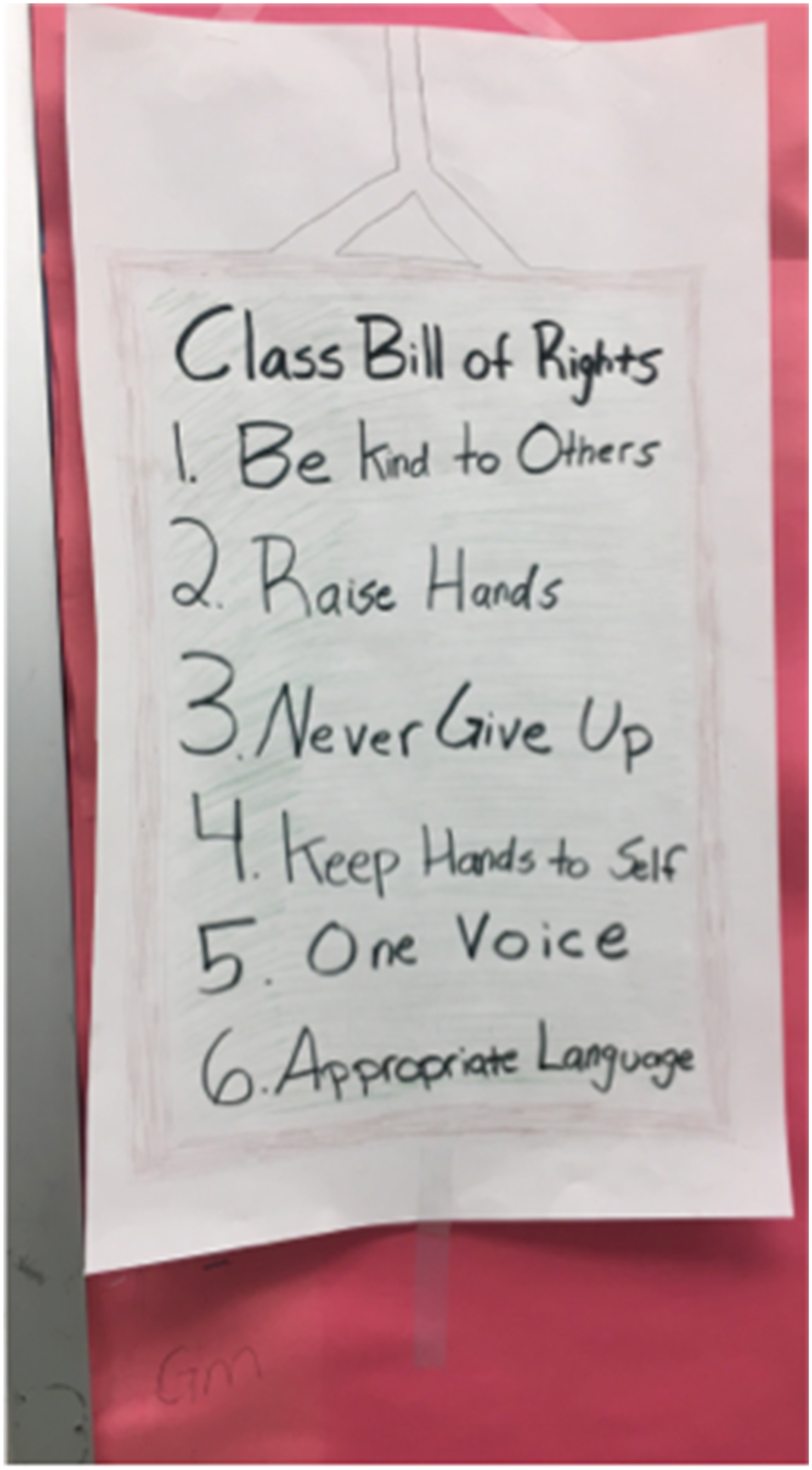
With a sole focus on voice as a speaking subject, my previous interpretation of this moment emphasizes and endorses compliance as the appropriate mode of being a student at the program. It does not unsettle the presumed idea that students undoubtedly benefit—academically and socially—from compliantly participating in an educational intervention like T4C. My earlier interpretation also unquestioningly embraced student feedback as posing a solution to a programmatic issue without challenging how that feedback is always already shaped by T4Cs participation in a problematically designed pursuit of equity. Given that the interpretation was informed by a grounded theory analytical approach, it could not offer a radical reading of student feedback that intervened on my meaning-making and the colonial-racial design of the larger educational system.
Nevertheless, Ana’s comments provide an opening to consider how racial logic is expressed through the ethical-juridical axes. Raciality primarily structures the T4C learning environment toward the educational equity goals of ESSA. By expanding the frame of this moment to consider the summer schedule, it is possible to see the compliance-oriented implications of students and teachers coming together for seven 45-minute class time blocks with 5 minutes of passing time in between. While 45-minute blocks can be standard teaching blocks in some schools, the time periods can feel rushed. Yet, students and teachers are expected to maximize time on academic tasks by following routines which strictly manage the flow of class learning as well as acceptable actions, encounters, and events in the classroom. Additionally, when in-person, T4C is a full day program, allowing students to be on a similar schedule as parents who work. Across the week, there was minimum down or open time with 7 classes a day (4 academic courses and 3 elective courses), a 45-min block for recess and lunch, and a 30 min end-of-day block. However, the intent to provide 4 academic classes per day (except days for program-wide activities or field trips) is less in service of students and more in service of T4C meeting federal and state stipulated goals: students’ academic growth for the LEA and a diversified, professionalized teaching force through apprenticeship for high school- and college- aged teachers of color. While the program updated the 45-minute block for recess and lunch to an hour in the following summer, the program is still largely based on measuring students’ academic outcomes from participating in T4C. When Ana proposes that students should be allowed the space to think about what they want to do, she is breaching the racial logic of T4C by acknowledging that students move at different paces and with different expressions. Her comment complicates the idea of a low achieving student who literally needs to get with the program and follow the schedule as intended. Her comments invite a consideration of having more time to creatively express learning in Engineering class. However, the strictness of the schedule does not allow for learning to be considered this way—or at least without proving academic growth on a test, for that matter.
Discussion
In this paper, my analytical engagements underscore how students’ feedback makes the racial logic of educational equity at T4C more visible. I demonstrate how attention to students’ comments and attention to material-discursive forces that shape T4C’s pursuit of educational equity in the Milltown school district unsettles what is readily apparent. The economic-ethical-juridical axes that inscribe raciality into educational equity are critical to my analytical engagements. Chakravartty and Ferreira da Silva (2012) discuss these major axes as stemming from modern thought. Their discussion of the axes as the registers of the modern subject also informs how the conception and pursuit of educational equity depends on raciality’s creation and maintenance of the educationally disadvantaged. The educationally disadvantaged student is created as an object of educational policy, who is “perceived, and therefore behaved towards, only as the Lack of the human” (Wynter, 1994, p. 2, emphasis in original). That is, educational equity law constructs racially and economically subjugated students as intellectually and morally deficient, suggesting an inherent and perpetual disadvantage that requires correction. In response, federal educational equity law and funding are leveraged to obliterate educational disadvantage through state and district monitoring-and-assessment apparatuses, which are reinforced by educational service provider interventions. By unfixing my previous grounded theory approach to data analysis and turning to anticolonial black feminist critique I was able to confront my ontoepistemological rendering of students and their feedback. I can no longer narrate them as fixed educationally disadvantaged subjects. Instead of writing students as fixed subjects with fixed worldviews that propose more inclusive strategies for educational equity (or do not), I consider how their comments show that T4C and my previous interpretations are “deeply implicated in/as/with” (Ferreira da Silva, 2022, p. 70) the neoliberal education context which sustains state capital, the problematic design of equity, and the productive effects of raciality. In expanding the frame of each moment discussed throughout our time together, it is possible to contextualize their comments in the larger pursuit of equity. I engage these encounters, actions, and events to expose and unsettle how raciality informs educational equity’s problematic design at T4C.
Further, through expanding the frame to offer greater material-discursive context, I illustrate how students’ comments open further consideration of how various axes meet up and produce a program dedicated to reversing summer learning loss, which aims to obliterate the low academic performance of the educationally disadvantaged. Such obliteration, I maintain, manifests through the ESSA and its predecessor, ESEA. I expose and confront raciality by making clear its productive effects, which play out through the program’s adherence to local, state, and federal policies for educational equity. These compliance measures, informed by raciality, are entangled with my actions as well as students’ comments and actions. By demonstrating how educational equity’s racial logic can be rendered more visible at T4C, I trouble the ease with which current equity efforts are considered morally or ethically good. That is, I unravel the idea that equity efforts solely produce positive academic and social outcomes for students. I also complicate the idea that educational equity is a worthy justice project in its current iteration. The same principles that ESEA and ESSA use to construct mechanisms of identifying and monitoring the so-called educationally disadvantaged illustrate, on a smaller scale, a “moral text [ethical], in which the principles of universality and historicity also sustain the writing of the ‘others of Europe’ (both colonial and racial other) as entities facing certain and necessary (self-inflicted) obliteration” (Chakravartty & Ferreira da Silva, 2012, pp. 370–371). This moral/ethical text (ESSA) and how it is juridically administered (through the SEA and LEA) depends on T4C (and numerous other programs) 6 as educational service providers (economic axis). In contracting service providers to deliver on educational equity, students are made to be compliant with educational equity policies as their labor is expropriated for a global capitalist agenda. Furthermore, students can face additional policing due to efforts that protect property while conducting business, as other moments not presented in this paper show. If these logics are animated and acceptable through the pursuit of educational equity, under the auspices of raciality, what else can be justified in the name of equity and justice?
The moving pieces that must align to demonstrate improved academic performance for the so-called educationally disadvantaged require raciality. If our equity efforts are to avoid justifying violence (or proximity to it) in the name of justice, then we must reconsider what we are demanding to be included in and whether concepts of inclusion, equity, and justice, as designed by raciality, should be the basis of our ethical-political educational program and demands. As researchers, we should consider that a different approach might require us to betray much of what we have come to know as equitable and inclusive in favor of being answerable to liberatory learning. Ferreira da Silva (2015) suggests we “should begin with asking different questions, methodological rather than ontological ones: instead of the question of who and what we are, we need to go deeper into the investigation of how we come up with answers to the questions” (p. 104).
Toward Black Inquiry Approaches for Anticolonial Education Futures
I began this work out of a deep haunting that followed me as I applied a grounded theory analysis to students’ feedback. As I transcribed, parsed students’ words and phrases into familiar codes, attempted to make meaning of voice and vocal silence, remembered the difficult moments of the summer, lingered with moments of joy, and studied radical black scholarship, it became clearer that a fixed notion of voice could not be the primary vehicle for making meaning of student feedback at T4C Milltown. Ferreira da Silva’s (2015) invitation to abate our fixation on who and what we are is radical for me. It is an invitation to pause on teaching and reproducing the transparent “I’s” descriptions and parameters for existence through our inquiry projects. It is an invitation to trouble the notion of the human, and how this concept rests on reproducing and adjudicating falsities of (im)proper-ness.
The methodological invitation also brings up many questions for those of us engaged in Black Studies (Myers, 2022) in education: Is drawing on youth voice for educational research ever an ethical engagement? What do we gain from learning about youth’s experiences of inequity if educational equity is designed by raciality? How are we unwittingly narrating students as deficient—even when we are motivated by including their perspectives on inequity? What if our collaborations with youth lead to anticolonial struggle that does not meet prevailing, neoliberal educational priorities? What if we returned to previous youth voice projects to address the insidious trappings of symbolic racial violence in our analyses? How could we engage such a return to undo students’ narratively condemned status in public education’s social scientific archive? What if the educational research archive did not thrive on evidence for intervening and correcting the disadvantaged? How could seriously engaging these questions lead us to different ethical-political education demands? I share these questions as provocations for us to ethically and politically engage in educational inquiry. The questions urge us to interrupt knowledge patterns that reproduce symbolic and actual violence for racially and economically subjugated youth (Ferreira da Silva, 2007).
Additionally, in posing these questions for generating black inquiry approaches in education, I call on us as scholars of black methodologies to pursue educational equity—instead of educationally subjugated youth—as our object of study (Rose, 2019; Spillers, 1994). Such an analytical move is important for unsettling the “prevailing account[s]” of educational and racial subjugation by exposing their political (ethical, economic, juridical, and scientific) dimensions (Ferreira da Silva, 2022, p. 39). I am also calling on us to trouble how our current and previous inquiry projects methodologically engage the perspectives and leadership of racially and economically subjugated youth. It is particularly important to ask these questions as we identify issues and contexts, ask our research questions, seek permissions, gather information, analytically engage that information, and publish about our work for the larger educational research community and beyond. Black method-making (McKittrick, 2021) supports us to radically read youth feedback by refusing to document their stories and perspectives as deficient or damaged (Dumas & Ross, 2016; Patel, 2016; Tuck, 2009; Wynter, 1994)—even in those moments when we think they are speaking from the internalization of domination. When we think we are hearing that internalization, it is an opportunity to consider how our analytical strategies—and those moments in youth feedback—constitute and are constituted by the larger colonial-racial design of educational equity. By troubling our analyses, we also pause on quenching the thirst of an educational archive that thrives on providing “evidence for the racial to work hand-in-hand with the accumulating and extracting processes of capital” (Carter & Jocson, 2022a, p. 241; Ferreira da Silva, 2007). Taking moments to pause and practice answerability (Carter & McIntee, 2021; Patel, 2016) also extends to: (a) educational policy scholars and how the issue of inequity is conceptualized and addressed; (b) teacher-educator scholars in how we teach critical pedagogical strategies that involve youth-led and youth-informed educational research; and (c) federal and state representatives who are charged with shaping the national educational policy agenda. Beyond these provocations, I specifically offer my closing points to youth who are struggling to upend colonial-racial violence in the global present and forging radical visions into existence: This study is an effort to be answerable to your present and future. I imagine that your analytical groundwork will push the limits of what I have examined and discussed in this project. So, I dedicate this work to you—anticipating that you will have much more to contribute to the thinking presented here.
Footnotes
Acknowledgements
Thank you to the editors for their thought-provoking call for papers and encouragement of this contribution. I would also like to acknowledge the labor and professional service of the two anonymous peer reviewers for their thoughtful engagement with this paper. A special thank you to Ali Brooks, whose labor and considerate feedback supported this paper. To Dr. Ferreira da Silva, I am inspired by your work. Any misreadings are my own to address through continued study and future writings. I am also grateful to the UnderCommons Constellation (UC2) for collaboratively generating support and engaged scholarly practice.
Author’s Note
Editors: Drs. Wilson Okello, DeMarcus Jenkins, and Tiffany M. Nyachae
Declaration of Conflicting Interests
The author(s) declared no potential conflicts of interest with respect to the research, authorship, and/or publication of this article.
Funding
The author(s) received no financial support for the research, authorship, and/or publication of this article.
Correction (October 2024):
Article has been updated with some textual corrections.
