



Abstract
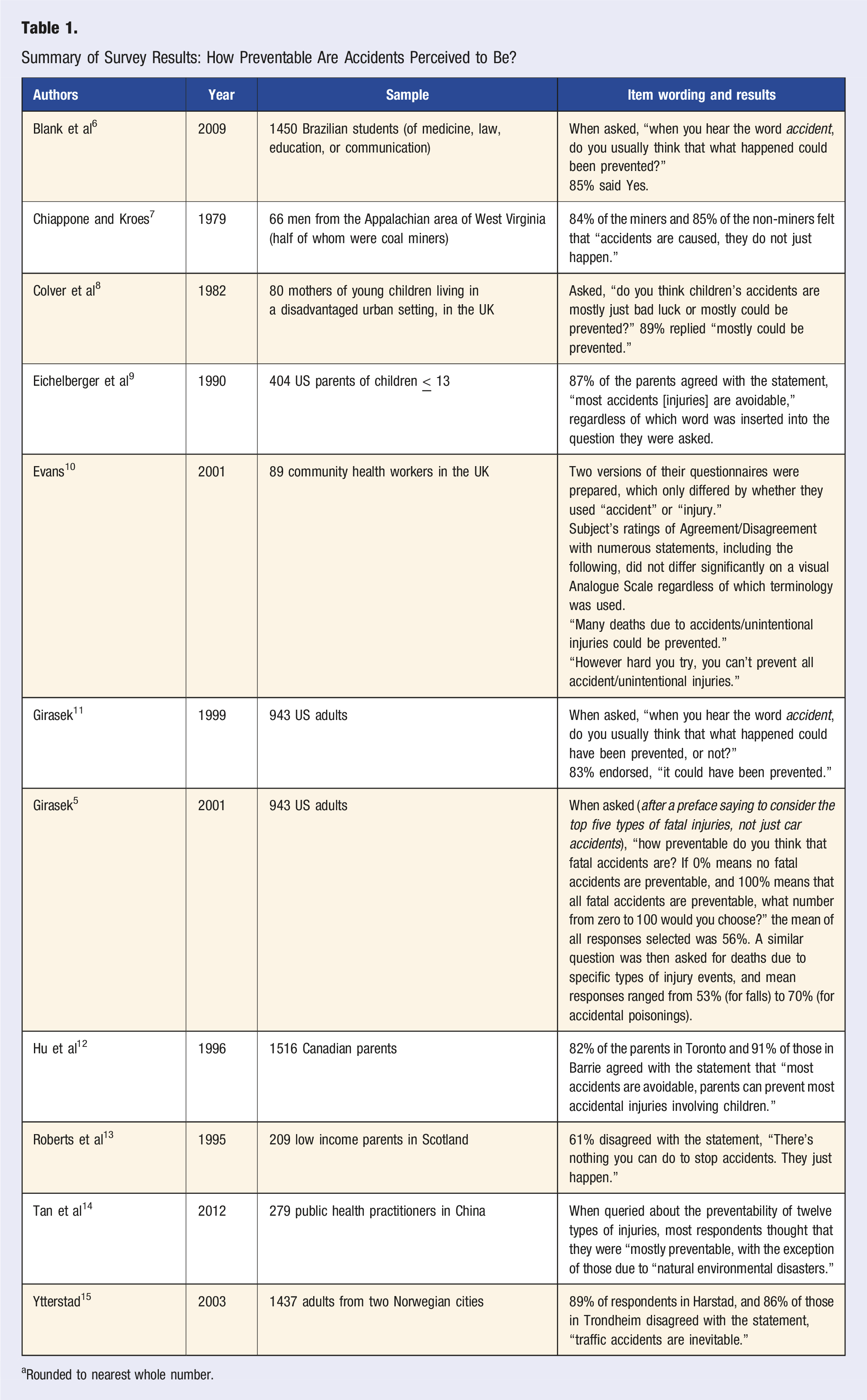
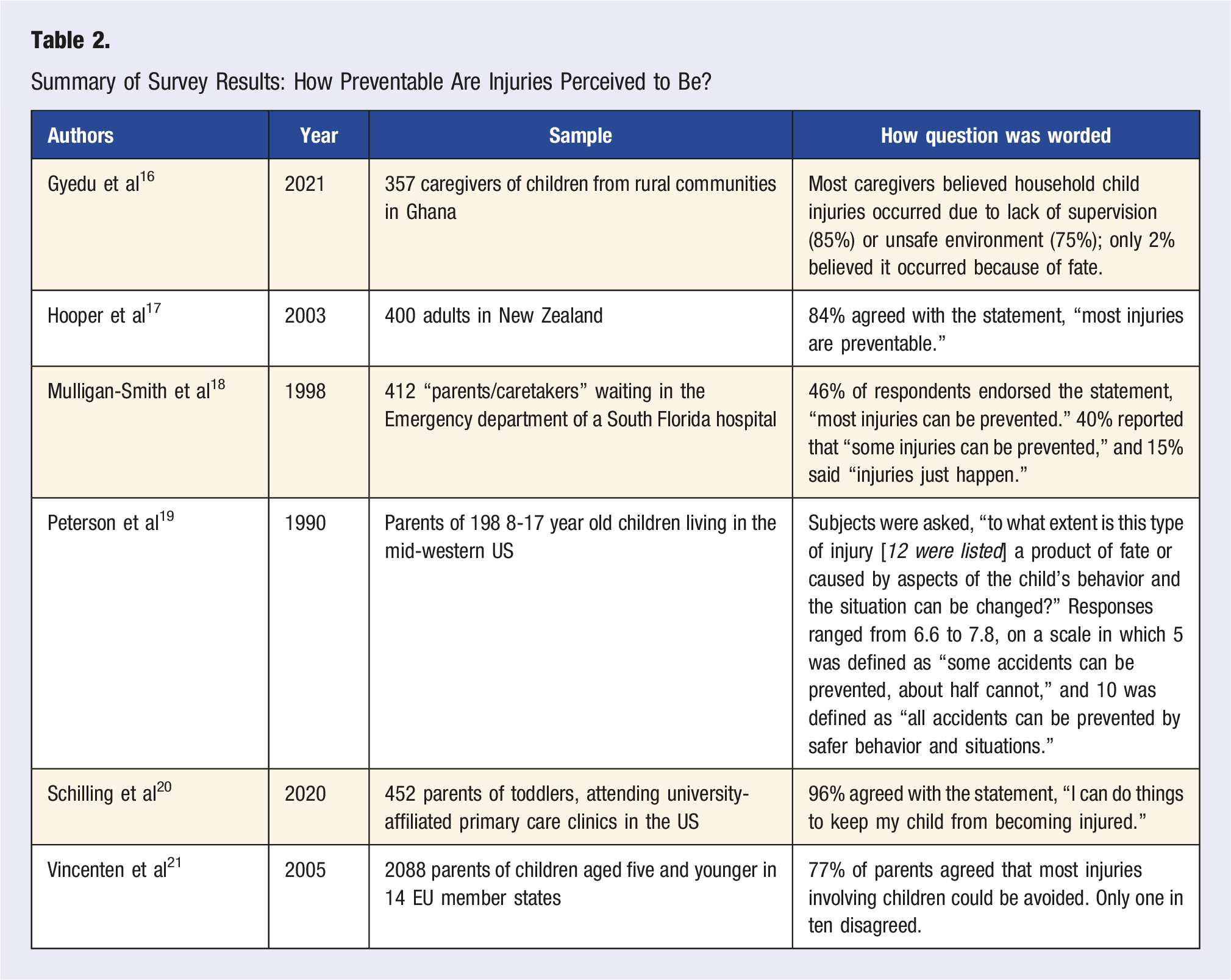
This report summarizes scientific literature relevant to the controversy regarding use of the word, “accident” in the injury prevention arena. The author has contributed to, and followed this issue for decades. She summarizes eleven studies conducted in seven countries, from 1979 to 2012. They found that a majority of respondents (Range: 56-89%) perceived injury-producing events to be preventable, despite the fact that the word “accident” was used in their assessments. Two studies interchanged the words “accident” and “injury,” but found that substitution yielded no difference in respondents’ perceptions of preventability. The author concludes that safety advocate concerns about the word “accident” are based more upon conviction than evidence. She raises potential harms that might be brought about by continuing this debate, and proposes an alternative communication effort that may have more potential to reduce the devastating toll of injuries in our world.
“Thousands of dedicated people around the world share the goal of reducing injury deaths and disability.”
Background
In 1996 I was a graduate student who sought evidence to support or refute accepted dogma in my field. Was the word “accident” contributing to the relative lack of attention and investment that injury prevention experienced? Numerous Federal agencies charged with protecting public safety, the founding parents of modern injury control and most of my mentors felt it was. One of the earliest texts in the field of modern injury control stated that injuries were “taken for granted” because of the “erroneous belief that they result from unpreventable ‘accidents’.” 1 According to the first head of the CDC’s National Center for Injury Prevention and Control, “The magnitude of the automotive injury problem…remains as great as it is largely because of the perpetuation of a societal ethic that automotive injuries are “accidents.” 2
Most often, however, such concerns were not accompanied by references to scientific literature. That might have been due to the fact that most of them, while world class professionals, were not trained in the social or behavioral sciences. So, they were comfortable with conclusions based upon intuition in that realm, while they would almost certainly have avoided making medical or engineering recommendations in the absence of data.
I had been a psychology major as an undergraduate, and recalled that random hazards, which are perceived as unpreventable, generally do garner public alarm and societal attention. 3 So, as a small subpart of my doctoral thesis research, I included four questions in my national telephone survey that were designed to explore how the public interprets the word, “accident.” Note that I had not been the first to explore this question, so this report will include the studies which I am aware of that explored beliefs associated with the word “accident,” specifically those which relate to the prevention of injuries.
Galea and Woolf have characterized the preventability of injuries as, precisely the reason that injury researchers avoid the term “accidents.” 4 Safety advocates’ interest in this topic is understandable. Preventability beliefs have been linked to individual safety behaviors, as well as to public support for safety legislation. 5 And it has been shown that policy makers are more likely to vote for such legislation when they perceive that it is popular with their constituents.
Published Reports
These articles were identified in part through a PubMed search of the terms, “Accident,” “Accident and Injury,” “Accident and Word and Injury.” That yielded 116 results, eight of which were selected as potentially relevant to this update. The author has also collected discussions of this topic over decades, including studies which examined beliefs about the preventability of injuries. Google searches were also conducted, to obtain examples of how this debate has played out in civil society.
Summary of Survey Results: How Preventable Are Accidents Perceived to Be?
aRounded to nearest whole number.
Summary of Survey Results: How Preventable Are Injuries Perceived to Be?
Also discussed are several studies which focused on the media’s use of accident. Goddard and colleagues 22 randomly assigned 999 US adults to read one of three versions of text that described the death of a pedestrian resulting from a traffic crash. In one of the three versions, they referred to the “fatal crash” as a “fatal accident.” The investigators then asked questions to ascertain the readers’ assessments of blame, appropriate punishment, and preferred solutions. The authors did find significant differences in the views expressed by respondents. For the sake of this paper’s focus, unfortunately, they had simultaneously introduced other differences in their descriptions, which prevent us from isolating the impact of substituting “accident” for “crash.” For example, in the text which used “accident,” they described a pedestrian wearing dark clothing (at night) being struck by a car. In the second version (which used crash instead of “accident”), they said the driver struck the pedestrian with his car, and there was no mention of the victim’s clothing. In their third framing, the word “crash” was again used, the driver was described as striking the pedestrian with his car, no clothing is mentioned and environmental context was provided (i.e., that that stretch of road separated a bus stop from a store, it experienced high traffic speeds, had a lack of streetlights and a history of similar incidents in the past). They called that framing “thematic.” That third framing was associated with more support for changes to public policy, as the authors had hypothesized. When comparing the two versions of the story which did not include contextual details, they found no difference in policy support between participants who had read the narrative that used “accident” and the version that used “crash”.
Woodcock and Sharma 23 conducted a content analysis of actual print media coverage incorporating the word “accident” over 12 days in Canada. Based upon the fact that 74% of applicable stories mentioned an investigation, they concluded “extreme concerns that accident is equated with unpreventable in the general public discourse…” were not supported. They go on to state, “as such, substitution of another term could cause confusion with little benefit.” Smith et al 24 found that when the modifier, “freak” was inserted in front of the word “accident” in print media coverage, less than 10% of stories included clear prevention messages. It is worth noting, however, that another study of how the media covers bicycle and pedestrian collisions (which used the word “accident” in only 2% of sentences) also found that stories contained a low percentage (15%) of safety recommendations. 25
Discussion
These findings demonstrate quite consistently—across decades and continents—that a majority of people believe that most injuries are preventable. And that their perceptions of preventability do not change based upon whether the words “accident” or “injury” are used.
In light of this evidence, one might surmise that this controversy has gone away. Unfortunately, that is not the case. The BMJ still bans the word “accident,” as does the National Highway Traffic Administration. (Interested readers are referred to the BMJ to review the spirited debate that was sparked by its decision to ban “accident.”) 26 It is perhaps ironic that the BMJ journal Injury Prevention selected my article on the interpretation of “accident” for special recognition because it was deemed to have “transcended typical academic impact.”27,28
According to BikePortland (https://bikeportland.org/2023/02/28/bill-would-replace-accident-with-crash-in-oregon-laws-370838) the “Crash not Accident Movement” has grown considerably in recent years. They laud a bill under consideration in the Oregon Legislature that would modify more than 100 state laws so that all references to “vehicle accident” are replaced with “vehicle crash.” Nevada has apparently already passed similar legislation, and more than 28 state departments of transportation are now avoiding use of the word “accident” when referring to traffic crashes (https://www.planetizen.com/node/86483/why-national-highway-traffic-safety-administration-doesnt-use-accidents).
Myriad safety advocacy groups, particularly those representing vulnerable road users, have embraced this issue. Road peace, a British charity of road crash victims has, for example, called upon the media to stop using the word “accident” (https://www.roadpeace.org/get-involved/crash-not-accident/). There is a similar movement underway in the United States (https://usa.streetsblog.org/2013/12/11/its-time-for-the-ap-to-nix-the-term-accident-to-describe-car-collisions/).
Another advocate for the “crash not accident” movement is the Portland Bureau of Transportation’s Safe Routes to School program. Their main problems with “accident” are that they perceive it to imply inevitability, and that it absolves anyone from responsibility. A common theme raised by many who oppose the word “accident” seems to be their desire to place blame. The AP stylebook, in fact, advises journalists to utilize “crash” or “collision” in place of accident, when “negligence is claimed or proven.” (https://twitter.com/APStylebook/status/1070020835711336451)
In my own work, I had the opportunity to discuss this controversy with a father who had lost a child to unintentional injury. He described the slogan “Safekids are no accident” as “tough” on him. “It’s telling me that, you know, you weren’t keeping your kids safe. That’s what it’s saying” (unpublished data). A Canadian study that explored how best to communicate safety information to the mothers of young children recommended against using the phrase, “injuries are not accidents.” 29 The authors reported that such messages are interpreted as “blaming” parents, and evoke defensiveness which “undermines their credibility.” The interpretation of “accident” that was most widely endorsed (by 96% of respondents) in one of the studies cited earlier, was “not done on purpose.” 11
The Maryland Highway Safety Office’s “Crashes Are No Accident” webpage also states that “the word accident suggests that an incident was unavoidable.” They seem to limit their attribution of fault, however, “to human error” https://zerodeathsmd.gov/how-you-can-help/crashes-are-no-accident/. That characterization flies in the face of the modern Vision Zero movement which acknowledges the inevitability of human error, but goes on to emphasize the responsibility of those who design and enforce the transportation system. 30 Professor Geetam Tiwari, Professor of the Indian Institute of Technology, describes a Safe Systems approach as having “three core tenets; ‘that we recognize human frailty, that we accept that people will always make mistakes, and that our systems must be ready to absorb these mistakes.’” 31
More lives would likely be saved if a systems approach to injury prevention was communicated to the public, rather than three-word slogans like “Crash not accident.” In the absence of a longterm, nuanced campaign to shift the lens through which the public and policy makers view safety, they are likely to persist in their thinking that it rests on teaching individuals how to behave. As a stand-alone strategy, that has not driven dramatic reductions in injury death and disability. 32 Within the realm of road safety, modern roads, crashworthy/crash avoidant vehicles and data-driven laws, however, are demonstrably effective. 33
Persistent attempts to engineer the word “accident” out of common usage represent a missed opportunity. Instead of focusing on semantics, we should unpack what modern injury prevention looks like for the public. Injury control professionals may have moved beyond telling people to “be careful,” but we have not brought the wider society along for our enlightenment. Quoting a recent commentary in JAMA International Medicine, “A yawning gulf exists between academic understanding and public appreciation of what is needed to solve these problems.” “Deaths from drugs, firearms, and other injuries,” the authors continue, “are all too easily labeled as ‘behavioral’, as if they represent personal choices that could easily be unmade, solving the problem.” 4
A longterm campaign is needed to communicate our evidence base, and some of the modern concepts that underlie it. A content analysis of media coverage of traffic accidents in the United States revealed that it was dominated by “episodic framing,” which promote individualistic rather than societal perceptions of where solutions lie. 34 A similar study in Ghana found little to no mention of road design or posted speed limits, potentially important protective factors that policy makers control. 35 The World Health Organization is to be applauded, for espousing a systems approach to injury prevention, and for training journalists to embrace that frame. It is in fact one strategy of WHO’s global action plan for road safety. They hope that such efforts will help shift society’s traffic safety focus beyond the “traditional” limits of individual behavior change. 36 To quote that organization’s Director-General, “We must work with all involved in designing and maintaining our roads, manufacturing our vehicles and administering our safety systems. So when crashes do occur, solutions are sought throughout the entire system.” 31
Advocates should consider whether telegraphing “injuries are preventable”—with no further elaboration—might exacerbate our challenge. Public health problems that are perceived to be preventable by the individuals they inflict have been associated with less support for victims, less support for prevention programs, less support for regulation, and fewer research dollars.3,37-40 The Evans study cited in Table 1 found few significant differences between the health visitors they surveyed, whether they were answering questions which incorporated “accident” or “injury” wording—with one exception. When asked to rank a list of public health problems, respondents exposed to “prevention of accidents” ranked it to be more important than those whose questionnaires read “prevention of injuries.” 10
Thousands of dedicated people around the world share the goal of reducing injury deaths and disability. We would be further along if we shared our understanding of evidence-based safety approaches with the civil officials who are tasked with public safety, policy makers, safety advocates, and the general public. It seems appropriate for any such effort to begin with crafting messages which themselves are data-driven.
Footnotes
Declaration of conflicting interests
The author(s) declared no potential conflicts of interest with respect to the research, authorship, and/or publication of this article.
Funding
The author(s) received no financial support for the research, authorship, and/or publication of this article.
Disclaimer
This manuscript reflects the views of the author, who was not speaking on behalf of the Uniformed Services University of the Health Sciences or any branch of the U.S. government.
