




Abstract
As the current literature and media continue to focus on the role of the production and consumption of animals within the food system, awareness of the devastating health, animal welfare, and environmental outcomes increases. With the omnivore majority present in the US, there is a compelling narrative forming in shifting away from a predominant animal product-focused consumption to more plant-based eating. While ample research has focused on individual psychology and public health elements of diet change, this research provides a novel lens into the social, cultural, and financial factors to unpack the mechanisms of change across the food system. This analysis offers a comprehensive examination of the challenges of an animal-centric food system and the benefits of a plant-based food system. From this understanding, we provide insight into several concepts for why change is occurring. To gain a better understanding of potential drivers, catalysts, and barriers of this plant-based shift, 33 leaders, innovators, and educators connected to the plant-based industry were interviewed. The analysis concludes that the drivers are multifaceted and interconnected and provide the potential for positive societal transformation. This research can be utilized to better aid businesses, organizations, policies, healthcare practitioners, and educational efforts around this transition.
“One critical element related to the change mechanism of market behavior is the role of distribution and supply chains for plant-based foods.”
Introduction
Consumption of energy-dense diets high in animal protein and fat has increased worldwide.1–4 Animal-based foods can be nutrient-rich; however, they are the primary source of saturated fat that is responsible for higher risks of disease (including coronary artery disease, stroke, high blood pressure, type 2 diabetes, and certain cancers).5–8 A systematic review of 22 studies analyzing dietary patterns and sustainability in the United States found that diets high in plant-based foods and low in animal-based foods would result in lower environmental impacts with less energy and water usage. 9 To address environmental and health concerns caused by the dependence on animal-derived food products, the animal product-laden food system is in dire need of transformation.10–12 In the face of this transformation, researchers have observed that social beliefs and positive attachment to meat and animal products can be a strong barrier to preventing Americans from consuming more produce. 13 Novel strategies are needed to effectively shift consumers from meat-based to plant-based dietary patterns. 14 Thus, the current study focuses on highlighting and uncovering the constellations of factors that exist or need to emerge in the creation of a plant-based food system and increase the number of plant-based food consumers in the United States.
Given the associated environmental and nutritional challenges of animal-centric consumption in the United States, it is imperative to determine how to build pathways for plant-based consumption.15,16 Minority influence is one potential pathway for change. Bolderdijk and Jans 17 described minority influence as an individual or minority of a population shifting the beliefs and behaviors of the majority by challenging the status quo norms and demonstrating alternatives. When the majority begins to adopt this alternative behavior or norm, a novel social norm is created. It is important to consider why animal consumption is a norm within the United States and what elements are influencing shifts toward plant-based consumption.18,19
Flexitarianism is one such aspect stimulating the increased development of plant-based products.20,21 Flexitarians are generally understood as people who actively reduce their consumption of meat.22,23 They may not want to make the full lifestyle change of being vegan or vegetarian; yet, health and environmental benefits tend to motivate their shifts. 24 Equally important to note is that for flexitarians, having plant-based options for familiar foods is paramount, with marketing trends reflecting this preference. 25 Recent analysis of the National Diet and Nutrition Survey rolling programme indicates that in 2018/2019 survey, 4.5% of United Kingdom adults identified as vegetarian or vegan, an increase from 1.9% who identified as vegetarian or vegan in the 2008/2009 survey. 26 In the United States, recent data indicate 6% of adults identify as vegetarian. 27 This amounts to approximately 22.9 million people.
A 2016 nationally representative poll commissioned by the Vegetarian Resource group surveyed over 2000 US adults with data showing over one-third always or sometimes eats vegetarian meals when dining away-from-home. 28 Marketing campaigns and messaging around plant-based eating may be an effective way to reach this population. 29
Another avenue for increased plant-based consumption is through social change generated by cultural icons and influencers. As part of a dissertation, Gheihman (2020) interviewed over 100 individuals involved, or associated with plant-based eating, and concluded that the vegan movement evolved from identification as a political movement into a focus on lifestyle consumption. Among several factors, she views the role of social icons (athletes, celebrities, etc.), cutting-edge icons, and entrepreneurs as actors working to build a mainstreaming of plant-based eating and vegan identity. 30 Increased understanding of these novel drivers for mainstream social change is of paramount focus and requires an understanding of how they are shaping the market where the majority of consumers engage in this behavior. Further, the values driving this movement must be effectively marketed to reach consumers. 31
The Good Food Institute (GFI), a non-profit working towards increasing consumption of alternate protein (plant and cell-based), 32 provides a toolkit on their website 33 that aggregates several studies and market reports on the drivers of plant-based eating and consumer trends. Labeling and description emerge as important factors to address in successfully marketing plant-based products to consumers. The GFI reports that products labeled “vegetarian” or “vegan” often invoke the lifestyle and identity, which could cause an indication that these products are only for these people. Thus, “Plant-Based” labeling focuses more on ingredients and benefits for a larger audience. Another element that the GFI report yields is whom to target. Drawing from Mintel’s 2017 Protein Report, it was found that 79% of millennials eat meat alternatives, with 30% eating them daily. As this younger segment will take over more of the consumer population and as environmental concerns continue to grow, this layer of marketing is crucial to highlight. Nonetheless, marketing efforts are eclipsed by buzz driven public relations. For example, when Beyond Meat stock became publicly available, it garnered 7.5 billion media impressions in the first 9 months of 2018, nearly double the 4 billion impressions the company had in 2017. 34 Both public relations and marketing emerge as tools that can influence consumers in creating perceptions and motivations around plant-based consumption.35,36
Addressing messaging and focusing on plant-based diets that create positive reinforcement about animal welfare and the environment and acknowledging incentives for sustainable food choices could create more widespread changes to improve health and environmental impacts. 37 Others see that messaging needs to combine factors of environmental, health, marketing, and psychology into promoting alternatives that satisfy the dominant omnivore's expectations.38–40 There is a complex change facing our society in shifting food behavior; however, understanding these challenging and multifaceted influences can perhaps create improved health and environmental outcomes. By understanding the prior research and current market trends, we can begin to examine and explore the elements driving more plant-based consumption and how these elements are connected. This analysis helps address a knowledge gap regarding how business, nutrition, marketing, psychology, and sociology form an interconnected web of factors that can potentially shift the United States to a plant-based food system. To our knowledge, few studies have focused on the specific nature of the plant-based food sector and the motivations, perceived catalysts, and barriers of those businesspeople and organizations directly involved with the promotion and sale of plant-based foods.
The current study can help develop systems change in the United States food system through improved marketing, potential government intervention, effective educational campaigns, and novel business opportunities. By grounding this research in the current literature, our analysis acknowledges the complex nature of societal dietary behavior change and utilizes it to shape and inform our methods. Thus, we aimed to understand the constellation of factors that are driving plant-based food sales and consumption in the United States and identify emergent themes through semi-structured interviews.
Methods
Study Criteria and Recruitment
Characteristics of Participants Completing Qualitative Interviews (n = 32).
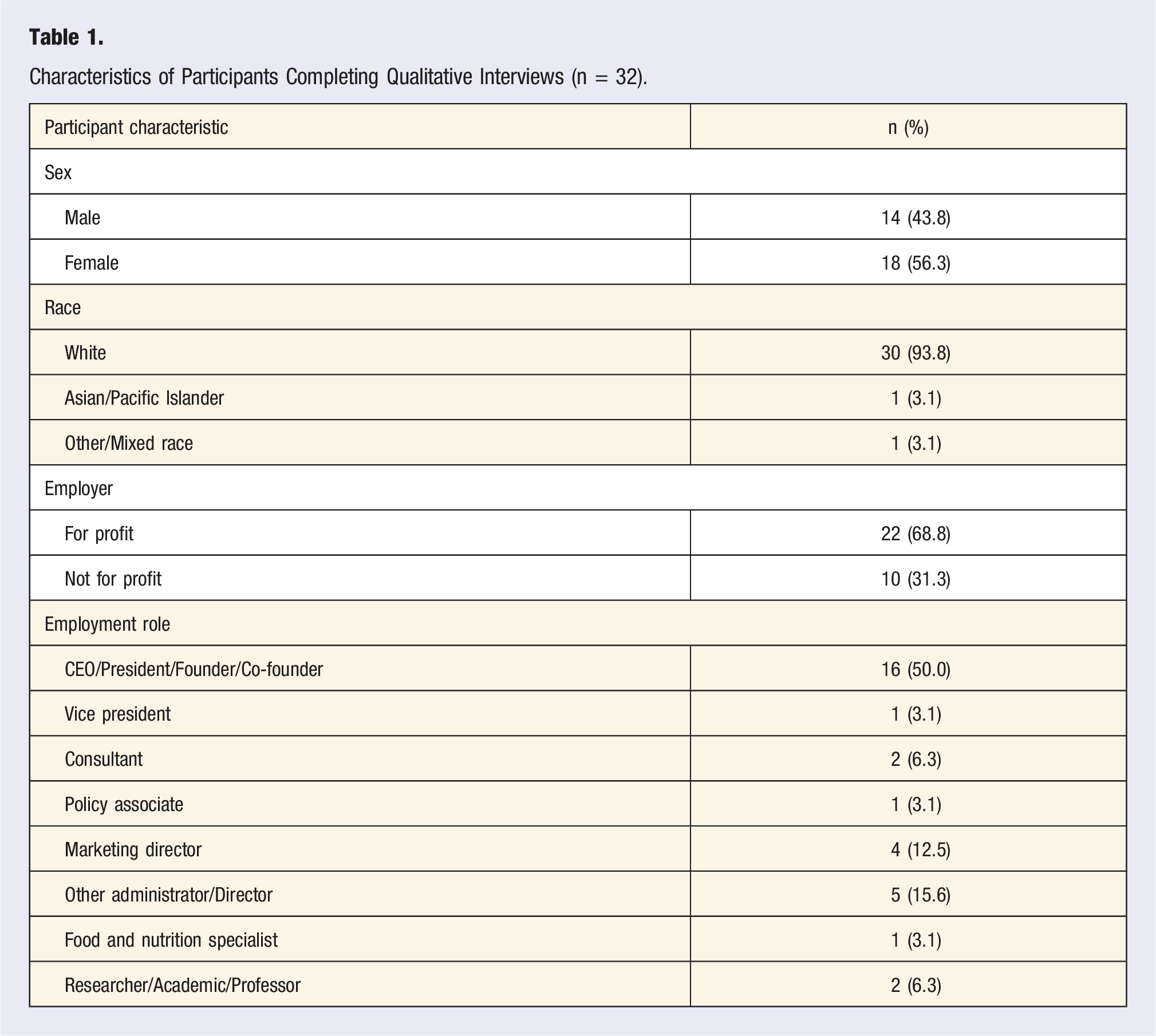
To our knowledge, there was no established metric or survey tool built for the societal and industry transformation toward plant-based consumption, which was the aim of this research. Interviewees were chosen based on their involvement with the multi-dimensional aspects interacting with a shift in plant-based societal change and the food system. With the projected growth of the plant-based food sector, 31 our aim was to interview investors, plant-based entrepreneurs, food policy, and marketing leaders. As the current food system is not majority plant-based, this work is an attempt to develop a stronger road map to that reality.
Inclusionary criteria for interviewees were: aged 18 years or older and employment related to plant-based foods, education, research, or policy. All interviews were conducted in English, were recorded on the Zoom communication platform, and lasted between 30 minutes to one hour in length. All study components were approved by the Institutional Review Board (IRB) at Northern Arizona University (Project #1658795-2).
Qualitative Interviews
Semi-structured interviews were utilized to garner insights into consumer behavior and trends, as well as to provide a holistic understanding of the past and future direction of the U.S. food system as it pertains to plant-based foods. In addition, the interviews were used to collect data concerning positionality, individual experience, and differing social explanations. 41
According to Silverman, 42 studies that focus more on exploration than confirmation need to be less structured. Thus, to better understand the motivations and perspectives of what is or could potentially be driving the change in plant-based eating, semi-structured interviews were deemed sufficient because the interview guide enabled focus throughout the conversations. 43 Additionally, interview guides can be utilized to help orient questions and interview responses to answer research questions and can provide structure if participants bring up themes that are to be discussed later in the interview. 44 There was not a previously validated instrument that existed for this specific topic and subject group. Questions were drawn from prior cultural and industry-related literature.30,33,45 A test run was conducted with five academic researchers versed in food studies and five professionals involved in food systems work. From the test run, questions were adjusted to include the balance of interviewees to speak on behalf of their organization’s perspective and their individual perspective. A set of 9 questions were developed based on a review of previously published literature related to this topic.
The first 4 questions were constructed to address the participants’ perceptions on the role of their company or organization in being a catalyst for social change in plant-based eating, what their goal is, who their target customer or audience is, and the role they view their group fulfilling in shifting behavior. From this first section, the subsequent questions captured what they perceived to be the main barriers preventing plant-based eating from being a majority behavior, what specific barriers their organization faces, and in general, what they view as the main catalysts driving more plant-based eating. The last section of questions asked what has been most effective in reaching new consumers, shifting consumer behavior to more plant-based food consumption, and what needs to happen for plant-based eating to become a majority behavior.
Questions: 1. Where do you and/or your organization see individual change and system change influencing the food sector? Do you see one being more important to focus on? 2. What do you see as the drivers of the plant-based food system? 3. What are the most influential factors for you and your organization that are enhancing/driving the promotion of plant-based products if the vegan/vegetarian base in the United States is in the minority? 4. What are the most important factors that are inhibiting the widespread adoption of plant-based diets? 5. What coalitions are needed to enhance the reduction of animal consumption and increase of plant-based diets? 6. What factors or solutions are needed in shifting interest from flexitarian to vegan diets? 7. What has been most effective in reaching new consumers with plant-based foods? 8. How do you see the role of identity influencing your marketing and outreach with consumers? 9. Imagining that the U.S. has a majority plant-based food system, how does it happen?
Qualitative Analysis
All interviews were conducted by the primary author. Coding was completed by all research team members and then were resolved via consensus. Through inductive coding and thematic analysis, distinct themes emerged. Coding was applied to interview transcripts recorded via the Zoom communication online platform. Codes were assigned to sections of the transcripts to highlight recurring patterns. Coding software was not used as themes were generated from reviews of the transcripts on Google Docs by the primary author. Following the inductive process, codes were refined through open and focused coding. 46 After this, similar codes were grouped to create pattern codes. 47 From this process, themes were generated and reported in the results section. Themes were reviewed by the research team and there was strong saturation among the first several interview transcriptions that continued throughout the analysis for the remaining interviews.
Results
A total of 18 women and 15 men were interviewed. Fifteen of the interviewees indicated they were CEOs or founders, seven were marketing professionals, and the remaining were involved in the following roles: Social Change Researcher, Campaign Manager, CPG consultant, Vice President of Business Development, Food and Nutrition Specialist, Vice President of Marketing, Head of Regulatory Science and Advocacy, Professor, Policy Associate, Corporate Partnerships Manager, and Education Program Director.
Qualitative Results
With the initial pass of coding, a total of 45 themes were found to capture the interviewees’ perceptions of the catalysts and barriers of shifting plant-based eating into the majority in the United States. Several of these themes were overlapping in nature so they were placed into more refined categories. For example, “Schools,” “Universities,” and “Food at hospitals” were all condensed into the theme labeled “Institutional Access.” From the refinement of themes (Figure 1), six key themes were found to be most salient across the sample. Exceptions to this were themes that included policy change, the social stigma of being vegan, better nutrition education for doctors, consumer nutrition education, social media and the role of influencers, and supply chain issues for plant-based products. Saliency was determined if the theme was referenced in at least 11 different interviews. An overview of the themes is provided in Figure 1 and the following section. The number of participants mentioning each specific theme is placed in parentheses following the theme title. Final Themes.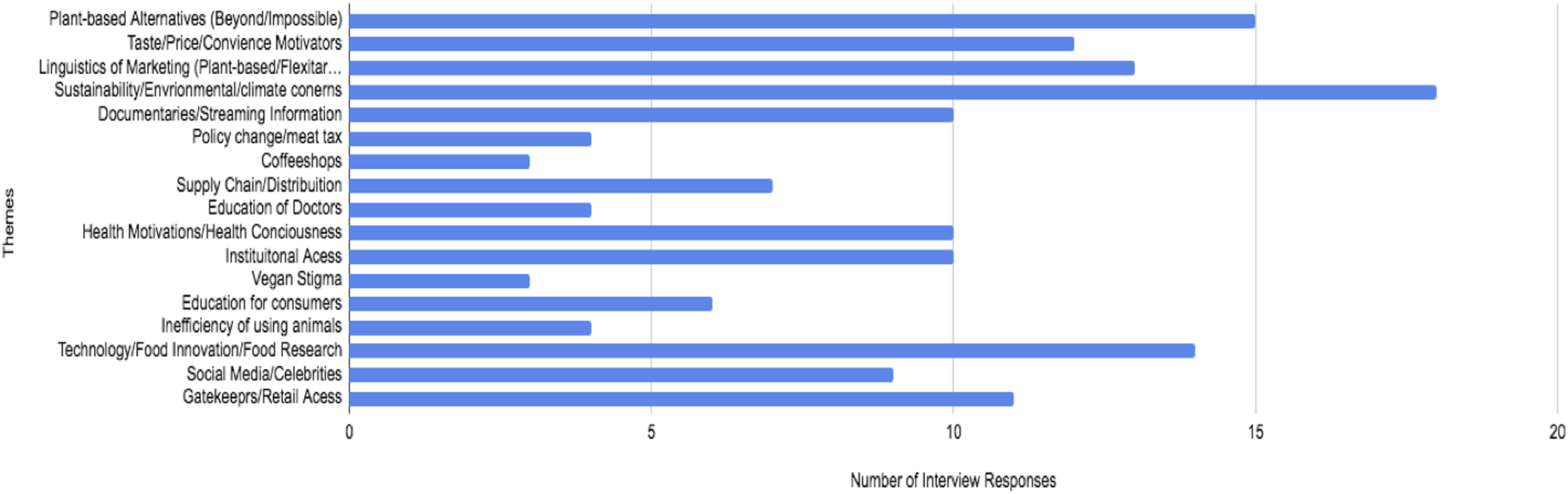
Key Themes
Sustainability/Environmental Concerns and Associations of Food
This theme was mentioned the most, with 18 participants discussing it. Sustainability and environmental concerns were broken down into two sections. The first pertained to the role of sustainability or consumers’ perceived associations between climate change and food consumption. The second area dealt with environmental concerns that food providers, organizations, and businesses have with their ability to operate with increased environmental challenges that stand as risk factors to business operations or serving customers. “As people start to realize that their diet does have a huge impact on the world and the climate (.....) how can we create plant-based products that are the new things that people know and love and be part of this sort of diet evolution?” - Participant A, a CEO of a plant-based company, captured this by saying
This quote illustrates comments from several participants who believe that consumers are identifying their diet as a piece of the climate change puzzle. Although it may not be the main reason for people to be eating plant-based, they are noticing that this is a trend that is only growing more popular.
In addition to the relationship with consumers’ attitudes, sustainability/environmental concerns were a large theme related to business operations or the increasing emergence of plant-based eating within a variety of businesses and organizations. “We have found that meat reduction and offering more plant-based products to be important in helping businesses and groups meet their sustainability goals and their corporate social responsibility goals. That's a huge part of our work. And just also showing them that it's good for their bottom line.” - Participant B, a Marketing Executive with an advocacy organization.
Thus, from both a consumer and institutional perspective, associations of environmental impact and plant-based eating have garnered momentum and appear as an important area of consideration and analysis. From the consumerism side, participants felt that addressing environmental impacts or creating awareness of plant-based products as a more “sustainable” choice has been effective in reaching younger consumers and growing demand. Several participants viewed a diverse range of organizations and companies desiring to offer more plant-based products as an approach to maintain business functions in future projections and being able to meet consumer needs given sustainability and future environmental impacts. Participants revealed that for several grocers, restaurant chains, and larger food service providers, increasing plant-based options are viewed as an attractive strategy in helping to reduce greenhouse gases and other environmental impacts and costs.
Increases in Plant-Based Alternatives Quality, Exposure, and Access
The next theme, with 15 participants’ responses, specifically emerged from participants mentioning the role that plant-based alternatives are having in shifting consumers’ behavior and altering the marketplace. Two companies that garnered the most attention were Beyond Meat and Impossible Foods; however, overarching elements such as the improving quality of products, the increasing availability and options of plant-based alternatives, and greater societal exposure to plant-based foods were identified as facilitating more plant-based eating behavior. “Beyond Meat and Impossible Foods in particular, and all of these plant-based companies, understand that food has cultural importance and that people have these ingrained taste preferences. So, if you can just switch one for the other, it takes out or removes a lot of those barriers to eating plant-based because it's not like consumers are giving something up.” - Participant C, a food policy expert at an alternative protein organization. “Well, I think that the success of the plant-based milk category has inspired a lot of people in the entrepreneurial and investor community to wonder, can the same happen with meat? We saw plant-based milk go from being an asterisk to now being 13 percent of the milk market and growing. That is an important indicator for other plant-based alternative markets.” - Participant G, a CEO of a plant-based meat company.
Similar to the first theme, plant-based alternatives can become an element to be harnessed for both consumers and businesses alike. From the consumer perspective, these quotes, among others, elucidate how plant-based alternatives can enable meat eaters to avoid “giving something up” and eliminate social pressure or judgment from radically changing diet or food identity. Participants reported that social pressures or stigmas typically addressed with vegan or vegetarian eating can be neutralized by offering plant-based foods and products that fit into traditional animal product molds that provide the same cooking and consumption experience. Plant-based offerings at fast food establishments like Burger King and KFC were some of the examples mentioned by interviewees.
Technology/Food Innovation
Following the rise of plant-based alternatives, 13 participants mentioned the role of technology and food innovation to improve alternative offerings and reach new consumers. The examples provided articulate how technology has enhanced the ability of alternatives to compete with their animal-based counterparts. “A really important piece is going to be with where the technology has come. Five years ago, even you really couldn't find what you can today with regards to all the different cheeses, butter, and egg substitutes. The plant-based meat really tastes like meat. The technology behind the movement is really important because, without that food tech, we're not getting Beyond and Impossible Foods and JUST Egg.”
- Participant E, a Business Director of a plant-based food company. “And then Henry Ford came and did more for those horses than the animal advocates ever dreamt of doing. The animal advocates weren't even dreaming of liberating horses from being our slaves in the streets. They were only trying to get them better conditions which are very noble. I mean, I'm all in support of it. The list goes on and on of all types of really horrible forms of animal exploitation that ended, not because of human sentiment, not because of awareness, but because new technologies were invented that rendered animal usage obsolete.” - Participant G, a CEO of a plant-based meat company.
Several participants believe that current alternatives, as compared to previous iterations of plant-based products, are better designed to meet customer desires and provide novel plant-based products that are similar to the conventional animal products with which they are comfortable or familiar. Participants felt that the technology in the form of improved engineering of products’ taste, texture, and consistency, has helped to allow for plant-based foods to mimic or be offered in restaurants and stores that traditionally serve animal products. Several were quick to note Impossible Foods and Beyond Meat are examples of groups that have invested heavily in technology, research, and development to offer features such as “bleeding,” color change during preparation and cooking, and animal meat-like textures that are able to reach traditional consumers of animal products.
Linguistics and Broader Marketing (Plant-Based/Flexitarian/Ingredients vs Label)
Thirteen participants perceived an acceptance of a variety of eating patterns and labels and marketing that addresses those patterns as a catalyst, removing a barrier for more people to engage in plant-based eating behavior. “Linguistics is a really important part of this equation…. people care a lot about what labels they can apply to themselves or that they want to apply to other people. Having words like plant-based or flexitarian is really permission for people to not be in either of the extremes and I think that that has been more impactful than one might expect.” - Participant F, a CEO of a plant-based food company. “A lot of consumers understand the objectives of, let's say, Beyond Meat or Impossible Foods. They like to contribute. They want the option to eat a vegetarian or vegan burger, but they don't want to commit to becoming vegan. So, that's a very, very large segment of the population.” - Participant H, a Department Head of regulation and policy at a food organization.
Participants viewed the technological improvements as critical, with several describing that the ability of groups and businesses to create effective marketing language around these products is a motivator and a way to overcome barriers. Several CEOs and marketing professionals shared how focusing on areas that draw traditional meat consumers and expanding the marketing of plant-based products beyond vegan or vegetarian labels have created a more inclusive form of consumption with marketing geared toward flavors, textures, and experience as compared to ethical indicators of climate impact and animal welfare. Several of the participants were motivated by more ethical values and animal welfare, however, they realize that meat eaters might not be drawn to those aspects and find a need to market toward the description of the experiential elements of the product (e.g., taste, texture, etc.) more.
Identifying Taste/Price/Convenience as Key Purchasing Factors
Building off labeling and marketing, 12 participants found that targeting taste, price, and convenience were important factors in shaping consumers' decisions to try plant-based products. They believed that new and existing plant-based foods must address these factors to reach those who predominantly eat animals and possibly provide sustained purchasing behavior change. “With vegans, food all of [sic] suddenly becomes easier and less important for them (where they find food) but it’s that there’s such a big mainstream of America that’s not willing to make that sacrifice in taste or convenience. They won’t wear the badge.” - Participant I, a Head of Marketing at a plant-based food company. “I think part of the increasing chunk of plant-based adoption is going to be price and taste. So, these alternative markets… I think they play a bigger role than we fathom right now. When there's an equivalent taste, at a comparable price, then I think these markets will really accelerate; we’re getting closer to the price piece and taste.” - Participant J, a CEO at a plant-based food company.
These quotes highlight the role that taste, price, and familiarity have in driving the consumption of food. Several of the participants indicated that these elements are critical to address in addition to the marketing focus on animal welfare, environmental impacts, or health. A majority felt that these factors drive behavior more than ethical motivations. This is important as there is a difference in focusing beyond vegans and vegetarians, which historically have chosen their dietary patterns based upon ethical concerns. They viewed their businesses and organizations as being able to make plant-based food taste delicious at a less expensive cost to drive larger waves of consumption of plant-based products over their animal-based counterparts.
Gatekeepers/Retail Access
Eleven participants revealed that the concept of engaging with institutional gatekeepers is significant. These gatekeepers were often identified as individuals, businesses, and organizations that make decisions regarding retail food access in restaurants, grocery stores, and other areas where consumers purchase foods. “Impossible Foods and Beyond Meat took a little bit of a different approach, but rolling out products pretty quickly to a lot of fast-food chains is huge. What I think also has been really successful is suddenly when Burger King or McDonald’s has Beyond Meat products on their menu and they taste delicious. People are going to feel like they’re more mainstream since that is like the definition of mainstream eating.” - Participant K, a Marketing Lead at a plant-based meat company. “The meat department manager from a grocery chain invited me out to present to his headquarters team. All the buying departments and executive teams across the entire store. So not just the meat department, but everyone. I can’t begin to tell you the impact that it’s had just in terms of them authorizing bringing in new items. New plant-based meat items went from three before to now having 30.” - Participant M, a Senior Executive at a food trade association.
Increasing access to plant-based foods in large grocery stores and chains was a common element mentioned in this theme. Beyond that, access to plant-based products in restaurants is critical as well. Fast food can be highly contested from a health perspective; however, as Participant K mentions, the ability for plant-based companies to have their options available at fast food chains helps to mainstream their consumption and increase social recognition. This theme highlighted the ability to engage with a small number of people who determine and influence food options and choices for a large majority of consumers. Furthermore, participants acknowledged that there is a large segment of the population that tends not to grocery shop on a regular basis—teenagers, students, etc. who can begin to see the inclusion of more plant-based foods as more common and widely available at mainstream vendor locations.
Overall Summary of Key Themes
The themes reveal that markets and technology play an important role in serving as catalysts for plant-based eating and overcoming barriers for consumers. Although there are six salient themes, they are interrelated, with the potential for them to converge and create novel catalysts and pathways for increasing the consumption of plant-based foods. Some of these areas include new plant-based products tailored to traditional meat eaters, offering plant-based food to businesses as a strategy for corporate sustainability, and decreasing supply chain and operation impacts through the reduction of greenhouse gas emissions and animal waste.
The key themes of Increases in Plant-based Alternatives Quality, Exposure, Access, and Technology/Innovation support each other with technology/food innovation playing a strong role in the quality, novelty, and diverse offerings of plant-based products. Innovation alone does not appear to be driving the change, as organizations marketing their products beyond those who identify as vegans and vegetarians drive strong growth. The role of environmental concerns and sustainability appears to be a novel element, yet one that is growing in importance as well. One of the more interesting elements that emerged from the interviews was the focus on engaging with specific gatekeepers (grocery stores, restaurants, etc.) and the importance of creating a partnership with institutions that consistently feed large groups of people including schools, universities, and hospitals. One segment of the gatekeeper theme was the ability to leverage these large buyers to help provide larger orders and an attempt to build demand and allow companies to scale their operations to approach price parity with conventional animal products.
Though some did not meet the threshold of participants' responses to be considered a theme, there were several other important elements that emerged from the interviews. A few of the participants mentioned that government intervention could play an immense role in helping to incentivize more plant-based consumption. They viewed this in the form of creating subsidies for plant-based products, removing subsidies or creating higher operational costs for conventional animal product producers, and funding research on alternative proteins. Though they found this important, they felt the government would be slow to act, which led them to engage the change through the private sector in the form of starting their respective plant-based company or shifting to working for a plant-based food company.
One fascinating development similar to the shift of focus from government influence to market influence was that a few of the participants previously held long careers in animal rights activism or groups that focused on education around animal welfare. They shared that through enrichment, they pivoted from activating their vegan values and animal ethics to creating plant-based food companies or working for plant-based food groups. They mentioned that several of their peers and fellow plant-based company CEOs and co-founders had a similar transition. Thus, there is a potential for an evolution in the way vegan values are interacting within and across the market.
Lastly, one interesting element that emerged was the use of social media and documentaries to expose and express the values and elements of plant-based eating. A few of the participants mentioned that various films like What the Health, Cowspiracy, and The Game Changers, have allowed for education around plant-based eating by reaching large numbers of people with different backgrounds. From their perspectives on social media, participants believed that social media has helped increase information about the practical application of buying and preparing plant-based foods. It has also helped to showcase high-profile celebrities that consume plant-based products and share this behavior across their networks.
Discussion
The aim of this study was to determine how a group of current plant-based food systems’ leading CEOs, founders, operating teams, consultants, food and nutrition specialists, and others understand factors and mechanisms that are currently driving social change around plant-based eating in the United States. This was done through conducting key informant interviews with individuals employed in plant-based food companies, education, research, or policy. The novel narrative resulting from this research is that technology, markets, and different marketing strategies appear to be key mechanisms of change. Policy change and government action were viewed as important elements in the equation; yet, the majority of the interviewees signaled that government is often too slow to act or is reactive to changes coming from markets and consumer behavior. This is an important factor to address as the immense growth in investment and consumption of plant-based foods has had few incentives or subsidies as compared to their animal counterparts. 48
Previous animal rights and vegan activism have often relied on moral sentiments and awareness; yet, the rise of plant-based alternatives and improved technology is making plant-based eating easier by focusing on broader marketing strategies, improved taste/similar taste to conventional animal foods, the convenience of accessing these plant-based foods, and increased affordability. A prior qualitative analysis interviewing food activists, founders, and business leaders revealed that several founders and leaders within plant-based companies and startups were former animal rights activists. 30 The entrepreneurial arm of these value-driven founders and leaders has evolved traditional vegan values from one of political identity to the packaging of plant-based eating as a form of lifestyle consumption identity. 30 By purchasing these novel plant-based products, consumers are able to display alignment with vegan values in terms of avoiding eating animals without identifying or even being aware of engaging in behavior that would be consistent with vegan identification. This is critical because other research has highlighted how communication and presentation of veganism with a greater emphasis on morals and ethics can cause uncomfortable feelings and conflict for omnivores. 49 With increased improvements in taste and similarities to animal products and more broad marketing strategies, plant-based products can emerge as a novel element for educational and activist organizations to offer people who consume animals rather than simply telling them to stop eating animals. Humans are often loss averse, 50 and technology through plant-based alternatives presents a compelling way to aid in the transition to eating plant-based foods through foods that are already familiar to people consuming animal products.
This research also provides insight into critical pathways for where individual change can fuse into systemic transformation through the role of internal champions. In this study, internal champions can be understood as individuals who are either vegan or follow a plant-based diet and utilize their perspectives and values into reaching larger audiences either directly or indirectly through their work. This replaces the notion of an individual simply handing out information or protesting outside of restaurants or animal factory farms. The study revealed that targeting key gatekeepers or vegan individuals who can engage through the market and other institutions can shift the behavior of key decision-makers in purchasing food. For example, when Participant M was able to present to the leadership team of meat, deli, and food purchasing at the headquarters of a large North American grocery retailer, stores increased their plant-based offerings from three to over 30 products.
Targeting key decision-makers has routinely occurred throughout the food industry. Recently, Kroger placed all plant-based meat alternatives within the meat department. It started as a trial that ran for 12 weeks beginning in December 2019 at 60 different grocery store locations. In Midwest stores, plant-based meat sales went up 32%. From this study, Kroger increased its offerings and saw an increase in sales of more than 75% of plant-based meat alternatives from March to June 2020. 45 This has massive potential ramifications as Kroger is one of the largest grocery chains in the United States. If they are able to demonstrate key earnings, other retailers and restaurants could follow their lead by increasing their plant-based offerings, which in turn can increase access and exposure to consumers.
Beyond the potential future financial gain for these retailers, the themes of sustainability and environmental impacts showed that these businesses are growing more concerned about the role of animal products in their operations. These businesses can potentially be strong actors in promoting plant-based consumption as they desire to remain profitable with increased environmental and resultant social challenges. This is critical as larger replacements of meat with plant-based offerings could collectively reduce pastureland and save 35-50% of cropland and lower greenhouse gas emissions and improve public health and nutritional concerns. 51 Further, other research has found that a total replacement of animal-based diets with plant-based diets in the United States can allow for enough food to feed an additional 350 million people, which is more than the total elimination of supply chain food losses. 52
One critical element related to the change mechanism of market behavior is the role of distribution and supply chains for plant-based foods. It was not a salient theme; however, several participants mentioned that one of the main barriers to making plant-based eating more of a majority behavior is to enable plant-based companies to drive the price down through increased sales volume and more efficient manufacturing processes. This might be overlooked by the average activist or consumer; nonetheless, it has important implications especially when large grocery retailers obtain more plant-based products or popular fast food restaurants like Burger King and KFC, incorporate more plant-based options into their menus. With profitability as a major concern for these companies to maintain business operations, it is critical that these plant-based offerings enable them to do so.
Lastly, marketing and general linguistics emerged as pivotal elements in the study. The CEOs and marketing leaders in the study revealed that their focus is less on specific labels (vegan, vegetarian) and directly on those that actively consume meat and desire similar taste and functionality. Beyond the label, specific language can help garner more consumption of plant-based products. For example, market research revealed that plant-based products that focused on “indulgent” labeling centered around flavor, textures, and taste led to people ordering those products 25% more than if the product had a basic description, 35% more if it had a healthy description, and 41% more than the labels that focused on healthy restrictive details. 33
Understanding how public relations can be utilized can help inform plant-based eating initiatives and educational campaigns. Researchers found that transparency of ingredients is important, but not to become too preachy, as vegans remain a smaller portion of the total consumer market. 34 The findings recommend avoiding flexitarianism being branded, as it is more of an industry term; yet, “plant” is very popular and culturally acceptable. For example, Chipotle’s “Plant-Powered” Lifestyle Bowls, vegan and vegetarian options, made up about 12% of Chipotle’s total meals sold in 2018, aligning with 2017 figures. 34 Other research further stresses the importance of marketers dropping labels such as “vegan” or “vegetarian” and instead promoting non-meat alternatives and plant-based foods as part of an “adventurous diet” or pathway with a variety of foods and meals to choose from. 53 As the current study suggests, industry and food purveyors are recognizing the trends; yet, it is still vital to understand how to market to individuals as they ultimately choose what to purchase and consume.
The interviewees also discussed how the streaming of plant-based documentaries and the sharing of information via social media has served as important catalysts in increasing awareness of plant-based eating. The documentaries all contain clear message alignment and are accessible to a wide audience. A better understanding of how companies can activate these insights with these platforms should be considered.
One of the main strengths of this research is its novel approach to understanding a transformation that is rooted in the future but also happening in real time. The novel elements central to this work revolve around the pool of participants directly engaged in the front lines of this transformation and social phenomena. This is critical because it moves this area of research beyond theory and can be utilized by the food industry to better align product offerings, marketing, and consumer reach. Furthermore, it can help spark potential collaboration across business, environmental, and psychological sectors as these topics interact with all of these areas.
Another strength is that this research features a diverse pool of over 30 working professionals and leaders who are currently involved or connected to the plant-based sector, which is growing exponentially. In a rather short amount of time, this sample of participants was contacted, recruited, and interviewed for this study.
One of the main limitations of this work was the lack of input from current government leaders and leaders within companies and organizations associated with the promotion of animal-based products and foods. Individuals were contacted; however, they declined to accept interview invitations. That said, from the responses provided by the participants interviewed, one of the benefits may be to build on this research to better understand what is driving the shift toward an increase in plant-based consumption.
Another challenge with this work was the development of our own semi-structured interview based on prior literature. To our understanding, few research tools were available specifically interviewing plant-based food companies and agents working in the sector. The novel survey tool created insights from the questionnaire that addressed social contexts within an emerging and future food system.
Lastly, it is our hope that this research will continue with additional efforts that seek to include an even larger and more diverse sample across the spectrum from the food systems industry, environmental groups, animal welfare advocates, healthcare, and academia.
Conclusion
Ultimately, this research suggests that there is a strong constellation of factors that are making what started as a political identity movement (veganism) into one that can draw strong influence from the market, consumptive patterns, healthcare, and environmental groups. The research has shown that plant-based eating breaks away from traditional social change movements and phenomena because it drives a clear aspect of consumption as a way that people can engage and spark change (i.e., purchasing plant-based food products). Diverse education and outreach should be further analyzed and incorporated within the realm of social change.
It is important to take note of the role of internal champions engaging within and across the market. Though not all founders and food businesses identify as vegan in the plant-based sector, there is strong message alignment in the removal of animals from the food system and greater adoption of plant-based alternatives. The total impact of internal champions might be difficult to fully determine, yet through the market, individuals can enhance their reach and sphere of influence.
It will be important to learn how other sectors like academia, nutrition services, healthcare, and public health can apply this information. We believe our findings provide insight into consumer and societal trends that healthcare practitioners can utilize in assisting their patients in shifting to a more plant-centered dietary pattern. Ultimately, this research began during the early phases of the COVID-19 pandemic. The social and economic ramifications of the pandemic also provide an interesting element for future research to incorporate in understanding how the perceived drivers of this study can lead to greater plant-based consumption in the United States.
Footnotes
Declaration of Conflicting Interests
The author(s) declared no potential conflicts of interest with respect to the research, authorship, and/or publication of this article.
Funding
The author(s) received no financial support for the research, authorship, and/or publication of this article.
