



Abstract
The evidence-based interconnection between mental health with lifestyle medicine practice is discussed. The extent to which physical health, and mental and behavioral health overlap are significant, and their interaction is seen in many ways. These bidirectional influences form a continuous thread through all lifestyle medicine pillars. The intersection of mental health and lifestyle should be considered and applied to provide optimal evidence-based lifestyle medicine for all patient populations who will benefit from the specific attention to diet, physical activity, relationships, stress, sleep, and substance use. Lifestyle medicine can be utilized to directly address and treat a range of mental health symptoms and disorders, and physical illnesses. In addition, behavior change skills and addressing the psychological factors contributing to barriers are crucial to helping patients reach their lifestyle medicine goals. Approaches to practice that attend to, and address, mental and behavioral health are relevant to and necessary for all types of providers who work within the lifestyle medicine framework.
This study aims to highlight the bidirectional influences of physical health and mental health within each pillar of lifestyle medicine
Why Mental Health and Why Now?
Key Definitions.
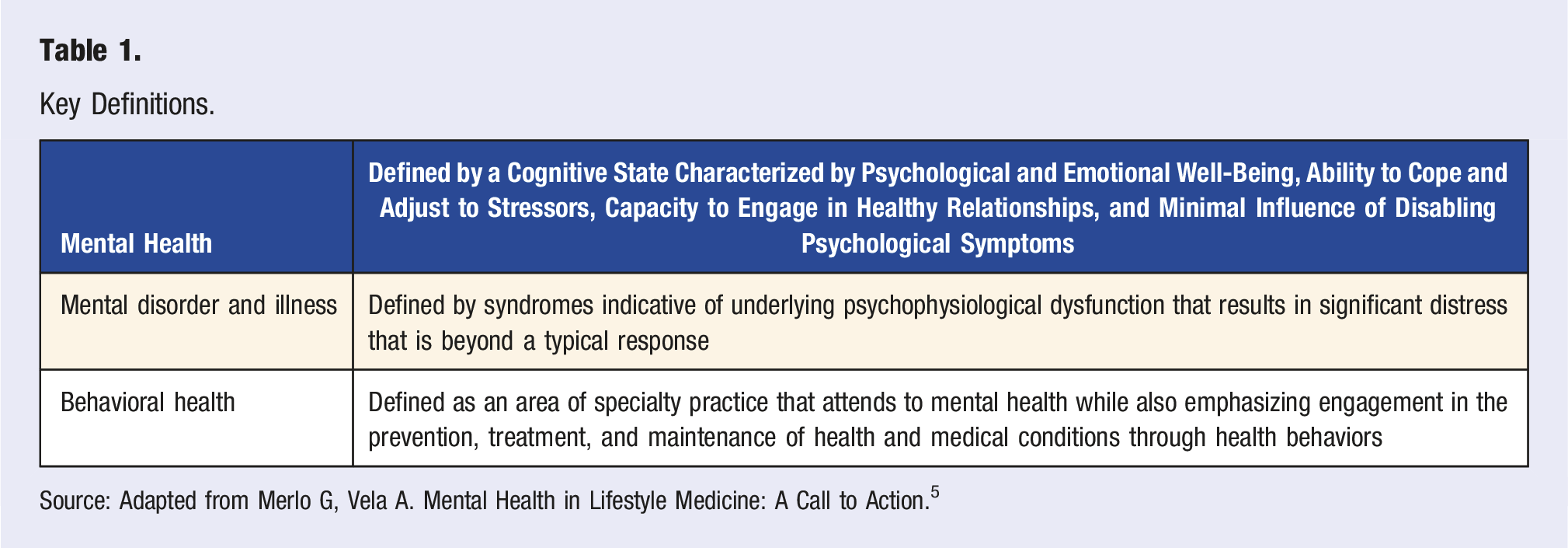
Source: Adapted from Merlo G, Vela A. Mental Health in Lifestyle Medicine: A Call to Action. 5
A Focus on the Evidence
Mental and behavioral health is a continuous thread through all lifestyle medicine pillars (nutrition, sleep, exercise, substance use, stress management, and healthy relationships). The lifestyle medicine literature has improved its scope to include mental and behavioral health, which in the past has been limited. For example, the forthcoming fourth edition of Lifestyle Medicine (Rippe) will include a section on psychiatry and mental health for the first time. Firth, Ward, and Stubbs’ editorial on Lifestyle Psychiatry, 6 and Firth’s 2020 Meta-review of Lifestyle Psychiatry 7 are recent articles that highlight this shift. Two 2021 articles by Merlo and Vela, recently published in the American Journal of Lifestyle Medicine, specifically focus on the intersection of mental and behavioral health with lifestyle medicine.5,8 This shift is in part the result of the field of medicine acknowledging the bidirectionality of the mind–body connection and shifting from a purely bio-medical model to a bio–psycho–social model. 9
The extent to which physical health and mental and behavioral health overlap are significant, and their interaction is seen in many ways. 7 High comorbidity among physical and mental health conditions makes focusing on one condition, in the absence of the other, less effective. Lifestyle medicine can be utilized to directly address and treat a range of mental health symptoms and disorders, and physical illnesses. Poor mental health can also inhibit the health behaviors needed to obtain lifestyle goals outlined by the pillars. 10 Behavior change skills and addressing the psychological factors contributing to barriers are crucial to helping patients reach their lifestyle medicine goals. 11
The Lifestyle Medicine Pillars and Mental Health
Nutrition
Overall dietary pattern and quality have been shown to impact mental health disorders. For example, a randomized controlled trial in adults with major depressive disorder found that those who followed a modified Mediterranean diet had a greater reduction in depressive symptoms that those following a standard diet. 12 The major mechanisms by which diet affects psychological health include the gastrointestinal (GI) microbiome, inflammation, and epigenetics, as well as the effects of macronutrients and micronutrients. 5 Interestingly, existing literature supports a bidirectional relationship between mental health and nutrients, such as glucose. One study found a relationship between negative affect (but not positive affect) and morning glucose the next day, theorizing that there are behavioral, endocrine, and immunological mediators that could explain this relationship. 13 Together, this suggests diet may be an important component to managing mental health and that mental health may be an important component to managing nutrition-related disorders. As nutrition science advances to include mental health outcomes, there will be more opportunities to implement lifestyle changes to support mental health. Attention to nutrition quality is a critical aspect of lifestyle medicine. From a behavioral health perspective, attention to eating behaviors, such as when and how people eat, is just as important as the food itself. Providers should assess for disordered eating symptoms and be aware of the newer concept of orthorexia, defined as health-focused eating that becomes pathological by causing impairment in functioning and/or malnutrition. 14 Screeners for problematic eating behaviors (e.g., Screen for Disordered Eating (SDE) 15 ) can help providers identify patients for referral to eating disorder specialists.
Substance Use
Substance use occurs along a continuum, from infrequent use to substance use disorders; any and all usage on this continuum is relevant in its effect on mental and physical health. Especially noted is the increased use reported since the start of the COVID-19 pandemic. 16 Substances are commonly reported as strategies for coping with stress and negative emotions. Yet, it is also commonly understood that substance use generally leads to negative mental health symptoms. 17 Alcohol, for example, is commonly used for relaxation; however, withdrawal from any amount of use increases anxiety and disrupts sleep, which in turn leads to increased use over time. 18 Di Chiara’s work shows how substances increase dopamine levels within the reward pathway to higher normal levels. For example, tobacco increases dopamine levels to 2.5% higher than normal, whereas morphine only produced a 2% increase in dopamine levels. 19 These alternations in the dopamine reward pathway frequently result in cravings symptoms, which are similar to anxiety. On the other hand, a study of almost 500 people who smoke found that while smoking tobacco may not serve as a stress reliever for everyone, failed attempts to quit were associated with an increase in anxiety symptoms. 20 Likewise, treatment for cannabis use disorder included treatment of anxiety symptoms was associated with better outcomes. 21 Given the nature of the relationship between mental health and substance use, there are many opportunities for leveraging lifestyle interventions to support optimal outcomes for both physical and mental health.
Physical Activity
Physical activity not only promotes general mental well-being, but also has a role in the prevention and management of mental disorders. Importantly, the beneficial effects of exercise on mental health have been demonstrated across age groups and many mental disorders, specifically depression, anxiety disorders, attention-deficit disorders, and substance use disorders. 22 Although the research on the mechanisms by which physical activity supports mental health is developing, there are a number of potential pathways. Biological mechanisms include increased synthesis and release of neurotransmitters and neurotrophins, which can then lead to neurogenesis, angiogenesis, and synaptogenesis. 23 Physical activity can also affect inflammation and oxidative stress and promote cardiovascular and metabolic health, all of which translate to improved brain health. 24 Additionally, psychological mechanisms include increased feelings of self-efficacy and self-esteem as well as promotion of prosocial behaviors. 25
Importantly, mood symptoms can also negatively affect self-efficacy and motivation, both of which are critical to engagement in exercise interventions, and trigger a cyclical pattern of symptoms. For example, individuals with major depressive disorder are less likely to feel motivated to engage in exercise, despite robust research indicating that exercise is an effective intervention for depressive symptoms. 26
Despite the growing body of evidence for exercise interventions, “prescribing” physical activity for mental disorders remains a challenge. For example, meta-analyses have demonstrated that exercise is an effective evidence-based intervention for major depressive disorder, with the best efficacy when aerobic and moderate to vigorous in intensity. 27 Nevertheless, exercise is not commonly utilized as a treatment for major depressive disorder or other mental health disorders, likely in part due to the relative lack of specific research comparing different types of exercise for different mental health conditions as well as lengths of exercise sessions. Given the well-established physical health benefits of exercise as well as growing evidence of mental health benefits, while these more specific research questions are being addressed, current research still supports the use of physical activity to complement current evidence-based mental health care.
Stress
Stress is an important part of life and has been shown to have benefits, such as performance enhancement 28 ; the term eustress is sometimes used to describe the normal stress that is needed in order to accomplish tasks. 29 Too much stress, however, can lead to detrimental chronic stress. In the context of a US culture that rewards overwork and stigmatizes rest, there are many challenges to recognizing and treating chronic stress. In addition, living with a chronic medical condition often contributes to stress and mental health issues. 30 Conversations around chronic stress are especially timely as both patients and clinicians are increasingly aware of stressors brought about or increased by the COVID-19 pandemic. Fortunately, attention to stress is increasing in the medical community, as exemplified by the American Heart Association’s 2021 scientific statement highlighting the importance of stress management in the prevention and treatment of cardiac disease. 31
Screening for stress is vitally important, especially in the primary care setting, as stress can contribute to many common complaints that may not meet criteria for a formal diagnosis. 32 Screenings should ideally include psychophysiological assessments for stress 33 as current screening for stress within allopathic medicine is often limited to asking patients about stress. This is a potentially problematic strategy as many patients, such as those with repressive copings styles, may lack insight related to stress. 32 Such screenings are also important to improve longevity while preserving functionality, as stress can cause or contribute to immune system suppression and consequent illness, such as increased risk for diabetes mellitus, digestive conditions, cardiovascular disease, psychiatric illness, and is associated with increased risk for self-destructive behavior.34,35 While the Perceived Stress Scale is not a physiological assessment, it is appropriate for use by providers to quickly screen patients before further workup.36,37
Interpersonal Relationships
Social support and healthy interpersonal relationships are critical to successful health behavior change, lifestyle maintenance, well-being, and longevity. The influence of social support can range from helping to support a specific change, such as cooking a healthy meal at home with family and friends, to necessary, such as the required instrumental support for organ transplant recipients. 38 A systematic review of therapeutic interventions for people with type 2 diabetes found that partner support had a major role in prevention and control of diabetes distress, associated depression, and medication non-adherence, all of which adversely affect glycemic outcomes. 39
A seminal epidemiologic study, the Alameda County Study, found that even after controlling for confounding factors, such as socioeconomic status and health behaviors, those with the fewest social ties were at more than twice the risk of death compared to those with the most social ties. 40 Additionally, a recent meta-analysis highlights the negative effects of loneliness on health outcomes (mental health, general health, well-being, physical health, sleep, and cognition). 41 Medium to large effects were observed on all health outcomes, with the largest effects seen for mental health and overall well-being. 41 Interpersonal relationships are critical to mental and physical health and warrant more study and attention within lifestyle medicine, particularly in an era of COVID-19, with our increased reliance on technology, significant periods of social isolation, and less in-person social interaction.
Sleep
Restorative sleep is critical for maintaining healthy biological function and is crucial for physical, mental, and emotional health. 42 Sleep deficiency has been well studied and has been shown to be associated with poor immune function and multiple medical conditions, including metabolic, cardiovascular, neurological, and mental health disorders. 43 Insufficient sleep is an independent risk factor for mental health and neurologic disorders, and is associated with impaired dysregulated mood, and emotional distress. 44 For example, a 2021 meta-analysis of 65 randomized controlled trials on the effects of sleep on mental health found that improving sleep resulted in a significant effect on mental health, 45 specifically depression, anxiety, and rumination (a common symptom of anxiety). Importantly, the review indicated a dose-response effect, meaning that the greater the improvement in sleep, the greater the improvement in mental health. 45
It should also be noted that the relationship between sleep insufficiency and anxiety can be affected by other lifestyle factors such as substance use and disordered eating behaviors (i.e., night eating). 46 Sleep insufficiency can also lead to cognitive impairments such as in vigilance, thinking, and decision making, leading to greater risk for medical errors, industrial and vehicular accidents, and risky behaviors. 43 Quality and quantity of sleep is also related to health behaviors, and can influence dietary choices, physical activity engagement, ability to manage and cope with stress, and energy to engage in interpersonal relationships. 47 Fortunately, addressing sleep can improve cognition and mental health, and likewise treating a mental or behavioral health concern can improve sleep. While sleep recommendations vary by age, greater than 7 hours a night is the consensus for adults.44,48
Where do We Go From Here?
The discussion above outlined the bidirectional influences of physical and mental health within each pillar of lifestyle medicine. Yet, how to initiate health behavior changes and maintain such lifestyle is also critical. Patients, and providers alike, may understand key health recommendations based on national guidelines and set goals accordingly, yet many people struggle to engage and maintain changes that align with their goals. 49 There is no one dominant theoretical model of health behavior change among the many that exist in the literature, 9 and understanding what works, for whom, and in what context is difficult to synthesize.50-52 People think and behave differently if a particular health behavior is a preventive action vs treatment, 53 or if a health behavior requires taking action (e.g., engaging in treatment) vs not taking action (e.g., watchful waiting). 54 Additionally, different processes are involved in initiation of behavior vs maintenance of behavior, 55 and cultural factors add to this already complex process.
Michie and colleagues’ capability–opportunity–motivation–behavior (COM-B) model states that to create sustained behavior change requires capability, opportunity, and motivation that are mutually reinforcing.56-58 For any behavior to occur, people must have the relevant physical and psychological capabilities, they must have the opportunity, and have “greater motivation to perform that behavior than anything else they could be doing at the time.” 56 This latter concept is what Jud Brewer calls the “bigger, better, offer,” 59 and requires mindfulness of thoughts and feelings. Thus, helping patients leverage lifestyle medicine to move towards physical and mental well-being is complex, and a roadmap to health behavior change needs to be individualized and approached with compassion.
In summary, approaches to practice that attend to, and address, mental and behavioral health are relevant to and necessary for all types of providers who work within the lifestyle medicine framework. The intersection of mental health and lifestyle should be considered and applied to provide optimal evidence-based lifestyle medicine for all patient populations who will benefit from the specific attention to diet, physical activity, relationships, stress, sleep, and substance use. Lifestyle approaches are key to the prevention and mitigation of the profound impacts of suboptimal mental health on cost, functional status, and quality of life for millions of people; and lifestyle medicine practitioners have a critical responsibility to best serve their patients by simultaneously addressing physical and mental health. Proactively recommending therapeutic lifestyle medicine–focused behaviors supports both mental health, mental disorders, and other chronic medical conditions. Hence, healthcare providers play a key role in flattening the rising rates of depression, anxiety, substance use, and other mood disorders through lifestyle medicine approaches.
Footnotes
Acknowledgments
This paper is based on the workshop presented at LM2021, November 7, 2021.
Declaration of Conflicting Interests
The author(s) declared no potential conflicts of interest with respect to the research, authorship, and/or publication of this article.
Funding
The author(s) received no financial support for the research, authorship, and/or publication of this article.
