




Abstract
Stanford Medical School has created a class in lifestyle medicine that any student in the university can attend for credit. It is based on the foundational principles of lifestyle medicine and also informs students about topics such as Chinese medicine, naturopathic medicine, and wearable devices. The popularity of the course at Stanford speaks to the growing interest in the field of lifestyle medicine for medical students, undergraduate students, business students, and even engineers.
‘Lifestyle medicine is an exciting new movement . . . to facilitate behavioral change and promote a culture of health and wellness in patients.’
The impetus for the Stanford Lifestyle Medicine Class at Stanford is directly attributable to the lifelong passion of Dr Walter Bortz to change the focus of medical student education. Based on the success of the Lifestyle Medicine Interest Group developed by Dr Beth Frates at the Harvard Medical School and the Lifestyle Medicine CME courses at Harvard created by the Institute of Lifestyle Medicine where Dr Edward Phillips is the founder and director, Dr Bortz worked with Dr Michael Fredericson and medical students, Jocelyn Chin and Rich Joseph, to explore setting up a similar elective course at Stanford. Dr Beth Frates, a graduate of Stanford Medical School, graciously shared teaching materials to get us off the ground, and we were fortunate to have an outstanding group of faculty who expressed interest in volunteering their time to lecture in the course.
Lifestyle medicine is an exciting new movement to empower practicing clinicians and aspiring physicians to facilitate behavioral change and promote a culture of health and wellness in patients. The course focuses on both concrete, evidence-based findings and tangible, practical tools to readily translate into everyday clinical practice. A series of leading experts and guest lectures guide students through interactive, patient-focused activities in topics including, but not limited to, nutrition, exercise, sleep, hypnosis, motivational interviewing, meditation, and acupuncture.
The course is registered under the medical school, although any Stanford student can register for the course. Enrollment includes medical students, undergraduate students in a variety of majors from mechanical engineering to human biology, MBA students, and engineering and social science graduate students. There are also postdoctoral students who take the course. The students register to learn about what healthy habits can be incorporated into both their and their patients’ daily lives. Because of the broad nature of topics covered, the class appeals to students across the university. Most students who enroll hope to hear how successful individuals balance their personal and professional lives, which is rarely covered in core academic classes. Each class lasts 1 hour, and the class meets once a week for 8 to 10 weeks. Last year’s classes featured the following speakers:
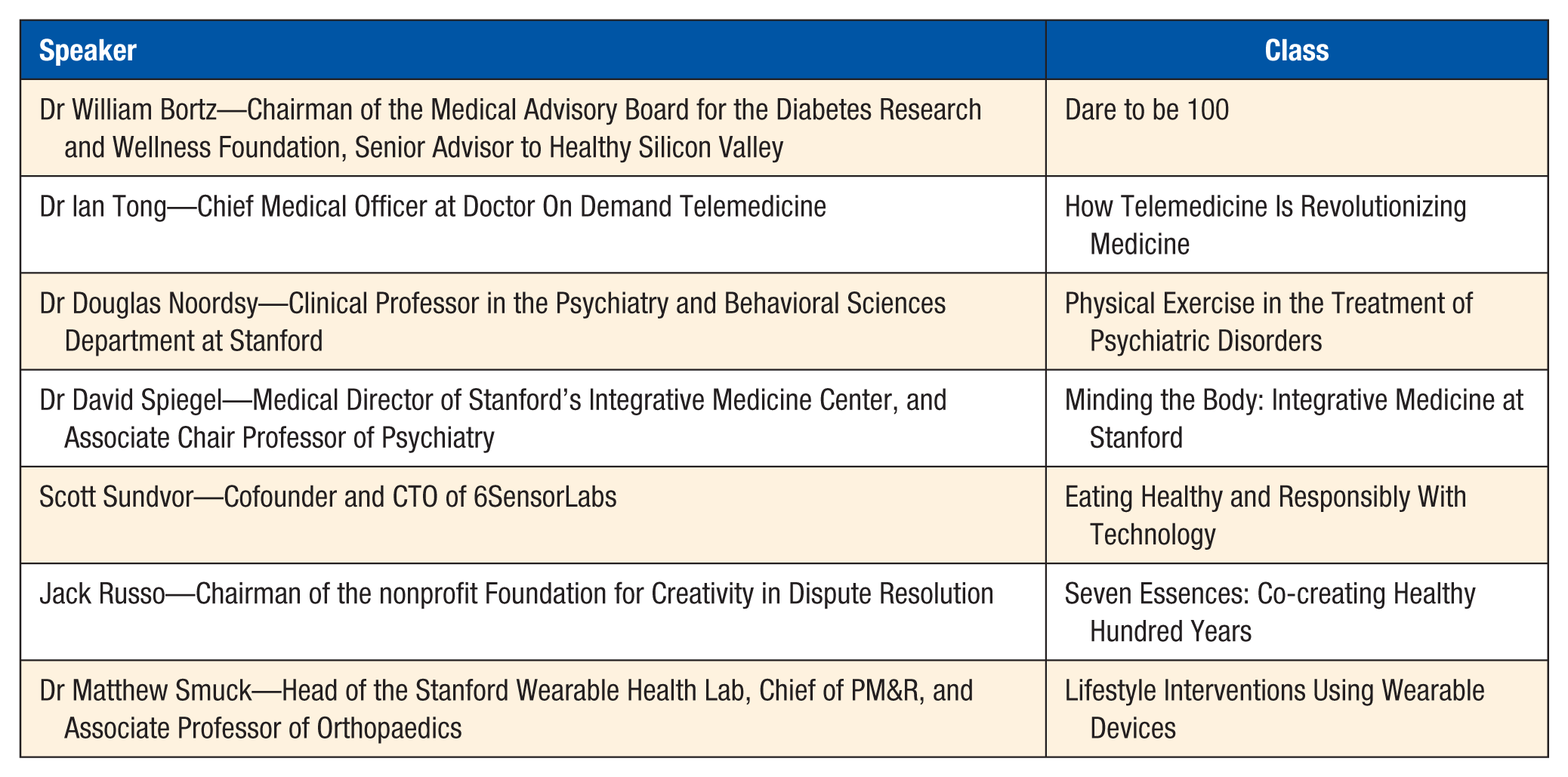
Thanks to the generous support of Jack Russo, one of the primary sponsors of the course, we have been able to invite other notable speakers in years past, including the following:
Dean Ornish, MD, President and Founder of the nonprofit Preventive Medicine Research Institute in Sausalito, California, as well as Clinical Professor of Medicine at the University of California, San Francisco
Edward Phillips, MD, Harvard Medical School
Beth Frates, MD, Harvard Medical School
Rani Pollack, MD, Harvard Medical School
John Ratay, MD, Associate Clinical Professor of Psychiatry at Harvard Medical School and one of the world’s foremost authorities on the brain-fitness connection
Wayne Dysinger, MD, MPH, previous chair, Department of Preventive Medicine, Loma Linda University; past president of the American College of Lifestyle Medicine
Liana Lianov, MD, MPH, FACPM, FACLM, immediate past president of the American College of Lifestyle Medicine and chair of the Lifestyle Medicine Task Force and later the Lifestyle Medicine Competencies Working Group of American College of Preventive Medicine
Bruce Feldstein, MD, founder and director of The Jewish Chaplaincy and an Adjunct Clinical Professor at Stanford University School of Medicine in the Division of Family Medicine
Arnold Tayam, Founder of the Longevity Center and Doctor of Medical Qigong (China), Master Instructor Shifu of Tai Chi & Bagua, Taoist Teacher
The speakers are well received by the students, teaching on a variety of topics in class that are not touched upon in most curriculums including hypnosis, wearable devices, how cultural diets affect disease rates in various populations, and other topics. Dr Walter Bortz, widely recognized as America’s most distinguished scientific expert on aging and longevity, opens up the course with his research on the importance of physical exercise in the promotion of robust aging. From there, each speaker addresses elements of daily life that can be maximized, from positive thinking in management of daily stressors, to sleep cycles and studies from sleep experts on how to optimize restful sleep, to improved nutrition and exercise habits, and to management of finances in medical school to minimize debt. Ultimately, all the speakers share a common theme—they seek to promote health and are selected to share their perspectives on what it means to have a well-balanced lifestyle.
Up until this past year, the course was only approved for 1 unit of credit, and all we required was class attendance. This year we introduced a 2-unit option where the students monitor their modifiable health practices with a wearable health/fitness watch. Students are then required to take pre- and posttest assessment of their health behaviors. We have found this to be a powerful tool to engage students in the possibilities of lifestyle interventions. Instead of standardized assignments and readings, we encourage students to monitor their own health through the usage of a fitness watch (ie, we partnered with Basis watches to distribute a watch for the duration of the course to each student). Students would then record observations about their fitness and note specific patterns/aspects of their daily life they would like to change. To make the class widely accessible, we focus on content during lecture and have students use time outside of the class to apply the concepts to their daily lives, as reflected in their weekly observations.
Since the inaugural class was listed a couple of years ago, the class has grown in popularity from just a handful of enrollees to 90 students in recent years. Students are appreciative that material on the importance of a balanced life is now covered in an academic setting they can take for credit. Each year more and more faculty hear about the course and offer to lecture, such that our speaker schedules are filled up well before the class begins. The growing popularity of the class attests to the movement toward integrating lifestyle medicine into traditional medical practices. Dr Fredericson states, his “main motivation is to offer a course that promotes approaches to health and wellness beyond what is presented in the traditional medical curriculum. Hopefully we can inspire the next generation of leaders in this evolving field of Lifestyle Medicine.” Dr Bortz believes the course is successful because it establishes an institutional priority for emerging physicians to embrace healthy living.
The course content varies from year to year. However, the basics of lifestyle medicine including nutrition, exercise, sleep, and techniques for behavioral change have held constant. A healthy lunch is also provided thanks to the generous support of Jack Russo, one of the primary sponsors of the course. Each meal consists of a salad, a white meat option, grilled vegetables, rice, and a small dessert to offer an example of a well-balanced diet while providing nutrition and incentive for attendance. Each week, all of the food is scraped clean except the dessert, which points to the students’ willingness to be healthy. One of our more popular sessions has been a panel discussion among Chinese medicine, naturopathic, and allopathic physicians on how they would approach various patients with lifestyle medicine issues. As word of the course spreads, we have seen a rise in graduate students and undergraduates who are interested in registering. Most of the undergraduates are looking to integrate lifestyle medicine principles into their lives, whereas many of the business and other graduate students are interested in the entrepreneurial possibilities of lifestyle medicine practices.
Emphasizing that a balanced lifestyle is important for everyone, both students and patients, is key to the success of this class. As health care costs and incidence of chronic disease increase, health care professionals should be the first to model habits that help prevent long-term disease. Prioritizing this goal with a class dedicated to Lifestyle Medicine is the first thing other universities can do to model Stanford’s groundbreaking class. By showing students how physicians maintain their health in a dedicated seminar and sharing the gospel of healthy habits of successful individuals, we can train the next generation of physicians and professionals to be champions of longevity. Modeling this importance through a class that features physicians and professionals who similarly make lifestyle a priority through a class has helped our students follow suit and adopt their habits.