



Abstract
From 2009 to present-day, the University of Central Florida College of Medicine has progressively incorporated lifestyle medicine into its curriculum thanks to a variety of student and faculty-led efforts. These efforts include extracurricular learning opportunities through a student-run Lifestyle Medicine Interest Group, curriculum-based didactics through University of Central Florida faculty members’ integration of lifestyle medicine in preexisting sessions, and clinical experiences for students provided by a American Board for Lifestyle Medicine certified practitioner.
Lake Nona is unique in the sense that it was developed as a smart city, earning it the nickname of “Medical City.
The University of Central Florida (UCF) College of Medicine (COM) is in Lake Nona, Florida, a community within the City of Orlando. Lake Nona is unique in the sense that it was developed as a smart city, earning it the nickname of “Medical City.” 1 Currently, Medical City is anchored by the (1) UCF Health Sciences Campus, which includes UCF COM, UCF Health, Lake Nona Medical Center, UCF Burnett School of Biomedical Sciences, and the UCF Lake Nona Cancer Center; (2) Orlando VA Medical Center; (3) Nemours Children’s Hospital; and (4) University of Florida College of Pharmacy. 2 Alongside the presence of these medical institutions are residential neighborhoods full of green spaces, recreational opportunities, and community gatherings. Lake Nona was primed to be a wellness community that lends itself to be an educational hub for lifestyle medicine.
The UCF COM started educating future physicians in 2009. The medical school curriculum needed to accommodate many known required board-tested topics that has posed a challenge for implementing lifestyle medicine into the curriculum. The quote by Napoleon Hill, “Patience, persistence, and perspiration make an unbeatable combination for success,” accurately portrays how the faculty and students have paved the way for incorporating lifestyle medicine into the UCF COM curriculum.
Six years ago, the authors (Dr Pasarica—an MD with a PhD in nutrition; and Dr Kay—an educational/counseling psychologist) launched the initial efforts to integrate lifestyle medicine in the required medical curriculum. Blending their expertise, they developed a creative approach to develop a longitudinal program that would expand medical students’ conceptualizations of the role of lifestyle behaviors in the etiology, prevention, and management of chronic diseases.3-11 Using learning outcomes, the curricula focused on the instruction and assessment of measurable behaviors to demonstrate students’ knowledge, skills, and confidence in lifestyle medicine. They utilized lectures, independent reading, case-based learning, and reflection exercises, with the latter centered on setting and maintaining personal behavior change goals. For assessment, they created multiple-choice and open-ended questions as well as clinical cases that portrayed diseases requiring lifestyle changes for management. They then designed and validated a Lifestyle Medicine Observed Structured Clinical Examination (OSCE) station. Additionally, they utilized technologies, like chatting, discussion boards, and audience response systems in innovative ways to encourage student engagement and life-long learning. Lifestyle medicine was also integrated into extracurricular activities. At KNIGHTS student-run free clinic, students offered lifestyle change support for each patient. This program received the Innovation Award for Healthcare Provider Training and Education from the Alliance for a Healthier Generation, the Bipartisan Policy Center, and the American College of Sports Medicine. 12 Medical students, under the supervision of Dr Pasarica, worked with student athletes for lifestyle change to improve athletic performance. 13
The 2019 ACLM (American College of Lifestyle Medicine) Conference in Orlando, FL, directly affected the UCF community. Sharon Wasserstrom, MD, new at UCF COM since January 2019 (internist and ABLM [American Board for Lifestyle Medicine] certified since 2017) invited Daniel Topping, MD (trained in family medicine and member of the UCF COM Department of Medical Education), to join her at the ACLM conference. Together, they attended a meeting about Lifestyle Medicine Interest Groups (LMIG). Shortly after the conference they subsequently were able to recommend the formation of a UCF COM LMIG to students who were interested in plant-based nutrition, exercise prescriptions, and motivational interviewing. This inspired Dan Topping, MD, to become the second ABLM-certified physician at UCF COM in 2020. The inaugural LMIG at UCF COM has been co-led by 2 very enterprising medical students, Léonie Dupuis and Carla Gonzalez (class of 2023), who are both passionate about lifestyle medicine. Their energy and creative spirits quickly made the group the most popular one of its kind. From the medical student perspective, LMIG serves as a one-stop shop for learning about all the pillars of lifestyle medicine and how to incorporate them into patient care.
The UCF COM LMIG chose to adopt a pillars-based approach to its board structure and programming. It incorporated the 6 pillars in the following ways:
Nutrition: An ACLM Taste of Lifestyle Medicine (TOLM) grant was used to provide snacks at the annual UCF COM Field Day. Both students and faculty members were surprised at the presence of healthy snacks at this trademark event. Dr Shivam Joshi, a nephrologist at NYU, presented on the use of plant-based diets in the management of Chronic Kidney Disease patients. A UCF student also gave a virtual workshop on homemade bread-making. Last, a second TOLM grant was awarded to the UCF LMIG in order to pilot a virtual community cooking class case study that would outline the benefit of increasing grant funding to LMIGs nationwide. Funding was budgeted to provide complimentary ingredient bags to all participants in this plant-based virtual event. Families all over Lake Nona partook in this fun and remote cooking event where LMIG board members broadcasted live a step-by-step culinary demonstration with nutrition education interspersed in-between!
Exercise/Stress Management: Fitness challenges of 21-, 48-, and 100-day duration were created to engage the incoming first-year and second-year students. The goal of the challenge was to encourage movement for the duration of the challenge from walks, to stretching, to high-intensity activity. Participants were placed in group chats for accountability and for finding workout buddies that resulted in a sense of virtual comradery among the challenge participants. In light of the pandemic, virtual Zumba and Yoga classes were hosted by UCF LMIG to help encourage activity and connection.
Sleep/Substance Abuse: UCF Student Health Services’ Nurse Practitioner Kristina Grabnickas presented “A Better Night’s Sleep” workshop to encourage better sleep habits. The Sleep Management Committee organized a research study of which the primary investigator is Sharon Wasserstrom, titled, “Coronasomnia: The Impact of COVID-19 on Pre-Clinical Medical Students’ Sleep Habits.” Currently, the team is analyzing these study results.
Healthy Relationships: The board members became close friends and encouraged general members to reach out and stay engaged on a personal level to foster connection in a fully virtual setting. At the UCF COM, a Big Sibling/Little Sibling program already existed, so UCF LMIG encouraged engagement in those relationships.
Outside of the ACLM’s 6 pillars exist some core values that the UCF LMIG wanted to establish and foster as a new organization. These values include professional development, community involvement, and service.
Professional Development: Although not a formal pillar of the ACLM, a large part of the LMIG concept is to provide networking opportunities to its members with practicing lifestyle medicine professionals. UCF LMIG hosted Dr Brian Taschner, a cardiologist and owner of Vibrant Beat Lifestyle Medicine Practice, to discuss his career in medicine, his concierge lifestyle medicine practice, and his vision for the future of lifestyle medicine.
Community Connection: Lifestyle Central is a student-run lifestyle medicine magazine designed to be Central Florida’s source of lifestyle medicine–related content. Through this publication, students can share their experiences in lifestyle medicine, interview professionals in the field of lifestyle medicine, and interview local community members who are making an impact in 1 of the 6 pillars. The first edition is scheduled to be published by the end of Spring 2021.
Service: UCF LMIG students designed the “Healthy Lifestyle Initiative” as a collaborative program between UCF COM and 2 public, underserved high schools. The program teaches high school students about the 6 pillars of lifestyle medicine in a hands-on activities-based approach to make the content memorable and exciting.
Dr Wasserstrom joined the UCF COM faculty in January 2019 as a clinician at UCF Health and associate professor for the UCF COM. One of her goals when starting this position was to help further enhance the curriculum with lifestyle medicine. Her passion for lifestyle medicine as one of the inaugural board-certified lifestyle medicine physicians in 2017 ignited her path to be innovative to find several pathways to further implement lifestyle medicine at the UCF COM.
Introduce Lifestyle Medicine to Third- and Fourth-Year Medical Students at UCF Health Clinic
Dr Wasserstrom quickly established a lifestyle medicine practice at UCF Health in 2019 including policies and procedures for the new service line. She serves as an outpatient preceptor for third-year medical students who get introduced to lifestyle medicine assessments and practice their lifestyle evaluation and lifestyle prescription skills. In addition, Dr Wasserstrom created a group visit program at UCF Health to incorporate education for a group of patients and facilitate group discussions on specific health topics to help support lifestyle modifications. During the group visits, UCF medical students do some of the teaching and become part of the group discussion.
She then launched a fourth-year elective titled “Lifestyle Modification Skills in Practice.” This 4-week elective consists of a practical component interacting with patients doing lifestyle assessments, motivational interviewing, running zoom group visits, and prescribing lifestyle prescriptions and a didactic component through weekly lectures on each of the pillars of lifestyle medicine.
Lecture in the Existing Curriculum and Embed Lifestyle Medicine Content
Dr Wasserstrom also sought opportunities to incorporate lifestyle medicine into preexisting curricular sessions. At the UCF COM, these preexisting sessions include a lecture on preventative skills for the third-year Family Medicine rotation, a lecture on Motivational Interviewing and another session on Clinical Skills for second-year students, and a lecture on Lifestyle Medicine for the first-year Psychosocial Issues in Healthcare course.
Recruit Medical Students to Perform Lifestyle Medicine–Related Research
She also mentored medical students in conducting 2 novel research projects with one being an 8-week intervention studying the efficacy of a plant-based diet program for diabetic patients and the other being a COVID-19 survey study to investigate how the pandemic affected the sleep habits of preclinical medical students.
Formed Committee and Task Force Regarding Lifestyle Medicine
A committee was formed to brainstorm ways to increase funding for lifestyle medicine at UCF COM. A Task Force for the Curriculum Committee was also created to find ways for the UCF COM and Lake Nona Center for well-being to form an educational partnership. The goal of this committee was to find ways to develop practicum experiences for UCF COM students in lifestyle medicine.
Lecture to Faculty to Educate About Lifestyle Medicine
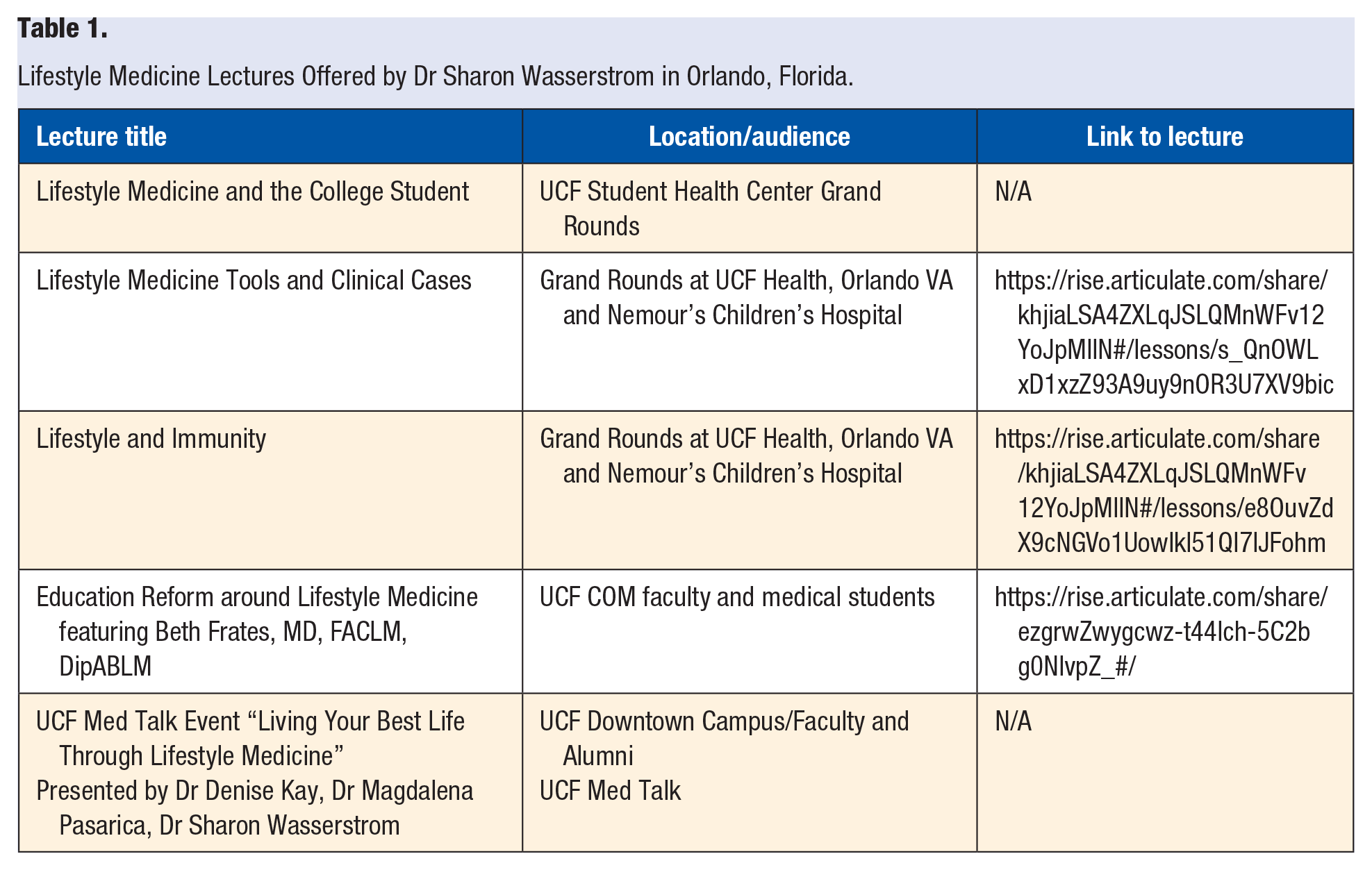
Dr Wasserstrom provided peer education by giving lectures to fellow UCF faculty members and neighboring faculty at the Orlando VA and Nemours Hospital on Lifestyle Medicine. For the full list of lectures, their targeted audience, and an access link, see Table 1.
Lifestyle Medicine Lectures Offered by Dr Sharon Wasserstrom in Orlando, Florida.
In summary, there have been innovative efforts to embed lifestyle into the education of medical students at UCF COM. Both the faculty and students have contributed to this successful implementation. Through this process, they learned to start small with one session in one course, building a progression that reinforces learning throughout the years as tolerated by curriculum time and stakeholders. A large takeaway was to give students access to physician role models that practice lifestyle medicine in clinical practice. The education in lifestyle medicine outside of the classroom has been outstanding due to what has been implemented by the UCF COM LMIG. In addition, providing grand rounds and CME for the faculty regarding lifestyle medicine has helped propel the greater faculty’s interest in incorporating more lifestyle medicine into the curriculum. Due to all the above efforts to bring more lifestyle medicine into the curriculum of UCF COM, the Curriculum Committee just recently designated lifestyle medicine as an official Longitudinal Curricular Theme. The future of lifestyle medicine at the UCF COM looks bright indeed!
Footnotes
Acknowledgements
Thank you to Beth Frates for motivating the authors to share their experiences with the AJLM.
Declaration of Conflicting Interests
The author(s) declared no potential conflicts of interest with respect to the research, authorship, and/or publication of this article.
Funding
The author(s) received no financial support for the research, authorship, and/or publication of this article.
Ethical Approval
Not applicable, because this article does not contain any studies with human or animal subjects.
Informed Consent
Not applicable, because this article does not contain any studies with human or animal subjects.
Trial Registration
Not applicable, because this article does not contain any clinical trials.