




Abstract
While mobile phones (henceforth cell phones) provide nearly constant access to activities (eg, watching videos, playing games) traditionally associated with sedentary behavior, the relationship between cell phone use, sedentary behavior, and physical activity is untested. The purpose of this study was to assess these relationships. A sample of college students (N = 236) completed surveys assessing daily cell phone use, sedentary behavior (sitting time) and physical activity. Regression demonstrated that cell use was positively associated (β = 0.23, P = .05) with sedentary behavior and not related (β = −0.02, P = .90) to physical activity. Tertile splits were performed for average daily cell phone use and participants were grouped as high (n = 81), moderate (n = 77) or low (n = 78) cell users. High users (495.1 ± 227.6 min/d) participated in significantly (P ≤ .03) more sedentary behavior than the moderate (417.1 ± 208.3 min/day) and low (395.2 ± 180.0 min/d) users. Sedentary behavior was not different (P = .5) between the moderate and low users. In conclusion, cell use was associated with college students’ sedentary behavior but not physical activity. High users allocated 18.7% and 25.3% more time to daily sitting than moderate and low users, respectively.
‘. . . sedentary behavior has been linked with negative health outcomes even in individuals who are regularly physically active.’
Presently, 98% of college-aged adults own a cellular/mobile telephone (henceforth cell phone), 83% own smartphones (ie, a cell phone with internet connectivity and capable of running a variety of software applications) and use these devices more than 4 hours per day, primarily for leisure purposes.1-4 Smartphones provide instant access to a variety of potential leisure activities such as Internet browsing, social networking, streaming videos, and playing video games. Of concern here is that participating in the traditional versions of these activities is associated with increased sedentary behavior (ie, sitting) and decreased physical activity.5,6 Thus, it is possible that the cell phone may be used in a similar fashion and promote sedentary behavior and decreased physical activity.
Examining the relationship between cell phone use and both physical activity and sedentary behavior is potentially important as physical activity and sedentary behavior are separate constructs that have independent associations with a myriad of diseases (eg, cardiovascular, metabolic, etc).7-9 It is well established that participation in regular physical activity leads to many health benefits, including but not limited to, improved cardiovascular and musculoskeletal fitness, and decreased anxiety and depression.10-12 Conversely, sedentary behavior has been linked with negative health outcomes even in individuals who are regularly physically active.13-16 While modern cell phones provide access to some activities that are traditionally associated with sedentary behavior (eg, watching videos, playing video games), other cell phone functions may encourage physical activity. In previous research from our group utilizing structured interviews, college students reported using their cell phones to connect with physically active peers and this increased the likelihood that they would participate in physical activity. 3 Additionally, physical activity interventions that have utilized cell phones to communicate with and encourage participants (ie, mobile health or mHealth) have been shown to have a positive effect on physical activity behavior. 17 Finally, cell phones provide access to an increasing variety of applications (“apps”) that are designed to increase physical activity and/or reduce sedentary behavior and while the actual efficacy of these “apps” is not well studied, there is evidence that the content of many of these “apps” is rooted in established behavioral change techniques. 18 Therefore, because physical activity and sedentary behavior are separate constructs and because of the potentially conflicting effects outlined herein, research examining the relationship between cell phone use and both constructs (physical activity and sedentary behavior) is needed.
In an initial study from our group that reported an inverse relationship between cell phone use and cardiorespiratory fitness (ie, VO2 peak), participants also completed qualitative interviews assessing their perceptions of cell phone use behaviors as well as daily, routine leisure behaviors. 3 Analysis of interview data revealed that high cell phone users, relative to low users, were more likely to perceive a link between high cell phone use and sedentary behavior. Additionally, high users reported participating in greater numbers of sedentary leisure behaviors and fewer physically active leisure behaviors. These differences coupled with the inverse relationship between cell phone use and VO2 peak suggest that, for college students, cell phone use may act in a manner that is similar to participating in traditional sedentary activities such as watching television and playing video games. 3 However, this initial study assessed physical activity and sedentary behavior only through qualitative interviews and did not measure these behaviors utilizing validated survey instruments.
The purpose of the present study was to assess the relationship between cell phone use and sedentary behavior and physical activity using validated survey instruments in a large sample of college students. We hypothesized that cell phone use, much like the use of traditional electronic media (eg, watching television), would be positively associated with sedentary behavior and negatively associated with physical activity.
Methods
A sample of 236 students (21.0 ± 2.0 years old, n = 128 females) from a large, public university in the Midwestern United States provided written consent and then completed a series of surveys designed to assess demographics (age and sex), cell phone use (minutes per day), physical activity and sedentary behavior (sitting minutes per day). Research personnel were situated across campus at various high-traffic pedestrian areas and every fifth person that walked past personnel was systematically asked to participate in the study. Data collection occurred at different times of the day and on different days of the week to increase the representativeness of the sample. All data was collected during a 1-month period in a single academic semester. All participants were required to be undergraduate students at the university and be 18 to 29 years old. Anyone not meeting these criteria was deemed ineligible to complete the surveys. All procedures were approved by the university institutional review board.
Cell phone use was assessed by asking the participants the following question:
As accurately as possible, please estimate the total amount of time (minutes) you spend using your mobile phone each day. Please consider all uses except listening to music. For example: consider calling, texting, sending photos, gaming, surfing, watching videos, Facebook, e-mail, and all other uses driven by “apps” and “software.”
As reported elsewhere, this self-report measure was carefully developed to assure content validity, and subsequent testing provided evidence of construct and criterion validity 19 . Furthermore, it is similar to other surveys assessing the use of electronic devices for media consumption (eg, television),2,20,21 and has been used in previously published research.2,5
Physical activity was assessed via the validated Godin Leisure-Time Exercise Questionnaire. 22 Participants reported the average number of times they participated in strenuous, moderate, and light intensity exercise for more than 15 minutes during a 7-day period. Weekly physical activity was calculated using the following equation:

where MET indicates metabolic equivalent.
Participants reported their average daily sedentary (ie, sitting) behavior (minutes) using the following question from the validated International Physical Activity Questionnaire
23
:
On average, how much time did you spend sitting each day during the past week?
Statistical Analysis
Multiple regression analysis was performed to test the relationship between cell phone use and the following variables: sex, age, physical activity, and sedentary behavior. The relationship between cell phone use and the interaction between physical activity and sedentary activity was also assessed in the model.
A subsequent analysis was used to further examine the relationship between cell phone use and sedentary behavior. A tertile split was performed and participants were assigned to a low (<33rd percentile, n = 78), moderate (33rd to 66th percentile, n = 77), or high (>66th percentile, n = 81) group (Table 1) based on cell phone use (minutes per day). This use of a tertile split is similar to previous methods that assessed qualitative data regarding physically active and sedentary leisure behavior across a range of cell phone use patterns. 3 These tertiles also allowed us to quantify how many minutes more sedentary the high cell phone users were relative to their peers. After completing the tertile split, a 3 cell phone use group (low, moderate, high), covarying for sex and age, analysis of covariance (ANCOVA) was performed to assess differences in sedentary behavior. Sex and age were included as covariates as both these factors were significantly related to cell phone use in the current analysis and have been identified as potential correlates to cell phone use and physical activity in previous research.24-26 Physical activity was not included in the ANCOVA model as it was neither a significant predictor of cell phone use in the regression nor did it moderate the relationship between cell phone use and sedentary behavior. Post hoc comparisons for any significant main and interaction effects were performed using independent samples t tests with Bonferroni corrections.
Average daily cell phone use. a
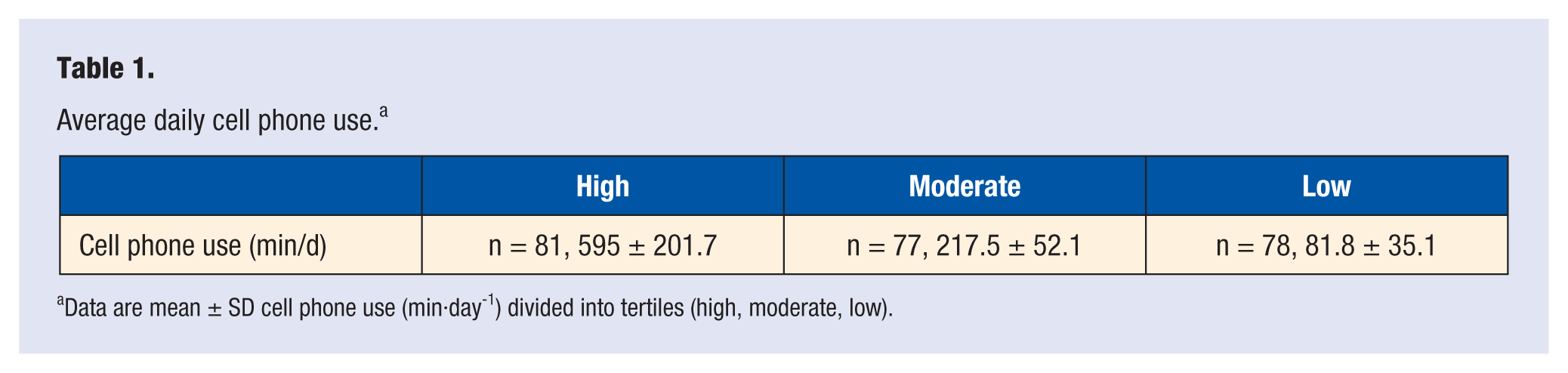
Data are mean ± SD cell phone use (min∙day-1) divided into tertiles (high, moderate, low).
Results
Sedentary behavior was significantly associated (β = 0.23, t = 1.9, P = .05) with cell phone use. As cell phone use increased sedentary behavior increased. Age (β = −0.22, t = 3.6, P < .001) and sex (β = 0.16, t = 2.5, P = .013) were also significantly associated with cell phone use. As cell phone use increased participants were of a younger age and females (344.6 ± 270.6 min/d) exhibited greater cell phone use than males (252.1 ± 217.1 min/d). Neither physical activity behavior (β = −0.02, t = 0.13, P = .90) nor the interaction between physical activity and sedentary behavior (β = 0.03, t = 0.18, P = .86) was significantly associated with cell phone use.
ANCOVA revealed that, independent of age and sex, there was a significant main effect (f = 4.8, P = .01) of cell phone use group on sitting behavior (Figure 1). Sitting behavior in the high cell users (495.1 ± 227.6 min/d) was significantly (t ≥ 2.3, P ≤ .03) greater than the moderate (417.1 ± 208.3 min/d) and low (395.2 ± 180.0 min/d) cell phone use groups. Sitting behavior in the low and moderate cell phone use groups was not significantly (t = 0.7, P = .5) different.
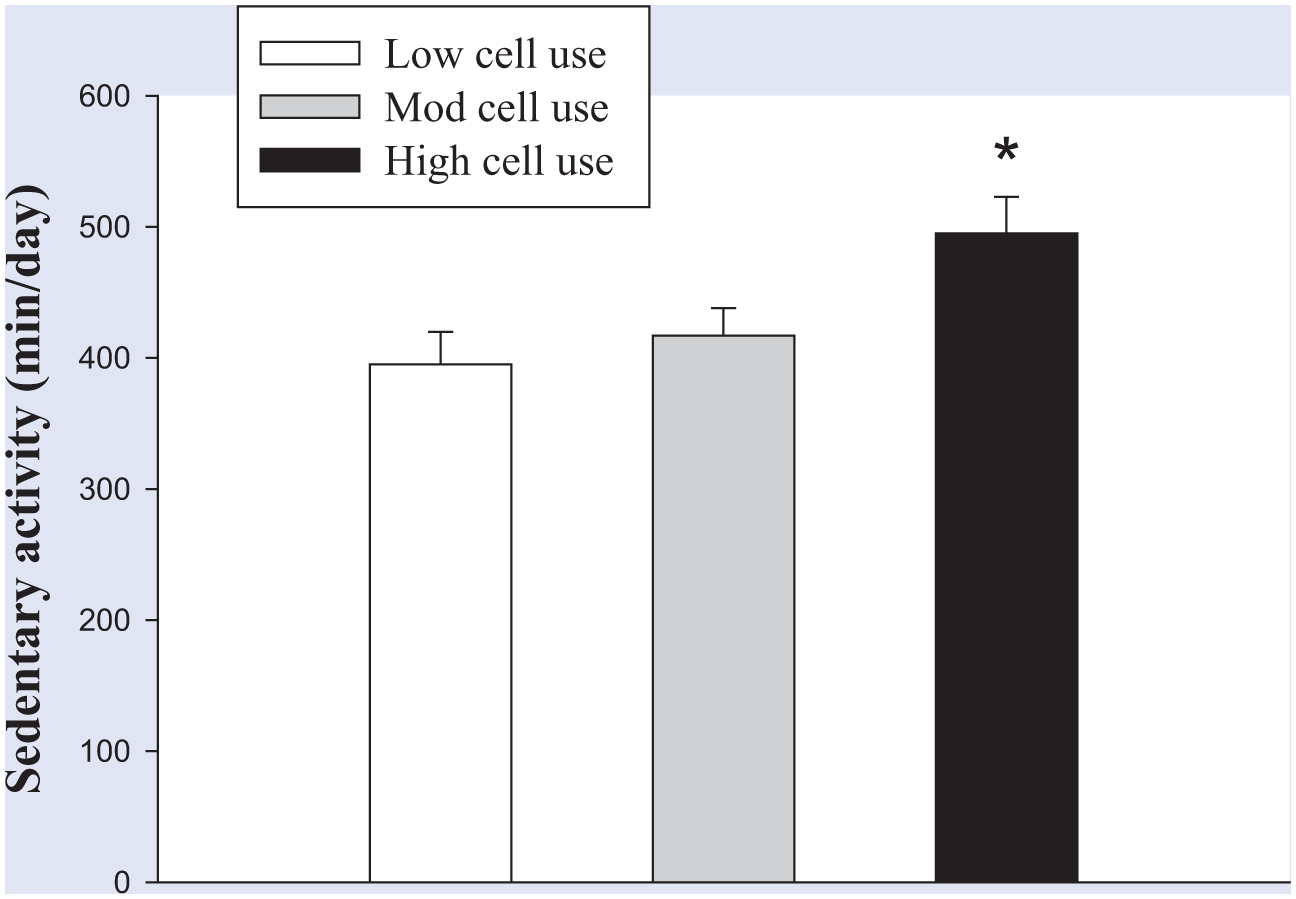
The significant main effect of cell phone use group (high, moderate, low) on sedentary (ie, sitting) activity per day. *Indicates significantly greater than moderate and low cell phone use groups.
Discussion
High cell phone users allocated 78.0 and 99.9 min/d more time to sitting versus the moderate and low cell phone users, respectively. Conversely, cell phone use was not significantly related to physical activity participation nor did physical activity moderate the relationship between sedentary behavior and cell phone use in the regression analysis. This was surprising as previous studies suggest the use of traditional electronic media (eg, watching television) is both positively associated with sedentary behavior and inversely related to physical activity.5,6
The designation “active couch potato” has been coined to refer to individuals that participate in adequate amounts of planned exercise yet still allocate large amounts of time to sedentary behavior. 27 In the present study, high cell use was associated with greater amounts of sedentary behavior yet physical activity participation was not significantly associated with cell phone use. Therefore, even if someone values and participates in adequate planned exercise, heavy use of a cell phone may be predictive of large amounts of sedentary behavior potentially qualifying this person as an “active couch potato.” While participating in physical activity for highly sedentary individuals is undoubtedly preferable to being highly-sedentary and not participating in physical activity at all, excessive sedentary behavior is still of concern. “Active couch potatoes” are of interest as emerging evidence indicates that sedentary behavior has deleterious health effects (eg, greater waist circumference, blood glucose, triglycerides, systolic blood pressure, and mortality from cardiovascular disease) even for individuals who participate in regular exercise.13-16 Because participation in sedentary behavior, independent of physical activity, may have deleterious effects on cardiometabolic health the present findings that cell phone use is predictive of sedentary behavior may partially explain the inverse relationship between cell phone use and cardiorespiratory fitness that has previously been reported. 3 However, in that previous study interviews with high cell phone users also indicated a lower amount of physical activity participation than the low cell phone users. Because of these somewhat inconsistent findings and differing methodological approaches, additional research simultaneously examining the relationships between cell phone use, physical activity, sedentary behavior, and measures of cardiometaboic health, including fitness, is recommended.
While this was the first study we are aware of to use validated surveys assessing the relationship between cell phone use and sedentary behavior and physical activity there are limitations. First, this was a nonexperimental study and did not allow for causal inference. It is possible that greater cell phone use may encourage or cause greater sedentary behavior. Conversely, it is also possible that individuals who are highly sedentary elect to use a cell phone frequently but that cell phone is not causing sedentary behavior. If the cell phone was not present, these highly sedentary individuals may simply select an alternative behavior to participate in while sitting (eg, watching television, playing a video game, talking on a telephone, etc). A second limitation was that the present survey methods were self-reports and these scales did not yield information about the context in which these behaviors occurred (eg, what were these individuals doing while they were sitting? Were they using their cell phones or perhaps something else?). Experimental research designs utilizing objective measures of cell phone use, physical activity, and sedentary behavior and questions assessing the context in which these activities occur would address these 2 limitations and are recommended for future studies. A third limitation was the rapidly evolving technology of cell phones and other, similar portable electronic devices. There are numerous new “apps,” and hardware (eg, smart watches, tablet computers) emerging that have features designed to promote physical activity and discourage sedentary behavior. Because this software and hardware is so new it is not well studied. Therefore, the relationship between cell phone (and similar technology) use and physical and sedentary behavior may change with the technology. A final limitation is the fact that the participants in the present study were all undergraduate students between the ages of 18 and 29 years at a single, large, public university in the Midwestern United States. Nonstudents, individuals of different ages, and other college students in different regions or at different types of universities may have differing results than what we are reporting. Future studies should take this into consideration.
To conclude, in this sample of college students the most frequent cell phone users were also the most sedentary. There was no relationship between cell phone use and physical activity. This is not to say that cell phones have no place in the area of physical activity promotion. There is emerging evidence that has illustrated the efficacy of mHealth and other cell phone disseminated health initiatives.17,28 However, while future research is needed in the area of cell phone use and health behavior, we believe the present results, taken together with the results of an earlier study linking increased cell phone use with decreased cardiorespiratory fitness, 5 suggest that the modern cell phone may encourage sedentary behavior among today’s college students.
Footnotes
Acknowledgements
This was an unfunded study. The authors would like to acknowledge Jian Li, PhD for her feedback regarding the analysis of the present data. Portions of these findings were presented at the Annual General Meeting of the Canadian Society of Exercise Physiology in 2013.