Abstract
Schools in the United States serve more than 12 million breakfasts and 32 million lunches every school day, as well as multiple snacks and supper meals in some cases. These meals are funded by federal legislation and regulated by nutrition standards that follow the Dietary Guidelines for Americans. School nutrition professionals face many challenges when improving campus food environments and are using multiple, innovative strategies to serve healthier meals to students.
Keywords
. . . schools are required to have policies to promote healthy lifestyles and create healthy campus environments.
For several decades, school nutrition programs served millions of children daily meals in relative obscurity. Now, school breakfast and lunch are frequently in the political, legislative, and news spotlight, and featured in media headlines, Congressional debates, and YouTube viral videos. School nutrition professionals, once derided as “lunch ladies in hairnets,” have become leaders in discussions about the rise of childhood obesity, the decline of youthful eating habits, and the appropriate role of schools in raising a healthier generation of American children.
The United States has a long history of school feeding programs. 1 Recognizing that schools are an efficient way to reach the majority of children, local agencies and the federal government both developed programs to provide healthy meals to hungry students. While the most familiar current programs are funded and regulated by the US Department of Agriculture (USDA), school feeding programs have been around since the mid-1800s. The goal of these programs has always been to improve the health, nutrition, and well-being of young people. As health concerns and nutritional problems have changed over the years, the rules and regulations guiding school nutrition programs have necessarily evolved to meet current needs.
Over the past 2 decades, there has been a movement to make school nutrition part of more comprehensive approaches to school health. The Coordinated School Health model, promoted and in some states funded by the Centers for Disease Control and Prevention, 2 represents an overall strategy for improving student health and learning in the nation’s schools.
Although not all districts use the full Coordinated School Health model, since 2004 those participating in USDA child nutrition programs have been required to have a written wellness policy. According to the requirements for a Local Wellness Policy, 3 districts must set goals for nutrition education, physical activity, and other school-based activities designed to promote student wellness. In other words, schools are required to have policies to promote healthy lifestyles and create healthy campus environments.
This review will describe the current USDA school nutrition programs and the guidelines that govern their implementation in more than 100 000 public and private US schools. It will also discuss what is known about the health impact of both school meal programs and nutrition policies, as well as the academic impact of school breakfast. Finally, it will highlight the innovative strategies and programs that schools and communities are using to enhance the health of the nation’s youth.
National School Nutrition Programs
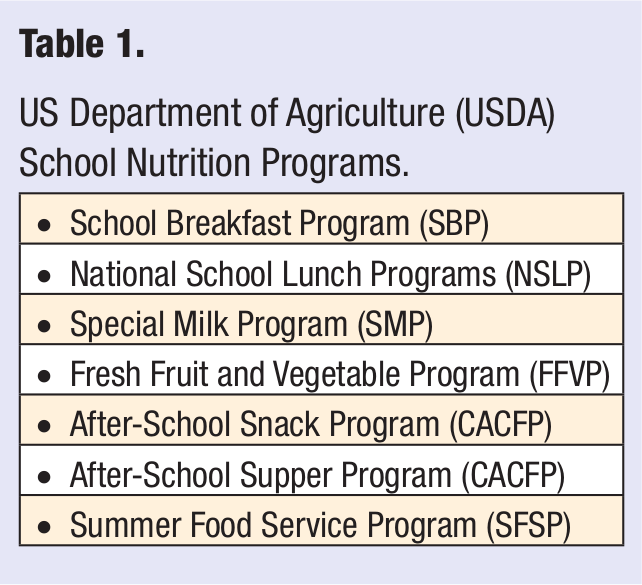
The number of nutrition programs available to schools—to say nothing of their acronyms, rules, and requirements—can be confusing even to those who work in schools every day. Table 1 lists the 7 major programs—available in all 50 states—for which schools can receive USDA funding for feeding students. This brief overview of USDA school meal programs is organized by the school day, using USDA participation data from December 2011. Current participation numbers, and detailed descriptions of each program’s regulations, are regularly updated on USDA’s Food and Nutrition Service Web site. 4
US Department of Agriculture (USDA) School Nutrition Programs.
The School Breakfast Program began as pilot in 1966 and was made permanent in 1975. During 2011, more than 12 million students ate breakfast every day with more than 10 million (83%) qualifying for free or reduced-price meals. Although participation has gradually increased over the past 10 years, there is a significant gap between the number of free/reduced eligible children who eat lunch and those who participate in breakfast programs. This gap has several important consequences, including the fact that many students come to school hungry in the morning, with decreased ability to concentrate and learn in the classroom.
The flagship USDA school nutrition program is the National School Lunch Program (NSLP), signed into law by President Harry Truman as the National School Lunch Act in 1946. This act was seen as a national security measure, since it was discovered that many young men could not serve in World War II because they were underweight. NSLP now serves nearly 32 million students per day, adding up to more than 5.25 billion meals per year. NSLP serves children in nearly every public and charter school in America, as well as in many private and parochial schools. This means that schools districts, in terms of meals served, are often the largest “restaurant chains” in cities and towns across America. About two thirds of school lunches are served to children who are eligible for free or reduced-price meals. Although overall participation has been steady since 2008, there has been a substantial increase in the number of free lunches served since 2006. This is not surprising considering the economic downturn for many families across the United States.
The Special Milk Program was started by the 1966 Child Nutrition Act, the same legislation that established School Breakfast Program Pilot. Participation is limited to institutions or students that do not have access to other meals, such as half-day kindergarten students. In 2011, more than 3800 schools and child care institutions participated and more than 66 million half pints of milk were served to children.
USDA’s After-School Snack Program represents an additional opportunity for some school districts to feed students. It provides reimbursement for a snack in programs meeting specific eligibility requirements. To serve snacks, a school must provide children with regularly scheduled activities in an organized, structured, and supervised environment, which includes educational or enrichment activities (eg, mentoring or tutoring programs). Competitive interscholastic sports teams are not eligible for this after-school feeding program.
All the USDA programs described thus far are available to any school district, public or private, in the 50 states and all US territories. The next 3 programs are available only to schools where a specific percentage of families—generally more than 50 percent—qualify for free or reduced-priced meals. After a recent pilot, the Child and Adult Care Food Program’s Supper Program has been expanded to low-income schools in all states, meaning schools can serve an evening meal to low-income children. The Summer Feeding Program, which may include breakfast and/or lunch meals, can be offered by schools or other sponsors who serve meals in schools and parks, as well as a variety of other locations.
The Fresh Fruit and Vegetable Program is a competitive program available to a limited number of schools. The Fresh Fruit and Vegetable Program allows school nutrition programs to serve fresh fruit and vegetable snacks in the classroom. It is an effective way to introduce new produce items to students so that they become more receptive to them in the cafeteria, while providing nutrition education at the same time.
Even though they may have slightly different nutrition standards and guidelines, the overarching goals of all USDA feeding programs are the same:
To provide meals to the nearly 17 million young children who live in food insecure households 5
To fill gaps in the nutrients of concern—calcium, vitamin D, potassium, and dietary fiber—as identified by the 2010 Dietary Guidelines for Americans 6
To promote healthy weights by reducing the prevalence of childhood overweight and obesity
To support classroom performance and academic achievement by insuring that children are well-nourished and ready to learn
USDA provides virtually all funding for schools meals. The per meal reimbursement rate depends on 3 factors: Family income level (paid, reduced price, and free), community need level (nonsevere or severe), and geography (48 contiguous states, Alaska, or Hawaii). In some states or districts, additional funds are provided to cover the gap between reduced and free meals, especially breakfast, to provide universal free breakfast, or to purchase local foods from agricultural producers.
Federal reimbursement rates must, in most districts, cover all costs associated with school meals. As an example, in the 48 contiguous states, they vary from $0.27 per paid lunch in a high-income district to $3.09 for a free lunch in a high-risk district. In addition to direct food costs, federal funds must also cover labor costs and often a proportion of indirect costs, such as utilities and garbage disposal as well. Although costs vary widely by location, it is estimated that after labor and other costs, schools have only $1.00 to $1.50 for the food to make a school lunch and less than $1.00 to spend on food in a school breakfast. Rates are updated each school year based on inflation and can be found on the USDA Food and Nutrition Service Web site. 7
Guidelines and Regulations for USDA School Nutrition Programs
Nutrition programs in schools are managed by local districts with oversight and technical assistance from state departments of education or agriculture (depending on the state). Districts and states must following all USDA guidelines to receive federal funding. The process used to develop federal guidelines includes scientific, legislative, and regulatory steps, as outlined in this section.
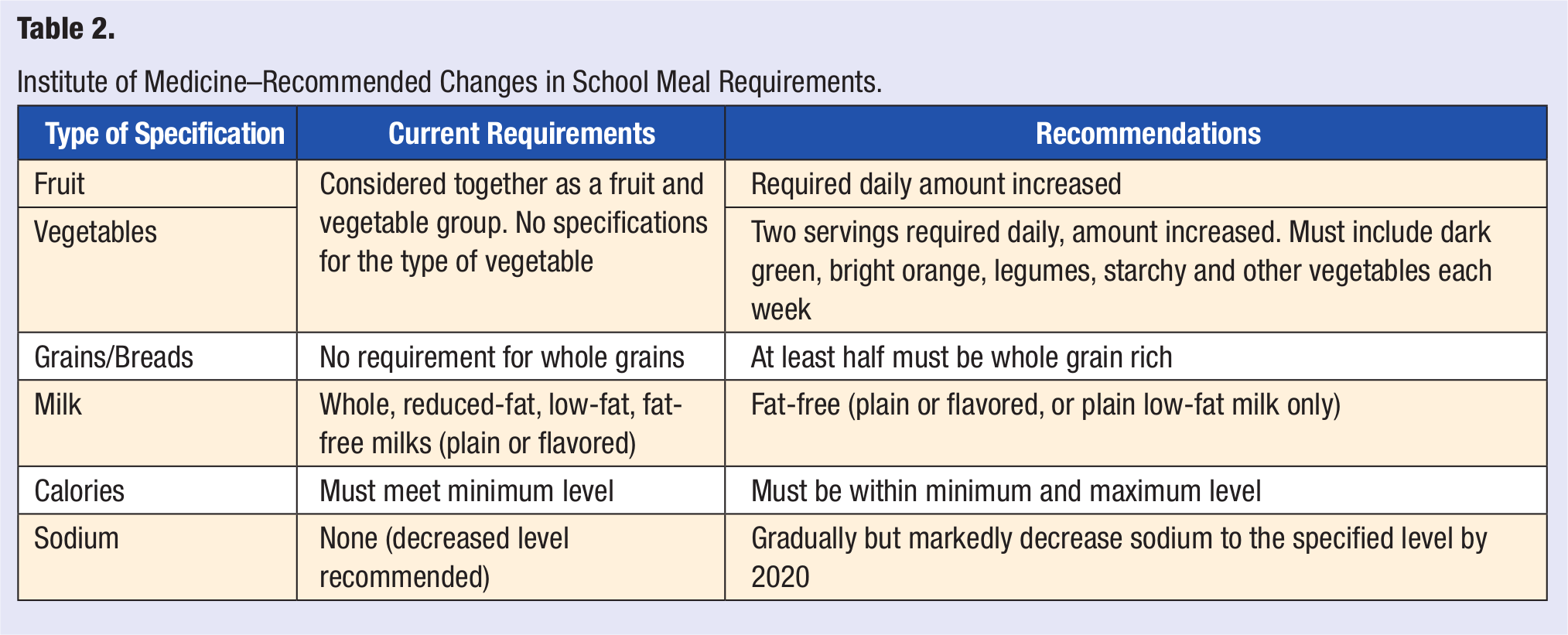
The scientific foundation for the current National School Lunch and Breakfast Program meal patterns is outlined in a 2009 report from the Institute of Medicine (IOM): “School Meals, Building Blocks for Healthy Eating.” 8 The report, summarized in Table 2, recommended multiple changes to align school meal patterns with the Dietary Guidelines for Americans and to address childhood health concerns, including obesity and risks for chronic diseases such as hypertension.
Institute of Medicine–Recommended Changes in School Meal Requirements.
The legislation for funding and regulating current school meals is the 2010 Healthy, Hunger-Free Kids Act (HHFKA). On December 13, 2010, President Obama signed the HHFKA, which includes the reauthorization of the Child Nutrition Act and funding for other public nutrition assistance programs, into law. This legislation was designed to help end childhood hunger, provide access to healthy food, improve child health, and reduce childhood obesity. The 2010 law included $4.5 billion in funding over a 10-year period and also gave USDA the authority to establish new nutrition standards for school meals. 9 HHFKA funding included an additional 6 cents reimbursement per lunch for schools that comply with the new meal pattern, as well as monies for implementation of School Wellness Policies, Farm to School programs, and professional standards for school nutrition directors.
With HHFKA funding and recommendations from the IOM report, USDA published proposed nutrition standards for school breakfast and lunch on January 13, 2011. After considering more than 300,000 public comments, the final Nutrition Standards in the National School Lunch and School Breakfast Programs were released on January 26, 2012. 10 These new USDA school meal pattern regulations follow the IOM recommendations closely and include the following changes 11 :
Specific requirements for 3 grade groupings (K-5, 6-8, and 9-12)
New calorie minimums and maximums for breakfast and lunch
New minimums and maximums on grains and meat/meat alternates
All grain foods must be whole grain-rich by July 1, 2014
New limitations on grain-based desserts
Five new vegetable subgroups with specific serving sizes by grade group 12
New fruit requirements for breakfast and lunch
Milk served must be 1% or fat-free plain or fat-free flavored
New limits on sodium, with a 10-year implementation timeline for compliance
As school nutrition programs transitioned to the new USDA guidelines, operational challenges become apparent. In particular, the rules on the weekly maximums on grains and meat/meat alternates resulted in meals with noticeably smaller portions. Students and school nutrition directors raised their concerns, and USDA responded. In December 2012, the USDA announced temporary flexibility by eliminating the maximum limits on grains and meat/meat alternates for the remainder of the school year (SY) 2012-2013, while maintaining the new calorie ranges. Flexibility on grain and meat/meat alternates was extended through SY 2013-2014 in February 2013.
The HHFKA also gave USDA the authority to establish additional nutrition standards for vending machines and other foods sold during the school day. On February 1, 2013, USDA announced Smart Snacks in Schools, the proposed rule for healthy foods outside of school meal programs. Like the new breakfast and lunch patterns, this rule is aligned with IOM recommendations and existing nutrition standards voluntarily set by many districts and enacted into some state laws. After a public comment period, USDA will publish a final rule, likely sometime during 2014, with an implementation timeline yet to be determined.
It is too soon to evaluate the effect of the new Nutrition Standards in the National School Lunch and School Breakfast Programs and the Smart Snacks in Schools final rule is still months away. There is evidence, however, to suggest that both may be effective in improving the nutrition environment of schools and the health of students. Mathematica Policy Research, Inc evaluated school breakfast (SBP) and lunch (NSLP) in the School Nutrition Dietary Assessment Study–III (SNDA-III). 13 In terms of school meals, major findings indicated that schools were making changes to meet USDA guidelines in force at that time. Examples of SNDA-III findings include:
In SY 2004-2005, NSLP lunches offered and served by most schools met USDA goals for target nutrients over a typical week and were lower in saturated fat than meals offered and served in SY 1998-1999. In SY 2004-2005, most schools offered and served SBP breakfasts that met USDA standards.
NSLP participants consumed more nutrients at lunch than nonparticipants and were more likely to have adequate usual daily intakes of key nutrients.
Compared with lunches of nonparticipants, the average lunches consumed by NSLP participants at all school levels provided significantly greater amounts of protein, vitamin A, vitamin B12, riboflavin, calcium, phosphorus, and potassium. This pattern of differences is, in large part, attributable to the fact that NSLP participants were 4 times as likely as nonparticipants to consumer milk at lunch.
SNDA-III also examined the availability and consumption of competitive foods—those food outside meal programs, include a la carte, vending machines, and fundraisers—in surveyed schools. The findings included
Foods sold in competition with USDA school meals were widely available on campus, particularly in secondary schools.
Roughly one third of elementary schools and close to two thirds of middle and high schools had foods or beverages other than milk for sale a la carte during lunch.
Fundraisers that were focused on food or beverage sales occurred in 37% of elementary schools and 50% to 60% of middle and high schools.
Vending machines were available in 17% of elementary schools, 82% of middle schools, and 97% of high schools.
Competitive foods were consumed by fewer NSLP participants than nonparticipants. The most popular choices for both groups were energy dense and relatively low in nutrients.
NSLP participants were less likely than nonparticipants to consume competitive foods in school (19% vs 37% of nonparticipants).
With regard to competitive foods, since the requirement for Local Wellness Policies was mandated in 2004, several small-scale studies have examined the potential for improvements in school environments and student health. One study looked at changes in school wellness policies and practices in Washington State after an unfunded mandate for physical activity and nutrition. 14 Results showed a modest effect on nutrition policies, such as restricting access to competitive foods and increasing physical activity in schools.
An analysis of the Utah Population Database evaluated the effects of school wellness policies on the prevalence of adolescent overweight and obesity. 15 The results suggested that wellness policies can significantly reduce the risk of adolescent obesity, noting that further research was needed to specify the most effective policy components. The authors also noted the critical importance of the commitment that is required at both the school and district-levels for sustained effect. This concern was also highlighted in a 2011 Alabama survey. 16 Although a majority of Alabama districts created appropriate policies, this did not guarantee the effective implementation of policies at the school building level.
A randomized group trial called Healthy ONES (Healthy Options for Nutrition Environments in Schools) published in 2012 studied a rapid improvement model to implement school nutrition policy and environmental change in one low-income district. 17 After 3 years, outside food and beverage items, especially unhealthful items, decreased in the intervention schools while increasing in the control schools. However, changes in rates of obesity were similar for children in both the control and intervention schools.
The impact of school breakfast programs has also been studied in terms of academic performance. Recent reviews of school breakfast programs in the United States 18 confirm the benefits of breakfast for classroom performance, as well as attendance and behavior, particularly for low-income and food-insecure youth.
For at-risk children, breakfast at school can have a positive impact on health, grades, school attendance, and behavior issues. A Universal Breakfast Program in Boston showed multiple improvements 19 in a population that was low income and at high risk for food insecurity. This free-to-all school breakfast program:
Increased participation in breakfast at school
Improved overall nutrient intake
Improved math grades
Reduced school absences and lowered rates of tardiness
Decreased emotional/behavioral problems
Any effort to enhance the school nutrition environment, whether in school meals, competitive foods, or wellness policies, faces multiple challenges. There is the ever-present issue of limited local and state funding for schools, making any unfunded federal mandate, like local wellness policies or nutrition education, problematic. Competitive food sales often are fundraisers for popular programs, like athletics and music, so booster clubs and coaches are skeptical about rules to limit them.
Two position papers of the Academy of Nutrition and Dietetics, formerly the American Dietetic Association, outline both the existing challenges and potential solutions for healthy school nutrition environments. Local Support for Nutrition Integrity in Schools 20 outlines the components of nutrition integrity and discusses the local policies necessary to implement them effectively.
The 2010 Position on Comprehensive School Nutrition Services was a joint paper of the American Dietetic Association, School Nutrition Association, and Society for Nutrition Education. 21 It states that
comprehensive, integrated nutrition services in schools, kindergarten through grade 12, are an essential component of coordinated school health programs and will improve the nutritional status, health, and academic performance of our nation’s children. Local school wellness policies may strengthen comprehensive nutrition services by encouraging multidisciplinary wellness teams, composed of school and community members, to work together in identifying local school needs, developing feasible strategies to address priority areas, and integrating comprehensive nutrition services with a coordinated school health program.
Many school districts across the United States have made a commitment to nutrition integrity and found innovative ways to deliver comprehensive, high-quality nutrition services to students, families, and staff. The number of districts who have implemented this level of excellence in their school nutrition environment is reflected in the more than 5900 schools that have received HealthierUS School Challenge (HUSSC) certification as of April 2013. 22 Established in 2004 to recognize those schools that have created healthier school environments, HUSSC was incorporated into First Lady Michelle Obama Let’s Move! campaign to raise a healthier generation of kids in 2010. At that time, monetary incentive awards became available for each HUSSC award level: Bronze, Silver, Gold, and Gold Award of Distinction.
Innovation in School Nutrition
Feeding children can be tricky, especially in a school setting. Humans have taste preferences and a certain set of acceptable foods. This presents a challenge when feeding hundreds or thousands of kids every day. Add the complexity of the school meal requirements and limited budgets and school nutrition directors are faced with a huge challenge, one they tackle using a variety of innovative strategies.
Scratch Cooking
Getting back into the kitchen, local foods and scratch cooking have been strong consumer trends in recent years, and schools have followed suit. Preparing meals from scratch, or almost from scratch, allows for more control over the final nutrient profile of the dish, especially in calories, saturated fat and sodium. As districts move toward more scratch cooking, many directors have provided culinary training for their staff to prepare them for taking on new recipes. Many have also hired chefs to help with culinary training and menu implementation.
Michelle Obama’s Chefs Move to Schools volunteer program, established in 2010, popularized inviting chefs to work with school nutrition programs, in some cases as consultants or permanent employees. 23 One concern among school nutrition directors when offering healthier options is a decreased acceptability. Another real roadblock may be a lack of culinary skills to produce healthier meals from scratch. A chef can help develop recipes and menus, and train staff on techniques for preparing eye-appealing meals that follow the nutrition standards and are popular with kids.
A 2-year pilot study, the Chef Initiative, conducted in Boston, Massachusetts, middle schools looked at the impact a chef can have on student participation in school lunch. 24 The Chef Initiative menus had lower saturated fat, higher dietary fiber, and lower sodium compared with the control school menus. The study provided evidence that a chef-based model improved menu quality and palatability, led to increased participation, and had the potential to enhance health. These types of programs also build kitchen confidence and earn staff buy-in for changes in the menu and workday.
Today many schools serve meals with all the taste of home and the quality of a good restaurant. Examples abound from coast to coast, incorporating USDA foods (formerly commodities), farm-to-school ingredients, and produce from school gardens. On the school menu are dishes like roasted garlic mashed potatoes and chicken stir-fry with fresh cut vegetables in Ventura, California Unified School District, and regional specialties like vegetarian collard greens in Marietta, Georgia City Schools.
Marketing and Merchandising
Promotion of healthy foods helps to increase sales and consumption of those items in the school cafeteria. Marketing foods with well-known children’s characters has a profound influence on kids choosing the branded item, even when it is healthy. 25 Other influences in the cafeteria can also nudge student food selection toward healthier choices. Giving dishes a fun, kid-friendly name increases selection and consumption of the named item compared with the same item unnamed. 26 Names like X-ray Vision Carrots and Firehouse Chili add interest to school menus and can also increase consumption.27,28
Simple changes on cafeteria lines can also lead to healthier selections. 29 By presenting healthier options earlier and more conveniently, students tend to choose and eat those items. For example, salad bars are being placed at the beginning of the line in some schools, allowing students to take fruit and vegetable choices before making an entrée choice. Likewise, placing more nutrient-rich foods, such as cooked vegetables, at the beginning of the serving line increase the likelihood that the item is selected.
Students notice when changes are made to the menu, so it makes sense to involve them in the process. Most districts hold student taste tests and offer samples of new items. Cooking demonstrations are also an effective way to promote a new item, especially with samples. Marietta City Schools Nutrition Services participates in Chefs Move to Schools with cafeteria demos by a local celebrity chef, an activity that has been shown to engage students and encourage consumption of new foods. 30
Farm to School
Federal support for schools to participate in regional food systems began with the 2008 Farm Bill, which provided additional funding for purchasing fresh local produce, and authorized the first pilot school garden programs. 31 Two years later, the HHFKA funded technical assistance and grants for farm-to-school and school gardens. According to the National Farm to School Network, as of January 2013, all 50 states have operational farm to school programs, with 12 429 schools involved in such programs, nearly 5 750 000 students reached and $13 million spent on local foods. 32
In 2007, Portland, Oregon, Public Schools began their Harvest of the Month farm to school program, which has become a gold standard for many other districts across the country. Their success with local sourcing has evolved into a popular program called Local Flavors, in which 30% of food purchases come from local farms and food producers. 33 Each month a locally produced food is featured, promoted, and served to students. Saint Paul, Minnesota, Public Schools also offer their students a wide variety of fruit and vegetables from local farms. All school menus indicate items that are locally grown, promoting their program to students and parents. 34
School Gardens
It has been documented that interactive garden-based curricula can help to increase preference for and consumption of a variety of vegetables and fruits.35,36 School gardens provide an opportunity for cross-curricular education, including lessons in math, science, language arts, and environmental studies, as well as nutrition. 37 While school gardens are instructional, their harvest, even in small amounts, can be integrated into school meals. Fairfax County, Virginia, Public Schools have gardens at 35 of their 234 schools. 38 Some of the produce from school gardens in served as a snack or used on the menu in established recipes. Lettuce and spinach are mixed with salad greens or simply served fresh on the salad bar.
Nutrition Education
Most school programs across the nation provide some level of structured food, nutrition, and culinary education. Students learn about nutrition, such as MyPlate, while in the lunch line and cafeteria. In the best-case scenarios, nutrition education extends from the cafeteria to the classroom.
Saint Paul, Minnesota, Public Schools Nutrition Services provides a fruit or vegetable snack combined with nutrition facts to 28 schools through the USDA Fresh Fruit and Vegetable Program. 39 The goals are to create healthier school environments, expand students’ experiences with a wide variety of foods, increase fruit and vegetable consumption, and affect future food preferences and choices. Classroom teachers are provided with nutrition education activities each month that include lessons applicable to writing, math, geography, and science. In many districts, school nutrition staff provide classroom, after-school, and family nutrition education in addition to overseeing menu planning and operations. Vahista Ussery, chef and registered dietitian for Hurst-Euless-Bedford, Texas, Independent School District Nutrition Services, regularly teaches students about nutrition and healthy eating through classroom lessons, student cooking clubs, online videos, and social media. 40
Summary: Resources for Ongoing Improvement in School Meals
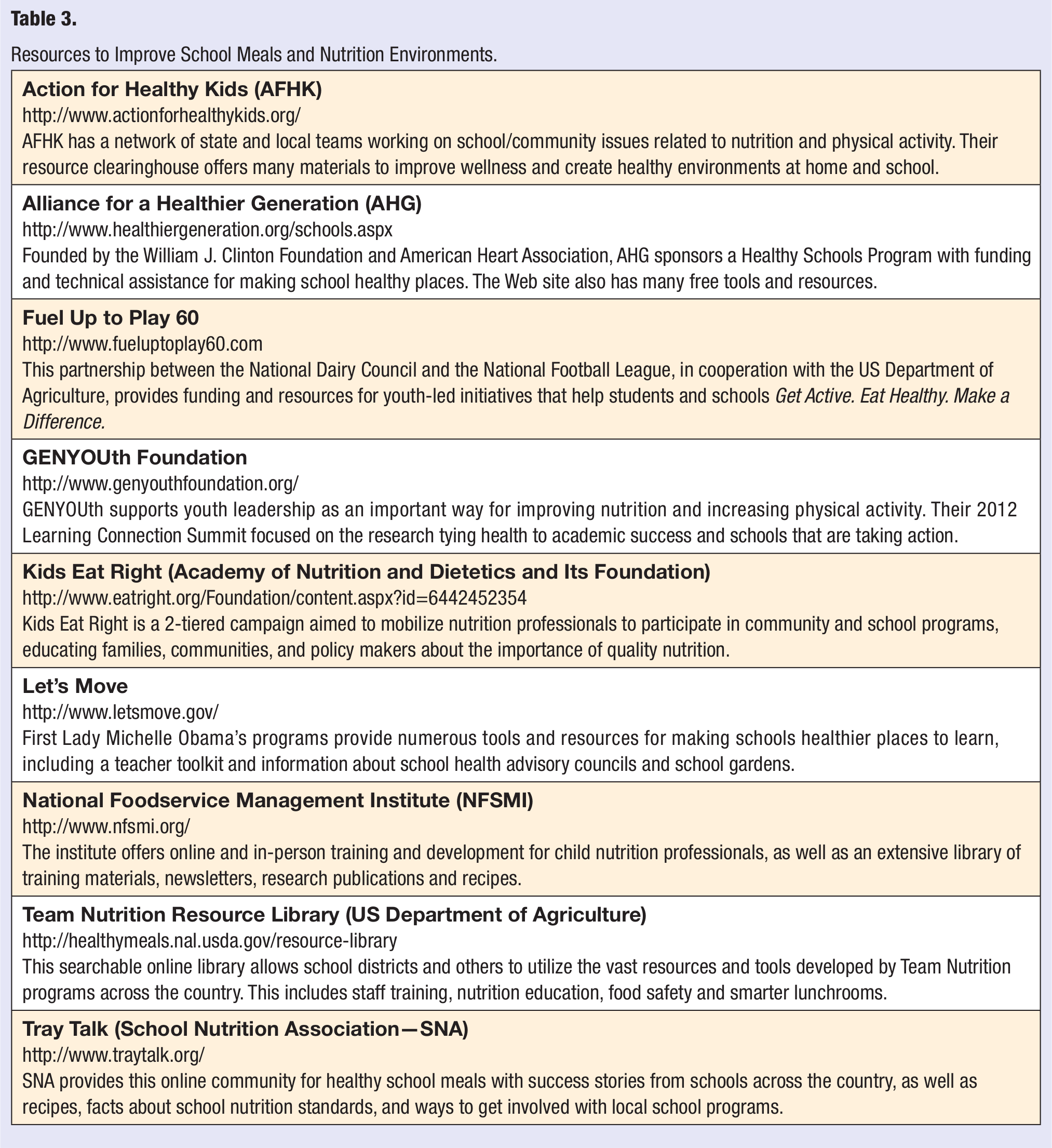
Schools serve billions of meals to students every year with funding challenges and complex regulations. School nutrition professionals are embracing innovative strategies to improve the quality and appeal of the meals they serve. Several national programs, including those in Table 3 offer funding, training, tools, and materials to help create and sustain healthy school nutrition environments. Health care providers can also help support quality nutrition programs in local school districts, by being a member of a school health advisory council, volunteering expertise in classroom activities, or raising funds for a school garden. The opportunities for positive, local involvement are virtually unlimited.
Resources to Improve School Meals and Nutrition Environments.