



Abstract
There is no minimum fiber requirement for on-pack whole-grain claims, yet consumers perceive products made with whole grains to provide at least a good source of fiber. To understand how this misperception may be fueling Americans’ fiber intake shortfall, this study investigated the impact on fiber intakes of ready-to-eat (RTE) cereal products with whole-grain claims. A 14-day eating frequency diary was collected from US free-living households over 3 years in the NPD Group’s National Eating Trends (NET) panel (n=10,708). Average daily fiber intake and sources were calculated from the types and frequency of food and beverages consumed at meals. T-tests were conducted on mean fiber intake at breakfast and daily to identify significant differences between all adults, adults consuming whole-grain RTE cereals with <3 g of fiber per serving, and adults consuming whole-grain RTE cereals with ≥3 g of fiber per serving. Adults eating whole-grain RTE cereals with ≥3 g of fiber per serving consumed 42% more fiber at breakfast and 14% more daily fiber than typical adults. Individuals choosing whole-grain RTE cereal with ≥3 g of fiber per serving consume significantly more fiber at breakfast and throughout the day relative to all adults and to adults eating whole-grain RTE cereals with <3 g of fiber per serving.
. . . average fiber intakes have remained essentially unchanged, with most Americans still needing to double their fiber consumption to meet the IOM daily fiber recommendation of 14 g of fiber per 1000 kcal.
Introduction
The importance of fiber to overall health is well documented, yet less than 3% of all Americans have a usual intake of dietary fiber that exceeds the recommended
Adequate Intake level of 21 to 38 g/d for most adults and 19 to 38 g/d for children 1 to 18 years old.1,2 Average consumption of fiber (ages 2 and over) ranges from 11 to 20 g/d, 3 with most Americans needing to double their intake of fiber to meet recommended amounts. This chronic shortfall in fiber intake levels has long-term implications for public health, related to the role of fiber in reducing the risk for coronary heart disease, stroke, hypertension, certain gastrointestinal disorders, obesity, and metabolic dysfunctions, including prediabetes and type 2 diabetes.4,5
Fiber is generally recognized as the carbohydrates and lignin that escape digestion in the upper gastrointestinal tract, undergo complete or partial fermentation in the colon, and exert varying beneficial physiologic effects depending on the type of fiber. 6 The Institute of Medicine (IOM) defines total fiber as the sum of the dietary fiber found naturally in foods and the functional (isolated or synthesized) fiber added to foods. 2 This classification of fiber based on the food source replaced the more traditional categorization based on fiber’s ability to dissolve in water (soluble or insoluble), which has limitations because of the many variations and overlap in functions and food sources. The recommended daily intake (AI level) established by the IOM is based on total daily fiber and does not differentiate between dietary and functional fiber. Nondigestible fibers, whether intrinsic or added, are associated with varying physiological health effects, which may include reduction in blood cholesterol level, reduction in postprandial blood glucose and/or insulin levels, increased stool bulk and/or decreased transit time, or fermentation by colonic microflora. 6 The effects vary depending on the source and specific type of fiber.
Fiber was first identified as a “nutrient of concern” for Americans in the 2005 Dietary Guidelines for Americans. 7 It was reaffirmed by the 2010 Dietary Guidelines Advisory Committee as an “under-consumed nutrient of public health concern.” 4 Advice to consume at least half of all grains as whole grains as a way to increase fiber intake is a key recommendation in both the 2005 and 2010 Dietary Guidelines for Americans.7,8 Awareness of whole grains appears to be on the rise, with several consumer surveys indicating that consumers are trying to consume more fiber and whole grains.9-11 However, less than 5% of Americans consume the minimum recommended amount of whole grains, which for many is at least 3 oz/d, 8 and average fiber intakes have remained essentially unchanged, with most Americans still needing to double their fiber consumption to meet the IOM daily fiber recommendation of 14 g of fiber per 1000 kcal.2,3 With energy balance as a critical consideration for today’s overweight population, increasing fiber intake while controlling calories poses a significant challenge.
Over the past decade, product launches of foods making whole-grain claims have increased sharply, from 164 in 2000 to 3272 in 2010, with breakfast cereals accounting for the second largest number in 2010. 12 In 2006, the Food and Drug Administration (FDA) issued draft guidance for industry on whole-grain labeling, allowing manufacturers to make factual statements about whole-grain content. 13 FDA has not approved content claims (eg, good or excellent source) for whole grains, in part because these could be considered implied claims about fiber content. Although there is no minimum fiber requirement for on-package whole-grain claims, consumer research suggests that there is an expectation that products with whole-grain label statements will provide at least a “good source” of fiber (≥3 g of fiber per labeled serving). 11 The FDA defines “good” or “excellent” source of fiber based on the percent contribution of fiber in relation to the Daily Value (DV) of 25 g of fiber per day, per the reference amount customarily consumed (RACC). 14 A “good” source of fiber must contain 10% to 19% of the DV for fiber or 2.5 to 4.9 g of fiber per RACC; rounding regulations for labeling will display the minimum amount of fiber for a “good” source in the nutrition facts panel as 3 g of fiber per labeled serving. 14 An “excellent” source must contain 20% or more of the DV, or 5 or more grams of fiber per RACC. 14
Whole grains, or foods made from whole-grain ingredients, should contain all the components of a grain, including the starchy endosperm, germ, and bran, in the same relative proportions as they exist in the intact grain. 15 Beyond fiber, whole grains provide other micronutrients and phytochemicals believed to provide protection against disease. Epidemiological evidence suggests an association between higher intakes of whole grain and reduced risk of heart disease and type 2 diabetes as well as lower body weight. 8 However, scientific evidence of the health benefits of whole grains continues to evolve, with recent reviews suggesting that many of the benefits of whole grains are likely to be related primarily to the fiber content.16,17 In reality, whole grains vary considerably in their fiber content (Table 1), and not all products labeled as whole grain qualify as a good source of fiber. The 2010 Dietary Guidelines for Americans acknowledges this fact in the recommendation to “use the Nutrition Facts label and the ingredient list to choose whole grains that are a good or excellent source of dietary fiber.” 8 Consistently low fiber intakes suggest that consumers are not doing this.
Fiber Content of a Variety of Grains Based on Edible Portion.
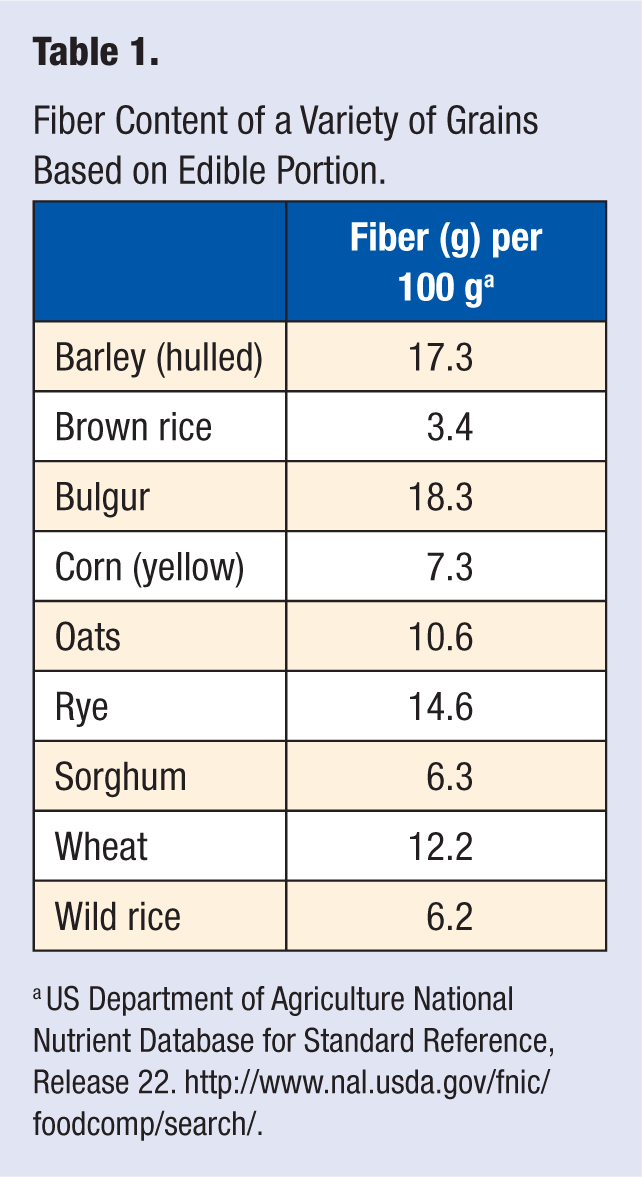
US Department of Agriculture National Nutrient Database for Standard Reference, Release 22. http://www.nal.usda.gov/fnic/foodcomp/search/.
The purpose of this study was to identify the top sources of fiber in the diets of Americans and measure the differences in daily fiber intake based on consumers’ choices of ready-to-eat (RTE) cereal that include any type of on-pack, whole-grain statement or health claim. RTE cereal was the focus of this research because more than 90% of households consume some form of RTE cereal. 18 In addition, the number of products with whole-grain ingredients and claims has increased dramatically over the past decade, with a general expectation that these products are providing ample amounts of fiber. Studying whole-grain cereal consumption will help determine whether consumers selecting whole-grain cereals with lower levels of fiber are at a meaningful disadvantage in breakfast, daily, and longer-term fiber intake relative to those individuals who are selecting whole-grain fiber cereals with at least a good source of fiber per serving. The results of this research can be used to assess whether whole-grain-containing foods, in general, with less than a good source of fiber (<3 g per serving) may be contributing to the substantial gap between recommended and actual fiber intakes, and provide support for a simple behavior change of using fiber as an indicator of whole-grain quality, with potential for important health benefits.
Methods
Sample
Data were collected from US free-living households in the NPD Group’s National Eating Trends (NET) panel. The NET panel captures all foods and beverages consumed by family members, at home and away, during a 14-day period. It comprises 2000 households (approximately 5000 individuals) per year, balanced to the US Census on key demographic variables. Three years (ending February 2008) of NET panel were included in this analysis, yielding a sample of 6,000 households and 10,708 adults. The study sample comprised 46% men and 54% women and 82% white/non-Hispanic, 9% black/non-Hispanic, 4% Hispanic, 3% Asian, and 2% other participants. We found that 47% of households had no children at home, whereas 53% had children <18 years of age. Also, 12% of homemakers were 65 years of age or older, 50% were 25 to 44 years of age, and 35% were 45 to 64 years old.
Measures
The NET panelist recorded food and beverage consumption of all household members for 14 days, capturing each meal occasion and snack, both at home and away from home. The food and beverage diary was completed and returned daily for each of the 14 consecutive reporting days. Every week throughout the year, approximately 60 households began a 2-week reporting period to ensure that all days were given equal weight and to provide seasonal balance.
For each person reporting within the NET households, each day was evaluated to ensure that the day represents complete reporting: either food was eaten at each of the 3 main meals or the diary indicates a main meal was skipped. In addition, daily diaries were checked to ensure that a person’s average daily caloric intake met a minimum threshold percentage of his or her caloric needs based on calculated basal metabolic rate. Daily intakes for the panelists included in the database were at least 70% or more of basal metabolic rate requirements from 3 valid meals, based on their age/sex/height/weight and total caloric intake for the day. If a day did not qualify on both counts, it was discarded from the database. This cutoff for reliable intake was chosen to eliminate daily reports from the analysis that may be incomplete or inaccurate. A minimum of 10 days of valid food dairies was required to be included in the analysis.
Design
An independent market research service (Mintel, Chicago, IL) that maintains a new product database was used to generate a list of cereals, including generic ones and products from national manufacturers, based on the presence of a whole-grain claim on the front of the package. These products were categorized by the level of fiber—either ≥3 g of fiber per serving (good/excellent source) or <3 g of fiber per serving (less than good source).
Based on this categorization, adults (18&0x002B; years) consuming cereals claimingwhole-grain content were identified within the NPD database and split into 2 exclusive groups: (1) adults eating only whole-grain cereals with <3 g of fiber per serving and (2) adults eating only whole-grain cereals with ≥3 g of fiber per serving. This segmentation was used to identify differences in total fiber intake between users of these 2 classes of whole-grain cereal.
Analysis
Consumption data were used to estimate fiber levels consumed (average intake per day and per meal occasion, in grams) and the top fiber sources in the diet. This was calculated from the Nutrient Intake Database, an analytical tool that combined the 14-day eating frequency from NET with the average portion sizes for 20 age/gender groups derived from an aggregate of 2003-2008 National Health and Nutrition Examination Study (NHANES) data and nutrient composition for more than 2400 foods and beverages from the USDA’s (US Department of Agriculture’s) Food and Nutrient Database for Dietary Studies. The nutrient values from the latter database used to calculate the nutrient amounts were based on USDA’s National Nutrient Database for Standard Reference (SR22). These databases are joined via a mapping and linking program developed by the NPD Group. The NET has more than 2400 foods and beverages that are common to all 3 databases.
To identify significant differences, t tests were conducted on mean fiber intake at breakfast and throughout the day. Tests of significance were completed for all adults, adults consuming whole-grain cereals with <3 g of fiber per serving, and adults consuming whole-grain cereals with ≥3 g of fiber per serving.
Results
The average fiber intake for adults in the study sample was 13.8 g in a typical day, which is slightly less than national intake data. 3 Examining the specific foods consumed, the data show that, on average, more than 25 different foods contribute to this level of fiber intake, indicating that many foods provide only fractions of a gram of fiber. By meal occasion, breakfast provided 21% of the average daily fiber, with 2.9 g of fiber at breakfast in a typical day. Lunch provided 30% of the average daily fiber and dinner, nearly 40%.
Vegetables, fruit, and sandwiches were the top 3 sources of fiber in the diet, followed by RTE cereal and potatoes (Table 2).These rankings are mostly consistent with national data showing that the primary foods contributing to fiber intakes include breads, mixed and pasta dishes, RTE cereals, beans, potatoes, and fruits. 19 When the cereal consumed was made with whole grain, it became the number one source of fiber in the diet. Compared with the average fiber from RTE cereal (1.01 g) in all adults, when the RTE cereal made with whole-grain ingredients provided ≥3 g of fiber per serving, fiber more than doubled, with a gain of 1.36 g, or a 144% increase in fiber from this change in RTE cereal selection. However, when a whole-grain-containing RTE cereal with <3 g of fiber per serving was consumed, intake increased by only half that amount or 0.65 g—that is, a 78% increase in fiber (Table 2).
Top Fiber Sources in the Diet for All Adults Compared With Adults Consuming Whole-Grain Cereal With Less Than or Minimum Good Source of Fiber, NPD Group National Eating Trends Panel. a
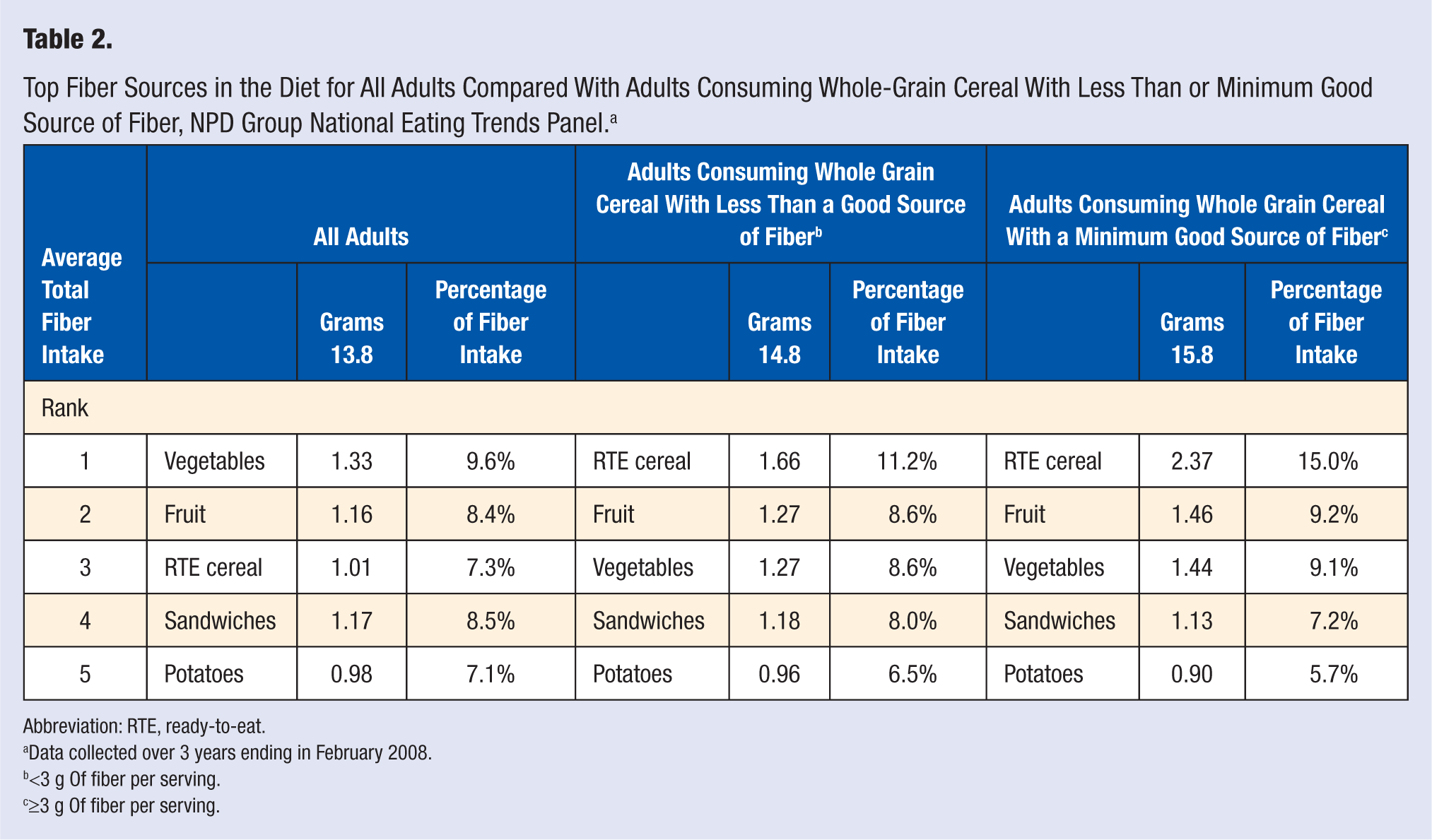
Abbreviation: RTE, ready-to-eat.
Data collected over 3 years ending in February 2008.
<3 g Of fiber per serving.
≥3 g Of fiber per serving.
Adults who ate whole-grain cereals with >3 g of fiber per serving consumed 42% (1.3 g) more fiber at breakfast (mean = 4.4 g, standard deviation [SD] = 2.4 g vs 3.1 and 2.3 g, respectively; P < .0001) and 14% (2.0 g) more daily fiber than all adults (mean = 15.8 g, SD = 5.3 g vs 13.8 and 5.2 g, respectively; P < .0001). When compared with cereals with <3 g of fiber per serving, consuming cereals with ≥3 g of fiber per serving resulted in 29% more fiber intake at breakfast (mean = 4.4 g, SD = 2.4 g vs 3.4 and 2.0 g, respectively; P < .0001) and 7% more daily fiber intake (mean = 15.8 g, SD = 5.3 g vs 14.8 and 5.0 g, respectively; P < .0001). See Table 3.
Mean and Incremental Fiber Intake Associated With Selection of Whole-Grain Cereal With a Minimum Good Source of Fiber, NPD Group National Eating Trends Panel. a
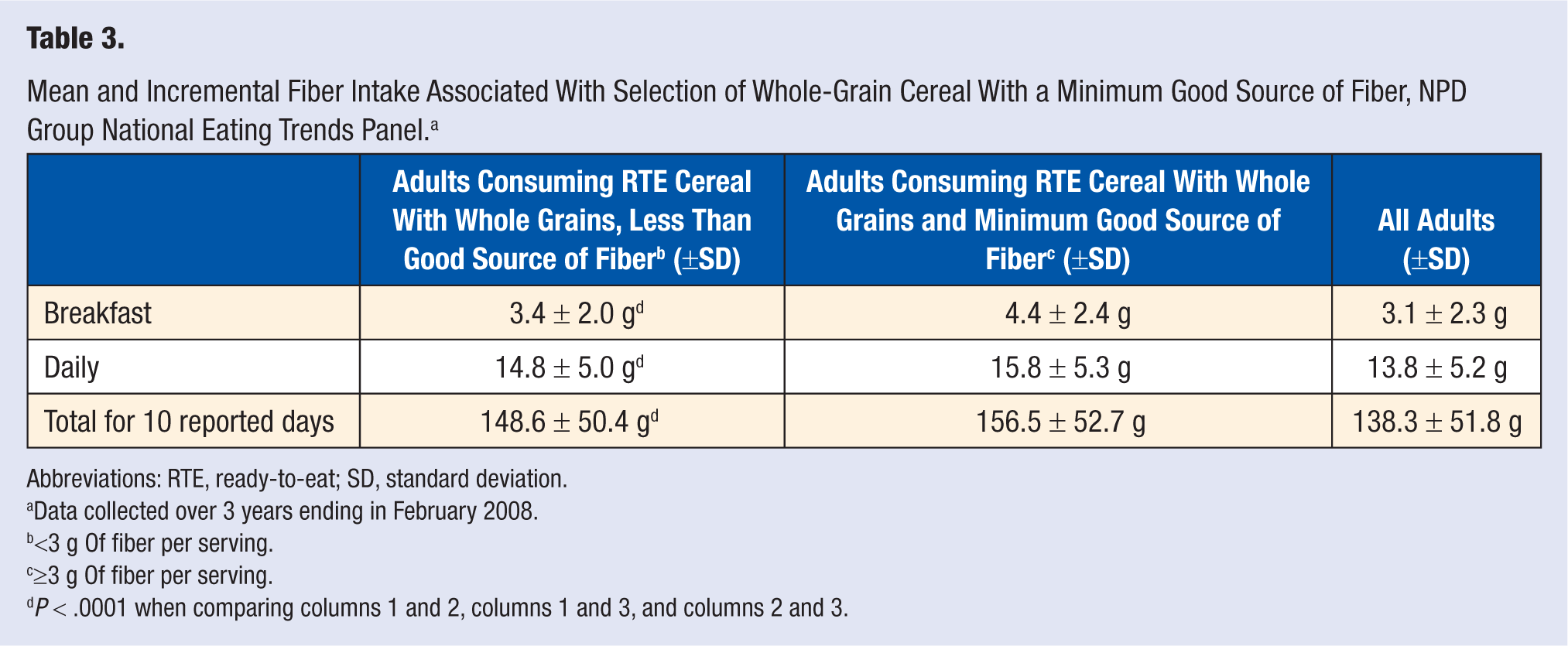
Abbreviations: RTE, ready-to-eat; SD, standard deviation.
Data collected over 3 years ending in February 2008.
<3 g Of fiber per serving.
≥3 g Of fiber per serving.
P < .0001 when comparing columns 1 and 2, columns 1 and 3, and columns 2 and 3.
Discussion
The results of this study indicate that fiber is obtained from a wide variety of foods and beverages in a typical dayfor most Americans. Not surprisingly, vegetables, fruits, and RTE cereals are among the top sources, but each category supplies only about 1 g of fiber per day, on average. This low level suggests that additional efforts are needed to help consumers select higher fiber options among these food categories, including other grain-based foods. Although consumers appear to recognize fiber’s health benefits and report actively trying to increase their fiber intakes,9,10 there is evidence of the mistaken belief that all whole-grain foods are at least a good fiber source (≥3 g per serving). 11 Thus, in an effort to increase fiber, consumers are choosing whole-grain products but may not be getting the fiber they expect. To illustrate the differences in fiber content of RTE cereals with whole-grain label statements, a cereal aisle audit revealed a significant variation in fiber content from 0 to 11 g per serving across RTE cereals with whole-grain messaging, and only half provided a good to excellent source of fiber. 11
Dietary guidance emphasizes eating more whole grains to help meet fiber recommendations, which, along with a lack of clear and consistent labeling of whole-grain-containing products, has likely contributed to the confusion between the food (whole grain) and the nutrient (fiber). Whole grain refers to a category of foods and ingredients that contain varying amounts of nutrients, including fiber, micronutrients, and phytochemical compounds, whereas fiber is a recognized nutrient with proven physiological benefits and established intake guidelines. Although scientists believe that the complex interactions of fiber, minerals, antioxidants, and bioactive compounds are responsible for the health-protective effects of whole grains,20,21 a review of the association of whole grains with reduction in risk for cardiovascular disease suggests that the fiber components of whole grains deliver the key health benefits. 16
As demonstrated by this observational study, simply consuming a RTE cereal made with whole grain can make a measurable difference in fiber intake—both at breakfast and throughout the day. However, looking beyond the whole-grain messaging to select a RTE cereal that delivers at least a good source of fiber (≥3 g of fiber per serving) results in a more meaningful increase in fiber intake, especially when this is measured over time. However, the lack of final guidance from the FDA on the use of whole-grain label statements presents a unique challenge for consumers who tend to equate whole-grain content with fiber when, in reality, products indicating “whole grain” may provide little or no fiber. 11 Selection of a whole-grain RTE cereal without checking the level of fiber potentially reduces the opportunity to take an even more significant step toward consuming greater amounts of daily fiber and thus may be contributing to the fiber deficit.
Although the differences in fiber provided by various whole-grain RTE cereal choices appear relatively small, it is worth noting that a few incremental grams of fiber per day add up to multiple “good-source” servings of fiber over the course of a week. Over the longer term, there is a significant difference in fiber intake when consumers eat whole-grain-containing RTE cereals with at least a good source of fiber, rather than whole-grain-containing RTE cereals with less fiber. A higher-fiber RTE cereal (≥3 g per serving) would provide a minimum of an extra 18 g of fiber consumed over a 10-day period or the equivalent of 6 good-source-of-fiber servings. This example of an incremental and simple lifestyle change may also lead to measurable benefits beyond whole grains and fiber because RTE cereal is a popular vehicle for delivery of fruit and dairy servings. A pooled analysis indicated that coronary heart disease risk was 10% to 30% lower for both men and women for each 10 g/d of increased total cereal or fruit fiber (equivalent to 1 bowl of high-fiber cereal, 1 large banana, and 1 large slice of multi-grain bread). 22
Conclusions
Effective strategies to increase fiber intake from nutrient-dense foods without significantly adding more calories to the daily diet are highly desirable. Breakfast of RTE cereal with milk is popular, convenient, and affordable at less than 50 cents per serving, 23 and the results of this study indicate that RTE cereal is already a top contributor of fiber to the American diet. These results not only highlight the benefit of incorporating any whole-grain RTE cereal into the diet but also, importantly, show the incremental value of selecting a whole-grain RTE cereal that provides at least a good (2.5-4.9 g per serving) or excellent (≥5 g per serving) source of fiber.
Selection of a whole-grain RTE cereal that offers a good source of fiber meets 2 of the recommended lifestyle changes of the Dietary Guidelines for Americans—to consume at least half of all grains as whole grains and to choose foods that provide more fiber. 8 It is also important to note that there is a category of RTE cereal products that may not contain whole grains, such as products with added fiber (eg, bran), but provide at least a good or excellent source of fiber. The addition of fiber to enriched, grain-based foods, such as RTE cereals, breads, and pasta, offers even more options for closing the fiber gap. 21
Because the average American consumes only half the fiber recommended for optimal health benefits, every additional gram counts toward the goal of doubling fiber intake. If RTE cereal consumers were more aware of the actual level of fiber delivered in their cereal choices and routinely chose RTE cereal with higher fiber content, this could translate into a significant increase in fiber intake without increasing calories. Simple lifestyle-change approaches like this are critical to reducing the magnitude of America’s fiber deficit.
Future guidance in whole-grain labeling and product development can support public health benefits associated with fiber by aligning the presence of whole grains and the marketing of products made with whole grains with a minimum good source of fiber. 21 The combination of a minimum level of 3 g of fiber per serving with the presence of whole grains will more effectively deliver against consumer expectations of a meaningful amount of fiber in products made with whole grains.
Footnotes
Acknowledgements
This research was supported by the Kellogg Company.