




Abstract
Diet is a contributing factor in the risk, development, and progression of cardiovascular disease. Emphasizing whole grain intake in a heart healthy diet is sometimes overlooked. Whole grains confer cardioprotective benefits and those whole grains higher in soluble, or viscous, fiber aid in the reduction of serum total cholesterol and low-density lipoprotein cholesterol concentrations. Whole grains contain all 3 parts of the grain kernel, and the unique combination of nutrients and phytochemicals inherent in all 3 parts of the kernel account for the many health benefits of whole grains. Health care providers have the opportunity to influence whole grain intake. By highlighting the health benefits associated with whole grain consumption and offering practical tips to help identify and add more whole grains to the diet, patients will be better equipped and more apt to increase their whole grain intake.
Eating whole grains is one dietary measure that can affect serum cholesterol concentrations. Promoting whole grains, as opposed to specific nutrients, supports the food-based approach to eating emphasized in the current Dietary Guidelines for Americans 2010 and US Department of Agriculture’s MyPlate.1,2 An estimated 31.9 million adults in America, or approximately 1 in 7, have high (≥240 mg/dL) total cholesterol levels, based on 2007-2010 National Health and Nutrition Examination Survey data. 3 Elevated cholesterol concentrations, particularly low-density lipoprotein cholesterol (LDL-c), accelerate atherosclerosis and increase the risk of cardiovascular disease (CVD). This article will provide an overview of whole grains, explore their cholesterol-lowering abilities and offer practical suggestions to improve intake.
‘Eating whole grains is one dietary measure that can affect serum cholesterol concentrations.’
An Overview of Whole Grains
A grain is the seed, or kernel, of a cereal grass, such as wheat, oats, corn, rice, or barley. The grain kernel has 3 distinct parts: the bran, germ, and endosperm. The hard outer covering that encases and protects the kernel is the bran. It is a rich source of fiber, minerals, B vitamins, small amounts of vitamin E, and phytochemicals. The endosperm is the large inner portion of the kernel that provides food for the germ and energy for the plant. It is comprised primarily of starchy digestible carbohydrates, protein, and the B vitamins, riboflavin and pantothenic acid. The germ, or embryo, is the smallest fraction of the kernel that eventually grows into a new plant. It contains B vitamins, vitamin E, minerals, phytochemicals, some protein and fat.4,5
A whole grain contains all 3 parts of the grain kernel (Figure 1). Based on the definition issued by the American Association of Cereal Chemists International, and adopted by the US Food and Drug Administration (FDA) in 2006, a whole grain must retain these 3 parts (the bran, germ, and endosperm) in the same relative proportions as that of the original intact grain kernel, even if it is physically altered in some way such as crushed or flaked.6,7
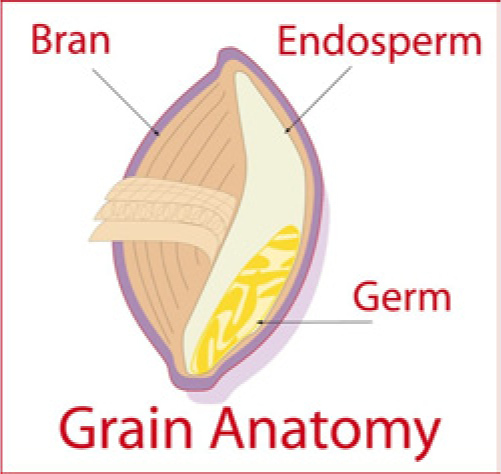
A whole grain.
In contrast, a refined grain is milled. Milling partially or completely removes the bran and/or germ leaving just the endosperm. While this process gives grains a longer shelf life and a finer texture, it reduces a grain’s nutrient density. Refined flour, compared with whole wheat flour, is lower in protein, phytochemicals, many vitamins and minerals, and approximately 80% lower in fiber. Most refined grains are enriched, whereby some of the nutrients lost during the refinement process are replaced. Some grain foods are also fortified, in which nutrients never present in the original food are added.8,9 Enrichment and fortification improve, but do not match, the nutrient density of a whole grain. For example, thiamin, riboflavin, niacin, folic acid, and iron are added to enrich refined flour per FDA requirements, yet other minerals and vitamins present in whole wheat flour are not added. 10 Refined flour contains only 7% of the vitamin E, 13% of the vitamin B6, and 16% of the magnesium of whole wheat flour. 8
Evidence is mounting that many of the health-protection and disease-prevention benefits associated with whole grain intake, including that of CVD, may be attributed to the phytochemical content of whole grains. The majority of these phytochemicals are found in the bran and the germ, not the endosperm. Phytochemicals such as phenolic acids, lignans, phytic acid, and carotenoids exhibit antioxidative effects; they can minimize or prevent oxidative damage from free radicals and may decrease the risk of CVD.5,11 Other phytochemicals such as plant sterols and stanols, fiber, resistant starch, and oligosaccharides can help lower serum cholesterol concentrations.4,5,12 In summary, the nutrient and phytochemical density of whole grains is significantly greater than that of refined grains.
Cholesterol-Lowering Abilities of Whole Grains
Whole grain consumption is repeatedly linked to the risk reduction of CVD. Results from large epidemiological studies such as the Atherosclerosis Risk in Communities Studies, Women’s Health Study, Health Professionals Follow-Up Study, and the Iowa Women’s Health Study, reveal whole grain intake is significantly associated with a 7% to 30% reduction in CVD risk over 9 to 13 years of follow-up.13-17 A recent 2012 systematic review of 10 longitudinal studies concluded that a daily whole grain intake of 48 to 80 g, or 3 to 5 servings, was associated with a 21% lower CVD risk compared with those who rarely or never consumed whole grains. 18
Whole grain intake is specifically shown to lower serum total cholesterol (TC) and LDL-c concentrations. A 2012 meta-analysis of 21 randomized controlled trials estimated that increased whole grain intake for 4 to 16 weeks significantly reduced serum TC and LDL-c. 18 In the 2013 American Heart Association/American College of Cardiology Guideline of Lifestyle Management to Reduce Cardiovascular Risk, consumption of a dietary pattern inclusive of whole grains is recommended to help lower LDL-c concentrations. 19
Whole grain foods higher in viscous or soluble fibers, such as oats and barley, have been shown to reduce TC and LDL-c concentrations compared with foods higher in nonviscous or insoluble fibers, such as wheat and brown rice, in numerous studies.20-26 In a 12-week randomized controlled trial of 144 overweight and obese hypercholesterolemic adults, subjects consuming 2 daily portions of a whole grain ready-to-eat oat cereal, supplying3 g of the soluble fiber, β-glucan, were able to significantly reduce their TC and LDL-c concentrations compared with those subjects eating energy equivalent low-fiber foods. 22 The dose-dependent effects of β-glucan were illustrated in a clinical trial of 25 hypercholesterolemic males and females in which subjects consumed whole grain foods containing 0, 3, or 6 g of β-glucan from barley for 5 weeks each. Consumption of the medium and high β-glucan diets significantly lowered TC levels by 9% and 10%, respectively, and significantly lowered LDL-c by 13.8% and 17.4%, respectively. 20 Every 10% reduction in serum TC or LDL-c correlates with a reduced risk of coronary heart disease by 15% or 10%, respectively.
Based on the strength of the evidence regarding the effectiveness of viscous fiber to reduce cholesterol concentrations, viscous fiber intake is recommended in the treatment of high cholesterol. The Expert Panel on Detection, Evaluation and Treatment of High Blood Cholesterol in Adults (ATP III) recommends increasing daily viscous fiber intake to 10 to 25 g as part of the cholesterol-lowering Therapeutic Lifestyle Changes diet. This evidence-based report also cites that daily consumption of 5 to 10 g of viscous fiber can reduce LDL-c levels by ~5%, which contributes to the risk reduction of cardiovascular disease. 27 In addition, the FDA-approved health claims for β-glucan in whole oats and barley, citing that a daily minimum of 3 g can lower TC, LDL-c, and coronary heart disease risk.28,29 A thorough review of 22 studies from 1997 to 2010 regarding the soluble fiber β-glucan found in oats, provides recent data to substantiate the above recommendations. The analysis concluded that a minimum daily intake of 3 g of oat β-glucan may reduce TC and LCD-c concentrations by 5% to 10% in people with normal and high blood cholesterol levels. 30
Improving Whole Grain Intake
The Dietary Guidelines 2010 and MyPlate recommends all adults eat at least half of their grains as whole grains and at least 3 ounce-equivalents, or servings, of whole grains a day. The exact recommendations are based on an individual’s age, sex, and activity level. One serving of whole grains is equivalent to 1 slice of whole grain bread; 1 cup of whole grain ready-to-eat cereal (flakes); ½ cup cooked whole grain cereal (such as oatmeal), whole wheat pasta or brown rice; 3 cups popped popcorn; 5 to 7 small whole wheat crackers; or one 6-inch whole grain tortilla.1,2 Adults are encouraged to replace half of their refined grains with whole grains, as opposed to adding whole grains on top of their refined grain intake.
How to Identify Whole Grains
Consumption of whole grains in the United States is quite low and, in part, stems from the consumers’ limited knowledge about whole grains and confusion surrounding their identification. Education about the heart healthy benefits and ways to identify whole grains is needed to encourage intake.31-34
Grain foods can be made with whole grains, refined grains or a combination of both. The consumer must rely solely on a product’s package to identify foods made with whole grains; appearance and color of the food are not indicative of whole grain content. To identify whole grains, first look for the words “whole grain” or “whole wheat” in large letters on the package. Foods labeled as “multigrain,” “stone-ground,” “100% wheat,” “seven-grain,” “cracked wheat,” or “bran” can be misleading; they may not be good sources of whole grains. Next, examine the ingredients list and look for the word “whole” before a grain’s name. Because ingredients are listed in descending order, choose foods that list a whole grain in its first few ingredients. 1 Some whole grain foods may bear the Whole Grain Stamp developed by the Whole Grains Council, a nonprofit consumer advocacy group. The stamp features a sheaf of grain on a golden background with a black border (Figure 2). Each approved food contains at least a half serving, or 8 grams, of whole grains. The stamp also denotes the number of grams of whole grains in one serving of that food. If all the grains in the food are whole grains, the stamp will have a 100%. Use of this stamp is voluntary by the manufacturer, however, and thus all whole grain foods will not bear this stamp. 35
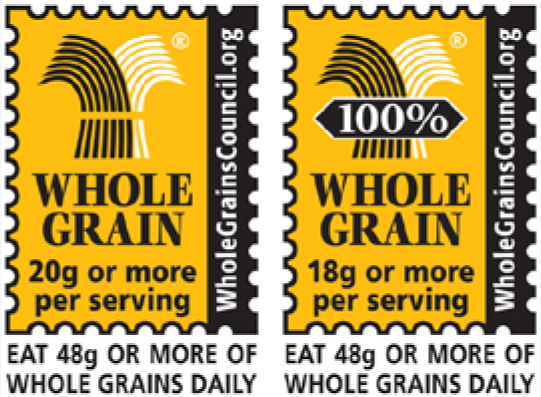
The Whole Grain Council Stamp.
Tips to Improve Intake
Here are practical, attainable suggestions to improve and encourage whole grain intake:
Replace white, refined grain products with whole grain ones. Opt for whole grain pastas, brown or wild rice, whole grain breads and tortillas rather than white.
Use whole grain bread crumbs or rolled oats to make meatballs and meatloaf.
Add wild or brown rice, dehulled or hull-less barley to soups and stews. (Most pearled barley is not considered a whole grain as some of the bran is removed in the pearling process.) 7
Substitute whole grain flour or oats, ground in a food processor, for up to ½ of the white flour in recipes (waffles, pancakes, muffins, and cookies).
Experiment with different whole grains available in the grocery store, such as quinoa, farro, buckwheat, millet, bulgur wheat.
For a snack, try whole grain crackers, baked tortilla chips, popped popcorn, or brown rice cakes.
Sprinkle oats on yogurt to add some extra crunch.
Remember that oats (rolled, quick-cooking, or steel cut), barley (dehulled or hull-less), and whole rye are particularly helpful in lowering cholesterol concentrations.
Visit helpful resources such as www.ChooseMyPlate.org and www.wholegrainscouncil.org.
Conclusion
The inclusion of whole grains in the diet is beneficial for cardiovascular health. Whole grain consumption lowers serum TC and LDL-c concentrations and thereby reduces risk of CVD. Whole grains higher in viscous or soluble fiber content, such as oats and barley, yield the greatest reductions in TC and LDL-c levels. Improving patients’ knowledge and identification of whole grains will give them the tools to increase their whole grain intake.