



Abstract
Sapindus mukorossi Gaertn is also known as Mu Huanzi, You Huanzi, soap tree, etc. The pericarp of Sapindus mukorossi contains many saponins, which is a type of natural non-ionic surfactant. Its extract has vigorous surface activity and biological activities such as bacteriostasis, oxidation resistance, and free radical scavenging. The Sapindus mukorossi extract is an environmentally friendly washing product that microorganisms can be rapidly decompose in nature without any environmental pollution.This study aims to investigate the effects of E-beam and Co60-γ irradiation on the total saponins content in the crude extract of the S mukorossi. The S mukorossi powder is irradiated with E-beam and Co60-γ ray at doses of 0, 4, 6, 8, 10, and 12 kGy for E-beam and 0, 50, 100, 150, and 200 Gy, respectively, for Co60-γ ray. The changes in the content of total saponins in the crude extract, total detergency, and the bacteriostatic abilities before and after the irradiation were analyzed. The results showed that the content of total saponins in samples irradiated by E-beam was significantly higher than that in non-irradiated samples. The saponins yield was the highest at a radiation dose of 6 kGy, and the detergency and bacteriostatic ability were also the strongest. After low-dose Co6-γ irradiation, the total saponins in the S mukorossi crude extract, and detergency and bacteriostatic ability had no apparent change. Conclusion: E-beam irradiation at a dose of 6 kGy can effectively improve the content of total saponins in the crude extract of S mukorossi powder. In addition, its effects on detergency and bacteriostatic abilities are relatively significant. The findings provide sufficient reference data for the further development of S mukorossi commodities.
Introduction
Sapindus mukorossi Gaertn is also known as Mu Huanzi, 1 You Huanzi, soap tree, etc. The pericarp of S mukorossi contains many saponins, 2 which is a type of natural non-ionic surfactant. Its extract has vigorous surface activity 3 and biological activities such as bacteriostasis, 4 oxidation resistance, 5 and free-radical scavenging.6-8 The S mukorossi extract is an environmentally friendly washing product that microorganisms can rapidly decompose in nature without any environmental pollution. 9
In recent years, the extraction process of S mukorossi has been gradually optimized and improved. However, the purity of the extracted products is relatively low, and bacteria multiply easily due to its rich nutrient content. Irradiation technology is a new product processing technology that can change the physical and chemical properties of materials utilizing the interactions of ionizing radiation (such as Co60-γ ray, E-beam, x-ray) with materials, and has a significant sterilization effect.10,11 It is mainly used to process perishable products such as food and cosmetics, by degrading harmful substances and killing microorganisms, and thus, improving products’ shelf life and safety.12,13 Studies have shown14,15 that there is no radioactive residue in the irradiated products because the process only changes the molecular structure, which is harmless and non-toxic to the human body. The primary purpose of irradiation is to control microbial contamination thus delaying spoilage and improving the hygienic quality of products. Some studies have shown that irradiation can reduce the viscosity and increase the permeability of the protoplasm of plant cells, which is conducive to material extraction.16,17 Irradiation can also cause degradation of macromolecular substances leading to the cross-linking and polymerization of some compounds.12,18,19
The purpose of this experiment is to explore how different types of irradiation (Co60-γ irradiation and electron beam irradiation) affect the total saponins’ content in the crude extract of S mukorossi. The experiment will also examine the bacteriostatic and detergency abilities of the crude extract, by treating the S mukorossi powder with different irradiation. The study aims to acquire an effective method to improve the extraction rate of saponins from S mukorossi, to make up for the deficiency of bacteriostatic and detergency abilities of saponins from S mukorossi, and to provide technical support for the development of commodities of S mukorossi.
Materials and Methods
Materials
The S mukorossi powder (self-made in November 2017, was produced by collecting the S mukorossi peels from the campus and then dried, crushed, and sealed; Escherichia coli, Staphylococcus aureus, Bacillus subtilis, and Candida albicans were purchased from Shanghai Lu Micro Technology Co, LTD. Commercially available bleached cotton cloth, tomato, soy sauce, lemon juice, carbon ink, snow chrysanthemum, petri dishes, glass rods, etc. were also sourced.
Irradiation Treatment
E-beam radiation source: Electron accelerator (1 MeV);
γ-ray radiation source: Co60-γ ray radiation source
Radiation dose:
1. Electron accelerator: 0, 4, 6, 8, 10, and 12 kGy.
2. Co60-γ ray radiation: 0, 50, 100, 150, and 200 Gy.
The crude extract prepared from the S mukorossi powder irradiated by the electron accelerator is labeled solution A, and the crude extract of S mukorossi powder irradiated by Co60-γ ray is labeled solution B.
Methods
Preparation of S mukorossi Crude Extract
Ten grams of the S mukorossi powder was taken and added to 90 mL distilled water, and then the mixture was heated in a microwave at a high temperature for 75 s and filtered twice. Combined, the two filtrates had a fixed volume of 270 mL. Finally, the clarified liquid was obtained using vacuum filtration and seal stored at 4°C. The treatment of each sample is the same as above.
Determination of Saponin Content
A. Determine the Maximum Absorption Wavelength
The total saponins content of S mukorossi was determined using the method established by Zhou Li-bin 20 (vanillin-glacial acetic acid color method). The instruments used were as follows: Shanghai ultraviolet-visible spectrophotometer UV-9000s, with oleanolic acid standard (purity ≥ 98%) as the control group, 550 nm was determined as the measurement wavelength of saponin compounds in the sample solution.
B. Draw a Standard Curve
The standard curve was drawn with absorbance A as ordinate and concentration C/(μg/ml) as the abscess. This was repeated three times. The calculated regression equation was y = .0336x-.0048 and R2 = .9991. Linear relationship was good.
C. Test the Sample
The crude extract of the saponins from the S mukorossi was diluted. The dilution of 100.0 μL was placed in a test tube, the rest of the process was the same as the one used to draw the standard curve. The content of total saponins in crude extract was calculated.
Determination of the Detergency of Crude Saponin Extract of S mukorossi
A. Prepare the Stain Solution
The fresh tomatoes and lemons, were, respectively, chopped, ground, and filtered, to obtain tomato juice and lemon juice, Boiled water was added to the extract, and the snow chrysanthemum extract was obtained.
B. Make Dirty Cloth
The appropriate size of the cloth was obtained and cut into 5 cm × 5 cm rectangle sizes. Tomato juice, lemon juice, snow chrysanthemum extract, carbon ink, and soy sauce (center, other four stains at four top corners) was added to each of the rectangular white cloth at a distance of 2 cm. The stained cloth was placed in a dryer in preparation.
C. Wash Dirty Cloth
A 100 mL S mukorossi diluent with a volume fraction of 3% was prepared. The three pieces of dried stained clothes were placed in glass bottles containing diluted S mukorossi and soaked for 12 h stirred with glass rods every 1 h. After 12 h, the stained cloth was taken out, drained, spread flat, and dried in a drying machine. The washing effect after drying was observed and scored.
D. Evaluate Detergency Ability
The detergency ability was set to 5 grades, A (no noticeable stain residue, 80-100 points), B (a little stain residue, but not noticeable, 60-80 points), C (most stain residue, 40-60 points), D (a little stain faded, 20-40 points), and E (stain basically unchanged, 0-20 points). After scoring by three to ten people, the average value was taken.
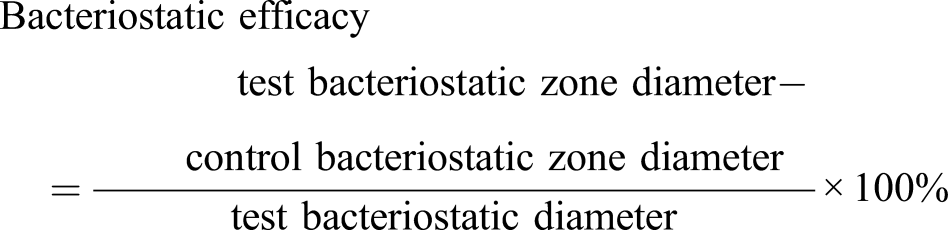
Determination of Bacterial Inhibition Zone
The bacterial inhibition zone was determined according to the method established by Zhu Chao-yang.
7
The bacteria used were E coli, S aureus, Bacillus subtilis, Candida albicans, a total of 4 kinds of bacteria.
Data Analysis and Statistics
In this article, three parallel experimental data were set, and the data were statistically processed by Excel 2016 software.
Results and Analysis
Effects of Different Irradiation on Saponins Content in Crude Extract of Sapindus mukorossi Powder
Sapindus mukorossi crude extract was prepared after irradiation to test the contents for total saponins. The results are shown in Figure 1 and Figure 2. According to Figure 1, the total saponins content of the powder treated by E-beam was significantly different in the irradiation group and the control group. The maximum content of total saponins was .67 mg/mL at the radiation dose of 6 kGy; when the radiation dose was greater than 6 kGy, the total saponins content decreased with the increase of the radiation dose. When the irradiation dose ≤ 6 kGy, the content of total saponins in the crude extract of the S mukorossi increased, which might be due to changes in the permeability of the cytoplasmic membrane of the S mukorossi by the peroxidation reaction caused by ionizing radiation and the increase of the yield. The permeability of the cytoplasmic membrane increased with increasing radiation dose. However, the content of total saponins in crude extract of Co60-γ ray irradiated powder showed no significant change with the increase of irradiation dose. This might be due to the relatively faster repair after the cytoplasmic damage caused by low-dose irradiation. Due to storage or external conditions, the permeability of the cytoplasmic returns to its original state.16,17 Content of total saponins in extract after irradiation of Sapindus mukorossi powder by the electron accelerator. Content of total saponins in extract after Co60-γ irradiation treatment of Sapindus mukorossi powder.

The Influence of Different Irradiation on the Detergency Ability of the Crude Extract of Sapindus mukorossi Powder
Crude extracts were prepared with S mukorossi powder irradiated by electron beam and powder irradiated by Co60-γ ray. After diluted to 3% of the volume fraction, the crude extracts were used to wash self-made dirty cloth followed by scoring and statistics. Figure 3 and Figure 4 are drawn. Average scoring results of the washing effect of Sapindus mukorossi crude extract irradiated by the electron accelerator at different doses on stains on the cotton cloth. Average score of the washing effect of the crude extract of Sapindus mukorossi on cotton cloth after Co60-γ irradiation at different dose.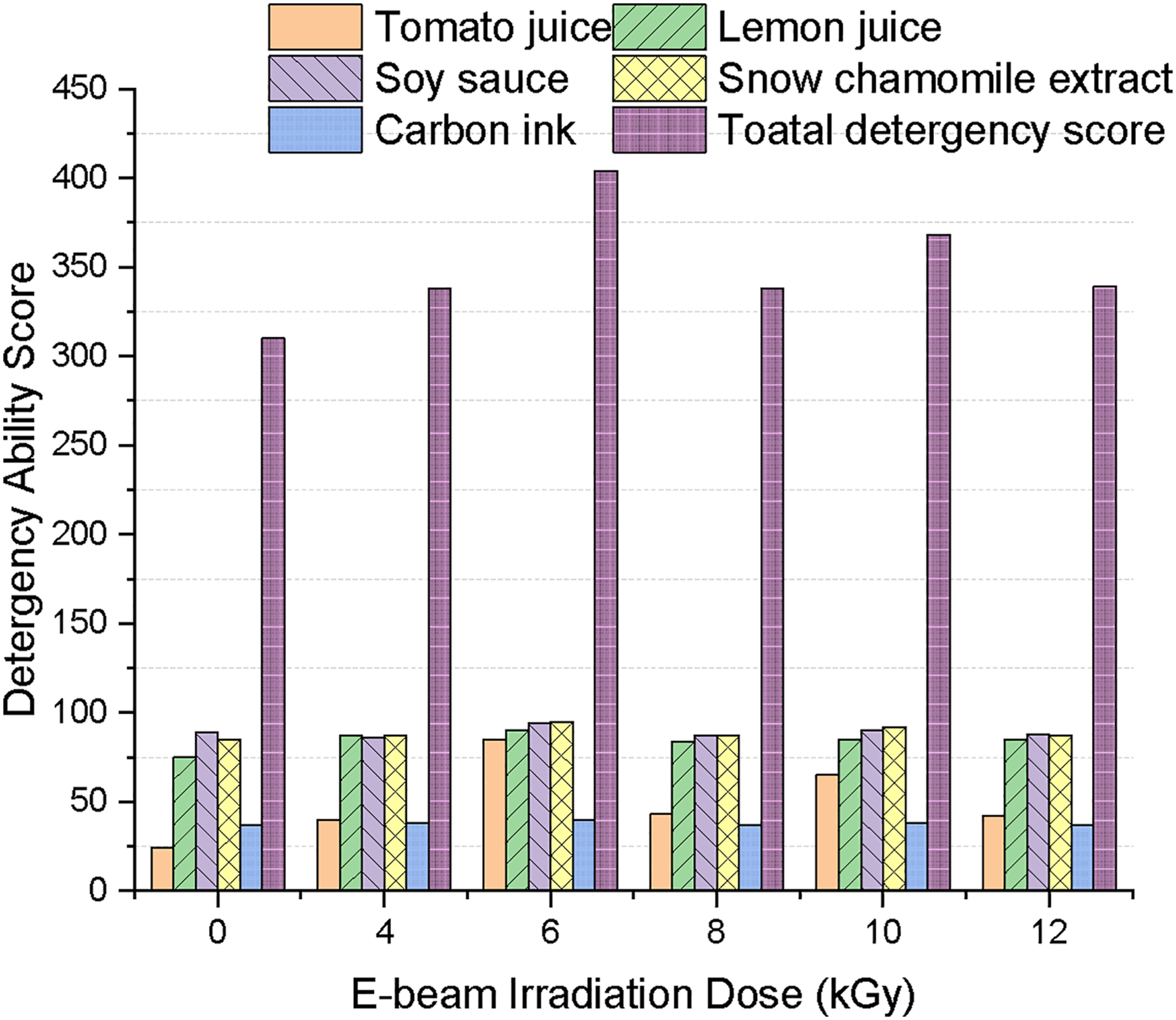

Both S mukorossi crude extract treated with two different irradiation treatments had a noticeable effect on the stains on the cotton cloth. Figure 3 illustrates the total detergency of A liquid increases sequentially with the increase of radiation dose. Among them, the total detergency ability of the crude extract treated with a radiation dose of 6 kGy was the highest, followed by that of the crude extract treated with 10 kGy. The total detergency ability of the crude extract of non-irradiated S mukorossi powder was the lowest. Figure 4 illustrates, after Co60-γ ray irradiation treatment, total detergency of the S mukorossi crude extract had no noticeable change. With the increase of Co60-γ ray radiation dose, the total detergency of crude extract remained constant. This is because there is no significant difference in total saponins content after irradiation at different doses, so there is no significant difference in detergency.
Effects of Different Irradiation on the Antibacterial Activity of the Crude Extract of Sapindus mukorossi Powder
Effect of Electron-Beam Irradiation on the Antibacterial Activity of the Crude Extract of S mukorossi Powder
Inhibitory Effect of Crude Extract of Sapindus mukorossi Powder Irradiated by Electron Accelerator on Four Kinds of Bacteria.
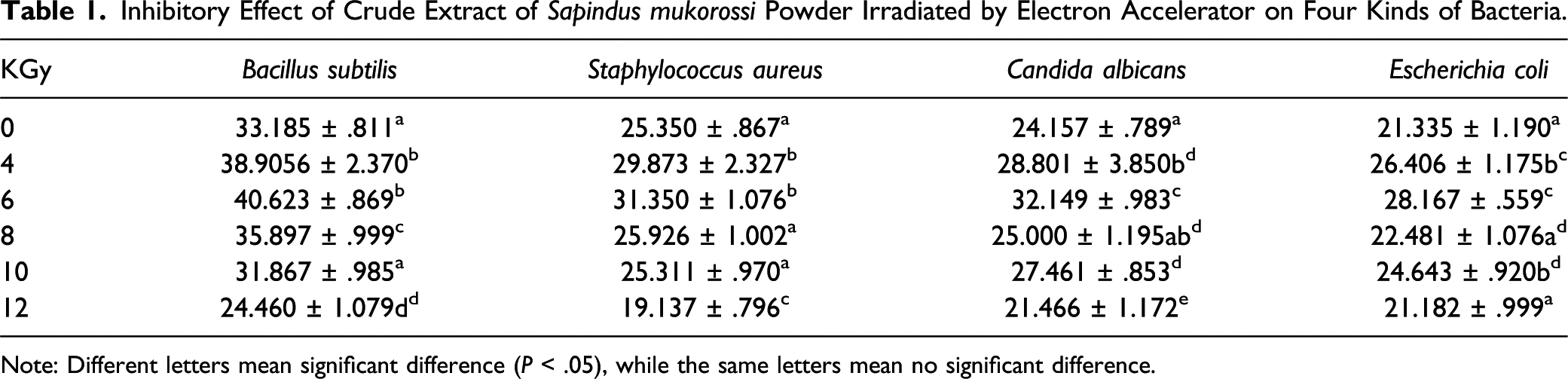
Note: Different letters mean significant difference (P < .05), while the same letters mean no significant difference.
Inhibitory Effect of Crude Extract of Sapindus mukorossi Powder After Co60-γ Irradiation on Four Kinds of Bacteria.

Note: Different letters mean significant difference (P < .05), while the same letters mean no significant difference.
Effect of Co60-γ Radiation on the Antibacterial Activity of the Crude Extract of S mukorossi Powder
From Table 2, it is evident that the bacteriostatic rate of the crude extract of the S mukorossi powder treated with different doses of Co60-γ ray irradiation did not change significantly. There was no significant difference between the 50, 100, 150, and 200 Gy irradiation group, and the 0 Gy irradiation group by ANOVA.
In conclusion, when the radiation dose of the electron beam was 6 kGy, the yield of saponins from the S mukorossi powder was the highest, and the detergency and bacteriostatic abilities were also at the maximum. When the irradiation dose was ≤4 or ≥ 8 kGy, the extraction effect of total saponins from the powder was normal. Therefore, when the radiation dose exceeds 10 kGy, it will lead to the reduction of detergency and bacteriostatic ability of the crude extract of the S mukorossi. A low dose of Co60-γ ray irradiation has no significant effect on S mukorossi powder when the radiation dose is ≤ 200 Gy. This is because the content of total saponins, detergency and bacteriostatic ability in the crude extract of S mukorossi were not significantly changed.
Conclusion
(1) When the dose of Co60-γ radiation was between 0 and 200 Gy, the extraction rate of saponins, total detergency and bacteriostasis of saponin crude extract of S mukorossi did not change significantly compared with the control group. 2) When the electron accelerator irradiated the powder of S mukorossi, and the irradiation dose was 0-6 KGy, the extraction rate, total detergency, and bacteriostatic power of total saponins in the crude extract of S mukorossi increased with the increase of the irradiation dose and reached the maximum when the irradiation dose reached 6 kGy. When the irradiation dose was between 6 and 12 KGy, the extraction rate, total detergency and bacteriostasis of saponins in the crude extract of Saponins from S mukorossi decreased with the increase of the irradiation dose.
Footnotes
Declaration of Conflicting Interests
The authors declared no potential conflicts of interest with respect to the research, authorship, and/or publication of this article.
Funding
The authors disclosed receipt of the following financial support for the research, authorship, and/or publication of this article: This article is funded by Hubei Key Laboratory of Radiation Chemistry and Functional Materials Key Fund Projects (2021ZX10), and National Undergraduate Entrepreneurship Project (201910927019S).
