



Abstract
Ramie (Boehmeria nivea L.), a perennial herb, is an important bast fiber plant. Its fiber with the advantages of attractive luster, high tenacity, enhanced strength, and good microbial resistivity is well known as the queen of natural fibers. The abundant cellulose fibers in ramie raw materials are stuck tightly by gums consisting of pectic substances, hemicelluloses, and little lignin. The gum should remove from the ramie raw material through degumming process to separate fibers, unveil unique fiber properties, and improve fiber-spinning ability to fulfill textile requirements. Low degumming efficiency and high environmental pollution are the major problems hindering the utilization of ramie fibers. Ramie degumming involves the degradation of pectin and hemicelluloses, which requires chemical, physical, biological treatment, or a combination of several treatments. No stereotyped parameters of the given degumming method have been yet established for the extraction of textile-grade ramie fibers. This review evaluated integrated methodology involving chemical, physical, biological and biochemical methods to degum raw ramie and obtain textile-grade refined fibers.
Introduction
Ramie is an important fiber crop used in textile processing. Planters harvest ramie approximately every 60 days by cutting mature bast and protect roots. Cortexes removed mechanically or manually in a process, so-called decortications. Then, the cortexes are scraped to remove shell and partial gums. 1 In China, ramie is planted as a key cash crop in flat and hillside, and approximately 500,000 tons of ramie fibers were harvested every year, which account for more than 95% of global production. 2 China exported 1000–4000 tons of ramie products from 2012 to 2017. Europe and Japan are the two major overseas markets for ramie yarn and fabrics. 3
Ramie fibers are one of the longest natural plant bast fibers with greatest strength. They are white, shiny, and look like silk. Ramie fibers are well known for their good shape and resistance to mold, bacteria, and insects. 4 They can be blended with wool, cotton, and even silk to enhance luster, color, and strength retaining fabric flexibility and produce different textile products. 3 Ramie fibers have good color, attractive appearance, and high quality, and their good performance in fabrics is a valuable property in textile processing. 5 Moreover, ramie fibers are popular because of their biodegradability, thermo-stability, and low cost. 6 What is more, ramie fibers have remarkable physical and chemical characteristics; for example, they have high luster, and their tenacity is twice as that of flax. 7
Ramie raw materials contain abundant cellulose (65%–75%) and other polysaccharide complexes (20%–30%), which are so-called gums. Ramie gum, which comprises mostly 4%–5% pectin, 14%–16% hemicellulose, and 0.8%–1.5% lignin, is embedded among cells, on cell walls, or inside fibroblasts.8,9 The ramie gum content varies greatly among different varieties and planting areas; for example, the gum content of Indian ramie genotypes (27%–30%) is higher than that of Chinese varieties (18%–20%). 10
Gum removed from decorticated ramie to separate fibers and ensure that the fibers meet textile requirements that the residual gum content is less than 5% (Figure 1). Given that residual gum content attaching to fibers is closely related to fiber spinning performance, ramie materials should be degummed in different degrees to satisfy the requirements of different textile production processes.11,12 Degumming is a major challenge to scientists in development and utilization of ramie fiber. At present, ramie degumming is mainly divided into chemical, biological, physical, and biochemical methods.
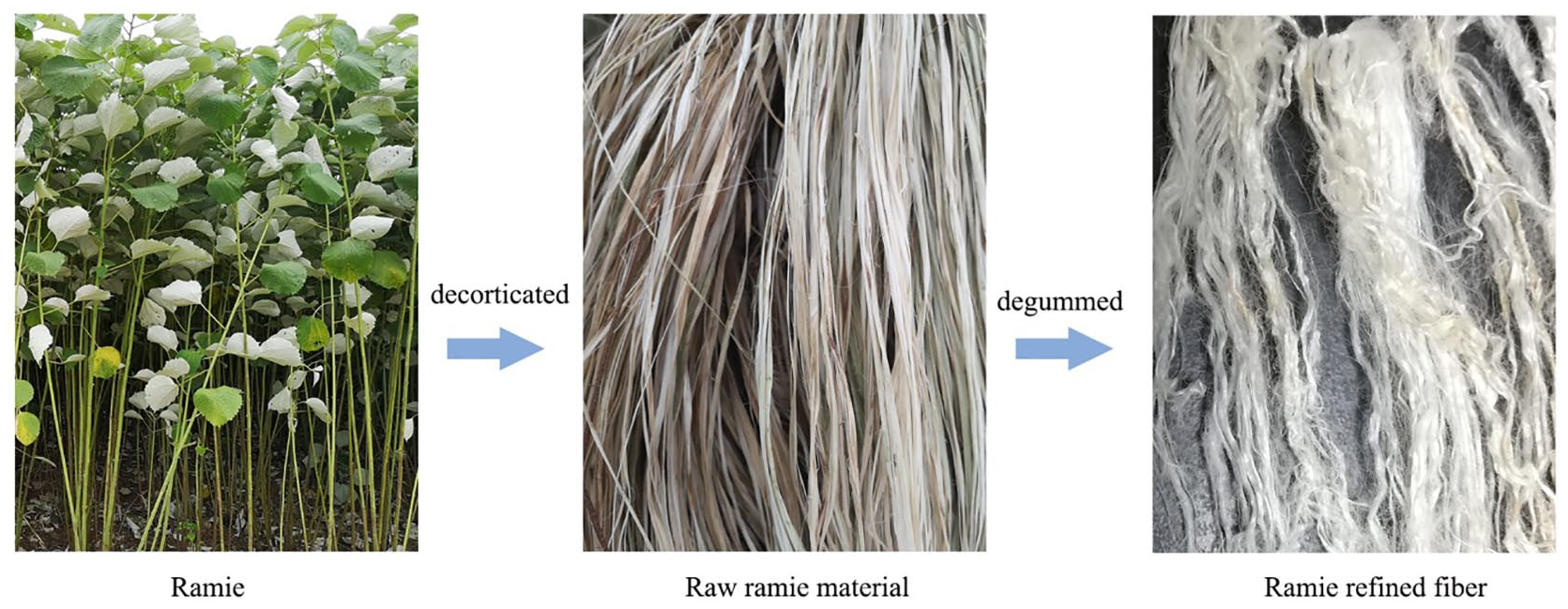
Main processing of ramie.
Chemical degumming
Chemical degumming for ramie is complicated system engineering. It is performed by the rule that the cellulose and the gum (pectin, hemicelluloses, and lignin) in ramie raw material decomposed to varying degrees in alkali, inorganic acid, or oxidant environments. The mechanism of chemical degumming is hydrolysis or oxidant differences between the cellulose and impurities in the given chemical environments to remove gum materials synchronously or step by step, coupled with principle that the mechanical and physical performance properties of refined ramie fiber was hurt less as far as possible. Typically, pectin and hemicellulose (primarily mannan and xylan) can easily hydrolyze in high-concentration alkali solution, while cellulose cannot. Chemical degumming is categorized into traditional chemical degumming and new chemical degumming in accordance with the varieties of the reagents used.
Traditional chemical degumming
In traditional chemical degumming, the decorticated ramie ribbon was treated with a high concentration of hot alkaline solution with or without high pressure and followed by scouring, washing, and other chemical, physical, and mechanical means to separate gum and cellulosic fibers further. According to the National Institute of Research Jute Allied Fiber Technology, chemical degumming was performed at more than 96°C for 2 h using 1% NaOH solution containing a wetting agent, and treatment with 0.5% Na2SO4 performed successively to improve fiber tenacity. Similarly, aqueous alkaline solutions (NaOH, Na2SO4, or their mixtures) were used to dissolve pectic substances and then degummed ramie fibers were bleached with ClO2 or H2O2 at high temperature. 13
The chemical degumming process according to Bhattacharya and Das 14 is the most commonly accepted. Decorticated ramie ribbons are cooked for 1 h at high pressure and 160°C with a 6:1 liquor ratio, 1% NaOH, 3% Na2SO3, and 3% Na5P3O10. The cooking liquor was discarded, and the ribbons were washed with water. The ramie fibers were bleached for 1 h with 1% H2O2 at 83°C and pH 9.0. The fibers were rinsed with dilute acetic acid and water and then mixed with oil emulsions, such as sulfonated hydrocarbons (3%–4% dry weight basis of the fibers). Next, the fibers were centrifuged, the excess emulsion saved for the next batch, and the fibers were dried. The fineness, tenacity, and extension at break of refined ramie fiber were 0.77 Tex, 828.3 mN/Tex, and 0.6 mm, respectively.
In China, traditional chemical degumming was usually performed by soaking ramie ribbons in 0.2% of H2SO4 solution for 60 h at 50°C, followed by washing in water. Then, the fibers were treated with a solution of 5% NaOH and 2.5% Na2SO3 for 150 min at 100°C. The fibers are thoroughly washed with water and treated again with a solution of 10% NaOH and 2% Na9O12P3 for 180 h at 100°C. 15 The fibers were washed fully and bleached through cold treatment for 2 h in 1% NaBO3·4H2O solution. Finally, the fibers were washed and dried in open air. Residual gum rate and fiber production ratio were calculated to evaluate degumming effects. 16
Traditional chemical degumming for ramie requires many NaOH reagents under high temperature and high-pressure conditions, so it is a real high cost and high-energy consumption method. Moreover, traditional chemical degumming generated a large quantity of wastewater, which cannot discharge directly because of its high chemical oxygen demand (COD). Wastewater treatment is expensive and significantly increases the cost of traditional chemical degumming, thereby limiting the large-scale use of this method to some extent.
New chemical degumming
The development of degumming additives has allowed the addition of new reagents, such as 2Na2CO3·3H2O2, pentasarbate, surfactants, and 1,8-dihydroxyanthraquinone, to the chemical degumming process to enhance hemicellulose removal from ramie materials.17–19
In an alkali environment, H2O2 oxidizes and hydrolyzes pectin, hemicellulose, and lignin polysaccharides into oligosaccharides that are soluble in water. However, H2O2 in the alkali environment is not a selective oxidant for celluloses, which can oxidize almost all of –OH in cellulose macromolecules resulting in reduced fiber strength and hydrophilicity, so reducers with a low standard electrode potential (e.g. KBH4 and NaBH4) should be introduced into oxidation of ramie degumming to protect the oxidant cellulose. 20 Meng et al. 21 found that after the introduction of the reducing agent (KBH4), the strength, elongation, and softness of ramie fiber in oxidation degumming improved by 20.96%, 3.57%, and 23.88%, respectively.
Fenton’s reagent composed of H2O2 and an iron catalyst was used to disrupt organic compounds and oxidize contaminants in wastewater treatment. Iron (II) sulfate is a typical catalyst. It is proved that Fenton’s reagent is a new oxidizing agent to degum ramie material, and this oxidation degumming process is performed under weak acid condition, resulting in good degumming effect. 22 Compared with the alkaline oxidation degumming method, the new degumming method using Fenton’s reagent can reduce the gum residual rate of ramie raw material and further improve the cellulose content of treated ramie fibers. Furthermore, the fibers degummed using Fenton’s reagent exhibit a bit increase in tenacity and drastically increased density and breaking elongation compared with fibers degummed through alkaline oxidation. 23
The use of urea peroxide as an oxidant in ramie degumming is studied and its effect is analyzed. The results showed that the fiber strength decreases with the increase in the amount of urea peroxide. A linear relationship exists between urea peroxide amount and fiber strength. The highest fiber strength is obtained at 95°C and 3 h under the given conditions. 24
Chemical composition, microstructure, and mechanical property analyses revealed that ramie fibers subjected to steam explosion treatment coupled with 2Na2CO3·3H2O2 soaking degumming process have a residual gum content of less than 5%, fineness of more than 1600 N m, whiteness of more than 50%, and breaking tenacity of 5.4 cN/dex, all of which meet the Chinese national standard of the degummed ramie fiber (GB/T 20793-2006). The whiteness and breaking tenacity of fibers treated through steam explosion treatment coupled with the 2Na2CO3·3H2O2 soaking degumming process are better than those of the fibers treated through traditional chemical degumming. 25
Mg (OH)2 with capability of buffering pH in the degumming solution was regarded as a good candidate of sustained-release alkali source to improve the properties of degummed ramie fibers and reduce the COD value of degumming wastewater. Meng et al. found that compared with the degummed fibers without Mg (OH)2, the tenacity, degumming yield of treated fibers, and work of rupture raised 39.82%, 5%, and 46.15%, respectively. What is more, the COD value of wastewater reduced 20%. 26
Compared with the traditional chemical degumming method, this new chemical degumming process for ramie shortens degumming time, reduces hard strips, and improves degumming efficiency, but it still requires substantial amounts of other chemical reagents replacing NaOH. The completely chemical process still requires high-temperature boiling and pressure, which easily leads to energy waste and environmental pollution.
Biological degumming
In the biological process, ramie gums are removed through treatment with noncellulose-degrading microorganisms in situ or with their extracellular enzymes. Two biological degumming methods are the same degradation processes in essence that noncellulose components are catalyzed by a series of polysaccharide-degrading enzymes. 27 The biological degumming of ramie raw material can be classified as bacterial or enzymatic in accordance with the different initial additives used.
Microbial degumming
The action process of microbial degumming is the cycle of microbial growth, microbial metabolism, and enzymatic degradation (shown in Figure 2). Interestingly, the microbial strains consume part of the gum hydrolysates as a carbon source for metabolic activity, so it prevents the feedback inhibition of the degumming enzymatic reaction by the hydrolysis product (oligosaccharides or other low molecular sugars) and promotes the thorough removal of gum, ultimately promoting the efficiency and effectiveness of the biological degumming of ramie fibers. 28
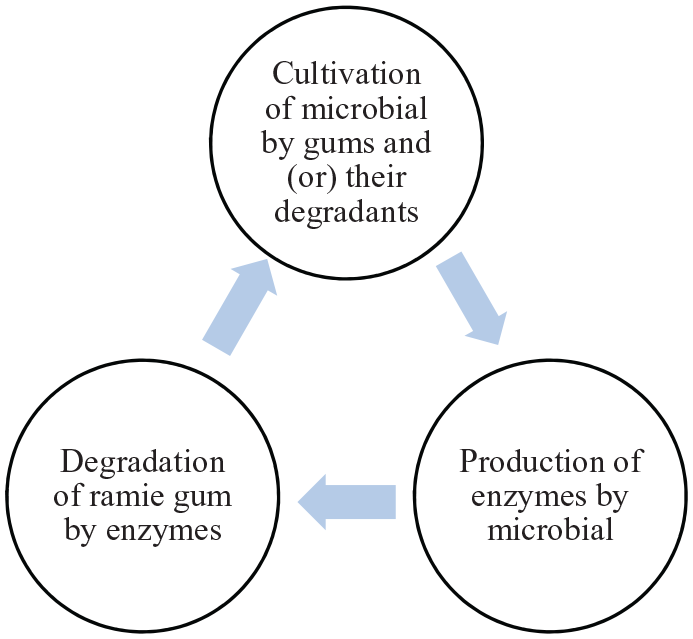
Action process of microbial degumming for ramie. In detail, the microbial strain first uses water-soluble sugars from ramie pretreatment as nutrients for growth and proliferation and then produces polysaccharide-degrading enzymes (pectinase and hemicellulase) that hydrolyze ramie gums. Finally, the strain consumes the hydrolysis products (such as monosaccharides and oligosaccharides) of gums to reproduce, entering successive flow.
One of the most important factors in microbial degumming is to obtain powerful strains with capability of removing ramie gums. A series of pectin-degrading strains free of cellulolytic activities, such as Paenibacillus campinasensis BL11, Bacillus pumilus DKS1, Bacillus clausii, Bacillus cereus, Bacillus tequilensis, and Actinomyces sp., have screened for ramie degumming.29–33 Samples collected from special habitats related to pectin and hemicellulose-degrading environments. The dominant bacteria capable of ramie-gum degradation were enriched after culturing with ramie raw materials as the sole carbon source, preliminarily screened on selective substrate medium (e.g. citrus pectin, apple pectin, and sodium polygalacturonate), and finally validated in a ramie degumming experiment.
Brühlmann et al. 34 isolated actinomycetes from 10 different soil and compost samples. The actinomycetes were screened for the exhibition of pectinolytic enzyme activities when grown on pectin-containing solid and liquid media. The pectinolytic enzymes detected using plate diffusion tests with a medium containing ramie bast material as the only carbon source were primarily Pels. The treatment of ramie raw materials with supernatant of fermentation liquid (containing Pel) by the selected strains showed a good correlation between the activity of the applied Pel and the degumming effect, resulting in good separation of ramie fiber. Cao et al. 35 screened the alkalophilic bacterium NT-33, which produces polygalacturonase and xylanase. NT-33 removed 70% of the ramie gum after 24 h of fermentation and proved to show excellent capacity for ramie degumming.
The microbial degumming process has been commonly used at an industrial or farmer’s level due to the no availability of specific strains, the cost and difficulty of microbial culture, and the low rate of gum removal. Two successful cases were reported in China. The direct application of Bacillus sp. HG-28 with excellent degumming ability and low cellulose damage developed in ramie degumming process. The gum-induced strain in ramie raw material secreted high pectinase and xylanase activity that is essential factor for degumming. After 16 h of microbial degumming, the gum removal rate reduced by 76.92%, and the loss of cellulose was negligible. This method is more effective than other microbial degumming methods that do not use microorganisms directly. An industrial-scale microbial degumming test showed that the residual gum rate of ramie fibers decreased to 1.81%, and the bundle breaking tenacity of the ramie fibers reached 5.09 cN/dtex. 28
The powerful strain Pectobacterium sp. CXJZU-120 is used in factory-scale ramie degumming in China. More than 90% of the ramie gum is removed by Pectobacterium sp. CXJZU-120 within 6 h in 34°C–35°C, so it is a rapid biological degumming process. Moreover, the twisting frequency, elastic modulus, and the abrasion frequency of the refined ramie fiber reached to 2.98 number/cm, 873 cN/dtex, and 166 times, respectively. In contrast to traditional chemical degumming, CXJZU-120 is used to degum ramie fibers, which is fit for ramie fiber extraction from different grades of raw materials and maintaining the inherent morphological structure and good spinning property of ramie fibers. Furthermore, this degumming process increased the resource utilization rate by over 50% and reduced the production cost by more than 20.5%. 36
Microbial degumming also has some disadvantages such as instability and incomplete removal of gum. What is worse, Saikia et al. 11 found that ramie degumming cannot be extended beyond 7 days because fiber quality starts deteriorating due to the growth of cellulose-degrading microorganisms during uncontrolled microbial degumming. Therefore, bacteria, which grow and multiply rapidly and comprehensively secrete hemicellulase systems without cellulase activity, are the main microorganisms used for ramie degumming.
Enzymatic degumming
The degradation of ramie gum requires the synergistic action of a series of polysaccharide hydrolases, including pectinase- and hemicellulosic-degrading enzymes, such as mannanase and xylanase. Pectinase is one of the most important enzymes as a primase in enzymatic degumming.12,37 In the early stage of ramie biological degumming, pectinase degrades the external pectic substance, relaxes the cell structure, promotes the effective permeation of hemicellulase and other degumming factors, and thus improves the overall degradation efficiency of gum complexes.38,39
Brühlmann et al. 27 treated bast fibers from ramie with crude enzymes secreted by wild Amycolata sp. and a genetically engineered microorganism Streptomyces lividans expressing pectate lyase gene (pel) from Amycolata to study the degumming effects of different extracellular polysaccharide-degrading enzymes. Degumming for 24 h with the crude enzyme of wild Amycolata sp. and the genetically engineered S. lividans strain resulted in residual gum contents of 14.7% and 17.3%, respectively. Crude enzymes from wild Amycolata sp. with high Pel activities were most effective in fiber separation and reduced the gum content of ramie fibers, and no significant degumming observed with cell-free culture supernatant from a S. lividans strain without Pel activity. This result indicated that the Pel plays a vital role in the ramie degumming.
Enzymatic degumming attributed mostly to Pel, and xylanase is responsible for removing residual hemicelluloses. Wang et al. 40 cloned the xylanase gene (xyn) from D. dadantii DCE-01 and expressed it in Escherichia coli through genetic engineering. They found that the recombinant xylanase exhibited good hydrolysis capability on commercial xylan and used effectively in the ramie degumming process. Interestingly, xylanase produced by Bacillus sp. and D. dadantii contributes significantly to degumming, whereas xylanase secreted by Amycolata sp. has no obvious effect on ramie degumming. The different effects of various xylanases on ramie degumming may result from their different characteristics, especially attributed to their substrate specificity. 41
Three strains of alkalophilic bacteria, namely, Bacillus sp. NT-39, NT-53, and NT-76, that can produce polysaccharide-degrading enzymes had incubated for 48 h. Then, their culture supernatants containing Pel and xylanase were used to treat ramie for 5 h. The residual gum rate of the fibers further reduced to 9.4% by enzymatic treatment, so it identified that Pel and xylanase play a vital role in the gum removal of ramie. 42 Debkumar et al. 43 conducted ramie degumming based on synergistic degradation with pectinase and commercial hemicellulase and found that when the ratio of xylanase to pectinase ranged from 1:1.3 to 1:1.6, ramie pectin was degraded well, the residual ramie-gum rate decreased to 5.02%, and the tensile strength and fineness of ramie were greatly improved. The synergistic catalysis of various polysaccharide-degrading enzymes without cellulase activity is thus more likely responsible for the thorough removal of gum and good separation of bast fibers than the activity of a single enzyme alone.
In enzymatic degumming, a moderate temperature (40°C–70°C) in alkaline environment (pH 8–11) is important for degumming effective and fiber quality improvement because gum-like materials are soluble under these conditions. Therefore, thermo-stable enzymes that are active in alkaline conditions are preference for the application of ramie degumming in industrial scale.44–46
Enzymatic degumming has many advantages over chemical degumming methods, such as mild and flexible processing conditions, environment-friendly operation, minimal fiber damage, and easy quality control. 47 However, enzymatic degumming has not been applied to industrial production on a large scale, because of the following two main reasons. First, the cost of enzyme preparation is a little high; second, it is a difficult task to construct a degumming-complex-enzyme-system matching with the derivative ramie-gum components given the complexity of the gum-like substance of ramie materials. 48
Physical degumming
Physical degumming is using physical means (e.g. mechanical rolling, ultrasound, supercritical CO2, and steam blasting) to destroy the hydrogen bonding between cellulose molecules, change the aggregation state of the internal structure of cellulose, and break the link between fiber, so as to make the follow-up enzyme, alkali, and other reagents easily permeate into the fibers, improving the utilization rate of reagent and degumming efficiency. Because the physical treatment of ramie raw material alone cannot achieve the ideal degumming effect, it is usually regarded as a means of fiber pretreatment coupled with other methods.
It has been reported that the combination of ultrasonic processing with chemical regents boiling, low-temperature oxygen plasma with a subsequent mild wet chemical process was used to degum ramie.49,50 Similarly, mechanical rolling coupled with microbiological degumming was successful in ramie degumming.28,36 These physical treatments as auxiliary means increased the contact surface between the chemical agents and the ramie gum, so as to improve the efficiency and the effectiveness of ramie chemical degumming.
Physical method for ramie degumming has the advantages of short degumming period, high efficiency, controllability, good repeatability, low cost, and almost no environmental pollution; however, it also has the disadvantages of low gum removal rate and poor spinnability of fiber.
Biochemical degumming
A combination of biological and chemical processes has been proposed to reduce the consumption of chemicals and energy and maximize the rate of gum removal from ramie fibers.
Shen et al. 51 reported that oxygen plasma has a significant positive effect on the effectiveness of the biological degumming of ramie compared with that of the traditional biological degumming method. The weight loss rate, whiteness, and capillary rise height of ramie fabrics are greatly improved using a half dosage of enzymes to assist oxygen plasma in biological degumming.
Liu et al. 52 applied the synergistic degradation of different enzyme components (enzyme complexes of pectinase and hemicellulase) to degum ramie at pH 7–10 and then used 2Na2CO3·3H2O2 to inactivate enzymatic catalysis. The properties of degummed ramie fibers are further improved and fiber surfaces are smoothened to fulfill textile requirements.
Guo et al. 53 combined a new process with enzymatic degumming and H2O2 bleaching for ramie treatment. An extracellular enzyme primarily containing pectate lyase (Pel) secreted by the powerful Bacillus sp. Y1 strain has the capability for ramie degumming. The bleaching of textile cellulose fabrics by H2O2, which can whiten and decolorize fibers and remove stains, is an established industrial process used to improve fiber performance in further finishing stages.
The biochemical degumming method combined the advantages of both biological and chemical methods to remove the gum thoroughly, but it also has obvious disadvantages, such as fiber damage and harsh processing conditions. Moreover, the biochemical degumming method relevant to chemical treatment and bacteria preparation or enzyme preparation needed complex and long process flow resulting in high cost and complicated operation.
Conclusion
This short review of methodologies for ramie degumming shows the action principle, process characteristics, advantages, and disadvantages of different ramie-degumming processes. Chemical degumming methods, involving mostly with substantial hot alkaline solutions in high pressure followed by H2O2 treatment, easily result in ramie fiber damage and environmental pollution. By contrast, biological degumming method reduces the harsh scouring or bleaching process and saves a large number of chemical reagents with fiber quality improvement. Thus, biological degumming, an efficient, energy-saving, and eco-friendly method, is the first choice in ramie processing. Efforts toward the development and improvement of biological degumming technology should focus on screening excellent microbial strains with good enzyme production performance, robust growth conditions, and high ramie-gum removal efficiency. We hope that this brief review can stimulate the readers to use ramie fibers in their own fields of research and further develop the ramie-degumming methods described here.
Footnotes
Declaration of conflicting interests
The author(s) declared no potential conflicts of interest with respect to the research, authorship, and/or publication of this article.
Funding
The author(s) disclosed receipt of the following financial support for the research, authorship, and/or publication of this article: The authors are grateful for the financial support of the Natural Science Foundation of China (Nos 31700438 and 31871675), the Chinese Agricultural Science and Technology Innovation Project (No. ASTIP-IBFC08), the Natural Science Foundation of Hunan Province (Nos 2019JJ40332 and 2019JJ50711), the China Agriculture Research System for Bast and Leaf Fiber Crops (No. CARS-16-E22), the Program of the Key Research and Development Projects of Changsha (No. kq1901112), and the Program of the Key Laboratory of Industrial Biotechnology, Ministry of Education (No. KLIB-KF201904).
