



Abstract
This study evaluates post-industrial textile waste as a sustainable alternative for thermal insulation composites used in automotive applications. Traditional thermal panels offer effective heat resistance but are resource-intensive, leading to environmental concerns. To explore an eco-friendlier approach, various fiber waste-polymer composites were examined for thermal conductivity properties. The objective of this research—to evaluate post-industrial textile waste for high-performance thermal resistance composites in automotive applications—is accomplished through systematic characterization methods. The study employs thermal conductivity measurements, fiber composition analysis, allowing for a comprehensive understanding of how these materials perform under various conditions. The modified guarded hot box setup provides an accurate assessment of thermal insulation capabilities, validating the effectiveness of different fiber-polymer composite formulations. Experimental findings indicate that sponge-like fiber composites exhibit a thermal conductivity (k) of 0.137 W/m·K, which decreases to 0.067 W/m·K when compressed. When incorporated into polyester matrix composites, the minimum thermal conductivity increases to 0.142 W/m·K. Additionally, flax fiber waste was blended with other fiber types in different ratios, where increased panel density improved thermal conductivity up to 0.164 W/m·K. However, compression significantly reduced k to 0.065 W/m·K. The impact of coating panels with fire-resistant polymer was also tested, showing only minimal influence on thermal conductivity.
Keywords
Introduction
The textile industry is one of the largest polluters in the world, with a significant environmental footprint resulting from resource-intensive production methods and waste generation. However, new solutions, in the form of textile fiber waste/polymer composites, are proving to be a more sustainable option than conventional automotive thermal panels, which possess good heat resistance.1–6 The formation of panels from recycled textile waste indicates that these materials have a thermal conductivity of 1.07 W/m·K, along with the added benefit of being environmentally friendly. Similarly, coir fiber composites also demonstrate high heat storage properties, further enhancing their applicability for automotive use. By utilizing recycled fibers, these products reduce dependency on virgin materials, align with the objectives of the circular economy, and fulfill the requirements set by regulations such as the EU’s recycling objectives. 3 This approach not only addresses environmental issues but also presents an economic solution for sustainable innovation in the automotive industry. Moreover, they are cost-effective, with materials priced at one-third the cost of traditional glass fibers.
Thermal resistance panels play a crucial role in automotive applications by ensuring passenger comfort, enhancing energy efficiency, and reducing noise. Thermal conductive polymer composites (TCPCs) have secured an important position in modern thermal management systems due to their lightweight, low cost, and excellent electrical insulation properties. 7 However, several scientific gaps in the design and development of heat-resistant panels pose challenges that require innovation and improvement. There is a need to develop enhanced thermal resistance panels made from sustainable, lightweight, and long-lasting materials for automotive applications.8–10 Research has examined thermally conductive polymer composites made from recycled automotive materials for thermal insulation sandwich panels in vehicle thermal management systems.11–13 To address current deficiencies, it is essential to develop panels that are recyclable and biodegradable while meeting vehicle performance standards.
Sealing these gaps involves the manufacture of recyclable or biodegradable panels that meet automotive performance requirements. Recent research reveals enormous potential for innovation in optimizing panel geometry, enhancing material usage sustainability, and improving thermal performance.14–21 Textile fiber waste/polymer composites offer a balance between thermal insulation, mechanical properties, and sustainability, making them suitable substitutes for traditional automotive thermal panels.22–26 Practically, these new materials can withstand significant stress, achieving tensile strengths of up to 52.81 MPa, while also transferring heat efficiently, exhibiting thermal conductivity values around 1.017 W/m·K, which makes them well suited for applications like heat dissipation and insulation. 25 Additionally, coir-based natural fiber composites show specific heat capacities of up to 26.313 MJ/m³K, enhancing their effectiveness in thermal management. These materials perform well, support circular economy initiatives, and reduce reliance on virgin resources, aligning with environmentally friendly objectives. In the automobile industry, they are attractive substitutes due to their low cost, roughly one-third that of conventional materials, and their compliance with strict environmental standards, including those set by the European Union.26,27
Various models have been developed to determine the thermal conductivity (k) of textile fiber/polymer composites. The thermal properties of these composites depend on the matrix value, fibrous bundles, fiber orientation, void volume fraction, and interfacial thermal resistance. In research on thermal conductivity in textile fiber/polymer composite systems, several models have been developed to predict thermal conductivity effectively, as the properties and volume fractions of the constituent parts were applied.14–24 Composite material thermal conductivity prediction models are generally categorized into empirical, analytical, and numerical models. Empirical models are based on experiments and are specific to a particular material system, whereas analytical models provide mathematical equations to predict thermal behavior in terms of the material’s structure and properties. Among the most common analytical models are the Maxwell-Eucken model, which is based on a dilute dispersion of spherical inclusions in a continuous matrix, and the Rayleigh model, which extends Maxwell’s model to include inclusion interactions. Hasselman and Johnson’s model accounts for interfacial thermal resistance effects between fillers and the matrix. Additionally, the Parallel and Series models provide straightforward bounding estimates of composite conductivity for parallel or perpendicular heat flow with respect to the layers of the component phases. The Bruggeman model treats both phases symmetrically when considering increased volume fractions of the filler, while Wis-Nielsen makes adjustments for filler geometry and orientation.24,25 The choice of a suitable model depends on the microstructure, phase distribution, and the trade-off between simplicity and accuracy required for the composite. While analytical models explain the mechanisms of the phenomenon, numerical simulations offer a general approach to handle complex geometries and interactions in composite materials.
Previous research has extensively explored the thermal conductivity and mechanical properties of polymer composites reinforced with various fillers and fibers. Studies on spherical fillers in epoxy and polyester matrices have demonstrated that increasing filler content enhances thermal conductivity, with experimental validation confirming the accuracy of finite element modeling predictions. Research on biodegradable and biocompatible polymer nanocomposites has highlighted their promising dielectric and thermal properties, showing improved conductivity through nanoparticle incorporation. Investigations into moisture absorption in chemically treated DPL-reinforced hybrid composites have revealed that alkaline treatment significantly enhances fiber-matrix bonding, reducing moisture-induced degradation and improving mechanical performance. Additionally, computational studies on teak wood dust (TWD)-filled polyester composites indicate that larger particle sizes contribute to better tensile strength and thermal conductivity, with finite element simulations aligning closely with experimental results. These findings collectively underscore the importance of optimizing filler selection, fiber treatment, and composite structure to enhance thermal and mechanical properties for advanced applications.26–29
Addressing these scientific intervals focuses on developing advanced thermal resistance panels for all automotive applications for interdisciplinary research.30,31 Future efforts should create light, durable, and durable materials that balance thermal performance with practical motor vehicle requirements, ensuring cost-efficiency and scalability. Despite the progression, panels remain a good opportunity for innovation to adapt geometry, integrate durable materials, and increase the thermal performance of polymer composites in automotive thermal resistance panels.
Materials and methods
Sample preparation
Different thermal resistance panels with different specifications were made.
Firstly, sponge-like waste panel samples were shaped, each 4 mm thick and 100 mm in diameter. These panels, whose texture was sponge-like, were formed by the tight compaction of the fibrous structure.
Second, various textile waste/polyester composite samples were prepared, each 2 mm thick and 100 mm in diameter. The composites were fabricated by hand lay-up technique, imitating the structural morphology of the sponge-like waste panel samples.
Thirdly, open-knitted fabric waste/polyester polymer composites with a diameter of 100 mm and a thickness of 2 mm were fabricated. The inclusion of open-knit fabric waste was to take advantage of the inherent flexibility and conformability of the materials in the composite structure. The waste polyester was pre-compressed and shredded to produce a thin sheet.
Fourthly, sophisticated structures were produced by the formation of large amounts of opened denim fiber waste, flax waste, and blends of polyester polymers, and by forming sophisticated composites. Samples measuring 10 and 4 mm thick and 100 mm in diameter were prepared to take advantage of the potential of different waste streams. The resulting composite possessed the mechanical properties of the waste denim along with the flax, moderated by the polyester matrix. Table 1 gives a photo of the same samples.
Samples of the prepared fibrous material for thermal measurement.

Finally, the samples were covered with a thin fire-resistant material coating. Jotachar 1709 is a solvent-free and two-component amine-cured epoxy intumescent coating that is specifically suited for the provision of fire resistance. It was applied manually and coated with a short nap roller to achieve a thickness level of 0.3 mm. The resulting samples are outlined in Table 2.
Samples of fiber material compositions.

Setup design using a modified guarded hot box
Thermal performance of the test materials at steady state was determined by a guarded hot box instrument modified to EN ISO 8990. The equipment consists of two chambers, as can be observed in Figure 1: a cold chamber with refrigeration and a hot chamber capable of maintaining high temperatures with the sample as a heat barrier in between. To enhance accuracy and reduce heat losses, the walls of the hot box were insulated with 100 mm glass wool wrapped over 4 mm wood planks and tight insulation tape where the insulation was necessary at joints. The system was installed under an effective laboratory condition to provide accurate temperature conditions. The new structure is well-insulated and installed with temperature sensors on the front and rear of each sample panel to define the thermal characteristics. The outside dimensions of the chambers, 300 mm × 300 mm × 600 mm, are broad enough for sample removal and insertion. The restructured design effectively reduces heat dissipation caused by three-dimensional heat transfer and system losses.
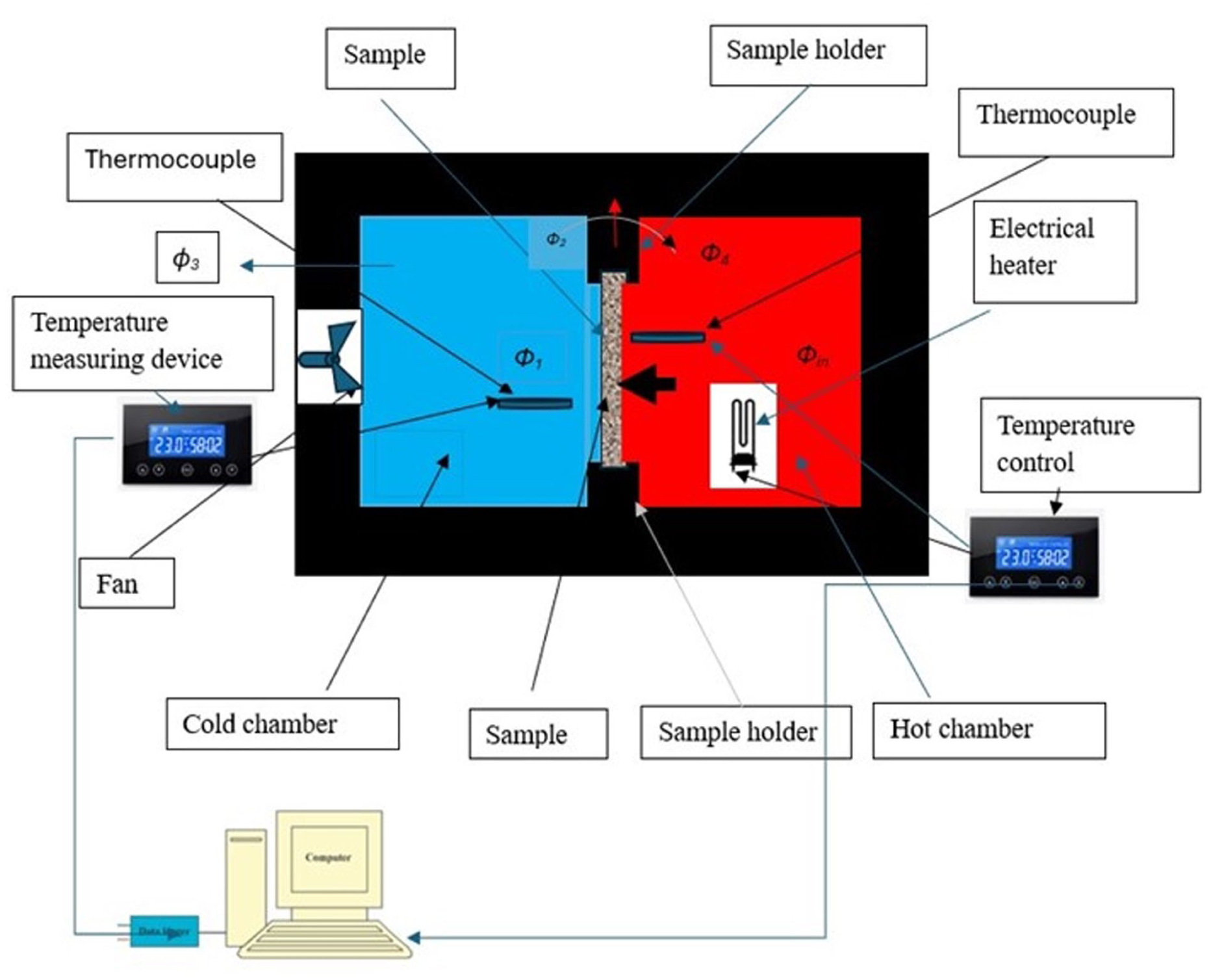
Layout and sample positioning in the modified hot box. Φ1, heat flow in the hot chamber (W), Φ2, difference heat flow in the plane of the sample holder (W), Φ3, Heat flow through the sample (W), Φ4, Heat flow through the sample holder(W), Φ1n, input heat flow (W).
The sample panel was positioned with its top surface exposed to ambient room temperature during being enclosed within the hot box. Heat transfer across the panel was induced by maintaining a controlled temperature difference between the two chambers: specifically, setting a cold chamber temperature of (T0) °C and a hot chamber temperature of (T2) °C. This procedure was systematically repeated for each tested sample before initiating thermal loading tests. The change of cold chamber temperature (T1) and (T2) as a function of time was recorded. The total thermal transmittance (Ut) of the test panel was calculated using the following formula:

Where:
Tai and Tae represent the air temperature difference between the hot and cold sides of the sample (in Kelvin).
The panel total thermal resistance Rt (m2 K W−1) is calculated as the inverse value of the total thermal transmittance.
Flow chart of the experimental part
1. Material and Methods:
○ Material Selection:
■ Textile Fiber Waste
■ Unsaturated Polyester Polymer
2. Sample Preparation:
○ Sponge-like-like Samples
○ Thin Composite Samples
○ Opened Knitted Fabric Waste Samples
○ Blended waste fiber samples
3. Specifications of Samples:
○ Dimensions
○ Compositions
○ Preparation Methods
4. Modified Guarded Hot Box Setup:
○ Cold Chamber temperature adjustment TO: Cooling System
○ Hot Chamber T2: temperature adjustment Heating System
○ Cold Chamber temperature T1: Measured as a function of time (t)
○
5. Sample Placement and Testing:
○ Positioning of Samples
○ Establishing a Temperature Gradient in both chambers
○ Data Collection
6. Data Analysis and Results:
○ Thermal Conductivity Calculation
○ Comparison with Theoretical Models
○ Statistical Analysis
Sample specifications
The selection of
The samples were made of different types of pre-consumer waste. Increasing fiber content in the composite structure enhances mechanical strength, while compression improves thermal insulation performance. Additionally, research supports the use of fire-resistant coatings, which slightly modify thermal conductivity but add safety benefits. These findings validate textile waste-based panels as an effective alternative for eco-friendly automotive thermal insulation, balancing efficiency, sustainability, and affordability. Three specimens from each composite, sharing the same identification code, were evaluated. Table 3 gives the specifications of the different samples designed.
Sample specifications.

Statistical analysis
The thermal conductivity data collected from different composite samples were analyzed using ANOVA (Analysis of Variance) to determine whether there were statistically significant differences among sample groups. One-way ANOVA was applied to assess the influence of different tested parameters. This statistical evaluation ensured data reliability and validated the observed trends in thermal insulation efficiency.
Results and discussions
A trade-off between comfort, safety, and efficiency is of paramount concern in automotive engineering, especially for cabin components and thermal management. The thermal conductivity of these components impacts the resistance and heat conduction to a large degree, which, in turn, has an impact on fuel efficiency and passenger comfort.
Panel thermal resistance absorption of thermal energy (Ea)
The direction of thermal energy in a multilayer fibrous absorber due to some controlling parameters is illustrated in Figure 2. These are temperature gradient, porosity, thermal conductivity, fiber structure, and the prevailing modes of heat transfer (radiation, convection, and conduction). The fibers that form the matrix of the fibrous insulation panel remain between the top and bottom surfaces and are joined with the help of a binder matrix. Air pocket, fiber contact points, and overall density are affected by the fiber arrangement and porosity of the panel, which determine the thermal insulation behavior of the panel.33,34 Natural fibrous products have a more complex process of heat absorption than synthetic fibers because of their complex microstructure. Differences in size between fibers, irregular air pockets, and differences in material composition are the causes of the variations. All these cause porosity, thermal conductivity, and efficiency of heat transfer. Highly effective thermal insulation panels may be produced by properly choosing the fibers, piling them in a specific way, and changing the structural pattern.

Thermal energy balance of the insulator panel.
A thermal balance equation is used to quantify the absorbed thermal energy in fibrous insulation materials:

Where:
Etf is the total thermal energy absorbed by the panel
Ei is the initial incident thermal energy
Er is reflected energy
Erp1 , Erp2 are partial reflections at different layers
Eam1 and Eam2 are energies absorbed at different material interfaces
Ea1 is absorbed energy within the core fiber layer
The fibers that make up the structure of the fibrous insulation panel are between the upper and lower surfaces and are bonded together by a binder matrix. Air pockets, points of contact among the fibers, and density are all affected by the orientation and fiber porosity of the panel, which determine the thermal insulation properties of the panel.33,34 Natural fibrous materials possess a more intricate mechanism of heat absorption compared to synthetic fibers due to their intricate microstructure. Differences in fiber sizes, inhomogeneous air spaces, and variations in material constitution account for this. They all influence porosity, thermal conductivity, and the effectiveness of heat transfer. Effective thermal insulation panels may be produced by selecting the fibers, arranging them suitably, and optimizing the structural design.
Heat insulation panel design mechanism
Automobile heat insulation panel design includes material selection, layer optimization, and thermal conductivity, understanding to optimize heat management. Panels control temperature to maintain comfort levels for occupants and safeguard vehicle components from overheating. In cars, the construction of heat insulation panels involves material selection, optimization of layers, and realization of the thermal conductivity theory to attain improved heat regulation. They control temperature to maintain passenger comfort and prevent car components from being overheated.
Materials select and layer construction
The design of insulation panels is based on thermal conductivity (k) because this property measures the ability of a body to transfer heat. A smaller value of (k) denotes good insulation properties. Based on composition by material and mode of production, composite insulating panels consisting of polymer matrix and waste fiber fabrics have a (k) value ranging from 0.03 to 0.16 W/m·K. In addition to material and polymer matrix selection, the thermal insulation property depends on a complex set of interlinked environmental factors. Figure 3 is the fishbone diagram of the major causes of thermal resistance: porosity, density, environmental conditions that affect it, and fiber direction. Blending the textile waste and polymer matrices provides a green path toward thermal insulation panel production.

Fishbone diagram of the most influential factors on thermal resistance in insulation panels.
Blending textile waste with a high fiber volume fraction (65%) into polymer matrices offers a sustainable approach to producing thermal insulation panels. This process repurposes post-consumer and industrial textile waste into functional, high-performance composites, significantly reducing reliance on virgin polymer materials while enhancing insulation efficiency.35–37
Analysis of the effect of the different designed composite samples
Thermal insulation panels in vehicles are required to meet thermal performance, mechanical strength, and environmental control standards. Car engineers can create high-performance and environmentally friendly thermal management materials through material properties optimization, multi-layered structures, and novel insulation processing. 38 Thermal performance, mechanical strength, and environmental sustainability need to be optimized in automobile thermal insulation panels. Both efficient, eco-friendly thermal management systems can be created by car engineers via material property optimization, multi-layer structure, and new insulation techniques. 38
Figure 3 shows the fishbone diagram of the most influential factors on thermal resistance in insulation panels.
The graph represents a multi-variable interdependent system where processing, structure, and materials (fibers, additives, polymers) interact to control thermal conductivity. Optimizing such parameters is the secret to providing high-performance, cost-efficient, and sustainable vehicle insulation panels.
Analysis of the effect of the different composite samples designed
Table 4 gives the results of testing the different samples
Thermal conductivity of the composite samples.

Standard deviation (W/m·K).
The thermal insulation panels for automotive applications must balance thermal performance, mechanical durability, and eco-friendliness. With material property optimization, multi-layered structure, and new insulation techniques, automotive engineers can achieve very efficient and environmentally friendly thermal management systems. 38
Ecological compatibility, mechanical strength, and thermal performance must be traded off in thermal insulation panels for vehicle applications. Highly efficient and environmentally friendly thermal management systems can be created by automotive engineers through the optimization of material properties, multi-layered structures, and novel insulation concepts. 38
Thermal conductivity values of samples (ID 1–10) and sponge-like samples (ID 1S -10S) are statistically different (p < 0.05) according to the two-sample t-test, as indicated in Figure 4. Sponge-like samples have much higher thermal conductivity (k) than the samples (ID 1–10). This shows that the sponge-like substance has strange thermal behavior, due to its composition or its structure. Figure 5 shows a comparison of experimentally observed and theoretically predicted values of thermal conductivity for various models.

Thermal conductivity for different types of samples.

Comparison between the measured and theoretically calculated value of the thermal conductivity of the sample.
There are several reasons for the difference between experimental observation and theoretical prediction, some of which are assumptions and approximations in theoretical models, microstructural differences of the material, interfacial thermal resistance, fiber orientation and distribution, polymer matrix effect, and fiber type and distribution in the composite. There are considerable differences between the calculated theoretical values and experimental values in the five theoretical models (Parallel, Series, Maxwell-Eucken, Lewis-Nielsen, and Bruggeman) when thermal conductivity data are compared. ANOVA results show the differences to be statistically significant (p < 0.05), with a large F-statistic value showing high variability between the models and the experimental data. Having the nearest forecasts to the experimental data and the smallest mean absolute percentage error (MAPE) = 21.13%). The Series Model is the most accurate of the models. The Parallel Model is the least accurate since it has the highest variance. The Series Model is the best model for this data set, even though none of the models precisely replicates the reported thermal conductivity. Shows the minimum deviations from the experimental values for all the samples, indicating that it is the best model among the given ones (the correlation coefficient r value is 0.92).
Design of the thermal resistance panels for automotive
The automobile industry relies on composites due to improved strength-to-weight ratios, efficiency, and performance. In addition to mechanical benefits, composite materials also provide thermal insulation with possibilities of heat resistance control and dissipation to provide passenger comfort and vehicle longevity. Thermal properties of composites are influenced by fiber loading, tensile strength, air space, and type of additives, all of which influence heat transfer phenomena. Studies have shown that air voids in composite parts provide thermal insulation against heat, while heat-conductive fillers can increase heat extraction in automobile use. As engineers can design the optimal interaction between matrices and fibers and structure configurations, they can manufacture high-performance composites that can sustain heat resistance with efficiency to facilitate improved thermal management of next-generation vehicles39,40
Effect of panel density
Several parameters, including fiber type, matrix material, fiber orientation, and voids’ presence or porosity, can affect the correlation between density and heat conductivity in fibrous composites. Increasing the density of a fibrous composite can sometimes increase its thermal conductivity, especially if the fibers have a greater thermal conductivity than the matrix material. On the contrary, since the heat transmission channels are less, reduced porosity can result in lower densities that reduce thermal conductivity. 41 The fiber panels’ thermal conductivity and porosity were analyzed concerning panel density and fiber diameter, and the results concluded that with an increase in panel density, the thermal conductivity grew higher. Lower porosity and higher solid content of the structure with more paths of heat transfer, have been implicated as the causations. Therefore, the intricate relationship between density and heat conductivity in fibrous composites is a function of the particular fiber configurations and materials used. When composites are being engineered for thermal insulation or conduction applications. These considerations must be addressed. Additionally, composite materials, including textile fiber waste panels, can be viewed as materials with discontinuities in the fibrous structure; therefore, such a structure of discontinuity might have some impact on the heat conductivity of the fiber panel mat.
The thermal conductivity of all fiber sample panels is plotted versus sample density in Figure 6, showing the importance of panel density to thermal conductivity. Thermal conductivity and density have a high inverse relationship according to the graph, implying that thermal conductivity will decrease with an increase in density. This effect is explained by the analysis of voids and air gap functions, since air insulation characteristics create decreasing heat conductivity by way of smaller air spacing when the voids are larger under conditions of low density. The conclusions set the significance of the insulating capability of the inter-fiber voids, in agreement with the minimum in the curve of the thermal conductivity curve at the low densities. The power-law behavior observed could be attributed to the shift in dominance of heat flow from intra-fiber to inter-fiber pores.
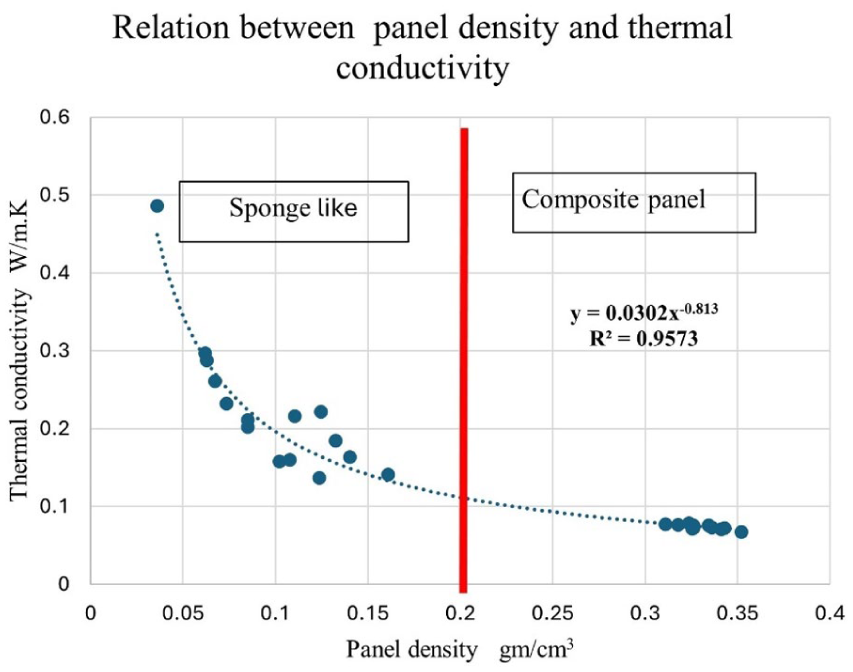
Thermal conductivity of the panels versus panel density.
The thermal conductivity (k) versus density correlation factor was 0.8, which was good. Studies on the thermal conduction characteristics of fiber mats confirmed that their ability to conduct heat is inversely dependent on density, particularly for tuft fiber/polymer composite samples42,43
This shows that at high densities, where the panels are denser and void spaces are minimized to the barest minimum, heat conduction is more effective. In samples (ID 1 S–10 S), reducing the bulk density in the panel resulted in a sudden drop in thermal conductivity; that is, heat conduction was even more effective at low densities when the panel was denser and contained fewer void-spaced samples (ID 1–10). Several studies have reconfirmed that the lower-density panels possess lower thermal conductivity, supporting the intuition that decreasing density will enhance insulation performance.44–46
Effect of porosity
Porosity (ϕ) and density (ρ) are inversely related in porous materials. As porosity increases, density will decrease since a greater fraction of the volume of the material is occupied by voids rather than solid material.
The bulk density (ρb), solid density (ρs), and porosity (ϕ) are connected by:

Where:
• φ is porosity (fraction or percent)
•
•
Figure 7 shows the effect of composite sample porosity on the thermal conductivity value

The thermal conductivity of the fiber waste/polymer panel versus the porosity.
The result indicates that the thermal conductivity of a fiber/polymer panel is increased with increasing porosity is surprising, as porosity will typically introduce pockets of air, which has low thermal conductivity (around 0.026 W/m·K). There are some cases where this may occur, however. If the increase in porosity makes the pore structure more interconnected, it can create channels for heat conduction through the solid matrix of the material. In this case, the solid fibers or polymer matrix may form a continuous network that promotes thermal conduction even with increasing porosity. 47 Thermal conductivity increases with porosity in fiber/polymer panels is due to the summation of several effects, such as improved solid-phase connectivity, fiber alignment, reduced contact resistance, or enhanced radiative heat transfer. This will be clear by comparing the effect of the porosity of the composite samples with that formed in a tuft shape alone (sponge-like structure; Figure 8).

Temperature conductivity of fiber waste/polymer panels and sponge-like structure specimens versus porosity.
The abrupt increase of thermal conductivity with porosity means that pores could create a network through which the heat can travel more freely, when the solid phase is very well connected or when pores have material with higher thermal conductivity than air (Fiber/polymer composite). The minimal increase in thermal conductivity suggests that porosity should improve contact between fibers or provide additional channels for heat transmission. The effect, however, is not as dramatic as that of a sponge-like structure. The findings suggest that porosity can be tailored to improve thermal conductivity in certain materials, as opposed to common expectations. The thermally conducting characteristics of high-porosity panels over compressed thin panels are a fact that attests to the complex interplay between control variables of heat transfer in porous materials.
Pore structure, air convection, and solid matrix contribution all play important roles in the overall thermal conductivity of the composite. Porosity tends to contribute to a decrease in thermal conductivity by providing air-filled pores, and interconnected pore networks, and air convection may enhance heat transfer in some cases. Air convection is suppressed, and pore structure is altered by compressing the material into thin panels, causing a new equilibrium of heat transfer mechanisms. Therefore, an integrated understanding of these competing parameters is important for the design and optimization of porous materials toward desired thermal management applications. The outcome shows that the geometric pore structure of the air pores in the material is the dominant factor for heat transfer control and porosity control in additive manufacturing materials can be a powerful tool to develop very efficient thermal insulation schemes.
Effect of panel tortuosity
Tortuosity is the snugness and length of air as it flows through a porous substance, that is, a polymer/fiber panel. It’s a quantification of the number of turns there are in the paths in the material. Consider the deviations from a straight line that fluid or gas takes as it travels through the material. The fibers in fiber composites create a devious set of pathways. Higher tortuosity indicates a longer and more tortuous path, it also influences thermal conductivity. The void space complexity in the panel, however, makes the quantification of tortuosity challenging.48,49 In this study, the tortuosity model for random fiber structures. 48
The value of tortuosity is provided by

Where α is a geometrical parameter as a function of the fiber structure. For random fiber structures, α ≈ 0.5,

(a and b) Thermal conductivity versus tortuosity. (a) composite panel and (b) sponge-like panel.
The thermal conductivity of the composite panel decreases as tortuosity increases. The lower slope of this trend indicates that changes in thermal conductivity occur gradually with increasing tortuosity. A stronger inverse relationship is observed in the sponge-like panel, suggesting that as tortuosity increases, thermal conductivity decreases significantly. Panels with a denser structure and more uniform fiber distribution experience a moderate effect of tortuosity on thermal conductivity. In contrast, the sponge-like panel, characterized by a more porous structure, contains greater air gaps and irregular fiber arrangements, which leads to a more pronounced impact of tortuosity on thermal conductivity.
In the composite panel, heat conduction primarily occurs through fiber contact; thus, while tortuosity affects the heat path, its impact is not substantial. Conversely, in the sponge-like panel, thermal resistance from entrapped air is the dominant mechanism, making tortuosity a crucial factor in disrupting heat transfer. The sponge-like panel is more sensitive to changes in tortuosity due to its highly porous nature, where increasing tortuosity significantly disrupts thermal pathways. The composite panel, however, shows a more gradual response, attributed to its denser material structure, which allows for effective conduction even with increased tortuosity. These results emphasize the importance of considering porosity and tortuosity in the design of thermal insulation materials.
The empirical equation for thermal conductivity (k), estimates the relationship between dependent and independent variables when the equation is not linear in its parameters. The regression process involved fitting the proposed empirical model:

Where
k1 is (1/((Popened denim fiber waste/k) +(Ppolyester/kpolyester))
Ware fiber weight g
d is the density of the composite kg/m3
t is Thickness m
Opened denim fiber waste and flax thermal conductivity (k) open denim fiber waste is 0.04, 0.035 polyester polymer thermal conductivity (k) is 0.2. Least squares experimental data. The least squares approach tends to reduce the sum of the squares of the errors between the experimentally determined thermal conductivity and calculated values from the equation. The fit was done using Python’s SciPy curve-fitting package (curve_fit) and Excel Solver, both of which iteratively adjusted to the constants (A, a, b, c, d, e) to minimize the error. As a measure of the goodness of the equation, we calculated the coefficient of determination (R2), the extent to which the model accounts for the variation in data. A high R2 value of 0.99 shows excellent agreement between experimental and predicted values. Additionally, the MAPE value of 2.4% and low Root Mean Square Error (RMSE) prove that the equation is valid for predicting the thermal conductivity with zero deviation from experimental results. This statistical verification proves the empirical model to be strong and safe for predictive modeling of textile fiber-polymer composite panels. Following the nonlinear regression of the data set. The optimized parameters are as follows: A is 5357, a = 0.72, b = 0.2, c = −0.65, d = 1.14.
Figure 10 shows the match between computed and measured values concerning equation (5).

Calculated values of the thermal conductivity versus the measured values.
Thermal resistance panel design for vehicle interiors
A few of the uses in automotive interiors include door panels, headliners, trunk liners, seat backs, and dashboard components. Management of the thermal performance of automobile interiors is the most important aspect of comfort and energy efficiency. Thermal resistance car panels must possess some characteristics to be efficient, effective, and long-lasting. A few of the characteristics are tensile strength of 150–500 kg/m³, influencing the overall insulation performance and panel strength.50,51 The tensile strength of the panel should be between 5 and 50 MPa to withstand mechanical load. Elongation at break, or the indicator of flexibility, must be between 10% and 50%. Flexural strength, or the quantification of the resistance of the panel to bending stresses, should be between 2 and 15 MPa. Compression strength, or that which holds the shape of the panel under pressure, should be between 0.2 and 4 MPa. Impact strength, for dissipation and absorption of energy, must be 3–20 kJ/m². The thermal conductivity (k-value) of the panel must be 0.025–0.08 W/m·K for thermal insulation. Such properties enable thermal resistance panels to effectively play their role in energy efficiency and passenger comfort in automotive applications.
This range is application and material dependent, for example, in the cabin of the vehicle, different components have their thermal conductivity values: roof panel is 0.14 W/m·K, door panel is 0.15 W/m·K, floor carpet is 0.04 W/m·K, dashboard is 0.17 W/m·K, and seat foam is 0.05 W/m·K. 50 These numbers show how thermal conductivity can change across the cabin, and how this affects how the inside of the vehicle allows for the conduction of heat. The components of panel manufacture are shown in Figure 11. Polyester and waste fibers were encapsulated within a woven fabric sample produced on a DORNIER weaving machine, with 100% flax being used as weft yarns and 100% cotton as warp yarns. The fabric requirement is given below: warp yarn 49.2 tex, weft yarn 209.4 tex, 10 ends/cm, 16 picks/cm, and area density of 378.16 g/m². Composite was created by mixing opened denim waste and flax fiber waste and tightly coiling on each side using opened cotton/flax fabric. The use of a polyester polymer matrix and a surface that is coated with a thin, fire-resistant coating is as in Figure 11.

Construction of the composite panel.
The natural fibers application, such as flax waste, to composites promise to significantly enhance the thermal resistance of polymers and textile fiber waste-based composites. Natural fibers are characterized by their lower thermal conductivity than synthetic fibers and, therefore, provide a better option for maximizing the material’s thermal performance as a whole. In their efforts to access these enhancements, several samples were prepared with definite compositions and characteristics, as specified in Table 5.
Modified sample results.

The thermal conductivity (k) regression analysis of the composite panel depicts significant correlations with the blending ratio of the fibers, fire protection material content, and panel thickness. The findings depict an increase in thermal conductivity (k) marginally with increasing flax fiber content. Conversely, the inclusion of fire protection paint has a highly significant decrease in thermal conductivity. There is a positive correlation between panel thickness and thermal conductivity, that is, thicker panels have higher thermal conductivity.
The regression model is extremely accurate, with predicted values closely matching measured values. The regression equation derived from this analysis is:

x1 is Opened Denim fibers waste%
x2 is the Flax fibers waste%
x3 is Polyester%
x4 is Fire Protection polymer%
x5 is the panel thickness in mm
This equation (5) is a predictive expression for the thermal conductivity calculation of similar composite panels based on composition and structural characteristics. The output highlights the significance of the fiber and functional additives choice in delivering the utmost thermal insulation capacity of the material. This equation reveals the contribution of each component to thermal conductivity. Denim fiber waste and flax waste have negative values because they act as insulators, and additives for fire protection raise k a little. The thickness of the panel influences k to the greatest degree, Table 6, reflects a linear one where the increased thickness of the panel leads to increased thermal conductivity. The model can accurately simulate the measured ones; therefore, it is acceptable to use it in material optimization for thermal insulation purposes. Surface coatings such as fire protection coatings can play an important role in the thermal conductivity (k) of porous materials. Surface pore closure through coating reduces material porosity and thus increases thermal conductivity. Pores filled with air are thermal insulators.
Comparison of the measured thermal conductivity and predicted thermal conductivity (k) values.

The most suitable textile waste panel for car cabin interior thermal resistance panels is the CS series (10% fire protection, 4.3 mm thickness). Its thermal conductivity (0.065–0.068 W/m·K) is competitive with that of traditional materials, and its fire protection factor adds an extra dimension of protection. Something like polyurethane foam has a little bit better thermal performance. CS series samples offer a green and sustainable solution. So, it is a good candidate to be used in the automotive sector, especially in the context of circular economy initiatives and reducing environmental footprint.
Figure 12 is a photograph of the entire inner part of a car door, which has been fabricated using Denim fiber waste/ flax-polyester compressed composite

The interior part of a car door.
Conclusion
This study succeeded in demonstrating the viability of post-industrial textile waste as a high-performance automotive thermal insulation material. Experimental data confirm that sponge-like composites of fibers exhibit a low thermal conductivity of 0.137 W/m·K, which further increases when compressed (0.067 W/m K), enhancing the insulation performance. Thermal conductivity is even greater when fiber-polymer composites are developed through polyester matrices, and they achieve a minimum of 0.142 W/m·K, making them applicable for structural purposes with heat dissipation control.
In addition, blending the flax fiber waste with other textile wastes improved the insulation performance to a top thermal conductivity of 0.164 W/m·K, but compression reduced the thermal conductivity to 0.065 W/m·K, emphasizing the requirement for density optimization. Advanced thermal conductivity simulations and experimental validation by the hot box, with the modification of the hot box ensure the validity of the findings for real-world automotive thermal management systems.
The results confirm the use of fire-resistant polymer coatings with minimal impact on thermal conductivity, solidifying them as safety-enhancing additives without compromising insulation ability. The regression equation developed in the course of this study (R² = 0.99, MAPE = 2.4%) is an effective predictor device for the optimization of fiber-polymer composites, whereby the processing may be scaled up in automotive panel manufacturing.
From thermal resistance panels of different types of textile waste fibers come a model of predicted accuracy regression, to predict thermal conductivity (k) from ratios of mixed fibers, panel thickness, and a fire-resistant coating, was established by the regression equation (5). The model established a high correlation (R² = 0.99) between predictive and experimental measurements with a mean absolute percentage error (MAPE) of 2.4%, verifying it. Use of fire protective coatings reduces the porosity on the surface and also increases slightly (k) by closing the air space gaps, thus leading to an increase in insulation. Theoretical thermal conductivities calculated with a series model equalized to experiment within a difference of 21.13%. CS series samples offer the optimum choice of textile waste panel for use as applications of thermal resistance solutions in car cabins. With a thermal conductivity of 0.065–0.068 W/m·K, they are as effective as conventional insulation materials. The work brings to the front the utilization of sustainable composite materials as a substitute for conventional thermal insulation panels, as a cost-effective, sustainable solution that is consistent with circular economic principles and demanding automotive requirements. Additional research in long-term endurance tests and fire resistance for composites in conditioned vehicle environments is suggested as a way of stimulating their industrial use.
Footnotes

Funding
The authors received no financial support for the research, authorship, and/or publication of this article.
Declaration of conflicting interests
The authors declared no potential conflicts of interest with respect to the research, authorship, and/or publication of this article.