



Abstract
The increasing production and improper disposal of plastic waste present a major global environmental challenge, highlighting the need for sustainable solutions. This review thoroughly examines the use of waste plastics in composite material production, providing a dual benefit: reducing environmental impact while creating valuable materials. This review examines the scale and ecological impact of plastic waste, focusing on various types of waste plastics, such as thermoplastics and thermosets. In-depth discussion includes various processing techniques such as melt blending, compression molding, extrusion, and injection molding. The review discusses various reinforcing materials used with waste plastics, including other polymers, natural and synthetic fibers, sand, clay, fly ash, and additional recycled materials. The focus is on analyzing mechanical, thermal, physical, and chemical properties, considering factors like waste plastic-type, reinforcement type, processing parameters, and additives. This review serves as a valuable resource for researchers, engineers, and policymakers aiming to find sustainable solutions for plastic waste management and to promote a circular economy.
Keywords
Introduction
Plastics are widely used materials that are not biodegradable. Despite this, their affordability and versatility make them popular in various applications. People utilize plastic daily for a multitude of purposes. The following materials are used extensively in commerce and at home, 1 including packaging, 2 office supplies, 3 logistics, 4 pharmaceuticals, 5 and electrical equipment. 6 In modern life, it is essential for various applications, from packaging to household items. However, due to its durability and resistance to decomposition, it poses a significant environmental threat if not managed correctly. 7 This reliance necessitated the disposal of plastic waste, which accumulates and cannot be reused due to its environmental harm. It was a significant challenge for everyone to manage the trash and arrange its disposal. 8 Improper disposal of plastic waste and insufficient recycling can cause many problems. Landfills are among the areas affected by plastic waste. 9 It also impacts river depths. 10 This also hurts the seas. If not managed well enough, plastic trash can get to animal systems through natural habitats such as the marine environment.11,12 Furthermore, it damages our environment; in addition, this waste material poses a considerable risk to human health, as it may take a significant time before any visible effects are noticed among individuals. 10
Managing waste effectively requires identifying different types of plastic waste. One-time-use items like water bottles, straws, and bags, as well as microplastics (tiny pieces created when larger plastics break down), are examples of plastic pollution.13,14 It is essential to recognize and treat the sources of these polymers.
From Figure 1, we can observe the global scenario of plastic waste management. 15% of the plastic garbage produced worldwide is recycled. Numerous factors contribute to this low rate, such as the difficulty of recycling various plastic types, the contamination of plastic waste, and the dearth of infrastructure in many areas.
15
Roughly 25% of trash plastic is burned to recover energy. More advanced incineration plants found commonly throughout developed nations such as Europe can effectively minimize emissions by converting waste to energy.
16
Landfills receive 35 % of plastic waste. This method is used widely in many countries because it is cheaper, and there are few alternatives for waste management. However, it has severe environmental risks, such as polluted soil and groundwater.
15
The environment gets polluted when about 25% of plastic trash is improperly collected or handled. This is a big problem in low- and middle-income countries as they do not have enough infrastructure for garbage disposal.
16
Plastic waste utilization worldwide.
The primary solution to the plastic issue is to use less of it. One way is to make intelligent choices so that no unnecessary throwaway plastics are used; likewise, carrying around with reusable bags or water bottles instead of buying new ones each time would help. 17 Living and shopping wisely will reduce the amount of plastic garbage made. When it comes to plastic waste management, recycling is crucial. We must segregate plastic products and deliver them to recycling plants to avoid much of them ending up in dumps and polluting the environment. 18 We must follow the recycling rules where we live and ensure that plastics are clean and free from contaminants before recycling them. One popular method of dealing with plastic waste is creating composite materials. Waste plastic cans are mixed with reinforcing or matrix elements to make composite materials. Here are a few typical techniques for producing composite materials from used plastics: melt blending, 19 compression molding, 20 injection molding, 21 vacuum infusion, 22 filament winding, 23 3D printing 24 etc.
Composite materials from recycled plastics have many benefits and are vital for solving environmental problems. Using old plastics in composite materials offers a creative and environmentally friendly way to deal with plastic waste. Putting thrown-away plastics into composites can help to lower the amount of plastics ending up in landfills or being improperly disposed of in the environment. 25 A circular economy cannot be achieved without converting waste into valuable products. Plastic wastes highly contribute to environmental pollution. Mixing disposed plastics with composite materials ensures that the environment is less affected. Composite materials are more effective than traditional materials in minimizing the extraction and consumption of natural resources and reducing carbon emissions and energy usage. 26
Amount of plastic waste consumed for composite material production in industries all over the world.

The environment can be protected against damage while reducing carbon dioxide emissions by reusing plastic waste to manufacture more sustainable composites. By turning waste plastics into composite products, we can better use resources and decrease the demand for new materials. This promotes a more sustainable approach to material usage, reduces the reliance on producing new plastic, and helps conserve natural resources. Additionally, composite materials from recycled plastic often have superior mechanical properties to pure plastic materials. 27 The strength, stiffness, and impact resistance of composites are enhanced by adding reinforcing agents such as fibers or nanoparticles. This makes them suitable for a range of uses in consumer goods, automotive, aerospace, and construction industries. Composite materials allow for the creation of unique products thanks to their flexibility and adaptability in design. Combining waste plastics with different matrix materials and various reinforcing agents makes it possible to tailor composite materials to specific applications, improving the functionality and performance of the final products. Due to their lightweight nature, composite materials are ideal for applications where weight is a concern. 28 Composite parts are used in automotive and aerospace applications because of their lighter weight, use less fuel, and emit fewer pollutants, making them an environmentally beneficial alternative. 29 When it comes to materials, using composites made from waste plastic often results in a longer lifespan and better durability compared to traditional materials. These composites can withstand harsh environmental conditions such as UV rays, moisture, and chemicals. As a result, they require fewer replacements, saving both money and reducing waste. Using waste plastic in creating composite materials has also led to new business opportunities and innovations. Research and advancements in composite fabrication, recycling techniques, and material science are helping to drive the growth of businesses focused on waste plastic recycling and composite manufacturing, ultimately contributing to economic development and job creation.
Materials and methods
You can use waste plastics as a base and reinforcement material in combination with various components. Plastic polymer, acting as a matrix, primarily maintains the structural strength of the fibers by holding them in place. In addition, it shields the reinforced fibers from the effects of their surroundings while transferring the load between them.
30
For construction engineering purposes, plastic debris is utilized as the basic building block or matrix to manufacture paver blocks, bricks, tiles, and wood-plastic composites. However, waste plastics may be employed as reinforcing material in place of the fine or coarse aggregates used in cement admixtures to manufacture cement concrete construction blocks.
31
Figure 2 represents the classification of composites acting either as reinforcement or as the matrix. The incorporation of waste plastics as a replacement for hybrid materials extensively affects the overall properties of finished products.
32
The filler or reinforcement provides additional strength, stiffness, and other properties to the composite. Classification of waste plastic composites where plastic acts as reinforcement or a matrix.
Plastic composite where plastic is used as matrix/binder/binding material
In plastic composites, the plastic acts as the matrix, forming a material that combines with various fillers such as sand, clay, natural fibers, and glass. The fillers improve certain composite features, including durability, rigidity, and heat resistance. The plastic matrix holds the fillers together, providing cohesion and structural integrity to the final material. This combination of plastic with different fillers results in a versatile range of composite materials suitable for various applications, including construction, automotive, and consumer goods industries. The fillers’ choice and proportion in the composite can be adjusted to utilize them for specific applications and requirements.
Plastic-sand composite
Cement-free paver blocks were manufactured utilizing plastic waste (LDPE) and sand to manufacture with basalt fiber.
33
To improve the mechanical characteristics of the building blocks, 0.1%–1% of basalt fibers were added to varying compositions of the plastic-sand composite, which comprised around 144 of the total samples. The study mainly focused on producing environmentally friendly and economically viable paver blocks to promote sustainable growth. The feasibility of creating thermoplastic composite floor tiles using waste plastic material and commercially available silica sand was investigated, with waste plastics utilized as cement substitute binding agents (Figure 3).
34
The plastic wastes were collected according to their color values using a computer-automated system. Subsequently, the aggregates were sliced into tiny fragments (10–15 mm) and combined with sand (150 µm) in three distinct proportions. This was done before melting and pouring the 150 × 150 × 50 mm mold at a pressure of 20.7 MPa. Flow diagram illustrating the specimen development process (CC by 4.0).
34

The mechanical properties of sand blocks made with polyethylene plastic waste were described.
35
Batches of plastic garbage were gathered, melted, and mixed with naturally occurring river sand that had been sieved using a 4.75 mm mesh screen. The homogeneous mixture is poured into molds and compacted using a tamping rod, followed by curing. Mechanical tests assess compressive and flexural strengths. The method aims to understand how plastic waste affects the mechanical characteristics of the resulting bricks. Waste plastic was used as a binding agent for cement-free paver blocks, which were categorized into three groups: HDPE, PP/PS, and a combination of all three (Figure 4).
36
Natural river sand with a 3.18 fine-ness modulus was sieved according to the Indian Standard Code (IS: 2386- Part I-1963). HDPE, PP/PS, and all mixed-type plastics were randomly shredded and blended with specified sand, keeping the ratio from 40% to 70%. The specimens were prepared in a tri-hexagonal form, and each hexagonal unit had 60 mm sides that were 60 mm thick. The average setting time was 19 to 24 minutes, while all the combined specimens were subjected to compression evaluations at temperatures ranging from 15 to 60°C. (a) Dimension and (b) molded units of paver block (CC by 4.0).
36

The development of plastic-bound sand composites was investigated as a low-cost recycling solution for waste plastics in underdeveloped nations (Figure 5).
37
The research investigated LDPE and HDPE-based composites and determined the best processing temperatures (250°C - 325°C) for generating good compressive and flexural strengths. The sand was separated into three particle-size fractions, and two manufacturing methods were used. The heat-mixing method (HMT) involved melting plastic and mixing it with sand before cooling, while the oven molding method (OMT) involved stacking plastic and sand before heating and cooling to form samples. The study examined the impact of processing temperature, thermoplastic binder type, quantities, and particle size on the qualities of the resultant plastic-bonded sand. Figure 5 represents the processing methods, including sorting, melting, mixing, and casting of plastic-bonded sand paving tiles. Sand-plastic composites were investigated to optimize their compressive strength.
38
The research utilized a mixture design of experiments to identify the most practical combination of materials for enhancing compressive strength. This involved varying the proportions of sand and plastic within the composite. Waste plastic and sand composite were utilized as construction materials using the melt-mixing method.39,40 Table 2 represents the studies concerning plastic-sand composites, focusing mainly on construction and building purposes. Sorting and melting leftover LDPE plastics, combining sand with molten plastics, and pouring the mixture into steel molds are the steps involved in creating plastic-bonded sand paving tiles (CC by 4.0).
37
List of the studies concerning plastic-sand composites.

Plastic-polymer composite
A plastic polymer matrix is reinforced with tiny plastic particles or fibers during polymer-polymer composite formation. Plastics composed of two or more different types of polymers are blended to create a composite material with improved properties. Waste plastics (polyvinyl chloride) from water tanks and tires were incorporated with various compositions into a polyester resin matrix to create polymer-polymer composites. The impact of this reinforcement on the resulting composites was investigated. 42 Waste tires and tanks were ground using a grinder of 1800 W at 2800 r/min speed to obtain particles of 1000 microns. 16 different types of specimens were prepared to investigate the specific mixtures with higher performance, including hardness and tensile strength, compared to individual components when utilized separately. Polyethylene terephthalate and low-density or high-density plastics (LDPE/HDPE) are two materials whose mechanical properties were assessed by Laria et al. (2023). Based on a mechanical resistance test, the recycled material’s tensile strength and compressive strength were judged to be around 60% that of a virgin material. This approach was used to recycle plastic materials and mold them into different specimen forms for mechanical testing utilizing particular equipment and conventional testing protocols. The acoustic properties of polymeric hybrid composites were investigated using varying weight fractions of unsaturated polyester (UP) combined with either high-density polyethylene and polystyrene or polymethyl methacrylate. 43 Ultrasonic tests were conducted to measure the time the ultrasonic waves traveled through the composite materials, from which the velocity and acoustic impedance were calculated. Compared to the reinforcing material’s density, the results indicated that raising the weight percentage of the constituent materials increased their density. UP/PMMA + PS at 28% had the highest acoustic impedance, indicating better ultrasonic wave dissipation than UP/PMMA + HDPE. The feasibility of using recycled polyethylene (PET) and polypropylene (PP) as an alternative to calcium carbonate in sewage and water pipes was evaluated. 44 By substituting 30% of the original blending of PET/PP with commercial waste containing a 70/30 wt percent ratio of PP to PET, the goal was to retain material stiffness. The effect of adding a commercial compatibilizer containing 5% maleic anhydride (MAh) was also evaluated. Morphological analysis, heat treatment, and mechanical properties of several formulations were assessed, and the best-performing mix was selected for an industrial-scale assessment, resulting in the practical manufacturing of a pipe utilizing recycled PET and PP. Polymer-polymer coupling microfibrillar plastic composites made from low-density polyethylene and polyethylene terephthalate were investigated to determine how the blend ratio affects their physical and sorption properties. 45 The method involved preparing microfibrillar composites by blending LDPE and PET at different ratios. Additionally, sorption behavior was studied by analyzing the moisture uptake and the properties related to water absorption at various blend ratios. These mixes’ flexural durability, stiffness, and other mechanical features were then assessed using mechanical testing. The impact of a compatibilizer on the mechanical characteristics of recycled PET blends containing polyethylene, polypropylene, and polystyrene was documented by. 46 The study involved preparing blends of recycled plastic polymers with a compatibilizer. The compatibilizer is introduced to enhance their compatibility and improve the adhesion at an interfacial level between the different polymers. Recycled PET was blended with EGMA, a glycidyl methacrylate copolymer, through a series of reactive processing experiments. 47 The reactive processing promotes chemical bonding between the two polymers, enhancing their compatibility and mechanical features.
Plastic-natural fiber composite
Natural fibers are cost-effective and derived from regenerative resources. The composites’ reinforcing capabilities now widely acknowledge these fibers’ positive influence. While they often show more elongation, which improves their ability to withstand damage, their tensile strengths and moduli are typically lower than those of polymeric fibers.
48
Natural fibers with varying integrity levels enhance the mechanical characteristics of fiber-reinforced waste plastic composites, as shown in Figure 6. Classifications of natural fiber (CC by 4.0)
30
(Amjad et al., 2022).
Waste plastic (expanded polystyrene foam board) and natural fibers (coconut husk and banana stem fiber) were combined to create composites using the dissolution method with mixed organic solvents. 49 Chemically treated (5% w/v NaOH) and untreated natural fiber were served as reinforced material and mixed with different proportions of polystyrene to raise the mechanical behavior of the waste composite material. Green composites were prepared by melt blending rice husk (a bio-filler) with recycled high-density polyethylene and polyethylene terephthalate wastes. 50 The green composites’ thermal, physical, and mechanical strengths for plain (un-compatibilized) and mutually reinforcing rHDPE/rPET blended composites were assessed as components of biofilter content. Recycled polyethylene and polypropylene combined with natural date palm fiber were compressed into composites with enhanced properties. 51 Alkali-treated (5 wt% NaOH) filler was processed to different lengths and compositions to be incorporated into polymer matrices to improve the transmitting action and the micro-failure mechanism.
Various lignocellulosic biocomposite-based architectural and structural applications were explored, highlighting different fabrication methods influenced by the specific nature and properties of the bio-composites.
52
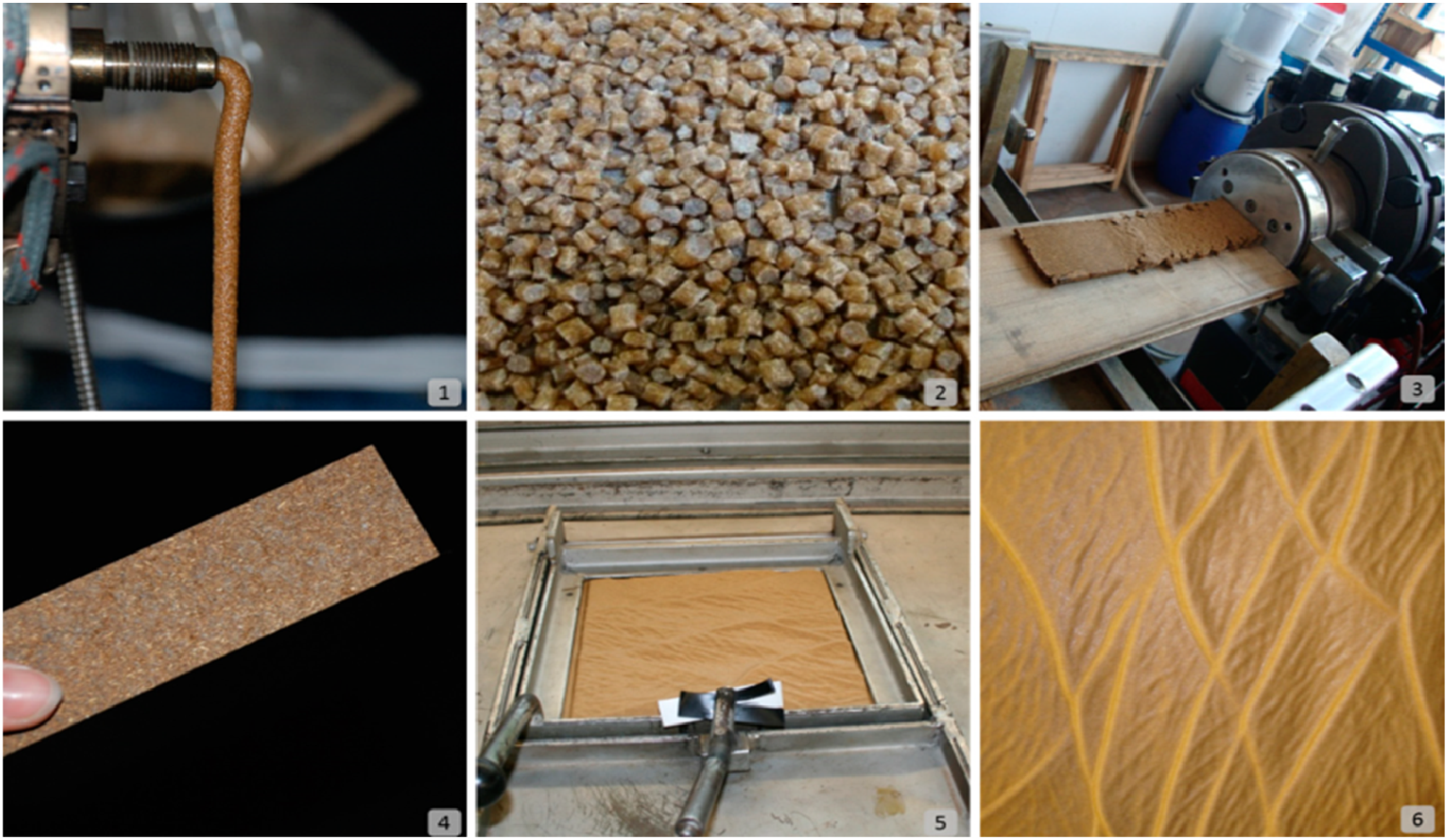
Depending on their utility or applicability, direct extrusion could be employed in a finished product using a mold to create thermoplastic bio-composite or pelletized for further extrusion or injection molding (Figure 7; 1-3). Due to the length of natural fibers like kenaf, flax, hemp, and cotton, different compounding techniques, including comingling, are employed. Hot pressing after processing enabled adequate polymer dispersion, leading to the production of high-performance composites. Lamination, drilling, and thermoforming were the finishing techniques (Figure 7; 4-6) that gave objects their final visual appeal and design, which was especially important in architectural applications. Table 3 enlisted the thermoplastic polymer and natural fiber composite list. The methods involved in producing a thermoplastic composite survey are as follows: (1) amortization, (2) granulating, (3) extrusion, (4) sliced panel, (5) the thermoforming procedure, and even (6) thermoformed final completed panel. (CC by 4.0).
52
Analyzing the processing of thermoplastic-natural fiber composites (CC by 4.0).
53

Plastic-synthetic fiber composite
Synthetic fiber-reinforced polymer matrix has gained enormous attraction in recent decades due to its outperforming characteristics, imparting lightweight, improved stiffness, elongation, modulus, and tensile strength compared to traditional tailored matrices.
56
Synthetic fibers are categorized and sub-categorized according to their origin, as shown in Figure 8. The applicability of composite materials depends on the fabrication methodology, the choice of fiber types, suitable size, and proper orientation, and the bonding nature (chemically or cohesively bonded). The superior properties of synthetic fibers in terms of flexibility, thermal and chemical resistivity, electrical conductivity, fatigue stability, and elasticity compared to natural fibers make them suitable for aerospace, automotive, indoor, and outdoor applications.57–59 Figure 8 lists synthetic fibers as organic, inorganic, and other subcategories. Classifications of synthetic fibers (CC by 4.0)
56
.
The fabrication methods of synthetic fiber-polymer composite.

Plastic-fly ash composite
Fly ash consists of lightweight and minute granules that emerge from the exhaust fumes as a byproduct produced by the combustion of coal in the ignition chamber of a thermal power plant. 67 Fly ash can be used as an additive in the polymer composite to improve waste plastic polymers’ mechanical stability, workability, and flexibility.68,69 Using waste plastic and fly ash as composite materials provides diverse applicability for building and construction purposes, strengthening the polymeric properties and promoting economic efficacy for sustainable development. 70
Several mechanical68,71 and chemical 72 methods were employed to investigate the improved properties of fly ash-based composite materials.
The impact of fly ash particle size on high-density polymer-based composite materials was investigated.
53
The raw fly ash powders were first sieved to eliminate any bigger particles, followed by mixing and combining 10% of each of the three fly ash types with high-density polyethylene while maintaining a temperature of 220°C for 30 minutes (Figure 9). A 10% fly ash loading was made in light of earlier study results showing that while tensile strength may be compromised, more significant fly ash levels can improve the material’s tensile modulus. 10% fly ash was the best option to balance these mechanical qualities. Injection molding was used to create dumbbell-shaped samples for the tensile testing process. This process took place at a temperature of 240°C for 10 seconds. Four replicas of each type of composite material, including plain HDPE, were created to evaluate the repeatability of the tensile characteristics, as shown in Figure 9. Fly ash was incorporated as a filler in a waste plastic matrix, and a flame retardant was added at various loadings (5%, 10%, 15%, and 20%). The resulting materials were processed using a dual-screw extruder to evaluate their enhanced properties.
72
These materials were used to create composite tiles, and their qualities were assessed. The study analyzed the effects of different filler loading levels on the matrix’s waste plastic properties. The fabrication method of fly ash reinforced polymer(HDPE) composite (CC by 4.0)
53
.
Plastic-clay composite
Plastic clay composites combine plastic polymers and clay particles to create advanced materials with improved properties. These composites enhance mechanical, thermal, and barrier characteristics using clay particles with high aspect ratios and large surface areas. Their versatility allows customization for specific applications through enhanced performances for packaging, automotive, and construction materials.73,74 The improved physical properties of polymer clay matrices depend on the suitability of the clay type and adjusting the polymer with diverse quantities. Various processing methods enable the creation of diverse morphologies and properties in plastic clay composites.
75
Figure 10 shows the application and synthesis method of polymer clay composite. Graphical presentation of application and synthesis method of polymer clay composite (CC by 4.0).
75

Listing of different fabrication methods of polymer-clay composite.

Isotactic polypropylene nanocomposites containing sepiolite, a type of clay mineral, were synthesized. 81 Isotactic polypropylene was polymerized in situ with sepiolite nanoparticles, which were present as part of the metallocene catalysis technique—the process aimed to create a strong interaction between the polymer and the sepiolite filler for enhanced properties. Table 5 represents a different processing method for polymer/clay composites.
Plastic composite, where plastic is used as reinforced material
Waste plastic aggregates can be used as additives to assist in producing lightweight concrete because of their reduced specific gravity. Lightweight concrete was produced using waste yogurt containers made of polypropylene to replace coarse gravel aggregate in the hand lay-up technique. 84 Different compositions (0%–25%) of polypropylene plastics were incorporated to prepare the concrete, keeping a water and cement proportion of 0.5 and a mixing proportions of coarse aggregate, sand, and cement ratio of 4:2:1 with a curing time of 28 days. Density and compressive strengths decreased, although water absorption showed an increased trend of as much as 15 wt% about traditional concrete. Polyvinyl chloride (PVC) waste was used as a filler to replace fine or coarse aggregates in environmentally friendly concrete production. 85 Shredded PVC sheets were crushed manually with an electric crusher, followed by sieving with a grading range in between coarse and fine aggregate having a thickness of 0.49–0.95 mm, 1.3 specific gravity, and 13.95–32.12 MPa tensile strength mixed with fine sand and coarse gravel aggregates. The content of up to 30% of PVC aggregates showed improved properties, although, above that content of aggregates, there was a deterioration of physical properties. Self-compacting concrete was produced by replacing cement with plastic waste powder, and its mechanical properties were also evaluated. 86 PET from waste bottles was used as a replacement for fine or coarse aggregates (sizes determined by sieve analysis) in a reported study. 87 For finely ground aggregates, 0 to 4.75 mm and for coarse gravels, 4.75 to 20 mm were sieved. The specimens were elevated to 3000C and 6000C temperatures to investigate the compressive strengths that ultimately resulted in the formation of pores with poor strength. Numerous studies found that when the amount of plastic waste in concrete increased, the compressive strength of composite material decreased.88–90 The workability of concrete was enhanced by incorporating finely ground waste plastic into the production process and studying its effects. 91
Physical and mechanical properties
The development and application of composite materials derived from waste plastics have become increasingly significant in confronting environmental challenges and advancing material science technology. These composites blend waste plastic with various materials, including wood, glass, and other reinforcing agents. The physical and mechanical properties of these materials are essential, as they influence the usability, performance, and sustainability of the final products. The overall performance of the composite is primarily governed by its physical and mechanical characteristics. Generally, the mechanical features are improved by adding fillers 92 or coupling agents 93 as reinforcing components, such as inorganic fillers and natural and synthetic fiber.94,95 Numerous studies have demonstrated that the mechanical properties of pavement blocks, construction tiles, and wood-plastic composites (WPC) produced from recycled waste plastics—specifically, density, tensile strength, compressive strength, and impact strength—are comparable to those of finished products derived from traditional materials such as cement and ceramics. Furthermore, the durability of these recycled materials, assessed through parameters such as porosity and water absorption, aligns closely with that of conventional materials.96,97 Plastic-sand composite bricks present several advantages compared to traditional bricks, particularly with respect to properties such as water absorption, compressive strength, and efflorescence. 35 Plastic bricks were developed through the combination of sand, waste plastic, and thermocol in varying ratios. Subsequently, these bricks underwent a thorough analysis to assess their material properties. 98 The attributes described below lead to an evaluation of the selection of ingredients, proportions, and steps for the final plastic composite preparation.
Hardness
The hardness of glass-sand composite bricks is due to the plastic wastes that act as a binder and the sand and crushed glass bottles as fillers. 99 The setting time is essential for achieving the desired hardness in concrete during the fabrication of concrete and cement-based blocks. It signifies the moment at which the cement paste begins to lose its inherent flexibility. 100 The indentation resistance of cementless paver blocks, created with plastic waste as a binding material, was assessed under two distinct loading conditions utilizing a Brinell hardness test. 36 The results indicated that hardness values varied between 38.75 and 148.6, with a significant proportion of plastic waste exhibiting softer characteristics. 36
Tensile strength
Tensile strength is a fundamental mechanical property that measures a material’s ability to resist forces that try to pull it apart. It is the maximum amount of tensile or stretching stress that a material can withstand before breaking or failing. Tensile strength is expressed in units of force per unit area, typically in megapascals (MPa) or pounds per square inch (psi). A test called the tensile test or tension test is commonly conducted to determine the tensile strength of a material. In this test, a standard material specimen is subjected to an increasing axial load while measuring the resulting deformation. The test continues until the specimen fractures. The maximum force applied just before the fracture is divided by the original cross-sectional area of the specimen to obtain the tensile strength. The kind of waste plastic utilized as the matrix and the type and quantity of reinforcements and fillers added all substantially impact this feature.
Since PE and PP are flexible, durable, and chemical-resistant, they are frequently used as matrix materials in composite compositions. These polymers’ molecular weight and crystallinity significantly impact their tensile strength. Better mechanical qualities are generally associated with larger molecular weight and higher crystallinity. For example, due to its higher crystallinity, high-density polyethylene (HDPE) has a higher tensile strength than low-density polyethylene (LDPE). 101 Another standard option for composite matrices is PET, particularly in fiber-reinforced polymers. PET’s stiff aromatic structure helps PET composites to have high tensile strengths. Because the polymer’s inherent viscosity can be weakened by repeated processing, recycling PET frequently requires blending it with virgin PET to preserve its strong tensile qualities. 102 Because natural fibers are inexpensive, strong, and good for the environment, they are frequently used to reinforce plastics. Examples of these fibers include jute, hemp, flax, and wood. The aspect ratio, orientation, and strength of the fiber-matrix interface all affect the composite’s tensile strength. For instance, compared to composites reinforced with short or randomly oriented fibers, those reinforced with aligned long hemp fibers have demonstrated enhanced tensile strength. 103 Because of their high modulus and strength, synthetic fibers like carbon and glass are very effective in increasing tensile strength. The remarkable tensile strengths of carbon fiber-reinforced polymers (CFRP) are particularly well-known; these materials are utilized in demanding and load-bearing applications, such as aerospace and automotive components. 104 Composites can be made more cost-effectively by adding fillers like mica, talc, and calcium carbonate, which also improve stiffness and tensile strength. Additionally, these fillers increase the composites’ resistance to heat, which can enhance tensile strength indirectly by preserving structural integrity at higher temperatures. 105 When inorganic fillers are used with natural or organic fibers, the results can be synergistic—that is, the strength and stiffness of the inorganic fillers balance out the toughness of the organic fibers. The composites’ tensile strength and other mechanical qualities can be optimized with this hybrid technique. 106 The tensile strength of the composite materials varies depending on the types of waste plastics and other constituents, the percentage of composition, and the presence of different filling materials.
Acetylated sugar cane bagasse has been employed as a filler in high-density polyethylene (HDPE) composites. The analysis revealed tensile strengths of 20.7 MPa for the composite containing 5% acetylated bagasse and 19.8 MPa for the one with 10% acetylation. In comparison, washed sugar cane bagasse achieved tensile strengths of 20.09 MPa with 5% acetylation and 19.5 MPa with 10% acetylation. These results suggest that acetylation significantly enhances the compatibility between sugar cane bagasse and HDPE, indicating its potential value in composite materials. 107 The incorporation of 30% bagasse into high-density polyethylene (HDPE) without the use of a coupling agent resulted in a tensile strength of 30.6 MPa. In contrast, the introduction of a coupling agent led to an increased tensile strength of 36.1 MPa. This enhancement underscores the coupling agent’s role in optimizing fiber-matrix adhesion. 108 An investigation was conducted on polypropylene (PP) composites that incorporate sisal fibers. The findings indicated that a tensile strength of 13.6 MPa was obtained with a 20% fiber content. However, an increase in the fiber percentage to 40% resulted in a reduction of tensile strength to 12.6 MPa. This observation suggests the occurrence of fiber agglomeration at elevated concentrations. 109 Modifications, including sodium hydroxide (NaOH) and glycidyl methacrylate-styrene-fiber (GMA-SF) treatments, resulted in an enhancement of tensile strength to 24.98 MPa. Polypropylene-sisal composites demonstrated a tensile strength of 40.5 MPa, whereas hemp fiber composites achieved a tensile strength of 55.1 MPa. These findings underscore the superior performance of hemp fibers in composite applications. 110
A 30% recycled PET/LDPE composite exhibited a tensile strength of 18 MPa, which increased to 27 MPa with 50% PET, demonstrating the reinforcing effect of PET. 111 It also investigated blends of PET and PE, revealing that a composition of 65% PET and 35% PE demonstrated a tensile strength of 11 MPa. 112 The study investigated composites of recycled PET resin that included sand, red mud, silica fume, and fly ash. The results indicated that the tensile strengths of these composites ranged from 10.92 MPa to 12.45 MPa, contingent upon the proportion of PET utilized in the formulations. 113 A polystyrene (PS)-clay composite demonstrated a tensile strength of 19 MPa, while a high-density polyethylene (HDPE)-clay composite achieved a tensile strength of 21.25 MPa. This comparison underscores the reinforcing effect of clay in enhancing the mechanical properties of these materials. 114 LDPE composites with alumina (Al₂O₃) had tensile strengths from 13.8 MPa to 15.5 MPa, depending on alumina content. However, higher alumina content resulted in diminishing returns. 115
Mixed polymer-wood waste composites displayed low tensile strengths, ranging from 2.87 MPa to 3.43 MPa, indicating the need for further optimization. 27 Recycled expandable polystyrene composites incorporating coir and banana stem fibers demonstrated tensile strengths ranging from 6.7 MPa to 15.97 MPa. The application of alkali treatment markedly enhanced the mechanical properties of these composites. 49 Waste LDPE-fly ash composites exhibited tensile strengths ranging from 10.22 MPa to 10.75 MPa, with minimal impact on these properties observed upon the addition of TPP. 72 The review study conducted an analysis of recycled PET fiber-reinforced cement and geopolymer composites. The tensile strengths observed in these materials ranged from 1.15 MPa to 2.99 MPa. Furthermore, the incorporation of fly ash significantly influenced their performance characteristics. 96
Compressive strength
The resistance of a substance to breaking under compression is known as its compressive strength. Engineers employ this important parametric attribute to assess the material’s performance under various service situations. With an increase in the percentage of plastic components, the compressive strength rises. However, it loses 31.17% of its strength when subjected to extremely high temperatures.36,116 These composites’ compressive strength is greatly influenced by their composition, particularly by the kinds of waste plastics utilized as the matrix, the kind of reinforcements used, and the presence of fillers. Comprehending these impacts can aid in the development of composite materials possessing the intended mechanical characteristics for certain uses, such as building, automobile parts, and packaging materials.
The compressive strength of waste plastic-based composite materials has been extensively studied, with variations in performance depending on the type and percentage of plastics, fillers, and matrix materials used. Recycled HDPE was utilized as a component in cement bricks, constituting 30% of the material. The bricks exhibited a compressive strength of 13.79 MPa, indicating moderate structural integrity suitable for non-load-bearing applications. 96 Cement blocks incorporating 25% mixed waste plastic demonstrated a compressive strength of 17.24 MPa, exceeding the strength of blocks formulated with a single plastic type. This finding indicates that the use of mixed plastics may yield enhanced advantages in composite material formulation. 117
Recycled HDPE (60%) in sand paver blocks exhibited a compressive strength of 32.59 MPa, while recycled PP/PS (40%) resulted in a lower strength of 10.25 MPa. 36 The combination of mixed recycled HDPE with PP/PS (70%) increased compressive strength to 20.74 MPa. 36 This outcome underscores the significant role of HDPE in enhancing the mechanical properties of these materials in relevant applications.
Cement bricks containing 30% recycled HDPE exhibited a compressive strength of 13.79 MPa, indicating moderate structural integrity suitable for non-load-bearing applications. 95 Cement blocks containing 25% mixed waste plastic achieved a higher compressive strength of 17.24 MPa, suggesting that mixed plastics may be more beneficial in such composites. Recycled HDPE (60%) in sand paver blocks exhibited a compressive strength of 32.6 MPa, while recycled PP/PS (40%) resulted in a lower strength of 10.25 MPa. Recycled PET (30%) in cement bricks yielded a compressive strength of 24.7 MPa, demonstrating PET’s compatibility with cement matrices. Acid-treated fly ash combined with recycled PET (35%) achieved the highest compressive strength of 86 MPa, highlighting the importance of acid treatment for enhancing matrix-filler interactions. 68 Recycled PET fibers in geopolymer and cement composites achieved compressive strengths up to 55 MPa, demonstrating the versatility of PET fibers. 70 Recycled PET resin composites combined with various fillers exhibited tensile strengths ranging from 10.32 MPa to 109.62 MPa, showcasing their potential for structural applications. 113 Recycled PET and PE blends achieved a compressive strength of 31 MPa, suggesting that combining different recycled plastics can produce materials with acceptable mechanical properties for certain structural uses. 112
General observations from the studies on waste plastic-based composites highlight several key trends in mechanical properties, particularly tensile and compressive strength.
Plastic type and filler impact
The type of plastic matrix, such as HDPE, PP, PET, or LDPE, plays a significant role in determining the composite’s mechanical properties. PET consistently demonstrates better reinforcement effects compared to other plastics, as seen in composites where PET content increased tensile and compressive strengths.68,111,113
Filler and matrix interaction
Fillers such as sisal fibers, bagasse, fly ash, red mud, and silica fume contribute to the mechanical properties of the composites. Composites reinforced with industrial byproducts like fly ash and red mud showed improved strength, particularly when combined with PET or HDPE matrices.68,113 Natural fibers like sisal and hemp showed mixed results, with hemp fibers generally outperforming sisal in polypropylene matrices. 110
Surface treatments and coupling agents
The application of surface treatments (e.g., acetylation, alkali treatment) and coupling agents greatly improves the fiber-matrix adhesion, leading to better tensile strength. For example, acetylated bagasse and alkali-treated fibers showed significantly enhanced mechanical properties in comparison to untreated fibers.49,107 Similarly, coupling agents used in HDPE-bagasse composites enhanced tensile strength by improving compatibility between the fibers and matrix. 108
High performance with industrial byproducts
Fly ash, red mud, and silica fume used as fillers, especially in PET and PE composites, produced some of the highest compressive strengths reported. These byproducts improve mechanical performance and contribute to sustainability by repurposing industrial waste. 113
Optimization of fiber content
Increasing fiber content does not always result in higher tensile strength, as observed with sisal fiber and wood waste composites, where higher fiber loadings led to reduced mechanical properties due to poor fiber-matrix interaction or agglomeration.27,109
Sustainability and recycled content
Studies consistently show that recycling plastics such as PET, HDPE, and LDPE into composite materials offers a sustainable alternative to construction materials. Composites with recycled plastics exhibit competitive mechanical properties, making them viable for various structural applications, especially when combined with cement, geopolymer, or sand matrices.96,112
Split tensile strength
Experiments indicate a linear correlation between tensile strength and the amount of plastic content in fiber-based composites, with tensile strength being significantly influenced by fiber adhesion to the matrix. In contrast, the tensile modulus is affected by the fibers’ distribution, orientation, and aspect ratio. 37 The effects of varying proportions of recycled plastic in Wood-Plastic Composites (WPCs) were investigated. 118 Their research demonstrated that different plastic contents (100%, 90%, 80%, 70%, 60%, and 50%) of PP, HDPE, and LDPE, when mixed with wood fibers, affected the tensile strength and modulus. 118
Achieving sufficient compatibility between the plastic matrix and fillers can strengthen the material and improve Young’s modulus, provided the fillers have the optimal aspect ratio. Measurements for splitting tensile strength are typically conducted after 28 days of curing. 119 Reducing the plastic content by 20% in bricks has been found to enhance their split tensile strength significantly. 35 However, further reductions lead to a decline in strength, likely due to reduced bonding between plastic and sand, as sand content surpasses plastic content.
Incorporating 10% silicon carbide filler into a glass-epoxy composite increased the tensile strength to 404.2 MPa and the modulus to 13.1 GPa, compared to 305 MPa and 12.6 GPa in unfilled composites. 92 Using coupling agents can further improve dimensional stability and filler dispersion and reduce water absorption, resulting in higher strength. 120 Adding three wt percent of molten polypropylene coupling agent to WPCs enhanced tensile strength by 60% and 35% for recycled HDPE/PP composites containing 50% wood flour. 121
Flexural strength
Flexural strength evaluates how well the composite can withstand under shear and impact forces during processing, transporting, installing, and use as pavement tiles. The flexural strength of various waste plastic-based composites varies significantly depending on the type of matrix, fiber content, and filler materials used. Recycled PET fiber composites were studied in both geopolymer and cement matrices, with and without the inclusion of fly ash. 96 Their results showed flexural strengths ranging from 2.4 MPa for 1% PET fiber in a geopolymer matrix with fly ash to 6.3 MPa for 1% PET fiber in a cement matrix. Interestingly, increasing the PET fiber content to 1.5% generally reduced the flexural strength, suggesting that higher fiber content might reduce bonding efficiency between the fiber and matrix.
Recycled PET resin composites reinforced with sand, red mud, silica fume, and fly ash exhibited flexural strengths ranging from 28.11 MPa to 33.29 MPa. 113 The study revealed that composites with 35% PET resin exhibited the highest flexural strength, particularly when combined with optimal filler ratios, demonstrating the strength-enhancing potential of PET in these applications.
Recycled expandable polystyrene composites reinforced with alkali-treated coir and banana stem fibers were investigated. 49 The coir fiber-reinforced composites showed better flexural performance, with values reaching up to 16.42 MPa, while banana stem fiber-reinforced composites exhibited lower flexural strengths, ranging from 6.55 MPa to 8.64 MPa, indicating that coir fibers provide stronger reinforcement than banana stem fibers.
Investigated recycled PET and PE (HDPE + LDPE) blends, resulting in a flexural strength of 20.19 MPa. 112 This demonstrates that mixing recycled plastics can result in composites with adequate mechanical properties for structural applications. Overall, the studies highlight the positive influence of PET and coir fibers on improving flexural strength in waste plastic-based composites.
Thermal properties
The thermal stability of waste plastic-based composite materials is a critical factor influencing their manufacturing, performance, and applicability in various industries. Thermal stability refers to the ability of materials to retain mechanical and physical integrity at elevated temperatures, which is essential for ensuring functionality in industrial applications. The degradation of plastic composites typically involves bond scission, leading to changes in molecular weight, off-gassing, discoloration, and diminished mechanical strength. 122
Recycled polymers like PE and PP are frequently used in composites due to their good thermal stability, withstanding thermal degradation up to 250°C and 300°C, respectively, because of their saturated hydrocarbon backbones. 123 PET composites can endure up to 250°C, but stabilizing chemicals may be required at higher temperatures to prevent degradation. 102 The inclusion of glass, carbon, or wood fibers in composites improves thermal stability by acting as thermal barriers and reducing thermal expansion. Inorganic fillers, such as talc, clay, and calcium carbonate, enhance heat deflection temperature and char formation, further improving thermal stability. 124 Thermogravimetric analysis (TGA) and Differential Scanning Calorimetry (DSC) are widely used techniques to assess the thermal properties of composites. TGA measures weight loss with temperature to determine decomposition points, while DSC evaluates heat flow related to material transitions, indicating glass transition temperature and heat stability. 122 The addition of natural fibers to polymer composites was found to delay thermal degradation, improving their thermal resilience. 125
Processing temperatures for composites vary based on the type of plastic. PP-based composites are processed at higher temperatures compared to PE, which degrades above 200°C. 123 For plastic waste-based products like plastic-sand bricks, processing temperatures range between 105°C and 115°C, 35 with final products capable of withstanding temperatures up to 180°C. 97 The composite samples exhibited a significant increase in compressive strength from 0.73 kN at 15°C to 6.24 kN at 60°C, demonstrating the influence of temperature on mechanical performance. 36 To improve adhesion and compatibility in composites, maleic anhydride (MA) was added as a coupling agent, resulting in a 16.3°C increase in the thermal stability of the polymer matrix. 115 TGA data revealed that the thermal decomposition of these composites occurs between 400°C and 500°C. Overall, the incorporation of fibers, fillers, and compatibilizers enhances the thermal stability and mechanical performance of waste plastic-based composites, making them suitable for high-temperature applications.
Water absorption and porosity
Water absorption (WA) is considered a reliable indicator of the durability of concrete blocks.126,127 The water absorption test, often conducted to evaluate porosity, aims to quantify the extent to which a brick absorbs moisture under damp conditions. The WA by soaking method, as outlined in IS: 3495(P-2)1992 or IS:1077;1992, is commonly used to assess the water absorption of manufactured pavement tiles.35,99,128 In this method, the substance is dried until a stable weight is reached, termed the dried mass (mdry), and then submerged in water at 27 ± 4°C or 27 ± 2°C.96,99 The material is weighed periodically over a period of 72 hours, or until its weight changes by less than 1% over 24 hours or more.126,128 The Water absorption (WA) is calculated using the equation mentioned below where the notation msoaked (g) indicates the final soaked weight -
Due to higher water absorption, fungal and microbial attacks can increase, negatively impacting the durability of composites. 129 Standard bricks should not absorb more than 12% of their weight in water, as excessive absorption can lead to fractures and faults in the building industry. However, a minimal level of water absorption is necessary to prevent these issues. 130 The porosity of recycled plastic-sand composites is generally very low (<5%) because the strong intermolecular bonds in the plastic matrix reduce water absorption. As the amount of waste plastic matrix increases, the porosity decreases.36,97 Conversely, the water absorption capacity increases with larger sand particle sizes due to increased capillary action. 33 In ternary composites like recycled plastic-sand-basalt fiber, water absorption decreases with the addition of basalt fiber, as the material becomes less porous. Similarly, when polymers replace sand, water absorption decreases due to reduced capillary action. 34 Blocks made from recycled materials absorbed water at a rate of 1.08%, significantly lower than the 3.71% absorption rate of regular blocks. This falls within the 2%–5% range specified by Ethiopian and British standards.131,132 Furthermore, composites containing 60 wt% rice hull flour exhibit the lowest maximum water absorption (about 25 wt%) compared to other fillers like sanding flour, wood sawdust, and particleboard sawdust. 50 Restricting water absorption is crucial for improving the durability and mechanical performance of fiber-based composite materials. 133
Efflorescence potential
Efflorescence refers to the white crystalline deposit or foggy salts, primarily composed of calcium sulfate, magnesium sulfate, and sodium and potassium carbonates, that form on the surface of materials like bricks. This issue is common in masonry and cement-based products, but can also affect waste plastic-based composites, particularly those with reinforcements or inorganic fillers used in construction. The process involves the migration and crystallization of soluble salts on the surface, which can lead to surface damage and aesthetic deterioration over time. The presence of efflorescence in waste plastic-based composites depends on factors like the types of materials used, environmental exposure, and the presence of hygroscopic components. While often considered a cosmetic issue, efflorescence can indicate underlying problems such as increased moisture, leading to long-term damage like cracking and peeling. 134 A high water absorption rate, even at levels around 10%, can result in significant salt solution penetration and migration through the pores of bricks, leading to structural deterioration. 135 A test was conducted on the bricks to detect alkalis according to IS 3495: 1992. No efflorescence was observed on the surface. 35 Despite being considered harmless, efflorescence is often unacceptable due to the potential moisture-related degradation it can cause over time. Thus, addressing efflorescence in waste plastic-based composites is crucial for maintaining the material’s integrity and preventing structural failure.
Carbonation and chloride migration
A major source of damage to concrete structures is reinforcement corrosion, primarily caused by carbonation and chloride penetration. 136 These factors significantly affect waste plastic-based composite materials’ durability and structural integrity, particularly in harsh environments like industrial settings or coastal areas. Understanding how the composition of these materials influences their resistance to carbonation and chloride ion penetration is crucial for improving their performance and longevity. Carbonation occurs when CO2 from the air reacts with calcium hydroxide in concrete pores, producing CaCO3 and water. 137 Between 5 and 60 mm/year of carbonation were observed in an accelerated chamber with 20% relative humidity and 10% CO2 concentration over 21 days to 32 weeks.126,138 Carbonation processes under 1% and 10% CO2 exposure were found to be similar, as confirmed by TGA and XRD analyses. 139 Furthermore, carbonation and chloride binding are interrelated, as carbonation can significantly influence chloride binding and vice versa.140–142 In conventional concrete structures, the cement matrix provides a high alkaline environment, which forms a passive layer protecting steel reinforcements from corrosion. However, when chloride ions penetrate the concrete, they can locally break down this passive layer, initiating corrosion. 143 The depth of chloride ion penetration is often measured using the silver nitrate (AgNO3) colorimetric technique. When sprayed, the AgNO3 solution reacts with chloride ions, causing a color change that delineates the depth of chloride penetration. However, this technique becomes ineffective when the concrete’s pH drops below 10 or when carbonation penetration exceeds that of chloride ions. 144 The durability of waste plastic-based composites, especially when exposed to carbonation and chloride migration, depends on their composition and the conditions of their application, making it essential to address these factors in structural applications to mitigate corrosion and extend service life.
Challenges and future prospects of composite materials from waste plastics
Composite materials made from waste plastics offer a promising solution for the plastic waste crisis, providing sustainable and cost-effective alternatives to traditional materials. However, several challenges must be overcome to fully realize their potential. One of the primary challenges is the variability of waste plastic streams, which often differ in composition, type, and quality. This heterogeneity can hinder the production of consistent and reliable composite materials.
50
Additionally, waste plastics may contain contaminants such as dirt, debris, or other materials that can degrade the quality of the composites. Effective cleaning and sorting processes are essential to mitigate this issue.
51
One of the challenges is to achieve the desired mechanical properties using composite materials made from waste plastics. Although these materials have desirable characteristics such as strength and durability, they may not always perform as well as virgin materials. It is crucial to optimize the manufacturing process and material selection to address this challenge.
44
Recycling composite materials can be challenging due to the presence of multiple components with different properties. It is essential to develop efficient recycling technologies and infrastructure to ensure effective reuse of these materials.
36
Moreover, negative perceptions about using recycled materials may hinder their adoption in various applications. Education and awareness campaigns are necessary to promote the benefits of composite materials made from waste plastics and address concerns related to their environmental impact.
86
Despite these challenges, the future prospects of composite materials from waste plastics are promising. Continued research and development efforts can address the existing limitations and unlock their full potential. Some key areas must be focused on to improve the sector’s future workability. Followings area must be considered: (1) (1) (2) (3) (4) (5)
Conclusions
The review article presents an in-depth analysis of composite materials derived from waste plastics and other substances, focusing on the methodologies utilized and the relationships between composition and material properties. This review is intended to facilitate the reduction of plastic waste by demonstrating its potential utility as a composite material applicable across various sectors of daily life. Entrepreneurs have the opportunity to manufacture floor tiles, paver blocks, and bricks utilizing recycled plastics and sand, thus contributing to the reduction of plastic waste while generating a viable source of income. This review study offers a comprehensive understanding of the chemical and physical treatments associated with producing these composite materials. Furthermore, it elucidates the optimal ratio of matrix to reinforcing materials, which is essential for achieving superior physical and mechanical properties in recycled plastic waste composites. This review article elucidates the relationships among key physical properties of composite materials, including porosity, water absorption, density, and weight, as well as the mixing ratios and various production conditions. The findings indicate that the incorporation of different waste plastics—such as polyethylene (PE), polypropylene (PP), polyvinyl chloride (PVC), and polyethylene terephthalate (PET)—can substantially enhance the mechanical properties of these composite materials. Furthermore, the inclusion of fillers such as fly ash, calcium carbonate, and silica, in conjunction with reinforcements derived from both natural and synthetic fibers, has been shown to improve both strength and durability significantly. In conclusion, this review highlights that all parameters influencing the production of waste plastic composite materials can be effectively optimized. Plastic pollution can be mitigated through the use of composite materials that serve as substitutes for conventional plastic in similar applications. This review demonstrates the potential for reusing plastic waste and reducing overall plastic consumption. Moreover, composite materials derived from residual plastics present a viable solution for waste management. These composites offer significant environmental benefits compared to traditional materials, including reduced carbon emissions and decreased reliance on landfills. As advancements in waste plastic composite technology and materials science progress, these materials are expected to play a crucial role in fostering a sustainable future. By adopting the principles of a circular economy, waste plastic composites can facilitate the development of valuable systems and products that are both environmentally and economically responsible.
Footnotes
Acknowledgments
The authors want to thank the Bangladesh Council of Scientific and Industrial Research (BCSIR) authority for providing a Research and Development project (
Author contribution
Declaration of conflicting interests
The author(s) declared no potential conflicts of interest with respect to the research, authorship, and/or publication of this article.
Funding
The author(s) received no financial support for the research, authorship, and/or publication of this article.
