



Abstract
The clothing and textile industry generates vast amounts of waste annually, some of which is combusted through incineration or being dumped in landfills, resulting in extensive environmental pollution. This work provides a green approach through recycling clothing and textile waste to manufacture sound-absorbing panels with a new sponge structure. Panels were formed through a blend of textile waste of different fiber diameter, tufting orientation, and porosity. Acoustic properties of the samples were characterized by sound absorption coefficient and sound transmission loss in the frequency range of 500–2000 Hz. The effects of fiber content, layer structure, and bonding process on noise reduction coefficient (NRC) and sound transmission class (STC) were studied. Outcome shows hybrid samples with multilayer sponge-like structures exhibited better acoustic performance with a maximum of 0.65 NRC values and more than 20 dB improvement in sound pressure in mid-frequencies. Hybrid samples of fiber diameters and layered layers showed maximum sound absorption with greater internal porosity and energy dissipation. Sample ID 27 possesses an NRC of 0.9175 and STC of 22.47, greater than double the values described for natural-fiber panels in the literature. In addition to greater absorption coefficients, improved sound insulation (STC > 20) is also provided. All these results clearly show the improved performance of our sponge-like hybrid material from garment textile waste. The study justifies the application of recycled textile materials in green acoustic panel design and the application of the circular economy in the textile sector.
Introduction
Textile production is among the primary reasons for global pollution, generating high volumes of waste at production and post-consumer levels. The fashion sector is among the largest world polluters, and it has been estimated that 75% of textile material ends up as waste in its lifecycle either in production (as pre-consumer waste) or after consumption (as post-consumer waste), whereas only a token 13% is recycled with severe environmental consequences.1–4 In turn, world policy shifts—such as the adoption of the circular economy approach by the European Union—are encouraging sustainable waste management, such as recycling fabrics.5 –7
Fast fashion has also hastened the production of textile waste; world textile production and use are still on the rise.8,9 There has been more research aimed at seeking means of minimizing the environmental impact of textile waste10–12. They have included zero-waste pattern making, recycling of pre-consumer waste, material efficiency, and upcycling wasted textiles to value-added products.13,14 –17
Among green options, recycling of textile waste for acoustics has been extremely promising. Recent reports introduce the promising acoustical performance of recycling of cotton and polyester fibers after transformation to porous, fibrous materials.18 –24 The porous, fibrous materials exhibit high sound absorption coefficient as they are highly porous, tortuous, and able to dissipate sound energy over a wide frequency range.22,25 –27 New technologies such as hybrid composite structure, thermochemical bonding, and use of multilayer or resonant textile panels have enhanced their mid-to-high-frequency sound absorption capability.28 –36
Textile sound absorbers are light in weight, cost-effective, eco-friendly, and highly efficient. Their uses vary from building insulation and automotive interior to consumer and industrial noise systems.37 –40 Despite all these developments, the majority of the earlier research do not include systematic design parameter (e.g. size of the fibers, porosity, density) optimization and acoustic effect analysis in a well-coordinated framework.36,41 –44
Current studies on hybrid fiber composites and novel bonding techniques, that is, thermochemical or mechanical bonding, have been reported to enhance sound absorption efficiency.22,29,30 These developments supplement the growing application of recovered textile wastes to engineered acoustic materials.
Even though increasing momentum is being created in the utilization of textile waste in acoustic devices, current research primarily focuses on global sound absorption capability of recovered fibers with limited direct attention to structure and design considerations of the impact on acoustic performance. Specifically, systematic study is not addressing the need for an effect of fiber tuft size, porosity, density, and layering geometries on important performance parameters like Noise Reduction Coefficient (NRC) and Sound Transmission Class (STC). Secondly, conventional, standardized, and scale-up able ideas such as sponge-like porous geometries and hybrid waste structures are uninvestigated—particularly for low- and mid-frequency sound insulation. Further, recent work has a propensity to neglect a well-balanced assessment of hybrid blends of waste performance and seldom proposes practicability as industrial or construction sound items. The connection between engineering performance and sustainability is incomplete, having a clear lack of optimization of performance and lack of creativity in design. This study addresses these gaps through the creation and experiment of low-cost acoustic panels from pre- and post-consumer textile waste blend of clothing materials. Due to a new theory on sponge-like structure, the study investigates the impacts of fiber types, tuft diameter, porosity, and stacking on NRC and STC ratings. The goal of the study is to obtain a sustainable and effective acoustic solution and encourage textile waste valorization and circular economy in material engineering. The study, therefore, attempts to develop and experiment low-cost sound absorber panels composed of garment and textile waste materials based on a sponge-like porous structure. The lack of methods for preparing, testing, and certifying textile waste-based acoustic panels hinders their widespread application in building and industrial environments.
This study addresses these gaps by developing and analyzing low-cost sound absorber boards made from garment and textile waste, engineered into a sponge-like porous structure to enhance sound absorption while promoting material circularity. The concept is based on transforming post-consumer and industrial textile waste into functional composite samples through a sustainable design approach. Specifically, we adopted a mechanical shredding and reinforcement strategy, in which the waste fibers were restructured into a fibrous mat and then bonded with a polymer resin to form a new composite material. This method not only reduces environmental impact but also introduces a novel application of textile waste in producing lightweight, cost-effective, and structurally viable materials. The updated section now clarifies this process and highlights its originality and sustainability.
Material and methods
The contribution of the research assists in the creation of effective sound absorber green materials using the recycling of textiles waste to create low-cost, environmental-friendly sound absorber boards. The concept is to recycle wastage from and pre-consumer and industrial textiles into potential composite samples based on sustainable design. In particular, we utilized a mechanical shredding and reinforcing process where wastage fibers were shredded to form a fibrous mat and later reinforced with a Arabic gum resin as a novel composite material. This not only reduces the environmental impact but also provides a novel use of the wastage of cloth in the production of low-cost lightweight and load-bearing material.
Material
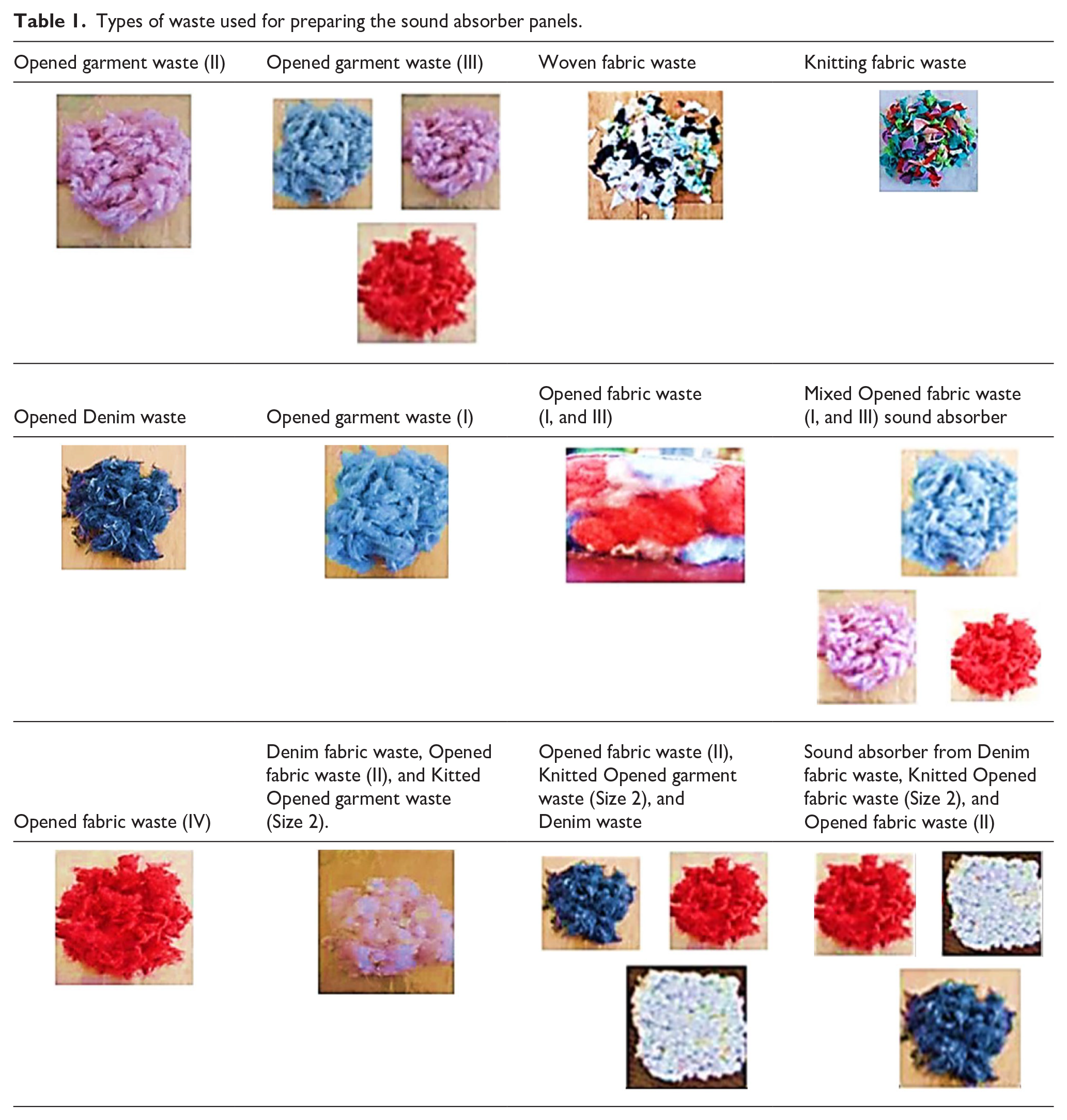
Several types of pre- and post-consumer waste, and opened fibers from garment mills, are utilized to create sound absorber panels. Denim waste generally contains shorter fibers than virgin cotton due to mechanical processing during fabric recycling, with lengths ranging from 5 to 20 mm. Cotton fibers in garments are reduced to shorter lengths during mechanical opening, typically between 5 and 25 mm. The opened knitted garment waste comprises very short fibers, measuring less than 5 mm in length. Small pieces of the fabric waste was considered. Table 1 gives the materials employed in the preparation of the sound absorber design.
Types of waste used for preparing the sound absorber panels.

Manufacturing of sound absorber panels
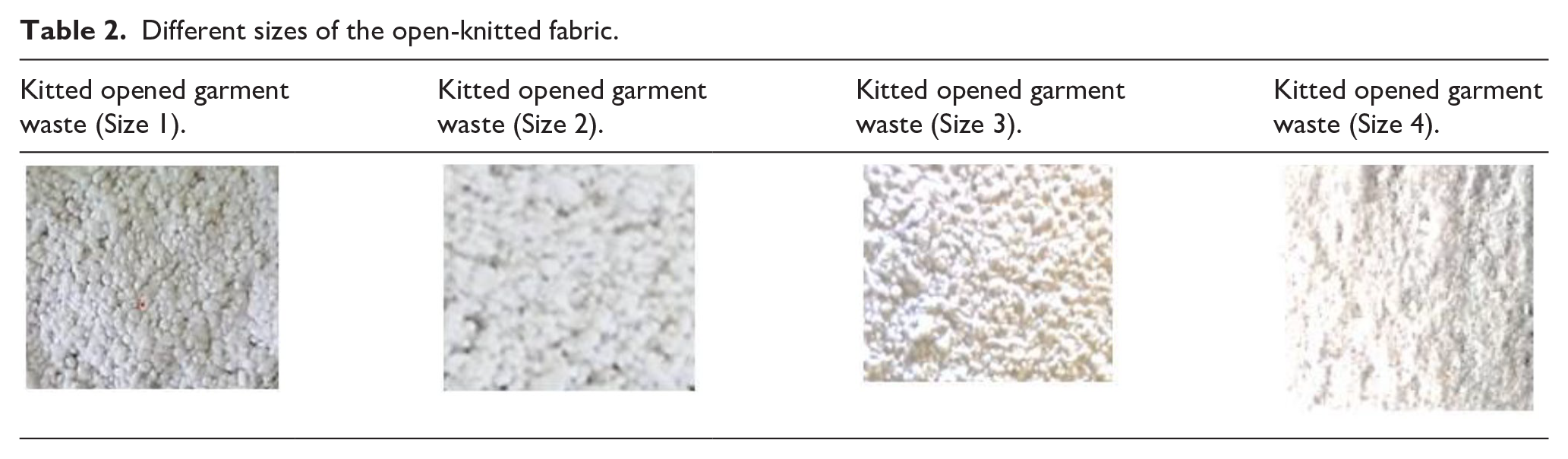
Two types of samples were prepared: one of different varieties of garment waste material, and another of opened fiber from fabric waste supplied by garment mills, mixed with tufts of small fibers from filter waste, and opened garment waste. Garment mill fabric waste was opened using the Laroche Tearing Machine. Trash of every kind of fabric was separately treated, as represented in Table 1. Trash of knitted fabric was separated using sieves of varying aperture sizes in order to obtain varying sizes of trash fiber tufts, as presented in Table 2. Tuft sizes were categorized as No. 1 (4.76 mm), No. 2 (3.1 mm), No. 3 (2.58 mm), and No. 4 (1.19 mm). These fibers tufts were employed in hybrid sample preparation.
Different sizes of the open-knitted fabric.
The absorber sample preparation
The procedure for the sound-absorbing sample fabrication was to place the fibers or fabrics randomly into a 100 mm diameter circular mold to form an efficient porous absorber using fibrous textile waste. The procedure began with the cutting or shredding of the fibrous materials into small equal-sized pieces, cleaned, and dried thoroughly for the proper bonding. First, a uniform thin layer of fibers was cast on the mold and disbanded with a low-velocity air blower in trying to provide fluffiness and evenness. Then, a fine spray of Arabic gum adhesive was sprayed over this top layer and left to partially dry to tackiness so that the fibers would remain in position. The same layer-by-layer approach with incremental fibers added. Low-strength Arabic glue was sprayed between layers. Speed of the blower was controlled strictly to achieve the required sponge-like porosity. Light hand compression was also given at regular intervals during layering to enhance bonding and permit equal density. Once the requisite volume and structure were achieved, the entire sample was completely cured in a well-ventilated area at 80°C. This resulted in sponge-like material of high tortuosity and pore size varying with waste type and size. Smaller tuft sizes gave more compact samples, while the application of a mix of different types of waste and differently sized open tufts gave irregular pores and porous passageway between layers. This new recycling process of textile wastage was used for the production of hybrid samples ID 22–28 in order to serve as sound-absorbing panels with excellent acoustic properties, Figure 1.

Flowchart of the fabricated sound absorber specimen. Flow chart of the absorber sample construction process from pre-consumer waste. Flow chart of the absorber sample construction process from pre-consumer and post-consumer waste.
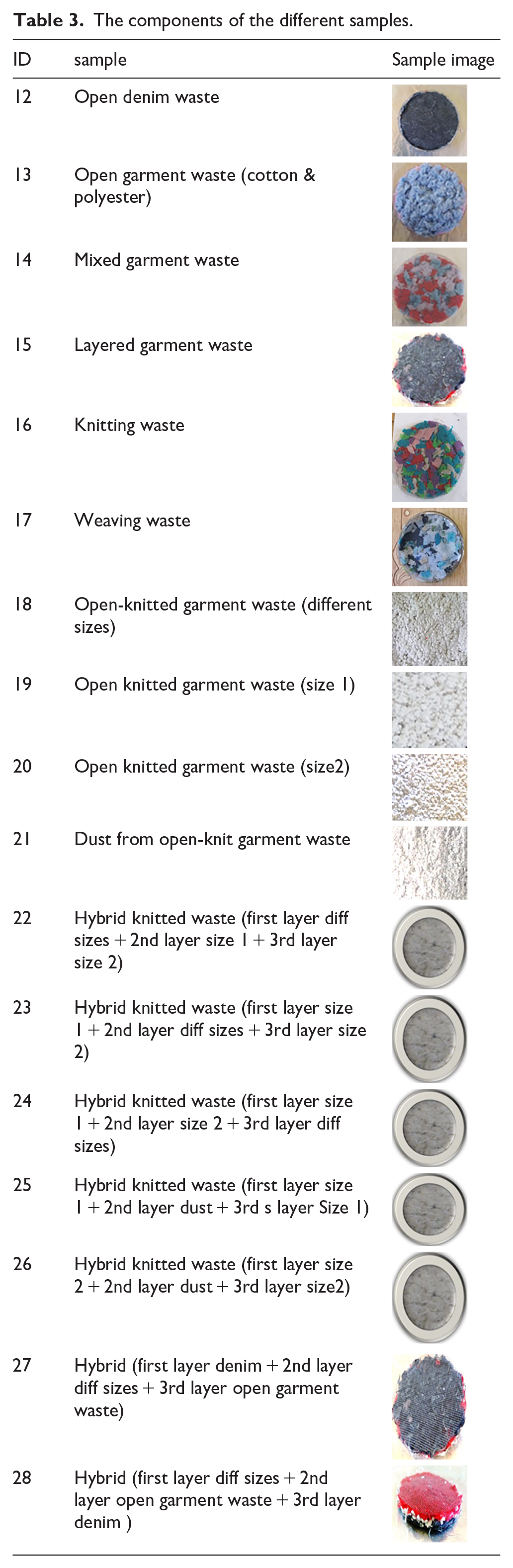
Table 3 provides an overview of the components utilized to form the seventeen samples. In the case of hybrid blended samples, each constituent component was taken in equal proportions.
The components of the different samples.
Material characterization
The sample thickness
The thickness of the samples was measured using a portable digital thickness Vernier caliper. The coefficient of variation, average, and standard deviation were calculated.
Sample porosity
Sample porosity was measured using an air porosimeter, which examines the porosity of materials by quantifying the movement of air through them, that is, air void volume in a solid sample. Physical properties of the material are known as porosity has influence on many of its properties, that is, absorption of sound. Porosity meter (JDC Skywatch) was employed for measuring the porosity of the sample. This instrument allows the amount of air to pass through an area of material and determine the porosity and time to reach 0.25 l of air, at a pressure of 10 mbar, passing through an area of 38.5 cm² of absorber.
Material specifications
Table 4 presents the specifications of the samples produced from the various pre-consumer clothing waste materials utilized in this research. The samples were specifically made to serve as a sound insulation.
Sample specifications.
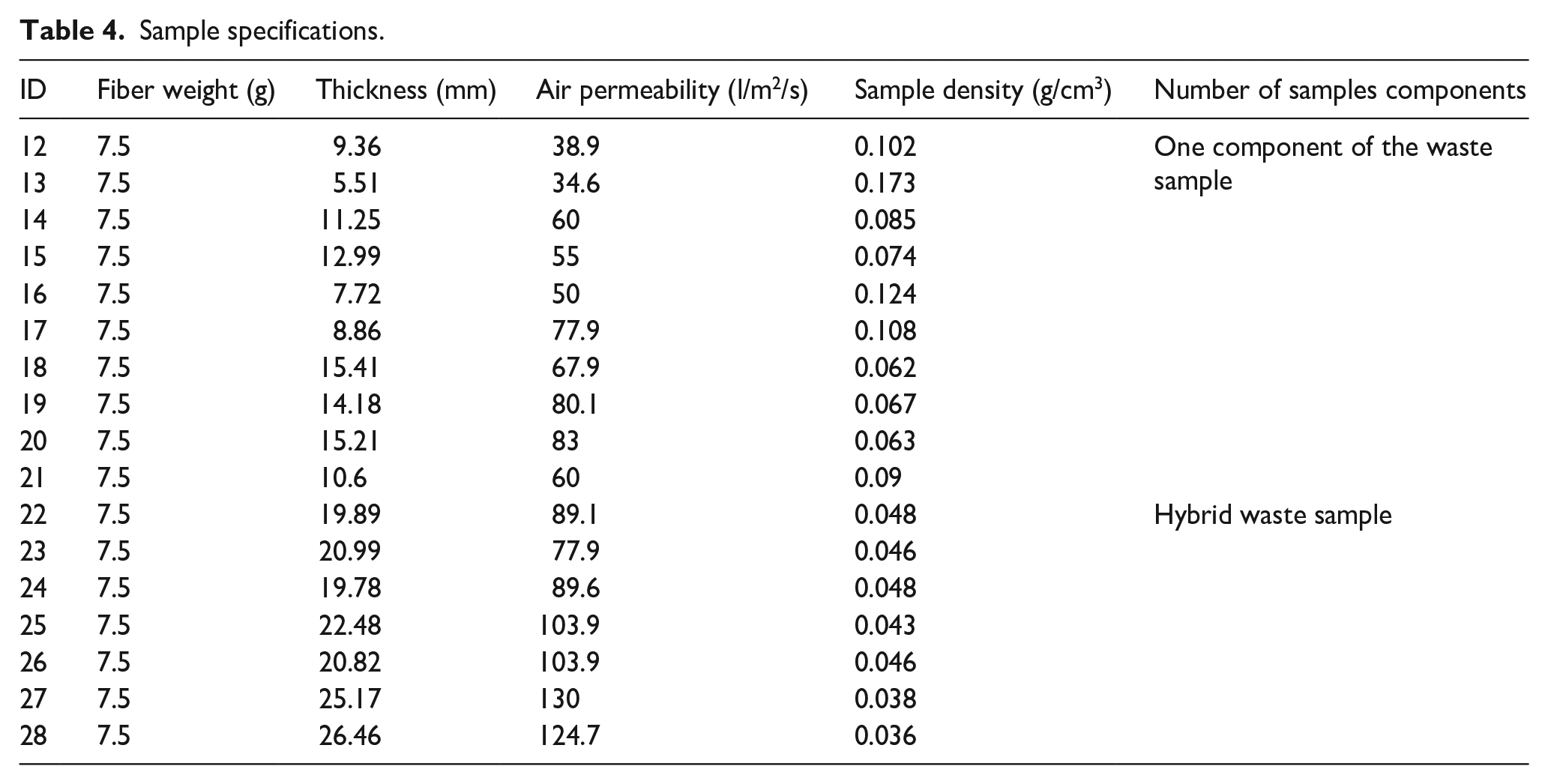
Although the fiber weight remained the same in all the samples, the final thickness differed because the final thickness relies on the heterogeneous and bulky nature of the fibrous waste material utilized in the fabrication process.
Air permeability for various samples is given in Table 4. Porosity is an important factor in acoustic impedance and energy dissipation calculation of materials. High porosity promotes sound absorption by enhanced wave penetration and dissipation, whereas low porosity promotes reflection. Optimum porosity depends on the application and frequency, and medium porosity tends to provide the best compromise between impedance matching, absorption, and structural integrity. Porosity with design can significantly enhance the acoustic performance of insulation panels and other soundproofing products.13,45
Sound insulation panels testing apparatus
The developed equipment for measuring sound insulation relies on the acoustic chamber method.29,37,38,46 Sound is measured using 10 cm diameter cylindrical samples. Digital voice recorders send the audio signals to a computer via a laptop. A digital sound pressure level meter is utilized, and its output is interfaced with the computer. The sound waves travel through the sample material of the sound insulating panel where they are detected by the digital sound pressure level meter and relayed to the laptop for Audacity analysis software. Three readings with and three readings without samples are taken and the average value is used to determine the sound absorption coefficients. Acoustical characteristics of waste panel were determined in the form of acoustic chamber method. 25 To efficiently evaluate various sound absorbers, a setup was designed to determine the reduction in the sound absorption coefficient, as illustrated in Figure 2. 37

Setup for the sound absorption measurement. 37
Sound measurement
A noise generator producing frequencies from 0 to 2000 Hz was used to test the sound insulation properties of the samples. Every sample was tightly fixed in a holder to ensure good alignment and flatness of the two surfaces. The holder was positioned halfway between the microphone and the speaker. A digital sound level meter was employed to measure the sound transmitted through the sample, and the acoustic chamber was sealed by closing the top cover. The sound transmission loss (STL) was measured at 250, 500, 1000, 1500, and 2000 Hz frequencies. The Noise Reduction Coefficient (NRC) was determined by taking the weighted average of the coefficients of sound absorption at 250, 500, and 1000 Hz, and 2000 Hz, according to the equation:

where α is the absorption coefficient at each of the respective frequencies. Sound analysis was conducted by measurement of sound pressure levels (dB) with and without the sample to calculate the STL. Following the procedure using the custom-made acoustic chamber, 25 transmission loss (TL) was measured for four replicates of each sample at 500, 1000, 1500, and 2000 Hz and computed following ASTM E90 and ISO 140 standards using the equation

where AR and AI are the output and input sound pressure levels measured, respectively.
Results and discussions
Analysis of garment industry waste
Textile waste occupies nearly 5% of landfill space, and clothing waste contributes to 84% of textile waste. Apart from this, massive amounts of wastes are created at various processes of textile production. Figure 3 depicts the material flow within the textile industry, indicating the rough proportion of pre-consumer waste by each process of production. The textile and spinning sectors have the highest proportion of pre-consumer waste, and garment sector has the highest proportion of post-consumer waste. The quantity of the waste generated in garment mills is a function of fabric type, marker efficiency, and sewing operations and post-consumer wastage of garments, as shown in Figure 3.

The flow of waste in the Garment industry.
Fundamental requirement in the design of natural fiber absorbers
The above necessitates the development of a good sound absorber with high volume fraction of fibers and low density. This is achieved by development of various cavities among fragments of fabric or fiber tufts of large tortuosity. For this reason, the fiber tufts or piece of fabric were freely dropped into the mold and the surface at the top of the fiber tufts was also given a natural adhesive treatment during molding in an effort to immobilize the position of the fiber tufts in the cross-section sample, hence developing a sponge-like structure. Similar to natural sponges which are porous in nature and contain a very interconnecting system of channels and void space, this porosity enables the penetration of the sound waves into the material to a great depth for absorption and dissipation. Various pores are used to provide high surface area where the sound energy is allowed to play with the fibrous material for effective sound absorption. Moreover, the absorber must also have an uneven surface with multiple projections and crevices that aid in scattering and diffusing the sound waves. When the sound waves strike the uneven surface of the absorber, they bounce off in varied directions, leading to multiple reflections, and increased sound energy absorption.
Comparison between the different samples of sound absorption
Recycled fiber can exhibit good sound absorption characteristics depending on the structure and processing of the material. Porosity and density of fibers play a critical role in identifying the sound absorption capability of the material. Materials with higher porosity are likely to be better absorbers.30,47 Figure 4(a) and (b) sound absorber from pre-consumer garment waste. The Noise Reduction Coefficient (NRC) of 0.6–0.8 at 500 Hz frequency. Above 500 Hz, NRC values were 0.62–0.95 at higher frequencies.

(a) and (b) The measured sound absorption coefficient for different samples, with different fiber consistency.
Higher SAC values indicate enhanced performance. The sample SAC value range was 0.6–0.8 at a frequency of 500 Hz. At very high frequencies from 500, 0.5, and 0.9. Most materials possess the highest SAC in the frequency range of 500–1000 Hz. At increased frequencies (1500–2000 Hz), SAC -frequency curve is flat or reduces the slope. All the samples have an obvious increasing trend of SAC values under low frequency (up to ~500 Hz), indicating good absorption in mid-low frequency. SAC values remain stable at frequencies above 500 Hz, with variation depending on the individuality of the material. SAC values split at 2000 Hz: there are highly absorbing samples (ID 13, ID 14, ID 18, and ID 20), whereas others have a drop (ID 16, ID 17, ID 21). Perhaps it is due to the difference in the density and porosity of the sample.33,42
The observed reduction of acoustic performance at high frequency in portions of the samples can be justified because of structural and material limitations. The comparatively larger pore size and more sparse fiber network in such samples reduced the possibility of effective scattering and sound wave absorption at high frequencies. Above 1500 Hz, absorption requires a denser internal pore structure with narrower pores and more tortuosity to increase the air flow resistivity and to dissipate additional acoustic energy into heat.48,49 In the absence of these features, sound waves will penetrate or reflect off the material rather than being absorbed. The lack of impedance multi-layer transitions in these samples also limited their capacity to absorb the high-frequency content through internal reflections. This correlated with the results from previous research experiments, which had identified the contribution of porosity and microstructural density for high-frequency sound absorption.34,50
The results emphasize the significance of an optimally structured fiber as one develops absorbers that need to respond within a large frequency range.
Design of a hybrid sample sound absorber from different opened pre-consumer waste
A sound absorber hybrid design using opened pre-consumer waste is obtained by mixing materials having the same acoustic performance to provide wide-frequency sound absorption. The porosity, flow resistivity, thickness, and density of bulk materials like textile waste are used to choose them, such that light materials are used for high frequency and denser layers for mid-low frequency ranges. The resulting design produces sustainable architectural, automotive, industrial, and consumer products sound absorbers.45,47 The differences in Sound Absorption Coefficient (SAC) performance are due to the important material properties such as porosity, Surface Area, Compaction, and Density. 38 In section a hybrid sample sound absorber was designed to improve the sound absorption coefficient. Knitting residuals and particles of dust can have more compaction and less porosity, which minimizes the ability of air entrapment and sound absorption. High-thickness and porosity materials absorb sound at low frequencies, but finer surface texture and micro-porosity are required at high frequencies. 59 The new samples were made with high porosity and with reduced density as given in Table 3. Waste from open-knit fabric was sorted into four types according to the size of the fiber tuft as given in Table 2. Panels were manufactured by altering fiber composition and layering sequence in the cross-section of the absorber panel. Three-layer sound absorber specimens of the same weight but with different mixes were prepared based on the information contained in Table 3. Through this, different porosity and density samples were attained.
During our experimental process, material weight and area were set constant while thickness naturally changed according to the character of the utilized waste fibers. Sample density variations inevitably arose as a consequence, which has a direct correlation with acoustic performance. Figure 5(a) indicates the curve of sample density (g/mm³) versus Noise Reduction Coefficient (NRC) correlation. The value of R2 indicates that 0.84 of the variation in NRC is explainable as sample density variations. 34
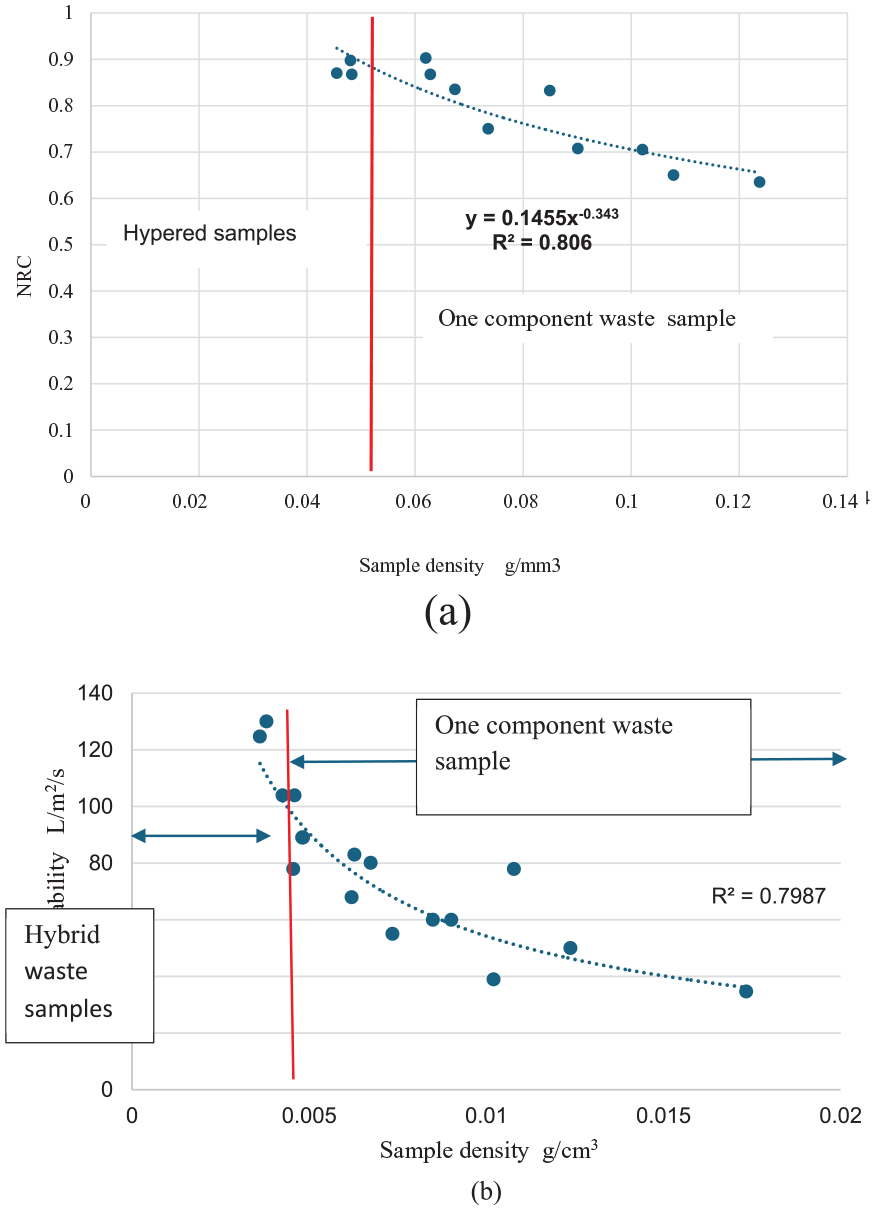
(a) and (b) Sample air permeability versus the sample density.
It is more probable that the less dense samples are porous, with the sound being able to penetrate and dissipate because of frictional and thermal losses. More dense samples will have lower porosity, which keeps the material from trapping and dissipating the sound energy. The change in density might also reflect the change in composition or structure of the samples that can influence their acoustic performance. Figure 5(b) presents the relationship between the prepared samples’ air permeability and density.
As the density becomes higher, porosity will decrease tremendously. This is understandable since denser materials contain fewer voids or air pockets, hence lower porosity. From the graph, when density rises and porosity drops, the sound absorption of the material will fall because fewer pores are present to hold and disperse the sound energy. More open material (less density) is employed for greater sound absorption and allows easier penetration and dissipation of sound waves. Density and openness must balance each other depending on the desired sound absorption requirements and considered frequency range. Samples possess a high sound absorption ability primarily due to the fact that they are very porous, and this allows for sound waves to interact with the internal material structure such as a hybrid waste sample. 46
Figure 6 illustrates that the SAC versus sound frequency for hybrid pre-consumer waste represents the samples. ID 28, 27,24, 23, and 22 have good sound absorption characteristics. Hybrid samples have improved the SAC at low frequencies. If the performance at mid frequencies (500–1600 Hz) is investigated, all samples have the sound absorption coefficients above 0.50. Compositional variation between the materials (e.g. opened used knitting fiber waste) influences performance in sound absorption. More ductile, fibrous geometries tend to absorb higher frequency sound more effectively.33,42

Sound absorption coefficient (SAC) versus sound frequency Hz for different hybrid samples.
Figure 6 represents SAC of the hybrid samples from 0 to 2000 Hz. ID 27 and ID 28 are performing better in the low frequency (0–500 Hz) with greater SAC than the others. In mid-frequencies (500–1500 Hz), the samples’ highest SAC values are between 0.8 and 0.9, and ID 27 and ID 28 maintain high absorption throughout, whereas others, such as ID 24, and ID 26, exhibit low fluctuation.
At higher frequencies (1500–2000 Hz), samples ID 25 and ID 26 both show a decline in SAC, while ID 27 and ID 28 both show increased broadband absorption. ID 27 and ID 28 are the optimal hybrid sound absorption samples, and they are recommended to be used in applications in which noise needs to be controlled to a high degree of accuracy like acoustic chambers or sound-insulating devices. In this study the improved performance of hybrid-layered absorbers associated with multilayer natural fiber composites is designed for broadband absorption.31,51,52 The improved acoustic characteristics observed for the hybrid samples, particularly ID 27 and ID 28, result from an interaction among material composition, porosity response, and layering structure. The samples were engineered with a combination of coarse and fine textile waste fibers, and this facilitated enhanced internal friction and allowed for multi-scale dissipation of sound energy. Moreover, their higher porosity allowed effective penetration by the sound waves, and greater material density provided stronger resistance and therefore higher absorption. The sponge-like layer structure, comprising alternating fiber types, provided acoustic impedance mismatches at every interface, leading to greater scattering, reflection, and absorption of the sound waves, particularly in the mid-frequency region. This material heterogeneity of cohesiveness and structure design is also responsible for the increased measured NRC and STL values in these hybrid samples compared to single-fiber configurations.
Comparison between the different designed absorber samples
The Noise Reduction Coefficient or NRC is a value used to indicate how well a material is able to absorb sound. To compare the NRC of the sound absorbers, look at the total capability of sound absorption at the standard frequencies. Figure 7 shows that all the under-investigation samples have computed values of Noise Reduction Coefficient (NRC) between 0.63 and 0.9. The higher the NRC rating, the better the sound blocking (NRC 60) of the partition, and above is a good sound insulator. As illustrated in Figure 7, samples 27, 18, 22, 23, 24, 20, 19, and 14 are good NRC values. But according to findings, most of the samples are good sound absorbers.
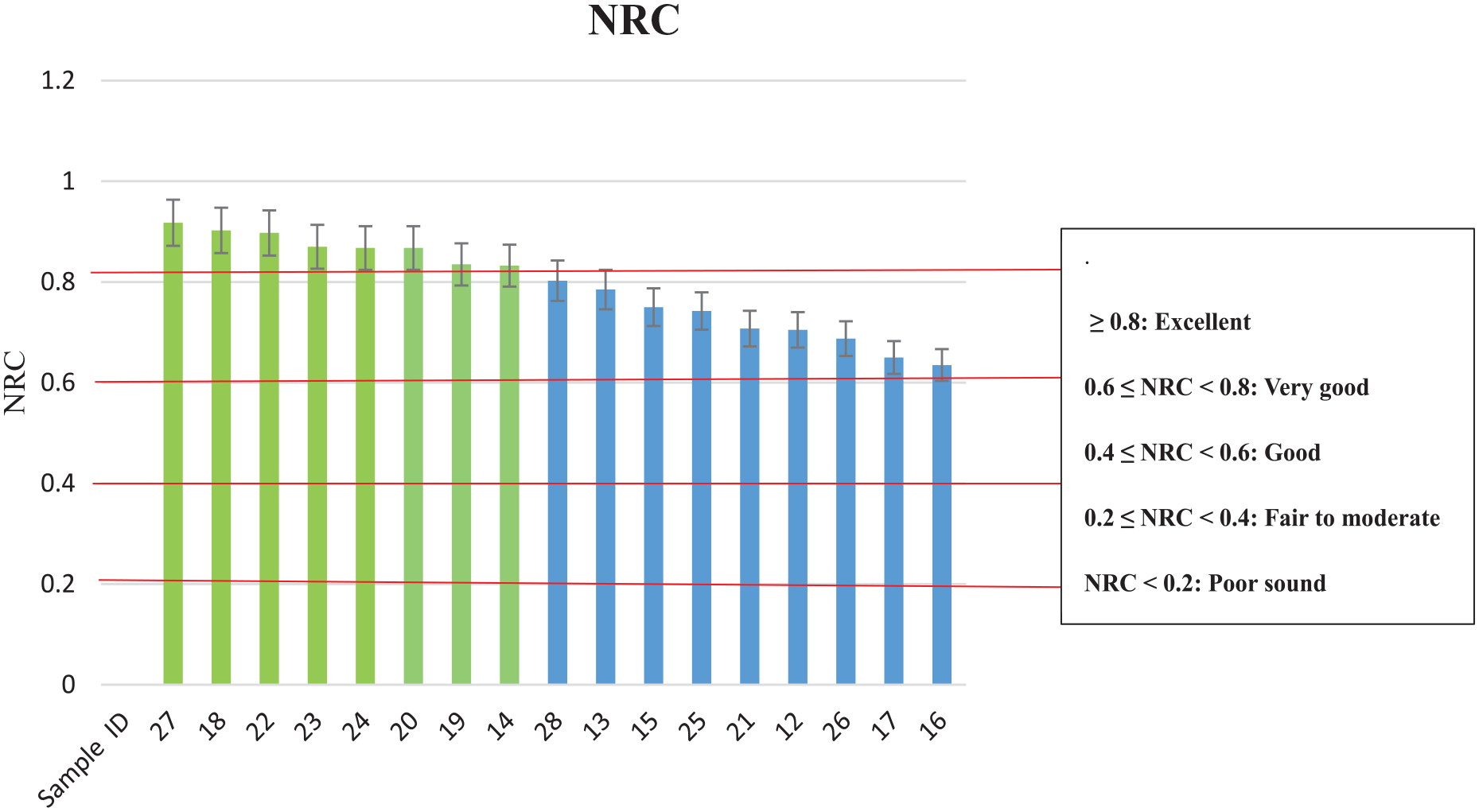
The value of NRC of the different tested samples.
on the investigation of the influence of material thickness on the sound absorption coefficient as a function of frequency. In our experimental process, the weight of the material and area were constant, while thickness differed naturally due to the nature of fibers available as waste. This consequently resulted in differences in sample density, which was a direct influence on acoustic performance.25,34
This enhanced sound absorption characteristic of hybrid samples results from their high-performance fiber size and structure. Sample 22 with one of the highest NRC values, for instance, consists of composite fiber size (diff sizes), fine (size 1), and coarse (size 2) with three-layer structure. It creates tortuosity and internal reflections to dissipate sound energy effectively over a wide frequency bandwidth. Similarly, Sample 27, which is heavy denim waste, mixed-fiber, and open garment waste, performed acoustically better overall since its heavy upper layer (denim) and its porous middle layers together provided stronger low and high-frequency sound absorption. While dust-added samples (Samples 25 and 26) were poor in blocking pores for airflow resistivity as well as internal friction reduction. This is in accordance with size fluctuation and layering optimization in fibers improving porous material acoustic quality by increasing internal surface area, scattering, and mechanisms of energy loss.53,54
The role of the absorber material on the sound transmission loss
The structure of an absorber is what determines the properties of the material as an absorber. Sound transmission loss describes the reduction of energy in sound as it travels through an obstruction or a material. The absorber material can determine the efficiency of sound absorption and damping, which affects the overall sound transmission loss. Sound transmission loss is a reduction in the energy of sound when it is transmitted through an absorber structure or material. Physical characteristics of the absorber material, such as thickness, density, porosity, and composition, have direct impact on the sound absorbing capacity of the material and its resistance to transmission of sound waves. Figure 8 shows the change of sound transmission loss of some specimens. Above sound frequencies of 500 Hz, the variation in sound transmission loss (STL) values between the panels being designed grows with increasing sound frequency, primarily because of higher acoustic resistance, resulting in reduced sound transmission. At higher frequencies, however, the improvement is noted as the sample structure cannot dissipate the high sound power effectively. Studies on the acoustic characteristics of configured pre-consumer garment waste reveal that These fibers were observed to do well with medium to high frequencies, and with low density and short length.35,46,55 Hybrid fibers have good absorption, with their performance improving at higher frequencies (Figure 8).

The value of STL versus sound frequency Hz for different absorbers.
The loss of transmission of STL Sound is made largely reliant on material impedance in the air, and maximum absorption is best with smooth transition. To achieve differently sized fibers is helpful to achieve the smooth impedance transition, minimum reflection of the sound wave, and maximum absorption. Fibers of varied sizes in sound absorbers also increase their absorption coefficient due to increased surface area and higher air resistance. These differences result in structure irregularities in the material, enabling multiple reflections and better scattering of sound waves. Also, the configuration of the air pockets of different sizes allows the material to vibrate at a range of different frequencies, basically trapping sound waves over a very wide frequency range. This contact of the sound wave with absorber material is facilitated by its higher absorption capability in a large frequency range, and also because the surface roughness of the absorber adds to scattering and diffusion of feed input sound waves, and therefore overall efficiency in absorption.16,24,40
Effect of the absorber design on the sound transmission class (STC)
The structure of a sound absorber plays a significant role in determining the value of Sound Transmission Class (STC). STC is thus a measure of the effectiveness of a material to keep airborne sound from passing through a partition. The effectiveness of a sound absorber to achieve this STC improvement depends on a number of factors related to its structure, such as material thickness. Thicker sound absorbers generally produce better sound insulation and higher STC ratings and therefore add more mass to sound blocking. In addition, material density is more capable of blocking sound transmission than lower-density materials, and high-density material will create higher STC ratings. Finally, sound absorption configuration can affect how good it is at sound blocking. Figure 9 indicates the STC values of the samples and demonstrates that the best results for inhibiting the travel of sound waves through them are obtained by samples ID 27, 18, and 22.22,45

The values of STC of the different samples.
Effect of air permeability on NRC and STC
Increased porosity refers to increased, interacting void spaces or pores in the material structure. Such an increased surface area offers an increased level of sound wave interaction with absorber material. As sound waves enter the material, they possess an increased surface area upon which they get absorbed and thus provide more sound absorption. They generate higher NRC values. Moreover, better airflow characteristics allow the sound waves to travel deeper into the material. While they travel through the material, there are greater opportunities for the sound waves to be scattered and damped in the porous media. This better airflow allows for effective sound absorption over a wider range of frequencies, thereby providing higher NRC values. Figure 10(a) and (b) shows that increased sample air permeability, increased sound wave penetration, increased surface area for absorption, and increased flexibility, all contribute to improved sound absorption performance, higher NRC values, and STC of the different samples. 56

(a) and (b) The values of sample STC and NRC versus air permeability for various samples.
It was found to have a high correlation coefficient of STC and NRC values and air permeability of the samples. The correlation between Noise Reduction Coefficient (NRC) and the porosity of the absorber is positive but not linear in general. Permeable materials allow sound waves deeper into the material, so more of the sound energy dissipated as heat by friction. It will have greater NRC values. The porous material is a three-dimensional matrix of fibers with varying length, containing cavities, channels, and interstices in which the sound waves may enter. When sound is propagated in porous materials, because of sound pressure, the air molecules oscillate in the interstices of the porous material at the same frequency as that of the exciting sound wave. Because of this oscillation, there are frictional losses produced. Other factors such as thickness of material, density, and surface texture dictate NRC values. These factors could interact with one another in a complicated way so that porosity to NRC relationship is not linear.57,58
Effect of sample density on sample NRC
Since the density of an absorber material is lower, then its NRC value will be greater. There are several reasons why this is so. Materials that have low density contain more open spaces or pores in their structure. The pores allow deeper penetration of sound waves into the material where they absorb and dissipate. Therefore, the material possesses greater sound absorption coefficients for a range of frequencies, and the result is greater NRC. Materials with lower density are less air flow resistant. Sound waves find it easier to pass through the material, such that absorption grows more probable and reflection less probable. Therefore, the material possesses greater general sound absorption characteristics and greater NRC. Figure 11 indicates the value of NRC for different samples. The highest of −0.74 correlation between the value of NRC and the density of the samples can be seen. The best blend was a hybrid sample of a blend between an equal proportion of ID 27 (first denim + second of different sizes + third open garment waste) and sample ID 18 (Open knitted garment waste of different sizes). In general, the lower is the sample density, the larger is the value of NRC.
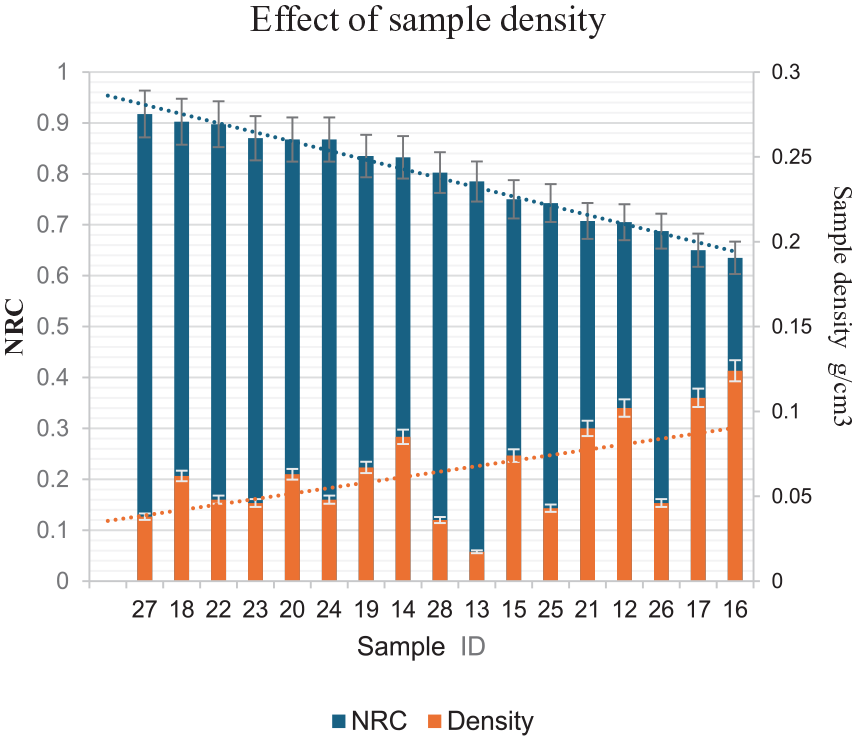
The values of sample density and NRC for various samples.
As the fibrous absorber is denser, the material also becomes stiffer. The stiffness can restrict the flexibility or vibration of the material when subjected to sound wave forces. Sound absorption tends to be based on the capacity of the material to deform or resonate under sound energy and converting the sound energy into thermal energy. But when the material is also too stiff and dense, it is also resistant to deformation and compromises sound absorption performance. The inverse trend between density and NRC ratings, Figure 11, is due to the tendency for reflection of the sound waves from stiff and dense surfaces rather than being absorbed. This sound energy reflection can contribute to overall lower sound absorption performance and lower NRC ratings.
The ANOVA analysis demonstrates that thickness, porosity, and sample density all have a statistically significant effect on both the Noise Reduction Coefficient (NRC) and Sound Transmission Class (STC), as indicated by p-values well below the 0.05 threshold. Furthermore, a significant correlation between STC and NRC suggests that materials effective at blocking sound transmission also tend to absorb sound efficiently.38,58,59
The sound absorber sample arrangement in this study is done based on two applicable acoustic performance parameters: the Sound Transmission Class (STC) and the Noise Reduction Coefficient (NRC). NRC is the actual sound absorption of a product at mid-to-high frequencies (250–2000 Hz) that indicates to what extent it can manage reverberation and echo in an enclosure, and STC is the rating of a material’s ability for transmission class of sound, primarily useful for sound insulation partitions, and panels. Both are deeply based on building and acoustic material standards such as ASTM C423, ASTM E90, ISO 354, ISO 717-1. Both will give a thorough analysis of sound efficiency. By putting NRC values together with STC values, good sound-absorbing materials and efficient sound-insulating materials can easily be found, which are construction, automotive, and interior noise controls’ essentials. According to this dual-criteria evaluation, Sample ID 27 demonstrates the highest overall performance, followed closely by Samples 18 and 22. This combined ranking approach is supported in the literature as an effective method for evaluating acoustic materials holistically.25,53,60
Our ranking shows Sample 27 with an NRC of 0.9175 and STC of 22.47—values many larger than previously reported for classical natural-fiber panels in the literature, from NRC ≈ 0.60 to 0.65–STC ≈ 10–15. Typically, flax, jute and ramie fiber composites provide NRC value in the range 0.60–0.65 (Green sound absorbing composite materials of different structure and profiling. Coatings (Basel). 2021;11(4):407.), coconut fiber panels with thickness 50 mm provide NRC ≈ 0.43 (Sound absorbing properties of selected green material—a review. Forests. 2023;14(7):1366.), and kenaf/urea-formaldehyde composites provide NRC ≈ 0.55 with STC values typically below 15. 61 Our hybrid Sample 27, in contrast to the values previously published, exceeds the provided absorption coefficients; additionally, it also possesses excellent sound-barrier properties with an STC >20. Our sponge-like hybrid structure, therefore, is made from waste garments and textiles, is highly competent.
Conclusion
The current research demonstrates efficient manufacturing of cost-effective and economically sustainable sound absorbing panels from garbage clothes and fabrics by exploiting the optimization of fiber tufts size, porosity, stacking, and bonding process to attain Noise Reduction Coefficient (NRC) and Sound Transmission Class (STC). Hybrid samples with multi-layered configurations showed better acoustic performance with NRC readings >0.90 and STC ratings >20 dB, showing they are effective in mid-to-high-frequency noise reduction (500–2000 Hz). Higher-porosity absorbers showed higher sound absorption, while the denser material showed more transmission loss, thereby validating the importance of optimal layering toward multi-frequency performance. The best-performing hybrid samples (ID 27, ID 18, and ID 22) exhibited broadband absorption and efficient energy dissipation and are suitable for acoustic structural application. The utilization of waste textile as high-performance acoustic sound absorption material, the present study is useful to environmental sustainability, is consistent with circular economy, and offers a feasible way to fiber recycling in modern acoustic engineering. In accomplishing maximum performance and effectiveness from textile-based sound absorbers, directional design adjustments can be applied: Optimized Fiber Composition and Layering take on a multi-scale fiber structure, that is, fine, and coarse fibers, in an effort to accomplish maximum tortuosity and energy loss.
Footnotes

Funding
The author(s) received no financial support for the research, authorship, and/or publication of this article.
Declaration of Conflicting Interests
The author(s) declared no potential conflicts of interest with respect to the research, authorship, and/or publication of this article.