




Abstract
Multilayer three-dimensional (3D) fabrics are gaining importance due to their unique properties, which are significantly influenced by the interlocking pattern and govern their end-use applications, particularly in protective textiles requiring higher through-the-thickness mechanical characteristics. This research focuses on developing 3D woven structures with novel orthogonal through-the-thickness interlocking patterns: warp interlocked (WP-IL), weft interlocked (WT-IL), and hybrid interlocked (HB-IL) by using warp and weft yarns simultaneously for interlocking fabric layers. Various performance characteristics, including air permeability, thermal conductivity, compression resistance, bending rigidity, tensile strength, and puncture resistance, were evaluated to assess the influence of fabric structure. Statistical analysis using One-way ANOVA was conducted to determine the significance of the interlocking pattern on these properties. The results indicate that weft interlock structures exhibit the highest air permeability due to their greater porosity, whereas hybrid interlock and warp interlock structures show 20.7% and 18% lower air permeability, respectively, due to their reduced structural porosity. Thermal conductivity results suggest no significant differences in insulation properties among the structures. Hybrid interlock fabrics demonstrate superior compression resistance and tensile strength, with 26.2% higher tensile strength than warp interlock structures and 12.3% higher than weft interlock structures in the warp direction, owing to the balanced distribution of binding yarns. In contrast, warp interlock structures exhibit the lowest bending rigidity in the weft direction, making them more flexible. Additionally, hybrid interlock structures provide the highest puncture resistance, while weft interlock structures show the lowest resistance due to their increased porosity. These findings highlight the critical role of fabric architecture in determining both comfort and mechanical properties, providing valuable insights for selecting optimal 3D woven structures in applications requiring specific performance attributes.
Keywords
Introduction
Multiple techniques are used for fabric formation such as weaving, knitting, non-woven, and braiding but the fabric formed through the weaving is the most stable and mechanically strong, due to the interlacement pattern of yarn. The fabrics formed through the weaving are further classified into two types, that is, two-dimensional (2D) woven and three-dimensional (3D) woven structures.1,2 2D woven structures are composed of two sets of yarns, namely warp and weft yarns, intersecting at right angles. These structures exhibit dimensions in length and width, with minimal thickness. 3 However, the limited thickness of 2D woven fabric results in suboptimal through-thickness properties. 4 To address this limitation, multilayered 3D woven structures have been developed, featuring three dimensions: length, width, and notably thickness. The fabric thickness is contingent upon the number of layers and the incorporation of yarn in the third dimension, that is, the z-direction. The presence of yarns in the z-direction contributes to enhanced in-plane and out-of-plane mechanical performance in 3D woven structures.5,6
The classification of 3D multilayered structures extends to angle interlock and orthogonal interlock structures,7,8 with the latter exhibiting superior impact properties attributed to the presence of yarn aligned with the impact direction. In multilayered woven structures, such as 3D warp interlock fabric, layers are interconnected by binding yarn to confirm greater cohesion. 9
The distinct structural design of 3D woven fabric allows a wide range of possibilities for improving mechanical durability, and thermal insulation in ways that would be unimaginable with conventional materials.10,11 When it comes to their durability, 3D woven constructions frequently outperform their flat counterparts. 12 Multilayer fabrics, whether bonded or interwoven, provide improved tensile strength, tear strength, and puncture resistance. 13 A comparative analysis by Nawab et al 14 demonstrated that 3D woven structures exhibit a 15% increase in tensile and impact strength compared to their 2D counterparts. Furthermore, they investigated the influence of interlocking patterns on the mechanical performance of 3D orthogonal through the thickness and layer to layer woven structures and reported that layer-to-layer hybrid structures exhibited superior tensile strength, elongation, and thickness compared to through-thickness hybrid structures. Boussu et al 15 investigated the effect of different weaving parameters, such as weave design, yarn density, and yarn placement, on the mechanical properties of 3D warp interlock fabrics such as tensile and bending strength in both warp and weft directions.
Similarly, Umair et al 16 developed warp, weft, and bidirectional interlock structures, comparing their mechanical properties. The results indicated that warp and weft interlock (WT-IL) structures displayed higher tensile strength, while bidirectional interlock structures exhibited superior flexural and impact strength. Dynamic Mechanical Analysis (DMA) results revealed that bidirectional interlock samples demonstrated the highest energy dissipation capacity, whereas warp interlock (WP-IL) samples exhibited a reduction in moduli and maximum storage. Abtew et al 17 studied how varying the ratio of binding and stuffer warp yarns within 3D warp interlock fabrics impacts their ballistic performance. Their findings provided valuable insights to optimize warp yarn orientation and interchange ratios of binding and stuffer yarns to enhance the ballistic resistance of these materials.
Heat transfer through a textile is a complicated phenomenon that depends on several factors, including the number of fabric layers, constituent fibers, yarn structure, fabric density, fabric geometry, thickness, and weave pattern.18 –22 Bilen 23 examined the physical and thermal comfort properties of woven fabrics made if blended yarns consisting of cotton, linen, viscose, and lyocell and found an improvement in shear, bending and air permeability with an increase in linen percentage. Baitab et al 24 studied the effect of different honeycomb woven structures on thermal and mechanical properties of the fabrics and found it significant. 3D structures feature air pockets that function as tiny shock absorbers, which makes them ideal for protective clothing. Certain 3D structures, such as those featuring hollow parts or channels, encourage airflow, keeping wearers cool, and comfortable even in direct sunlight. Kiš and Kovačević 25 studied the thermos physiological properties of a 3D woven fabric and demonstrated how a 3D woven fabric structure attains the ideal balance between thermal protection and comfort. Arshad and Alharthi 26 studied the effect of woven fabric structural design on Air permeability, thermal resistance, stiffness, and moisture management properties for potential use in sportwear and outdoor applications.
From the literature, it is clear that the interlocking pattern has a profound effect on the thermophysical and mechanical properties of multilayer three-dimensional fabrics. There has been considerable research focused on warp interlock patterns with orthogonal layer-to-layer structures. This is because the fabric is more crimped in the warp direction and less crimped in the weft direction. There is a mechanical mismatch that contributes to the instability of 3D woven fabrics that can have an evident effect on fabric thermal and mechanical properties which ultimately define the fabric end-use. However, limited research has focused on the development and characterization of 3D orthogonal through-the-thickness (OTT) fabrics with different interlocking patterns. This study aims to develop novel 3D interlocking patterns that is, warp interlock, weft interlock, and hybrid interlock (HB-IL), and systematically evaluate their thermophysical and mechanical properties. By analyzing these structures, this research provides valuable insights into their performance characteristics, contributing to the advancement of 3D woven fabric engineering.
Materials and methods
Since most textile fibers are synthetic, adopting eco-friendly and sustainable alternatives is essential to combating environmental degradation. 27 Thus, hemp yarn, a sustainable and eco-friendly natural fiber with a linear density of 59 Tex (9.89 Ne), was used in this research to fabricate four-layered 3D woven structures as a viable solution. The physical and mechanical properties of hemp yarn are presented in Table 1. PVA was used as the sizing material to facilitate the weaving process by increasing yarn strength. Although the commercial sizing method can also be used for sampling purposes, it is too expensive. The single-end sizing process was designed to eliminate the problems associated with the commercial sizing method. Because the yarns are kept separated in slots in the single end sizing apparatus, they are dried individually, resulting in less damage to the yarns. The warping for samples was performed on a CCI sample warping machine E-900 and was woven on a CCI sample weaving machine E-500 as shown in Figure 1.
Physical and mechanical properties of hemp yarn. 28 .


Manufacturing process of 3D woven fabrics.
With the help of layer-to-layer interlacing designs, four-layered fabric models were obtained according to the experimentation strategy. The interlocking pattern of binding yarns is changed for the 3D structures as for the first sample, the binding yarns used are warp yarns as shown in Figure 2(a). For the second sample, binding yarns of the 3D structure are weft yarns as shown in Figure 2(b), while for the hybrid interlock structures, combined binding yarns from warp and weft are used to stitch the 3D structures as shown in Figure 2(c).

Cross-sectional view of 3D woven structures: (a) warp interlock, (b) weft interlock, and (c) hybrid interlock structures.
The desizing of woven fabrics is required for further processing to remove size material. Without desizing, the fabric will not provide thermal comfort because the sized coating will reduce the fabric’s permeability as well as its workability. Desizing of 3D woven fabrics was carried out using hot water with temperature of 80°C to remove PVA from the fabric as PVA is a water-soluble polymer. Then the fabrics were dried under standard condition for 48 h until the weight became constant. During the desizing process, the fabric shrinks in both warp and weft directions, and the density of the yarns increases, consequently increasing the warp and weft yarns per inches of the fabrics. The GSM of fabrics reduces due to elimination of sized material from the yarns. The specifications of 3D woven fabrics before and after desizing are listed in Table 2.
Specifications of 3D woven structures before and after desizing.

Characterization
To assess the air permeability, the test was performed according to ISO 9237 using air permeability tester as shown in Figure 3(a). The samples were first conditioned for 4 h under standard atmospheric conditions, maintaining a relative humidity of 65.7% and temperature of 21°C. Five specimens were tested, each with a test area of 20 cm2. The airflow through the fabric was measured at a constant pressure drop of 10 mm head of water.

Testing equipment: (a) air permeability tester, (b) fabric touch tester, (c) tensile testing machine, and (d) puncture testing machine.
Fabric touch tester provides the objective assessment of fabric quality and performance by evaluating fabric thermal properties, fabric surface roughness, fabric compression, and fabric bending. To assess the thermophysical characteristics of 3D woven structures, SDL ATLAS Fabric Touch Tester (FTT) M293 (shown in Figure 3(b)) was used. FTT measures heat flux, fabric thickness, compression, bending, surface roughness, and surface friction. The testing instrument consists of one upper and one lower plate. A constant temperature of 10°C was established between the upper and lower plates. To perform the test, an L-shaped specimen was cut including both weft and warp directions, and all required indices were measured, and all the measurements were recorded according to standard testing conditions. 29
The tensile strength test was conducted using the Universal Testing Machine (Z100 Zwick Roel shown in Figure 3(c)) following ASTM D5035 standard with a sample size 152 × 50 mm and the puncture test was conducted on the Universal Testing Machine (LLOYD LRX Plus, Amptek shown in Figure 3(d)) using the EN 388 standard test method with a sample size of 50.8 mm × 50.8 mm. Table 3 presents the coding scheme used for sample notation in the characterization process. This coding was applied independently for the warp and weft directions, reflecting the fact that mechanical testing was carried out in both directions.
Coding of samples.

Results and discussion
Thermophysical characteristics
Air permeability
The air permeability of the fabric measures how well it allows the passage of air through it. It affects different parameters like heat flow, filtration efficiency, air breathability, and air resistance. The comparison of the air permeability values of warp, weft and hybrid interlock structures is presented in Figure 4. The average air permeability values, based on three measurements, for the face of warp interlock (WP-IL), weft interlock (WT-IL), and hybrid interlock (HB-IL) were found to be 993 mm/s, 1172 mm/s, and 971 mm/s respectively. In addition, the average air permeability values for the back of warp interlock, weft interlock and hybrid interlock were 887 mm/s, 1168 mm/s, and 923 mm/s respectively. The values of air permeability of weft interlock structure for both the face and the back were found to be the highest while the hybrid interlock structure has shown the lowest values of air permeability for both the face and the back among all three samples due to hindrance provided by the combined warp and weft binding yarns. Air permeability is purely dependent on the porosity of the fabrics, as the increasing number of pores in 3D fabrics governed a trend of increasing air permeability.30,31 In weft interlock structures, the binding weft yarns taken from both the upper and lower layers, create higher porosity, allowing greater airflow. As a result, this structure exhibits the highest air permeability values. In contrast, the hybrid interlock structure, which incorporates binding yarns in both warp and weft directions, experiences less overall structural disturbance, leading to reduced porosity providing higher hindrance to airflow. This results in 20.7% lower air permeability values of hybrid interlock structures compared to weft interlock structures. Moreover, the air permeability values of warp interlock structures are 18% lower due to minimal structural disturbance, leading to less porous structures compared to weft interlock structures, thereby offering higher resistance to airflow.

Air permeability testing results of 3D woven structures.
Thermal conductivity
Thermal conductivity refers to a material’s ability to conduct heat with lower values indicating better insulation properties, implying reduced heat transfer. Figure 5 presents the thermal conductivity values of three different interlocked structures, where the hybrid interlock structure exhibited the highest values at 55 Wm−1K−1, while the weft interlock structure had the lowest at 49 Wm−1K−1. The difference in thermal conductivity among these structures is minimal, with only a difference of 1.2%, suggesting no significant difference in the thermal insulation properties of 3D woven structures. However, as seen in Figure 5, the weft interlock structure showed relatively higher thermal resistance compared to other 3D structures, making it more effective at limiting heat transfer. In contrast, the hybrid interlock structure exhibited higher thermal conductivity due to its less packed structures. This is because binding yarns are taken from both warp and weft yarns, disrupting structural packing and allowing more heat to flow. Additionally, the different interlacing pattern of the warp and weft threads add imperfections to the structure increasing the fabrics thermal conductivity. 32

Thermal conductivity of 3D woven structures.
Compression
Compression work represents the energy absorbed by a fabric when subjected to compression. Higher compression work values indicate the fabric’s ability to absorb more energy during compression. The hybrid interlock structure displayed the highest compression work value of 1384 gf.mm, suggesting it has a greater capacity for energy absorption when compressed compared to the other samples as shown in Figure 6. The behavior of binding yarns plays a significant role in determining the compression properties of 3D woven structures. In hybrid interlock structures, both warp and weft yarns function as binding elements, leading to an increased resistance to compression and overall improved compression properties. This is because the combined effect of binding yarns in both directions enhances the structural integrity and resistance against compression forces. 33 Whereas for warp and weft interlock structures, only warp yarns or weft yarns serve as binding elements, providing less resistance to compression compared to hybrid interlock structures. As a result, hybrid interlock structures require more compression work and exhibit superior performance in applications requiring high compressive strength.

Compression work of 3D woven structures.
Bending rigidity
The bending work and bending rigidity values provide insights into the stiffness and resistance to bending of the fabrics, with higher values indicating increased stiffness. Bending work is the term used to describe the energy that a material or structure absorbs during bending deformation, while bending rigidity indicates the fabric’s resistance to bending. In the provided results, higher bending work values imply increased stiffness and resistance to bending. Figure 7 depicts the relationship of bending work and bending rigidity with 3D woven structures. The WT-IL (P) fabric exhibited the highest bending work value of 6544 gf.mm/rad, indicating that it requires more energy to bend compared to the other samples. Similarly, the WT-IL (P) fabric also had the highest bending rigidity value of 1370 Nm2, suggesting it possesses greater stiffness compared to the other 3D woven structures. The hybrid interlock structure exhibits moderate bending rigidity, while the warp interlock demonstrates the lowest bending rigidity in the weft direction. This lower bending rigidity in warp interlock occurs because the warp yarns primarily contribute as binding elements, reducing the overall stiffness in weft direction. 34 Since fewer structural elements provide resistance to bending in this direction, the fabric becomes more flexible and less rigid.

Bending work and bending rigidity results of 3D structures.
Statistical analysis of thermophysical characteristics
The investigation utilized one-way ANOVA with Tukey’s post hoc comparison to assess the impact of innovative 3D woven structures on the air permeability, determining whether the effect is statistically significant or not as shown in Figure 8. The air permeability results revealed a highly significant effect of the woven structure, as indicated by the p-value of 0.000, which is below the conventional significance threshold of 0.05. This implies that alterations in the woven structure led to corresponding changes in air permeability properties. Furthermore, the model summary provided insights into the effectiveness of the model. The coefficient of determination, R-squared (R-sq), expresses the percentage of variation in the response variable that the model can account for. A higher R-sq value, such as the reported 96.06%, denotes a more accurate model that better describes the variation in the response. For the air permeability results, the p and R-sq values were 0.00 and 96.06%, respectively.
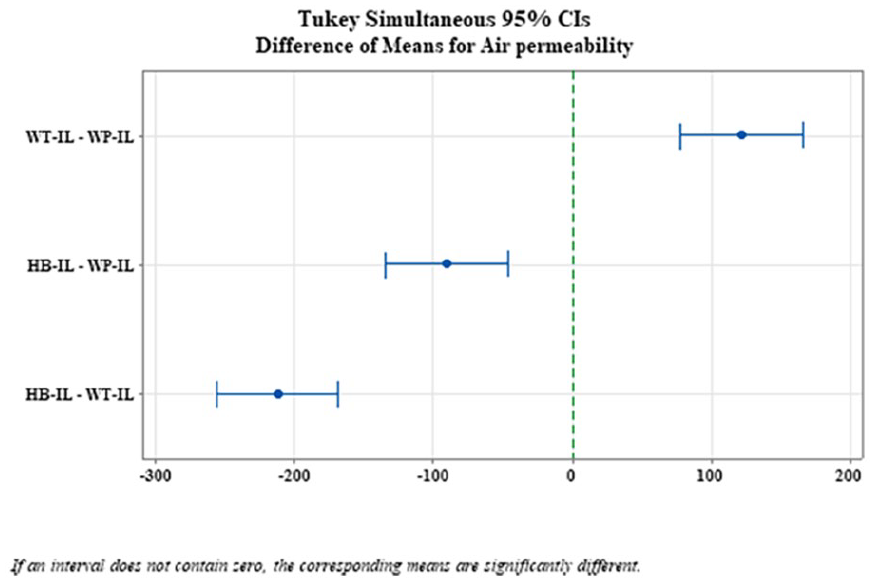
Tukey simultaneous plot of 3D woven structures for air permeability test.
Tukey simultaneous plot of compression work and thermal conductivity for WP-IL, WT-IL, and HB-IL is shown in Figure 9. For compression work and thermal conductivity, the figure indicates that only single pair of WT-IL – WP has 0 in their range so practically it was considered non-significant. The rest of the pairs have a non-zero mean value in their range, so all others are considered practically significant.
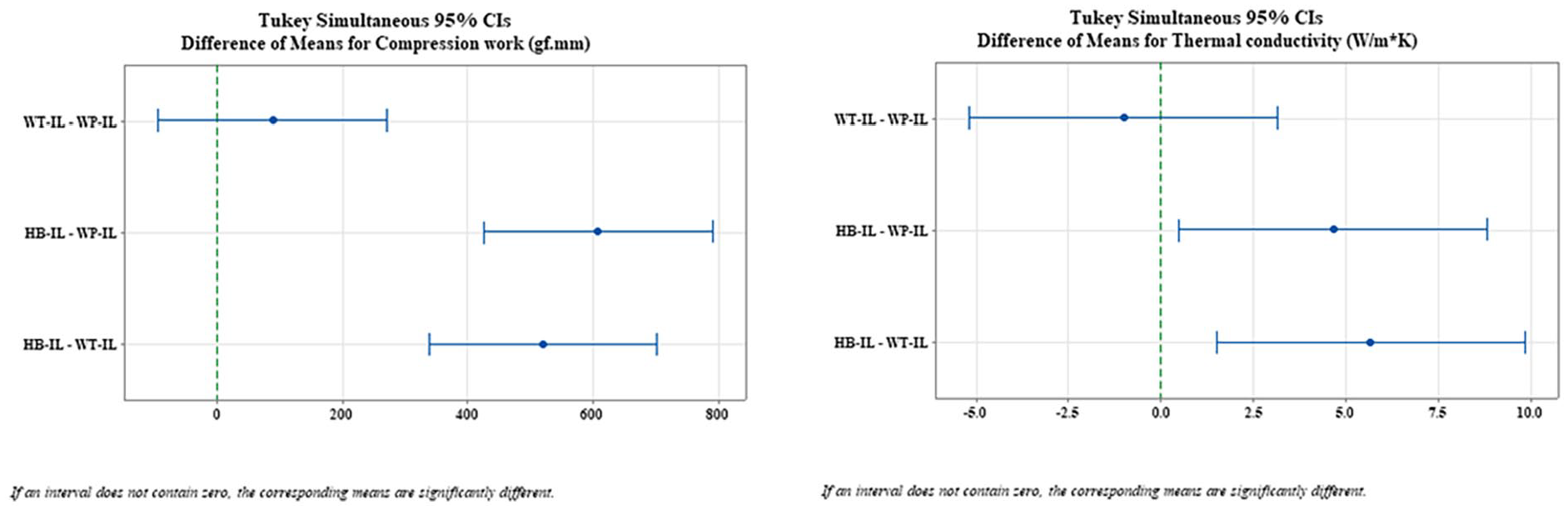
Tukey simultaneous plot of 3D woven structures for compression work and thermal conductivity.
Moreover, the coefficient of determination (R-sq) was utilized to gage the model’s explanatory power in elucidating the variation in the response. A higher R-sq value, such as the observed 99.97%, signifies an accurate model, aptly describing the variance in the response.
The Tukey simultaneous plot for bending work and bending rigidity for WP-IL, WT-IL, and HB-IL in Figure 10 reveals noteworthy insights. In the context of bending work, only two pairs of intervals, namely HB-IL (P) – WP-IL (P), and WT-IL (T) – WT-IL (P), exhibit a range including zero. For bending rigidity, seven pairs of intervals, namely WP-IL (T) – WP-IL (P), WT-IL (T) – WP-IL (P), HB-IL (T) – WP-IL (P), WT-IL (T) – WP-IL (T), HB-IL (P) – WT-IL (P), HB-IL (T) – WP-IL (P), and HB-IL (T) – HB-IL (P), include zero in their range, rendering them practically non-significant. Conversely, the remaining pairs manifest non-zero mean values in their range, signifying practical significance.

Tukey simultaneous plot of 3D woven structures for bending work and bending rigidity.
Mechanical characterization of 3D woven structures
Tensile strength
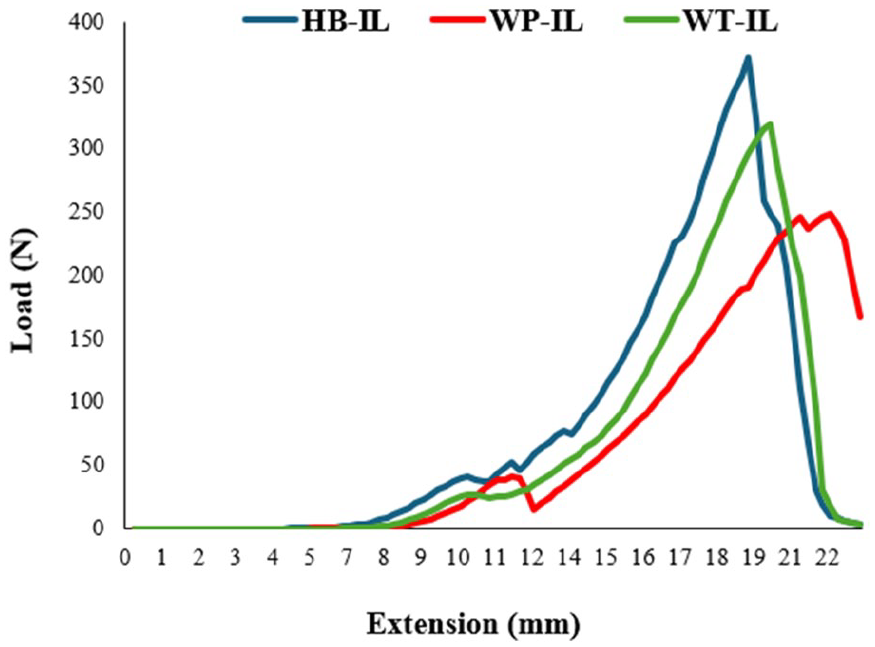
Tensile results help to understand materials behavior under axial loading. Mechanical characteristics of woven fabrics vary in warp and weft directions; hence, tensile characterization was performed for both warp and weft directions. The tensile results for 3D woven structures are presented in Table 4, while Figure 11 illustrates the load-extension curves of these structures. The tensile strength of WP-IL (P) is relatively higher than that of WP-IL (T) by 6%. This increment in strength is due to stronger interlocking of yarns in warp direction. 35 For the weft interlock samples, weft yarns were kept loose during weaving process to gain binder yarns from weft to bind the layers hence the amount of crimp increased in weft direction yarns that resulted in 5.6% decrement of tensile strength of WT-IL(T) compared to WT-IL(P). 36
Tensile results of 3D woven structures.


Load versus extension curves of 3D woven structures.
For hybrid interlock structures, the tensile strength of HB-IL(P) is significantly higher than that of HB-IL(T) by 42.8%. In hybrid interlock structures, both warp and weft yarns contributed in binding layers of 3D structures. The sharing of binding yarns results in more warp yarns contributing to resistance against tensile loading that gives higher strength in warp direction, while for HB-IL(T), loosening of weft binding yarns results in a significant decrement of tensile strength. 37
In comparison between the 3D structures the hybrid interlocked structures showed 26.2% higher strength than warp interlock structures and 12.3% higher than weft interlock structures in warp direction. As for warp interlock structures, warp yarns are contributing to binding yarns, so these are divided in-plane and in thickness directions so their resistance against tensile loading decreased while for hybrid interlock, the binding yarns are both warp and weft yarns, so less warp yarns are used for binding purpose resulting more warps yarns available for providing tensile resistance against loading. 38
Puncture resistance
Puncture resistance is used for evaluating fabric performance against penetration of sharp objects. The more compact fabric structure will provide more resistance against penetration of sharp objects. Figure 12 entails the puncture resistance performance of 3D woven structures. The hybrid interlock structure exhibited the highest puncture resistance of 362 N, followed by the warp interlock structure with a moderate puncture resistance of 283 N. The weft interlock structure had the lowest resistance, measuring 226 N.
Puncture characterization results of 3D woven structures.
For 3D woven interlocking, warp, and weft yarns are distributed along the thickness direction to bind the layers of the 3D structures. This yarn distribution disrupts the top layer, enhancing its volume porosities that lowers the resistance to penetration of sharp objects. In the case of warp and weft interlocked structures, warp and weft yarns are utilized for binding yarns respectively, while hybrid interlock structure uses a combination of both warp and weft yarns for binding of layers. As a result, greater disturbance is observed in weft interlock structures, leading to higher volume porosity, which creates weak points in the fabric and facilitates puncture initiation. 39 Thus, the weft interlock exhibited the lowest puncture resistance while the hybrid interlock structure experienced minimal disturbance with lower volume porosity, resulting in the highest puncture resistance. The superior puncture resistance of the hybrid interlock sample is attributed to the combined effect of both warp and weft interlock patterns which collectively enhance puncture resistance compared to warp and weft interlock samples individually.
Statistical analysis of mechanical characteristics
The investigation employed Tukey’s post hoc comparison tool within the framework of a one-way Analysis of Variance (ANOVA) to examine the influence of 3D woven structures on the significance of tensile strength. The p values derived from the Tukey comparison served as indicators of whether the specific factors under consideration had a statistically significant impact or were deemed non-significant. In Figure 13, the Tukey simultaneous plot illustrates the comparative analysis of tensile strength in both warp and weft directions. Notably, all pairs within the plot exhibit non-zero values within their respective ranges, signifying a statistically significant effect on tensile strength. Consequently, the observed results suggest that variations in the 3D woven structures have a discernible impact on tensile strength in both warp and weft directions, as evidenced by the Tukey simultaneous plot.
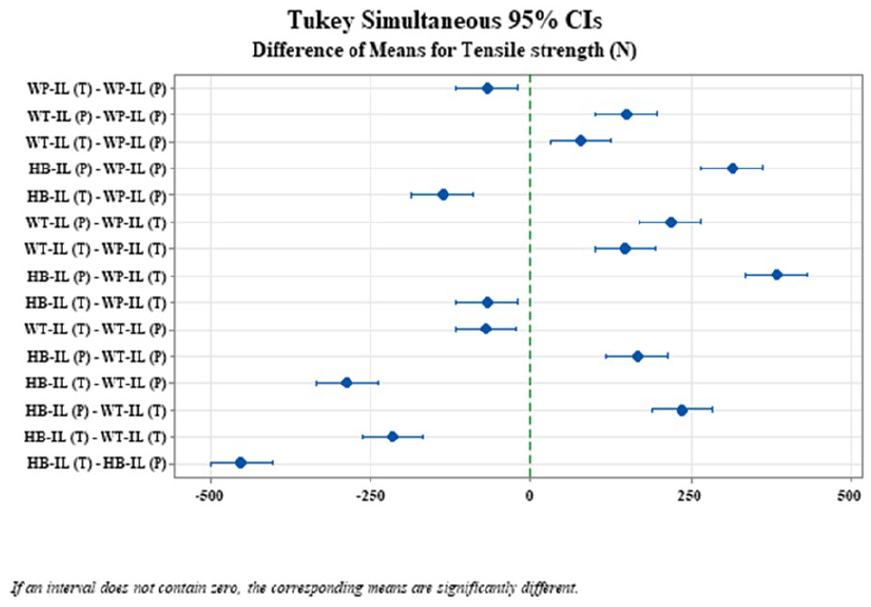
Tukey simultaneous plot of 3D woven structures for tensile strength.
The investigation into the impact of novel 3D woven structures on puncture resistance involved the application of One-way Analysis of Variance (ANOVA) with Tukey’s post hoc comparison as shown in Figure 14. The objective was to ascertain the statistical significance of the observed effects. The puncture test results yielded a remarkably low p-value of 0.000, indicating a highly significant influence of the woven structure, as this value is below the conventional significance threshold of 0.05. This suggests that alterations in the woven structure led to corresponding changes in puncture resistance properties.

Tukey simultaneous plot of 3D woven structures for puncture test.
Furthermore, the model summary provided insights into the explanatory power of the employed model. The coefficient of determination, R-squared (R-sq), represents the proportion of variability in the response variable that the model can elucidate. A higher R-sq value signifies a more accurate model, better capable of describing the variance in the response. For the puncture test results, the obtained p and R-sq values were 0.00 and 96.06%, respectively. The interpretation is that the model, with a 96.06% R-sq, is highly effective in explaining the variations observed in the puncture test results.
Conclusion
This study compared the comfort and mechanical properties of three different 3D woven interlock structures: warp interlock, weft interlock, and hybrid interlock. The results revealed significant variations in air permeability, compression resistance, bending rigidity, tensile strength, and puncture resistance based on the structural design of each fabric. Among the tested structures, weft interlock fabrics exhibited the highest air permeability due to greater porosity, as binding weft yarns were taken from both the upper and lower layers. In contrast, hybrid interlock structures showed 20.7% lower air permeability compared to weft interlock structures, while warp interlock structures exhibited 18% lower air permeability, both due to their reduced porosity and increased airflow resistance. However, thermal conductivity results suggested no significant differences in insulation properties among the three fabric structures. In terms of compression performance, hybrid interlock structures required more compression work, demonstrating superior resistance and making them more suitable for applications demanding high compressive strength. Similarly, bending rigidity varied across the structures, with WT-IL (P) fabrics exhibiting the highest bending rigidity (1370 Nm²), while hybrid interlock structures had moderate bending rigidity, and warp interlock structures displayed the lowest bending rigidity in the weft direction due to the influence of warp yarns as binding elements.
The tensile test results indicated that hybrid interlock structures exhibited the highest strength, with 26.2% greater strength than warp interlock structures and 12.3% higher than weft interlock structures in the warp direction. This was attributed to the efficient distribution of binding yarns in both warp and weft directions, which allowed more warp yarns to contribute to tensile resistance. Conversely, warp interlock structures exhibited lower tensile strength due to the division of warp yarns between in-plane and thickness directions, reducing their ability to resist tensile loading. Finally, puncture resistance was highest in hybrid interlock structures, owing to their lower porosity and minimal structural disturbance. In contrast, weft interlock structures had the lowest puncture resistance, as their higher porosity made them more vulnerable to puncture forces.
Overall, hybrid interlock structures demonstrated the best balance of mechanical strength, compression resistance, and puncture resistance, making them ideal for applications requiring durability and structural integrity. Meanwhile, weft interlock structures were more breathable due to higher air permeability, and warp interlock structures exhibited greater flexibility due to their lower bending rigidity. These findings highlight the influence of structural design on the performance characteristics of 3D woven fabrics, providing valuable insights for selecting suitable materials based on specific application requirements.
Footnotes
Acknowledgements
The authors thank Mr. Muhammad Haris Minhas and Mr. Maisam Tammar for their help with sample development and testing.

Funding
The author(s) received no financial support for the research, authorship, and/or publication of this article.
Declaration of conflicting interests
The author(s) declared no potential conflicts of interest with respect to the research, authorship, and/or publication of this article.
Data availability statement
Data will be available on request.