




Abstract
Honeycomb being a cellular solid is a well-known core in sandwich structure and is considered an ideal structural material because of its high strength and shear stiffness, high impact strength, lower weight, excellent energy absorbing property, high crushing stress, and almost constant crushing force. In this study, 3D woven honeycomb structures were developed with different cell geometry by varying the cell size, free wall length, bonded wall length, opening angle, and the number of honeycomb layers keeping overall composite thickness and cell shape constant. The variation of cell geometry was carried out by changing the number of picks in the honeycomb wall. Composite samples were prepared from the honeycomb preforms with epoxy resin (matrix) using VARIM (vacuum-assisted resin infusion method) process and characterized for their flatwise compression behavior. It was found that the structural parameters influenced compression energy absorption. The results revealed that regular cell shape, smaller cell size, and higher number of layers of honeycomb composites exhibited higher specific energy absorption. These findings are useful in engineering design development and applications of 3D honeycomb composites.
Introduction
One of the most important objectives of textile structural composites is light-weighting. Lightweight engineering seeks novel ways to make products lighter without weakening them, and in some cases, even strengthening them. One option is to use cellular structures and materials, such as honeycombs, as a solution for lighter items. Honeycomb structures are frequently employed as sandwich panels in various applications due to their outstanding mechanical performance such as high stiffness to mass ratio and excellent energy absorbing capacity.1–3 Honeycomb cores with hexagonal structures provide stronger shear rigidity, higher crushing stress, extended stroke, low weight, and continuous crushing force in sandwich panels. 4 The inherent hollow space in the internal geometry of the 3D honeycomb structure reduces weight while simultaneously ensuring desired strength. Due to their unique qualities resulting from their cellular architectures, cellular solids like sandwich panels have been employed as advanced materials in the aerospace, automobile, and marine sectors for decades.5,6 By and large, the honeycomb sandwich panels are related to polymeric and metal honeycombs and only a few studies have demonstrated 3D woven honeycomb preforms and their composites. In recent years, there has been a lot of interest in figuring out how to weave this intricate structure and how it performs mechanically under various loads. 7
Honeycomb structures are employed in the aerospace, mantle, marine, industrial structure, automotive high-speed trains, thermal management, thermal insulation, 8 and packaging industries, particularly in the space and aviation industries. It is also utilized in sporting goods, furniture, doors, yachts, ships, and boats, as well as architectural projects and caravan décor. These honeycomb structures can also be employed as a buffer in buffer design, acting as an energy absorber and therefore reducing accidents. Honeycomb structures can also be employed as traffic barriers on highway viaducts to decrease accidents in abrupt curves.9–11 Because of the enhanced weight/strength ratio, these honeycombs are also used in the railway and automobile industries. 12 Aerospace, building construction, dampened structure, and acoustic applications are among the most common contemporary applications.
There are different types of cores in sandwich panels, in which honeycomb with a hexagonal core structure is most commonly used. 4 The split Hopkinson pressure bar was used to analyze the crushing behavior of honeycomb. 13 Some models are designed for out-of-the-plane crushing (×3-direction) and in-plane crushing (×1 and ×2 direction) such as elastic and fracture models for transverse shear. 14 Other topics like fracture detection by elastic waves 15 and the honeycomb of negative Poisson’s ratio 16 were also developed. Chawla et al. 17 investigated the crushing behavior of honeycomb using the PAM-CRASH program for finite element analysis. A new class of hierarchical honeycombs was designed and fabricated using a 3D printing technique. It has been reported that the compression strength of polymeric honeycomb sandwich panel changes with cell size, 18 and the compressive strength and energy increase with a decrease in cell size.15,19,20 Further, filling the empty cells of the honeycomb with thin-walled aluminum tubes enhances compression strength and energy absorption.
Under uniaxial compression, the hierarchical honeycomb exhibits a gradual failure mechanism. Improved stiffness and energy absorption have been achieved in comparison to ordinary honeycombs. Under cyclic loading, high energy dissipation has also been recorded at significant applied stresses (up to 60%). 21 Fused filament fabrication 3D printing was utilized to create hyperplastic honeycombs with four density grading approaches. A quasi-static, cyclic, and high strain-rate impact study was performed on all thermoplastic polyurethane honeycombs. 22 The research paper 23 compares the cyclic loading compressive behavior of non-auxetic (positive Poisson’s ratio) and auxetic (negative Poisson’s ratio) thermoplastic polyurethane foams.
The Plascore Nomex honeycomb core was studied under dynamic and static loading to determine the effect of core thickness, loading angle, and test speed on the energy absorption. 24 The previous researchers25,26 studied the energy absorption capacity or the compression behavior in the out-of-plane direction of an aluminum honeycomb panel with various cell geometrical parameters, such as cell wall thickness and cell size. It was investigated that the use of low core height and cell size having stronger cell material increases the energy absorption of the honeycomb structure.
Wierzbicki 4 created a model for the honeycomb structure’s mean crushing stress, as well as formulas for predicting the half wavelength of plastic buckling under quasi-static loading Wu and Jiang 26 studied the compressional behavior of honeycombs experimentally under quasi-static conditions and the results were compared with the theoretical results. When the specimens began to buckle gradually, both the quasi-static and the impact data revealed a load plateau carried by small oscillations. When the specimens loaded under quasi-static conditions and those loaded dynamically were examined, a rise in the crush strength of up to 74% was seen. This increase was discovered to be inversely proportional to the initial striking velocity of the projectile.
Fan et al. 27 investigated out-of-plane properties of honeycomb compression by the linear and nonlinear methods by finite element analysis (FEA). The only defect type modeled in the nonlinear analysis is the tilt of cell walls. The nonlinear reaction is solely triggered by the extremely slight tilting angle; it does not decrease model resistance. Zhang and Yu 28 investigated the effect of pressurized air on crushing strength under axially crushing. The theoretical analysis of the pressurized tubes' deformation mode and energy absorption is based on experimental measurements. In the initial crushing stage, the number of lobes N is defined by the initial fold of the crushed tubes, which is revealed to be in extensible diamond mode. In the stable stage, however, the deformation is in inextensible diamond mode with round corners.
Kobayashi et al. 29 carried out dynamic and static compression tests on polypropylene, polyester, and thermoplastic honeycombs. If the characteristics of the wave propagation in the (PVC) polyvinyl chloride tube are obtained by preliminary wave propagation experiments, specifically to determine the rate of decrease in amplitude and the propagation velocity, it was found that the PVC long tube was quite useful as a device for measuring stress waves in dynamic compression tests. Modeling and simulation were performed on 3D woven hollow composite structures for the compression behavior by FEM analysis. 30 It was discovered that, for the rectangular construction, compression energy increases with an increase in width while, initially, it tends to increase and then decrease with an increase in height.
Xiaozhou Gong 31 for simulating the effect of geometrical parameters on mechanical characteristics of 3D woven honeycomb composites, the finite element (FE) was approached. It is discovered that the cell size of the composites sufficiently influences the mechanical performance of the honeycomb structure for all impact energies (6 J, 8.3 J, and 10 J). The investigation demonstrates that composites with medium cell size possess a greater damage tolerance with the same energy absorption and force attenuation performance. Some of the research work has been done to predict the internal geometry, tensile behavior, 32 and impact behavior 33 by mathematical modeling of the 3D solid woven structure. A detailed review has been given regarding the concepts of honeycomb structural materials, manufacturing, and engineering design 34 ; 3D-woven honeycomb composites have amazing properties for extensive applications. 1
Honeycombs based on polymers and metals have also been abundantly used in many applications where impact resistance is the prime requirement. However, textile structure-based composites have an added advantage of being lightweight which increases a lot of mechanical properties. 3D woven fabric provides a compact structure, and there will be no delamination or interlaminar separation will occur to provide higher mechanical properties such as tensile and shear strengths. There is limited research on the mechanical characteristics of 3D woven honeycomb composites. In this study, 3D woven honeycomb fabrics composed of different cell structures and the number of layers were manufactured with different picks of their constituent sides using the same material. These fabric samples were converted to their respective composites. A Flatwise compression test was carried out to determine and understand the role of structural parameters on energy absorption capacity.
Materials and methods
Materials
All honeycomb fabric samples were produced from E-glass tow of 600 Tex and have different cell structures. The cell structures were changed by changing the number of picks in their wall length. Epoxy LY556 (resin) and Aradur HY951 (hardener) were used to make composites.
Glass fiber is a material made up of several very fine glass fibers that are often used in composite reinforcing because of their low cost and great performance. Other fibers, such as polymers and carbon fibers, have mechanical properties that are roughly comparable to glass fiber. As a result, glass fibers are utilized as a reinforcing agent in many polymer goods, resulting in glass fiber reinforced composites, which are an extremely strong and comparatively lightweight fiber-reinforced polymer composite material. They have excellent acid and alkali resistance, as well as improved electrical insulation.
Methodology
Representation of 3D woven honeycomb structure
General coding formats are created to denote the particulars of the honeycomb structure. For example, in the format (x,y) PzLθ of a particular honeycomb: x defines as free wall-length measured in the number of picks (P), and y is defined as bonded wall-length measured in terms of the number of picks (P), z is layers of fabric which are used to form the bonded wall, L denotes the layer, θ is opening angle of the hexagonal cell that varies from 0 to 90°. 35 The coding format can be represented as: xPzLθ, if y = x. Here, x, y, and z are integers, and, x > 1, y > 1 z > 2.
The schematic representation for the structure 5P4L60 is shown in Figure 1. The representation of weft yarn is shown by a straight line and warp yarns show by curved lines as shown in the cross-section diagram (Figure 1(a)). Each structure is constructed with a varied weave design to create honeycomb fabric samples with varying cell geometry. Figure 1(b) shows the weave design or lifting plan of a 5P4L60 honeycomb sample.
1
(a) Cross-section representation of honeycomb structure 5P4L60 sample (b) weave design of 5P4L60 honeycomb sample (14 × 82).
1

Honeycomb cell
Designing of weave is a basic and essential element of starting a process of weaving. Each honeycomb of different weave designs is used to prepare the structure. Different weaving designs are used to prepare the structure. With varying cell geometry. The preparation of all designs is done according to the principle of double cloth having two distinct layers separated from each other. The integration of both layers of the fabric at a particular point forms a honeycomb structure. Vary the number of picks in the needed portion of the fabric repeating unit to change the geometric parameters of the honeycomb fabric. Figure 2 shows the honeycomb structure’s structural properties.
1
The dimensions of honeycomb structures are also changed by varying the number of picks in the free wall (lf) and the bonded wall (lb), the height of cell (h), opening angle (θ), number of layers of honeycomb fabric, and many more constructional parameters. Parameters of single honeycomb cell.
1

Calculation for design parameters of honeycomb fabric
The design parameters may be computed using a simple trigonometric relationship and pick per inch in the honeycomb structure, and the dimensions of a cell in honeycomb fabric can be modified by simply adjusting the number of picks in the needed section of the unit cell of fabric. Bonded wall thickness (tb) and free wall thickness (tf) were measured by digital thickness tester as per ASTM D1777 standard. Other parameters such as free wall length (lf), bonded wall length (lb) and cell height (h) were calculated by equation (i) and equation (ii) respectively.
35

Similarly, for calculating height of cell (h) trigonometric relationship can be used by taking reference of Figure 1:

Production of 3D woven honeycomb fabric
In this work, 3D woven honeycomb fabric samples were prepared on a modified 2D weaving machine shown in Figure 3. The loom is equipped with four positively driven beam arrangements with a modified take-up system and has a good synchronization with let-off and take-up mechanisms. The machine is also equipped with an electronic dobby, 24 heald shafts, and produces different types of fabrics like multilayer solid structures, spacer fabric, and hollow honeycomb fabrics.
1
Customized rapier weaving machine.
1

Construction particulars of 3D woven honeycomb fabric samples
Ends per inch of the bonded wall is twice that of the free wall, but PPI is kept the same throughout. For three layers of honeycomb: Total no. of ends = 800, No. of warping beams required = 4 [4 beams = 200 ends/beam ], and denting order is 10 ends per dent. For four layers of honeycomb: Total no. of ends = 1120, No. of warping beams required = 4 [3 beams = 320 ends/beam + 1 beam = 160 ends/beam] and denting order is 14 ends per dent. For five layers of honeycomb: Total no. of ends = 1440, No. of warping beams required = 4 [4 beams = 360 ends/beam], and denting order is 18 ends per dent. Other parameters are constant: Ends per inch (EPI) – 10. Picks per inch (PPI) – 10, Warp and Weft linear density- 600 Tex., Reed count = 10, and Fabric width = 16 inches.
All the honeycomb samples were produced keeping the opening angle the same at 60° except for the group of samples varying different opening angles. Some of the produced fabric samples for 5P3L60, 7P4L60, (5,7) P4L60, and 5P4L60 are shown in Figure 4(a)–(d) respectively.
1
Specifications of individual fabric layers are given in Table 1. 3D woven honeycomb fabric sample (a) 5P3L60 honeycomb, (b) 7P4L60 honeycomb, (c) (5,7) P4L60 honeycomb, and (d) 5P4L60 honeycomb. Specification of individual fabric layers in E-Glass samples.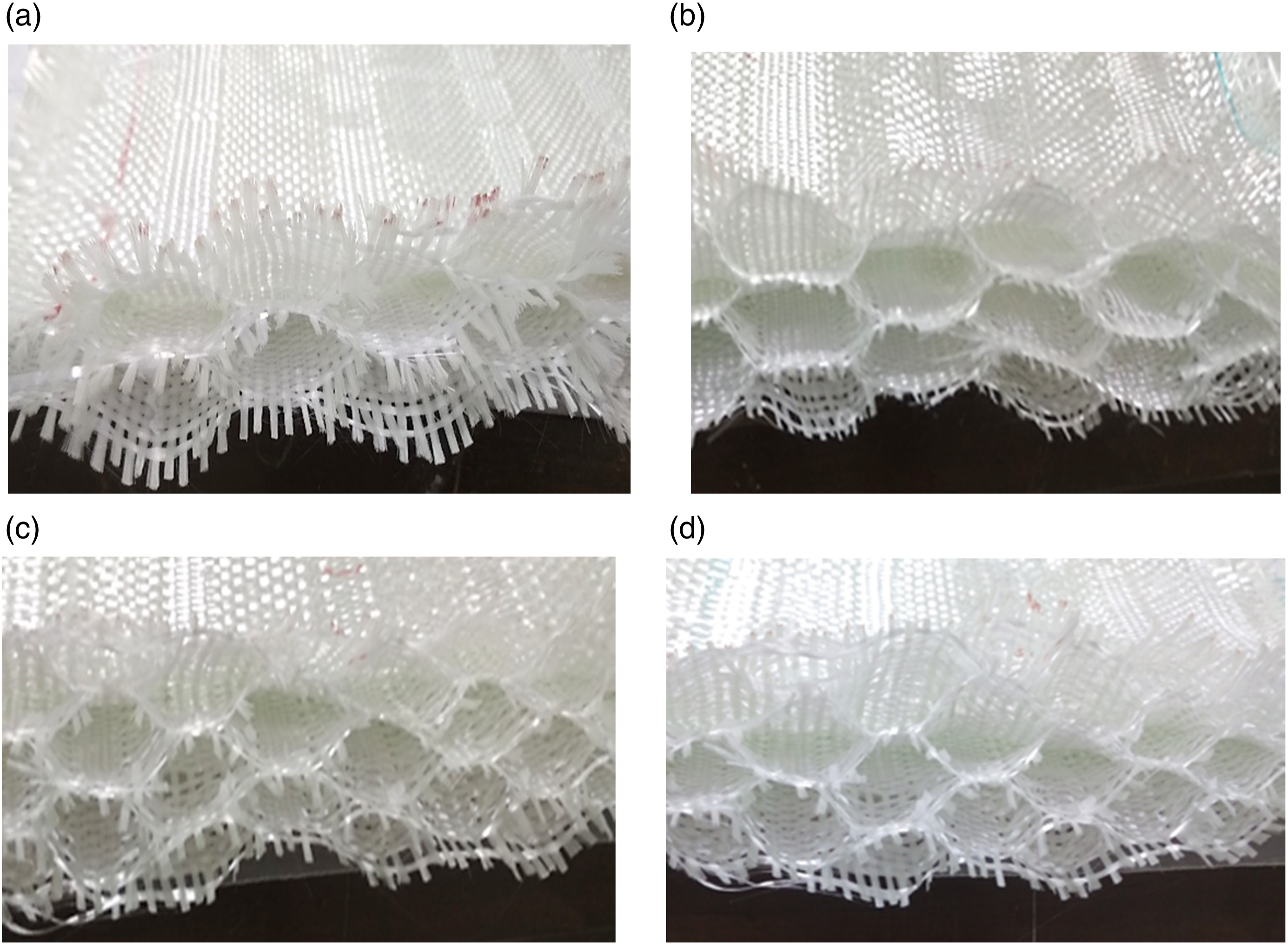

Creation of 3D woven honeycomb composites
This study utilized the VARIM (vacuum-assisted resin infusion moulding) technique to create composite materials using Epoxy LY556 resin as the matrix and Aradur HY 951 as the hardener. A schematic of the VARIM pocess
36
is given in Figure 5(a). A resin to hardener ratio of 10:1 was chosen based on the mechanical properties optimization study
37
for the identical resin material. The resin was de-aired in the desiccator after being mixed with the hardener. Before applying the resin for the impregnation, air bubbles were removed from it using two cycles of 2 min each. The particular size of wooden blocks is manufactured, Teflon sheet was wrapped and inserted into the honeycomb before infusion of resin, as illustrated in Figure 5(b) to keep the hexagonal cross-section in the composite. Teflon sheets were used in moulds as it helps to avoid the sticking of mould to the composite and can be easily taken out from the structure after curing. All 3D woven honeycomb composites were cured for 24 h at room temperature. The fiber volume fraction (FVF) of the honeycomb composites is kept at 50%. Equation (3) was used to determine composite FVF. (a) Schematic representation of VARIM process (b) Teflon sheet wrapped wooden block used for composite making.
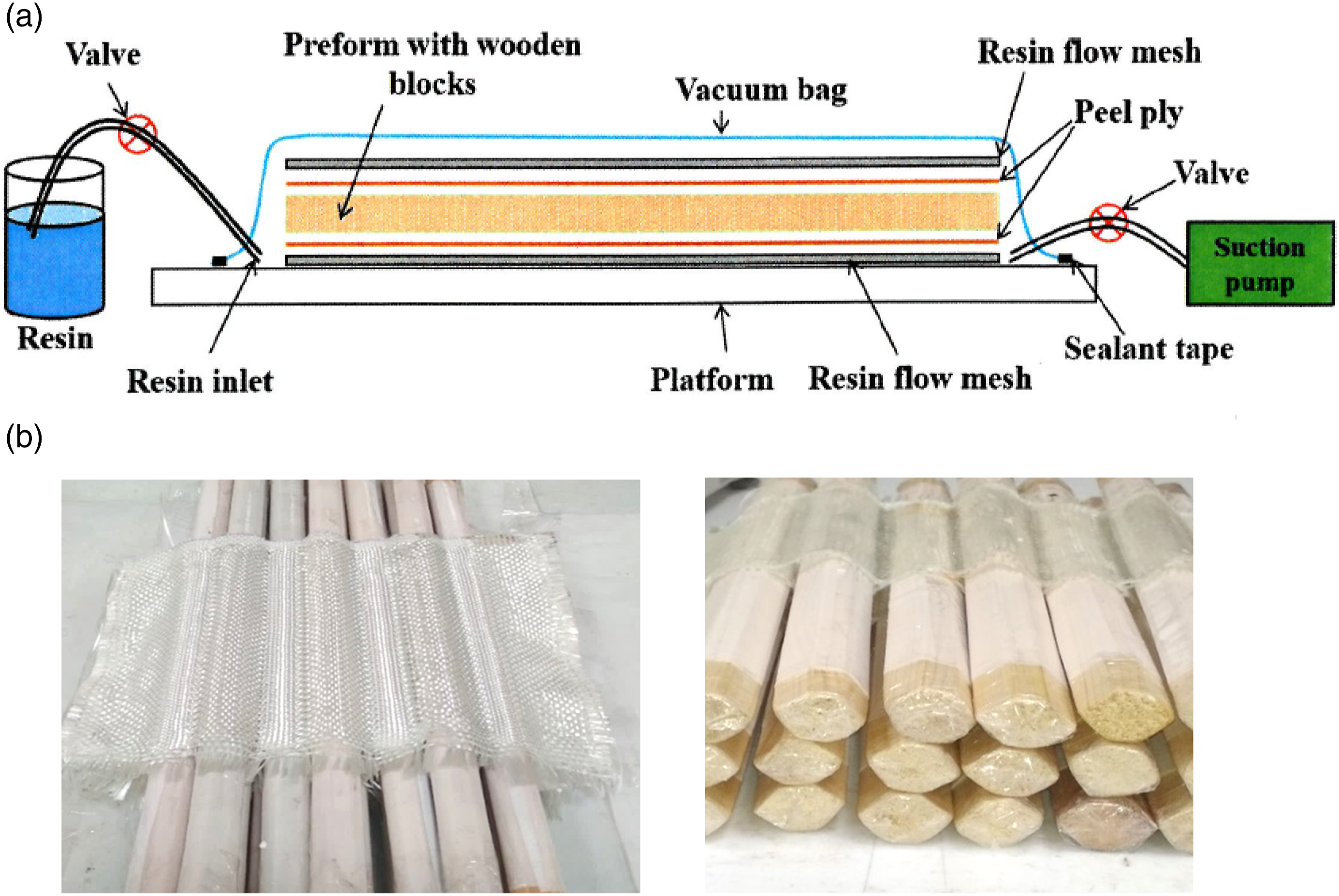
In this equation, FVF% is kept at 50%, So, by equation (3), we get the value of resin weight and prepare the composites, and achieved the constant FVF% value. Over the platform, the resin flow mesh was placed, and on top of that, a layer of peel ply was placed, making it easier to remove cured composites. The resin inlet was placed on one side of the preform, and the outlet was placed on the exact other side so that the entire fabric preform was sandwiched between the inlet and outlet. The composite structure used to explore the effect of structure on flatwise energy absorption for various sorts of parameters is shown below.
Sample groups
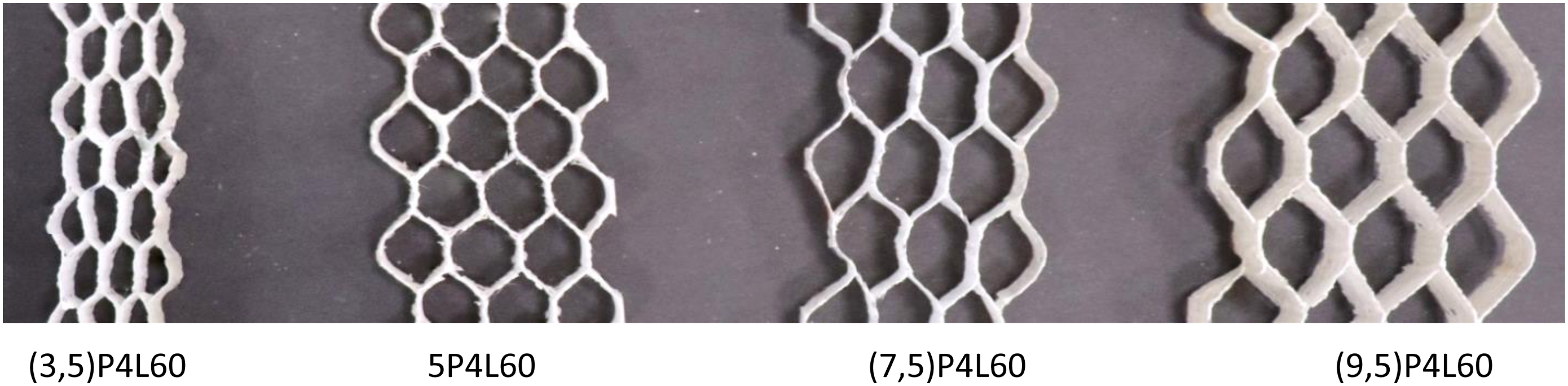
The different honeycomb composites were made and they were organized into four–six groups. The first group (shown in Figure 6) was for the investigation of the cell size, in which the bonded and free wall lengths were changed with the same picks by 3, 5, 7, and 9, and other parameters were kept constant. The second one is the opening angle (shown in Figure 7) in which the angle is changed by 30, 45, 60, and 75 respectively. The third one is changing the free wall length (shown in Figure 8) by the number of picks 3, 5, 7, and 9 respectively. The fourth part is changing the bonded wall length (shown in Figure 9) by picks 3, 5, 7, and 9 respectively. In all the investigations, other parameters were kept constant. The last two parts were regarding the number of layers, in which the first was to change the number of layers keeping cell structure constant (shown in Figure 10) and the last one is to change the number of layers by keeping the constant thickness of composite (shown in Figure 11). Table 2 shows different parameters for a different honeycomb structure according to the sample groups. Variation of the cell size. Variation of opening angle. Variation of bonded wall length. Variation of free wall length. Variation of layers keeping cell shape constant. Variation of layers keeping composite thickness constant. Structural parameters of different honeycomb fabric.




Determination of flatwise compressive properties
Characterization of flatwise compression property
The energy absorption property is an important characteristic of the honeycomb structure. Flatwise compression testing of honeycomb composite was carried out according to ASTM C365 at a loading rate of 2 mm/min on the Zwick/Roell universal testing machine (shown in Figure 12). The composite specimen of appropriate size were cut with a special cutter and sandwich panels were made as shown in Figure 13(a) using plain 2D woven composites as upper and lower face sheets and an adhesive (Fast setting epoxy) was used to stick the core with face sheets. The core height or core thickness is 20 mm and the number of cells is nine of in the honeycomb samples were kept constant. The schematic representation of the prepared sandwich panel for compression testing is shown in Figure 13(b). Average values are taken for final results after testing the number of samples (Five samples). Experimental setup for compression test. Sandwich panel of honeycomb core (a) 3Dwoven composite (b) schematic representation.

Determination of specific compression energy
Compression energy of the honeycomb structure was determined for the entire specimens up to the initiation of the densification region or up to the completion of the plateau region, as this value indicates the effective measure of energy absorption capacity of the honeycomb composite structure. The specimen size was selected based on a similar number of layers. Therefore, the weight of the specimen was different for all composite samples as the numbers of picks are different. In man-made cellular solids, numerous ways for energy absorption exist
38
and are related to elastic, plastic, and cell wall deformation. Generally, the absorption of energy (W) up to a strain (ε) is expressed as given in equation (4)
To compare the attributes of various structures, the absorption of energy of each structure was normalized using the mass and volume of each structure gives specific energy, as shown in equations (5) and (6).

‘M’ and ‘V’ are the mass and volume of the honeycomb composite specimen respectively. Mass and volume were taken experimentally. Volume was simply calculated by multiplying the length, width, and thickness as a taken reference from Figure 13.
It is of interest to investigate the influence of various cell geometry parameters such as cell size, opening angle, free wall length, bonded wall length, and the number of layers on the flatwise compression behavior of honeycomb composite structure.
Result and discussion
In this section, the flatwise compression performance of different honeycomb composite structures has been discussed in detail.
Variation of cell size
All of the honeycomb composites in this category are made up of four layers of fabrics, each of which is made up of four regular hexagonal cells with the same length of walls. The opening angle of these hexagonal cell composites is 60°. The cell wall length changes with the same weft density from three, five, seven to nine picks, resulting in cells of increasing sizes for all reinforcing fabric sections. These composites are 3P4L60, 5P4L60, 7P4L60, and 9P4L60 respectively.
The load-deformation curve for different cell sizes is shown in Figure 14(a). It may be observed from the figure that peak load increases with an increase in cell size. Larger cell size is obtained by incorporating more number picks during weaving which helps to carry a higher load. But the specific energy depends on the mass and volume of the sample. Since the increase in cell size increases the mass of the sample, the compression energy value is normalized by dividing the mass and volume of the composite samples. The specific compression energy (energy per unit weight and unit volume) is shown in, Figure 14(b) and (b). It may be seen from the figures that smaller honeycomb cells absorb more specific compressional energy as they buckle less, have a larger fiber volume fraction, and weigh less. Reducing cell size can make engineering materials less bulky. However, specific compression energy decreases with increasing cell size and cells buckle elastically or bend plastically easily, causing non-linear behavior. (a). Load deformation curve for different opening angle. Compression energy of different cell sizes of the honeycomb (b) per unit weight of (c) per unit volume.
Variation of opening angle
This group involves composites 5P4L30, 5P4L45, 5P4L60, and 5P4L75. These composites are developed from the same fabric but all have different opening angles, as given in the code format such as 5P4L60 (a). Load deformation curve for different opening angle. Compression energy of different opening angles of the honeycomb (b) per unit weight of (c) per unit volume.
Variation of free wall length
This group involves (3,5) P4L60,5P4L60, (7,5) P4L60, and (9,5) P4L60 where the bonded wall length is kept at five picks and the free wall length takes the values of three, five, seven, and nine picks. The cell opening angle for all the composites is 60°.In this category bonded wall length is kept constant to investigate the influence of free wall length on compression energy.
The load-deformation curve for different free wall-length honeycomb composites is shown in Figure 16(a). For different free wall lengths, peak load is higher for the highest free wall length and lowest for the lower wall length. The presence of more number of picks carries more load but the specific energy is influenced by the mass and volume. The compression energy was normalized by mass and volume to get the specific compression energy for better comparison. The specific compression energy (energy per unit weight and unit volume) is shown in Figure 16(b) and (c). The result shows that 5P4L60 is showing higher energy because of the regular structure as well as less weight compared to (9,5) P4L60. In addition, irregularity of the cell shape influences the effect of imperfections on stress wave propagation. Cell irregularity leads to lower mechanical performance compared to the regular one for a honeycomb structure. Weight of the structure has a significant influence on the final results. (a) Load deformation curve for different free wall length. Compression energy of different free wall lengths of the honeycomb (b) per unit weight of (c) per unit volume.
Variation of bonded wall length
In this group involves (5,3) P4L60,5P4L60, (5,7) P4L60, and (5,9) P4L60, the free wall length is constant with five picks while bonded wall-length changes from three, five, seven, and nine picks. The opening angle of the cell for all the composites is 60°. The load-deformation curve for different bonded wall-length honeycomb composites is shown in Figure 17(a). For different bonded wall lengths, peak load is higher for the highest bonded wall length and lowest for the lower length. For better comparison, energy was normalized by mass and volume because the sample size was different. The specific compression energy (energy per unit weight and unit volume) is shown in Figure 17(b) and (c). It can be investigated from the result that 5P4L60 is showing higher energy because of the regular structure and less weight as compared to the (5,9) P4L60 honeycomb structure. Regular honeycomb which has a symmetric structure absorbs more energy as compared to irregular honeycomb. Irregular samples buckled and crushed earlier when compared to regular honeycomb samples. It results in identical buckling strength in the widthwise and lengthwise directions. There is also a weight effect, as 5P4L60 gives higher specific energy. (a) Load deformation curve for different bonded wall length. Compression energy of different bonded wall lengths of the honeycomb (b) per unit weight of (c) per unit volume.
Variation in the number of layers keeping the thickness of composite constant
This group of honeycomb samples includes 6P3L60, 4P4L60, and 3P5L60, whose thicknesses are 53.55 mm, 53.91 mm, and 54.28 mm respectively with similar lengths, which are similar in practical terms. The influence of honeycomb density with the same cross-sectional area on compression energy was investigated. The load-deformation curve for the different number of layers is shown in Figure 18(a). The figure shows that peak load is higher for honeycomb composite having a higher number of layers. This is because, with more layers, there is more number of picks at a constant thickness which carries more load. The specific compression energy (energy per unit weight and unit volume) is shown in Figure 18(b) and (c). It can be seen from the result that 3P5L60 is showing higher energy because, with the same thickness of all-composite, it has more number of layers which has more number of picks to absorb higher energy. The cell size is also smaller and gives a higher volume fraction which helps to increase the load bearing capacity and results in higher energy absorption. (a) Load deformation curve for different number of layers keeping thickness constant. Compression energy of honeycomb for different number of layers keeping thickness constant (b) per unit weight of (c) per unit volume.
Variation in the number of layers keeping cell shape constant
This group of honeycomb composites includes 5P3L60, 5P4L60, and 5P5L60. In this category, the number of layers is different but the cell shape is the same and investigated the effect of these parameters on compressional energy. The load-deformation curve for the different number of layers is shown in Figure 19(a). The figure shows that peak load is higher for honeycomb composite having more layers. The specific compression energy (energy per unit weight and unit volume) is shown in Figure 19(b) and (c). The result shows that the higher number of layers with constant cell shape (5P5L60) absorbs higher specific energy because of more number of picks in the layers which results in higher load bearing capacity The strain hardening of the cell wall material has a strengthening influence on plateau stress: if the strain hardening is stronger, the plateau stress will be higher. This effect is substantial for regular honeycomb structures, but not for irregular honeycomb structures with irregular cell shapes. (a). Load deformation curve for different number of layers keeping cell size constant. Compression energy of honeycomb for different number of layers keeping cell size constant (b) per unit weight of (c) per unit volume.
Description of the load-deformation curve
There are four stages in the load-deformation curves shown in Figure 20 (elastic, yield, plateau region, and densification). The honeycomb composite deforms elastically until it hits the peak load in the first stage, which is an elastic stage. The yield stage is marked by elastic buckling of the walls, which results in a steady reduction in the load that the composite is subjected to. This comes after the long deformation plateau. The duration of this region demonstrates the composite material’s ability to absorb energy. Densification of the composite eventually causes compaction of the structure and failure. The energy absorption is determined by the extension of the plateau region as discussed earlier. The findings of the compression tests demonstrate the three phases of the crushing behavior. The cells folded elastically and collapsed due to an inelastic action at higher stress levels. The trend that is obtained in this study (Figure 20) for flatwise compression is similar to the research work studied in the literature.20,28,40 Load deformation for honeycomb sample with different regimes.
Failure modes
Out-of-plane deformation and failure of 3D woven honeycomb composite are analyzed in this paper. Failure can be defined as the onset of large deformation (elastic buckling) shown in Figure 21 or catastrophic fracture. In honeycomb specimens, buckling, debonding, and fracture are identified as collapse mechanisms. In a honeycomb structure, every cell will not collapse at the same time and to the same level during the final crushing period, which leads to mixed buckling of many cells. The crushed honeycombs after compression are shown in Figure 22(a)–(c). According to the unit cell configuration, it may be said that the compression load will not be distributed equally among all the cell walls because the bonded wall is denser (two times higher number of warp yarns) and thicker than the free wall. It will also affect the buckling phenomenon. Buckling behavior in honeycomb during compression. (a), (b), and (c) Crushing behavior occurs in honeycomb after compression test.

It was investigated that the plastic buckling occurs from the middle region in all honeycomb specimens without exception under quasi-static and dynamic compression. This indicates that the dimension of the honeycomb structure specimen influences the onset of plastic buckling. 40 All of the structures collapsed as a result of the honeycomb’s vertical cell walls buckling. This is shown by the edges of the test samples in the images. Despite widespread vertical edge delamination and mild skin kinking, the composites also showed localized buckling-type failure in a few places.
Conclusion
3D woven honeycomb structures and their composites with different cell sizes, opening angles, wall lengths, and the number of layers were produced successfully. VARIM method was used for the fabrication of composite with epoxy resin. Flatwise compressive strength was measured to determine the energy absorption capacity of different honeycomb cells. The experimental findings confirmed that regular cell shape, smaller cell size, and higher number of layers of honeycomb composites display higher specific energy absorption These structure-property relationships can be used to develop honeycomb structures at the weaving stage. The findings of this study can be useful in designing lightweight honeycomb composites.
Footnotes
Acknowledgements
The project team sincerely acknowledges the Ministry of Textiles, Government of India for sponsoring this project to Focus Incubation Centre of 3D Fabric and Structural Composite.
Declaration of conflicting interests
The author(s) declared no potential conflicts of interest with respect to the research, authorship, and/or publication of this article.
Funding
The author(s) received no financial support for the research, authorship, and/or publication of this article.
