



Abstract
Circular economy embedded in business models have gained prominence in scientific research, as they describe strategies to create, capture, and deliver value. Despite the increase of studies on this topic, there is a lack of integration of the several circular business model practices in the literature, which hinders the circularity of products effectively. Then, this paper proposes a model that integrates circular business model practices in the textile industry. The method consisted of bibliometric and systematic literature review and Delphi. The result was the integrative business model of 27 circular practices for the textile industry. The theoretical contribution was to structure a business model not yet found in the literature. From the management perspective, the model can support the decision-making in textile industry aiming to recover resources. Other contribution, the model proposes ways to reduce the extraction of new resources, which preserves the environment and improves the lives of people.
Introduction
The textile industry is the fourth largest user of raw materials and water in the world. 1 The people awareness on the environmental and social impacts caused by this industry has increased the demands for the transition from a linear to a circular economy (CE).2,3 CE of textiles minimize the intensive consumption of resources from a circular business model that creates, captures, and delivers value, to increase resource efficiency and extend the product lifetime. 4 CE proposes sustainable production and consumption practices through the cycling of products, components, and materials, factory waste can become a valuable contribution to another process, and products can be repaired, reused, or upgraded rather than discarded.5,6 CE stimulates restorative and regenerative industrial systems, from product design to the lifetime cycle. 7 CE gives alternatives to the consumption of virgin natural resources, through the recovery and reuse of products and materials at end-of-life 8 including design for the environment, 9 contributing to sustainability. 10
The search for circular business models in the textile industry revealed work on this topic. The product life extension model enhances repair, reuse, and recycling through product and clothing collection,11,12 despite Staicu and Pop 13 and Kumar and Carolin 14 proposed reconditioning instead of maintaining clothes.
The remanufacturing of products and parts or clothing proposed by Siderius and Poldner 4 and Ballie and Woods 15 is aligned with the issues of reprograming assets, 16 and reducing impacts on jeans production according to Kant Hvass and Pedersen 17 and Weber 18 and proposes the use of skills in repairing and caring for clothes.19,20
Notwithstanding the redesign to extend the useful life of 18 clothes proposed by Denic et al. 21 indicates according to Chen and Lin 22 the need to renew products. Following the same line of reasoning, the reuse of work clothes was studied by Alhola et al. 23 and Real et al. 24
Recycling jeans for the development of fashion products,25,26 saving the value of products after their useful life,27,28 regeneration 29 of used clothing 30 extension of product life.31,32 Another trend is the substitution of materials that can be reused more frequently, such as paper instead of plastic. 33 Other finding was the resource recovery model that stimulates the collection of waste, 30 of textile materials used to make clothes to be reused 34 or used clothing,35,36 which are recovered,11,27 with operations 14 to be redesigned, 24 reused,28,37 reused 32 or recycled38,39 chemically, 40 either by Upcycling or Downcycling, 20 and can be used to make new regenerated clothing. Such practice reduces environmental pollutants and waste at the source, 23 which can be stored to develop energy. 41
The product service system model consists of replacing a product to a service 27 for it to be marketed to more individuals by purchasing a subscription, 11 meaning a specific outcome will be provided to the customer. 42 Another model is the sharing model, which offers the consumption of products through lending, 43 renting,23,38 or leasing, 12 providing alternatives to the consumer to enjoy used clothes in good condition without having the need to purchase them, and returning them when they are no longer needed for their use. 36 Furthermore, the circular input model that addresses the waste recycling as raw material for new products.11,16 With operations such as redistribution and manufacturing 14 there is limited use of scarce virgin resources. 44
Other studies have approached circular business model. Costa Leal 45 assessed the degree of knowledge by Portuguese organizations about adopting a new circular business model, as well as their interest, opinion, and potential for CE adherence. Eccard 46 used voluntary standards to study the implementation and development of CE, in production and consumption, in Portugal. Also, Pinheiro 47 proposed a model for implementing CE principles in apparel clusters.
The articles identified in the bibliometric and systematic review and mentioned previously addressed the circular business model in the textile industry. However, none of them presented integration of circular business model practices applicable to the textile industry, which denotes a research gap. This research gap identified in the literature suggests the following research question: How to structure a business model that integrates circular model practices applicable in the textile industry? To answer the question raised, this study aims to develop a business model integrating circular model practices found in the textile industry.
This study is delimited in activities that generate environmental impact in the textile sector, which involves waste generated in the extraction, production, and post-consumption phases. In the production phase, remnants are generated that can be recovered as raw materials and, in post-consumption, CE solutions enable recycling and reuse of used clothing, which minimizes the use of virgin material. 48
The theoretical motivation of this research was to propose an integrative business model of circular practices not yet identified in the literature, which brings together practices from six circular business models. The proposed business model presented in this study aims to maximize advantages of CE adoption.
The motivation for developing the proposed business practice model was to provide a way to improve textile company management in terms of resource recovery, product and service system, product sharing, product lifetime extension, circular product redesign, recycling, circular input optimization, and reduction of virgin material consumption.
Therefore, the use of the integrative business model of circular practices offers society a reduction in textile waste and virgin resource extraction. The reduction of environmental impact is associated with the reuse of scraps that can be recovered as new fibers to produce new products.
This paper is organized in six sections: 1—Introduction; 2—Systematic review on circular economy business models applied in the textile industry; 3—Methodology; 4—Results; 5—Discussion of results; 6—Conclusion.
Systematic review on circular economy business models in textile industry
This section comments on the results of the content analysis of articles found in the literature that addressed circular business models.
The CE proposes sustainable production and consumption practices through the cycle of products, components, and materials. The CE principles in business models achieve economic and environmental benefits. Circular business model of product-service systems has emerged with the potential to address sustainability and circularity issues. 49
Circular business models involve multiple actors to concurrently address the economic, environmental, and social aspects of waste, yielding long-term combined sustainable solutions. Cooperation plays a crucial role in many circular business models, whether it involves collaboration in the absence of financial resources or partnerships aimed at generating revenue. These collaborations extend beyond businesses and encompass various stakeholders within civil society, including non-profit organizations, local authorities, government entities, and individuals. 50
The primary function of a circular business model is to embed the principles of a circular economy into the planning and revamping of business operations and partnerships, which involves creating or reimagining activities in a way that establishes a cost and revenue framework, while also focusing on controlling and reducing expenses and developing new sources of income that align with sustainability and profitability goals. 51
The key characteristics of a circular business model are regeneration of products and materials that encompass the reuse of products for application in the same function or in various other possibilities of use. Servitization as a process of transforming the shift from selling products and to delivering services. The remanufacturing of products in the industrial process by which damaged parts or components are replaced by new or recovered in accordance with quality standards required in the design of the new product and performed within the original facilities of manufacturer, or by some authorized company. The sharing of assets and infrastructure for waste circularity.
With respect to value creation for its various stakeholders, circular business models include cost savings and reduction of negative ecological and social impacts through reduced consumption of virgin materials and changes in the behavior of customers and end users. Circular business models differ in that value creation occurs through value networks that aim to solve economic, social, and environmental problems through collaboration. 50
The conceptual logic of a circular business model for value creation is based on using the economic value retained in products after use in the production of new offerings, promoting for organizations to create, deliver, and capture value in closed material loops, that is, when material is reused for the same purpose. 52 Circular business model is a term used to describe business models that are based on circular economy practices, highlighted as 3Rs: 1—Reduce consumption as much as possible; 2—Reuse products and materials if they can be reused; 3—Recycle those that have reached the end of their useful life. 2
A circular business model is characterized by a company and its partners utilizing innovation to enhance resource efficiency, prolong the lifespan of products and their components, and ultimately deliver value that brings about environmental, social, and economic advantages. These models embody a conceptual framework where value creation is centered around maximizing the economic worth inherent in products beyond their initial use. 53
Recycling, to a lesser extent, and redesign, work further down the waste hierarchy and instead retain the value of the material. Circular business models often integrate various design strategies aimed at promoting recycling and/or prolonging the lifespan of products. These strategies encompass activities like employing monomaterials, designing products for easy disassembly and repair, optimizing material usage, and enhancing durability. 2
Circular business model contrasts with linear business model, in which value creation is based on a flow of virgin material that is manufactured, consumed, and disposed of as “waste.”
The circular business model operates by leveraging the economic value embedded in used products to create new offerings, thereby enabling a company to separate its operations from the consumption of new resources. 54
Lifetime extension to promote care and repair when needed to extend the life of a product. Technical-material loops in products that have been sustainably produced are sold to a customer, and therefore an end-of-life product is recovered. Examples of the product-service system model and dematerialization resource loops occur when technological advancements or the use of smaller products replace larger ones, such as through rent, lease, and pay-per-use business. 55
The challenges to implementing circular business model start with the variety of different business models, all with varying benefits and trade-offs, and it is important to identify, develop to finally implement a circular business model that is best suited to the prevailing situation of a company. A circular business model is when companies take responsibility for product conditions or retain ownership without being able to add value from that arrangement. The problem here is that they do not have the digital technology to track product condition or the expertise to resolve malfunctions.
A circular business model must be meticulously designed to facilitate the attainment of an optimal level of resource utilization, which involves seeking a model that emulates nature’s efficiency and aims to achieve near-complete recycling of materials. This means to establish a framework that maximizes the value extracted from resources while minimizing waste and environmental impact. 53
After selecting the Business Model to be applied in the company it is necessary to adopt five tactics based on this choice: 1—Contract: designed to address all aspects of service delivery and to clearly formulate the rights and responsibilities of the parties involved; 2—Marketing: describes how circular business model providers interact, communicate and use customer and market insights to implement their business models; 3—Networks: describes how circular business model providers use their network relationships with external partners to ensure a successful implementation; 4—Product and service design: describes how providers design products and services to meet diverse customer needs and to successfully implement circular business model; 5—Sustainability: can ensure that circular business models are successfully implemented, as a proactive approach can promote sustainability-driven changes will likely deliver the dual objectives of economic and environmental benefits, typically generated from circular business model. 53
The overview of business models found in the literature is shown in Table 1.
Conceptual model of circular business in the textile industry.

The construction of the theoretical model of this paper proposes to bring together CE practices identified in business models in the literature. Warwas et al. 28 presented value creation and entrepreneurship based on the recovery and reuse of the economic value contained in products after their useful life, as well as on eco design and cleaner production. Staicu and Pop 13 elaborated a circular business ecosystem applied to the textile and apparel sector that is characterized by four hierarchical loops: maintenance and repair; reuse as product; remanufacturing and reuse as material; and recycling.
The model of Marques et al. 20 promotes reuse and extends life through a shared service provision for customers who want repairs, rebuilding, remanufacturing, or retrofits of their clothing. Real et al. 24 addressed a reuse center that offers a second life to waste by implementing four functions: collection; object valorization; resale in a reuse store; and environmental awareness.
The redesign of the products seeks extended life cycles, as well as increased use of recycling to generate new products. In this view, the challenge is to readjust the product line to circular, and especially how consumers or businesses will receive whatever is produced again, helping to reduce the need for new products and raw materials. 56
The recycling process is characterized into two types. The first is Upcycling, which refers to product upgrading such as, for example, a t-shirt with sleeves being transformed into a tank top. The second type of recycling is Downcycling, which is the recovery of a resource with loss of value or quality.
Another trend investigated is eco-design, which promotes the reuse, remanufacturing, and recycling of end-of-life products. Processes such as biotechnology uses recycling and reprograming of products for collaboration in measuring sustainable performance indicators. 16
Protocol used for the bibliometric and systematic literature review
This research is characterized by using a scientific, objective, and replicable method. 57 Research was selected using the method described by Cassia et al., 58 and de Oliveira Neto et al., 59 through inclusion and exclusion criteria recommended in the PRISMA method. 60 A systematic review search may include database search results, items identified through reference lists, questions to experts and authors, web site searches, expert records, and other sources of information. 61
This study performed a bibliometric and systematic literature review to analyze scientific research on circular business models in textile industry. The first step was the selection of a set of keywords related to the research subject: “circular economy,” “business model,” and “textile.” The databases searched were Scopus, Science Direct, Springer, Wiley Library, Taylor & Francis, Sage, Wolters Kluwer, Oxford University Press, Emerald, Inderscience Publishers, Cambridge University Press, Bentham Science, IEEE, Ebsco, Proquest. Those search databases were taken account to ensure the cover of circular business models applicable to the textile industry. The outcomes appointed 48 documents. This study followed the guidelines suggested by the Preferred Reporting Items for Systematic Reviews and Meta-Analyses (PRISMA). The screening showed a study with no authorship and poor scientific contribution. Then, the next step taken 47 documents to the eligibility process. The content analysis is basis for arrange the studies. 62 Five conference papers, 11 book chapters and five documents out of the scope of this research were excluded in this step. Then, the result indicated the inclusion of 26 research for the in-depth content analysis to extract the main information of the studies to develop the conceptual model. A small number of studies on this subject denotes that it is still an emerging topic. This significantly strengthens the opportunity to present an integrated circular economy model for the textile industry based on scientific research published in relevant journals.
Discussion about circular business models in the textile industry was initiated in 2017 and has evolved each year. The bibliometric review conducted in this study made evident the growth of research interest on circular business models in the textile industry, which enables opportunity in this field.
Expert analysis
The expert analysis was performed using the Delphi method. The Delphi method is characterized by the selection of a panel of specialists who answer a questionnaire to assess the competence of a proposal to be evaluated, and after a series of rounds, which only ends with the consensus of each specialist, the analysis of the answers is performed. 63 The Delphi method is usually conducted through questionnaires that are answered by the selected experts, to create a consensus among the opinions of the participants. 64
Results
The choice of specialists for the application of the Delphi method considered professionals with experience in the textile industry and familiarity with the research theme. After obtaining the consensus of the opinions of the experts, the analysis of the results began to consolidate their points of view and incorporate them to the conceptual model.
A pilot test was conducted to evaluate the clarity of the information in the questionnaire. A new questionnaire was applied at each round of the Delphi method. This cycle was repeated until consensus was reached among the experts. The opinions of the experts were collected via electronic questionnaire in February 2022. The average time to obtain responses was 12 days. The qualitative and quantitative analysis, and the redrafting of the assertions, as well as the revision of the content of the two rounds of questionnaires, were carried out in 5 days for each round.
Ten specialists from different textile companies in Brazil collaborated with this research, in the following positions: one owner partner; one commercial director; four managers from the administrative, executive, industrial, and process areas; three coordinators who work in production, product development, and consulting services; and one commercial analyst. This sampling can be considered in accordance with the Delphi method as the experts have adequate qualifications and mastery of the area studied. 65
In this phase, a semi-structured interview was conducted using a questionnaire based on the assertions presented in Table 2. In the semi-structured questionnaire, each expert assigned a degree of agreement from 1 to 5 (with 1 indicating disagreement and 5 indicating full agreement) for circular economy practices related to circular business models adopted by the textile industries. Additionally, each expert had the opportunity to provide comments for each practice and suggest the logical sequency of the steps. It should be emphasized that during the interview, experts were given complete freedom to comment and present their contributions.
Results of expert analysis.
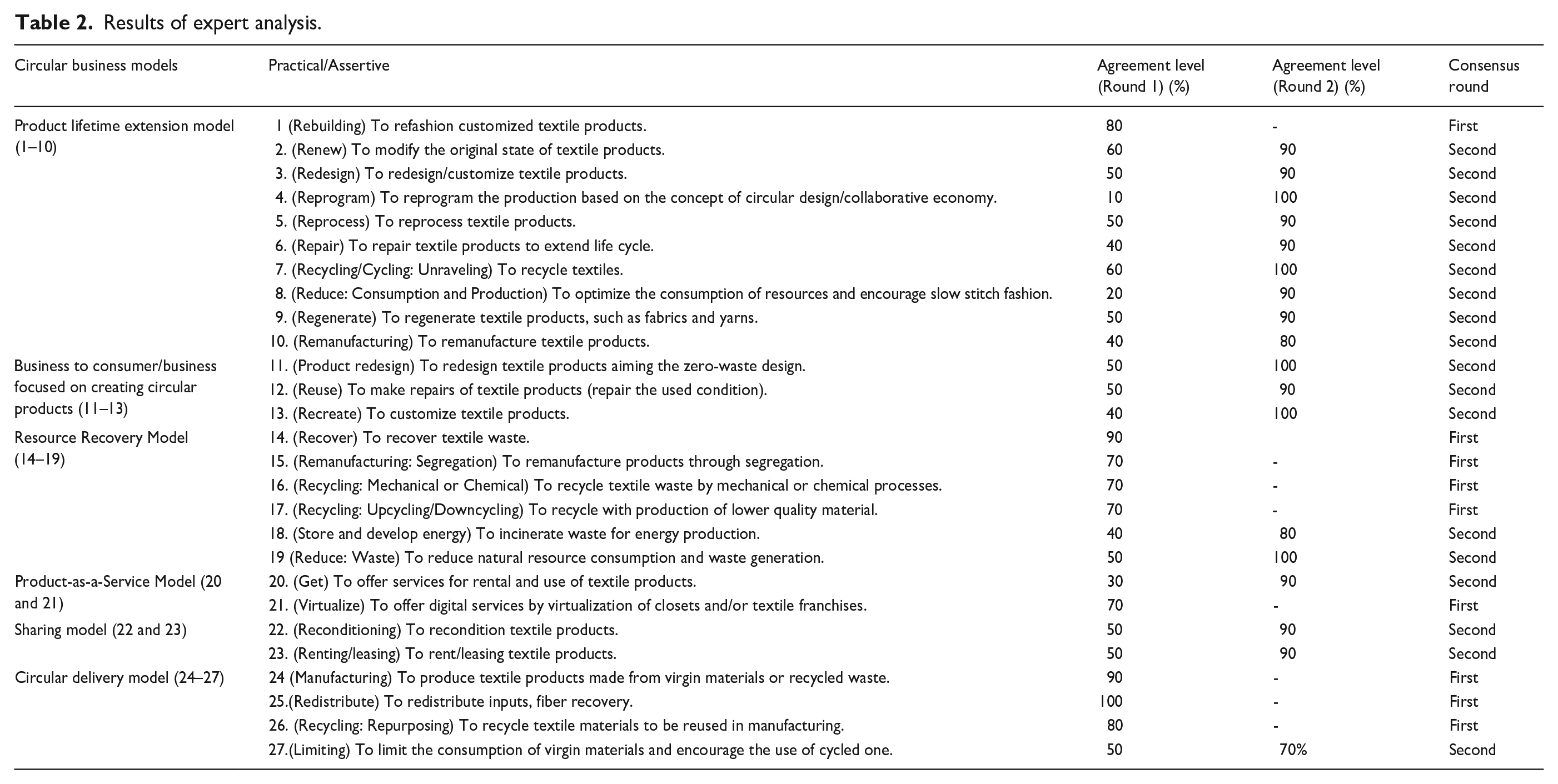
The first round indicated a lack of consensus among the perceptions of the experts. Then, the proposal of the integrative circular business model for the textile industry was adjusted. The modified questionnaire was forwarded to the experts for the second round. This study assumed 70% agreement as an acceptable consensus value. According to Munaretto et al., 66 the application of Delphi aims to seek consensus from most participants. The analysis of the collected data was performed using the statistical software SPSS V28. The cross analysis of the theoretical and practical perspectives makes it possible to propose the integrated circular model for application in the textile industry.
The 10 experts in textile industry answered a form related to 27 circular business model practices identified in the literature. The consensus in the first round of responses occurred in nine assertions. This outcome means that the nine practices have been already carried out by the textile industry: to refashion customized textile products; recover textile waste; remanufacture products through segregation; recycle textile waste by mechanical or chemical processes; recycle with production of lower quality material; offer digital services by virtualization of closets or textile franchises; produce textile products made from virgin materials or recycled waste; redistribute inputs, fiber recovery and; recycle textile materials to be reused in manufacturing.
The 18 assertions that did not reach 70% consensus were reworded based on the responses of the participants. Consensus for maintaining the circular practices was reached on all assertions, however the experts indicated that the 18 practices are trends in the textile industry. Thus, consensus on the 27 circular practices was reached. The unfolding of the analyses of the first and second round of consultation with the experts is shown in Table 2.
The analysis of experts on the 27 practices found in the literature indicated that nine practices are consolidated in the textile industry, while 18 are trends in this sector. The integrative business model of circular practices was structured in stages and based on the logical sequence revealed in the experts’ opinion. The text within quotation marks indicates the experts’ opinions regarding the integrative business model stage and the corresponding practice or trend.
The first stage of the integrative business model of circular practices is the development of a circular product, which consists of a trend to develop circular products to optimize resource consumption and promote slow stitch fashion (CE_08). “This emerging trend has focused on sustainability and longevity. A notable example of this movement is the rise of upcycled denim brands that transform discarded jeans into unique, handcrafted garments, extending their lifespan and reducing waste.”
The second stage of the model is the development of the circular process, whose CE practice is Reprogram (CE_04), which is a trend of using the concept of circular process design, collaborative economy, and the reprograming of textile article production. “A current trend involves embracing circular process design and collaborative economy principles to implement closed-loop production systems and foster sustainable practices.”
The third stage is the redesign of textile articles, which indicates a trend of redesigning products (CE_11) with an eco-friendly concept that aims for zero waste design. “This trend has gained traction as companies strive to minimize environmental impact and promote sustainability, as seen in the creation of innovative upcycled tote bags made from discarded denim scraps.”
The fourth stage is the redesign of textile articles with a focus on customization, which indicates a trend of recreating and customizing textile articles (CE_13). “This trend has gained popularity as people seek unique and personalized fashion statements. For instance, individuals are revamping plain denim jackets by adding hand-painted designs, intricate embroidery, and patches that reflect their personal style and interests.”
The fifth stage is the redesign in the production process, which consists of the tendency to redesign processes (CE_03) to reduce resources and reuse textile waste. “There is a trend of redesigning processes to minimize resource consumption and repurpose textile waste to create new textiles, thereby reducing waste and conserving resources.”
The sixth stage is the traceability of post-consumer textile articles, which reveals a trend in regenerating (CE_09) textile articles through the traceability of post-consumer waste. “An emerging trend in the textile industry involves regenerating textile articles by tracing their origins through post-consumer waste. For example, the use of blockchain technology to trace the journey of recycled clothing, ensuring transparency and accountability in the regeneration process.”
The seventh stage refers to the restriction of material consumption in production, which shows a tendency to limit (CE_27) the consumption of virgin materials and encourage closed-loop reuse. “A growing trend is promoting the reduction of virgin material usage and embracing closed-loop reuse systems, such as a fashion brand that exclusively uses recycled fabrics to create new clothing collections, reducing the need for new resources.”
The eighth stage is the reduction of non-renewable resource consumption, which indicates a trend toward reducing the consumption of non-renewable resources and waste generation (CE_19). “The textile industry is experiencing a growing trend focused on minimizing the use of non-renewable resources and reducing waste generation, such as through the adoption of recycled polyester made from plastic bottles.”
The ninth stage of the model is the remanufacturing of textile articles in the production system, which reveals a trend in remanufacturing textile articles at the plant (CE_10). “The trend in remanufacturing textile articles at the plant is growing steadily as more businesses prioritize sustainability and circular economy practices.”
The tenth stage involves the remanufacturing of textile articles with a specialized company, which highlights the market practice of outsourcing the remanufacturing of articles and component segregation (CE_15). “It allows companies to focus on their core competencies while benefiting from specialized expertise and cost savings.”
The eleventh stage is the repair of textile articles in the production system, which indicates a tendency to repair textile articles on-site (CE_06). “A growing trend of on-site textile repairs highlights the convenience and sustainable approach to extending the lifespan of clothing and other fabric-based items.”
The twelfth stage involves the repair of textile articles through a specialized company, which reflects a market practice of outsourcing the textile repair process (CE_14). “clothing companies now outsource their textile repair process to specialized service providers.”
The thirteenth stage is the reform of textile articles in the production system, indicating a trend of carrying out repairs on textile articles to restore them to usable condition on the premises (CE_12). “This trend indicates that people opt to restore their worn-out garments and fabrics to functional state. For instance, a clothing store incorporates a repair service in which customers can bring in their favorite pieces of clothing that need fixing, such as replacing buttons, mending seams, or resizing garments. The store offers quick and efficient repairs, allowing customers to revive their beloved items rather than discarding them.”
The fourteenth step involves the reconstruction of textile articles with a specialized company to obtain the same product, which reveals the actions of companies working on customization and rebuilding of textile articles while maintaining the original product’s concept (CE_01). “Companies specializing in customization and textile article rebuilding demonstrate a remarkable ability to preserve the core concept of the original product while infusing it with personalized touches and adaptations.”
The fifteenth stage is the renewal of textile articles with a specialized company to obtain another product, which indicates a trend of Renew textile articles (CE_02) by modifying their original state. “a growing trend in the fashion industry is renewing textile articles by transforming their original state, such as upcycling old jeans into trendy denim skirts.”
The sixteenth stage is the recycling of textile articles in the production system, which indicates a trend toward recycling textile waste through defibrillation at the plant (CE_07). “a clothing manufacturer can implement defibrillation techniques to convert textile waste into fibers, which can be used to create sustainable and eco-friendly garments.”
The seventeenth stage involves the recycling of textile articles within the production system to supply the market, which represents a market practice of recycling materials and textile articles to be reused in the manufacturing processes of other companies (CE_26). “One market practice involves recycling materials and textile articles to be repurposed in the manufacturing processes of other companies, such as transforming plastic bottles into polyester fiber for clothing production.”
The eighteenth stage is the recycling of textile articles in a specialized company, which denotes a market practice of mechanical and/or chemical recycling of textile waste (CE_16). “Mechanical and chemical recycling of textile waste is an innovative market practice that transforms discarded fabrics into new materials, reducing environmental impact. For instance, a company can break down polyester garments, extracting the raw materials to produce new polyester yarns for textile production.”
The nineteenth stage involves the recycling of textile articles to produce lower-quality materials, which refers to the recycling market practice of producing lower-quality materials (CE_17). “The recycling market practice in the textile industry sometimes involves the production of lower-quality materials, such as using recycled fibers with diminished strength for manufacturing fabric. For instance, some companies may blend recycled cotton with new fibers to create a fabric with reduced durability and performance.”
The twentieth stage is the search for a specialized company for fiber redistribution, which is a market practice to carry out fiber redistribution (CE_25). “Unused fibers are repurposed and redistributed for further production. For example, textile manufacturers often collect excess fabric scraps from their production process and recycle them into new yarns or textiles, reducing waste and promoting sustainability.”
The twenty-first stage is the reuse of waste to produce textile articles in the production system, which denotes a trend toward reusing textile waste in the factory (CE_05). “Some clothing manufacturers are implementing innovative techniques to transform discarded fabric scraps into new garments, reducing the need for virgin materials and fostering a circular economy.”
The twenty-second stage is the reuse of waste to produce by-products in other companies, which refers to the market practice of companies manufacturing by-products using recycled waste (CE_24). “Companies have converted discarded plastic bottles into polyester fibers for clothing.”
The twenty-third stage involves the provision of digital services for sharing textile articles with the aim of rental, showcasing a growing trend in the plan for leasing and utilizing textile articles (CE_20). “A growing trend of clothing rental services allows people to enjoy fashionable outfits without the need for long-term ownership. For example, companies offer a wide range of designer dresses and accessories for rent, catering to individuals who want to embrace sustainability and reduce fashion waste.”
The twenty-fourth stage consists of providing digital services for textile article cleaning and sharing, which demonstrates a trend toward utilizing digital service for requesting the cleaning of textile articles (CE_23). “There is a growing trend of using digital platforms to request the cleaning of clothes, curtains and carpets, with apps gaining popularity among users.”
The twenty-fifth step is the search for a market specialist for digital services, which is a market practice to offer digital services for rental and sanitization of articles, virtualization of wardrobes, and textile article franchises (CE_21). “There are apps and platforms that offer a comprehensive solution for individuals to rent and sanitize clothing, virtually organize their wardrobes, and even start their own textile article franchise.”
The twenty-sixth stage is the sharing of repair services among companies, which is a trend in repairing textile articles between businesses (CE_22). “a fashion brand can offer repair services for their customers’ damaged clothing items.”
The twenty-seventh stage is the energy recovery in the production system, which indicates a trend toward incinerating waste for energy production (CE_18). “Generating electricity with cotton husks is more profitable than selling them for livestock feed. Moreover, the biomass is a renewable energy production.”
The findings from the literature analyzed by experts in the textile industry suggested the integrative circular business model for the textile industry, composed of 27 stages, as shown in Figure 1.

Integrative circular business model for the textile industry proposed by this study.
Discussion
The model developed in this work, which was validated by experts, indicates the viability of using the circular economy to maximize results and obtain benefits for society, the environment, and the economy. The practices of rebuild, renovate, and redesign contribute to the execution of new projects for modification and adjustment of projects that meet the needs of the final customer. This finding corroborates the results of Marques et al., 20 Chen and Lin, 22 and Denic et al., 21 regarding circular economy practices.
The incorporation by companies of practices to reprogram, reuse, repair, and recycle meets a societal demand aimed at the collaborative economy, as proposed by Olatubosun et al., 16 and presented by this article with the aim of incorporating this model into corporate purposes. Moreover, repair and reuse present aspects of a new environmental awareness in the fashion industry, as was described by Alhola et al. 23 and Rossi et al. 11 Another finding refers to the reduction of raw materials that should be encouraged and planned, as described by Weber. 67 Also, regeneration and remanufacturing can be used for material savings as proposed by Han et al. 26 and Gazzola et al. 27 and contribute to the insertion of this model as a condition for a circular economy in the practice of the textile industries.
The circular product creation model highlights that product redesign should be adopted by industries in the quest for zero waste generation. For example, consider from product design and development the use of scraps in the production of new products, as guided by Denic et al. 21 This practice is directly linked to the reuse, recreation, and reuse of materials to save raw materials and production, as demonstrated by Rossi et al. 11 and Alhola et al. 23 and adapted to the model presented in this work.
The resource recovery model is directly connected to the aspects of preservation of the environment from the economy of raw materials in the elaboration of new products, that is, the recycling of textile products, 27 the reuse of scraps in the making of new products, 37 the use of new technologies for recycling that alter the fabric and improve or even decrease the quality of the final product, but without the need to use virgin raw materials.20,26 Also, the resource recovery model proposes the incorporation of production process that recovers energy and water consumed in the company. This finding was also presented by Baranova et al. 41 and Alhola et al. 23
Resource recovery is related to the product-as-a-service model. The model presented in this paper highlights that a new type of business in which the rental service is offered instead of the purchase of the clothing makes the sustainability of the industry feasible. This finding is in line with the findings of Stål and Jansson. 42 The sharing model resembles the product-as-a-service model in designing a process of exchanging or renting products as an alternative to immediate purchase and disposal, as validated by experts and found in Rovanto and Bask. 38 The use of a sharing model that restores the integrity of components of a product or exchanges these components for others is a viable alternative to the use of virgin raw materials. This result was also found in Staicu and Pop 13 and corroborates the viability of the sharing process in sustainability aspects.
Recycling and production of sustainable raw materials in clothing manufacturing was presented in the circular input model as a sustainable alternative to the current production scenario. This finding corroborates the findings of Kumar and Carolin 14 and Olatubosun et al. 16 In addition, the recycling and reuse of materials from the textile industry proposed in this model contribute to life cycle analysis and in the development of products that integrate circular production, as was also described by Happonen and Ghoreishi. 44
Conclusions
The present scientific study allows us to conclude that the proposal for a circular economy business model validated by experts in the area studied and most suitable for the textile industry refers to a business model that integrates circular practices for the textile industry, consisting of nine practices and 18 trends that maximize the benefits of adopting the circular economy.
Of these practices, nine were categorized as market practices, which are already operating in the textile industry, and 18 were named market trends, that is, which are in the context, but require attention in cultural, infrastructure, and technology aspects to become a reality.
Finally, the proposed model was evaluated by specialists in the textile industry, who needed two rounds of consensus to arrive at its best formulation by answering each questionnaire. As a result of the application of the Delphi method, a business model integrating circular practices for the textile industry was obtained.
Regarding the first survey, it can be concluded that in the circular economy there are considerable business model studies, bringing together five types of business models. Regarding the second survey, a systematic review was made based on what was previously found, resulting in six types of circular business models for the textile industry. As this research revealed that there is the adoption of business models with their practices, however without having their practices integrated in a logical way to be implemented.
Based on the qualitative and quantitative analysis of the answers about the proposed model, it can be concluded that it has achieved the objective of integrating circular practices, in order to unify the six business models found in the systematic review. Thus, it can be concluded that the main objectives formulated in this thesis were achieved.
As academic contributions of this work one can mention: (I) A systematic review on circular economy business models in the textile industry was carried out in the scientific literature, which provided the perception of the need to propose an integration of circular practices of the business models found; (II) An integrative business model of circular practices for the textile industry was proposed and validated, with 27 circular practices; (III) Identification of 18 circular practices as market trends in the Brazilian textile industry; (IV) Identification of nine circular practices as market practices in the Brazilian textile industry; (V) Identification of the Virtualize practice as non-adherent in the Brazilian textile industry; and (VI) Six circular business models were identified for the textile industry.
The business model resulting from this research presents the necessary actions to incorporate circular economy tools, based on the integration of more sustainable production processes and economic and environmental issues, observing new consumption paradigms and presented for Figure 1.
As a practical contribution, it is expected that the proposed model may help the textile company management improvement, regarding resources recovery, product to service conversion, as well as sharing platforms. In addition to practices that contribute to extending the product lifetime, redesigning products with circular characteristics, and recycling, optimizing the use of virgin materials of circular inputs.
Circular practices that did not receive consensus in the first round of the Delphi method may contribute to strategic management and consequently to the organizational practice, given that it is possible to discover aspects that might be improved in the circular economy adoption process within the organizational practice. Through circular practices that received consensus in the first round of the Delphi method, it is evident their contribution to organizational practice, because they act in the recovery of resources to design a new cycle, with new characteristics, providing a new product, besides corroborating in the strategic and textile waste management.
The operational managers need to study better about the practice of virtualizing; however, it does not progress by the absence of investment, but also because they do not have industry 4.0 implanted, which has as a prerequisite the use of high-cost technologies, which could corroborate in such a way if they come to implant it.
The application of circular business models shows the diversity of possibilities to fit processes of company and can be a great partner for organizational practice. Since the models promote circular practices in the adherence to strategic plans to use a resource to propitiate a new life cycle, or to recycle it to generate a new input to manufacture new resources.
As contributions to society, the proposed model can contribute to the optimization of textile waste, promoting recycling that can replenish production, reducing the extraction of new resources. As well as scraps that were not reused, can be recovered to generate new fibers for the purpose of processing and manufacturing new clothes.
By textile waste management, which can contribute to environmental aspects, reducing the volume of textile waste to be discarded, which could be reduced by adopting circular practices, not to equal the example of inappropriate disposal of clothing in the Atacama Desert, Chile. With regard to reusing resources that were sometimes discarded, which could pollute the environment, but with the practices of the consensus of the first round, it is possible to give them a new destination, so that they can be repositioned in the economy, providing a new financial income to those who own them, and granting new characteristics so that the resource can be used once again, preventing its disposal in landfills.
The virtualization of scenarios can promote better planning, and in this way the viability of implementation is ascertained, besides helping in the process of adhering to the circular economy, corroborating the social and environmental aspects. The diversity of circular business models contributes to environmental and economic aspects, which consequently help in the reduction of textile waste, which influences the environmental pollution, and in the manufacturing of new reused products with circular practices.
Although the integrative practices business model has been validated by experts to allow its use, such a conceptual model does not fully guarantee its feasible application in all types of textile industries. Another specific limitation is the fact that its evaluation was carried out only by specialists from the Brazilian textile industry, which does not guarantee that a feasibility study for the proposed model can be equally effective in other sectors of society.
As future works, the following are proposed: (I) Deploy the integrative business model of circular practices for textile industry in companies of the same sector and do case studies or survey; (II) Adapt and apply the integrative business model of circular practices for textile industry for another sector; and (III) Investigate strategies for applying circular practices of textile industry considered as market trends, in order to combat the obstacles that prevent them from being deployed in the textile chain.
Footnotes
Declaration of conflicting interests
The author(s) declared no potential conflicts of interest with respect to the research, authorship, and/or publication of this article.
Funding
The author(s) disclosed receipt of the following financial support for the research, authorship, and/or publication of this article: The authors are grateful to CNPq Conselho Nacional de Desenvolvimento Científico e Tecnológico (National Council for Scientific and Technological Development) – Research funding in Productivity – PQ-2 09/2020 - in the field of Production and Transportation Engineering - Process: 305272/2020-9 - for funding the study.
